
Revision Notes
AQA A-Level Business: Strategic methods: how to pursue strategies (7132) – Revision Notes
Condensed revision notes on growth, innovation, internationalisation and digital technology for AQA A-Level Business 7132, with a self-test.
- Subject
- Business
- Level
- A LEVELS
- Topic
- Strategic methods: how to pursue strategies
- Author
- Marlbridge Academic Team
- Updated
- Reviewed by
- Salman Ahmad (what this means)
Aligned to AQA A Level Business (7132), For first teaching from September 2023. Official specification .
Syllabus page (what it covers and how it is assessed): AQA A Level Business.
Syllabus points this page covers
7132
- 9 Strategic methods: how to pursue strategies (whole topic)
Found an error? Report a correction.
Need help with this topic? Request a free trial class for A Level Business (7132).
These notes condense section 3.9 of the AQA AS and A-level Business specification (7132), “Strategic methods: how to pursue strategies” (A-level only). For full explanations and worked examples, read the study guide. Then try the practice questions, the A-level Business hub, the printable checklist and the free diagnostics.
3.9.1 Change in scale
Key definitions
| Term | Meaning |
|---|---|
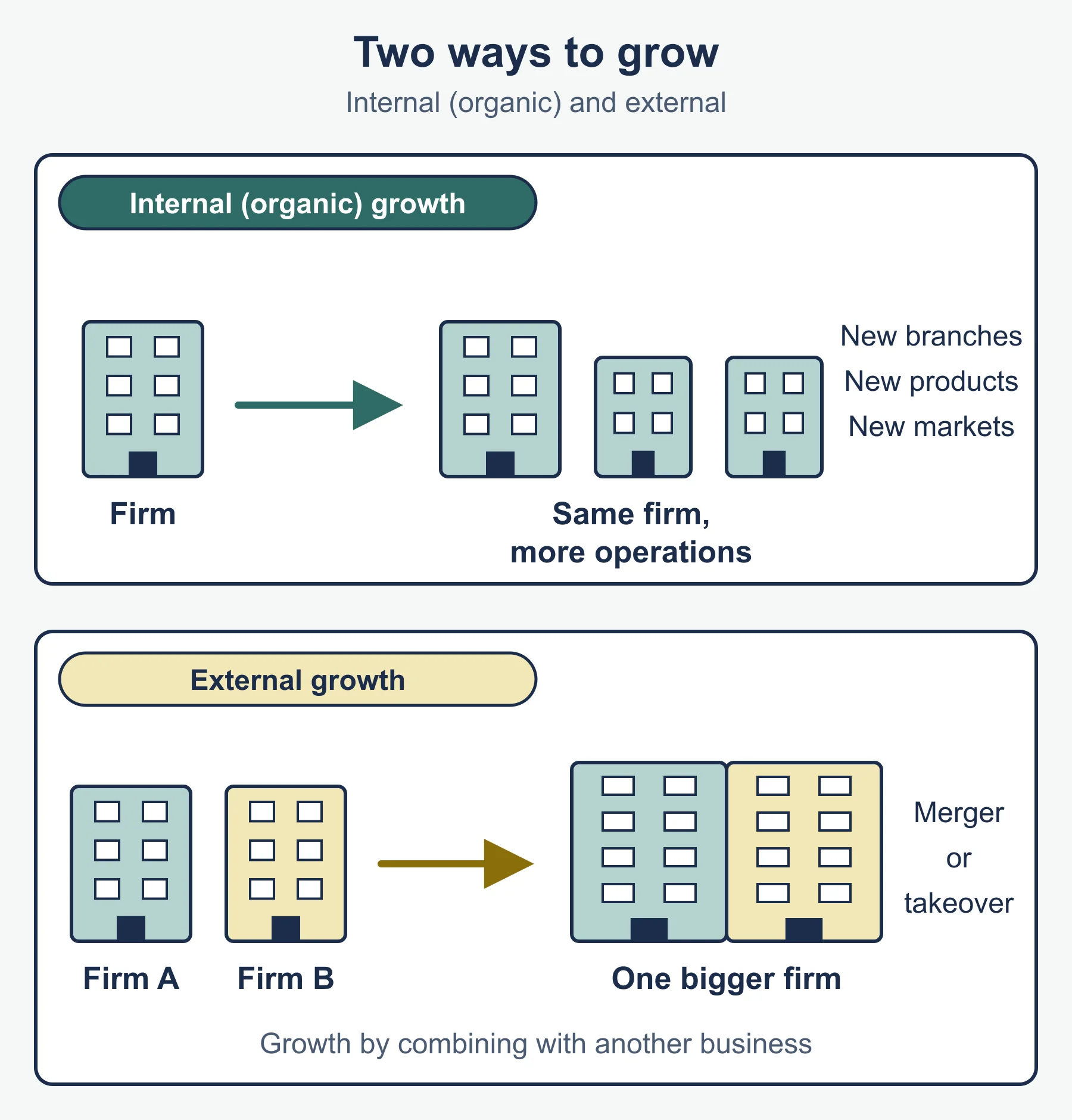
| Organic growth | Growth from the firm’s own resources (new products, outlets, customers) |
| External growth | Growth through other firms: merger, takeover, venture, franchising |
| Retrenchment | Reducing the scale of the business (closures, disposals, job cuts) |
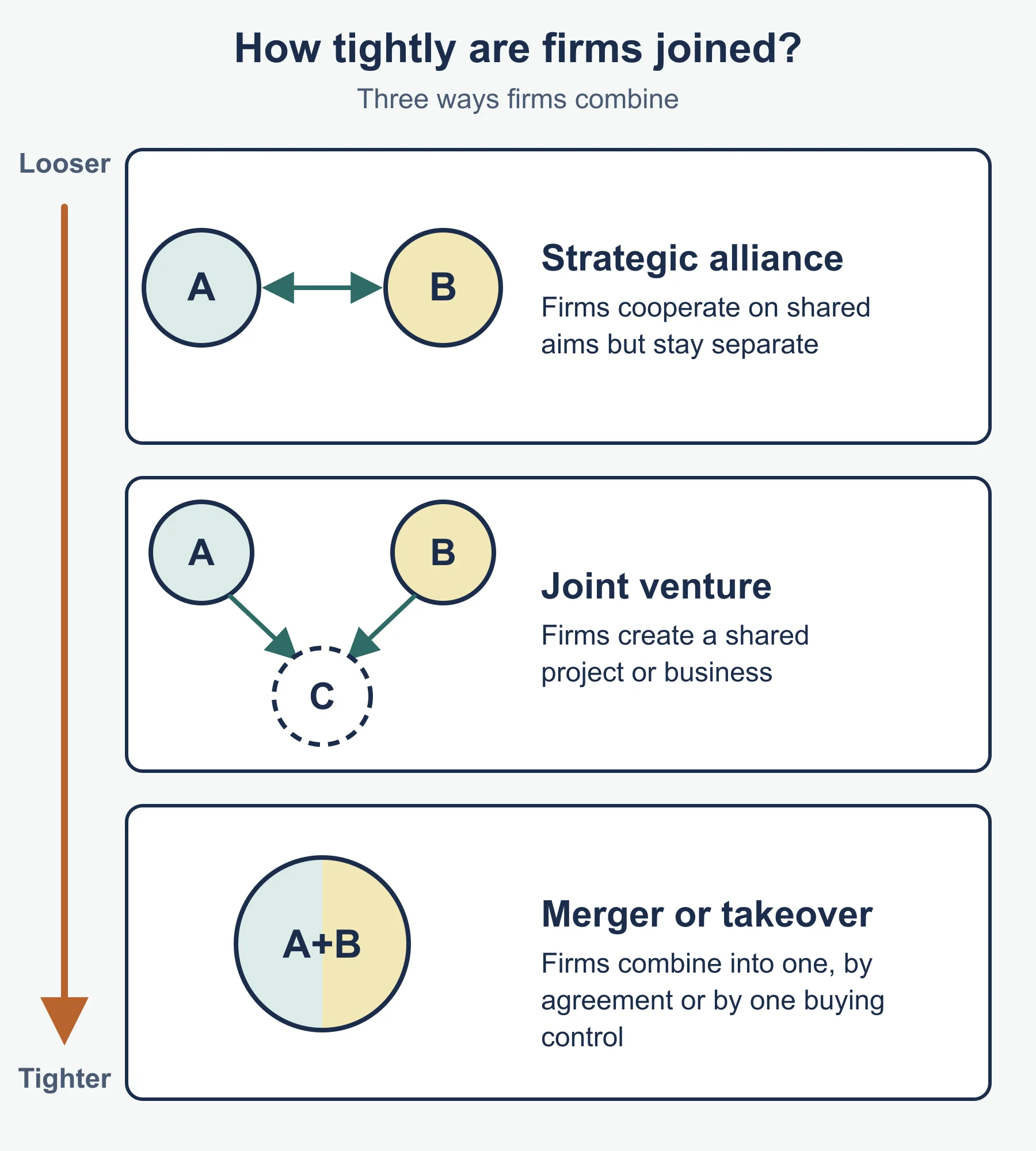
| Merger | Two firms agree to join |
| Takeover | One firm buys control of another (friendly or hostile) |
| Venture | Joint venture or alliance sharing cost, risk and control |
| Franchising | Franchisor licenses its brand and system for a fee and royalty |
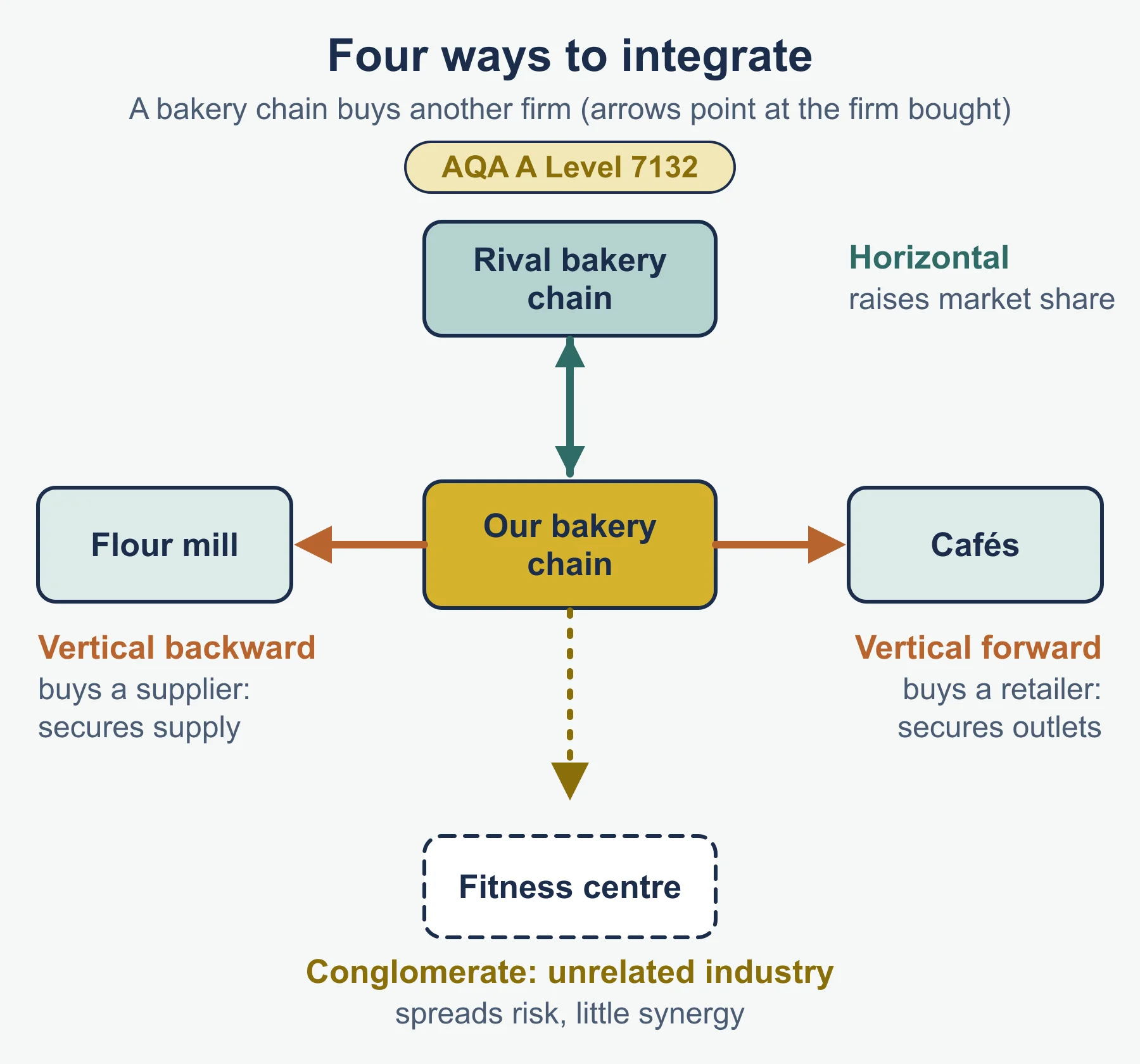
| Horizontal integration | Same industry, same stage |
| Backward vertical | Integration with a supplier |
| Forward vertical | Integration with a distributor or retailer |
| Conglomerate | Integration with an unrelated business |
Reasons
- Growth: more sales revenue, profit and market share; lower unit costs; market power; spreading risk; defence against takeover.
- Retrenchment: falling demand, loss-making units, high debt, refocusing on core activities, cutting costs.
Scale and cost issues
| Concept | Remember |
|---|---|
| Technical economies | Bigger, more efficient machines and processes |
| Purchasing economies | Bulk-buying discounts |
| Managerial economies | Specialist managers spread over more output |
| Economies of scope | Lower average cost from a related product range sharing resources |
| Diseconomies of scale | Rising average cost at large size: communication, coordination and motivation problems |
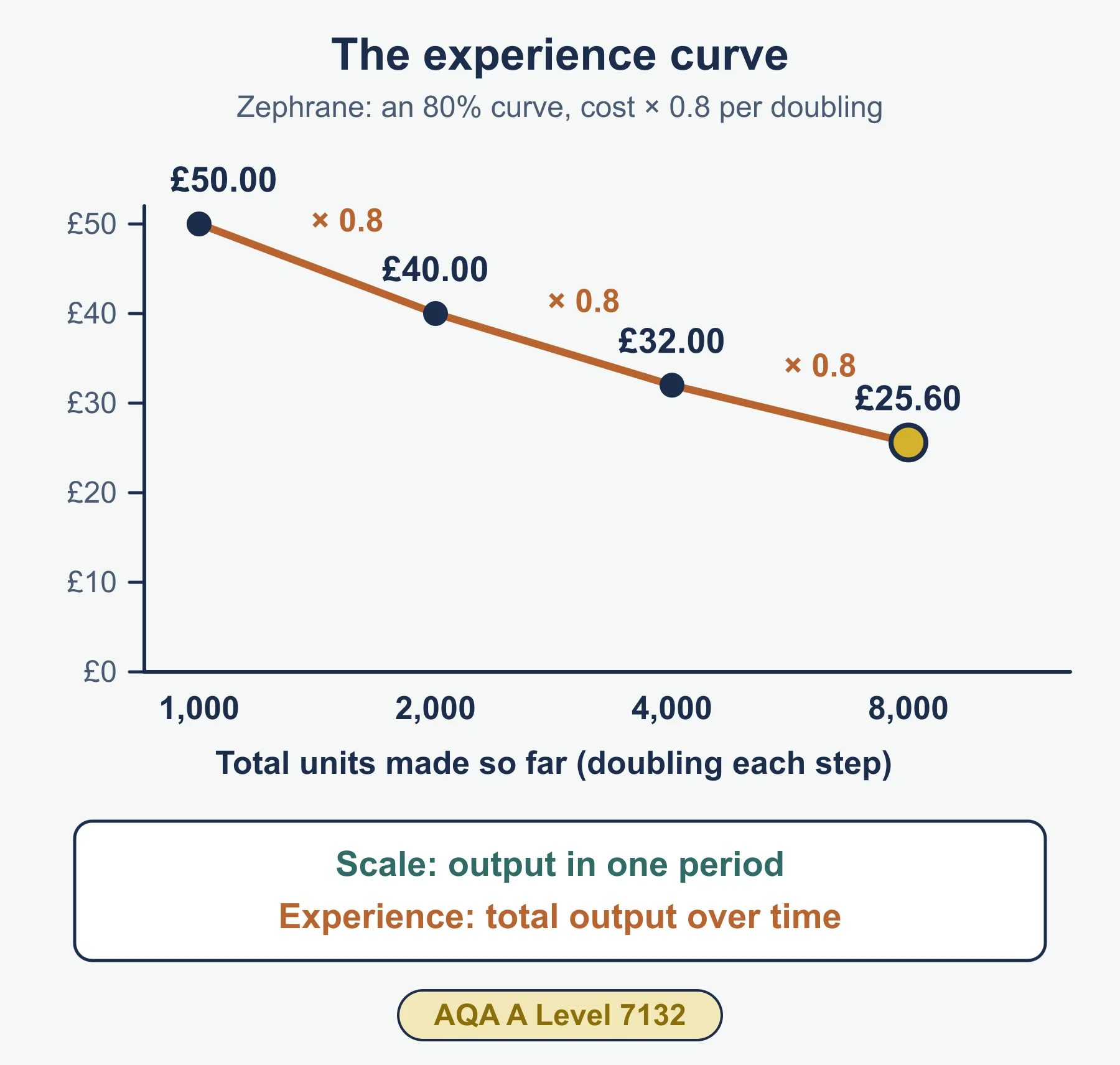
| Experience curve | Unit cost falls with cumulative output; often stated as a percentage per doubling |
| Synergy | Combined value greater than the parts |
| Overtrading | Sales grow faster than the working capital that supports them |
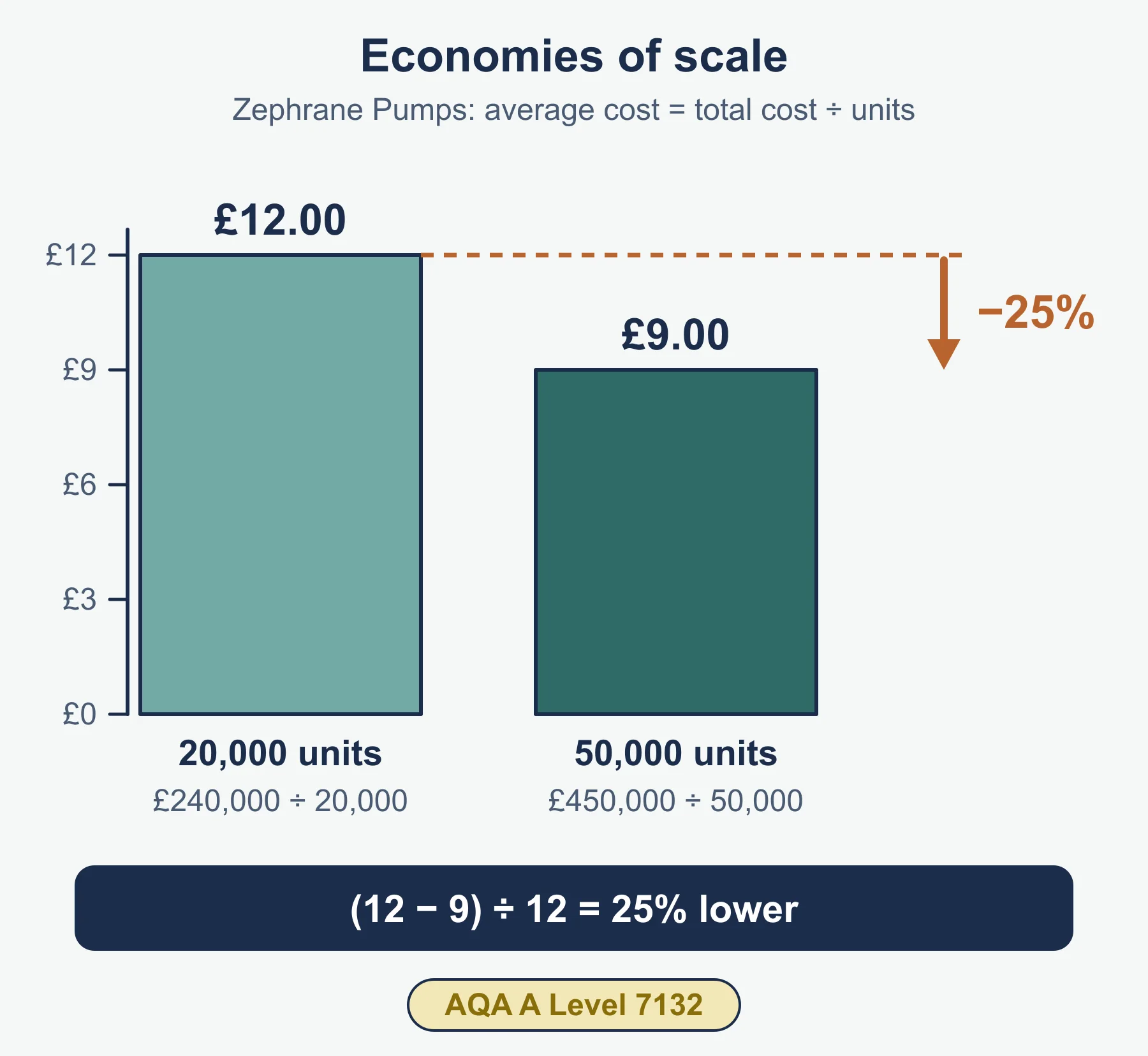
Average cost = total cost / output. Scale is about output per period. The experience curve is about total output over time.
Method: experience curve
- Identify the starting unit cost and the percentage curve (for example 90%).
- Each time cumulative output doubles, multiply by the percentage.
- State the cost at each doubling.
Reminder: a 90% curve starting at £100 gives £90, then £81.
Method: assess overtrading
- Compare sales growth with cash and finance. Sales rising from 550 to 660 is 20% growth: (660 - 550) / 550.
- Check the current ratio (current assets / current liabilities, standard form) and cash.
- Look for rising stock and trade receivables, and late supplier payments.
- Recommend slower growth, longer-term finance or tighter credit control.
Greiner’s model of growth
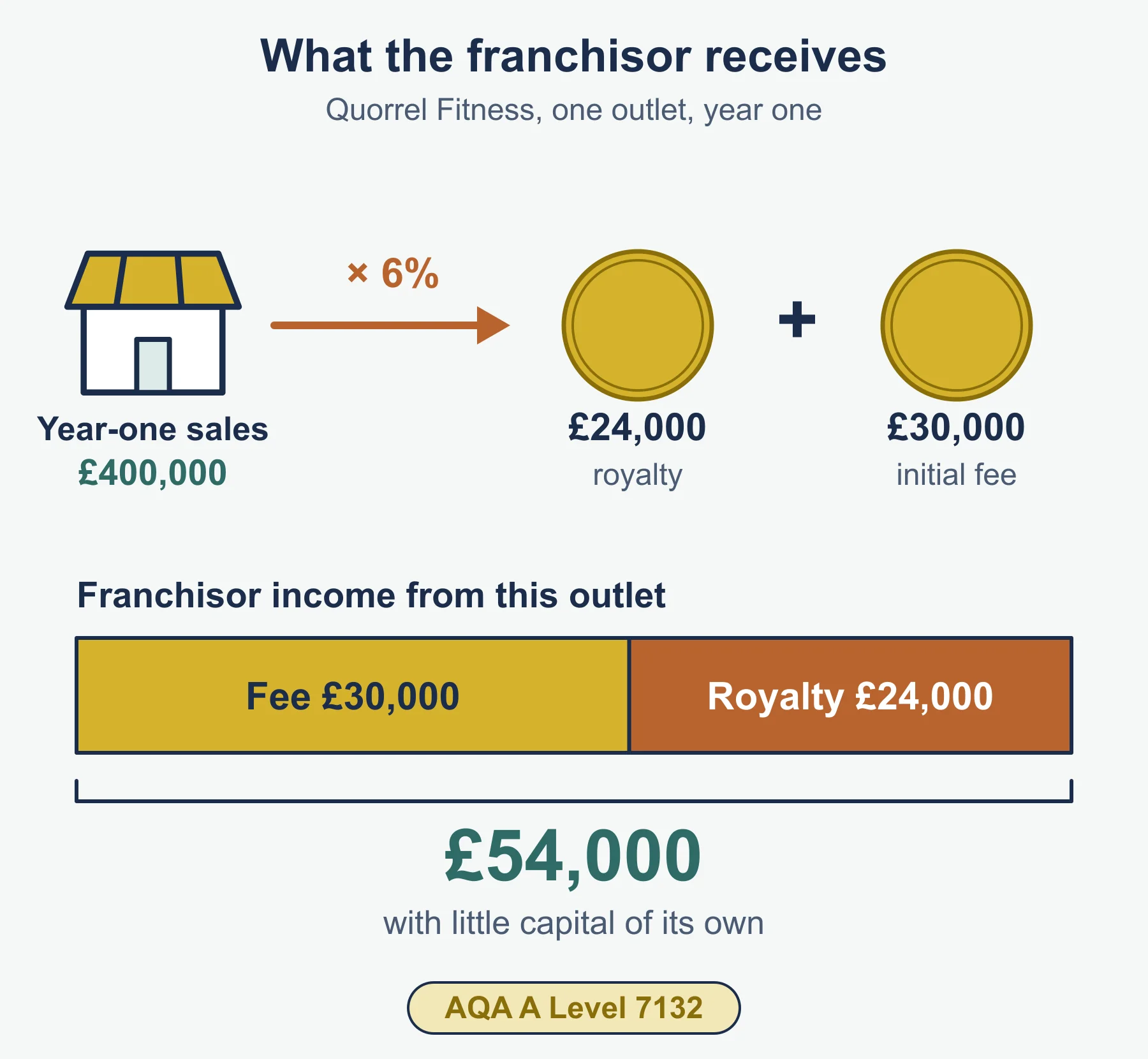
Growth through creativity (crisis of leadership), direction (crisis of autonomy), delegation (crisis of control), coordination (crisis of red tape), then collaboration. Each crisis forces a new management approach. Use it to judge what a growing firm needs next, and note that firms rarely follow it exactly.
Franchising reminder
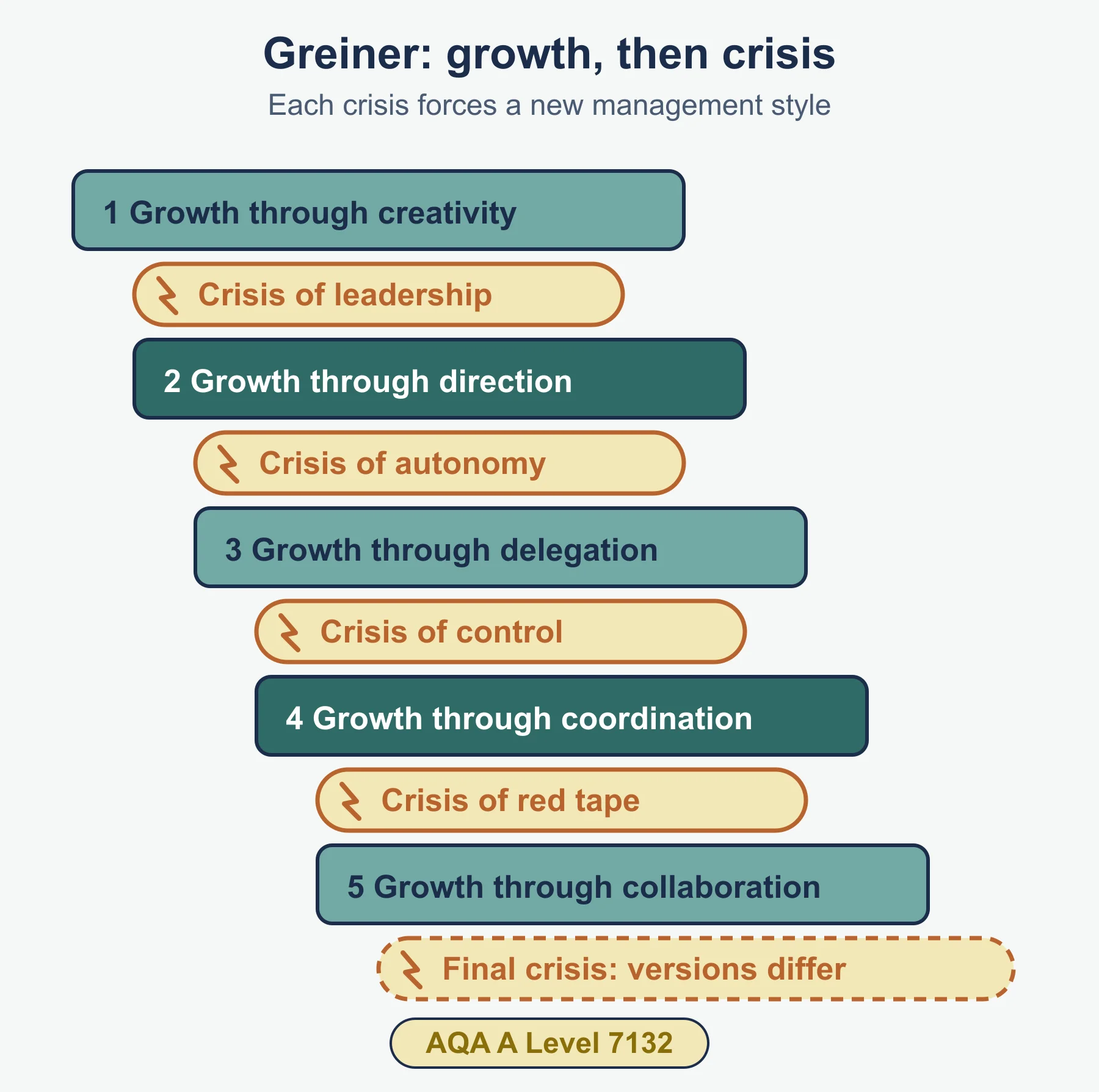
Franchisor income = initial fee + royalty. With a 5% royalty on sales of £80,000, the royalty is £4,000. Benefits: rapid growth with little capital. Costs: less control over standards and a shared brand risk.
Merger or organic: quick comparison
| Organic | External | |
|---|---|---|
| Speed | Slow | Fast |
| Cost | Lower | Higher |
| Risk | Lower | Higher: integration and culture |
| Control | High | Shared or disrupted |
Synergy example: two firms earn profits of £5m and £3m separately and £10m combined, so synergy is £2m.
Functional areas
Marketing (brand, market share), operations (capacity, quality), finance (funding, cash flow), human resources (structure, recruitment, redundancy).
3.9.2 Innovation
| Term | Meaning |
|---|---|
| Product innovation | A new or improved good or service |
| Process innovation | A new way to make or deliver it |
| Kaizen | Continuous improvement through small changes by all staff |
| R&D | Planned investment in new knowledge, products and processes |
| Intrapreneurship | Entrepreneurial behaviour by employees inside the firm |
| Benchmarking | Comparing with best practice and adopting what works |
| Patent | Time-limited legal right over an invention |
| Copyright | Legal protection of original creative work |
- Pressures: competitors, customer tastes, technology, shorter product life cycles, cost.
- Value: competitive advantage, premium prices, lower cost, new markets. Costs: spending, failure, imitation.
- Compare the four routes: Kaizen is cheap and gradual; R&D is costly and uncertain; intrapreneurship needs culture; benchmarking catches up but does not lead.
- IP: patents and copyrights give legal protection, but cost money and are limited in time and place.
- Functional areas: marketing (launch), operations (retooling), finance (funding and return), human resources (skills, culture).
3.9.3 Internationalisation
- Reasons: saturated home market, faster growth, risk spread, economies of scale.
- Attractiveness: market size and growth, income, competitors, stability, culture, trade barriers, infrastructure, exchange rates.
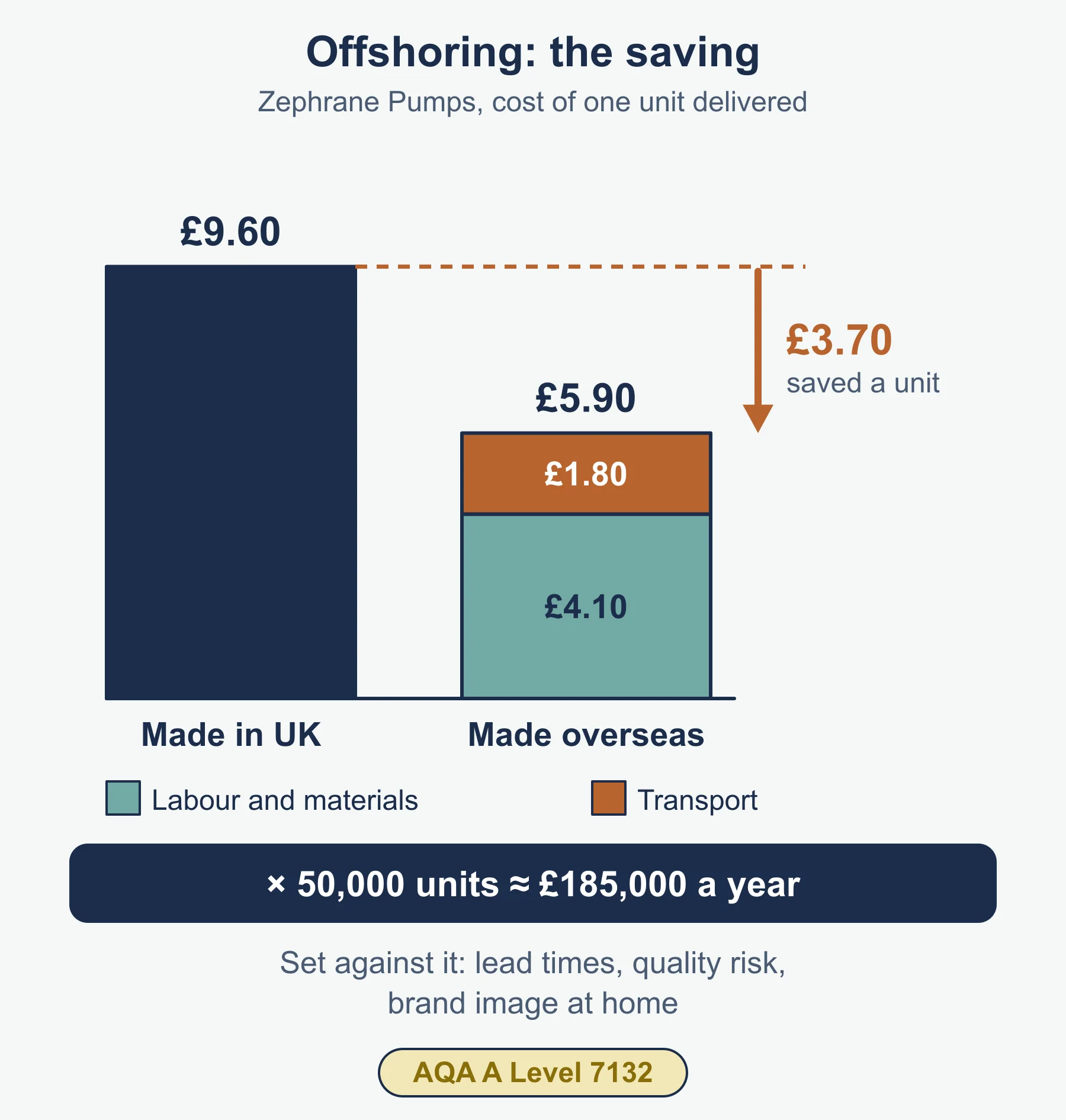
- Produce or source abroad: lower costs, skills, resources, closeness to customers. Off-shoring moves production abroad; re-shoring returns it.
- Multinational: operates in more than one country.
Entry methods
| Method | Best when | Weakness |
|---|---|---|
| Export | Testing a market cheaply | Little control of local selling |
| Licensing | Capital is scarce | Quality and brand control |
| Alliances | Local knowledge is needed | Shared profit, disputes |
| Direct investment | The market is large and long term | Cost and risk |
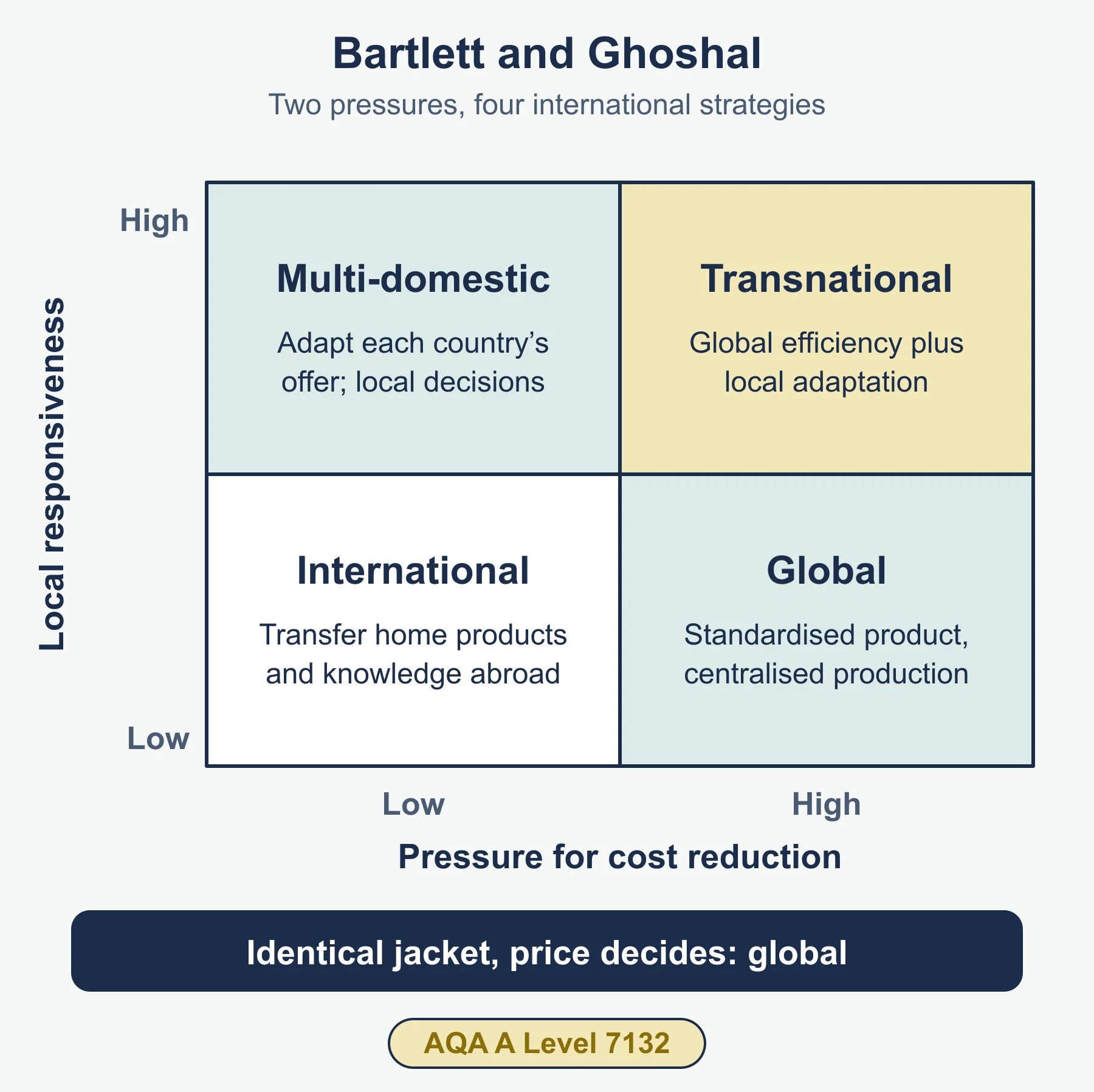
Bartlett and Ghoshal
| Strategy | Local responsiveness | Cost reduction pressure |
|---|---|---|
| International | Low | Low |
| Multi-domestic | High | Low |
| Global | Low | High |
| Transnational | High | High |
Influences on buying, selling and producing abroad: exchange rates, culture, laws, trade barriers, transport. Functional areas: marketing (adaptation), operations (supply chains), finance (currency and funding), human resources (cross-cultural management).
3.9.4 Digital technology
| Term | Meaning |
|---|---|
| E-commerce | Buying and selling online |
| Big data | Very large, fast-growing sets of data |
| Data mining | Searching data for patterns |
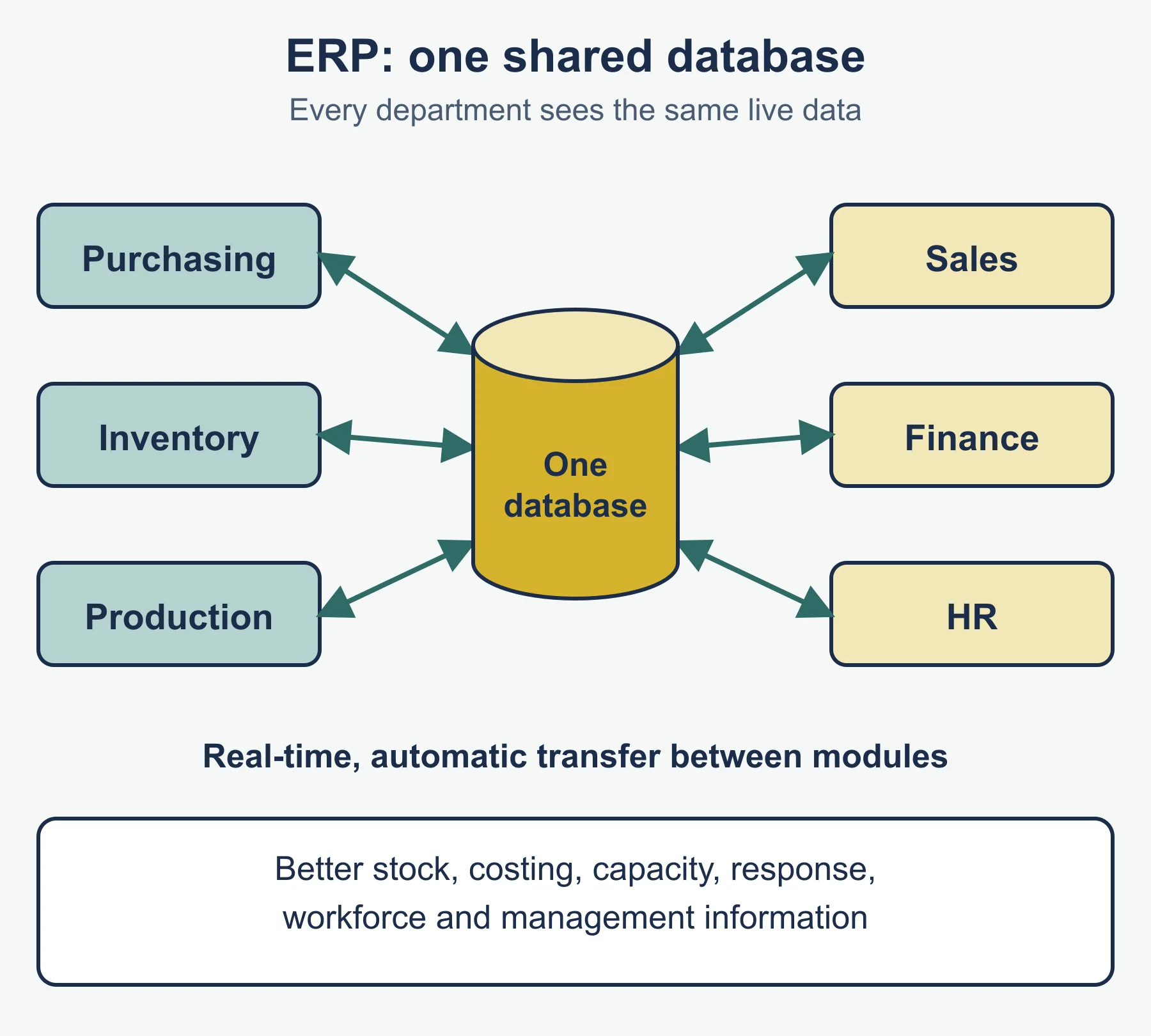
| ERP | Integrated software linking functions such as finance, stock and orders |
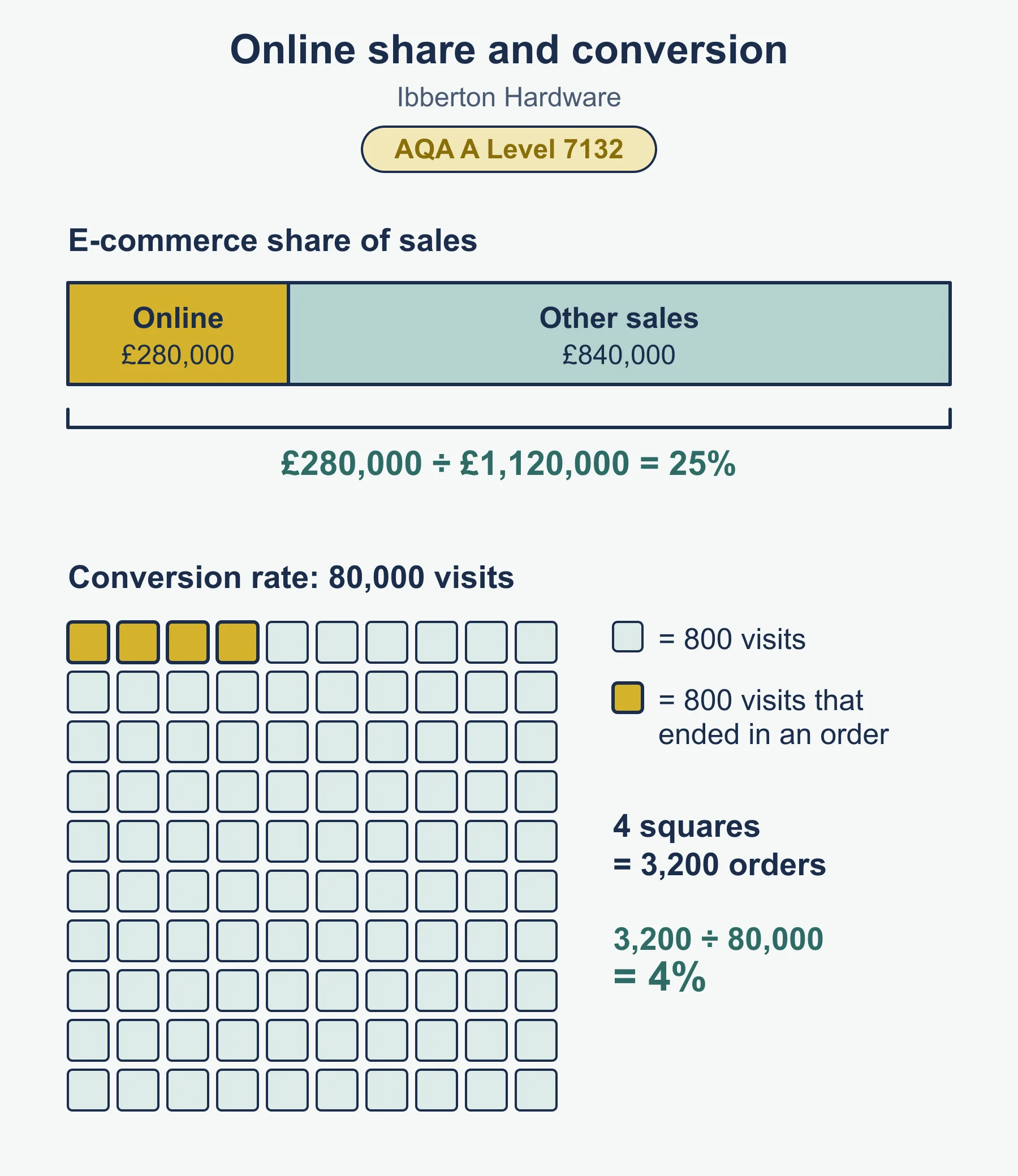
Pressures: competitors, customer expectations, cost, supply chain. Value: reach, personalisation, forecasting, efficiency. Risks: cost, security, resistance. Functional areas: marketing (targeting), operations (stock and scheduling), finance (real-time data), human resources (skills and jobs).
Building a judgement
Questions in this topic ask you to assess a method for a particular business. Use this chain.
- Point: state the method and what it offers (for example, a joint venture gives local knowledge).
- Evidence: pull a number or fact from the case (cash balance, market growth, the firm’s size).
- Link: explain the effect on a function or objective (lower cost, faster entry, weaker control).
- Counter: give the best argument against.
- Judgement: say which side wins and what it depends on, such as the firm’s cash, its time horizon, how fast rivals move, or how different the new market is.
Typical “it depends” factors
| Method | It depends on |
|---|---|
| External growth | Cash available, quality of the target, culture fit |
| Retrenchment | Whether the fall in demand is temporary, and the cost of redundancies |
| Innovation | The firm’s cash, product life cycle length, strength of IP protection |
| Entry mode abroad | Capital, risk appetite, need for control, market size |
| Digital investment | Customer habits, rivals’ moves, staff skills, data security |
Retrenchment checklist
Reasons: falling demand, losses, debt, refocus. Methods: closing sites, selling divisions, cutting product lines, reducing staff. Effects: lower costs and a smaller cash drain, but redundancy payments, lower morale, damage to reputation and a risk of cutting capacity the firm later needs.
Linking the four sections
Growth abroad often depends on digital tools such as e-commerce. Innovation may be the reason a firm can compete internationally. Rapid growth can cause overtrading, which limits the money available for innovation. A good extended answer connects sections like this rather than treating each in isolation.
Must-know distinctions
- Merger (agreed) versus takeover (control bought).
- Economies of scale (output per period) versus experience curve (cumulative output).
- Economies of scale versus economies of scope (one product’s volume versus a range).
- Backward (supplier) versus forward (customer side) integration.
- Product versus process innovation.
- Off-shoring versus re-shoring.
- International versus multi-domestic strategies: transfer home products or adapt to each country.
- Big data (the information) versus data mining (the analysis).
Quick self-test
- Define organic growth.
- Name the three economies of scale the specification lists.
- A 90% experience curve starts at £100. What is the cost after two doublings?
- Aldbrook Joinery buys a timber yard. Which type of integration is this?
- A franchisee has sales of £80,000 and pays a 5% royalty. How much is the royalty?
- Which Bartlett and Ghoshal strategy combines high local responsiveness with high cost pressure?
- Give two ways of protecting intellectual property named in the specification.
- A firm’s sales rise from 550 to 660. Calculate the percentage growth.
- State one difference between off-shoring and re-shoring.
- Name two things an ERP system links.
- Give one reason a growing profitable firm might fail through overtrading.
- Identify one example of process innovation.
Answers
- Growth from the firm’s own resources, such as new products or outlets.
- Technical, purchasing and managerial.
- £81 (100 x 0.9 x 0.9).
- Vertical backward integration (a supplier).
- £4,000.
- Transnational.
- Patents and copyrights.
- 20%.
- Off-shoring moves production abroad; re-shoring brings it back home.
- Any two of finance, stock, orders, HR.
- Cash is tied up in stock and trade receivables, so it cannot pay suppliers and wages on time.
- For example, a new automated production line or a new online booking system.
Where marks are usually lost
- Defining terms but not applying them to the business in the case.
- Mixing up mergers and takeovers, or horizontal and vertical integration.
- Treating overtrading as overproduction rather than a cash-flow problem.
- Quoting Greiner’s phases with no judgement about the firm’s position.
- Offering one-sided answers on international entry methods with no weighing.
- Naming Bartlett and Ghoshal strategies without linking to the two pressures.
- Forgetting to show the working in a unit-cost or percentage calculation.
- Ending an evaluation without a reasoned judgement on which option suits this business.
Frequently asked questions
What is the difference between economies of scale and the experience curve? Economies of scale come from output per period: producing more at once lowers average cost. The experience curve comes from cumulative output over time: unit cost falls each time total output doubles.
What are the stages of Greiner’s model of growth? Growth through creativity leads to a crisis of leadership, direction to a crisis of autonomy, delegation to a crisis of control, and coordination to a crisis of red tape, followed by growth through collaboration. Firms rarely follow it exactly.
What is the difference between big data and data mining? Big data is the information itself, the very large data sets a business holds. Data mining is the analysis of that data to find patterns.
Which economies of scale are listed in AQA 7132? The specification lists technical, purchasing and managerial economies of scale.
How do you calculate franchisor income? Franchisor income = initial fee + royalty. For example, a 5% royalty on sales of £80,000 earns £4,000 in royalties.
Official syllabus
AQA AS and A-level Business (7131 and 7132), section 3.9, “Strategic methods: how to pursue strategies” (A-level only), AQA.
Get free revision emails (optional)
Occasional emails with practice questions, worked explanations and links to free resources for the qualification and subjects you choose. No spam, and you can unsubscribe from any email. The free tools on this site never need an email.
Related resources
-
Study guides
AQA A-Level Business: Strategic methods: how to pursue strategies (7132)
Study guide to growth and retrenchment, innovation, internationalisation and digital technology for AQA A-Level Business 7132, with worked examples.
Business · AQA · A Level
Read guide -
Practice questions
AQA A-Level Business: Strategic methods: how to pursue strategies (7132) – Practice Questions
Original practice questions with worked answers on growth, innovation, internationalisation and digital technology for AQA A-Level Business 7132.
Business · AQA · A Level
Try questions -
Study guides
AQA A-Level Business: Understanding management decision making (7132)
Study guide to AQA A-Level Business 3.2.2: data versus intuition, decision trees, expected value, net gain, risk, opportunity cost and influences.
Business · AQA · A Level
Read guide
Related articles
-
teaching
A Level tuition in Dubai: Cambridge or Pearson Edexcel International A Level?
Schools in Dubai and Abu Dhabi teach either Cambridge International AS & A Level or Pearson Edexcel International A Level. How the two are structured, why it matters for tuition, and how online classes from Lahore work.
9 October 2026
-
curriculum guides
Choosing subjects at IGCSE and A Level
How subject choices at 14 and 16 affect university options later, and how to keep pathways open without overloading a timetable.
28 July 2026
Studying this with a teacher
Working through Business A LEVELS?
This page is free and stays free. If you would rather be taught it, Marlbridge runs Business classes one-to-one and in small groups of up to 15, online in your own time zone. The first trial class is free. WhatsApp replies within an hour (8am–11pm Pakistan time, every day); email the same day.
AQA Business teachers at Marlbridge
