
Study Guides
AQA A-Level Business: Operational management (7132)
Study guide to operational management for AQA A-Level Business: objectives, productivity, capacity, lean, quality, inventory and supply chains.
- Subject
- Business
- Level
- A LEVELS
- Topic
- Operational management
- Author
- Marlbridge Academic Team
- Updated
- Reviewed by
- Salman Ahmad (what this means)
Aligned to AQA A Level Business (7132), For first teaching from September 2023. Official specification .
Syllabus page (what it covers and how it is assessed): AQA A Level Business.
Syllabus points this page covers
7132
- 4 Operational management (whole topic)
Found an error? Report a correction.
Need help with this topic? Request a free trial class for A Level Business (7132).
This guide covers the operations section of the AQA A-level Business specification (7132), listed in the specification as 3.4 “Decision making to improve operational performance”, sub-sections 3.4.1 to 3.4.5. Marlbridge numbers it as topic 4, Operational management. The specification’s assessment overview says the A-level papers assess all of the subject content, so this topic can appear on any of the three papers. The guide uses the board’s own terms and gives each formula in its standard form, because the official text prints none.
Related pages: the revision notes, the practice questions, the AQA A-level Business hub, the printable checklist and the free diagnostics.
Map of the topic
| Section | What you must be able to do |
|---|---|
| Throughout 3.4 | Link operations to technology, ethics and the environment, market conditions and competition, competitiveness and other functions |
| 3.4.1 Setting operational objectives | Explain the value of objectives; objectives for cost, quality, speed of response and flexibility, dependability, the environment and added value; internal and external influences |
| 3.4.2 Analysing operational performance | Interpret and calculate operations data (labour productivity, unit costs, capacity, capacity utilisation); use data in decisions and planning |
| 3.4.3 Increasing efficiency and productivity | Capacity; efficiency and labour productivity; lean production including Just in Time; difficulties; labour and capital intensive mixes; using capacity; technology |
| 3.4.4 Improving quality | Importance of quality; methods including quality assurance; benefits, difficulties and consequences of poor quality |
| 3.4.5 Managing inventory and supply chains | Flexibility (including mass customisation), speed, dependability; matching supply to demand; inventory control; suppliers; supply chain; outsourcing |
Themes that run through the whole topic
The specification asks you to consider five themes in every operations decision. Use them to develop your evaluation.
- Technology. More online business, better links with customers and suppliers, and better inventory control.
- Ethical and environmental influences. Waste, emissions, working conditions in the supply chain and the cost of acting responsibly.
- Market conditions and competition. A rival’s price or delivery promise can force a change in operations.
- Competitiveness. Good operations lower costs or raise quality, which supports a price or a reputation rivals struggle to match.
- Interrelationship with other functions. A marketing promise of next-day delivery needs operations capacity. Cheaper inputs help finance but may upset quality. Training for productivity needs human resources.
3.4.1 Setting operational objectives
Operational objectives are targets for the operations function. They give managers a standard against which to judge performance, keep operations in line with the corporate objectives, and let managers see when to act.
| Objective | Typical target |
|---|---|
| Costs | Cut unit cost by 4% over the year |
| Quality | Fewer than 1% of items returned |
| Speed of response and flexibility | Deliver within 48 hours; switch product lines in a day |
| Dependability | 98% of orders delivered when promised |
| Environmental (waste, emissions) | Reduce waste to landfill by a third |
| Added value | Raise the gap between selling price and bought-in inputs |
Objectives can conflict. A cost target can pull against a quality target, and a speed target can pull against an environmental one if it needs extra transport.
Internal influences include finance available, the skills of the workforce, existing capacity and technology, and the corporate objectives. External influences include customer expectations, competitors, suppliers, legislation, the state of the economy and the pace of technological change. A maker of surgical tools is more likely to put quality first than cost.
3.4.2 Analysing operational performance
The specification expects you to calculate four measures. The official text gives no formulas for them, so these are the standard forms.
- Labour productivity = output ÷ number of employees (or per hour worked).
- Unit cost (average cost) = total costs ÷ output.
- Capacity = the highest output the business can achieve in a period with what it has now.
- Capacity utilisation = (actual output ÷ capacity) × 100.
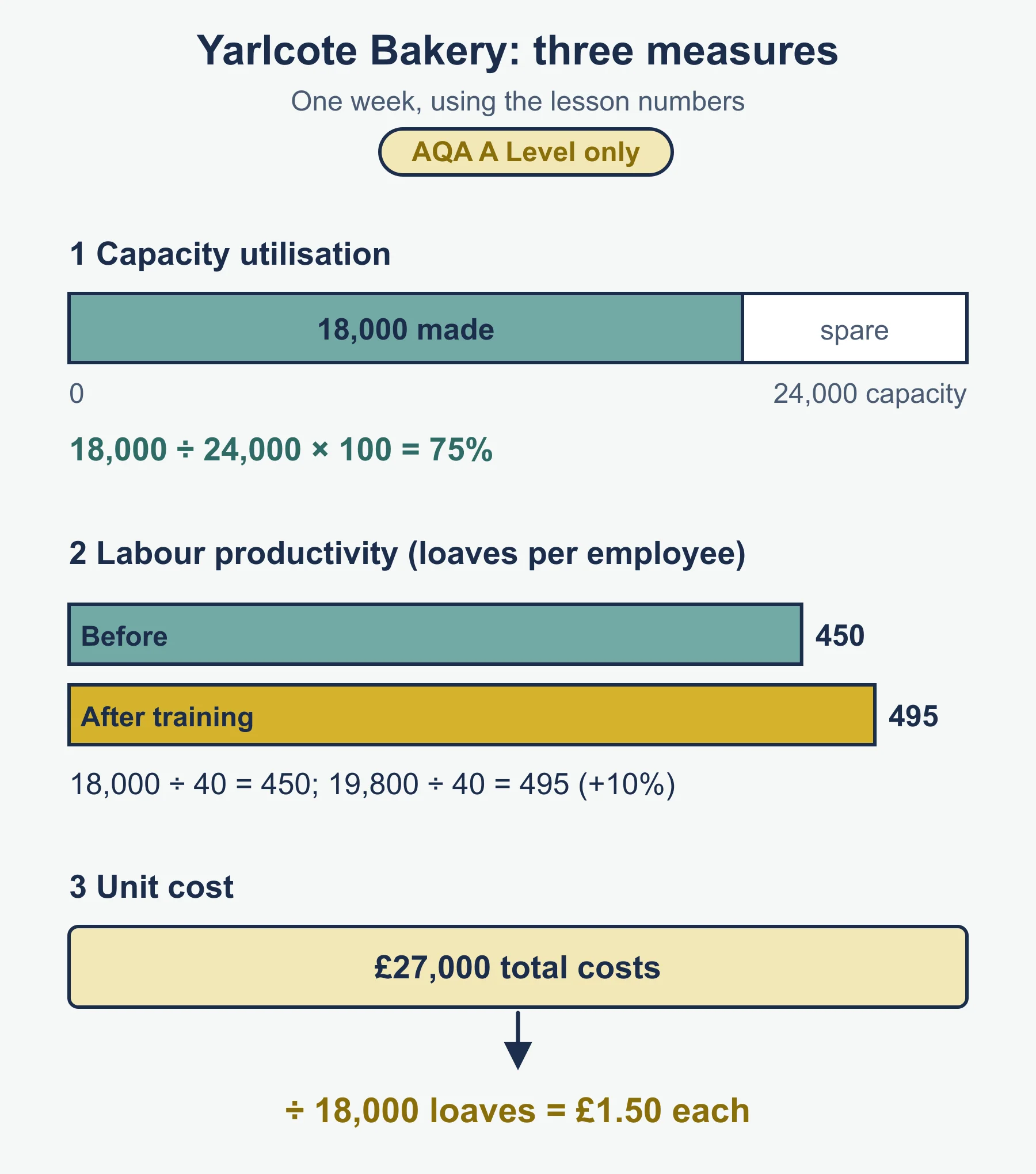
Worked example. Yarlcote Bakery made 18,000 loaves in a week with 40 employees. Its capacity is 24,000 loaves and its total costs were £27,000.
- Labour productivity = 18,000 ÷ 40 = 450 loaves per employee.
- Unit cost = £27,000 ÷ 18,000 = £1.50.
- Capacity utilisation = 18,000 ÷ 24,000 × 100 = 75%.
After a training programme the same 40 employees make 19,800 loaves. Productivity is now 495 per employee, a rise of 45, which is 10% of 450.
Interpreting data means asking what a number means for the decision, not only what it is. A 75% utilisation figure says there is spare capacity, so extra orders can be met without new investment. Compare it with earlier periods and targets. Data supports planning: forecast demand against capacity, spot bottlenecks, decide when to hire or invest, and check whether a change has worked. Data can mislead if it is out of date or ignores quality.
3.4.3 Increasing efficiency and productivity
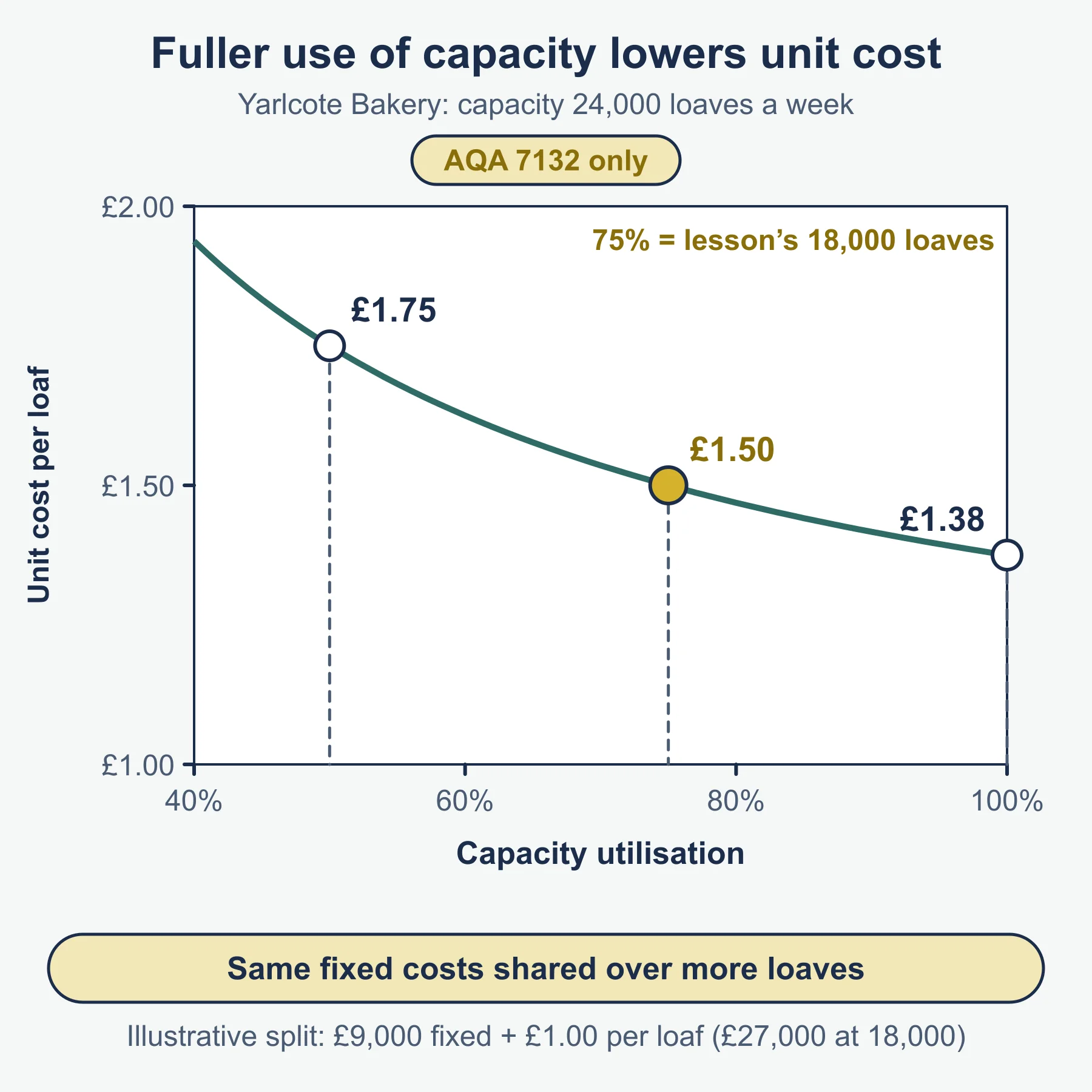
Capacity. Capacity matters because a business with too little loses sales and damages dependability, and one with too much carries idle fixed costs. High utilisation spreads fixed costs over more units, so unit cost falls. Run it too close to 100% and there is no slack for breakdowns or surges.
Efficiency and labour productivity. Efficiency means using resources with little waste to produce output. Higher labour productivity lowers labour cost per unit, which can lift profit margins or allow lower prices. It also supports competitiveness.
How to increase them: train staff; motivate them through better pay structures or involvement; improve methods and layout; invest in machinery or software; remove wasteful steps. Difficulties: training takes time and money; staff may fear job losses and resist; new machines cost a lot and may need new skills; pushing speed too hard can harm quality and morale; productivity gains are hard to see in services where output is hard to count.
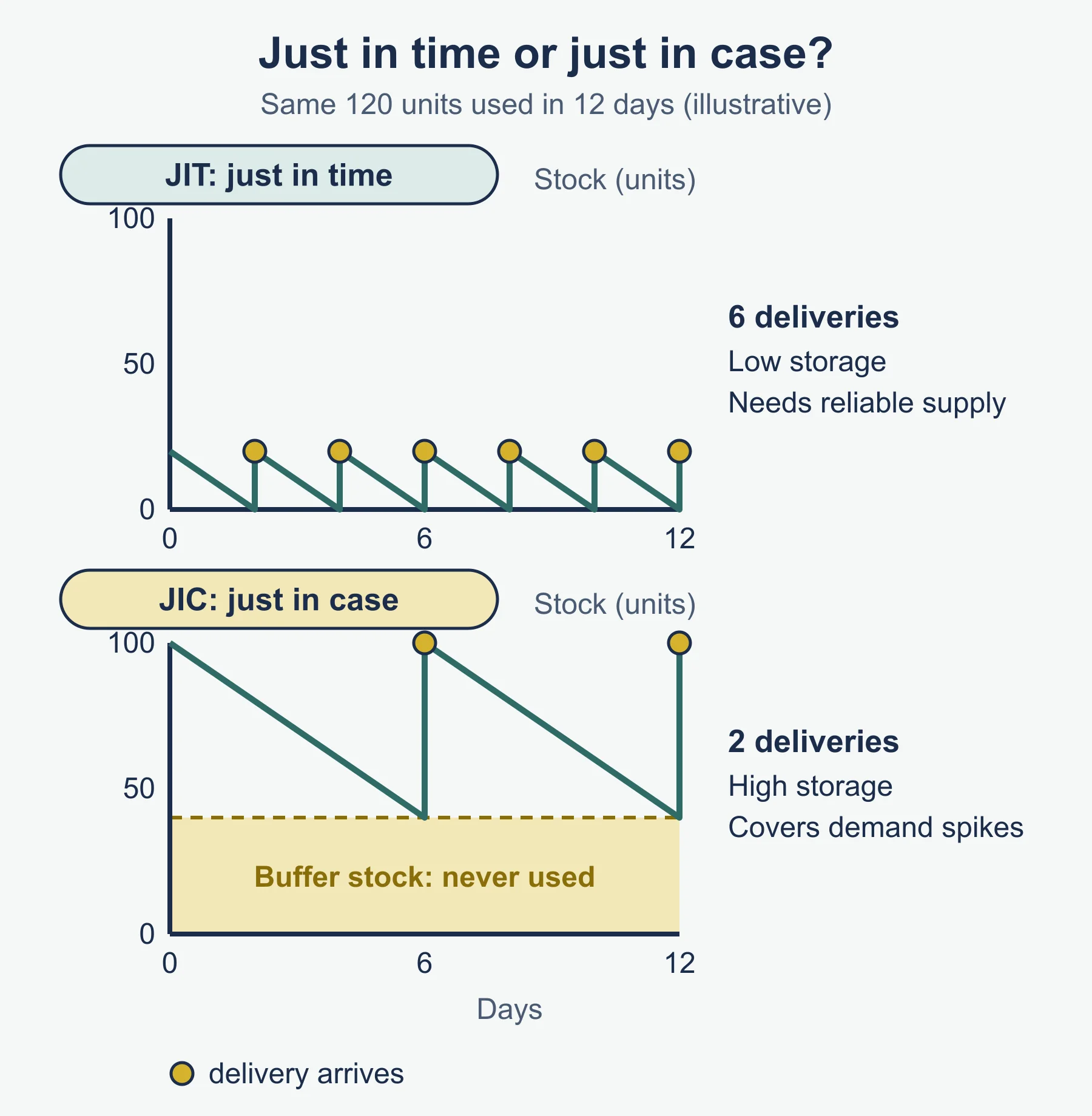
Lean production aims to cut waste of every kind (time, materials, space, effort) while still meeting customer needs. Just in Time (JIT) is part of it: materials arrive as they are needed and finished goods go straight to customers, so inventory is very low.
| Benefits of lean and JIT | Difficulties |
|---|---|
| Lower storage and holding costs | Depends on reliable suppliers; one late delivery can halt production |
| Less waste and less cash tied up | Little buffer if demand surges, so orders may be lost |
| Faster response to design changes | Frequent small deliveries cost more and can add transport emissions |
| Problems show up quickly | Needs skilled, flexible staff and strong systems; set-up cost may be high |
Optimal mix of resources. Processes are labour intensive (labour is the main input, as in a hairdresser or craft workshop) or capital intensive (machinery is the main input, as in an automated bottling line). The best mix depends on output level, flexibility needed, cost of labour against capital, quality required and the image of the product.
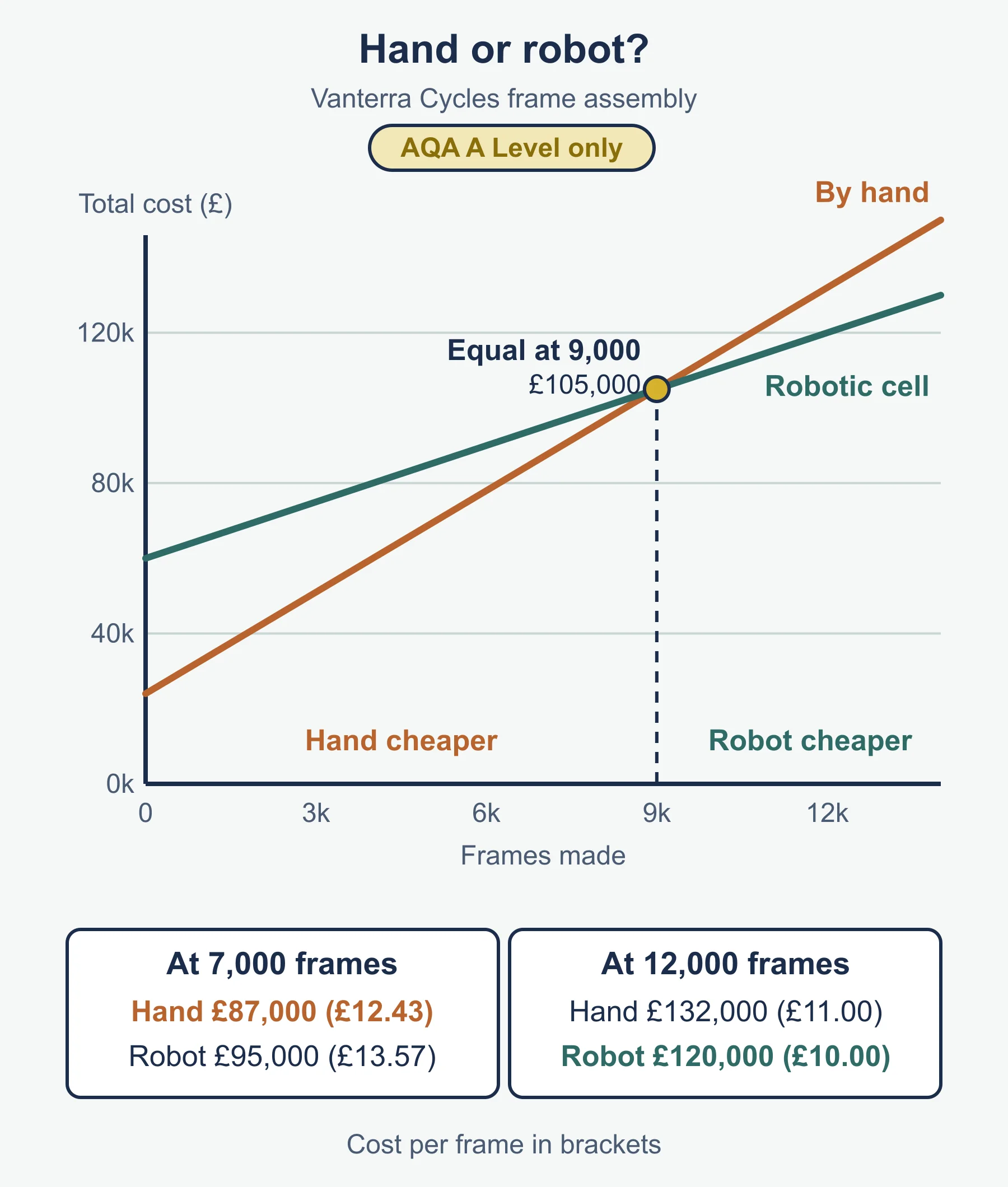
Worked example. Vanterra Cycles can assemble frames by hand (fixed costs £24,000, variable cost £9 a frame) or with a robotic cell (fixed costs £60,000, variable cost £5 a frame).
- Costs are equal when 24,000 + 9q = 60,000 + 5q, so 4q = 36,000 and q = 9,000.
- At 12,000 frames: by hand £132,000 (£11.00 each); robotic £120,000 (£10.00 each). Capital intensive is cheaper.
- At 7,000 frames: by hand £87,000 (£12.43 each); robotic £95,000 (£13.57 each). Labour intensive is cheaper.
So the answer depends on expected volume, how sure the forecast is, and how quickly the firm needs to change product.
Utilising capacity efficiently. Raise demand through promotion or off-peak pricing; take extra orders from other firms; rent out spare space; schedule maintenance for quiet periods; if utilisation is persistently low, cut capacity by selling or closing assets. Technology can help: computer-aided design and manufacturing, robots, automated stock systems, sensors that predict breakdowns and software that plans production. Costs, retraining and cyber-security are the usual drawbacks.
3.4.4 Improving quality
Importance. Quality is how well a product or service meets customer expectations. Good quality supports price, repeat purchase, reputation and brand loyalty, and reduces waste, returns and warranty costs. What counts as quality varies: a budget airline’s customers may mean punctuality and safety, while a luxury hotel’s mean service and detail.
Methods of improving quality include:
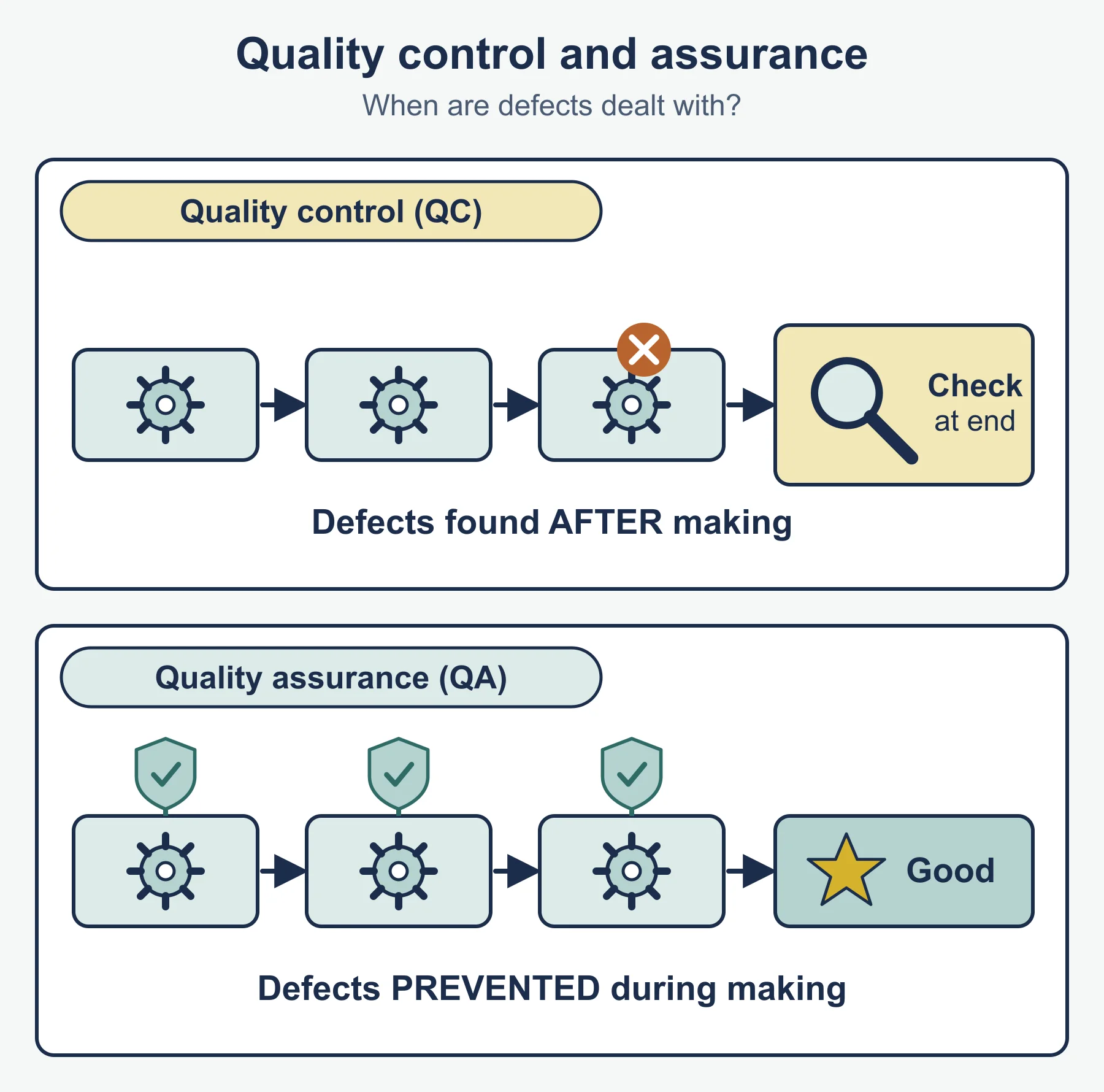
- Quality control: inspect output and remove faulty items. It finds faults after they occur.
- Quality assurance (required by the specification): build quality into the whole process, with agreed standards at every stage, supplier checks and staff responsible for their own work. It aims to prevent faults.
- Training, better materials, better equipment, customer feedback systems and employee quality circles (small groups that suggest improvements).
Benefits: fewer defects, lower waste and rework, a stronger brand, and the chance to charge more. Difficulties: training and equipment cost money; more inspection slows output; very high standards can cost more than customers will pay.
Consequences of poor quality: returns and refunds, rework and scrap, lost customers, damaged reputation, falling sales, extra complaint handling, possible legal claims, and low staff morale.
3.4.5 Managing inventory and supply chains
Flexibility, speed of response and dependability. Flexibility is the ability to change the product, volume or timing. Mass customisation is making products to individual customer wishes at close to mass production cost, for example trainers designed by the customer online. Speed of response is how quickly an order is met. Dependability is meeting promises about quality, time and quantity. Improving them raises customer satisfaction and supports competitive advantage, but can cost money in extra capacity, skilled staff and stock.
Matching supply to demand. Demand often varies by season or day. The value is that the business does not lose sales in peaks or carry idle resources in troughs. Ways include:
- Outsourcing: hand work to an external firm in peaks.
- Temporary and part time employees: add or remove labour hours as needed, though they may be less skilled and less committed.
- Producing to order: make only when ordered, so no unsold stock, though customers wait.
Inventory control. Influences on how much inventory to hold include demand and its variability, supplier lead time and reliability, storage cost, shelf life, cash available, and the cost of running out.
Terms and standard forms:
- Lead time: how long a delivery takes, from order to arrival.
- Re-order level: the amount of stock at which a new order is placed. Standard form: buffer + (daily usage × lead time).
- Buffer level: a minimum safety stock against late deliveries or demand surges.
- Re-order quantity: how much is ordered each time.
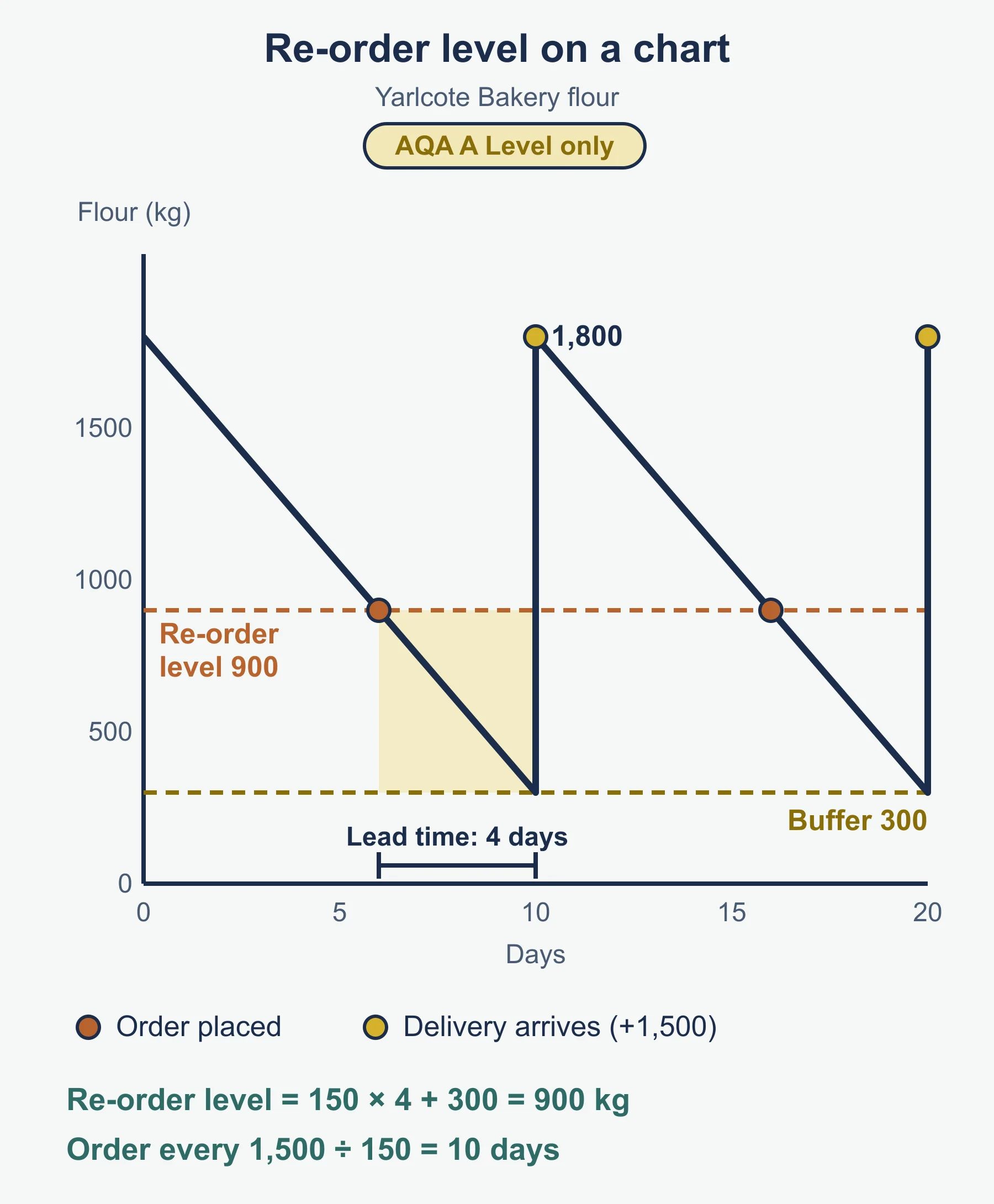
Worked example. Yarlcote Bakery uses 150 kg of flour a day. Lead time is 4 days, buffer inventory is 300 kg and the re-order quantity is 1,500 kg.
- Re-order level = 150 × 4 + 300 = 900 kg.
- Stock falls to the buffer (300 kg) as the delivery arrives, then rises to 300 + 1,500 = 1,800 kg.
- Orders are placed every 1,500 ÷ 150 = 10 days.
On an inventory control chart the line falls steadily at the rate of use, a horizontal line marks the re-order level, a second marks the buffer, and the line jumps up at each delivery after the lead time. If lead time lengthens, the re-order level must rise.
Choosing suppliers. Consider price, quality, reliability, speed, flexibility, payment terms, ethical and environmental record, location, and the supplier’s financial strength. Cheapest is not always best if late deliveries cause stoppages.
Managing the supply chain. Share forecasts and sales data, build long-term relationships, use technology to track orders, reduce the number of links, and agree standards. The value is lower cost, fewer shortages and faster delivery.
Outsourcing. Using an outside firm for an activity lets the business focus on what it does best, access expertise and turn fixed costs into variable ones. Risks include less control over quality, dependence, confidentiality, and reputational harm if the supplier acts badly.
Common errors
- Dividing capacity by output instead of output by capacity.
- Stating a re-order level without the buffer.
- Writing as if quality control and quality assurance were one method.
- Listing advantages with no link to the case. Name the business and use its numbers.
Practise with the practice questions, then check recall with the revision notes.
Frequently asked questions
How do you calculate labour productivity and unit cost? Labour productivity = output ÷ number of employees (or per hour worked). Unit cost = total costs ÷ output. The specification names these measures without formulas, so these are the standard forms.
What is lean production? Lean production aims to cut waste of every kind, including time, materials, space and effort, while still meeting customer needs. Just in Time is part of lean production: stock arrives only as it is needed.
What is mass customisation? Mass customisation means making products to individual customer wishes at close to mass-production cost.
How should a business choose a supplier? Consider price, quality, reliability, speed, flexibility, payment terms, ethical and environmental record, location and the supplier’s financial strength, and weigh them for the business in question.
Which section of the AQA Business specification covers operations? Section 3.4, Decision making to improve operational performance, covering operational objectives, operations data, efficiency and productivity, quality, and inventory and supply chains.
Official syllabus
AQA AS and A-level Business specification (7131 and 7132), subject content section 3.4, published by AQA.
Get free revision emails (optional)
Occasional emails with practice questions, worked explanations and links to free resources for the qualification and subjects you choose. No spam, and you can unsubscribe from any email. The free tools on this site never need an email.
Related resources
-
Practice questions
AQA A-Level Business: Operational management (7132) – Practice Questions
Original short-answer, calculation and case-study practice for AQA A-Level Business operational management, with worked answers and examiner insights.
Business · AQA · A Level
Try questions -
Revision notes
AQA A-Level Business: Operational management (7132) – Revision Notes
Condensed revision notes on AQA A-Level Business operational management: formulas, lean, quality, inventory and supply chains, with a self-test.
Business · AQA · A Level
Revise topic -
Study guides
AQA A-Level Business: Strategic methods: how to pursue strategies (7132)
Study guide to growth and retrenchment, innovation, internationalisation and digital technology for AQA A-Level Business 7132, with worked examples.
Business · AQA · A Level
Read guide
Related articles
-
teaching
A Level tuition in Dubai: Cambridge or Pearson Edexcel International A Level?
Schools in Dubai and Abu Dhabi teach either Cambridge International AS & A Level or Pearson Edexcel International A Level. How the two are structured, why it matters for tuition, and how online classes from Lahore work.
9 October 2026
-
curriculum guides
Choosing subjects at IGCSE and A Level
How subject choices at 14 and 16 affect university options later, and how to keep pathways open without overloading a timetable.
28 July 2026
Studying this with a teacher
Working through Business A LEVELS?
This page is free and stays free. If you would rather be taught it, Marlbridge runs Business classes one-to-one and in small groups of up to 15, online in your own time zone. The first trial class is free. WhatsApp replies within an hour (8am–11pm Pakistan time, every day); email the same day.
AQA Business teachers at Marlbridge
