
Study Guides
AQA A-Level English Language (7702): Methods of Language Analysis (Paper 2)
Using the six language levels to describe diversity and change, research them with dictionaries and corpora, and analyse texts about language: AQA 7702 3.2.2.
- Subject
- English
- Level
- A LEVELS
- Topic
- Paper 2 – Language Diversity and Change
- Author
- Marlbridge Academic Team
- Updated
- Reviewed by
- Ammar Bilal (what this means)
Aligned to AQA A Level English (7702), For first teaching 2015. Official specification .
Syllabus page (what it covers and how it is assessed): AQA A Level English Language.
Found an error? Report a correction.
Need help with this topic? Request a free trial class for A Level English Language (7702).
This guide covers 3.2.2 Methods of language analysis in AQA A-level English Language (7702), the toolkit integrated into Paper 2. The levels are the same six as in Paper 1, but the specification gives them three distinct jobs here. The broader Paper 2 language discourses and writing guide shows how Section B uses them; this page teaches the methods themselves.
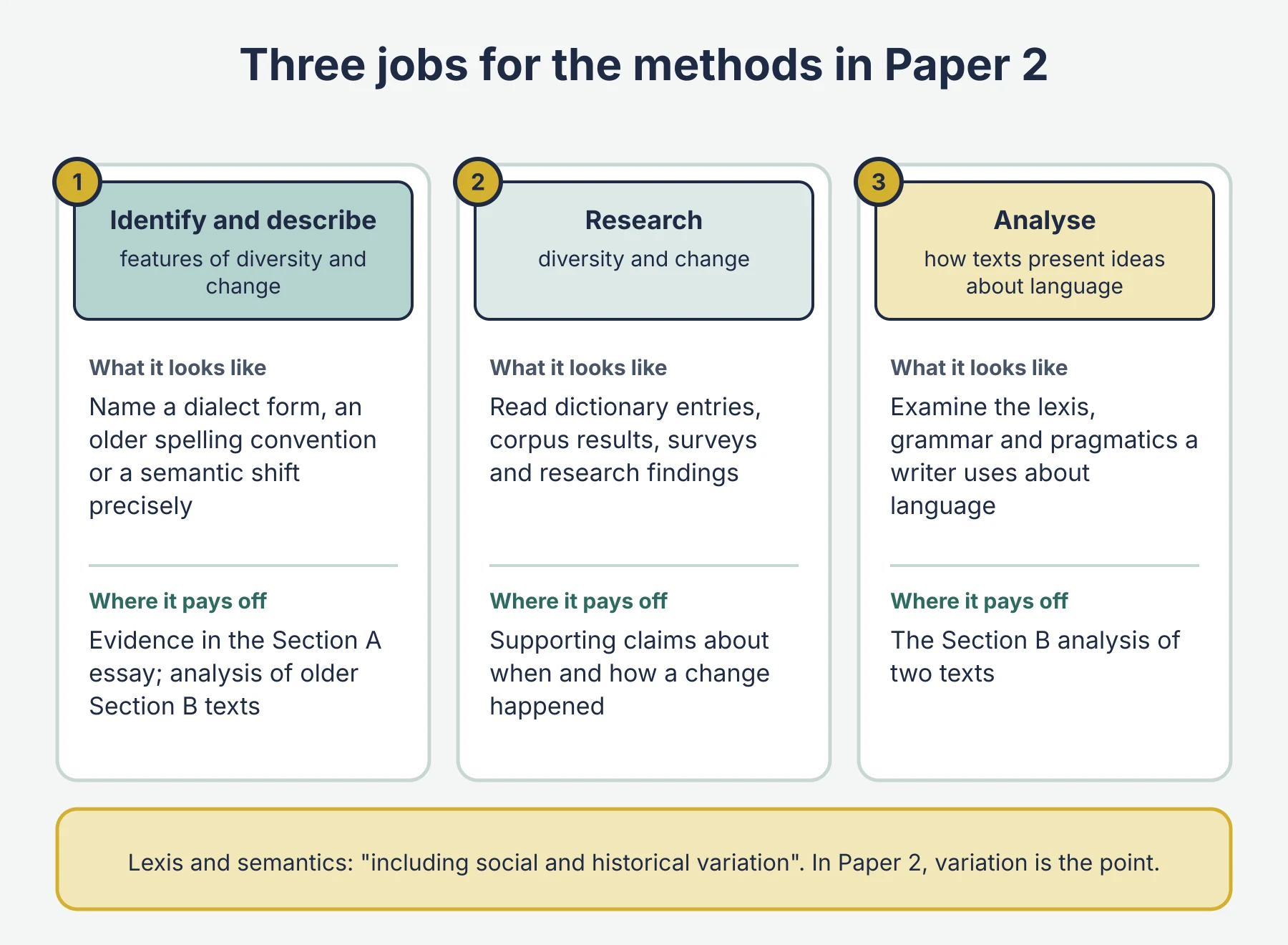
Three jobs for the methods
The specification says you use methods of language analysis to:
| Job | What it looks like | Where it pays off |
|---|---|---|
| Identify and describe features of language diversity and change | Naming a dialect form, an older spelling convention or a semantic shift precisely | Evidence in the Section A essay; analysis of older Section B texts |
| Research diversity and change | Reading dictionary entries, corpus results, surveys and research findings | Supporting claims about when and how a change happened |
| Analyse how texts present ideas about language | Examining the lexis, grammar and pragmatics a writer uses about language | The Section B analysis of two texts |
Note the specification’s wording for lexis and semantics: “the vocabulary of English, including social and historical variation”. In Paper 2, variation is the point.
Job 1: describing diversity and change precisely
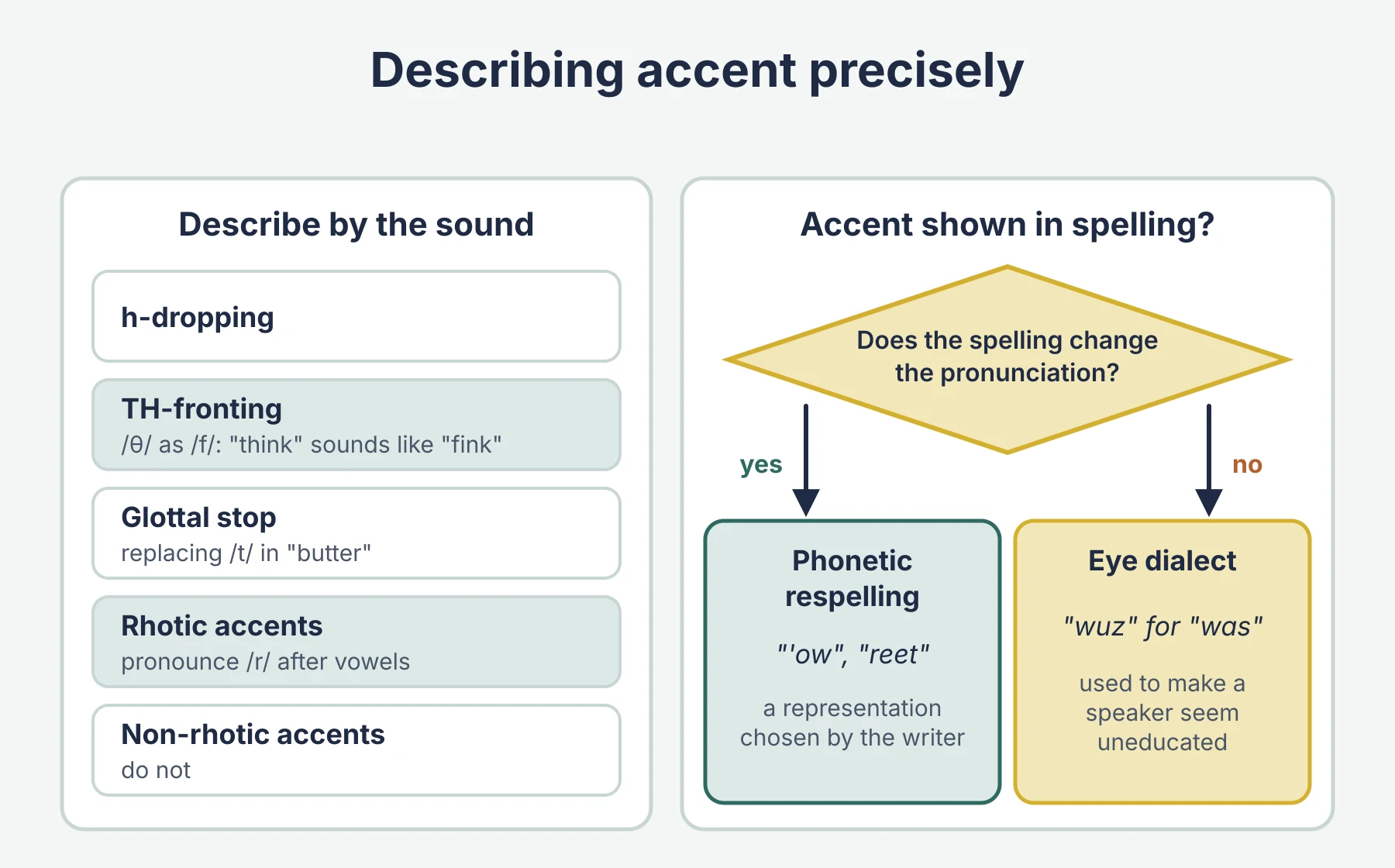
Phonetics, phonology and prosodics. Describe accent features by the sound involved, not by spelling alone. Useful terms: h-dropping; TH-fronting (/θ/ pronounced as /f/, so “think” sounds like “fink”); the glottal stop replacing /t/ in “butter”; rhotic accents (pronouncing /r/ after vowels, as in many Scottish and West Country accents) versus non-rhotic accents. If a text represents accent through spelling (“’ow”, “reet”), say so: that is phonetic respelling, a representation chosen by the writer. Strictly, eye dialect is non-standard spelling that does not change the pronunciation at all (“wuz” for “was”), used to make a speaker seem uneducated.
Graphology. For older print: the long s (ſ), capitalised common nouns, italic for emphasis or names, blackletter type in early printing, dense layout. For digital texts: emoji, capitals for volume, repeated letters (“sooo”) for prosody, and platform-specific layout.
Lexis and semantics. Identify dialect lexis (“bairn”, “ginnel”), archaisms (“wherefore”, “pray”), neologisms, borrowings, and words whose meaning has shifted. When a word looks familiar but its meaning has changed, say what it meant in the text’s period.
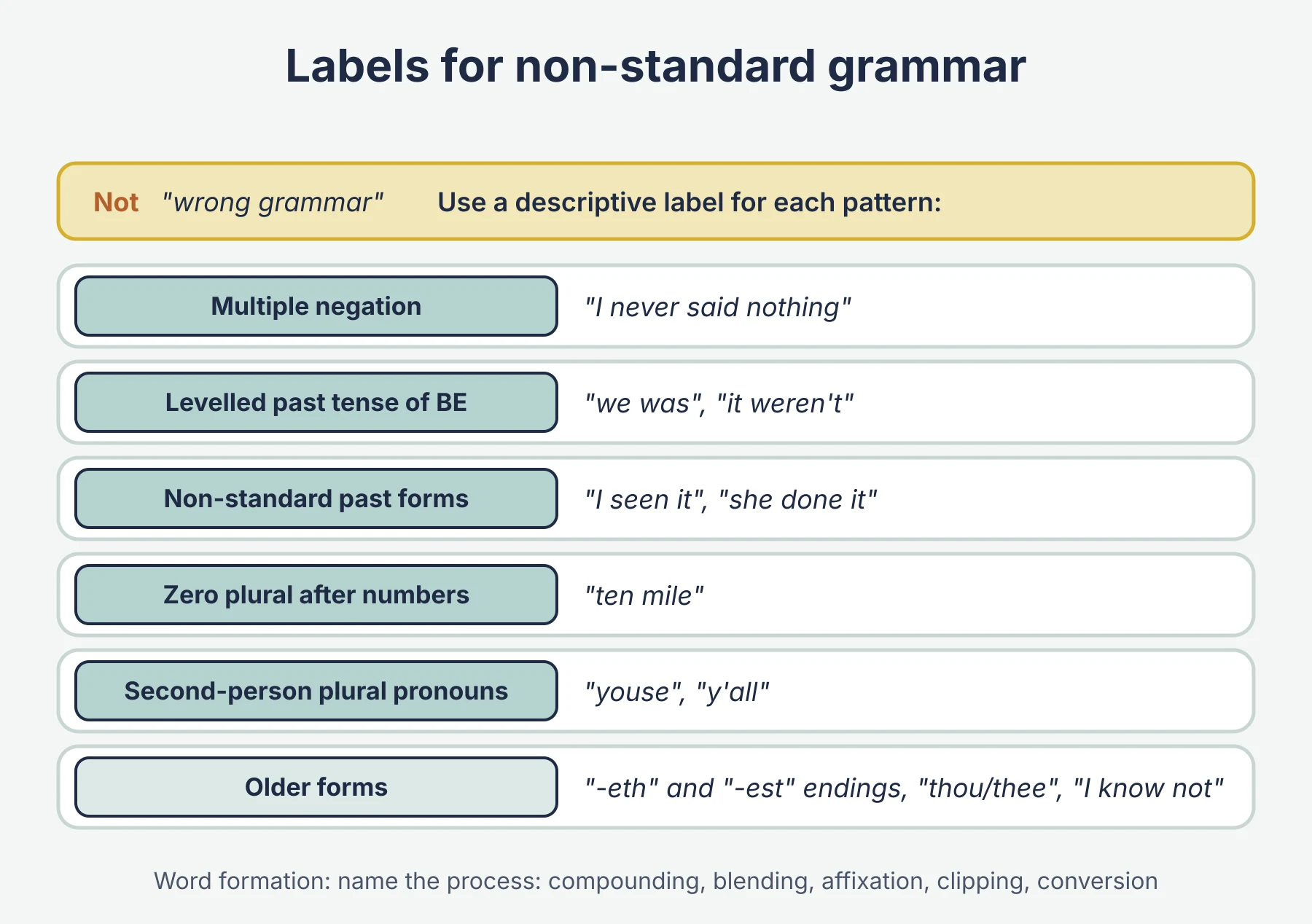
Grammar, including morphology. Use descriptive labels, not “wrong grammar”:
- multiple negation: “I never said nothing”;
- levelled past tense of BE: “we was”, “it weren’t”;
- non-standard past forms: “I seen it”, “she done it”;
- zero plural after numbers: “ten mile”;
- second-person plural pronouns: “youse”, “y’all”;
- older forms: “-eth” and “-est” verb endings, “thou/thee”, absence of do-support (“I know not”).
For word formation, name the morphological process: compounding, blending, affixation, clipping, conversion.
Pragmatics. Politeness conventions change and vary: “Pray”, “Sir”, “your humble servant” in older letters; regional terms of address (“love”, “duck”, “pet”); differences in directness across varieties.
Discourse. Genre conventions change too: the structure of letters, newspaper reports or adverts in different periods; turn-taking patterns in different communities; the conventions of online interaction.
Worked example: describing a dialect utterance
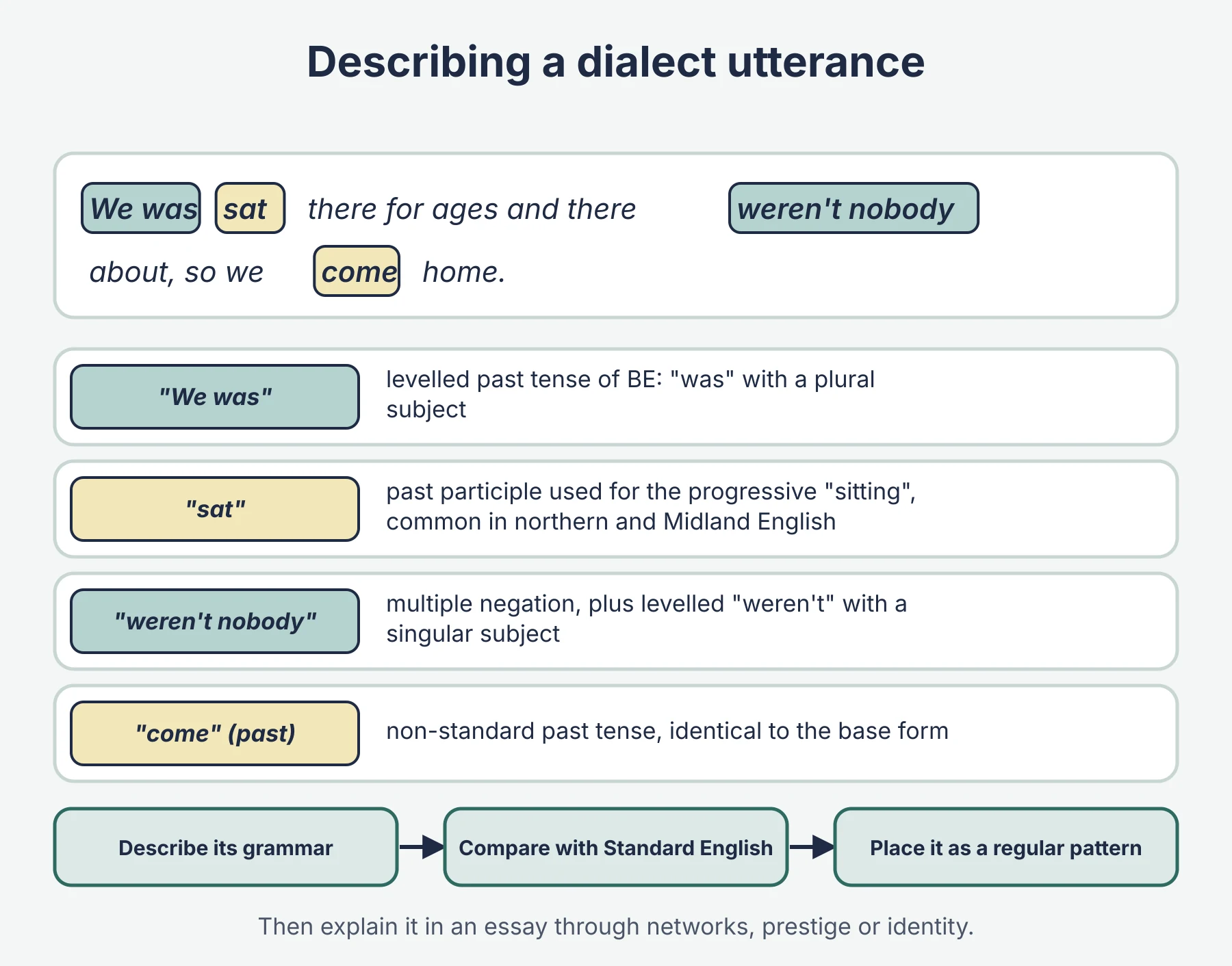
The sentence below is original, constructed to show several features at once.
“We was sat there for ages and there weren’t nobody about, so we come home.”
"We was"              levelled past tense of BE: "was" with a plural subject
"sat"                 past participle used for the progressive "sitting",
                      a construction common in northern and Midland English
"weren't nobody"      multiple negation, plus levelled "weren't" with a
                      singular subject
"come" (past)         non-standard past tense, identical to the base form
Each feature is described by its grammar, compared with Standard English, and placed as a regular pattern of a variety, not an error. In an essay, you could then explain such features through networks, prestige or identity.
Job 2: researching diversity and change
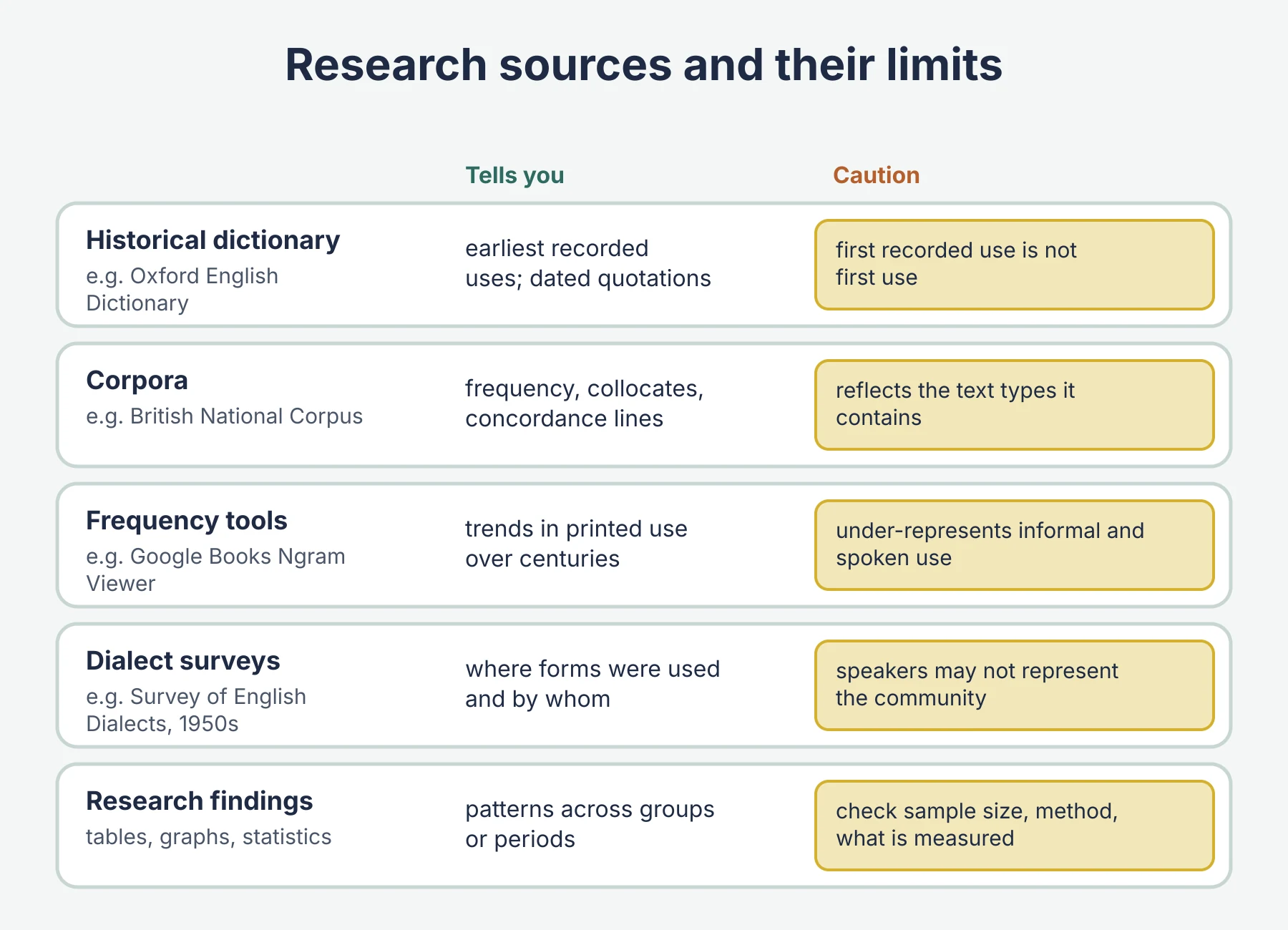
| Source | What it tells you | Caution |
|---|---|---|
| Historical dictionary (for example the Oxford English Dictionary) | Earliest recorded uses and dated quotations showing meaning over time | First recorded use is not first use, especially for speech |
| Corpora (for example the British National Corpus) | Frequency, collocates and concordance lines from large text collections | A corpus reflects the text types it contains |
| Frequency tools across books (such as Google Books Ngram Viewer) | Trends in printed use over centuries | Printed books under-represent informal and spoken language |
| Dialect surveys (such as the Survey of English Dialects, 1950s) | Where forms were used and by whom | Speakers recorded may not represent the whole community |
| Research findings (tables, graphs, statistics) | Patterns across groups or periods | Check sample size, method and what is actually measured |
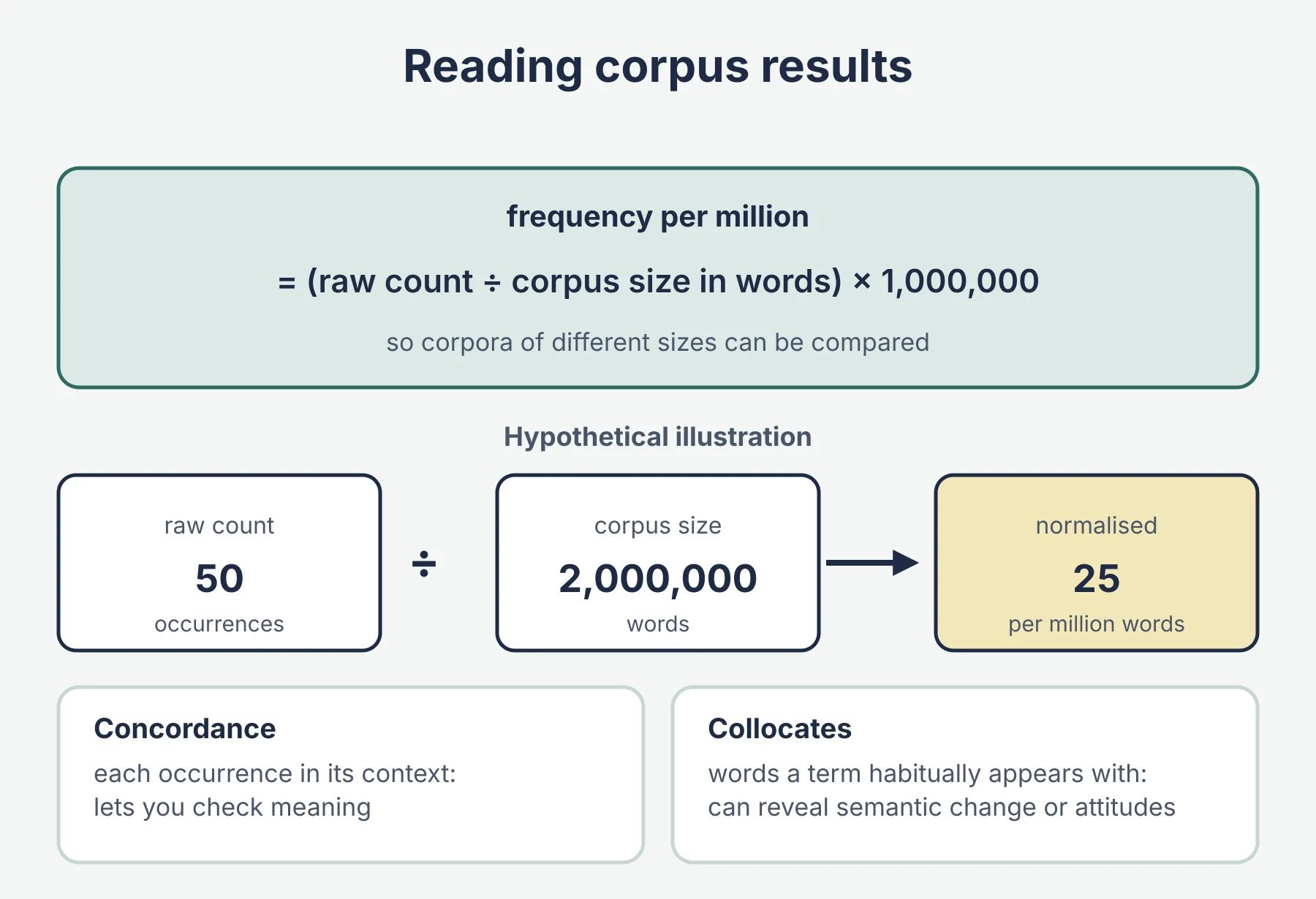
Reading corpus results. Frequencies are usually normalised (for example per million words) so corpora of different sizes can be compared: frequency per million = (raw count ÷ corpus size in words) × 1,000,000. As a hypothetical illustration, 50 occurrences in a 2-million-word corpus is 25 per million. A concordance shows each occurrence in its context, which lets you check meaning; collocates show which words a term habitually appears with, which can reveal semantic change or attitudes.
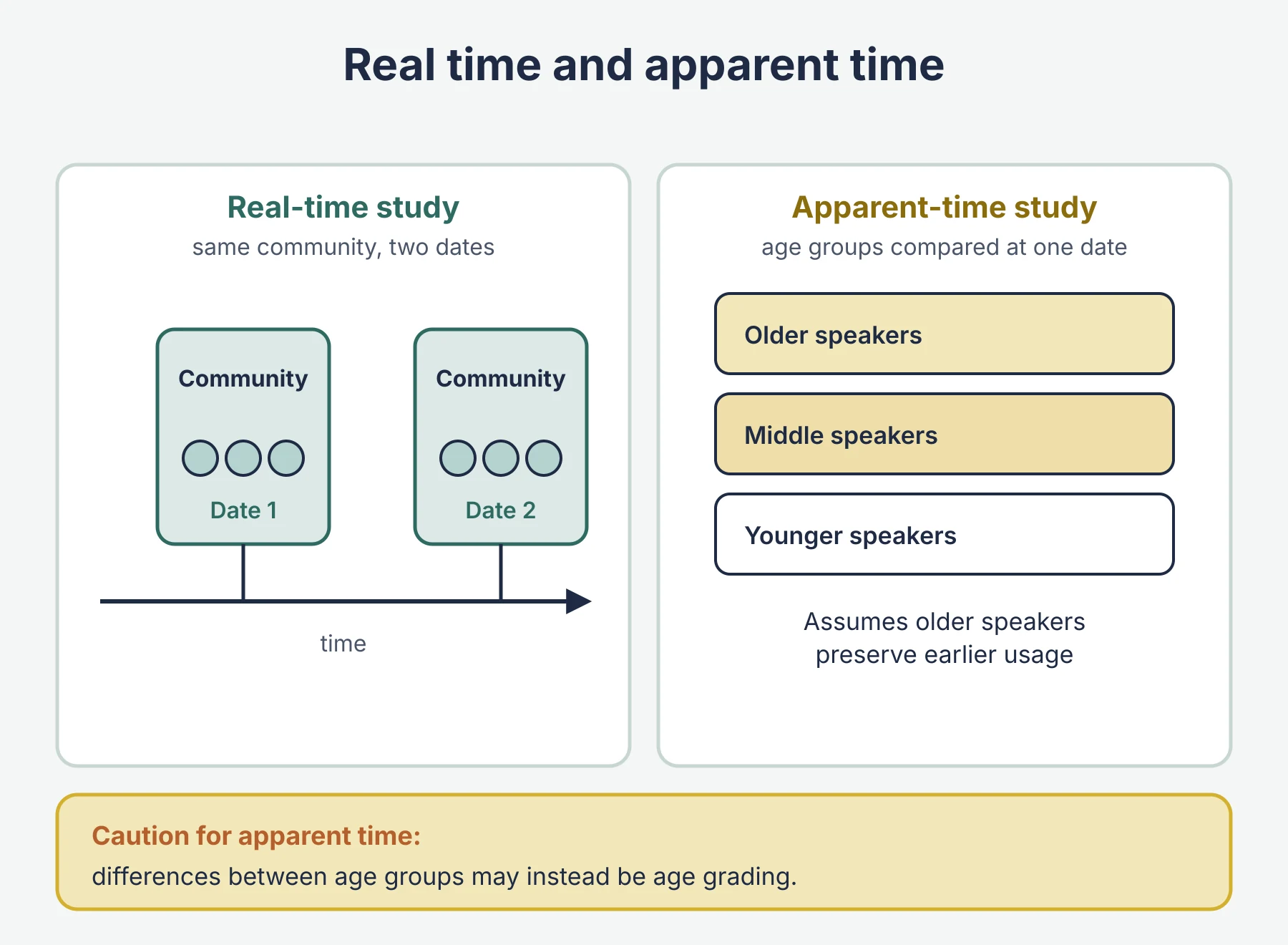
Real time and apparent time. A real-time study compares the same community at two dates. An apparent-time study compares age groups at one date, assuming that older speakers preserve earlier usage; differences may instead be age grading.
Job 3: analysing how texts present ideas about language
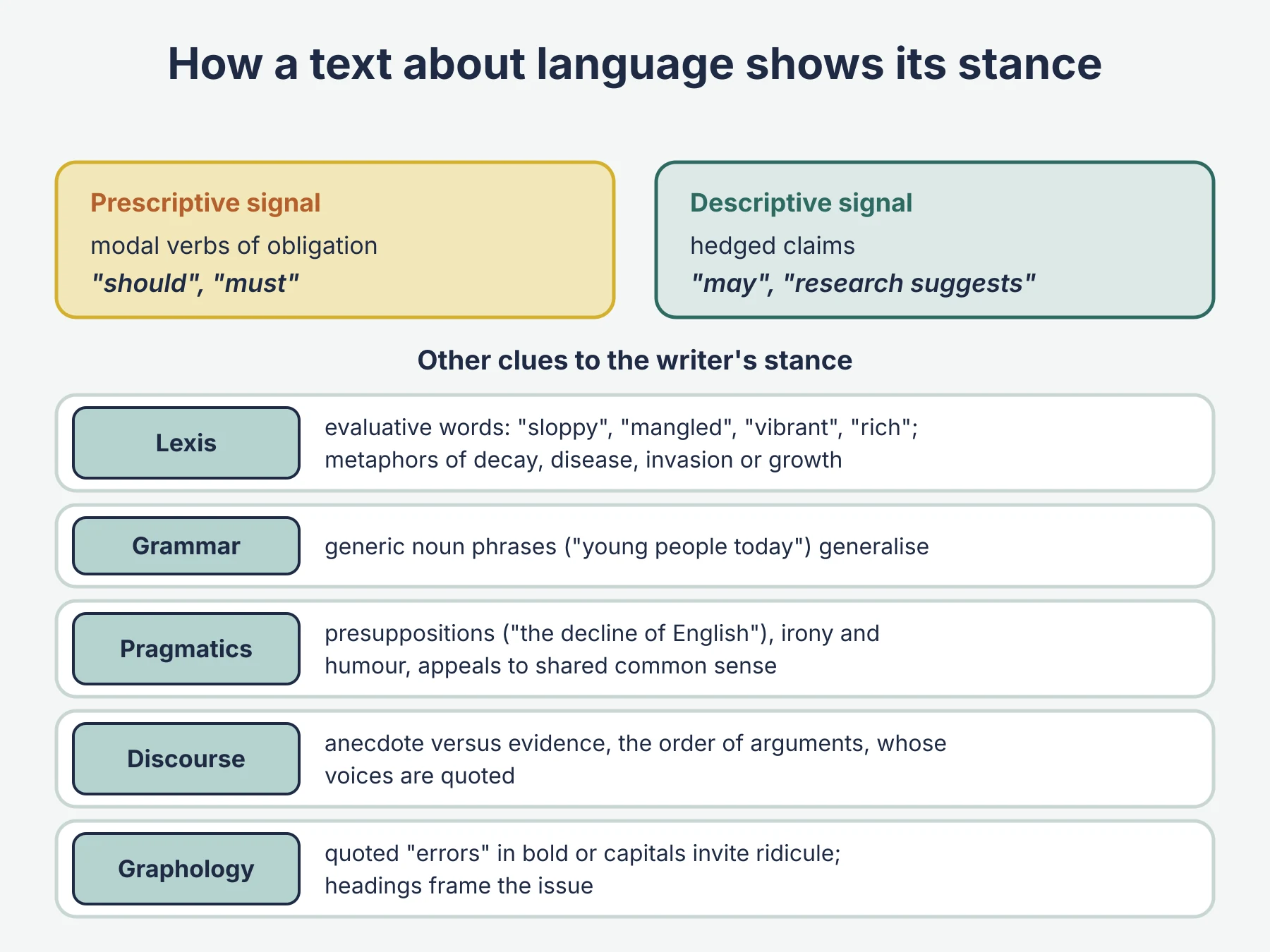
When a text is about language, the methods reveal its stance:
- Lexis: evaluative words for language and its users (“sloppy”, “mangled”, “vibrant”, “rich”); metaphors of decay, disease, invasion or growth.
- Grammar: modal verbs of obligation (“should”, “must”) signal prescriptive views; hedged claims (“may”, “research suggests”) signal descriptive ones; generic noun phrases (“young people today”) generalise.
- Pragmatics: presuppositions (“the decline of English”), irony and humour, appeals to shared common sense.
- Discourse: anecdote versus evidence, the order of arguments, whose voices are quoted.
- Graphology: quoted “errors” in bold or capitals invite ridicule; headings frame the issue.
Common mistakes
- Calling dialect grammar “slang” or “incorrect” rather than describing it.
- Describing accent only through spelling in a transcript that uses phonemic symbols, or ignoring respellings and eye dialect in a written text.
- Treating a first recorded date as the date a word was invented.
- Using corpus raw counts to compare corpora of different sizes.
- Describing a Section B text’s opinions without the language features that carry them.
Exam technique
- In the Section A essay, use precisely described examples as evidence for an argument about causes or attitudes.
- In Section B, choose the levels that reveal the writer’s stance, and link each to the discourse it draws on.
- Use the specification’s language level names, so your method is visible.
Where to go next
- Paper 2 methods of language analysis revision notes
- Paper 2 methods of language analysis practice questions
- Language Diversity and Change study guide
Official syllabus
AQA AS and A-level English Language (7701/7702) specification, A-level subject content 3.2.2 Methods of language analysis, integrated into Paper 2.
Section numbers. This site follows the A-level (7702) subject content on aqa.org.uk, where Paper 2 content is 3.2. The combined AS and A-level specification PDF numbers the same A-level sections 4.1, 4.2 and 4.3.
Related resources
-
Practice questions
AQA A-Level English Language (7702): Methods of Language Analysis (Paper 2) – Practice Questions
Original practice describing dialect and older forms, reading corpus evidence and analysing a text about language, for AQA A-level English 7702 Paper 2.
English · AQA · A Level
Try questions -
Revision notes
AQA A-Level English Language (7702): Methods of Language Analysis (Paper 2) – Revision Notes
Recall notes on describing dialect and historical features, reading corpus and dictionary evidence, and analysing texts about language, for AQA 7702 Paper 2.
English · AQA · A Level
Revise topic -
Study guides
AQA A-Level English Language (7702): Language Discourses
How texts about language represent it, build a persona, position readers and draw on wider discourses, with a worked comparison: AQA A-level English 7702 3.2.3.
English · AQA · A Level
Read guide
Get free revision emails (optional)
Occasional emails with practice questions, worked explanations and links to free resources for the qualification and subjects you choose. No spam, and you can unsubscribe from any email. The free tools on this site never need an email.