
Revision Notes
AQA A-Level English Language (7702): Methods of Language Analysis (Paper 2) – Revision Notes
Recall notes on describing dialect and historical features, reading corpus and dictionary evidence, and analysing texts about language, for AQA 7702 Paper 2.
- Subject
- English
- Level
- A LEVELS
- Topic
- Paper 2 – Language Diversity and Change
- Author
- Marlbridge Academic Team
- Updated
- Reviewed by
- Ammar Bilal (what this means)
Aligned to AQA A Level English (7702), For first teaching 2015. Official specification .
Syllabus page (what it covers and how it is assessed): AQA A Level English Language.
Found an error? Report a correction.
Need help with this topic? Request a free trial class for A Level English Language (7702).
Condensed recall for 3.2.2 Methods of language analysis in Paper 2 of AQA A-level English Language (7702). The full explanation and worked examples are in the Paper 2 methods of language analysis study guide.
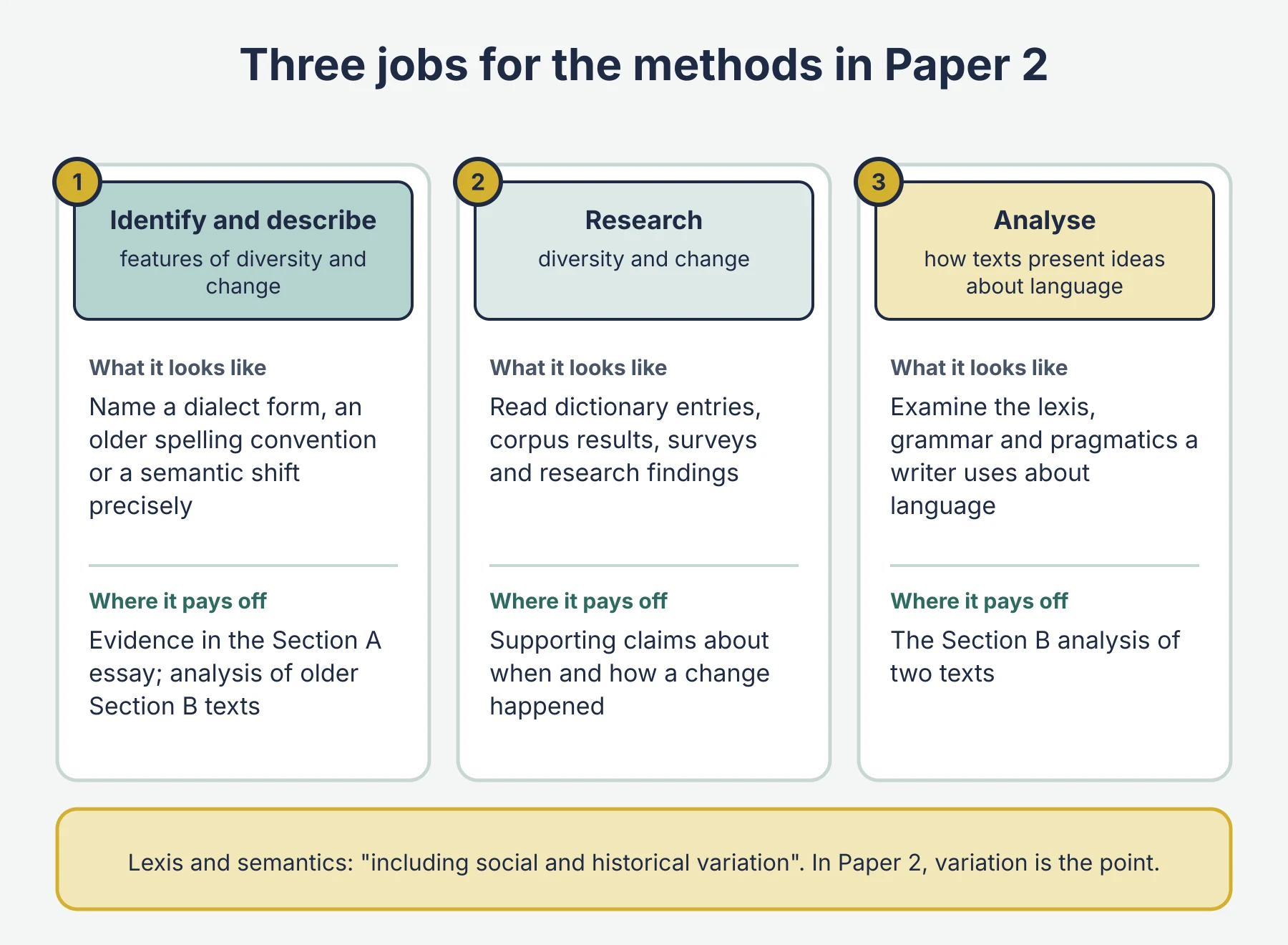
The three jobs (specification wording)
- Identify and describe features of language diversity and change.
- Research diversity and change.
- Analyse how texts present ideas about language.
The six levels are the same as in Paper 1; lexis and semantics explicitly includes social and historical variation.
Describing diversity: precise labels
| Level | Feature | Example |
|---|---|---|
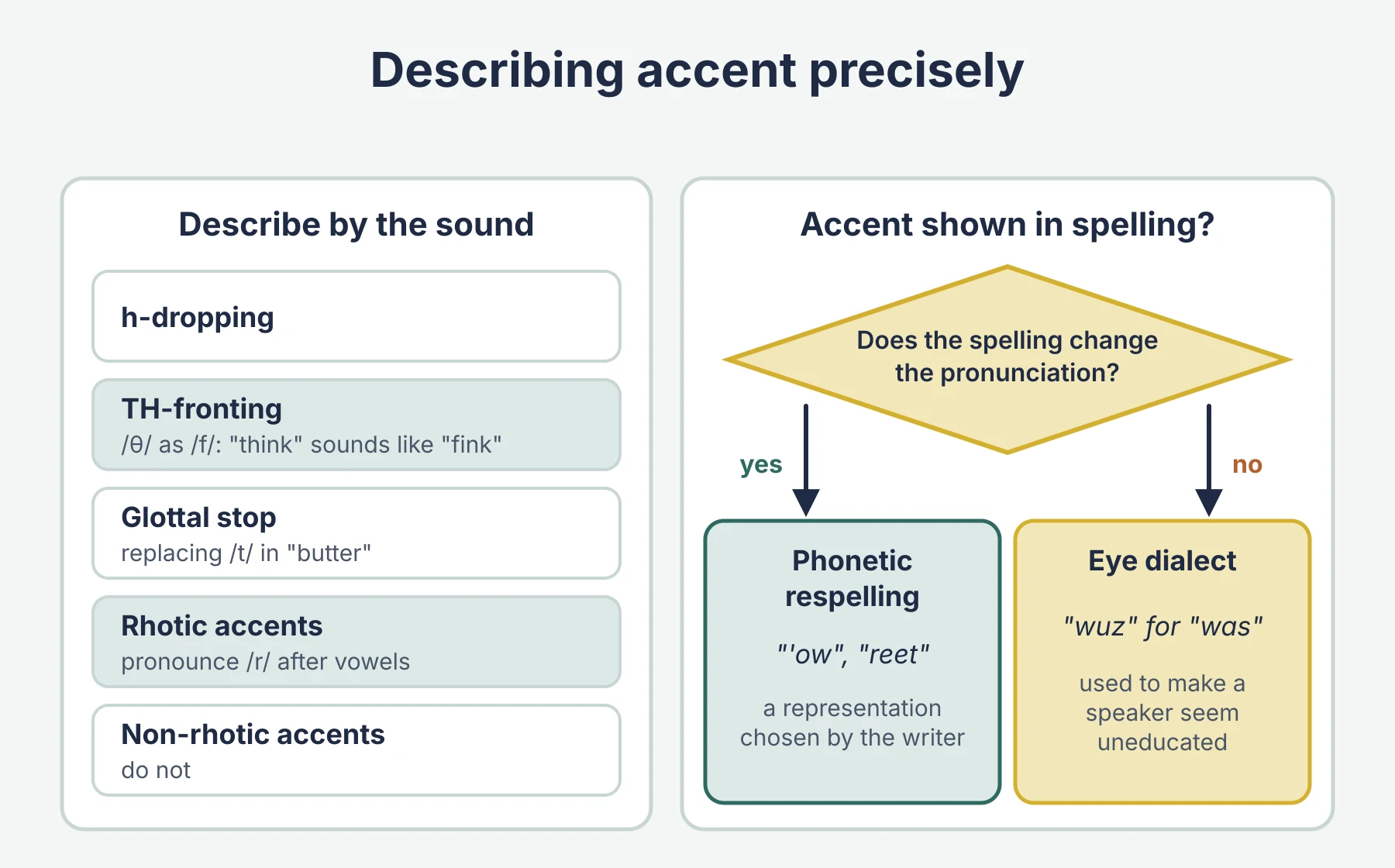
| Phonology | H-dropping | “’ouse” |
| Phonology | TH-fronting | “fink” for “think” |
| Phonology | Glottal stop for /t/ | “bu’er” |
| Phonology | Rhotic / non-rhotic | /r/ pronounced / not pronounced after vowels |
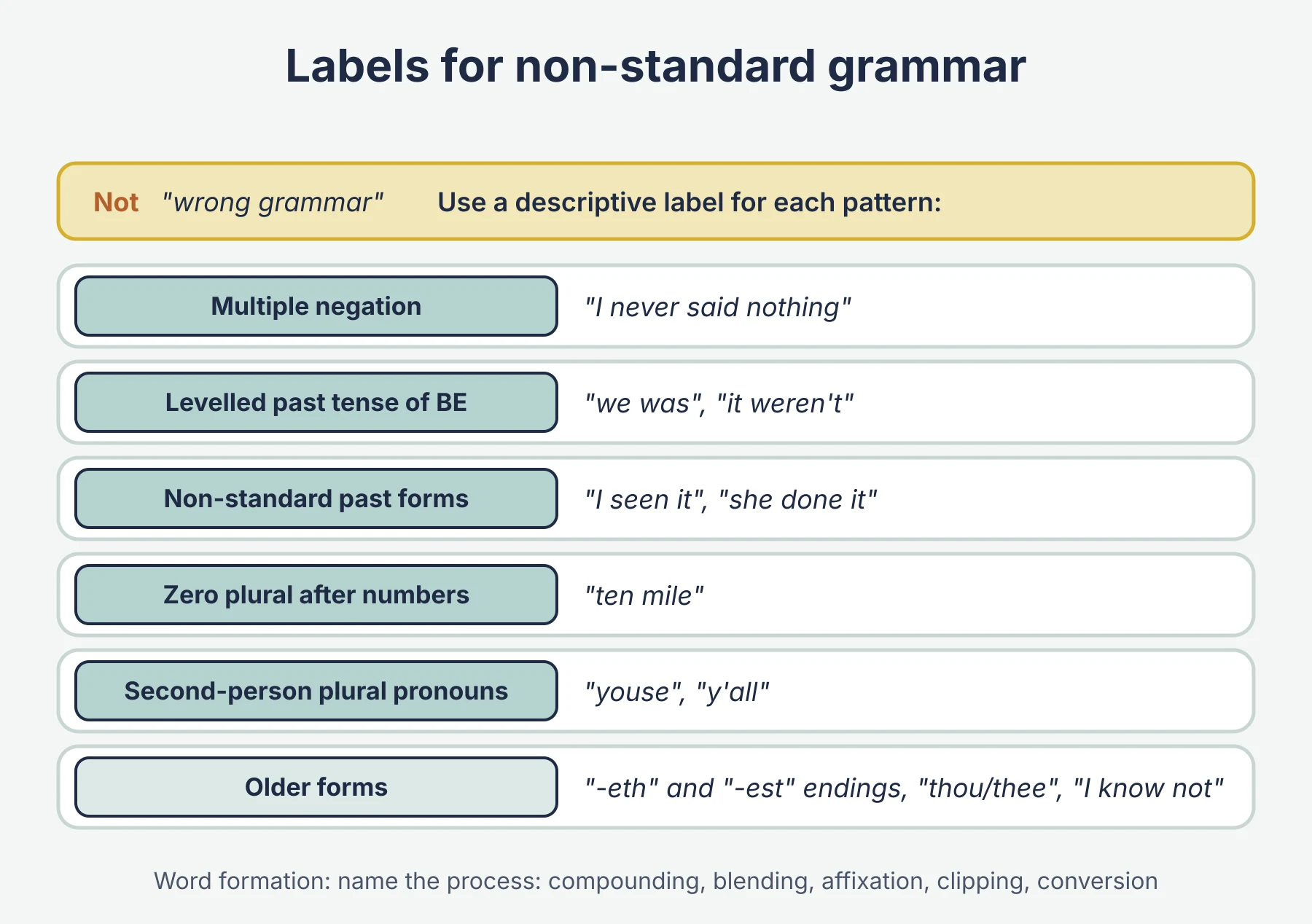
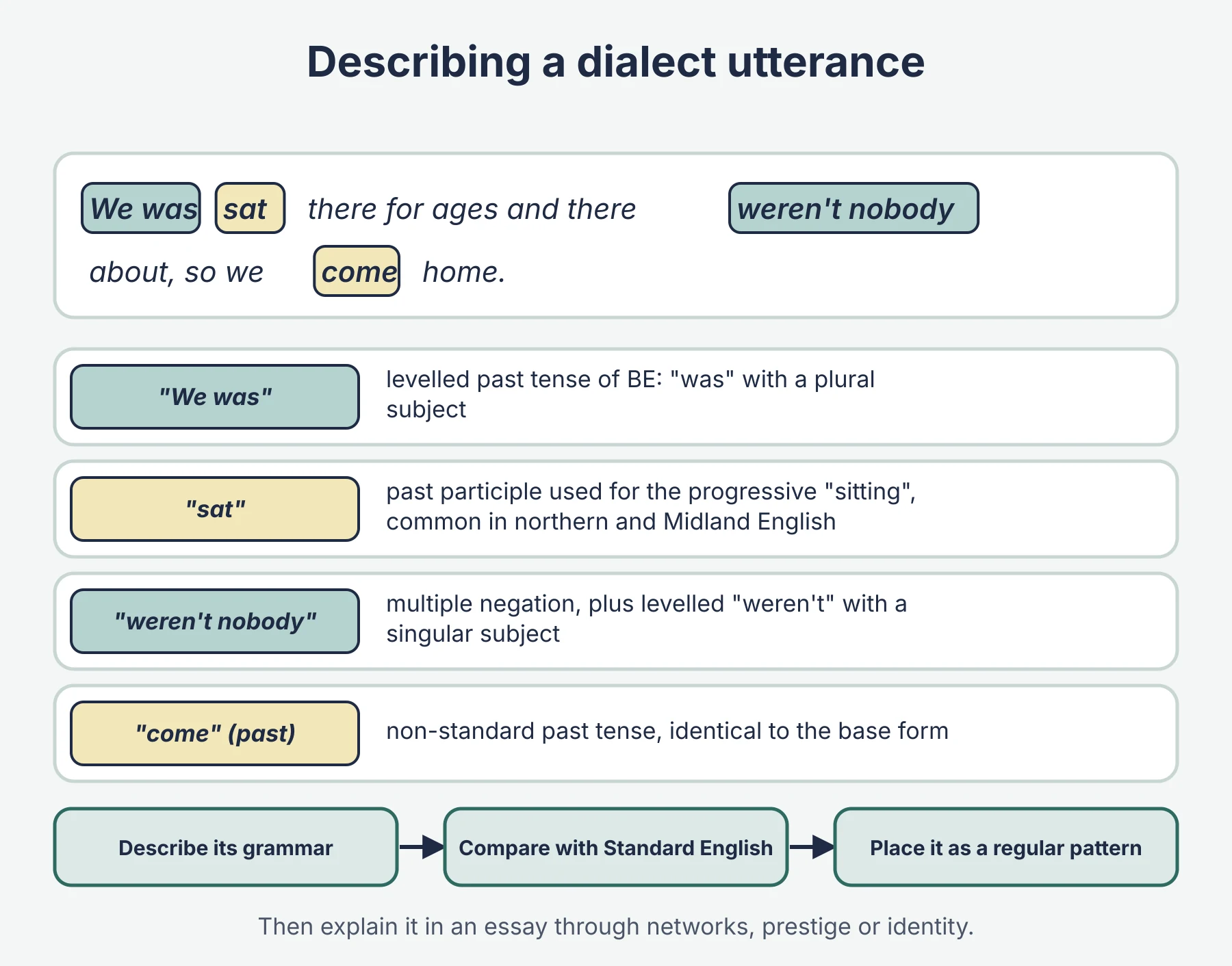
| Grammar | Multiple negation | “didn’t do nothing” |
| Grammar | Levelled BE | “we was”, “it weren’t” |
| Grammar | Non-standard past | “I seen it” |
| Grammar | Zero plural after numerals | “five mile” |
| Grammar | Second-person plural | “youse”, “y’all” |
| Lexis | Dialect lexis | “bairn”, “ginnel” |
| Pragmatics | Regional address terms | “love”, “duck”, “pet” |
Describing change: precise labels
| Level | Feature | Example |
|---|---|---|
| Graphology | Long s; capitalised nouns | “ſuch”; “the Weather” |
| Orthography | Unfixed spelling; final “-e” | “olde”, “Towne” |
| Grammar | “-eth” / “-est” endings | “he walketh”, “thou knowest” |
| Grammar | No do-support | “I know not”, “Saw you him?” |
| Grammar | BE as perfect auxiliary with motion verbs | “he is come” |
| Lexis | Archaism | “wherefore”, “pray” |
| Semantics | Shifted meaning | “nice”, “silly” |
| Pragmatics | Deferential formulas | “your humble servant” |
| Discourse | Changed genre conventions | older letter openings and closings |
Key terms
| Term | Meaning |
|---|---|
| Phonetic respelling | Spelling altered to represent a pronunciation |
| Eye dialect | Non-standard spelling that does not change pronunciation (“wuz”) |
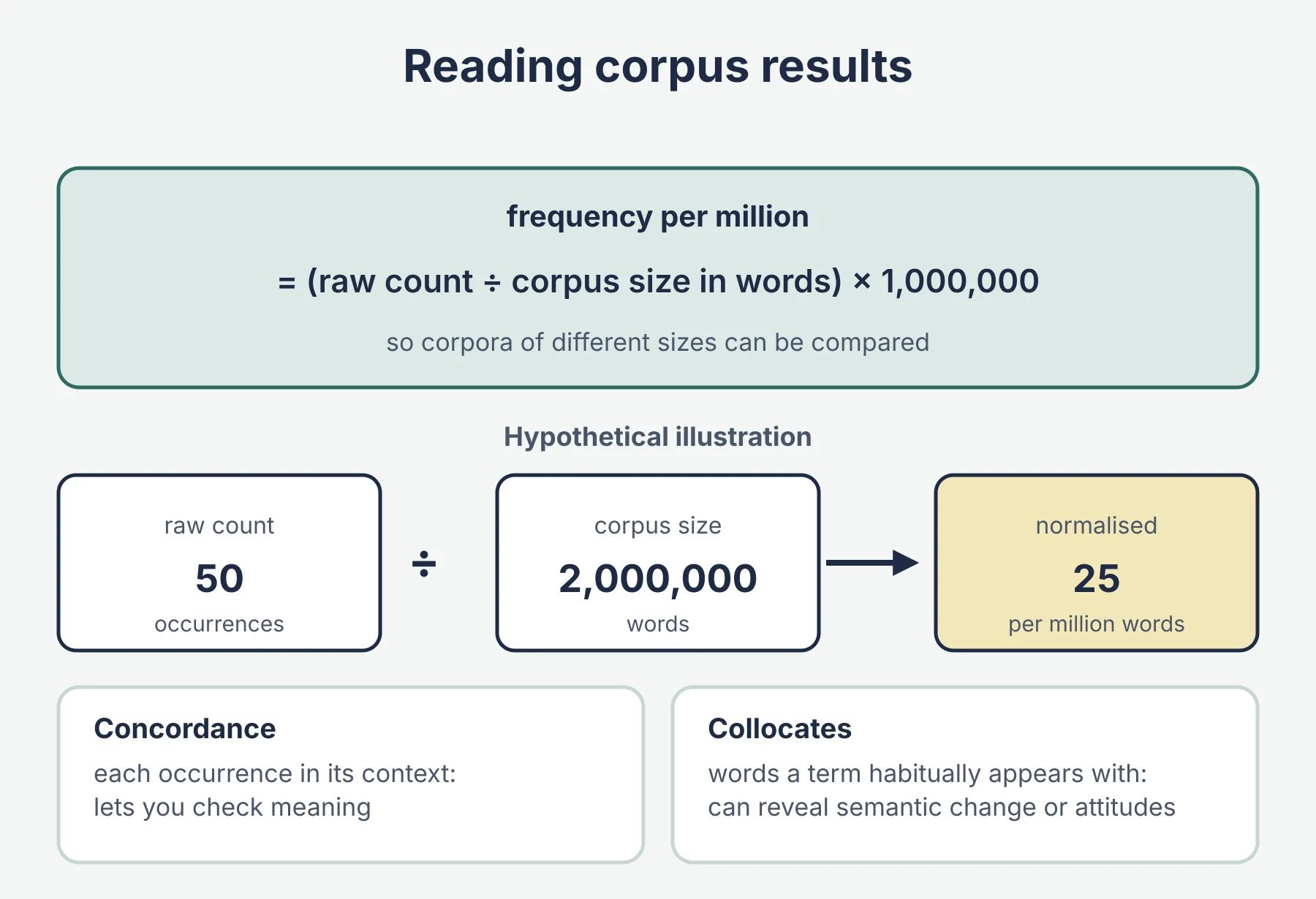
| Corpus | A large, structured collection of real texts used for analysis |
| Concordance | List of every occurrence of a word with its surrounding context |
| Collocate | A word that frequently appears near another |
| Normalised frequency | Frequency adjusted to a standard size, such as per million words |
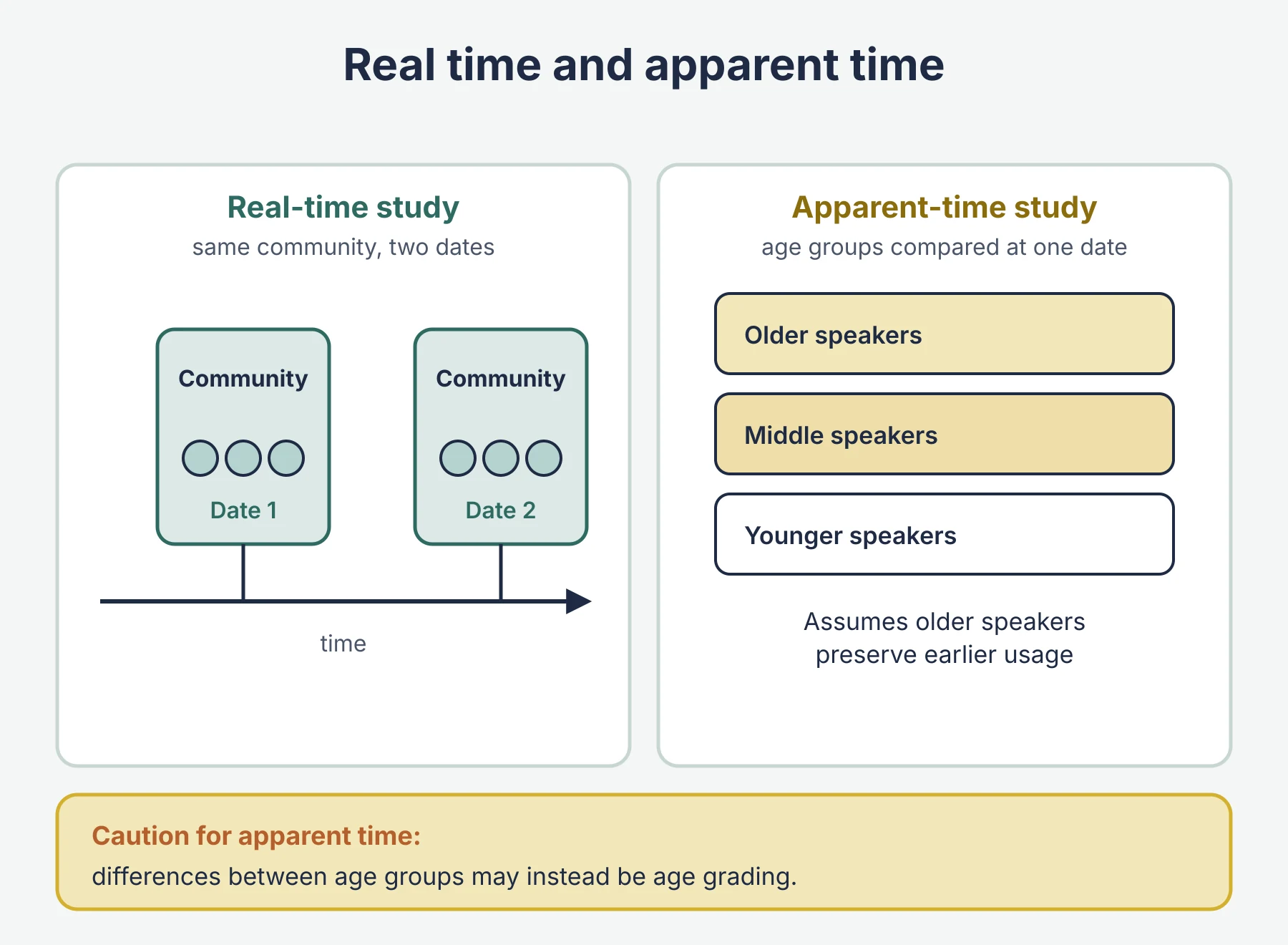
| Real-time study | Compares a community at two different dates |
| Apparent-time study | Compares age groups at one date to infer change |
| Age grading | Speakers change usage as they age, without a community-wide change |
| Metalanguage | Language used to talk about language |
Research sources and cautions
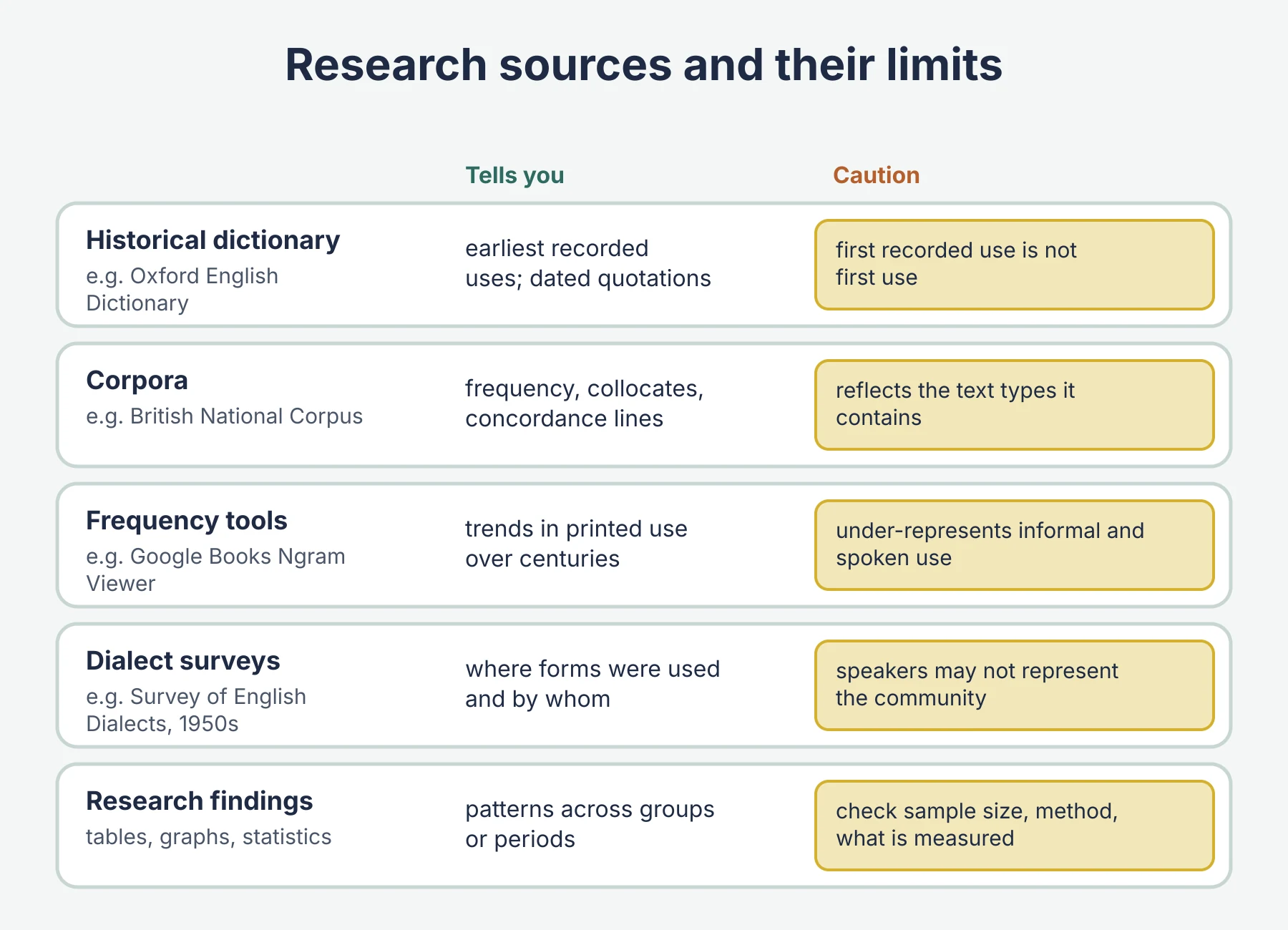
- Historical dictionary: dated quotations; first recorded use is not first use.
- Corpus: frequencies and contexts; only as representative as its contents.
- Book frequency tools: long-term trends; written, edited language only.
- Dialect surveys: geography of forms; sample may be limited (for example older rural speakers).
- Research findings: check sample size, method and what is measured before generalising.
Analysing texts about language: stance signals
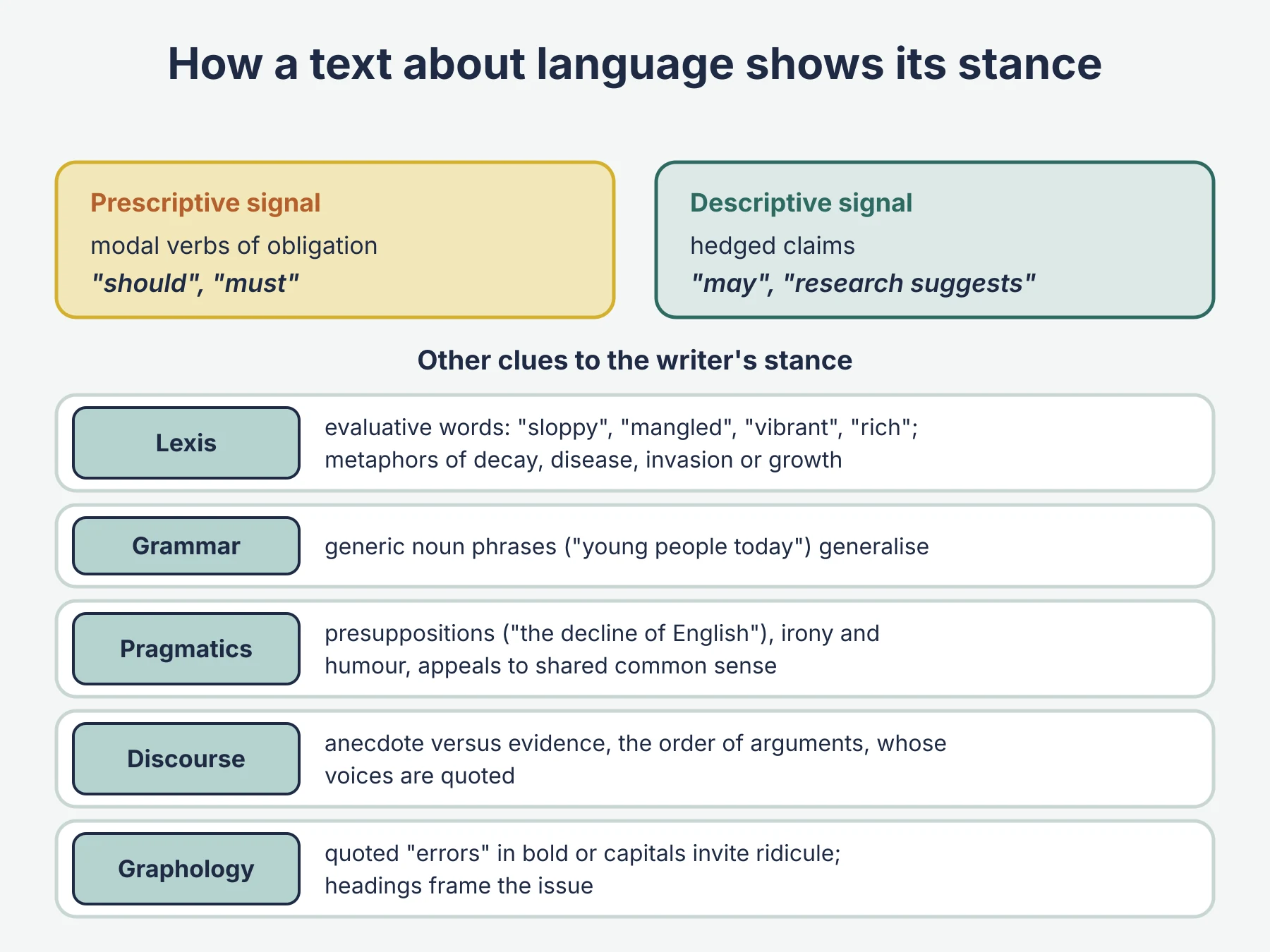
| Signal | Prescriptive stance | Descriptive stance |
|---|---|---|
| Lexis | “sloppy”, “lazy”, “mangled”, “proper” | “variation”, “pattern”, “rule-governed” |
| Metaphor | Decay, disease, invasion | Growth, evolution, toolkit |
| Modality | “should”, “must” | “may”, “research suggests” |
| Evidence | Anecdote, appeal to common sense | Studies, data, examples across time |
| Graphology | “Errors” quoted in bold or capitals | Forms quoted neutrally, often italicised |
Exam traps
- Calling non-standard grammar “slang”.
- Using only spelling to describe accent in a phonemic transcript.
- Treating eye dialect as accurate representation of speech.
- Comparing raw corpus counts from corpora of different sizes.
- Assuming an age difference proves change (it may be age grading).
- Summarising what a Section B writer thinks without analysing how the language shows it.
Self-test
- Name the three jobs the specification gives methods of language analysis in Paper 2.
- What is TH-fronting?
- Describe the grammar of “it weren’t me”.
- What is a rhotic accent?
- What is the difference between phonetic respelling and eye dialect?
- Give an example of a sentence without do-support.
- Why must corpus frequencies often be normalised?
- What does a concordance show?
- What is the main caution about a dictionary’s earliest recorded date?
- Distinguish real-time and apparent-time studies.
- What is age grading?
- Name two grammatical signals of a prescriptive stance in a text about language.
Answers
- Identify and describe features of language diversity and change; research diversity and change; analyse how texts present ideas about language.
- Pronouncing /θ/ as /f/ (and often /ð/ as /v/), so “think” sounds like “fink”.
- Levelled past tense of BE: the plural form “were” is used with a singular subject, contracted with negative “n’t”.
- One where /r/ is pronounced after vowels, as in “car” or “hard”.
- Phonetic respelling changes spelling to show a real pronunciation; eye dialect changes spelling without changing pronunciation, often to make a speaker seem uneducated.
- “I know not” or “Saw you him?”
- So that corpora or sections of different sizes can be compared fairly.
- Every occurrence of a word in its surrounding context, so meaning and usage can be checked.
- It is the first use that survives in the records consulted, not necessarily the first time the word was used, especially in speech.
- Real-time compares the same community at two dates; apparent-time compares different age groups at one date.
- A pattern in which people change their usage at different life stages, so age differences do not necessarily show change in the community.
- Modal verbs of obligation (“should”, “must”); generic noun phrases (“young people today”); imperatives (“stop saying…”).
More resources on this topic
Related resources
-
Study guides
AQA A-Level English Language (7702): Language Discourses
How texts about language represent it, build a persona, position readers and draw on wider discourses, with a worked comparison: AQA A-level English 7702 3.2.3.
English · AQA · A Level
Read guide -
Practice questions
AQA A-Level English Language (7702): Language Discourses – Practice Questions
Original practice analysing and comparing texts about Americanisms: representation, persona, positioning and discourse, for AQA A-level English Language 7702.
English · AQA · A Level
Try questions -
Revision notes
AQA A-Level English Language (7702): Language Discourses – Revision Notes
Recall notes on discourses about language, personas, reader positioning and comparing two texts, for AQA A-level English Language 7702 Paper 2 Section B.
English · AQA · A Level
Revise topic
Get free revision emails (optional)
Occasional emails with practice questions, worked explanations and links to free resources for the qualification and subjects you choose. No spam, and you can unsubscribe from any email. The free tools on this site never need an email.