
Study Guides
AQA A-Level English Language (7702): Language Discourses
How texts about language represent it, build a persona, position readers and draw on wider discourses, with a worked comparison: AQA A-level English 7702 3.2.3.
- Subject
- English
- Level
- A LEVELS
- Topic
- Paper 2 – Language Diversity and Change
- Author
- Marlbridge Academic Team
- Updated
- Reviewed by
- Ammar Bilal (what this means)
Aligned to AQA A Level English (7702), For first teaching 2015. Official specification .
Syllabus page (what it covers and how it is assessed): AQA A Level English Language.
Found an error? Report a correction.
Need help with this topic? Request a free trial class for A Level English Language (7702).
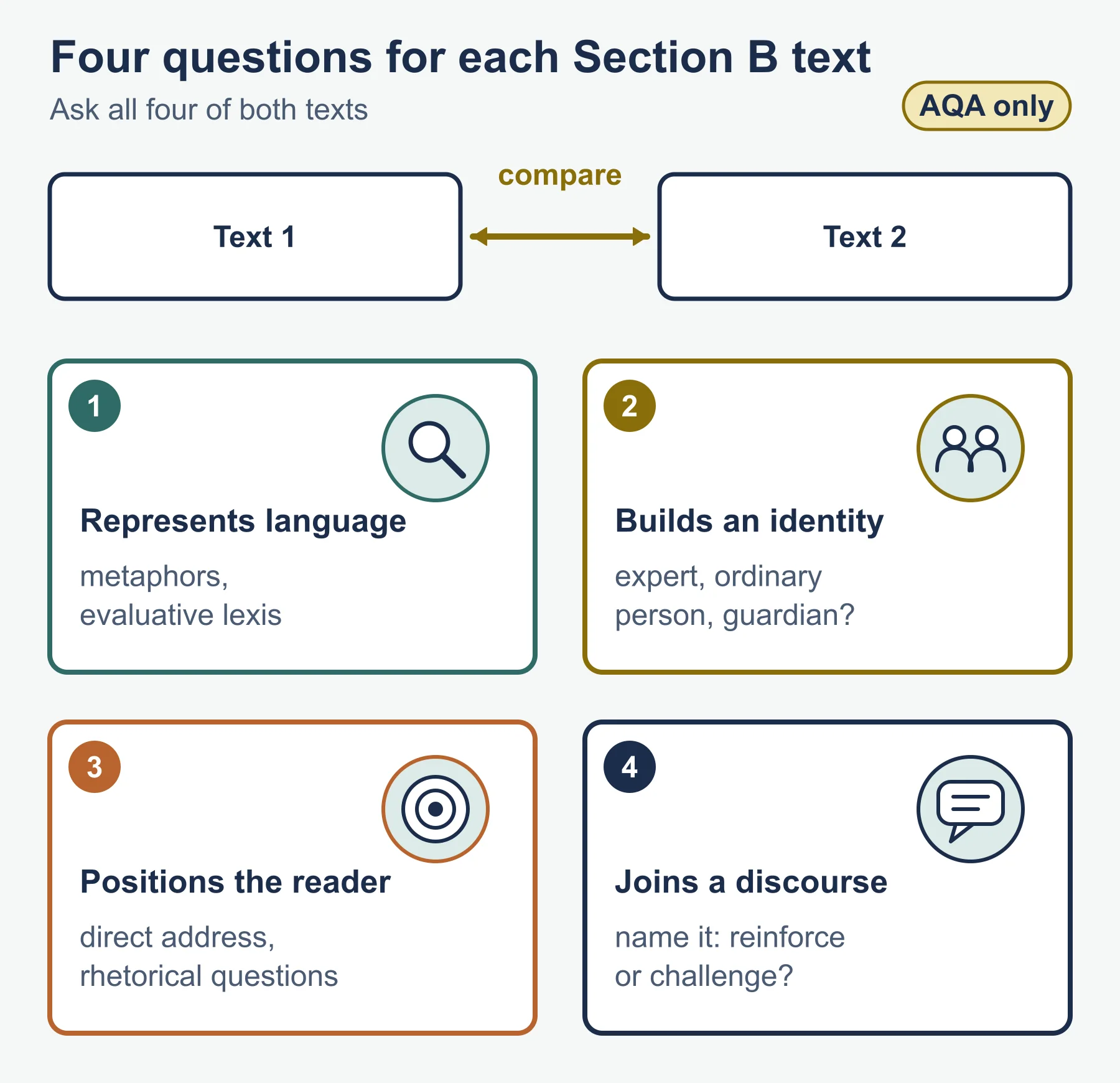
This guide covers 3.2.3 Language discourses in AQA A-level English Language (7702), the content behind the Paper 2 Section B analysis question (40 marks), in which you analyse how two texts about a topic linked to diversity and change use language to present ideas, attitudes and opinions. The Paper 2 language discourses and writing guide introduces the four analytical questions; this page takes each one further and works through a full comparison on a new topic.
What the specification asks you to study
You study a range of texts that convey attitudes to language diversity and change, including texts written for non-specialist audiences. You explore how texts are produced to convey views and opinions about language issues, and how they:
- represent language;
- construct an identity for the producer;
- position the reader and seek to influence them;
- are connected to discourses about language.
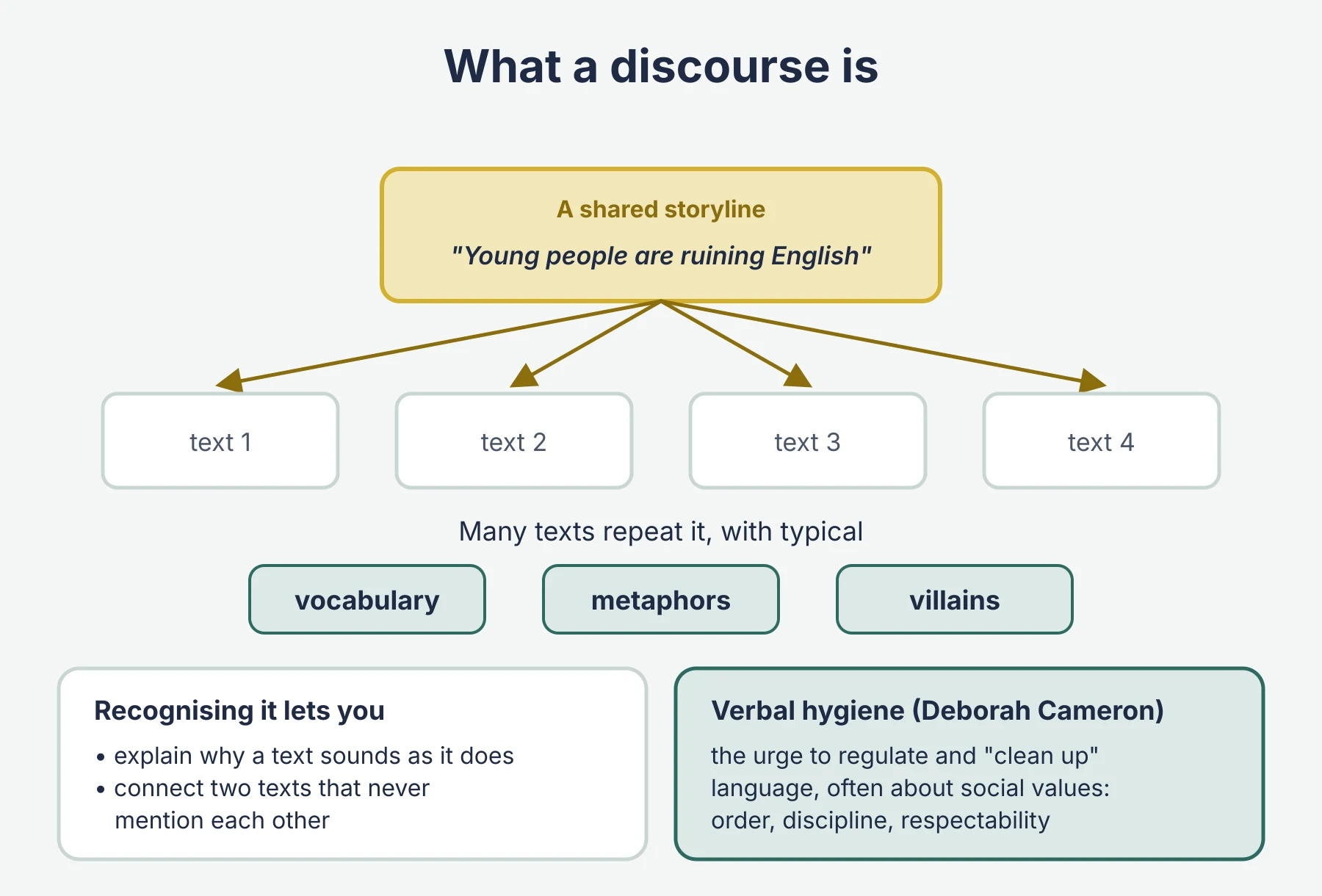
What a “discourse” is
In this content, a discourse is a recurring, socially shared way of talking about a topic that carries assumptions and values. “Young people are ruining English” is not one writer’s idea: it is a familiar storyline that many texts repeat, with typical vocabulary, metaphors and villains. Recognising the discourse lets you explain why a text sounds the way it does, and lets you connect two texts that never mention each other.
Deborah Cameron’s term verbal hygiene describes the widespread urge to regulate and “clean up” language, which she argues is often about social values (order, discipline, respectability) as much as about language itself.
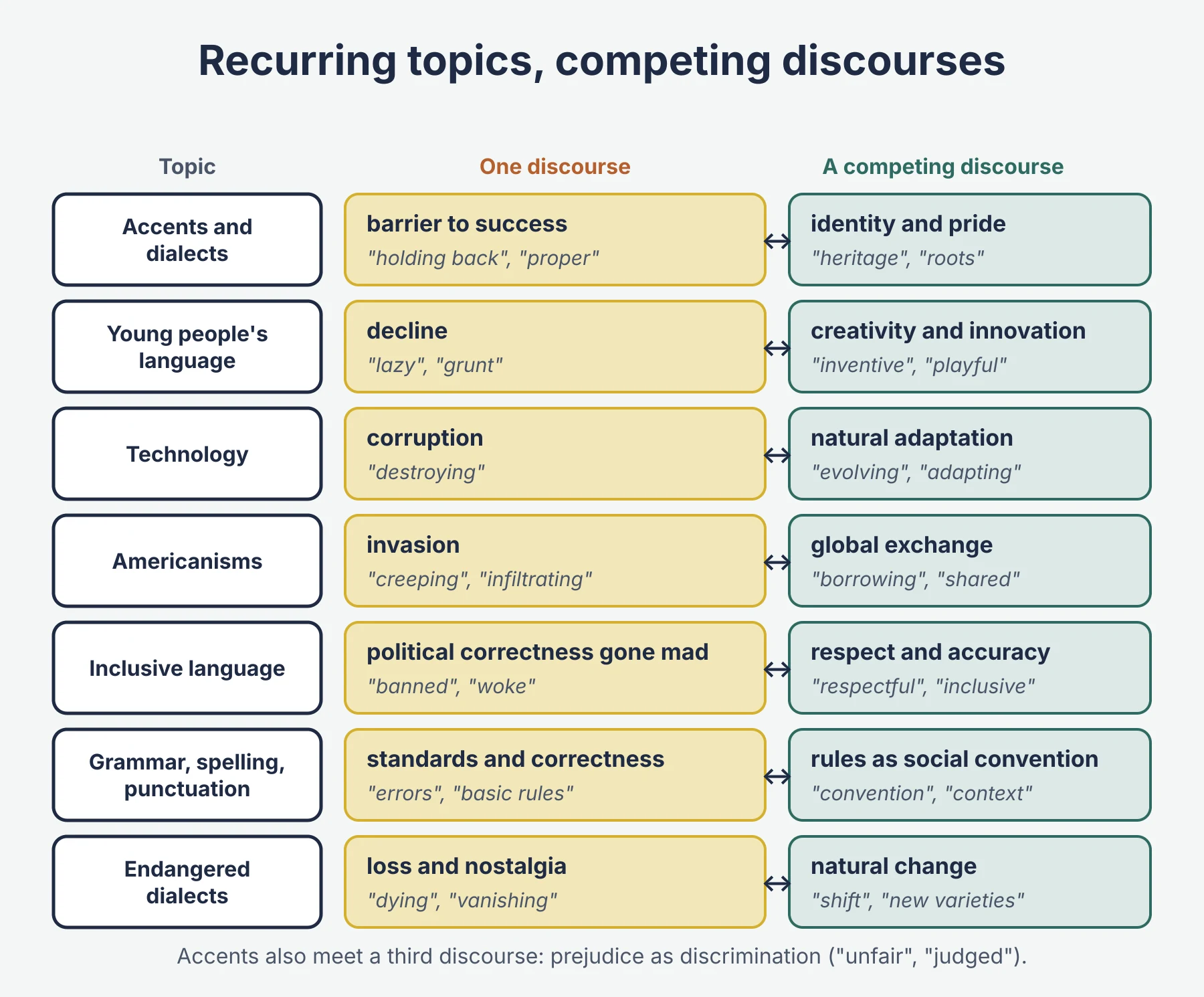
Recurring topics and the discourses around them
| Topic | Discourses you may meet | Typical language |
|---|---|---|
| Accents and dialects | Accent as barrier to success; accent as identity and pride; accent prejudice as discrimination | “holding back”, “proper”; “heritage”, “roots”; “unfair”, “judged” |
| Young people’s language | Decline; creativity and innovation | “lazy”, “grunt”; “inventive”, “playful” |
| Technology and language | Corruption; natural adaptation to a new mode | “destroying”; “evolving”, “adapting” |
| Americanisms | Invasion of British English; global exchange | “creeping”, “infiltrating”; “borrowing”, “shared” |
| Inclusive and gender-neutral language | Political correctness gone mad; respect and accuracy | “banned”, “woke”; “respectful”, “inclusive” |
| Grammar, spelling, punctuation | Standards and correctness; rules as social convention | “errors”, “basic rules”; “convention”, “context” |
| Endangered dialects and languages | Loss and nostalgia; natural change | “dying”, “vanishing”; “shift”, “new varieties” |
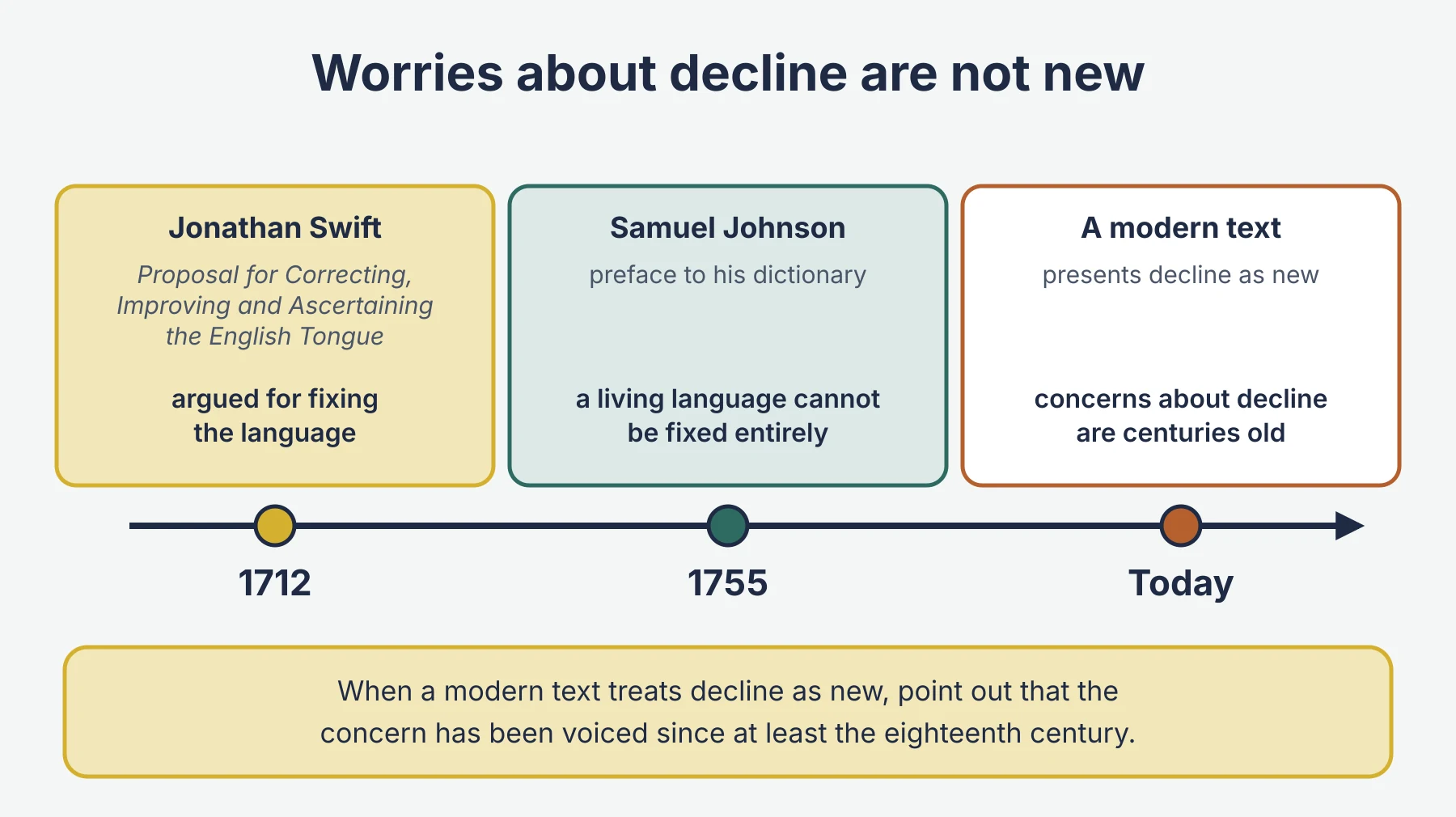
Texts from earlier centuries can join these debates too. Jonathan Swift’s Proposal for Correcting, Improving and Ascertaining the English Tongue (1712) argued for fixing the language, while the preface to Samuel Johnson’s dictionary (1755) accepted that a living language cannot be fixed entirely. Concerns about decline are therefore centuries old, a point worth making when a modern text presents them as new.
Going deeper on the four questions
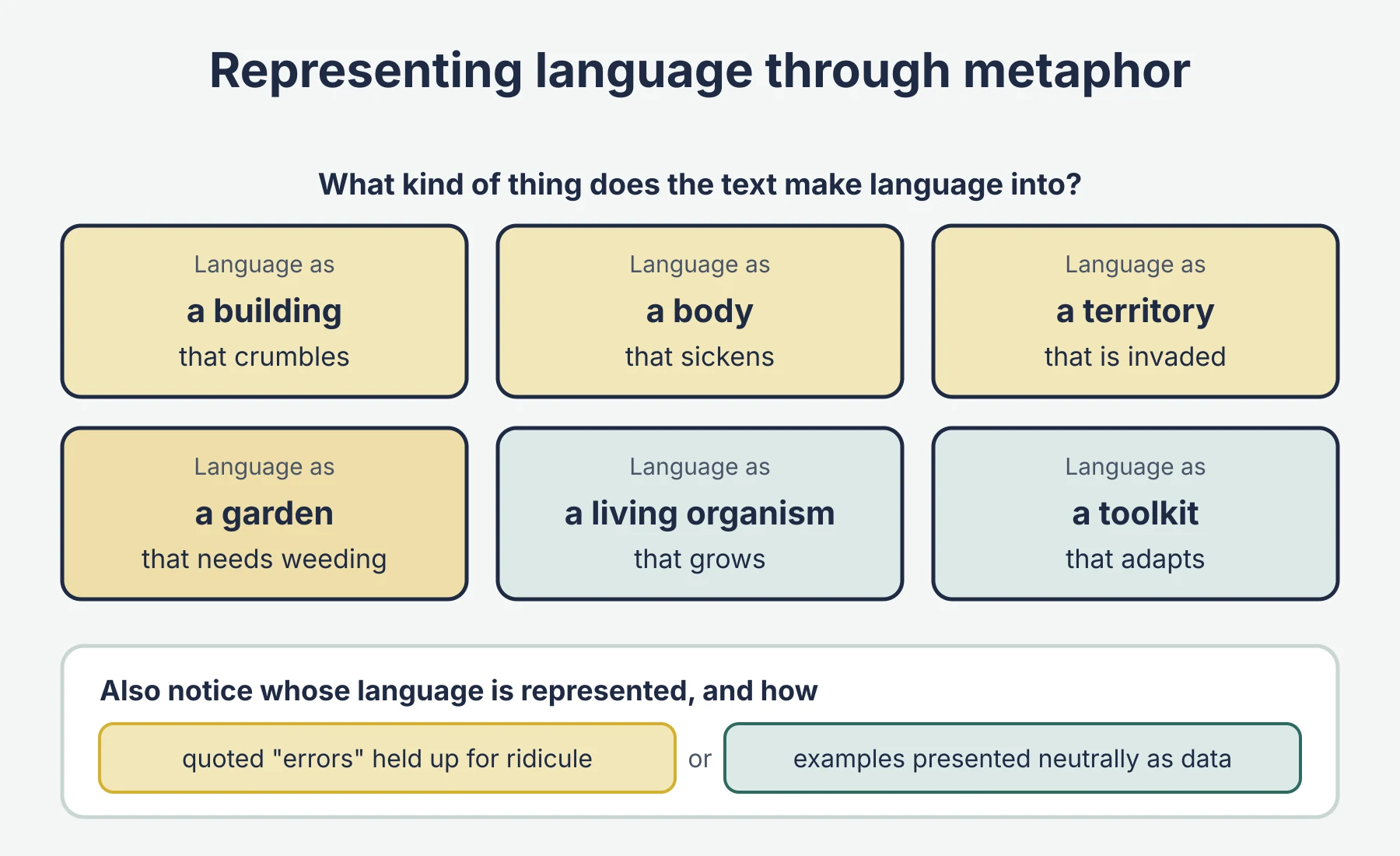
Representing language. Ask what kind of thing the text makes language into. Metaphors are the quickest clue: a building that crumbles, a body that sickens, a territory invaded, a garden that needs weeding, a living organism that grows, a toolkit that adapts. Also notice whose language is represented, and how: quoted “errors” held up for ridicule, or examples presented neutrally as data.
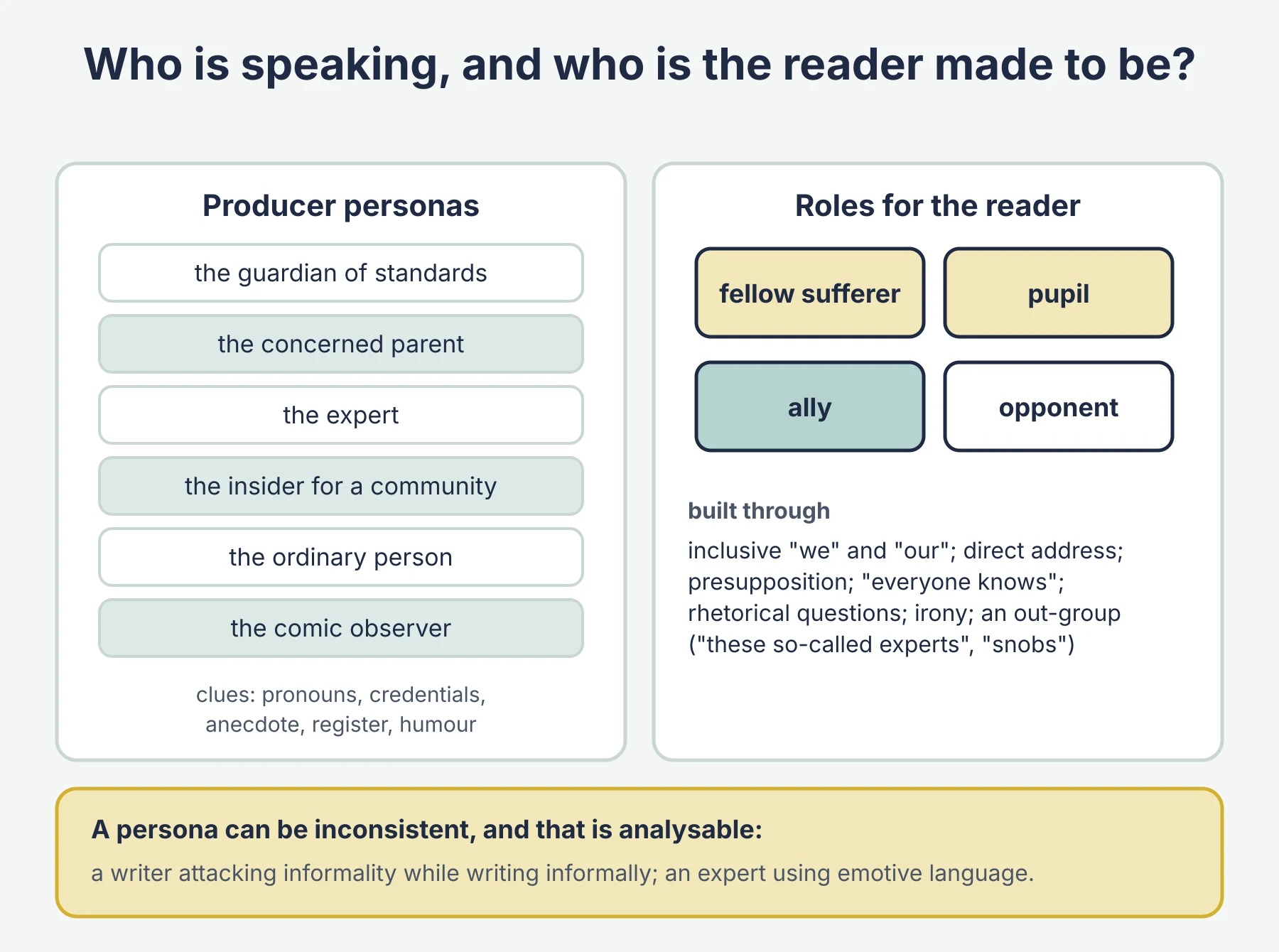
Constructing the producer’s identity. Common personas: the guardian of standards, the concerned parent, the expert, the insider speaking for a community, the ordinary person, the comic observer. Look at first-person pronouns, credentials, anecdotes, register and humour. A persona can be inconsistent: a writer attacking informality while writing informally, or an expert who uses emotive language. Inconsistency is analysable.
Positioning the reader. Inclusive “we” and “our”; direct address; presupposition (“the decline of grammar”); appeals to common sense (“everyone knows”); rhetorical questions; irony that invites the reader to share a joke at someone’s expense; the construction of an out-group (“these so-called experts”, “snobs”). Ask what role the reader is given: fellow sufferer, pupil, ally, opponent.
Connecting to discourses. Name the discourse, then show the specific features that reproduce or challenge it. A text may draw on more than one discourse, or quote a discourse in order to attack it.
Context still matters
Note genre and publication (a broadsheet column, a tabloid editorial, a blog, a speech, a book extract), the date, the intended audience and the purpose. The same view expressed in a satirical column and in a government report works through very different language.
Worked example: two texts on accents
Both texts are original, written for this page.
Text 1 (opinion column):
“Let’s be honest: a broad regional accent is a handicap in the job market. Employers want polished, professional communicators, and schools do pupils no favours by pretending otherwise. Teach them to speak properly, and you open doors.”
Text 2 (personal blog):
“At my first interview, the panel smiled when I said ‘bath’ with a short vowel. Nobody said anything. They didn’t need to. I’ve got two degrees and the same accent as my nan, and I’m not ashamed of either. The problem isn’t how we talk. It’s how some people listen.”
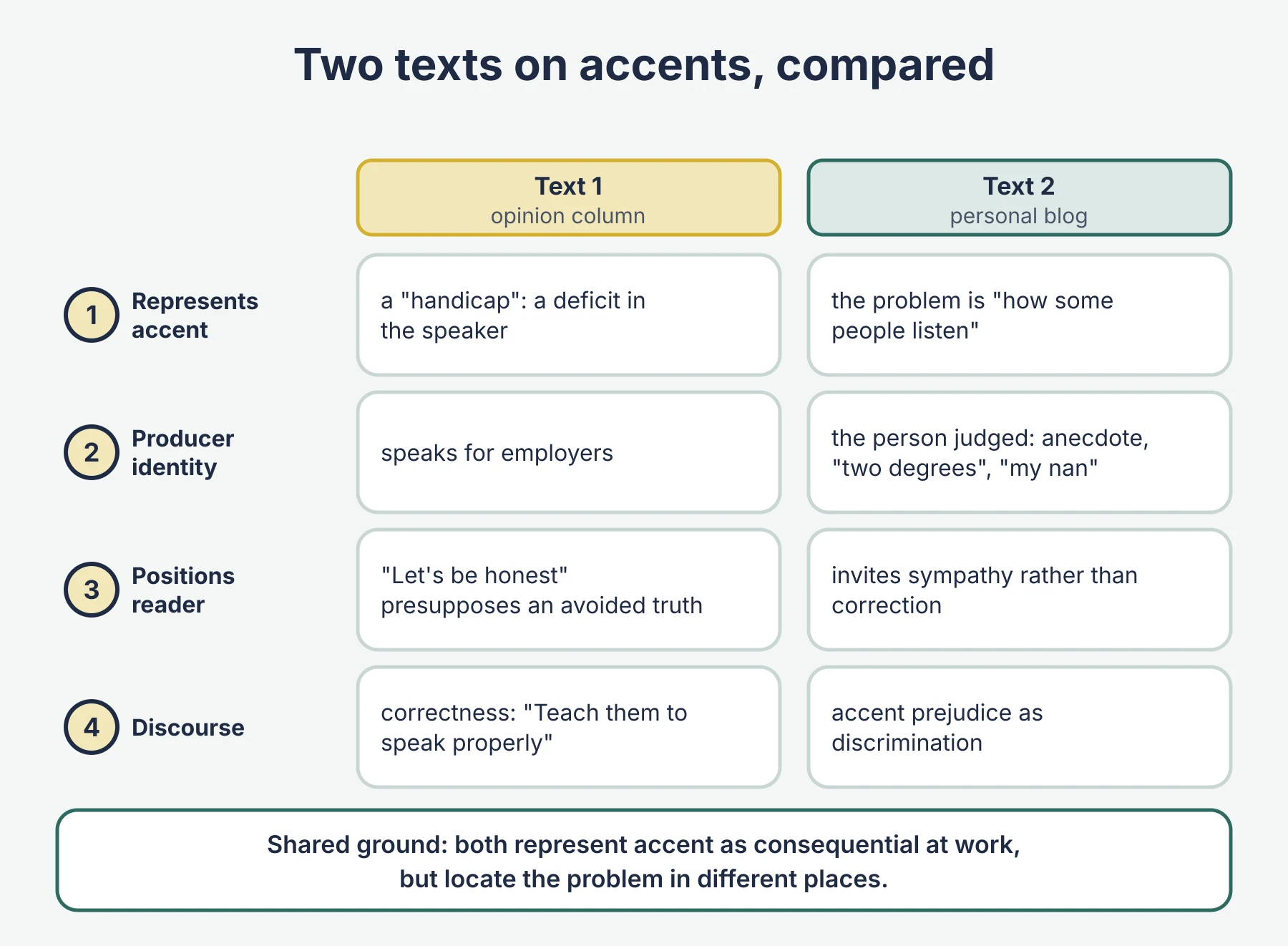
Comparative paragraph. Both texts represent accent as consequential at work, but they locate the problem in different places. Text 1 represents a regional accent through the metaphor of a “handicap”, a deficit belonging to the speaker, and positions the reader through the discourse marker “Let’s be honest”, which presupposes that its view is a truth others avoid. Its imperative “Teach them to speak properly” reproduces a correctness discourse in which one accent is “proper”. Text 2 relocates the problem to the listener: the parallel declaratives “The problem isn’t how we talk. It’s how some people listen” reverse the deficit, drawing on a discourse of accent prejudice as discrimination. Its producer identity is built through personal anecdote and credentials (“two degrees”), and “my nan” ties the accent to family and belonging, inviting sympathy rather than correction. Where Text 1 speaks for employers, Text 2 speaks as the person judged.
This paragraph compares throughout, quotes briefly, names features, and links each to representation, identity, positioning and discourse.
Building the comparison from the four questions
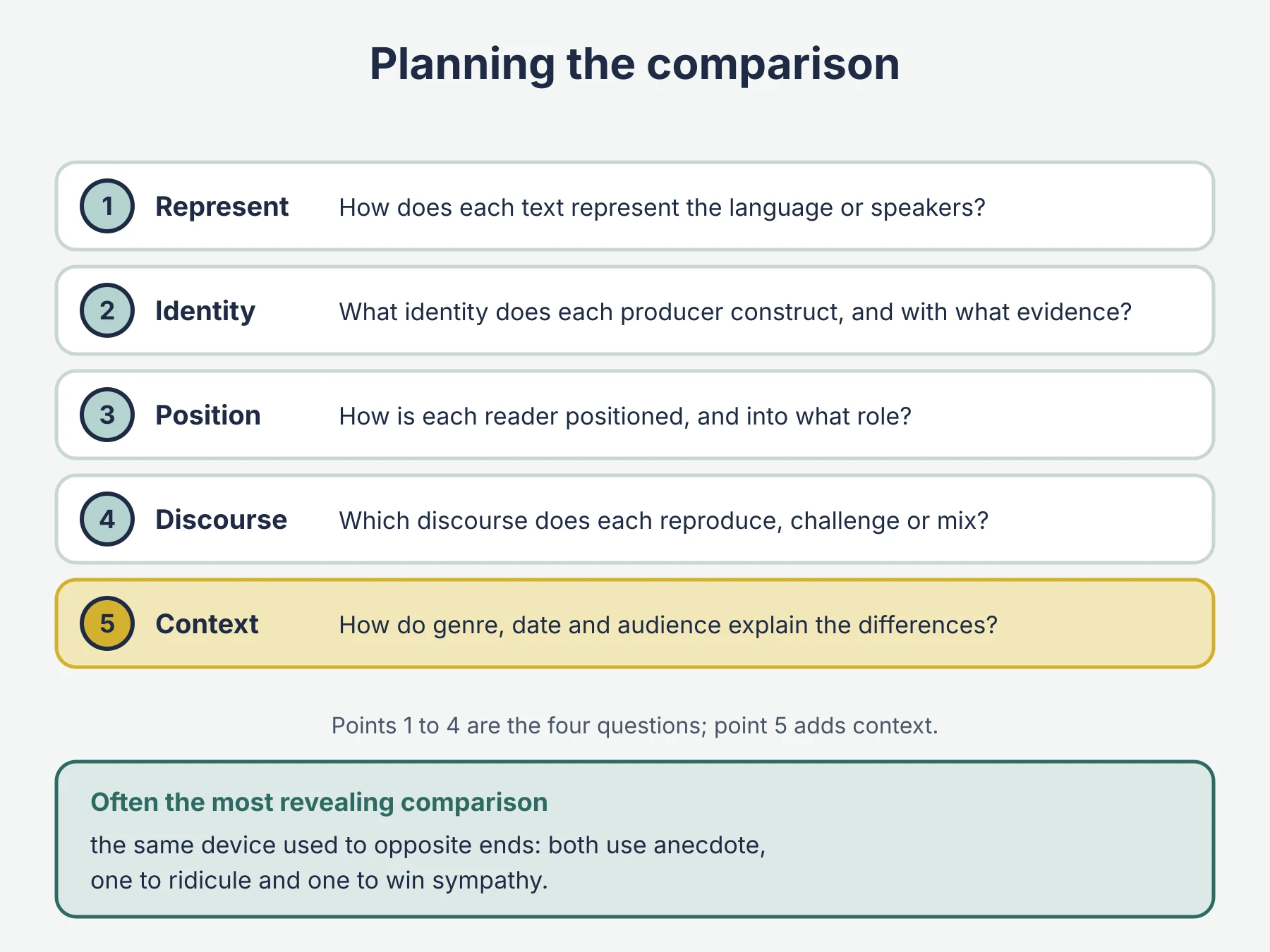
A reliable plan uses the four questions as comparison points, then adds a fifth on context:
Point 1  How does each text represent the language or speakers?
Point 2  What identity does each producer construct, and with what evidence?
Point 3  How is each reader positioned, and into what role?
Point 4  Which discourse does each reproduce, challenge or mix?
Point 5  How do genre, date and audience explain the differences?
Not every point needs equal space. If both texts use the same device to opposite ends (for example, both use anecdote, one to ridicule and one to win sympathy), that shared device is often the most revealing comparison.
Exam technique
- Analyse how the texts use language to present ideas, attitudes and opinions: the focus is the how, not whether you agree.
- Plan three or four comparison points before writing, drawn from the four questions.
- Use context (genre, date, audience) to explain differences.
- Use linguistic knowledge to evaluate claims only where it illuminates the texts’ methods.
Common mistakes
- Arguing with the texts instead of analysing them.
- Summarising content paragraph by paragraph.
- Naming a discourse without showing the language that carries it.
- Treating “prescriptive” and “descriptive” as the only labels available.
- Ignoring humour, irony or persona inconsistency.
Where to go next
- Language discourses revision notes
- Language discourses practice questions
- Writing skills study guide
Official syllabus
AQA AS and A-level English Language (7701/7702) specification, A-level subject content 3.2.3 Language discourses, assessed in Paper 2 Section B.
Section numbers. This site follows the A-level (7702) subject content on aqa.org.uk, where Paper 2 content is 3.2. The combined AS and A-level specification PDF numbers the same A-level sections 4.1, 4.2 and 4.3.
Related resources
-
Practice questions
AQA A-Level English Language (7702): Language Discourses – Practice Questions
Original practice analysing and comparing texts about Americanisms: representation, persona, positioning and discourse, for AQA A-level English Language 7702.
English · AQA · A Level
Try questions -
Revision notes
AQA A-Level English Language (7702): Language Discourses – Revision Notes
Recall notes on discourses about language, personas, reader positioning and comparing two texts, for AQA A-level English Language 7702 Paper 2 Section B.
English · AQA · A Level
Revise topic -
Study guides
AQA A-Level English Language (7702): Writing Skills
The three Paper 2 writing skills: academic essay, analytical writing and directed writing for non-specialists, with worked examples. AQA 7702 3.2.4.
English · AQA · A Level
Read guide
Get free revision emails (optional)
Occasional emails with practice questions, worked explanations and links to free resources for the qualification and subjects you choose. No spam, and you can unsubscribe from any email. The free tools on this site never need an email.