
Study Guides
AQA A-Level English Language (7702): Writing Skills
The three Paper 2 writing skills: academic essay, analytical writing and directed writing for non-specialists, with worked examples. AQA 7702 3.2.4.
- Subject
- English
- Level
- A LEVELS
- Topic
- Paper 2 – Language Diversity and Change
- Author
- Marlbridge Academic Team
- Updated
- Reviewed by
- Ammar Bilal (what this means)
Aligned to AQA A Level English (7702), For first teaching 2015. Official specification .
Syllabus page (what it covers and how it is assessed): AQA A Level English Language.
Found an error? Report a correction.
Need help with this topic? Request a free trial class for A Level English Language (7702).
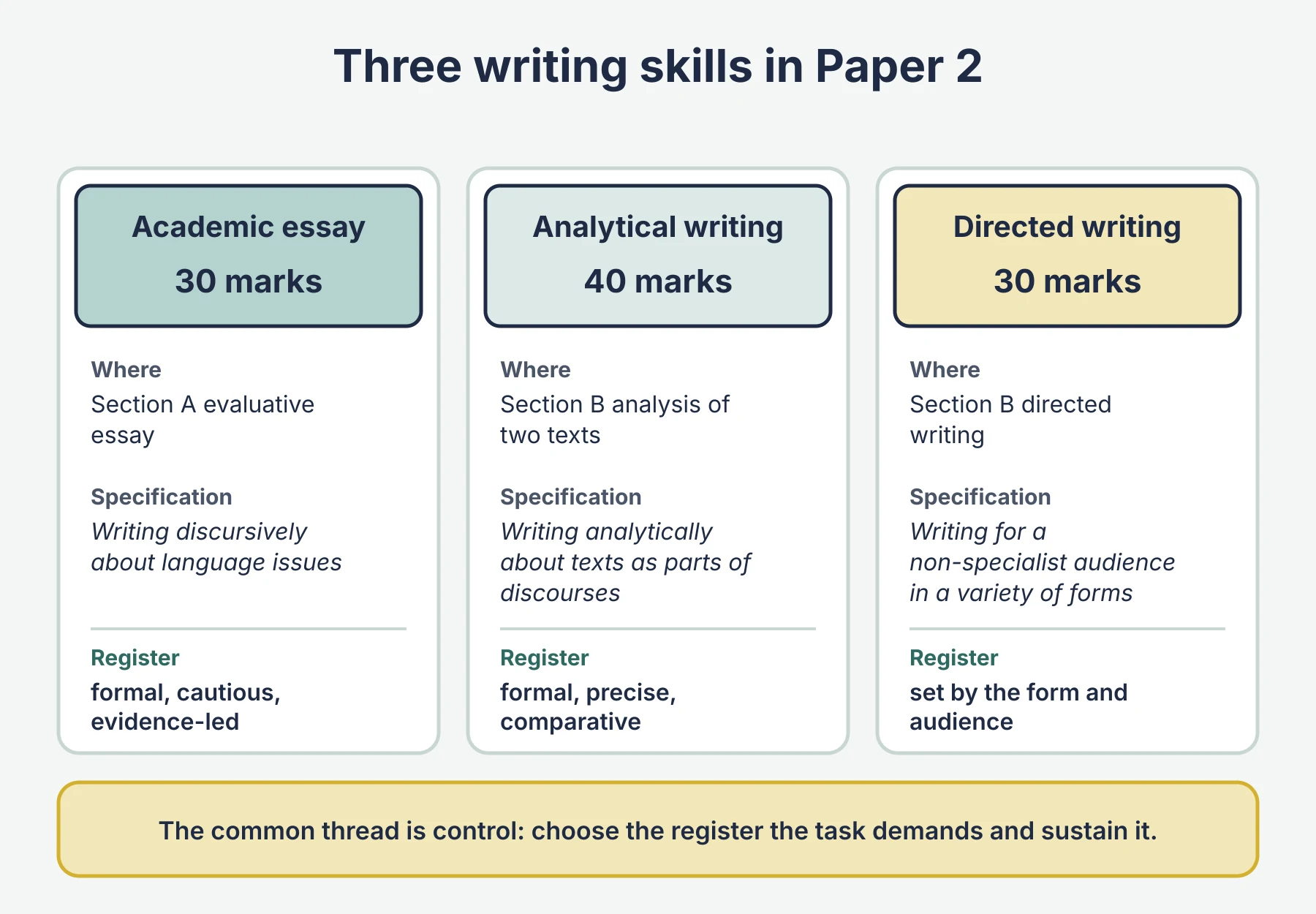
This guide covers 3.2.4 Writing skills in AQA A-level English Language (7702). Paper 2 asks you to write in three different ways, and each has its own register, structure and success criteria. The Paper 2 language discourses and writing guide summarises the directed writing task; this page teaches the craft behind all three skills, sentence by sentence.
The three skills in the specification
| Skill (specification wording) | Where it is used | Register |
|---|---|---|
| Writing discursively about language issues in an academic essay | Section A evaluative essay (30 marks) | Formal, cautious, evidence-led |
| Writing analytically about texts as parts of discourses about language | Section B analysis of two texts (40 marks) | Formal, precise, comparative |
| Writing about language issues in a variety of forms to communicate ideas to a non-specialist audience | Section B directed writing (30 marks) | Set by the form and audience in the task |
The common thread is control: choosing the register that the task demands and sustaining it.
Skill 1: the academic essay
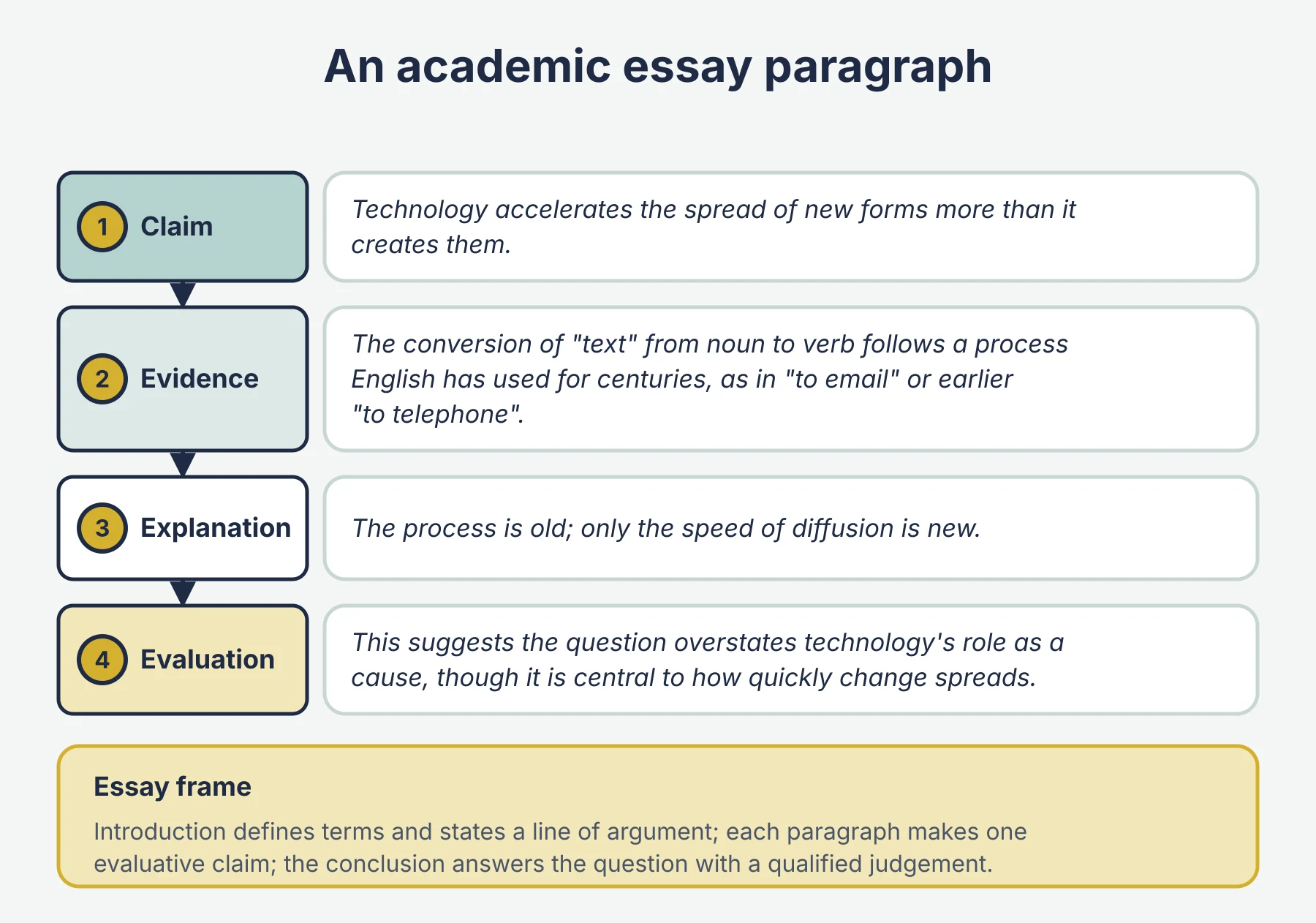
Structure. An introduction that defines the terms of the question and states a line of argument; paragraphs that each make one evaluative claim; a conclusion that answers the question with a qualified judgement.
Paragraph pattern. Claim, evidence, explanation, evaluation:
Claim        Technology accelerates the spread of new forms more than it creates them.
Evidence     The conversion of "text" from noun to verb follows a process English has
             used for centuries, as in "to email" or earlier "to telephone".
Explanation  The process is old; only the speed of diffusion is new.
Evaluation   This suggests the question overstates technology's role as a cause,
             though it is central to how quickly change spreads.
Academic register features:
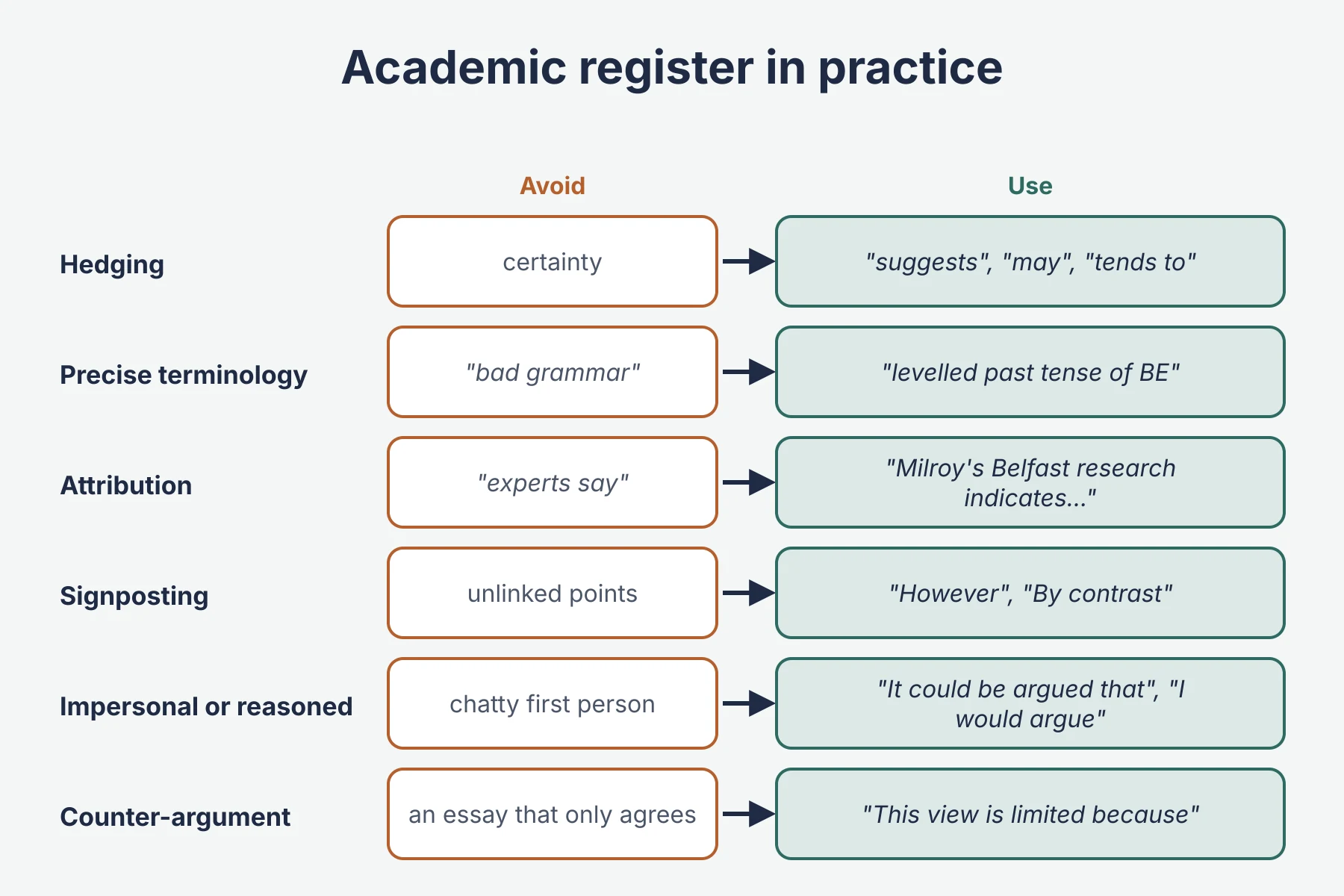
- Hedging: “suggests”, “may”, “tends to”, “in many contexts”. Linguistics rarely deals in certainties.
- Precise terminology: “levelled past tense of BE” rather than “bad grammar”.
- Attribution: “Milroy’s Belfast research indicates…” rather than “experts say”.
- Signposting: “However”, “By contrast”, “This view is limited because”.
- Impersonal construction: “It could be argued that” or a direct, reasoned “I would argue”, but not chatty first person.
- Counter-argument: an essay that only agrees is not evaluating.
Skill 2: analytical writing about texts
Analytical writing about Section B texts treats each text as a contribution to a discourse. Each paragraph should say what a text does, how its language does it, and why, in context.
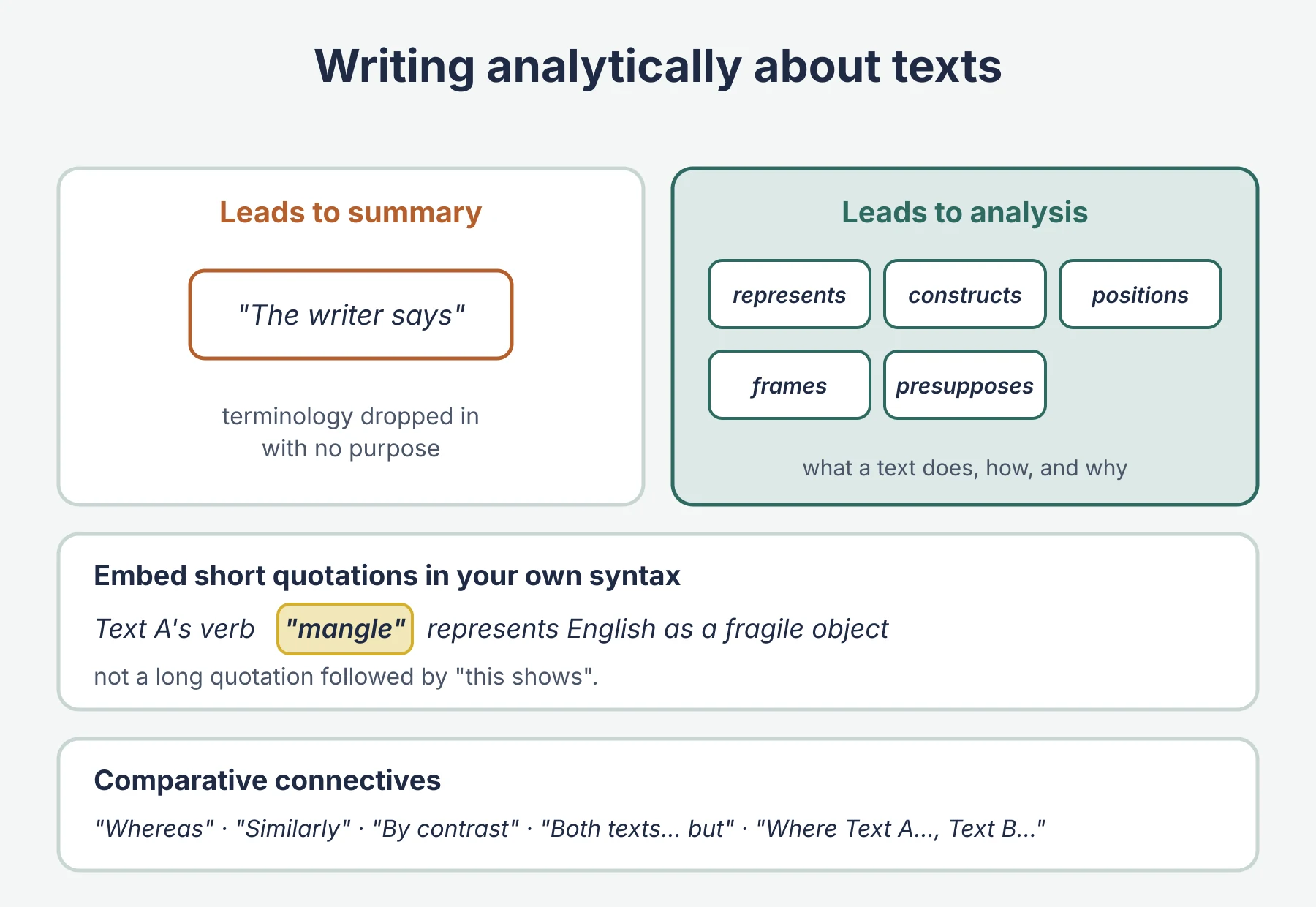
Embedding quotations. Weave short quotations into your own syntax: Text A’s verb “mangle” represents English as a fragile object, not a long quotation followed by “this shows”.
Comparative connectives. “Whereas”, “Similarly”, “By contrast”, “Both texts… but”, “Where Text A…, Text B…”.
Avoid summary verbs. “The writer says” leads to summary; “The writer represents”, “constructs”, “positions”, “frames”, “presupposes” lead to analysis.
Terminology with purpose. Name the feature, then explain its contribution to meaning; terminology alone earns little.
Skill 3: writing for a non-specialist audience
The directed writing task names a form (for example an article, blog, speech, letter or the script of a talk), an audience and a purpose. Your piece must carry accurate linguistic ideas, but in a voice the audience will read.
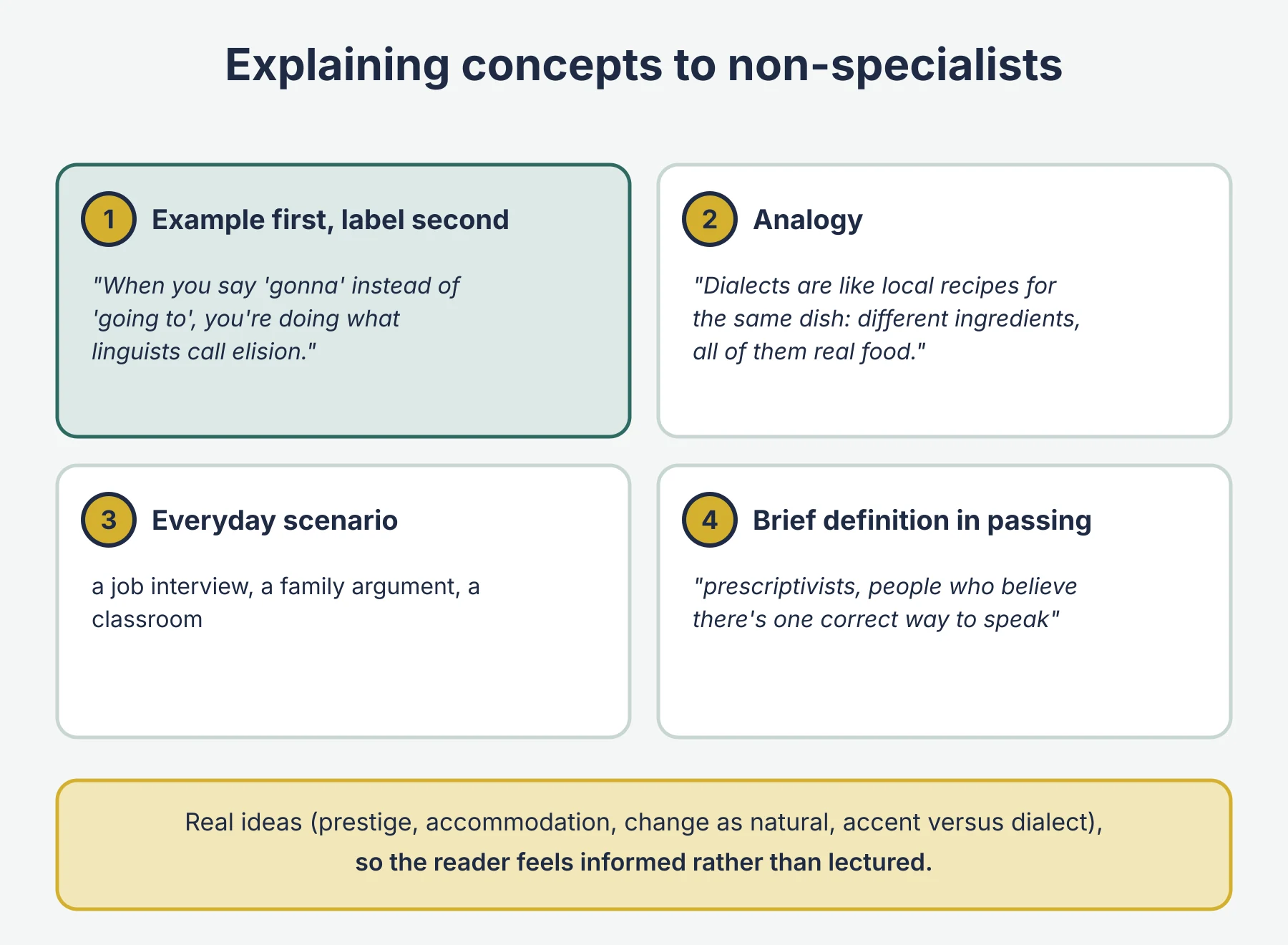
Explaining concepts accessibly. Four techniques:
- Example first, label second: “When you say ‘gonna’ instead of ‘going to’, you’re doing what linguists call elision: running sounds together.”
- Analogy: “Dialects are like local recipes for the same dish: different ingredients, all of them real food.”
- Everyday scenario: a job interview, a family argument, a classroom.
- Brief definition in passing: “prescriptivists, people who believe there’s one correct way to speak”.
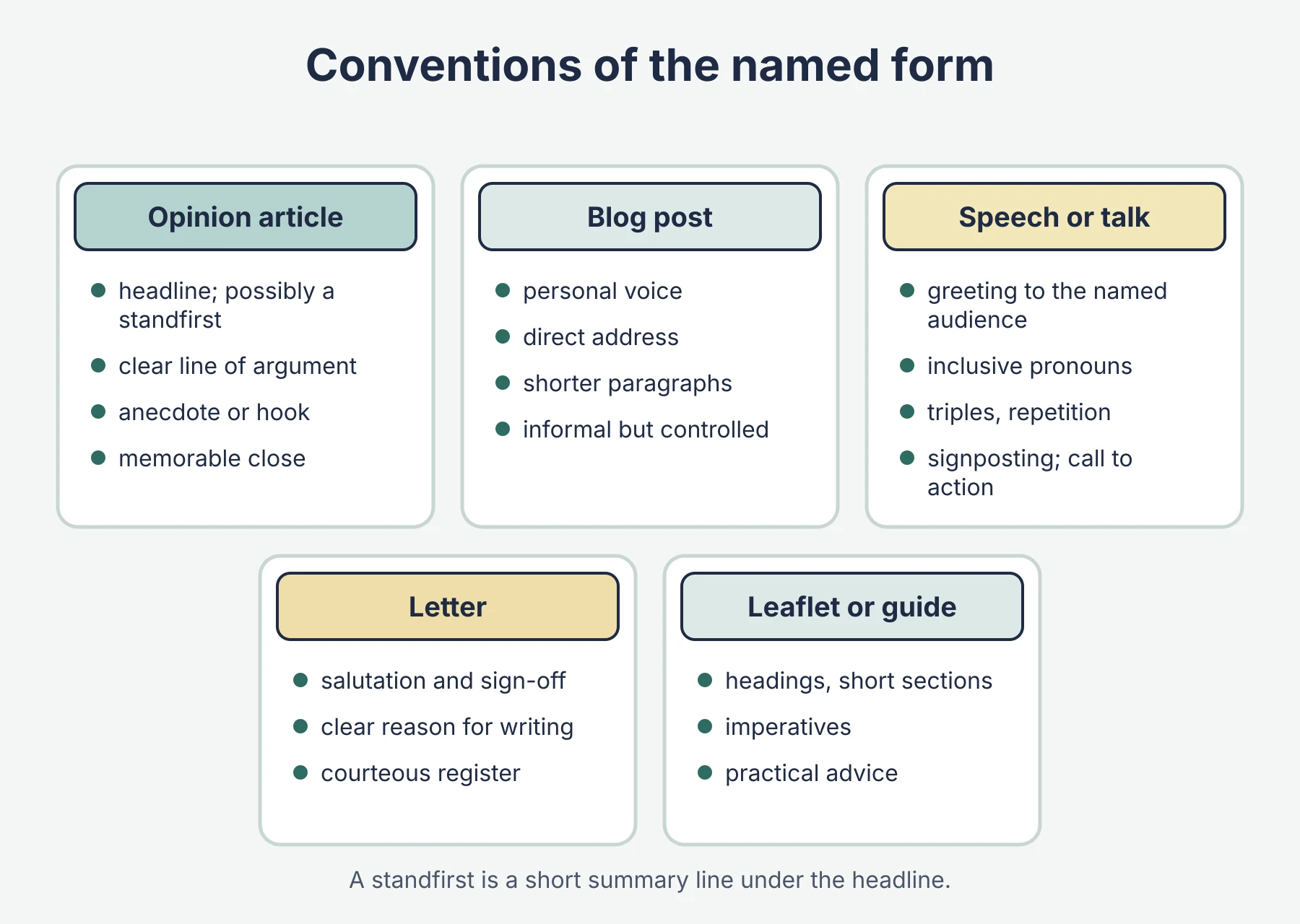
Form conventions.
| Form | Conventions to use |
|---|---|
| Opinion article | Headline, possibly a standfirst (a short summary line under the headline), clear line of argument, anecdote or hook, memorable close |
| Blog post | Personal voice, direct address, shorter paragraphs, informal but controlled register |
| Speech or talk | Greeting to the named audience, inclusive pronouns, rhetorical patterning (triples, repetition), signposting for listeners, call to action |
| Letter | Appropriate salutation and sign-off, a clear reason for writing, courteous register |
| Leaflet or guide | Headings, short sections, imperatives, practical advice |
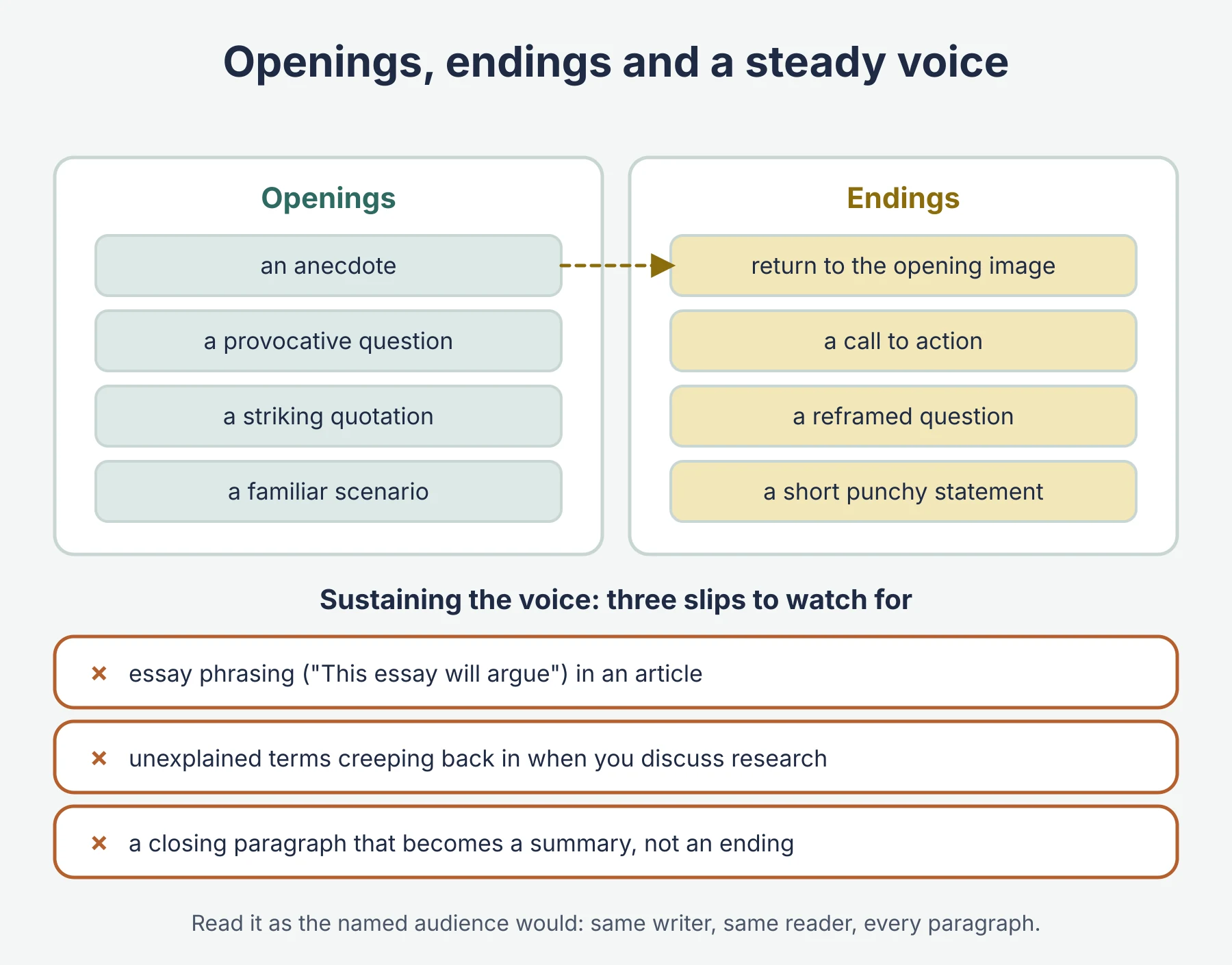
Crafting openings and endings. Openings: an anecdote, a provocative question, a striking quotation, a familiar scenario. Endings: return to the opening image, a call to action, a reframed question, a short punchy statement.
Using the source texts. Draw on their ideas, attribute or paraphrase them, and add your own linguistic knowledge. Do not lift whole sentences.
Sustaining the voice. Once you choose a register, keep it. Watch for three slips: a sudden switch into essay phrasing (“This essay will argue”) in an article; unexplained terms creeping back in when you discuss research; and a closing paragraph that becomes a summary rather than an ending. Read your piece as the named audience would, and ask whether every paragraph sounds as if the same writer is speaking to the same reader.
Showing linguistic understanding without jargon. The best directed writing still contains real ideas from language study (prestige, accommodation, change as natural, the difference between accent and dialect) but lets the reader feel informed rather than lectured.
Worked example: one idea, three ways
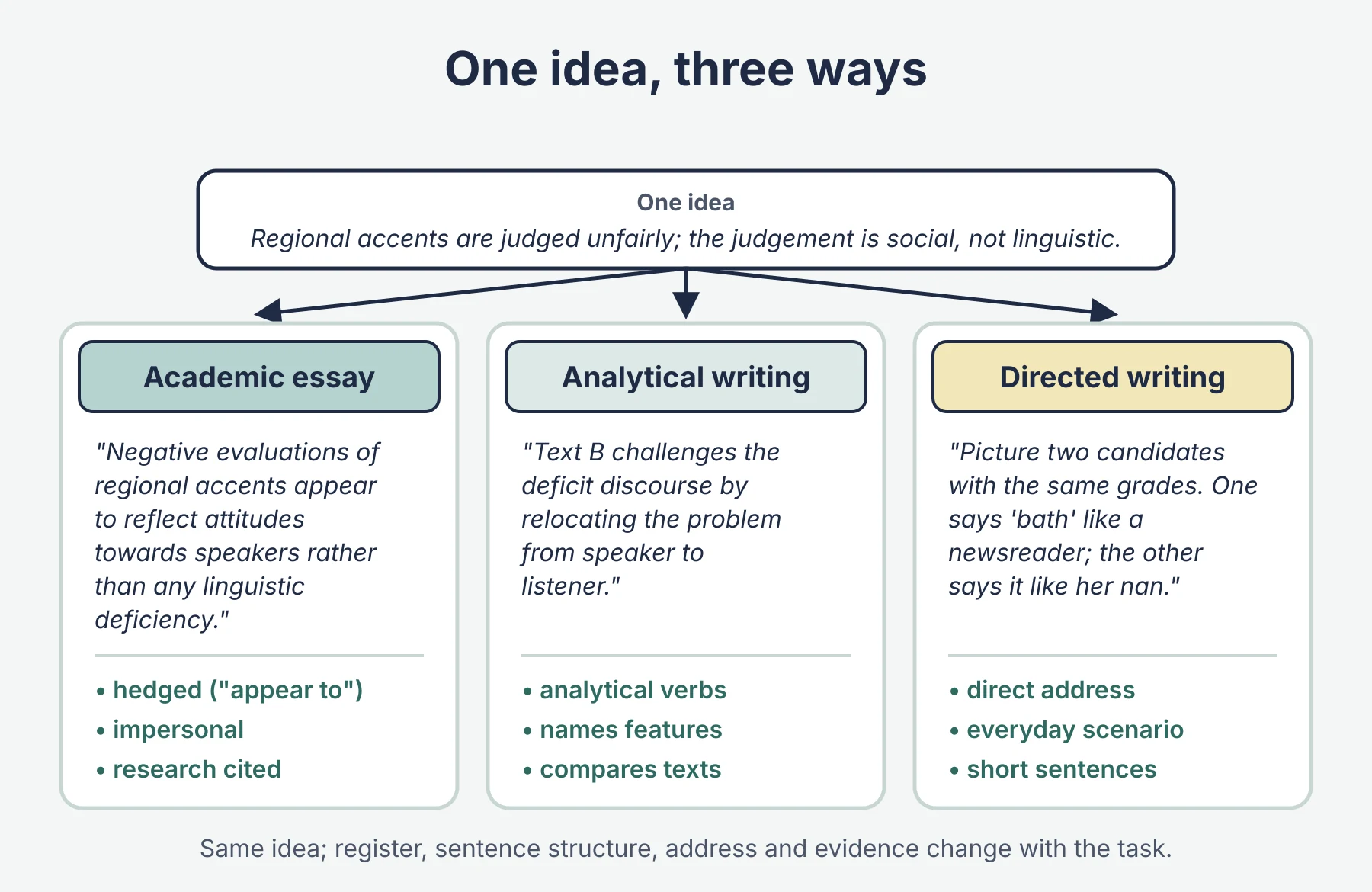
Idea: Regional accents are judged unfairly, and that judgement is social rather than linguistic.
Academic essay: Negative evaluations of regional accents appear to reflect attitudes towards speakers rather than any linguistic deficiency. Accents are equally systematic; the prestige of one over another is socially constructed, as research on overt and covert prestige suggests.
Analytical writing: Text B challenges the deficit discourse by relocating the problem from speaker to listener: the parallel declaratives “The problem isn’t how we talk. It’s how some people listen” reverse the agency implied in Text A’s “handicap”.
Directed writing (school magazine article for parents): Picture two candidates with the same grades. One says “bath” like a newsreader; the other says it like her nan. If you think one sounds cleverer, you’re not hearing intelligence. You’re hearing a habit our society taught you, and habits can be unlearned.
Each version carries the same linguistic idea, but register, sentence structure, address and evidence change with the task.
Common mistakes
- Writing the Section A essay in a chatty register, or the directed writing in essay register.
- Using undefined jargon for non-specialists, or no linguistic content at all.
- Ignoring the named form (no headline for an article, no address for a speech).
- Copying phrases from the source texts.
- In analysis, “the writer says” summaries with terminology dropped in.
- Essays without counter-argument or conclusion.
Exam technique
- Underline form, audience and purpose in the directed writing task before planning.
- Plan the directed writing piece as a sequence of four or five ideas, each with an accessible example.
- Leave a few minutes to check accuracy: writing skill is part of what is assessed.
- For the essay, write the judgement in your plan first, so every paragraph builds towards it.
Where to go next
Official syllabus
AQA AS and A-level English Language (7701/7702) specification, A-level subject content 3.2.4 Writing skills, assessed across Paper 2.
Section numbers. This site follows the A-level (7702) subject content on aqa.org.uk, where Paper 2 content is 3.2. The combined AS and A-level specification PDF numbers the same A-level sections 4.1, 4.2 and 4.3.
Related resources
-
Practice questions
AQA A-Level English Language (7702): Writing Skills – Practice Questions
Original practice on academic, analytical and non-specialist writing about language issues, with model answers, for AQA A-level English Language 7702 Paper 2.
English · AQA · A Level
Try questions -
Revision notes
AQA A-Level English Language (7702): Writing Skills – Revision Notes
Recall notes on academic, analytical and non-specialist writing for AQA A-level English Language 7702 Paper 2: registers, form conventions and exam traps.
English · AQA · A Level
Revise topic -
Study guides
AQA A-Level English Language: Language Discourses, Methods and Writing Skills (7702)
AQA A-level English Language 7702 Paper 2 guide: methods of analysis for diversity and change, Section B language discourses analysis and directed writing.
English · AQA · A Level
Read guide
Get free revision emails (optional)
Occasional emails with practice questions, worked explanations and links to free resources for the qualification and subjects you choose. No spam, and you can unsubscribe from any email. The free tools on this site never need an email.