
Revision Notes
AQA A-Level English Language (7702): Writing Skills – Revision Notes
Recall notes on academic, analytical and non-specialist writing for AQA A-level English Language 7702 Paper 2: registers, form conventions and exam traps.
- Subject
- English
- Level
- A LEVELS
- Topic
- Paper 2 – Language Diversity and Change
- Author
- Marlbridge Academic Team
- Updated
- Reviewed by
- Ammar Bilal (what this means)
Aligned to AQA A Level English (7702), For first teaching 2015. Official specification .
Syllabus page (what it covers and how it is assessed): AQA A Level English Language.
Found an error? Report a correction.
Need help with this topic? Request a free trial class for A Level English Language (7702).
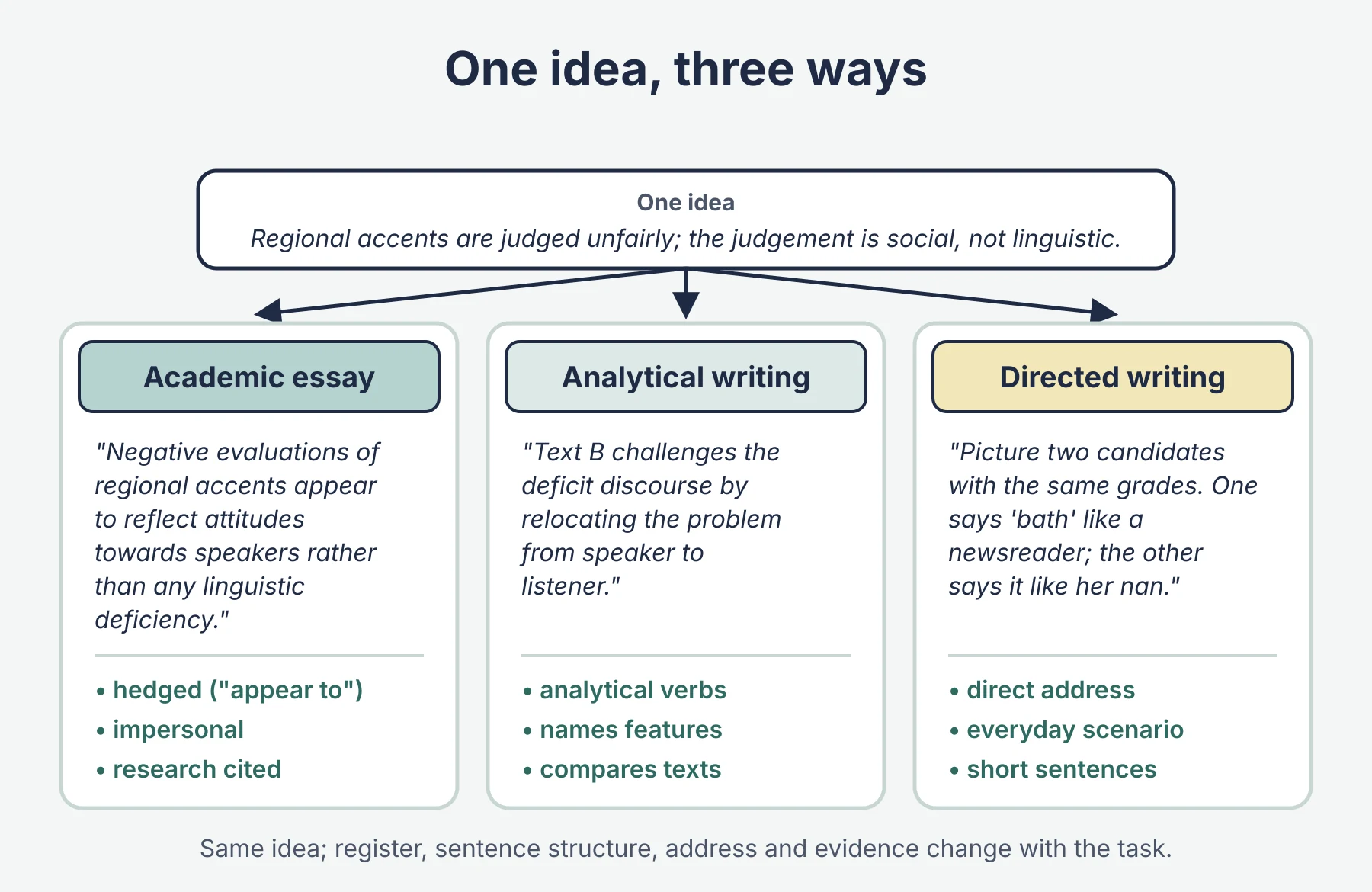
Condensed recall for 3.2.4 Writing skills in Paper 2 of AQA A-level English Language (7702). The full guide, with one idea written in three registers, is the writing skills study guide.
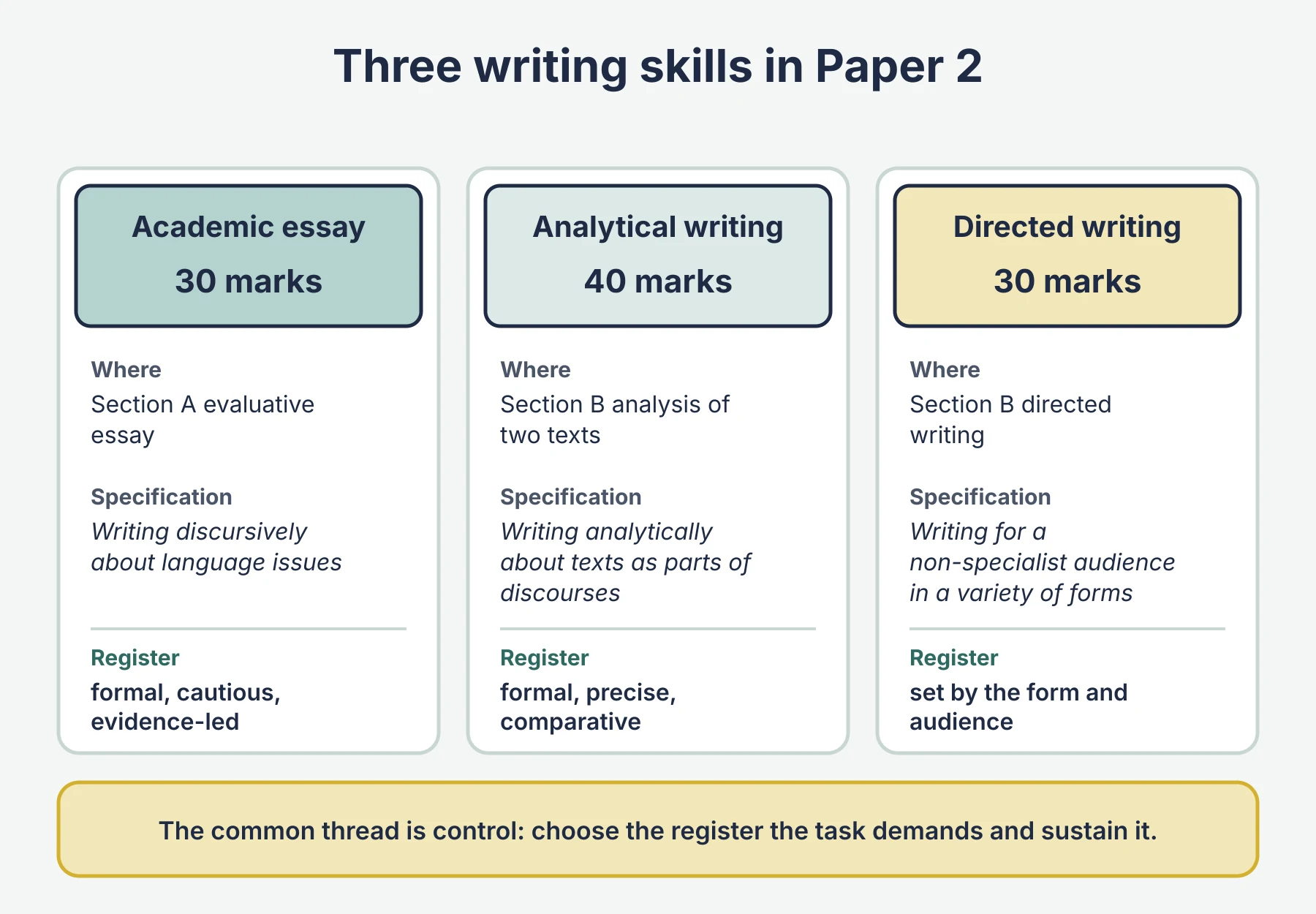
Three skills, three registers
| Skill | Task | Register | Success looks like |
|---|---|---|---|
| Academic essay (discursive) | Section A evaluative essay | Formal, hedged, evidence-led | A clear line of argument, weighed evidence, qualified judgement |
| Analytical writing | Section B analysis of two texts | Formal, precise, comparative | Features linked to representation, identity, positioning and discourse |
| Writing for non-specialists | Section B directed writing | Set by the form and audience | Accurate linguistic ideas made accessible in a well-crafted piece |
Key terms
| Term | Meaning |
|---|---|
| Discursive | Exploring an issue by weighing different views |
| Hedging | Language that qualifies claims (“suggests”, “may”, “often”) |
| Attribution | Credit to a named source (“Trudgill found…”) |
| Signposting | Phrases that guide the reader through an argument |
| Topic sentence | Opening sentence that states a paragraph’s claim |
| Embedded quotation | A short quotation built into your own sentence |
| Register | Language variety suited to audience, purpose and context |
| Form conventions | Expected features of a genre (headline, salutation, address) |
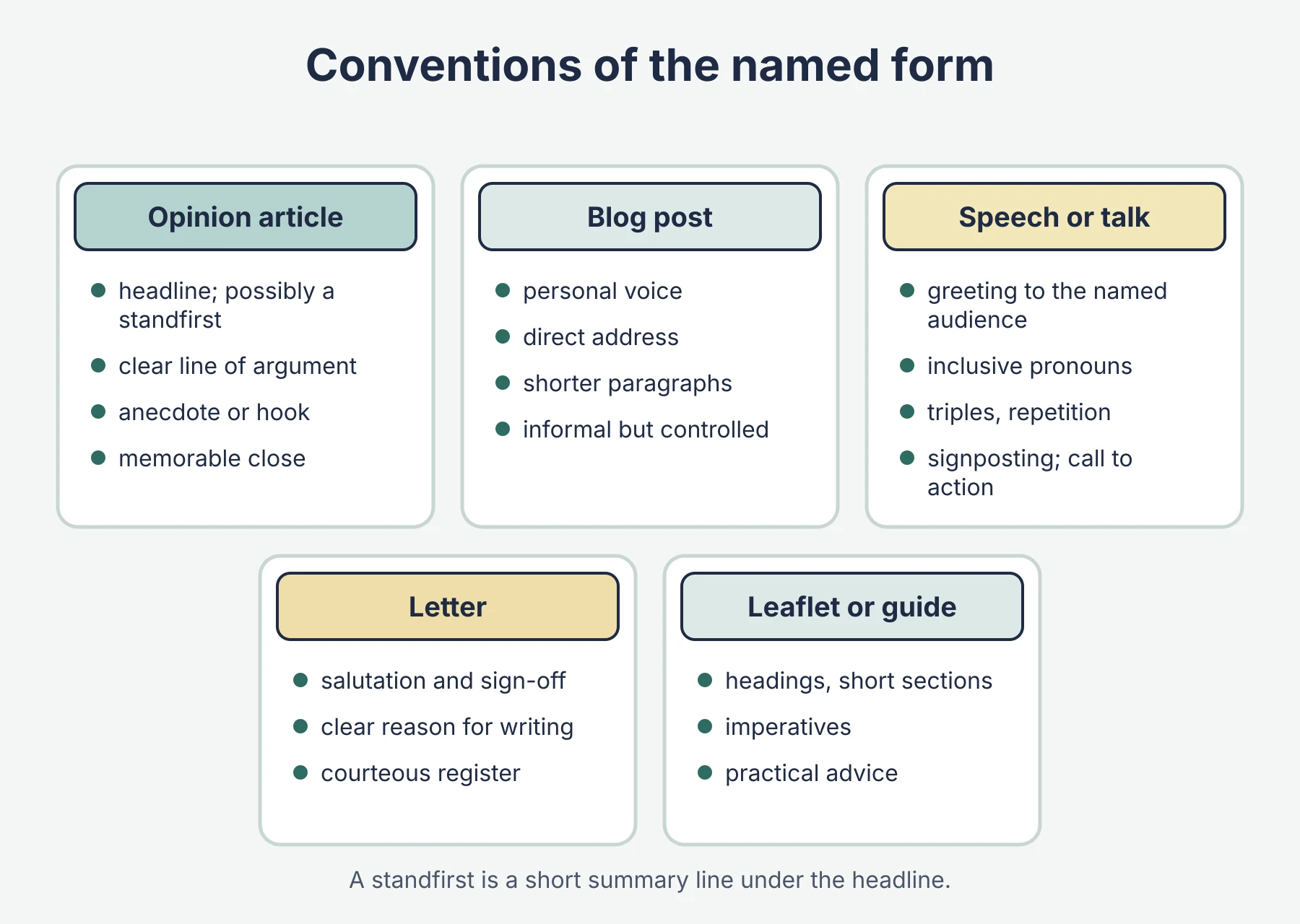
| Standfirst | A short summary line under an article headline |
| Non-specialist audience | Readers without training in linguistics |
Academic essay checklist
Introduction: define terms, state a line of argument
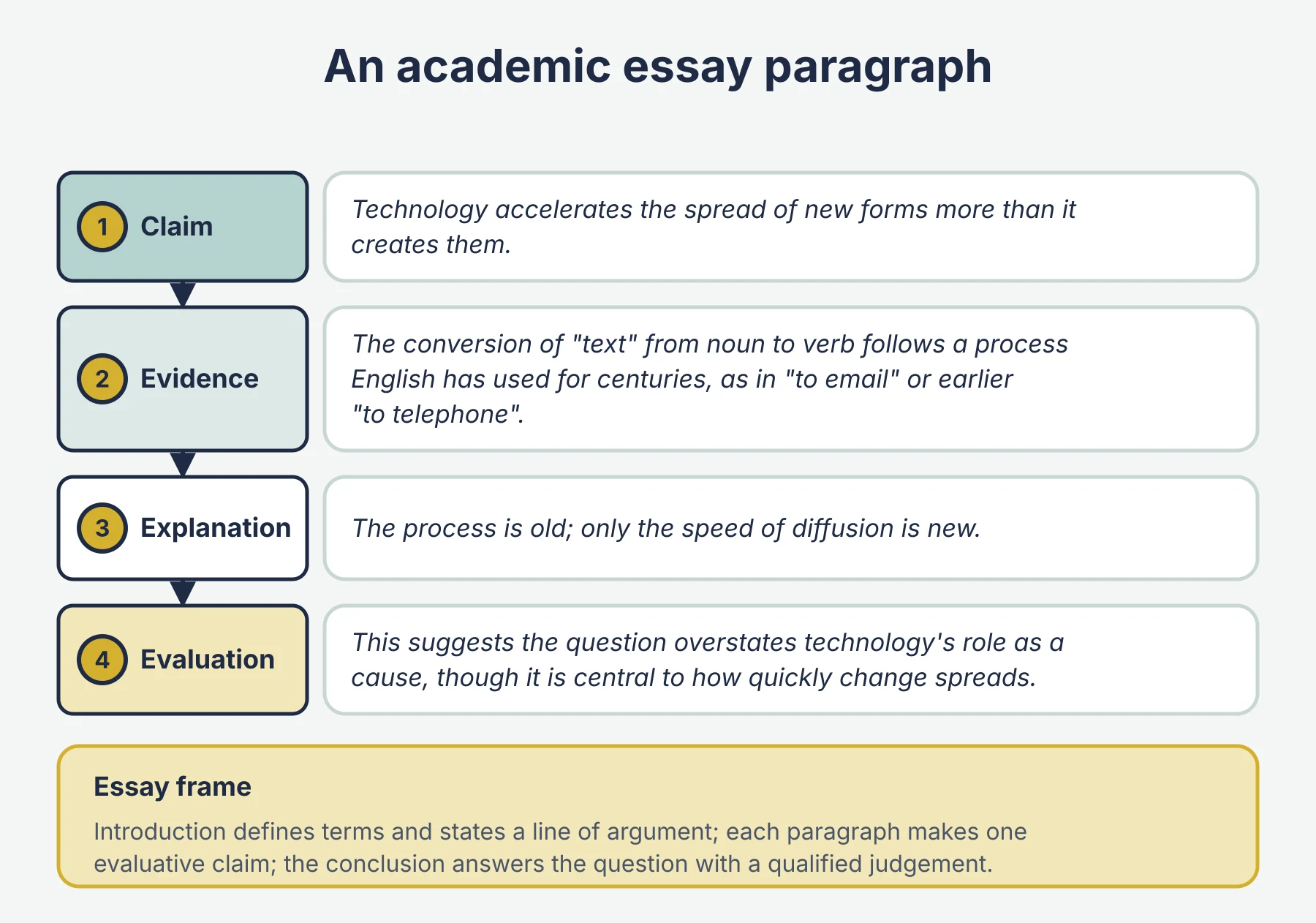
Each paragraph: claim -> evidence -> explanation -> evaluation
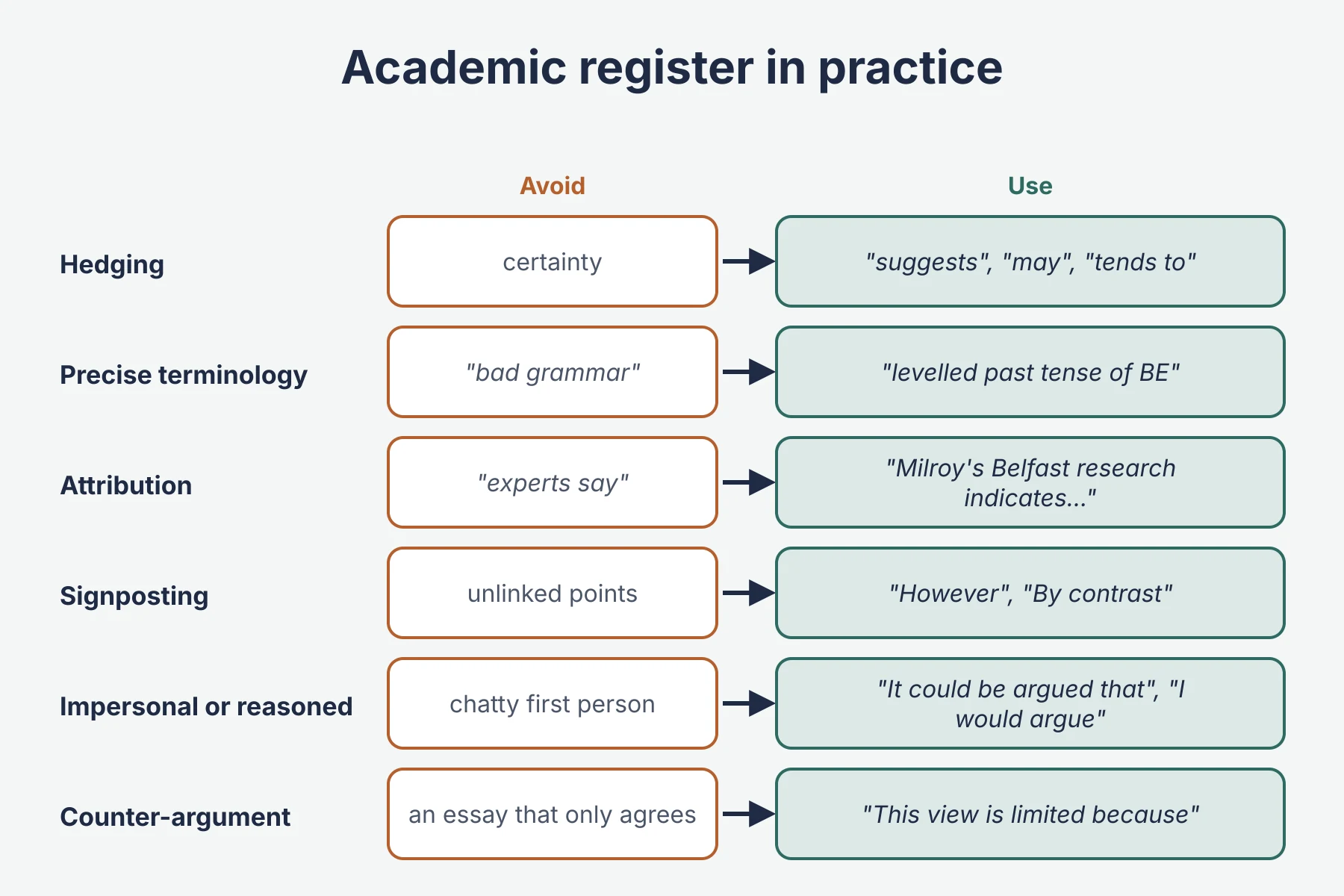
Hedge claims; attribute research; use precise terminology
Include counter-arguments
Conclusion: a qualified judgement that answers the question
Useful frames: “This view is persuasive in so far as…”, “However, it underestimates…”, “A more convincing explanation may be…”, “On balance…”.
Analytical writing checklist
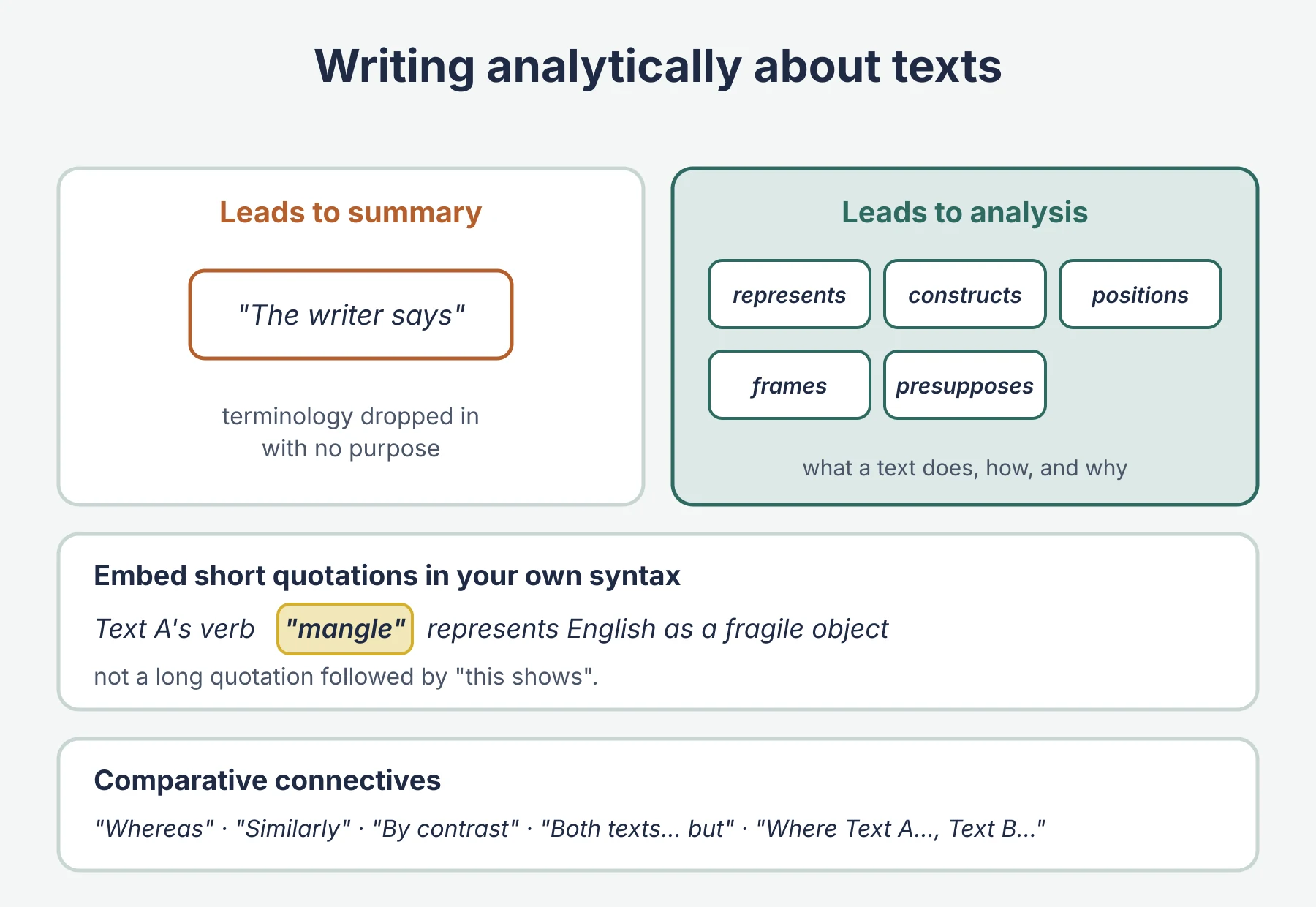
- Open each paragraph with a claim about what the text does, not what it says.
- Embed short quotations; name the feature; explain its effect; link to context and discourse.
- Use comparative connectives: “whereas”, “by contrast”, “similarly”, “both… but”.
- Prefer analytical verbs: represents, constructs, positions, frames, presupposes, challenges, reproduces.
Directed writing checklist
- Underline the form, audience and purpose.
- Decide your position.
- Plan four or five points from the texts plus your own knowledge.
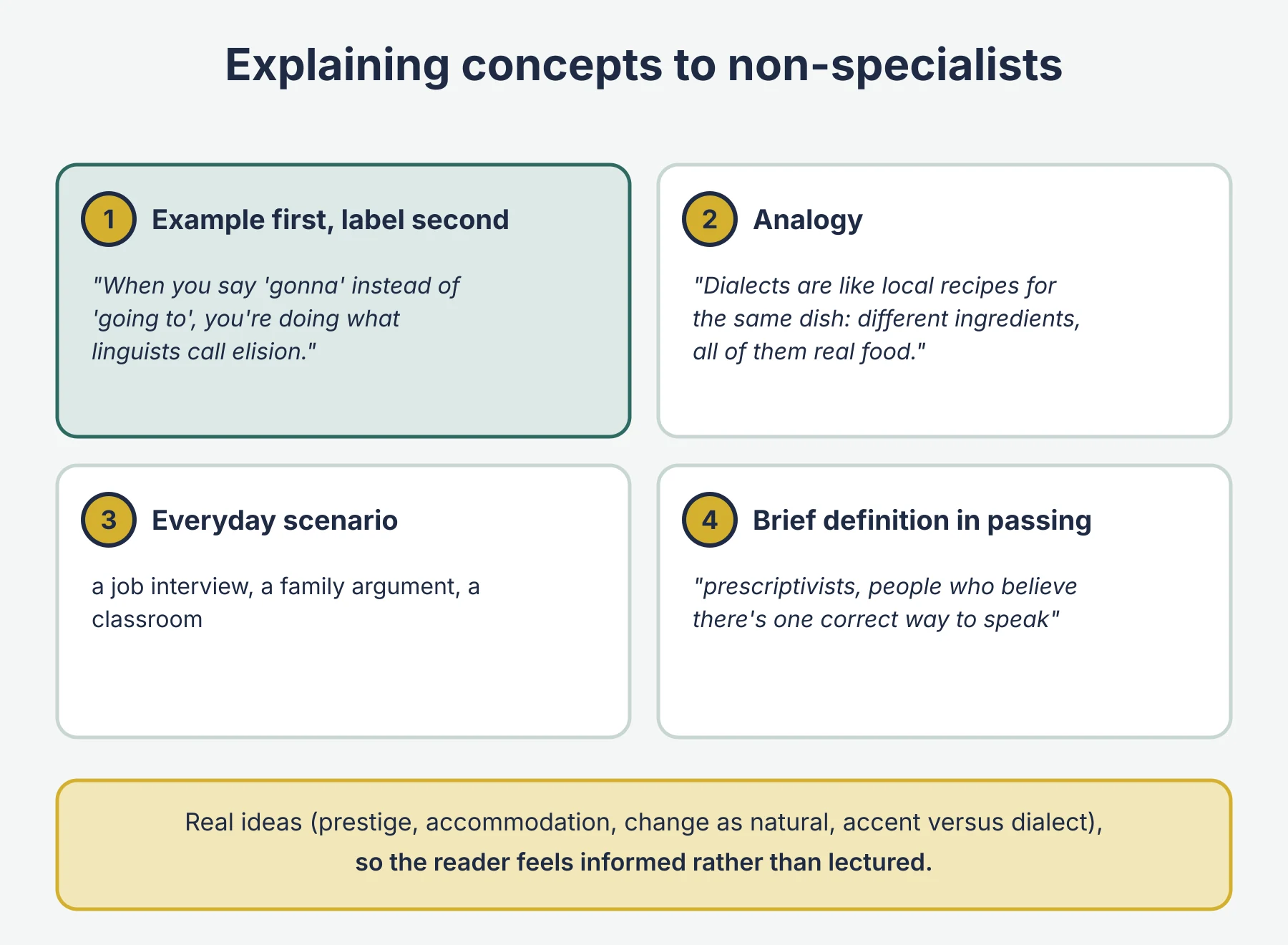
- Give each concept an everyday example, analogy or scenario.
- Use the form’s conventions.
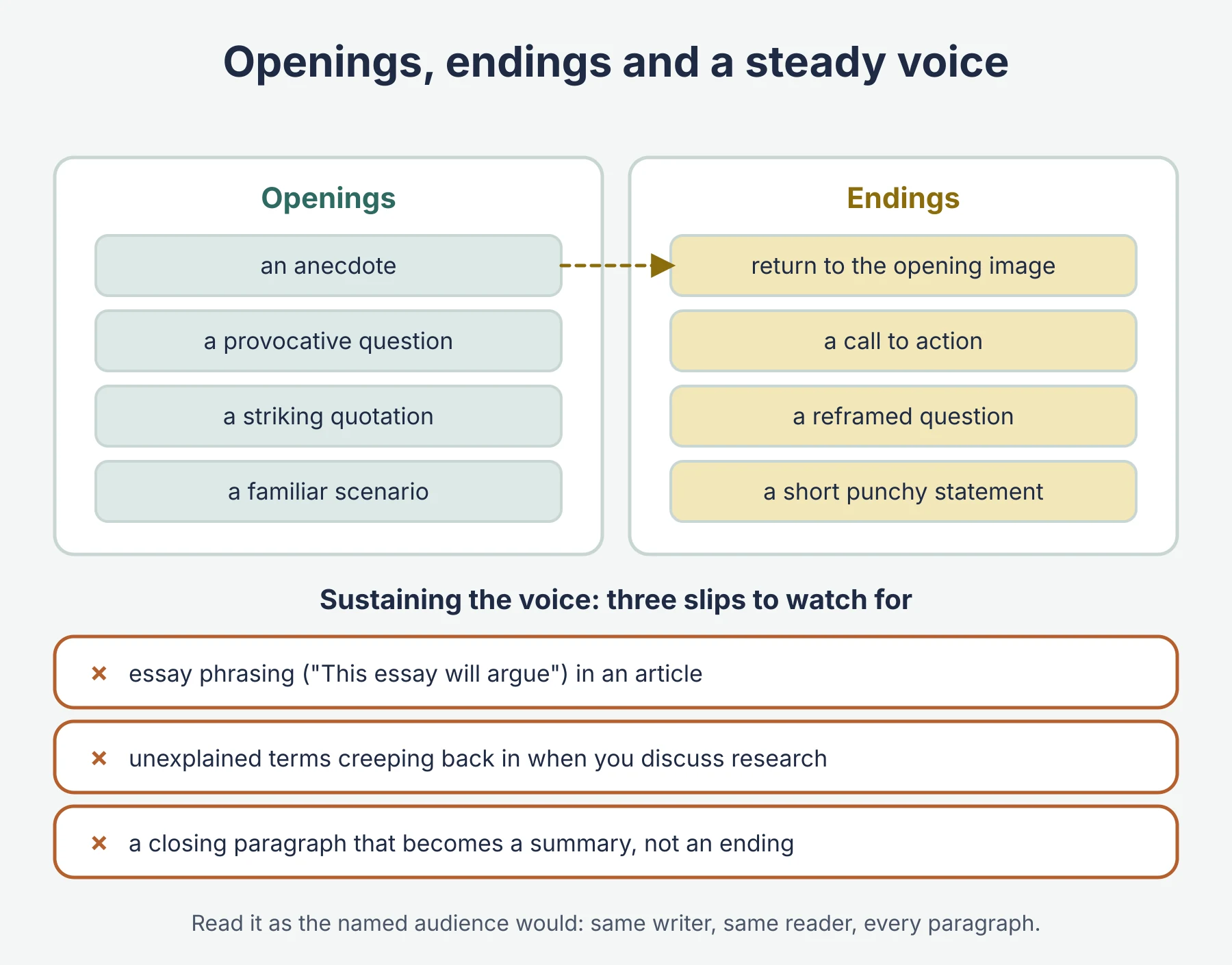
- Craft an opening hook and a deliberate ending.
- Proofread.
Form conventions at a glance
| Form | Must include |
|---|---|
| Article | Headline; engaging opening; clear argument; strong close |
| Blog | Personal voice; direct address; short paragraphs |
| Speech / talk script | Address to the audience; inclusive pronouns; rhetorical patterning; spoken signposts |
| Letter | Salutation; purpose stated early; courteous register; sign-off |
| Leaflet / guide | Headings; short sections; practical advice; imperatives |
Making jargon accessible
| Technical | Accessible |
|---|---|
| Prescriptivism | The belief that there is one correct way to speak or write |
| Code-switching | Switching between languages or styles depending on who you’re with |
| Covert prestige | The street credibility that comes from not sounding “posh” |
| Semantic change | Words changing meaning over time, as “awful” once meant “full of awe” |
Openings: weak and strong
| Weak opening | Why it fails | Stronger opening |
|---|---|---|
| “In this article I will discuss accents.” | Announces instead of engaging; essay habit | “Two candidates. Same grades. One gets the job. The difference? A vowel.” |
| “Language change is when language changes over time.” | Circular definition | “Your great-grandparents would have found ‘awful’ a compliment.” |
| “Prescriptivism and descriptivism are two views.” | Jargon before interest | “Is there one right way to speak English? Your answer says a lot about you.” |
Accuracy and control
Writing skill includes accuracy. Check sentence boundaries, apostrophes, agreement and consistent tense, and make deliberate non-standard choices (a fragment for emphasis, a colloquialism in a blog) look controlled rather than accidental.
Exam traps
- Essay register in the directed writing, or chatty register in the essay.
- Undefined jargon for a non-specialist audience.
- Directed writing with no real linguistic content.
- Ignoring the named form.
- Copying phrases from the source texts.
- Summary verbs (“says”, “talks about”) in analytical writing.
- Essays without counter-arguments or conclusions.
Self-test
- Name the three writing skills in 3.2.4.
- Which task uses each skill?
- What are the four parts of the essay paragraph pattern used in the study guide?
- Give two hedging expressions.
- Why is attribution better than “experts say”?
- What is an embedded quotation?
- Give three analytical verbs to replace “says”.
- Name four techniques for explaining a concept to non-specialists.
- What conventions should a speech include?
- What is a standfirst?
- Give two ways to end a directed writing piece.
- Explain “covert prestige” for a non-specialist reader in one sentence.
Answers
- Writing discursively in an academic essay; writing analytically about texts as parts of discourses; writing for a non-specialist audience in a variety of forms.
- The Section A essay; the Section B analysis; the Section B directed writing.
- Claim, evidence, explanation, evaluation.
- Any two: “suggests”, “may”, “tends to”, “in many contexts”, “appears to”.
- It shows precise knowledge of research and lets the reader judge the evidence.
- A short quotation built into your own sentence’s grammar.
- Any three: represents, constructs, positions, frames, presupposes, challenges, reproduces.
- Example first; analogy; everyday scenario; brief definition in passing.
- Address to the audience, inclusive pronouns, rhetorical patterning, spoken signposts and a call to action.
- A short summary line beneath an article’s headline.
- Any two: return to the opening image; a call to action; a reframed question; a short punchy statement.
- For example: “Sometimes sounding local, rather than posh, earns you respect among your friends.”
More resources on this topic
Related resources
-
Study guides
AQA A-Level English Language: Language Discourses, Methods and Writing Skills (7702)
AQA A-level English Language 7702 Paper 2 guide: methods of analysis for diversity and change, Section B language discourses analysis and directed writing.
English · AQA · A Level
Read guide -
Practice questions
AQA A-Level English Language 7702: Language Discourses and Writing Skills — Practice Questions
Original AQA A-level English Language 7702 Paper 2 Section B practice: two short texts on language, analysis and directed writing tasks, and indicative answers.
English · AQA · A Level
Try questions -
Revision notes
AQA A-Level English Language: Language Discourses, Methods and Writing Skills — Revision Notes
Condensed AQA A-level English Language 7702 notes on Paper 2 Section B: language levels, discourses about language, analysing two texts and directed writing.
English · AQA · A Level
Revise topic
Get free revision emails (optional)
Occasional emails with practice questions, worked explanations and links to free resources for the qualification and subjects you choose. No spam, and you can unsubscribe from any email. The free tools on this site never need an email.