
Revision Notes
AQA A-Level English Language (7702): Language Discourses – Revision Notes
Recall notes on discourses about language, personas, reader positioning and comparing two texts, for AQA A-level English Language 7702 Paper 2 Section B.
- Subject
- English
- Level
- A LEVELS
- Topic
- Paper 2 – Language Diversity and Change
- Author
- Marlbridge Academic Team
- Updated
- Reviewed by
- Ammar Bilal (what this means)
Aligned to AQA A Level English (7702), For first teaching 2015. Official specification .
Syllabus page (what it covers and how it is assessed): AQA A Level English Language.
Found an error? Report a correction.
Need help with this topic? Request a free trial class for A Level English Language (7702).
Condensed recall for 3.2.3 Language discourses, assessed by the 40-mark analysis of two texts in Paper 2 Section B of AQA A-level English Language (7702). Full explanation and a worked comparison are in the language discourses study guide.
The task in one paragraph
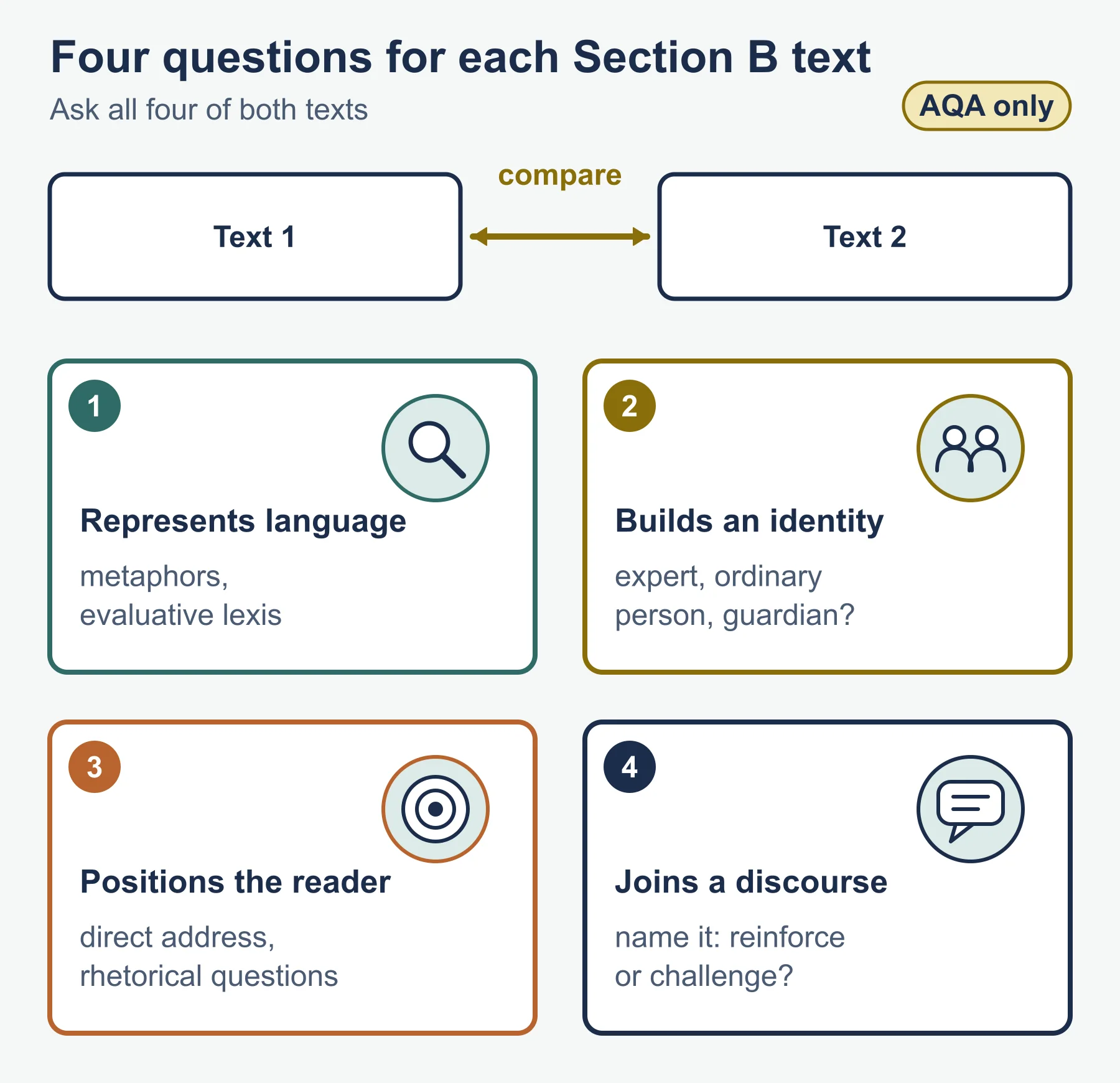
Two texts about a topic linked to diversity and change. Analyse how each uses language to present ideas, attitudes and opinions: how it represents language, constructs its producer’s identity, positions its reader and connects to discourses about language. Compare throughout, and use context to explain differences.
Key terms
| Term | Meaning |
|---|---|
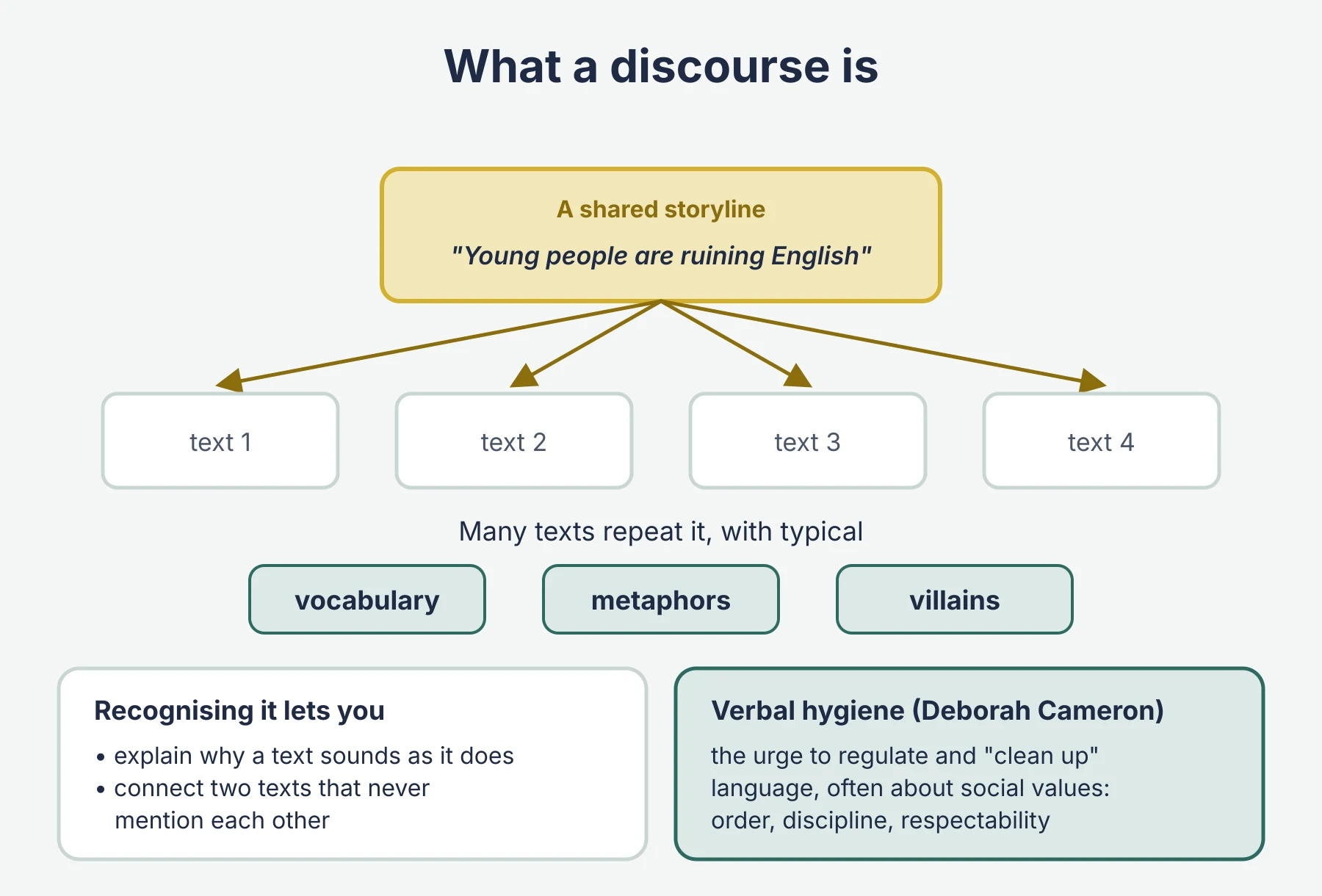
| Discourse | A shared, recurring way of talking about a topic that carries values |
| Verbal hygiene | Cameron’s term for the urge to regulate and improve language |
| Persona | The identity a producer constructs in a text |
| Ideal reader | The reader the text assumes, sharing its values |
| Out-group | A group a text sets against the reader (“snobs”, “pedants”, “kids today”) |
| Presupposition | An assumption built into the wording (“the decline of English”) |
| Accentism | Discrimination on the basis of accent |
| Non-specialist audience | Readers without linguistic training |
| Satire | Humour and irony used to criticise |
| Counter-discourse | A way of talking that challenges a dominant discourse |
Topic and discourse bank
| Topic | Discourse A | Discourse B |
|---|---|---|
| Accents | Barrier to success | Identity, pride; prejudice as discrimination |
| Youth language | Decline, laziness | Creativity, rule-governed variation |
| Technology | Corruption | Adaptation to mode |
| Americanisms | Invasion | Exchange, borrowing |
| Inclusive language | Censorship, “political correctness” | Respect, accuracy |
| Grammar and punctuation | Fixed rules, standards | Convention, context |
| Dialect loss | Nostalgia, death | Natural change, new varieties |
Historical context: Swift’s Proposal (1712) wanted to fix English; Johnson’s preface (1755) accepted that a living language cannot be fixed entirely. Worries about decline are not new.
Metaphors for language (representation shortcut)
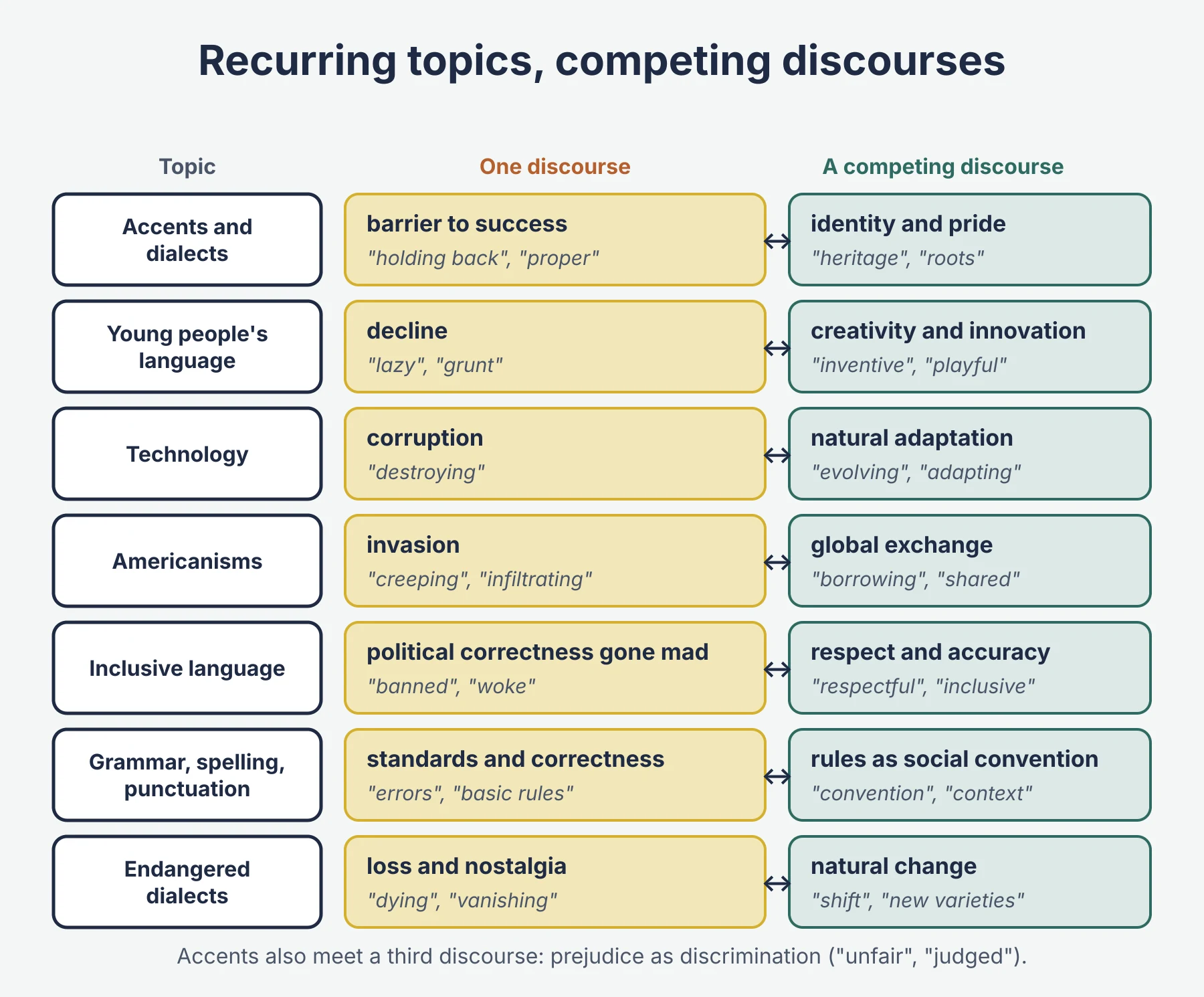
| Metaphor | Implies |
|---|---|
| Building, castle | Language was perfect once and is now crumbling |
| Body, disease | Change is infection to be cured |
| Territory, invasion | Outside forms are enemies |
| Garden, weeds | Language needs tending and pruning |
| Organism, evolution | Change is natural growth |
| Toolkit | Language adapts to the job in hand |
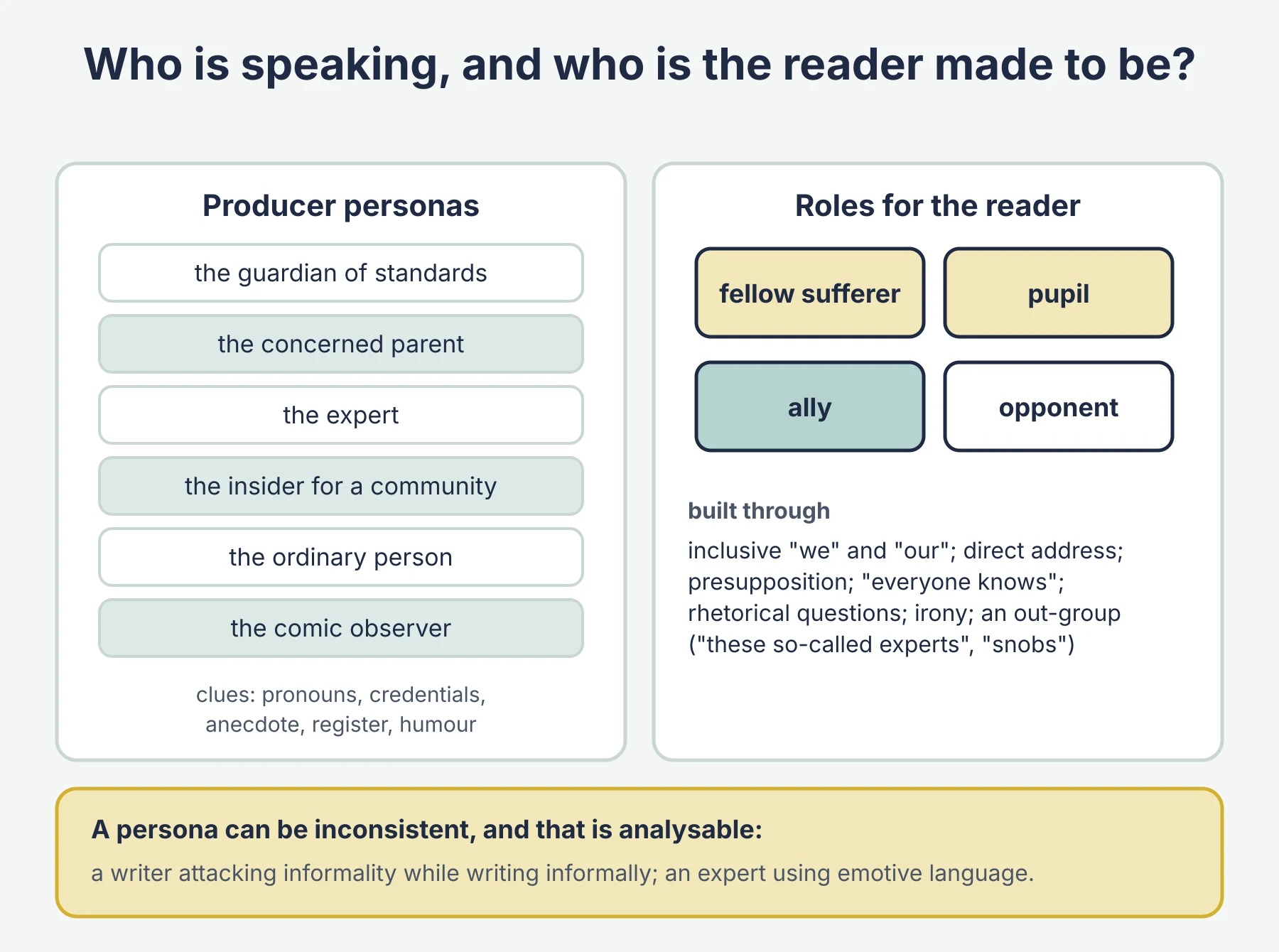
Persona checklist
- Guardian: modals of obligation, nostalgia, lists of “errors”.
- Expert: research references, hedges, technical terms explained.
- Insider: first-person anecdote, community lexis, pride.
- Ordinary person: colloquial register, common sense appeals.
- Comic observer: irony, hyperbole, mock outrage.
Positioning checklist
Inclusive “we”; second-person “you”; presupposition; rhetorical questions; irony; appeals to common sense; out-group construction; selective evidence; the final line as a call to action.
Genre and context reminders
| Genre | What to expect |
|---|---|
| Opinion column | Strong persona, humour or outrage, generalisation from anecdote |
| Letter to the editor | Formal address, personal grievance, call to action |
| Blog or social media post | Personal voice, informal register, direct address, links to experience |
| Book extract by a linguist | Evidence, examples across time, measured tone, explained terms |
| Speech | Rhetorical patterning, inclusive address, audience-specific references |
| Older text (for example an eighteenth-century preface) | Formal syntax, appeals to reason or authority, period assumptions about class |
Comparison method
1. Context of each text: genre, date, audience, purpose.
2. Main view of each.
3. Plan 3-4 points from: representation, identity, positioning, discourse.
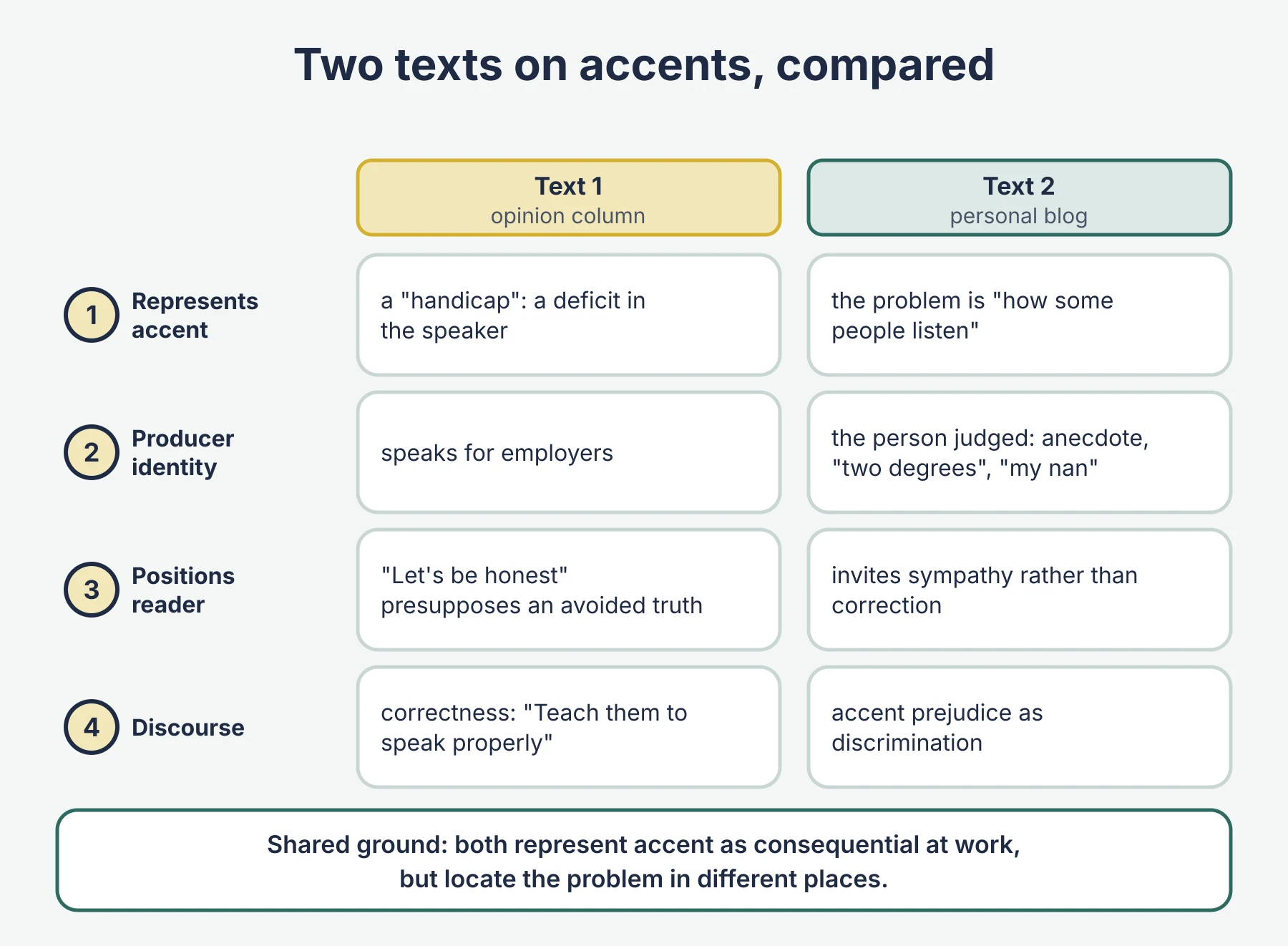
4. Each paragraph: Text 1 feature + effect, Text 2 feature + effect, reason for the difference.
5. Finish with the overall difference in how they treat the issue.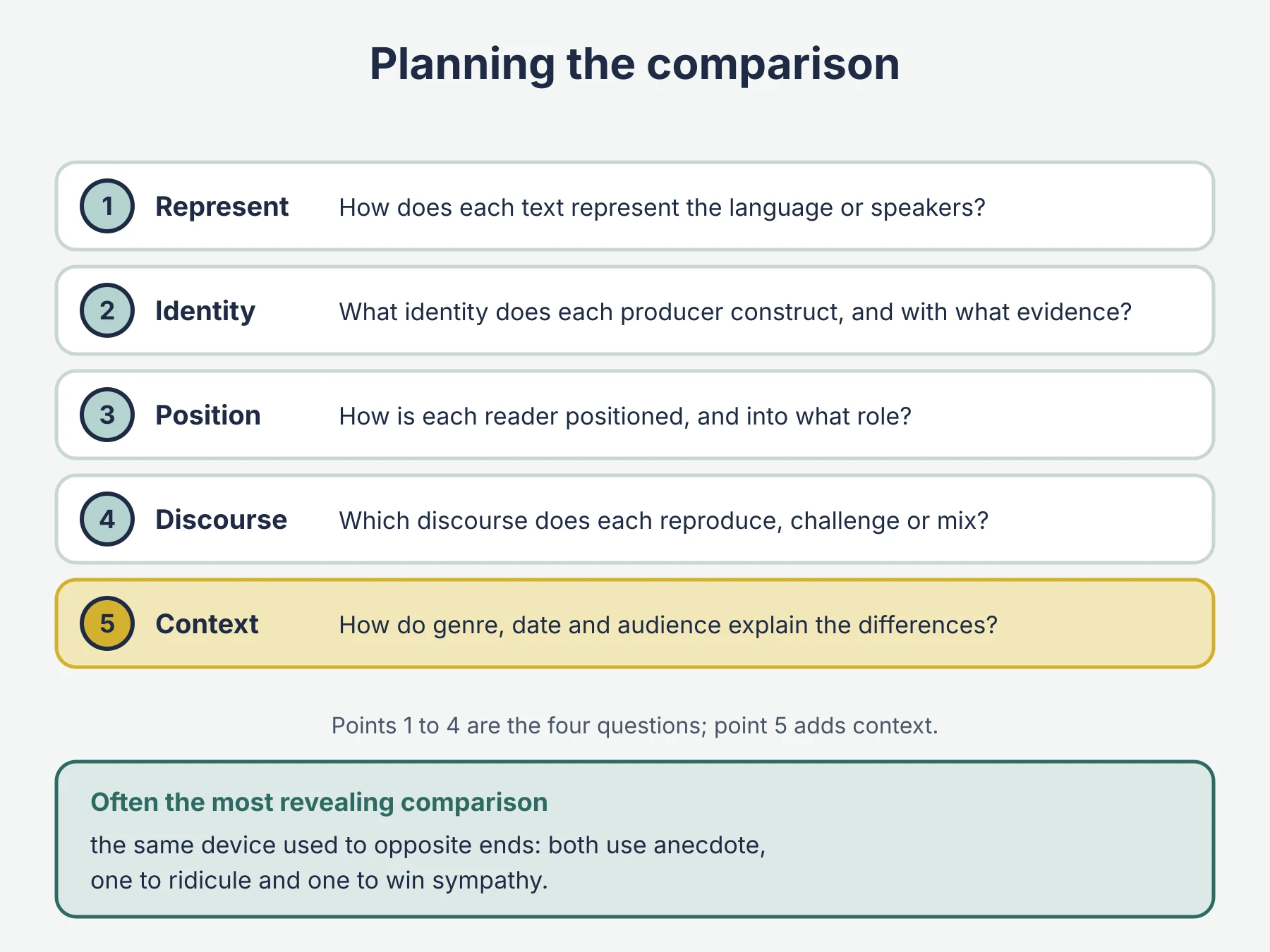
Exam traps
- Arguing with a text rather than analysing it.
- Summary of content with occasional terminology.
- Treating the two texts separately.
- Labelling a text “prescriptive” without showing which features make it so.
- Missing irony: a satirical text may voice a view it mocks.
- Ignoring a persona’s inconsistency (an informal attack on informality).
- Forgetting the older text’s date when one text is historical.
Self-test
- Name the four things the specification says you explore about how texts are produced.
- What is a discourse, in this content?
- Whose term is “verbal hygiene”, and what does it mean?
- What does an invasion metaphor imply about language change?
- Give two features that construct an expert persona.
- What is an out-group, and why does a text build one?
- Give an example of presupposition in a text about language.
- Why might a satirical text be misread?
- What did Swift’s 1712 Proposal argue?
- Why is it useful to note that complaints about decline are centuries old?
- What should each comparison paragraph contain?
- How is persona inconsistency useful in analysis?
Answers
- How they represent language; construct an identity for the producer; position the reader and seek to influence them; are connected to discourses about language.
- A recurring, socially shared way of talking about a topic, carrying assumptions and values.
- Deborah Cameron’s; the urge to regulate, correct and “clean up” language, often reflecting social values.
- That new forms come from outside and are a threat to be resisted.
- Any two: references to research; hedged claims; explained technical terms; a calm, measured register.
- A group set against the reader (“pedants”, “kids these days”); it unites writer and reader by contrast.
- “Why has nobody stopped the decline of grammar?” presupposes that grammar is declining.
- Because it may voice the view it mocks, so the surface meaning is the opposite of the intended one.
- That English should be corrected, improved and fixed.
- It lets you show that a modern text’s claim of new decline is part of a long-running discourse.
- Evidence and features from both texts, their effects, and a reason (context or purpose) for the difference.
- It reveals a gap between what a writer claims and how they write, which can undermine or complicate their position.
More resources on this topic
Related resources
-
Study guides
AQA A-Level English Language (7702): Writing Skills
The three Paper 2 writing skills: academic essay, analytical writing and directed writing for non-specialists, with worked examples. AQA 7702 3.2.4.
English · AQA · A Level
Read guide -
Practice questions
AQA A-Level English Language (7702): Writing Skills – Practice Questions
Original practice on academic, analytical and non-specialist writing about language issues, with model answers, for AQA A-level English Language 7702 Paper 2.
English · AQA · A Level
Try questions -
Revision notes
AQA A-Level English Language (7702): Writing Skills – Revision Notes
Recall notes on academic, analytical and non-specialist writing for AQA A-level English Language 7702 Paper 2: registers, form conventions and exam traps.
English · AQA · A Level
Revise topic
Get free revision emails (optional)
Occasional emails with practice questions, worked explanations and links to free resources for the qualification and subjects you choose. No spam, and you can unsubscribe from any email. The free tools on this site never need an email.