
Revision Notes
AQA A Level Law (7162): Law Making: Law Reform – Revision Notes
Revision notes on the Law Commission's process and its reform, codification, consolidation and repeal work, with evaluation and a self-test for AQA Law 7162.
- Subject
- Law
- Level
- A LEVELS
- Topic
- Section 3.1 – The Nature of Law and the English Legal System
- Author
- Marlbridge Academic Team
- Updated
- Reviewed by
- Aizaz Raoof Ali (what this means)
Aligned to AQA A Level Law (7162), For teaching from September 2017 onwards, A-level exams 2019 onwards. Official specification .
Syllabus page (what it covers and how it is assessed): AQA A Level Law.
Syllabus points this page covers
7162
- Law making: law reform
Found an error? Report a correction.
Need help with this topic? Request a free trial class for A Level Law (7162).
Condensed notes on Law making: law reform in AQA A-level Law (7162) section 3.1: the work of the Law Commission (reform, codification, consolidation and repeal) and the advantages and disadvantages of reform through it. For full explanation and an annotated answer, see the Law Reform study guide.
The body
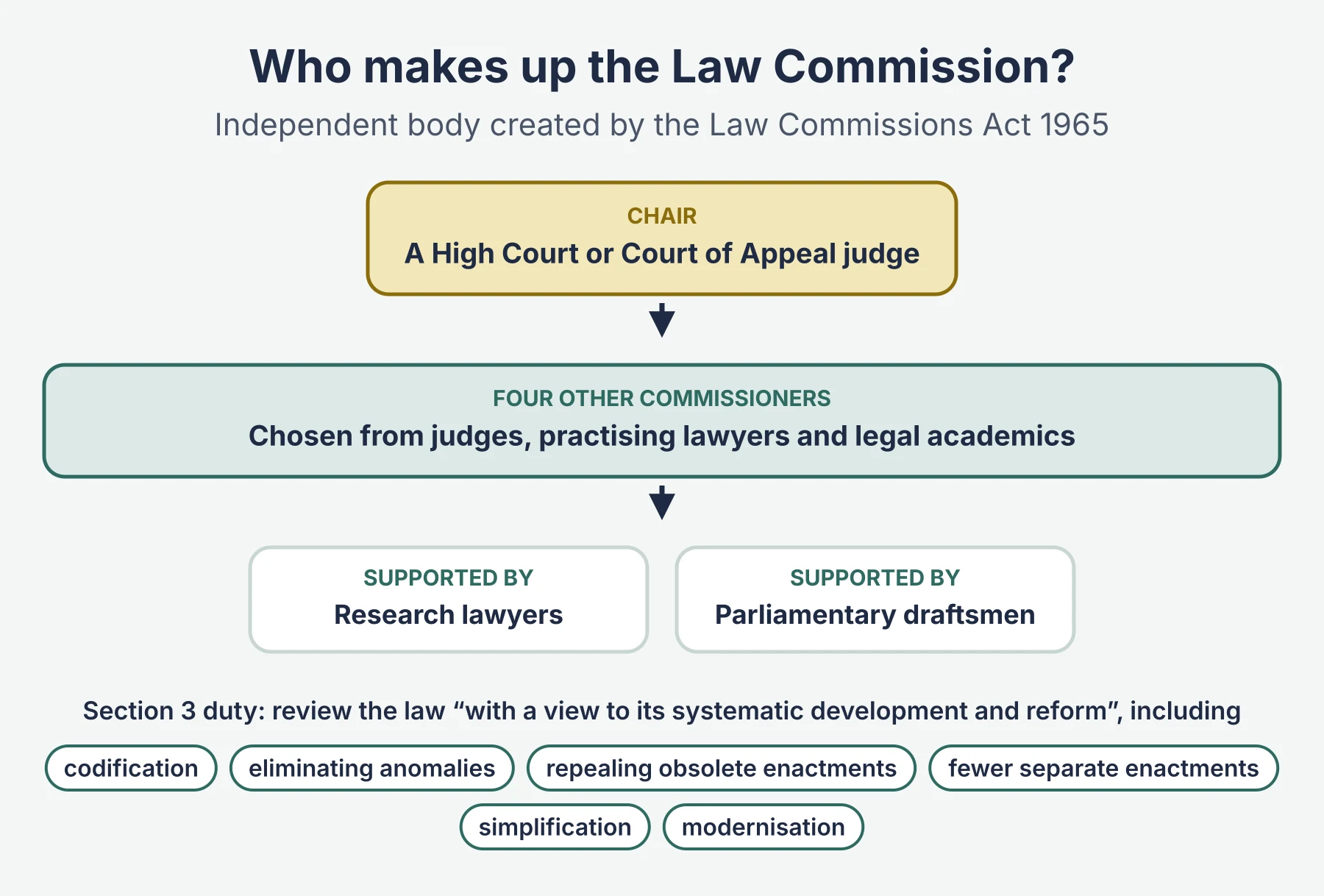
- Created by the Law Commissions Act 1965; covers England and Wales (Scotland has its own commission).
- Chair: a High Court or Court of Appeal judge. Four other commissioners: judges, practising lawyers, academics.
- Supported by research lawyers and parliamentary draftsmen.
- Section 3 duty: review the law for its systematic development and reform, including codification, removing anomalies, repealing obsolete law, reducing the number of enactments, and simplifying and modernising the law.
The process
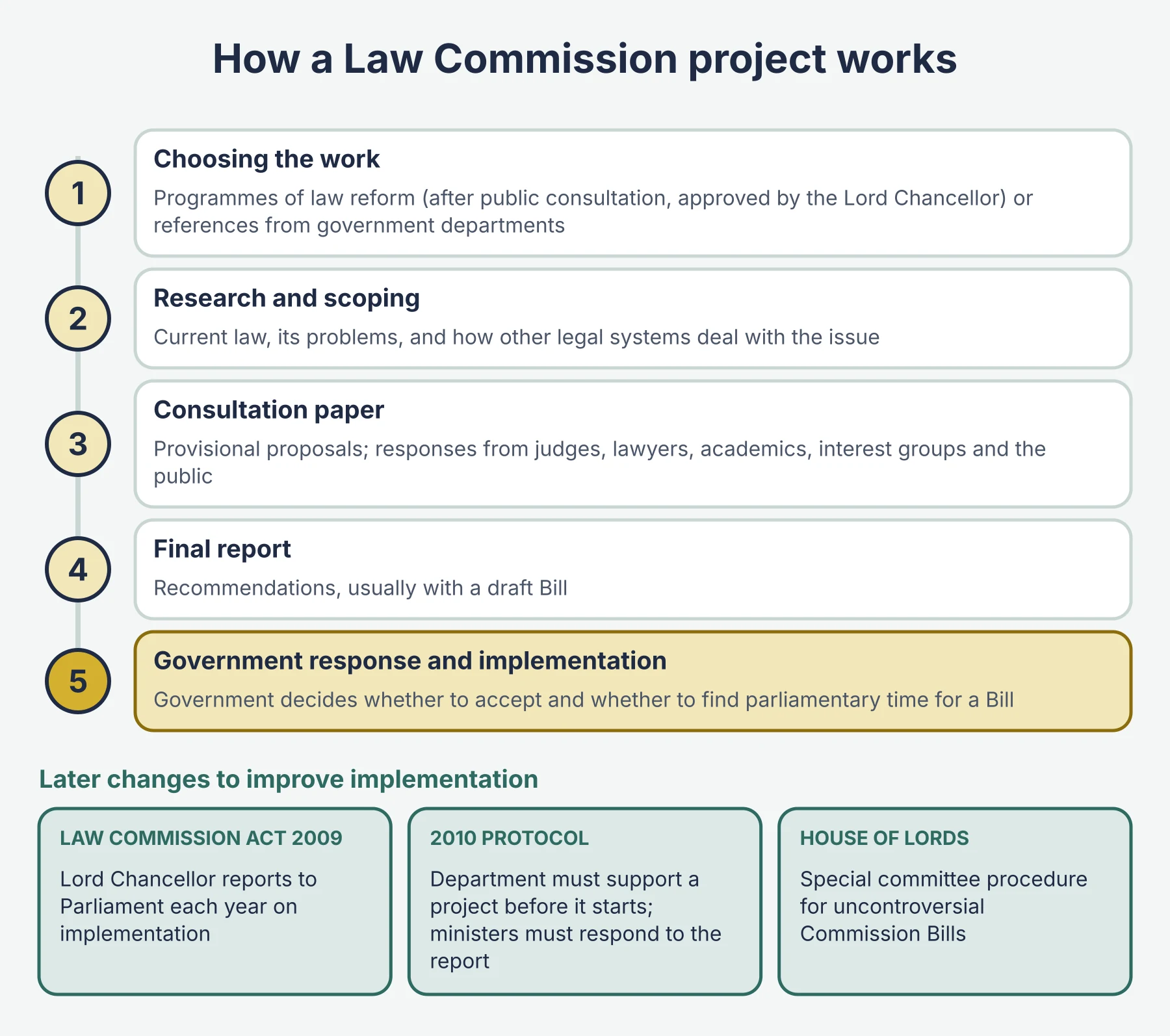
- Work chosen: programmes of law reform (consulted on, approved by the Lord Chancellor) or references from government.
- Research and scoping.
- Consultation paper with provisional proposals.
- Final report, usually with a draft Bill.
- Government decides whether to implement.
Implementation improvements:
- 2010 protocol: department supports a project before it starts; ministers commit to respond.
- Law Commission Act 2009: Lord Chancellor reports annually on implementation.
- Lords special procedure for uncontroversial Commission Bills (committee can take evidence).
The four functions
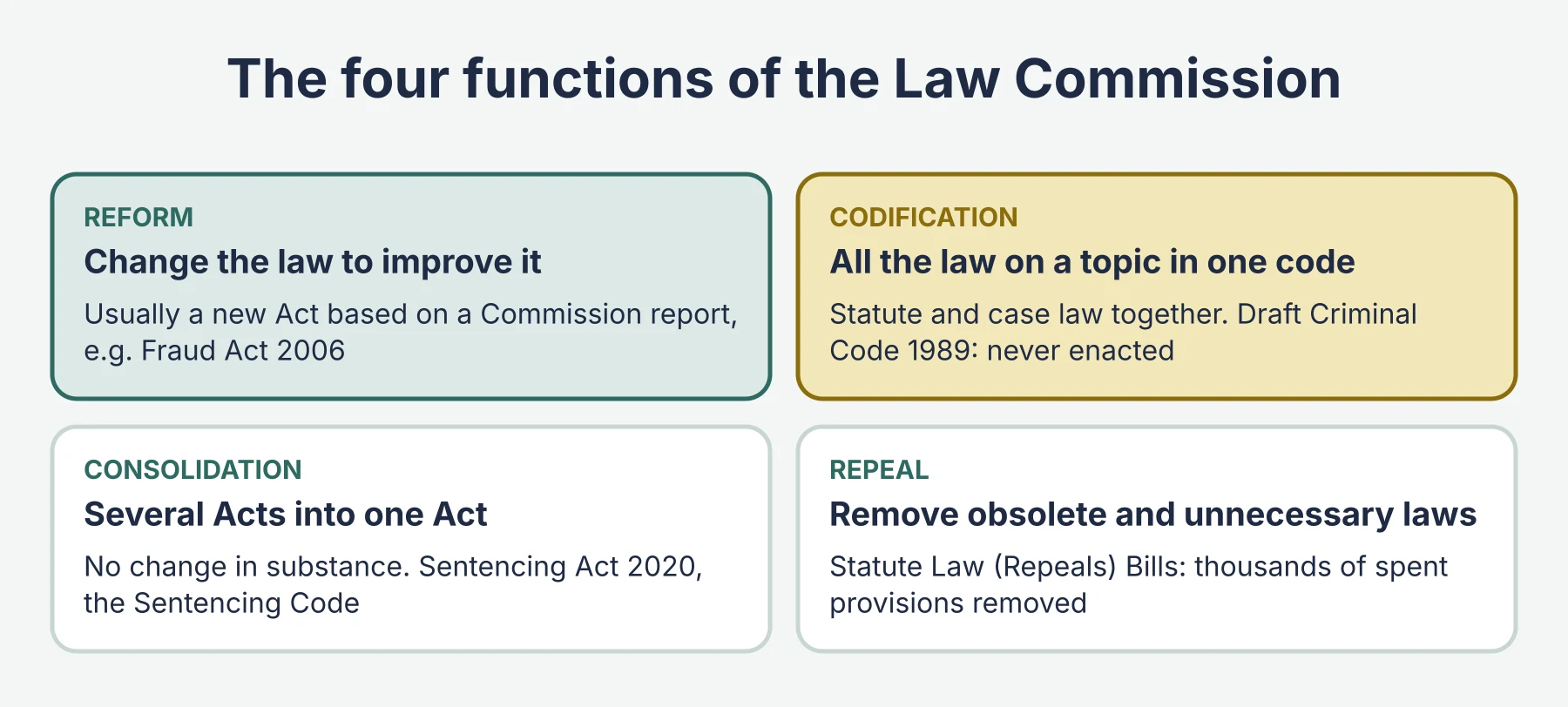
| Function | Meaning | Example |
|---|---|---|
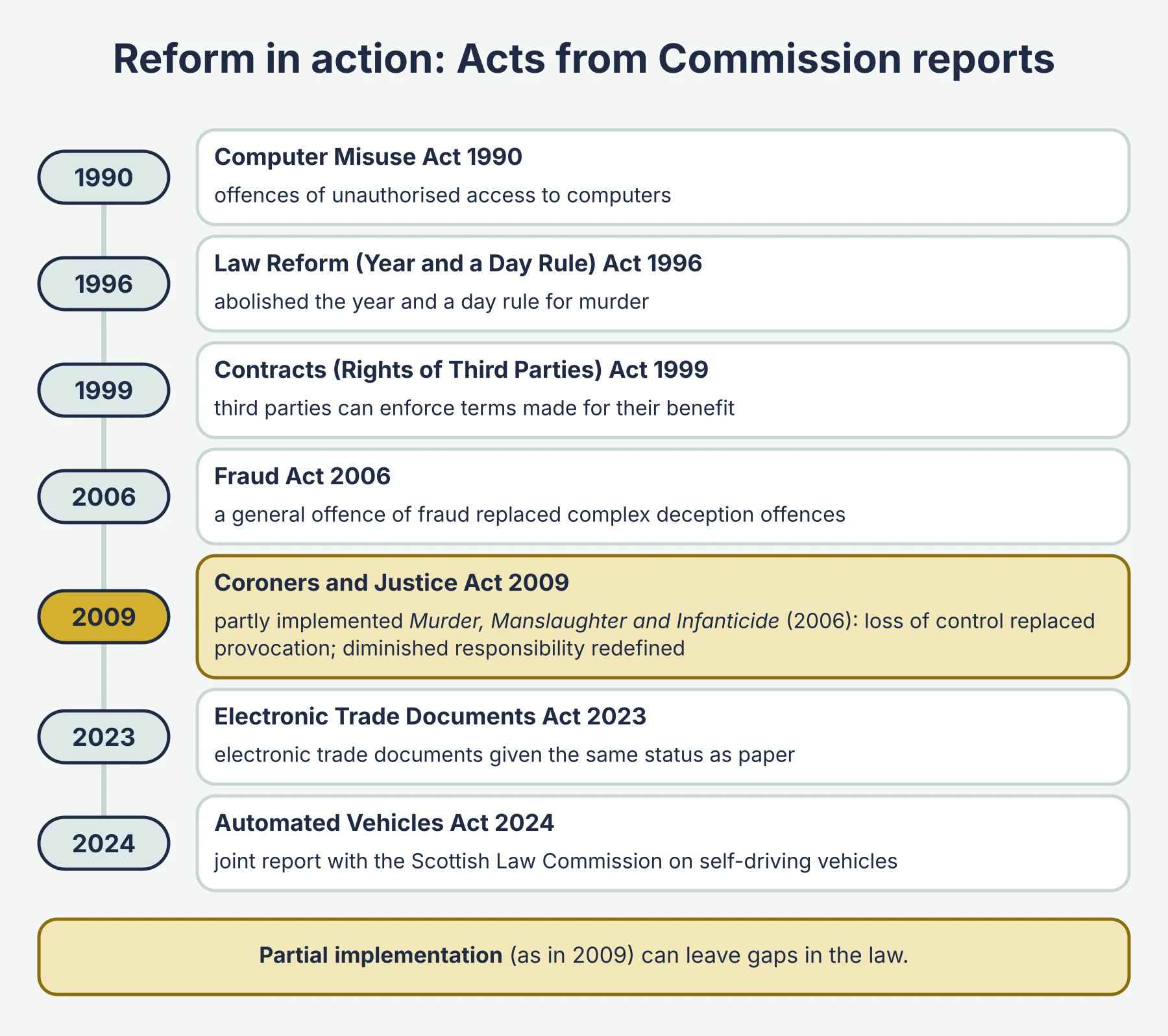
| Reform | Improving the law, usually via a new Act | Computer Misuse Act 1990; Contracts (Rights of Third Parties) Act 1999; Fraud Act 2006; Electronic Trade Documents Act 2023; Automated Vehicles Act 2024 |
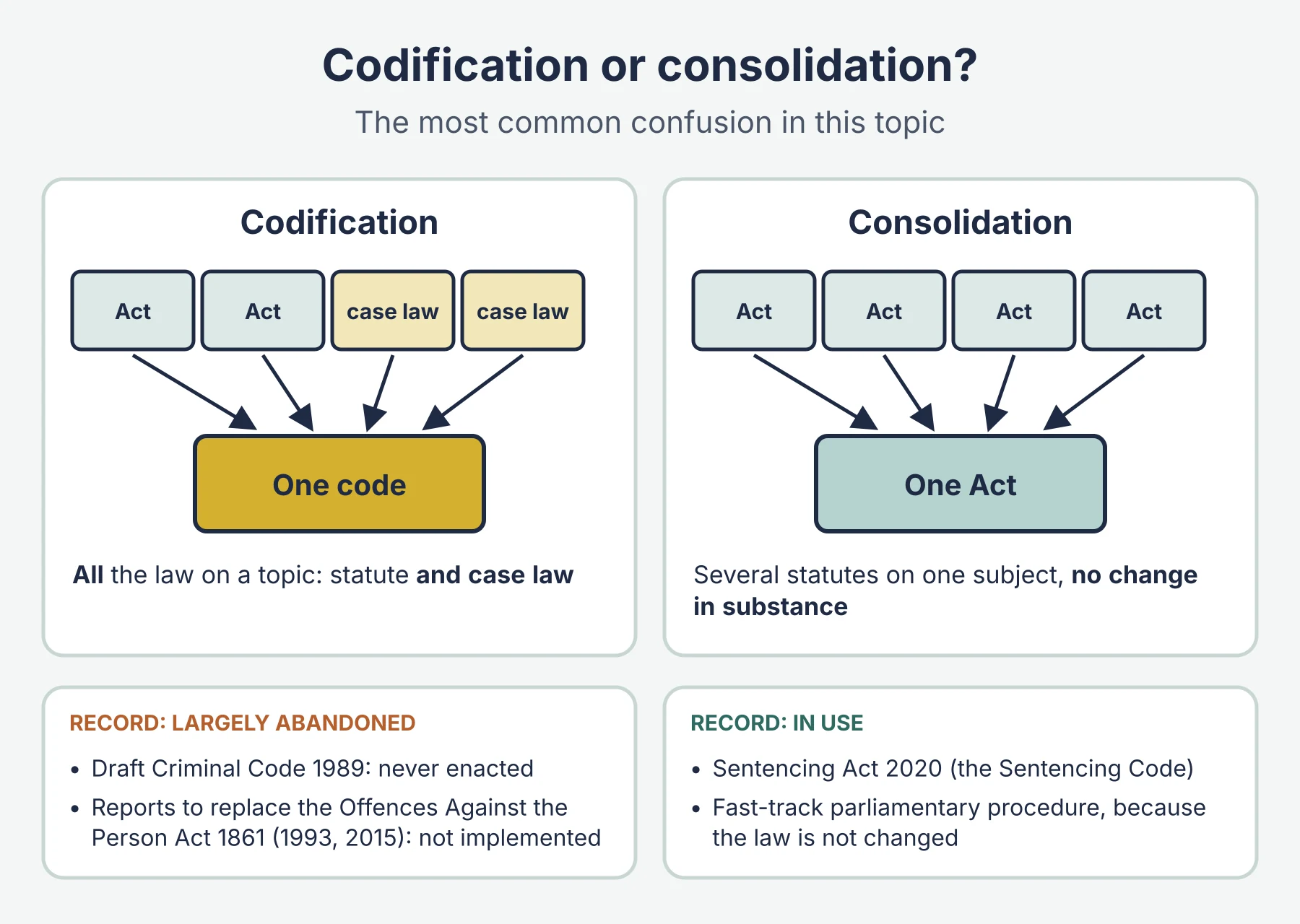
| Codification | All law on a topic (statute and cases) in one code | Draft Criminal Code 1989, never enacted; Offences Against the Person reports (1993, 2015) not implemented |
| Consolidation | Several Acts combined, substance unchanged | Sentencing Act 2020 (the Sentencing Code) |
| Repeal | Removing obsolete law | Statute Law (Repeals) Acts |
Partial implementation: Coroners and Justice Act 2009 adopted parts of Murder, Manslaughter and Infanticide (2006): loss of control, diminished responsibility.
Evaluation
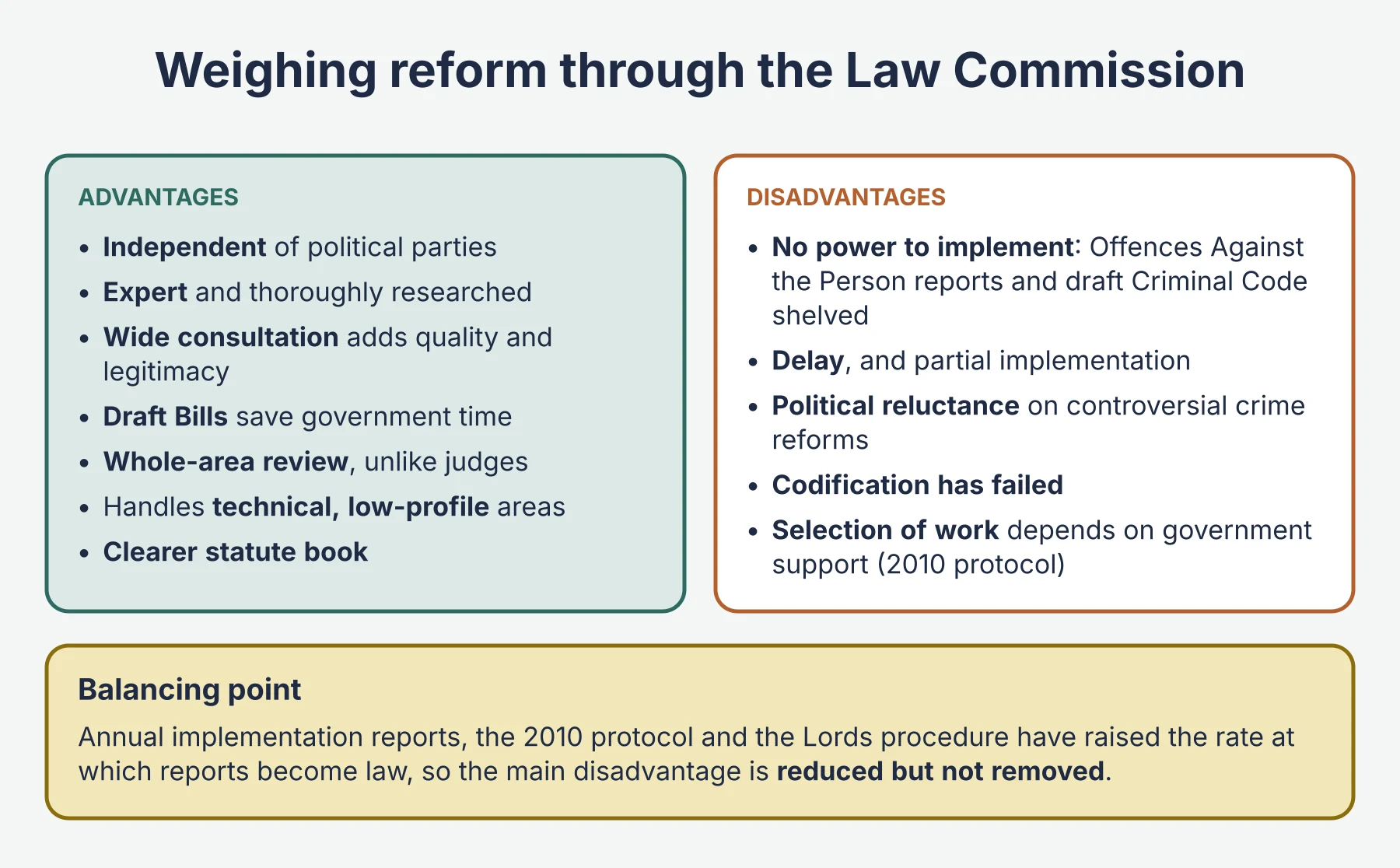
Advantages
- Independent of party politics.
- Expert commissioners and staff; thorough research.
- Wide consultation improves quality and legitimacy.
- Draft Bills save government time.
- Reviews whole areas, unlike judges deciding one case.
- Handles technical, low-profile law.
- Consolidation and repeal clarify the statute book.
Disadvantages
- No power to implement; depends on government and parliamentary time.
- Delay and partial implementation.
- Governments avoid controversial criminal law reform.
- Codification ambition has failed.
- 2010 protocol means work depends on government support.
Judgement line: reforms since 2009 have improved implementation, but the Commission’s influence still depends on political will.
Three case studies for evaluation
Use one success, one failure and one partial success to give balance.
- Success: the Fraud Act 2006. The Commission’s report found the old deception offences under the Theft Acts technical and hard to apply. Parliament replaced them with a general offence of fraud, committed by false representation, failing to disclose information or abuse of position. Shows expertise and a draft Bill leading to clearer law.
- Failure: offences against the person. Reports in 1993 and 2015 proposed replacing the Offences Against the Person Act 1861, criticised for outdated language and inconsistent mens rea. No government has legislated. Shows dependence on political will and parliamentary time.
- Partial success: the Coroners and Justice Act 2009. Parliament adopted the recommended loss of control defence and a new definition of diminished responsibility, but not the proposed restructuring of homicide into degrees of murder. Shows that government can select parts of a report, leaving the wider scheme incomplete.
How to use them: in a “discuss” answer, pair each advantage with a success and each disadvantage with a failure, then let the partial success support a balanced conclusion.
Key terms
| Term | Meaning |
|---|---|
| Law Commission | Independent body recommending reform of the law of England and Wales |
| Programme of law reform | The Commission’s planned list of projects, approved by the Lord Chancellor |
| Reference | A request from government to examine a specific area |
| Consultation paper | Publication of provisional proposals for comment |
| Draft Bill | Proposed legislation attached to a final report |
| Codification | Combining all law on a topic into one code |
| Consolidation | Combining several statutes into one without changing the law |
| Repeal | Removing laws from the statute book |
Exam traps
- Codification and consolidation confused.
- Saying the Commission makes law.
- Evaluation with no examples of implemented or ignored reports.
- Discussing other reform bodies; the specification names the Law Commission.
- Calling the Commission part of government.
Self-test
- Which Act created the Law Commission?
- Who chairs it?
- Name the two ways projects reach the Commission.
- What happens at the consultation stage?
- What usually accompanies a final report?
- What does the Law Commission Act 2009 require?
- Give two Acts that resulted from Law Commission reports.
- Why is the draft Criminal Code significant in evaluation?
- Define consolidation and give an example.
- What does repeal achieve?
- Give two advantages of reform through the Law Commission.
- What is the main disadvantage?
Answers: 1. The Law Commissions Act 1965. 2. A High Court or Court of Appeal judge. 3. Programmes of law reform approved by the Lord Chancellor, and references from government departments. 4. Provisional proposals are published and responses are invited from lawyers, judges, academics, interest groups and the public. 5. A draft Bill. 6. The Lord Chancellor must report annually to Parliament on progress in implementing Law Commission proposals. 7. Any two: Computer Misuse Act 1990; Contracts (Rights of Third Parties) Act 1999; Fraud Act 2006; Electronic Trade Documents Act 2023; Automated Vehicles Act 2024. 8. It shows the failure of codification: it was published in 1989 but never enacted. 9. Combining several Acts on one subject into one Act without changing the law: the Sentencing Act 2020. 10. It removes obsolete and unnecessary laws, making the statute book shorter and clearer. 11. Any two: independence; expertise; wide consultation; draft Bills; whole-area review; handles technical law. 12. It has no power to implement its proposals, so reform depends on government and Parliament.
More resources on this topic
Law Reform study guide | Law Reform practice questions | Rule of Law, Law Reform, the EU and Civil Justice revision notes
Related resources
-
Study guides
AQA A Level Law (7162): Law Making: Parliamentary Law Making
Parliamentary law making for AQA A Level Law 7162: Green and White Papers, the legislative process, influences, and parliamentary supremacy and its limits.
Law · AQA · A Level
Read guide -
Practice questions
AQA A Level Law (7162): Law Making: Parliamentary Law Making – Practice Questions
Original practice questions with full answers on the legislative process, influences on Parliament and parliamentary supremacy and its limits, for AQA Law 7162.
Law · AQA · A Level
Try questions -
Revision notes
AQA A Level Law (7162): Law Making: Parliamentary Law Making – Revision Notes
Revision notes on Green and White Papers, Bill stages, Parliament Acts, influences on Parliament and supremacy's limits, with a self-test for AQA Law 7162.
Law · AQA · A Level
Revise topic
Get free revision emails (optional)
Occasional emails with practice questions, worked explanations and links to free resources for the qualification and subjects you choose. No spam, and you can unsubscribe from any email. The free tools on this site never need an email.