
Study Guides
AQA A Level Law (7162): Law Making: Law Reform
Law reform for AQA A Level Law 7162: how the Law Commission works, reform, codification, consolidation and repeal, its successes and failures, and evaluation.
- Subject
- Law
- Level
- A LEVELS
- Topic
- Section 3.1 – The Nature of Law and the English Legal System
- Author
- Marlbridge Academic Team
- Updated
- Reviewed by
- Aizaz Raoof Ali (what this means)
Aligned to AQA A Level Law (7162), For teaching from September 2017 onwards, A-level exams 2019 onwards. Official specification .
Syllabus page (what it covers and how it is assessed): AQA A Level Law.
Syllabus points this page covers
7162
- Law making: law reform
Found an error? Report a correction.
Need help with this topic? Request a free trial class for A Level Law (7162).
This guide covers the Law making: law reform row of AQA A-level Law (7162) section 3.1. The specification is short and precise: the work of the Law Commission: reform, codification, consolidation and repeal, and the advantages and disadvantages of reform through the Law Commission. Because the content is narrow, questions expect detail: how the Commission actually works, accurate examples of each function, and evaluation backed by evidence. The Rule of Law, Law Reform, the EU and Civil Justice revision notes give a summary table. This page explains the process, adds a wider set of examples, and builds the evaluation.
What the Law Commission is
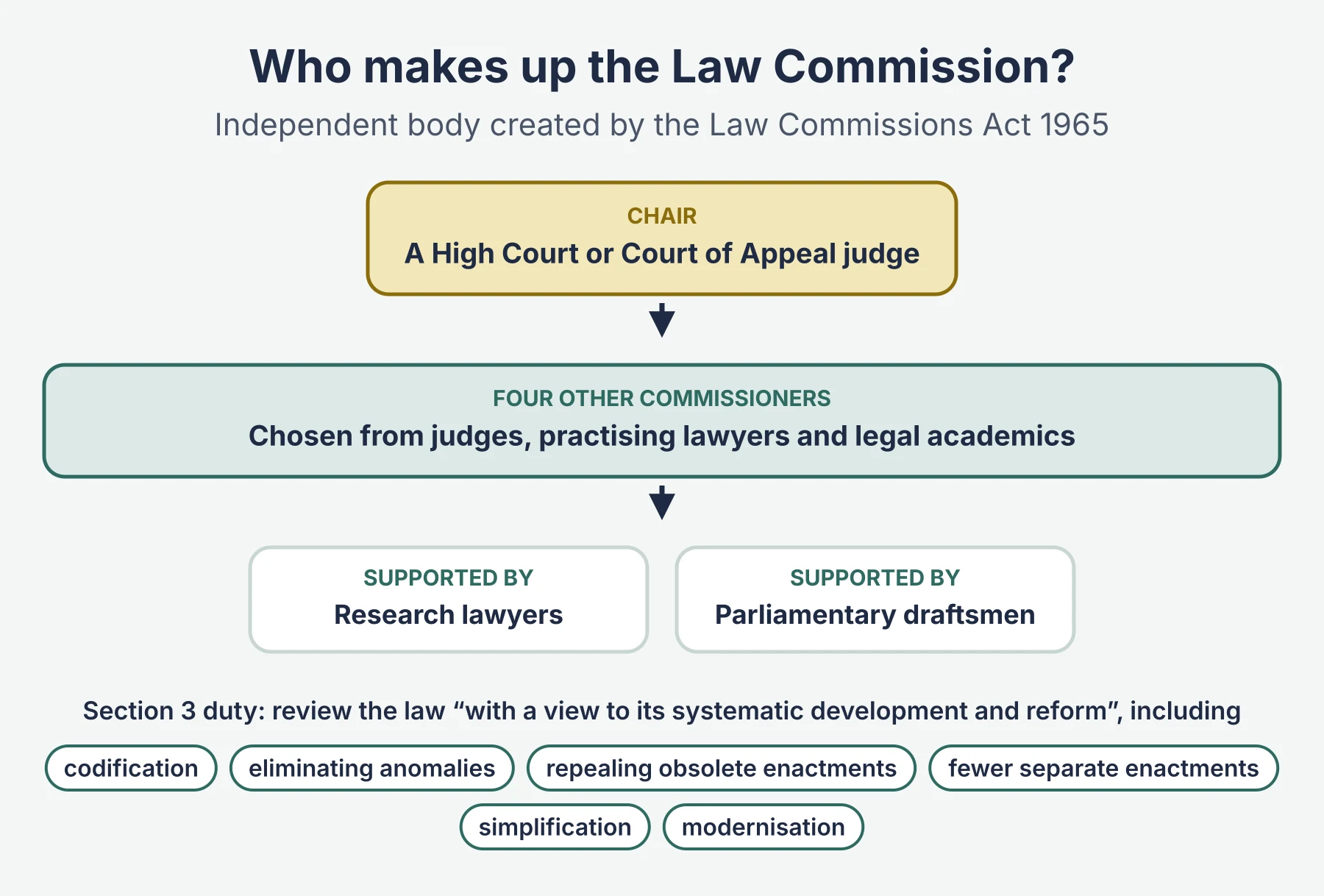
The Law Commission was created by the Law Commissions Act 1965 as an independent body to keep the law of England and Wales under review and recommend reform. Scotland has its own Scottish Law Commission, and the two sometimes work jointly. The Commission has a chair, who is a High Court or Court of Appeal judge, and four other commissioners, chosen from judges, practising lawyers and legal academics, supported by research lawyers and parliamentary draftsmen.
Its duty under section 3 of the 1965 Act is to review the law “with a view to its systematic development and reform”, including codification, the elimination of anomalies, the repeal of obsolete and unnecessary enactments, the reduction of the number of separate enactments and, generally, the simplification and modernisation of the law.
How a project works
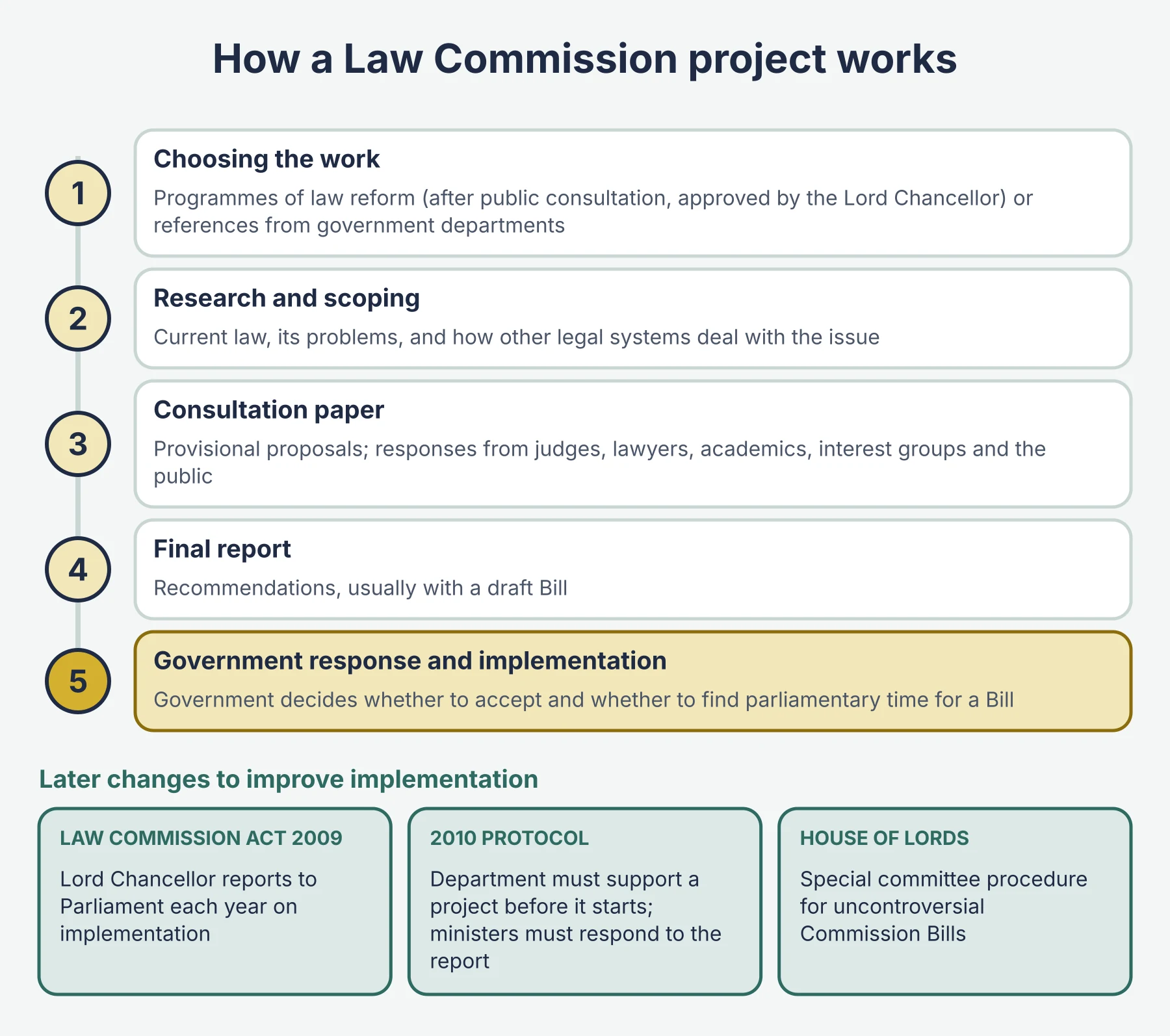
- Choosing the work. Projects come from the Commission’s programmes of law reform, which it draws up after public consultation and the Lord Chancellor approves, or from references by government departments asking it to look at a particular area.
- Research and scoping. Research lawyers study the current law, its problems and how other legal systems deal with the issue.
- Consultation paper. The Commission publishes its provisional proposals and invites responses from judges, lawyers, academics, interest groups and the public.
- Final report. After considering responses, it publishes a report with recommendations, usually with a draft Bill.
- Government response and implementation. The government decides whether to accept the report and whether to find parliamentary time for a Bill.
Two later developments aim to improve implementation:
- A protocol agreed between the government and the Commission in 2010 requires a government department to support a project before it starts and commits ministers to respond to the final report.
- The Law Commission Act 2009 requires the Lord Chancellor to report to Parliament each year on the government’s progress in implementing Law Commission proposals.
The House of Lords also has a special procedure for uncontroversial Law Commission Bills, sending them to a committee that can take evidence, which saves time on the floor of the House.
The four functions with examples
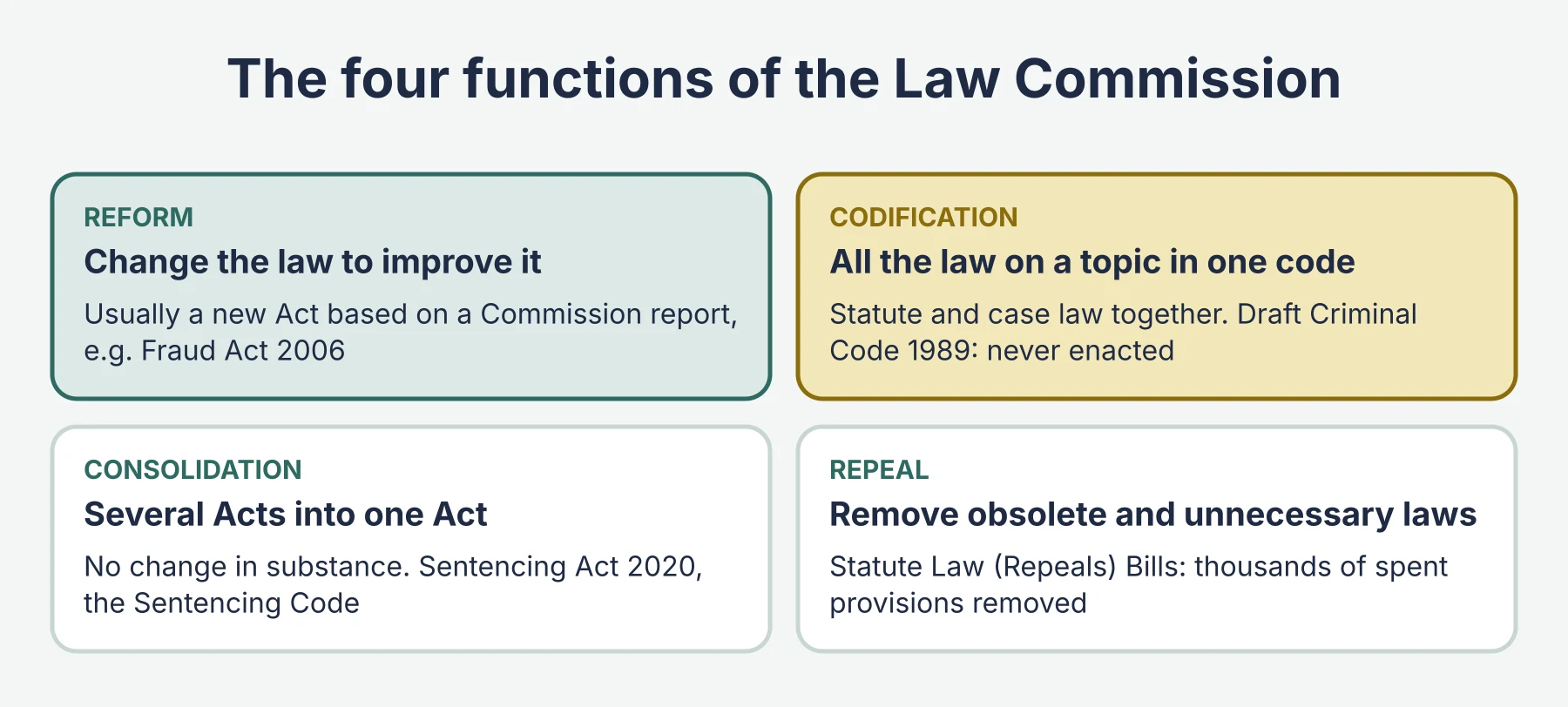
Reform
Changing the law to improve it, usually through a new Act based on a Commission report.
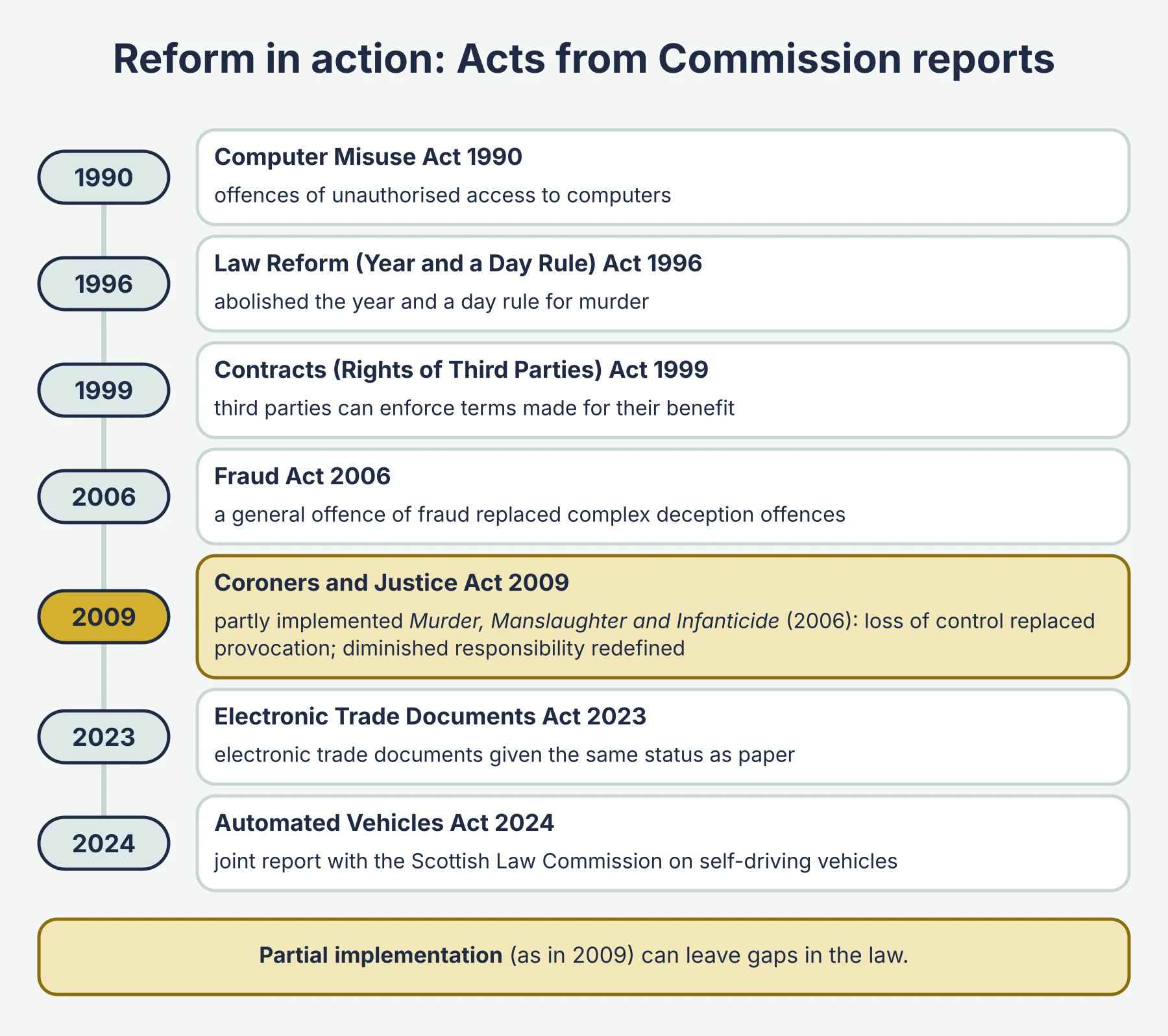
| Act | Commission work behind it |
|---|---|
| Computer Misuse Act 1990 | Report on computer misuse; created offences of unauthorised access to computers |
| Law Reform (Year and a Day Rule) Act 1996 | Recommended abolishing the rule that death more than a year and a day after the act could not be murder |
| Contracts (Rights of Third Parties) Act 1999 | Allowed third parties to enforce contract terms made for their benefit |
| Fraud Act 2006 | Replaced complex deception offences with a general offence of fraud |
| Coroners and Justice Act 2009 | Partly implemented the report Murder, Manslaughter and Infanticide (2006), replacing provocation with loss of control and redefining diminished responsibility |
| Electronic Trade Documents Act 2023 | Gave electronic trade documents the same legal status as paper ones |
| Automated Vehicles Act 2024 | Based on a joint report with the Scottish Law Commission on self-driving vehicles |
Codification
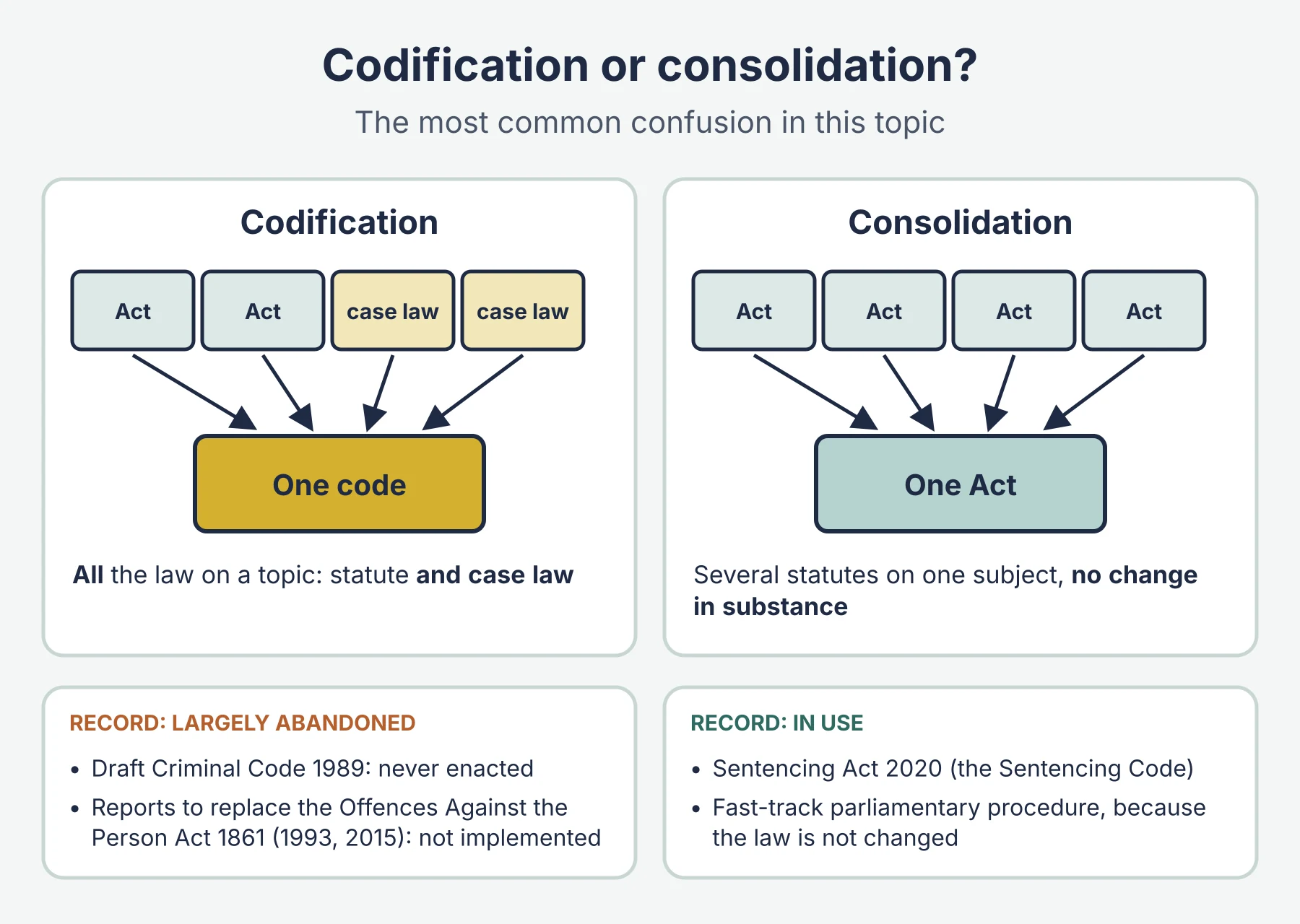
Bringing all the law on a topic, statute and case law, into one complete code. The Commission’s original aim was to codify major areas such as contract and criminal law. It published a draft Criminal Code in 1989, but it was never enacted. Its proposals to replace the Offences Against the Person Act 1861 with a modern statute, made in reports in 1993 and 2015, have also not been implemented. Codification has largely been abandoned as an overall goal in favour of reforming smaller areas.
Consolidation
Combining several Acts on one subject into a single Act without changing the law’s substance, so it is easier to find and use. The Sentencing Act 2020, known as the Sentencing Code, brought sentencing procedure from many separate Acts into one place. Consolidation Bills pass through a fast-track parliamentary procedure because they do not change the law.
Repeal
Removing obsolete and unnecessary laws. The Commission prepares Statute Law (Repeals) Bills, which have removed thousands of spent provisions, such as Acts dealing with long-closed railways or abolished institutions. This makes the statute book shorter and clearer.
Advantages of reform through the Law Commission
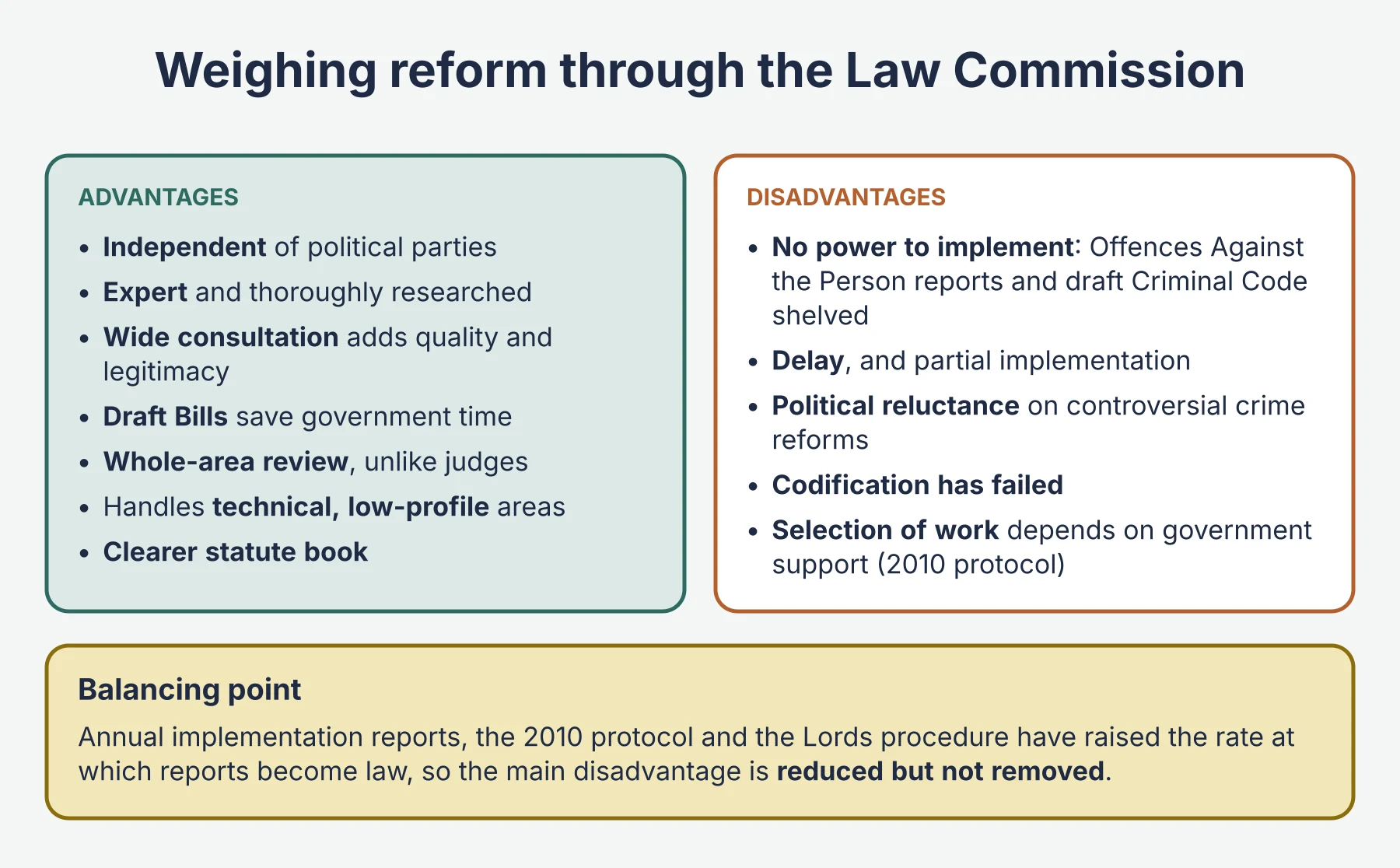
- Independence. It is not controlled by any political party, so it can recommend reform on its legal merits.
- Expertise. Commissioners and staff are experienced judges, lawyers and academics; reports are thoroughly researched.
- Wide consultation. Consultation papers gather the views of practitioners and the public, improving quality and legitimacy.
- Draft Bills. Reports come with a Bill ready to introduce, saving government time.
- Whole-area review. Unlike judges, who can change the law only when a case arises and only on the point argued, the Commission looks at a whole area at once and can propose a coherent scheme.
- Technical areas. It deals with complex, low-profile areas, such as insurance law or electronic documents, that Parliament and pressure groups rarely prioritise.
- Clearer statute book through consolidation and repeal.
Disadvantages
- No power to implement. Reform depends on government accepting the report and Parliament finding time. The Offences Against the Person reports and the draft Criminal Code show how valuable work can be shelved.
- Delay. Even accepted reports may wait years for a Bill, and partial implementation (as in the Coroners and Justice Act 2009) can leave gaps.
- Political reluctance. Governments may avoid controversial criminal law reforms, and the Commission cannot campaign politically.
- Codification has failed. The original ambition of codifying major areas has not been achieved.
- Selection of work depends on government support under the 2010 protocol, so the Commission may be steered away from areas the government does not wish to touch.
Balancing point: the improvements since 2009 (annual implementation reports, the protocol and the Lords procedure) have increased the rate at which reports become law, so the main disadvantage is reduced but not removed.
Worked example: annotated answer
Question: Explain the work of the Law Commission in codification and consolidation. (6 marks)
Codification means bringing all the law on a topic, both statute and case law, into a single comprehensive code [definition]. The Law Commission published a draft Criminal Code in 1989, but Parliament never enacted it, and later proposals to replace the Offences Against the Person Act 1861 have also not been implemented [example and outcome], so codification has largely been abandoned in favour of reforming smaller areas [development]. Consolidation means combining several Acts on one subject into a single Act without changing the substance of the law [definition]. The Sentencing Act 2020 brought sentencing procedure from many Acts into one Sentencing Code [example], making the law easier for judges and lawyers to find and apply [purpose].
Common mistakes
- Confusing codification (all the law, including case law, into one code) with consolidation (several statutes into one, no change in substance).
- Saying the Law Commission makes law; it only recommends.
- Giving “advantages and disadvantages” without evidence of implementation or failure.
- Writing generally about law reform bodies; the specification names the Law Commission only.
- Describing the Commission as part of government; it is independent.
Exam technique
For explain questions, define each function and give a specific example. For discuss or evaluate, weigh independence and expertise against dependence on government, using implemented and unimplemented reports, and conclude on how effective reform through the Commission is.
Revise with the Law Reform revision notes and test yourself with the Law Reform practice questions. The Commission’s place among influences on Parliament is covered in Parliamentary Law Making.
Related resources
-
Practice questions
AQA A Level Law (7162): Law Making: Law Reform – Practice Questions
Original practice questions with full answers on the Law Commission's reform, codification, consolidation and repeal work and its evaluation, for AQA Law 7162.
Law · AQA · A Level
Try questions -
Revision notes
AQA A Level Law (7162): Law Making: Law Reform – Revision Notes
Revision notes on the Law Commission's process and its reform, codification, consolidation and repeal work, with evaluation and a self-test for AQA Law 7162.
Law · AQA · A Level
Revise topic -
Study guides
AQA A Level Law (7162): Law Making: Parliamentary Law Making
Parliamentary law making for AQA A Level Law 7162: Green and White Papers, the legislative process, influences, and parliamentary supremacy and its limits.
Law · AQA · A Level
Read guide
Get free revision emails (optional)
Occasional emails with practice questions, worked explanations and links to free resources for the qualification and subjects you choose. No spam, and you can unsubscribe from any email. The free tools on this site never need an email.