
Study Guides
AQA A Level Law (7162): Law Making: Parliamentary Law Making
Parliamentary law making for AQA A Level Law 7162: Green and White Papers, the legislative process, influences, and parliamentary supremacy and its limits.
- Subject
- Law
- Level
- A LEVELS
- Topic
- Section 3.1 – The Nature of Law and the English Legal System
- Author
- Marlbridge Academic Team
- Updated
- Reviewed by
- Aizaz Raoof Ali (what this means)
Aligned to AQA A Level Law (7162), For teaching from September 2017 onwards, A-level exams 2019 onwards. Official specification .
Syllabus page (what it covers and how it is assessed): AQA A Level Law.
Syllabus points this page covers
7162
- Law making: parliamentary law making
Found an error? Report a correction.
Need help with this topic? Request a free trial class for A Level Law (7162).
This guide covers the Law making: parliamentary law making row of AQA A-level Law (7162) section 3.1. The specification lists five things: Green and White papers; the formal legislative process; the influences on parliament; the doctrine of parliamentary supremacy and limitations on it; and the advantages and disadvantages of influences on parliamentary law making. The Rule of Law, Parliament, Morality and Justice study guide gives the outline: types of Bill, the five stages, the Parliament Acts, a table of influences and the main limits on supremacy. This page goes into the detail that separates a middle-band answer from a top-band one.
Before a Bill: Green and White Papers
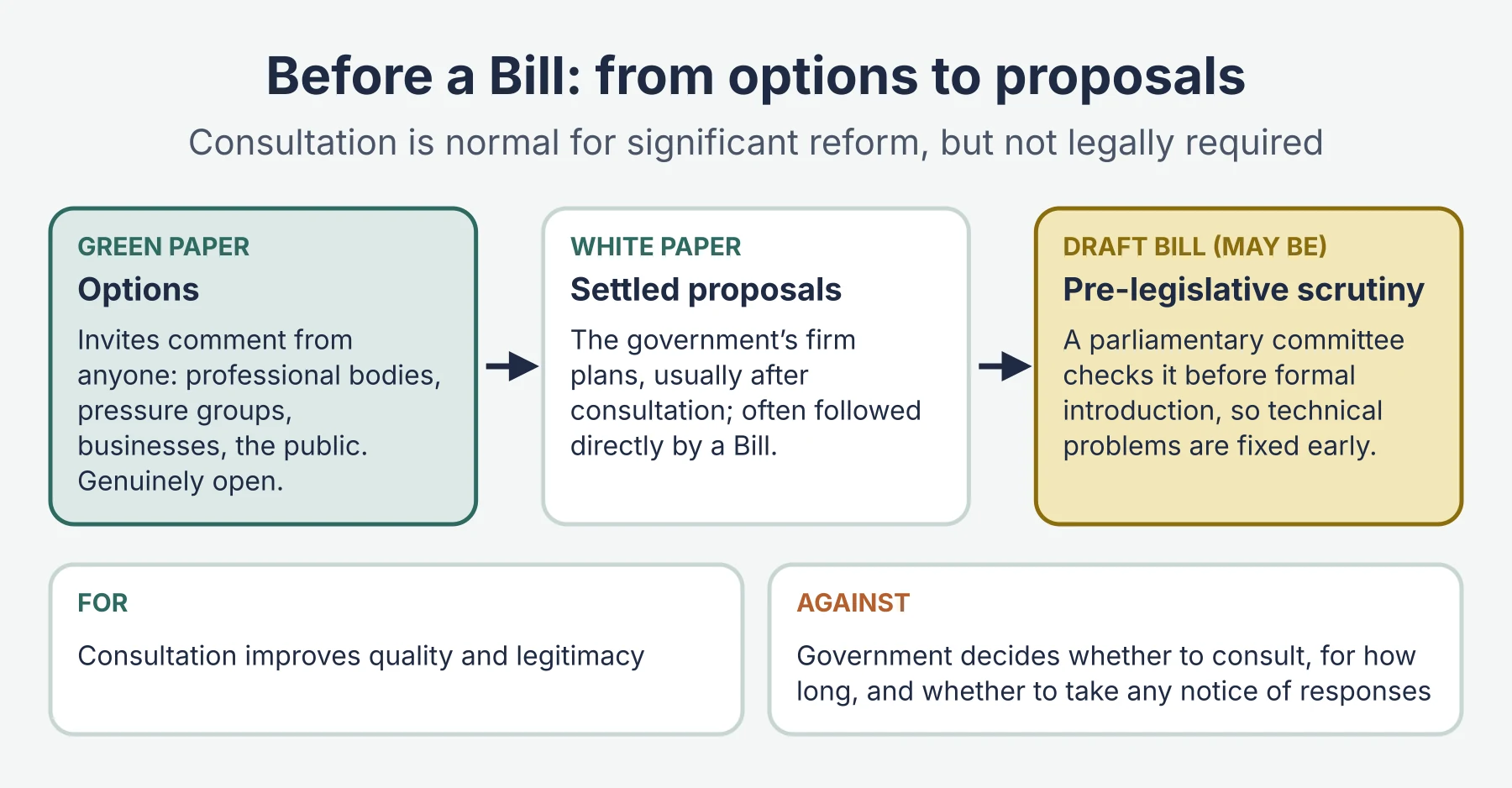
Most government Bills begin as policy inside a government department. Consultation is not legally required for every Bill, but it is normal for significant reform.
- A Green Paper sets out options and invites comment from anyone interested: professional bodies, pressure groups, businesses and the public. It is genuinely open.
- A White Paper sets out the government’s settled proposals, usually after consultation, and is often followed directly by a Bill.
- A draft Bill may also be published for pre-legislative scrutiny by a parliamentary committee before formal introduction, allowing technical problems to be fixed early.
Evaluation: consultation improves quality and legitimacy, but government decides whether to consult, how long to allow and whether to take any notice of the responses.
Kinds of Bill in more detail
| Type | Introduced by | Example |
|---|---|---|
| Public Bill (government) | A minister | Most major legislation |
| Private members’ Bill | A backbench MP or peer | Murder (Abolition of Death Penalty) Act 1965, introduced by Sydney Silverman |
| Private Bill | A promoter such as a local authority or company, affecting a particular body or place | Bills to give a local authority specific powers |
| Hybrid Bill | Government; a public Bill that also affects particular private interests | High Speed Rail (London - West Midlands) Act 2017 |
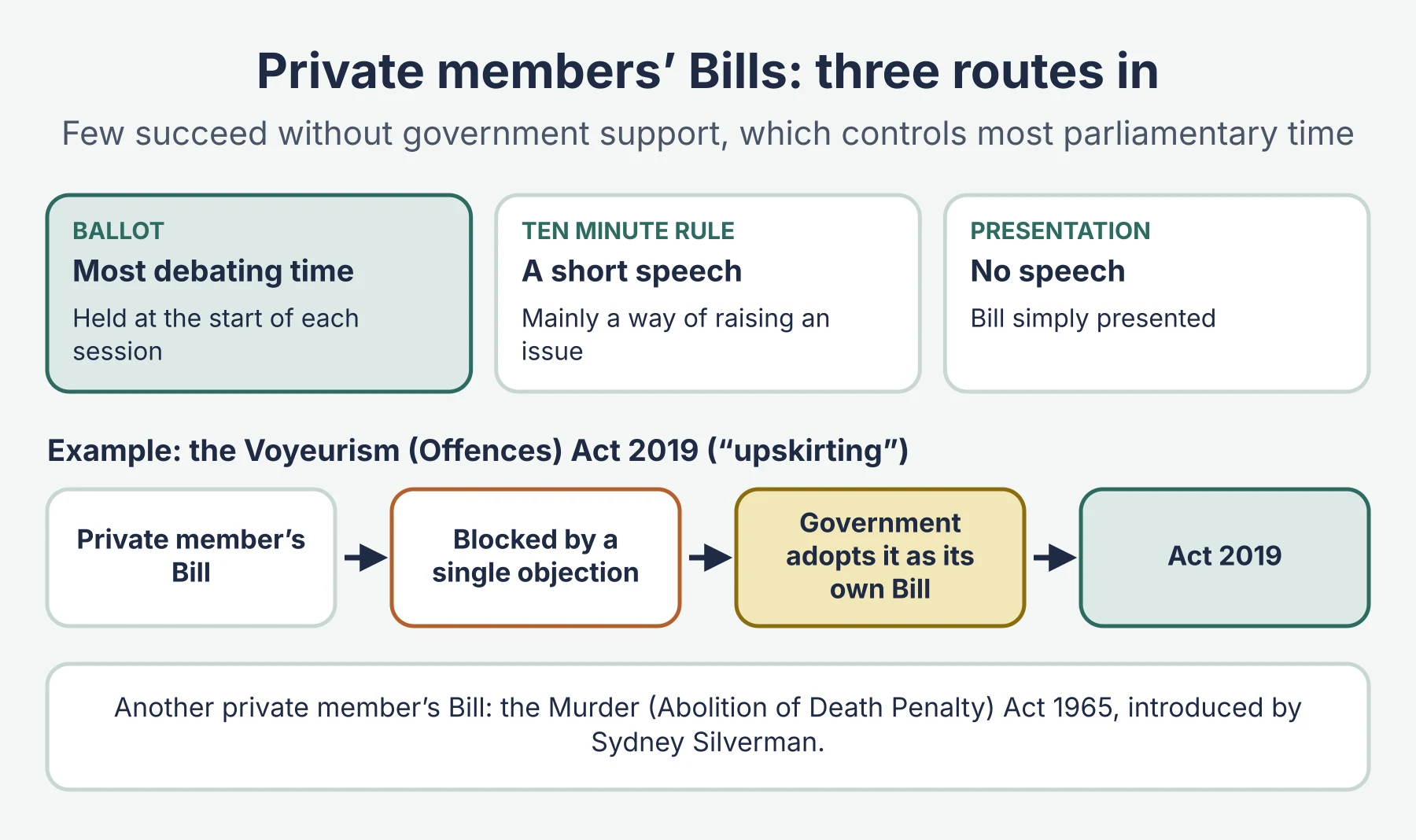
Private members’ Bills enter through three routes in the Commons: the ballot at the start of each session, which gives the most debating time; the Ten Minute Rule, which allows a short speech and is mainly a way of raising an issue; and presentation, with no speech. Few succeed without government support, because government controls most parliamentary time. The Voyeurism (Offences) Act 2019, which made “upskirting” an offence, began as a private member’s Bill that was blocked by a single objection, after which the government adopted the measure as its own Bill.
The formal legislative process: the detail
| Stage | Commons | Lords |
|---|---|---|
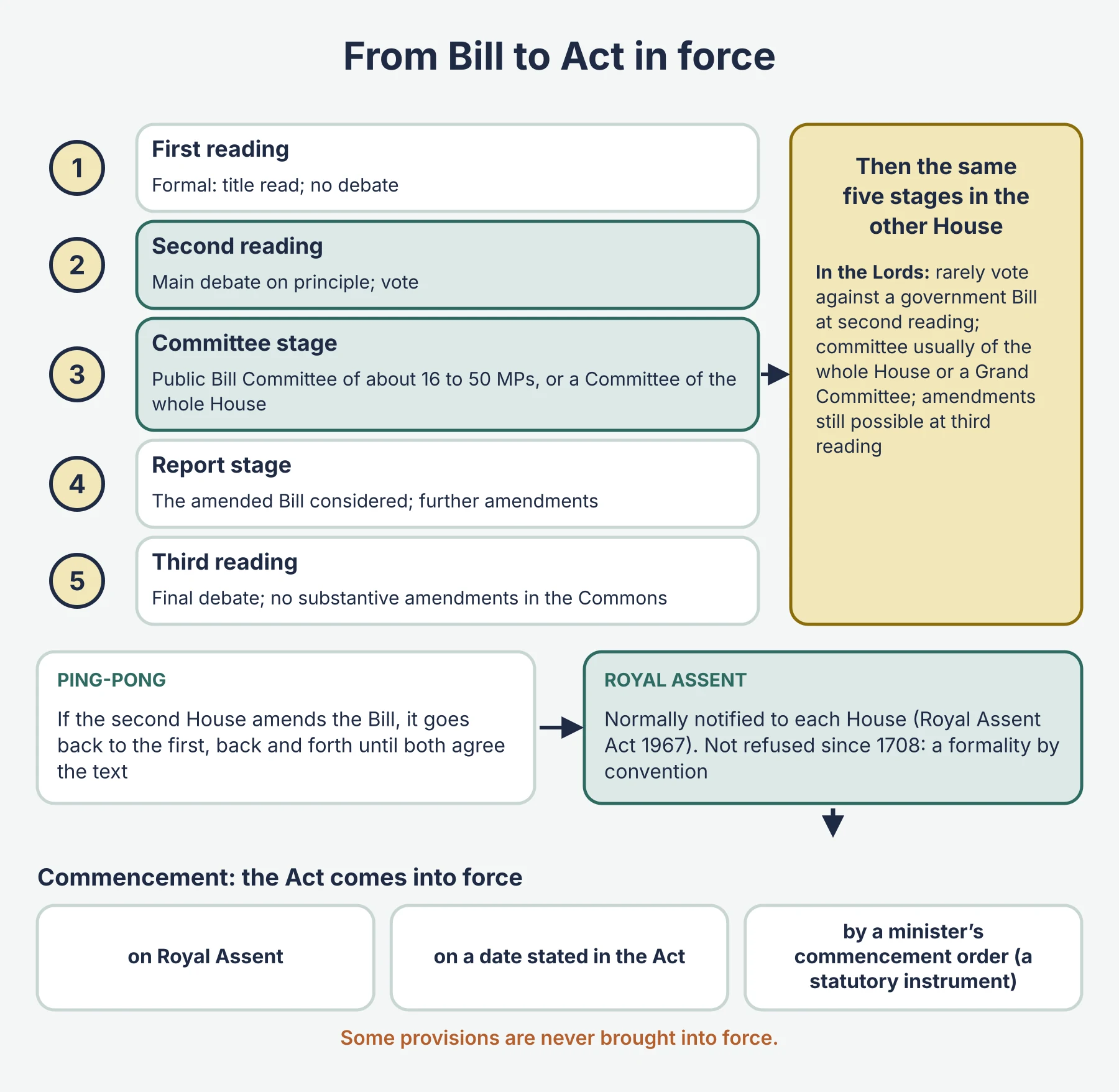
| First reading | Formal: title read; no debate | Formal |
| Second reading | Main debate on principle; vote | Main debate on principle; Lords rarely vote against a government Bill at this stage |
| Committee stage | Usually a Public Bill Committee of about 16 to 50 MPs reflecting party strength; some Bills, such as major constitutional Bills, go to a Committee of the whole House | Usually a committee of the whole House or a Grand Committee open to all peers |
| Report stage | The amended Bill is considered; further amendments | Further amendments |
| Third reading | Final debate; in the Commons no substantive amendments | Amendments still possible |
Ping-pong: if the second House amends a Bill, it returns to the first, and may pass back and forth until both agree on the text.
Royal Assent: under the Royal Assent Act 1967 the monarch’s assent is normally notified to each House rather than given in person. Assent has not been refused since 1708 and is now a formality by convention.
Commencement: an Act may come into force on Royal Assent, on a date stated in the Act, or on a date set later by a minister through a commencement order, which is a statutory instrument. Some provisions are never brought into force.
When the Lords and Commons disagree
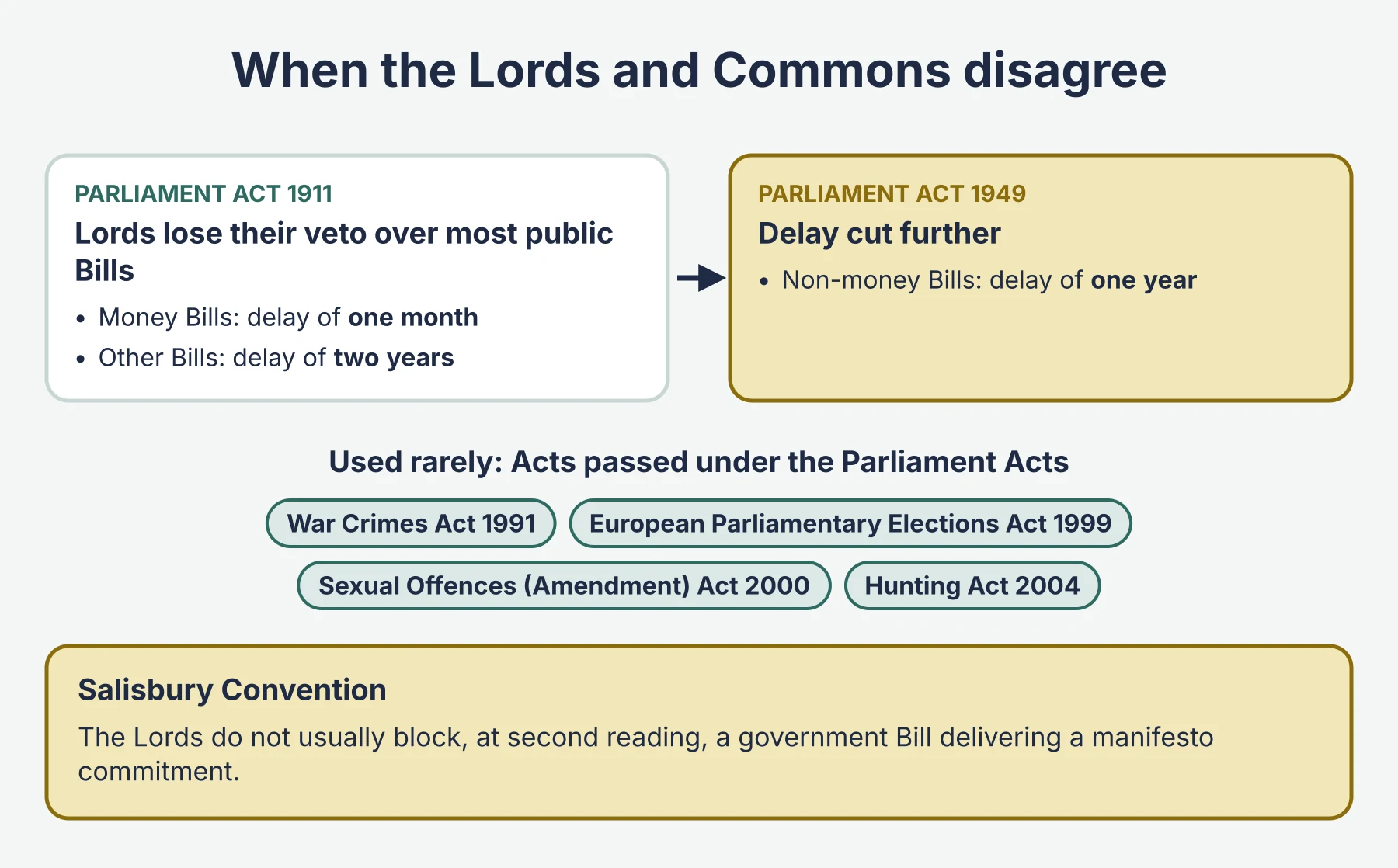
The Parliament Act 1911 removed the Lords’ power to veto most public Bills: money Bills could be delayed for only one month and other Bills for two years. The Parliament Act 1949 reduced the delay for non-money Bills to one year. The Acts have been used rarely; besides the War Crimes Act 1991 and the Hunting Act 2004, they were used for the European Parliamentary Elections Act 1999 and the Sexual Offences (Amendment) Act 2000. The Salisbury Convention means the Lords do not usually block, at second reading, a government Bill delivering a commitment in its election manifesto.
Influences on Parliament: new examples and evaluation
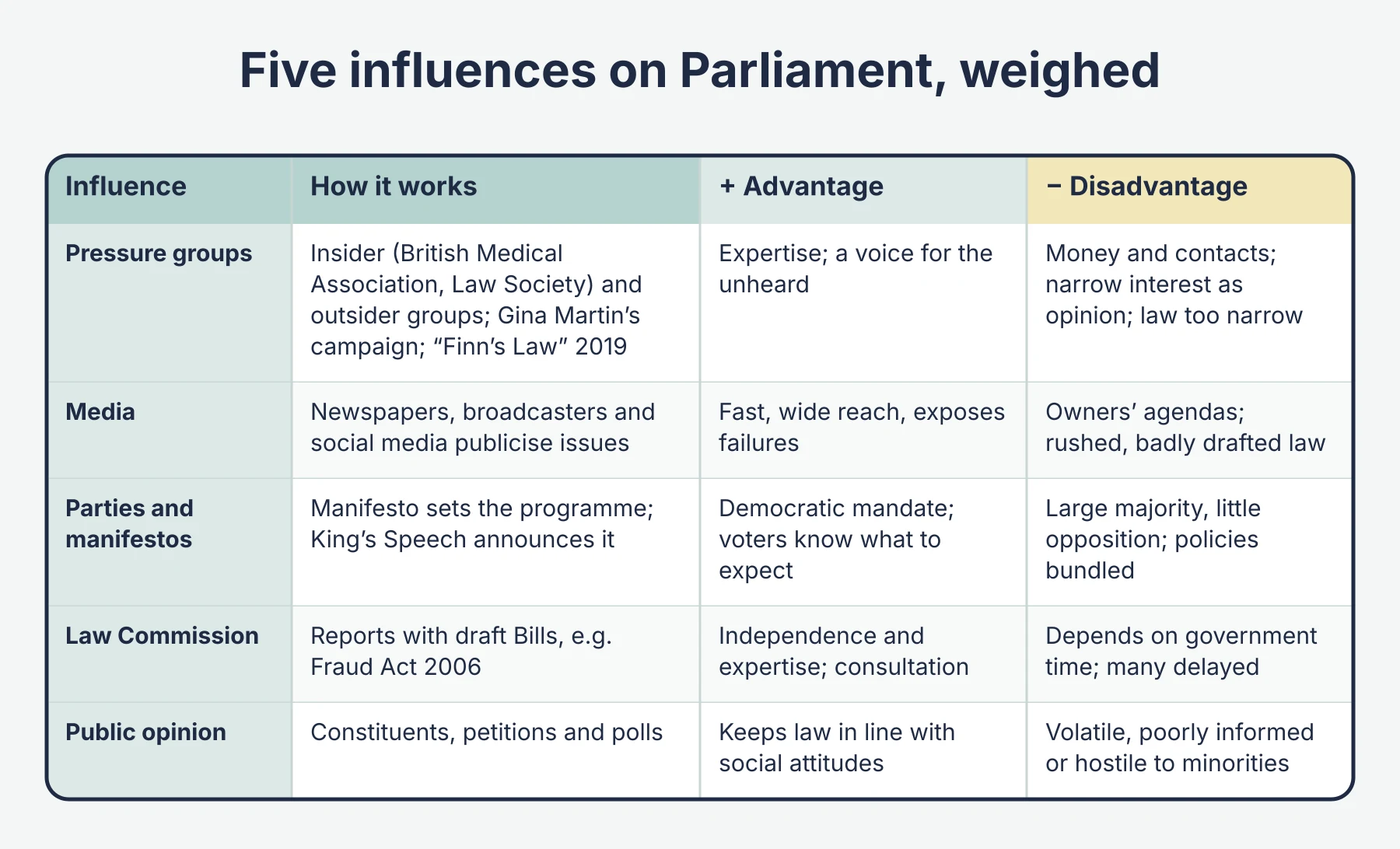
The specification requires the influences and their advantages and disadvantages. Use different examples for each, and evaluate each one.
Pressure groups
Insider groups have regular access to government and are consulted (the British Medical Association, the Law Society). Outsider groups lack access and rely on publicity and protest. Campaigns by individuals can also work: Gina Martin’s campaign contributed to the Voyeurism (Offences) Act 2019, and a campaign after a police dog, Finn, was stabbed contributed to the Animal Welfare (Service Animals) Act 2019, known as “Finn’s Law”.
- Advantages: expertise; give a voice to people who would otherwise be unheard; raise issues parties neglect.
- Disadvantages: influence depends on money and contacts; a narrow interest may be presented as public opinion; law made in reaction to one case may be too narrow.
The media
Newspapers, broadcasters and social media publicise issues and can pressure the government into acting quickly.
- Advantages: fast, reach a large audience, can expose problems (media investigations put pressure on government after high-profile failures).
- Disadvantages: media owners have their own agendas; pressure for speed can produce badly drafted law; coverage reflects what sells, not what matters most.
Political parties and manifestos
The governing party’s manifesto sets much of the legislative programme, and the King’s Speech at the start of each session announces it.
- Advantages: democratic mandate from an election; voters know what to expect.
- Disadvantages: a large majority lets the government pass laws with little effective opposition; manifestos bundle many policies, so a vote is not approval of each one.
Law Commission and expert bodies
Law Commission reports, often with draft Bills, can lead to legislation, such as the Fraud Act 2006.
- Advantages: independence and legal expertise; careful consultation.
- Disadvantages: reports depend on government finding time; many are delayed or not implemented.
Public opinion
Elected MPs respond to constituents, petitions and polls.
- Advantages: keeps law in line with social attitudes.
- Disadvantages: opinion can be volatile, poorly informed or hostile to minorities.
Parliamentary supremacy and its limits
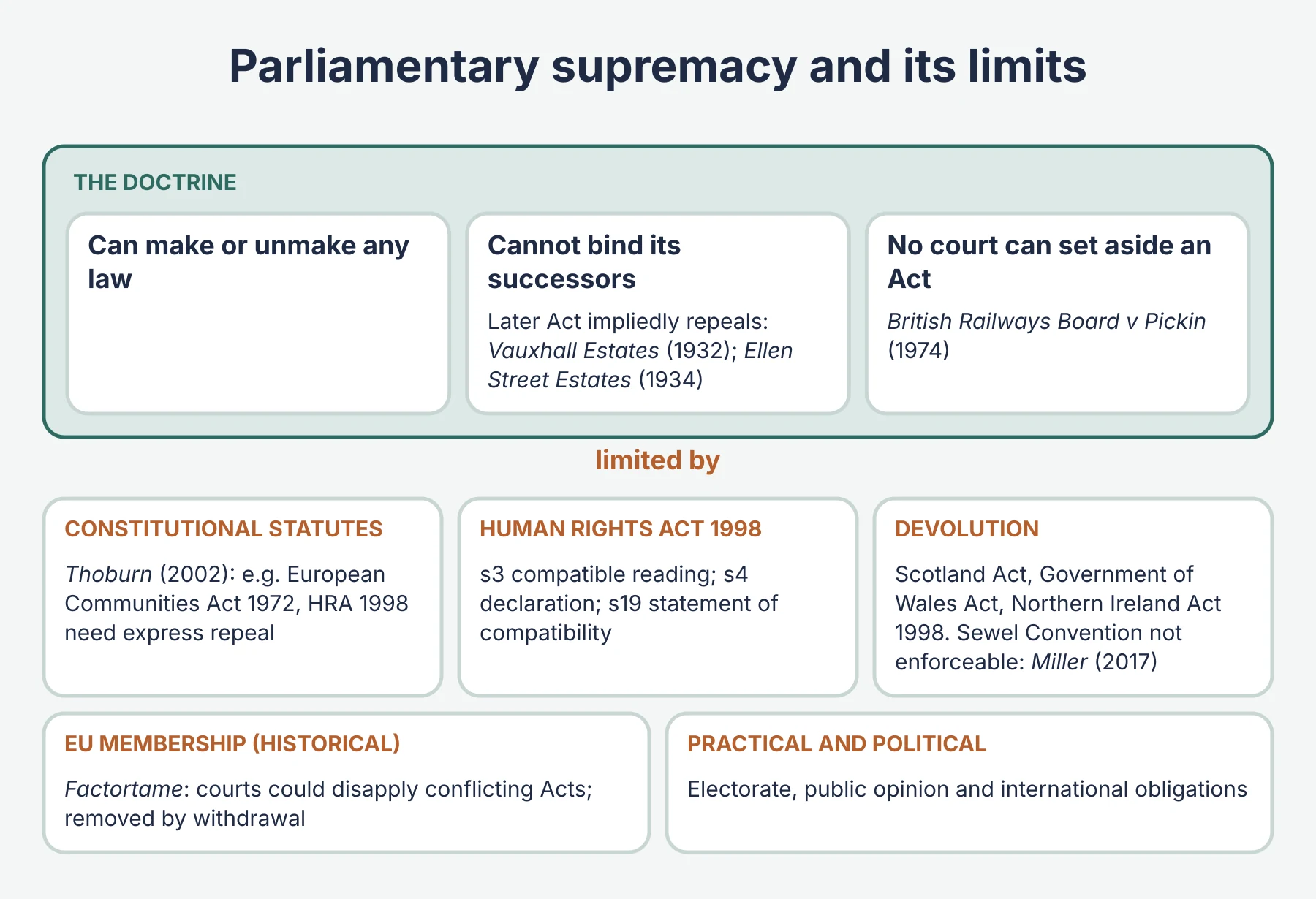
The doctrine
- Parliament can make or unmake any law.
- No Parliament can bind its successors. If a later Act conflicts with an earlier one, the later Act impliedly repeals it, as in Vauxhall Estates v Liverpool Corporation (1932) and Ellen Street Estates v Minister of Health (1934).
- No court or other body can set aside an Act. In British Railways Board v Pickin (1974) the courts refused to examine whether Parliament had been misled during a private Bill’s passage.
The limits
- Constitutional statutes. In Thoburn v Sunderland City Council (2002), the “metric martyrs” case, Laws LJ said some statutes, such as the European Communities Act 1972 and the Human Rights Act 1998, are “constitutional” and cannot be impliedly repealed; only express words will do.
- Human Rights Act 1998. Courts read legislation compatibly with Convention rights where possible (section 3) and can make a declaration of incompatibility (section 4). A minister must make a statement of compatibility on a Bill under section 19, or state that he cannot but wishes to proceed. In practice Parliament usually responds to declarations.
- Devolution. The Scotland Act 1998, Government of Wales Act 1998 and Northern Ireland Act 1998 gave law-making powers to devolved bodies. The Sewel Convention, that Westminster will not normally legislate on devolved matters without consent, is now written into statute, but in R (Miller) v Secretary of State for Exiting the European Union (2017) the Supreme Court held it is a political convention that courts cannot enforce.
- European Union membership (historical): Factortame allowed courts to disapply Acts that conflicted with EU law while the UK was a member. Withdrawal removed this limit.
- Practical and political limits: the electorate, public opinion and international obligations restrain what Parliament will actually do.
Worked example: evaluation of one influence
Question: Discuss the advantages and disadvantages of the media as an influence on Parliament. (Plan)
Define: newspapers, broadcasting, social media
Advantage 1: speed and reach -> issue reaches government quickly
Advantage 2: scrutiny of failures -> accountability
Disadvantage 1: agenda of owners and editors -> distorted priorities
Disadvantage 2: reaction to one case -> rushed, poorly drafted law
Weigh: media works best as a trigger for consultation, worst as a substitute for it
Conclude
Common mistakes
- Saying a Green Paper contains firm proposals.
- Describing the stages without the role of each (what actually happens at committee).
- Stating that the Lords can veto any Bill, or that the Parliament Acts apply to every Bill.
- Listing influences without advantages and disadvantages, which the specification names separately.
- Treating the Human Rights Act as allowing courts to strike down Acts.
Exam technique
Outline the process with each stage’s function, not a list of names. Explain an influence by saying how it works and giving an example. Discuss or evaluate influences or supremacy by weighing both sides and concluding.
Revise with the Parliamentary Law Making revision notes and test yourself with the Parliamentary Law Making practice questions. Law made under Acts is covered in Delegated Legislation.
Related resources
-
Practice questions
AQA A Level Law (7162): Law Making: Parliamentary Law Making – Practice Questions
Original practice questions with full answers on the legislative process, influences on Parliament and parliamentary supremacy and its limits, for AQA Law 7162.
Law · AQA · A Level
Try questions -
Revision notes
AQA A Level Law (7162): Law Making: Parliamentary Law Making – Revision Notes
Revision notes on Green and White Papers, Bill stages, Parliament Acts, influences on Parliament and supremacy's limits, with a self-test for AQA Law 7162.
Law · AQA · A Level
Revise topic -
Study guides
AQA A Level Law (7162): Law Making: Statutory Interpretation
Statutory interpretation for AQA A Level Law 7162: literal, golden and mischief rules, the purposive approach, aids, and the impact of EU law and the HRA.
Law · AQA · A Level
Read guide
Get free revision emails (optional)
Occasional emails with practice questions, worked explanations and links to free resources for the qualification and subjects you choose. No spam, and you can unsubscribe from any email. The free tools on this site never need an email.