
Revision Notes
AQA A Level Law (7162): The Rule of Law – Revision Notes
Revision notes on the rule of law: three elements, Dicey, Raz and Bingham, modern cases and its application in three areas, with a self-test for AQA Law 7162.
- Subject
- Law
- Level
- A LEVELS
- Topic
- Section 3.1 – The Nature of Law and the English Legal System
- Author
- Marlbridge Academic Team
- Updated
- Reviewed by
- Aizaz Raoof Ali (what this means)
Aligned to AQA A Level Law (7162), For teaching from September 2017 onwards, A-level exams 2019 onwards. Official specification .
Syllabus page (what it covers and how it is assessed): AQA A Level Law.
Syllabus points this page covers
7162
- The rule of law
Found an error? Report a correction.
Need help with this topic? Request a free trial class for A Level Law (7162).
Condensed notes on The rule of law in AQA A-level Law (7162) section 3.1. The specification wants a basic understanding of the constitutional doctrine and its application to law making, the legal system and substantive law through three elements. For full explanation and an annotated answer, see the Rule of Law study guide.
The specification’s three elements
- No person shall be sanctioned except in accordance with the law.
- Equality before the law.
- Fairness and clarity.
Always state these in the specification’s words before using any theorist’s version.
Status of the doctrine
- A constitutional principle, not a single enforceable rule.
- Recognised but not defined by section 1 of the Constitutional Reform Act 2005 (“the existing constitutional principle of the rule of law”).
- The Lord Chancellor’s oath includes respecting the rule of law.
Three theorists
| Theorist | Account | Key content | Use in evaluation |
|---|---|---|---|
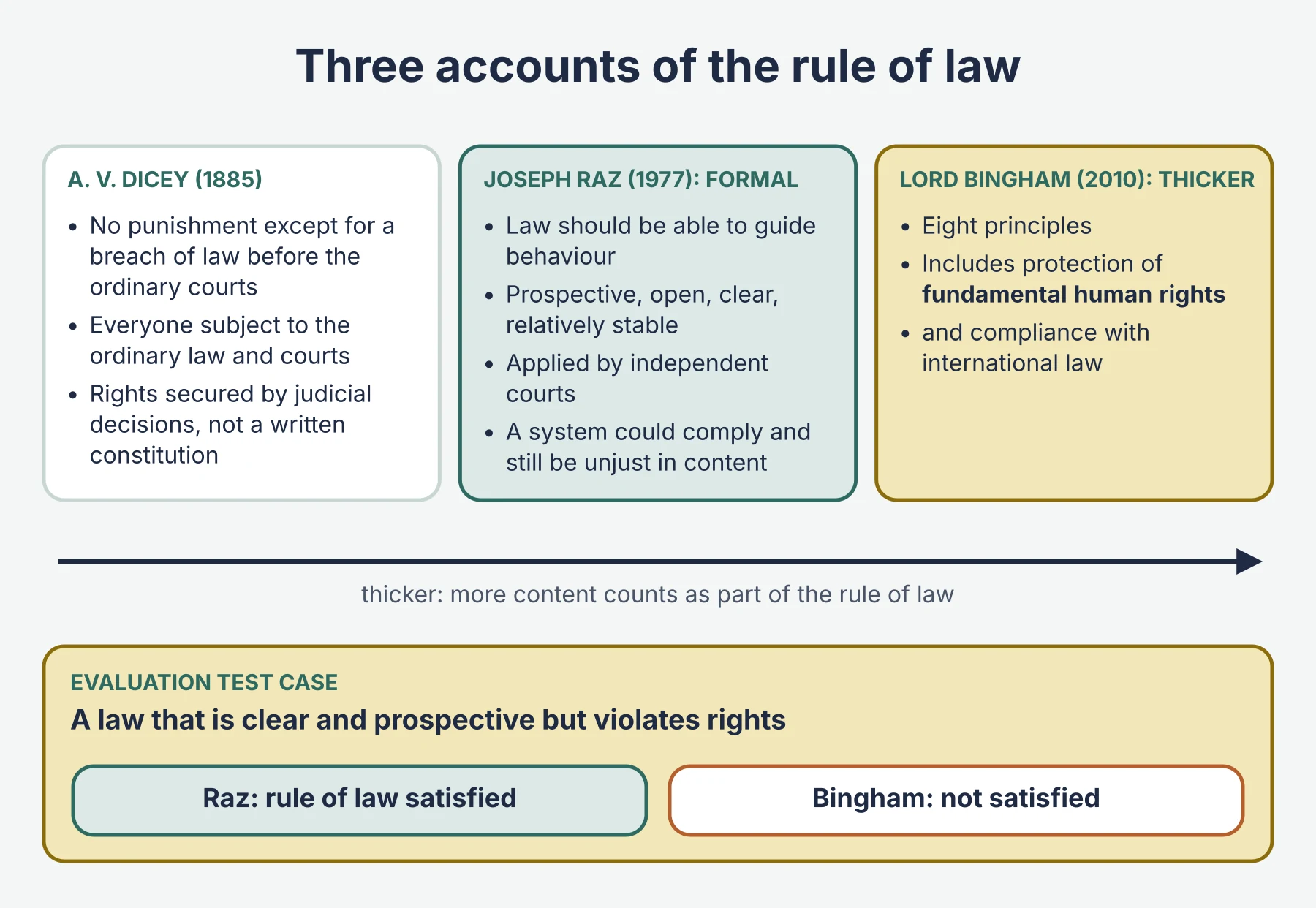
| Dicey (1885) | Classic | No punishment except for breach of law before ordinary courts; everyone subject to ordinary law; rights secured by judicial decisions | Source of elements 1 and 2; dated by the administrative state |
| Raz (1977) | Formal (thin) | Law must be able to guide conduct: prospective, open, clear, stable, applied by independent courts | A clear but unjust law can satisfy it |
| Bingham (2010) | Substantive (thick) | Eight principles including equality, limits on official power, human rights, affordable dispute resolution, fair procedures, international law | Rights are part of the rule of law |
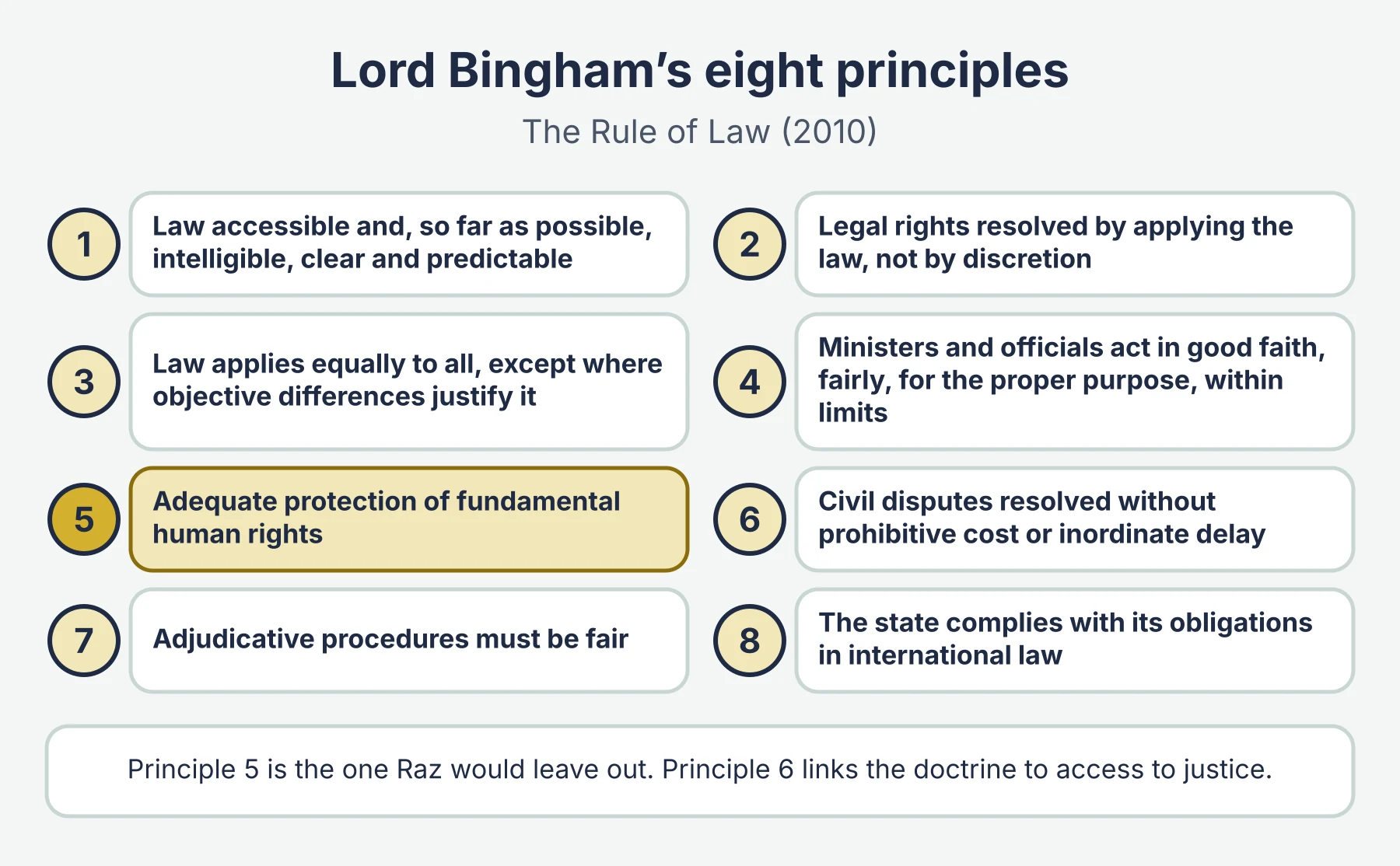
Bingham’s eight in short form: accessible and clear law; rights decided by law not discretion; equality (unless objectively justified); officials act in good faith and within limits; protection of fundamental rights; civil disputes resolved without prohibitive cost or delay; fair procedures; compliance with international law.
Authorities by element
Element 1: sanction only in accordance with law
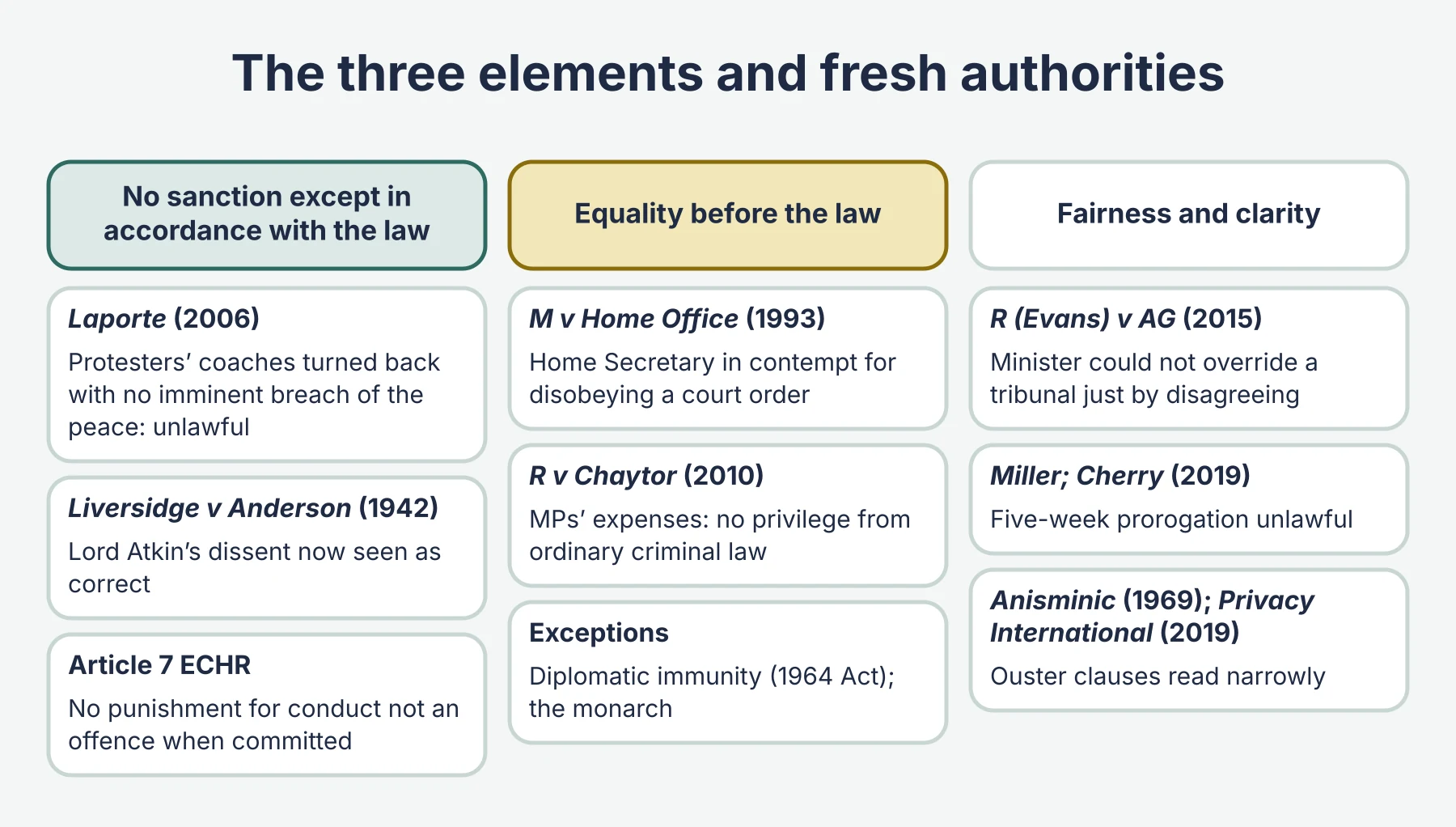
- R (Laporte) v Chief Constable of Gloucestershire (2006): coaches of protesters turned back with no imminent breach of the peace; unlawful.
- Liversidge v Anderson (1942): Lord Atkin’s dissent; courts must test “reasonable cause” for detention.
- Article 7 ECHR: no punishment without law.
Element 2: equality before the law
- M v Home Office (1993): Home Secretary in contempt of court.
- R v Chaytor (2010): parliamentary privilege did not protect MPs from prosecution over expenses.
- Exceptions: diplomatic immunity (Diplomatic Privileges Act 1964); the monarch.
Element 3: fairness and clarity
- R (Evans) v Attorney General (2015): ministerial override of a tribunal decision on disclosure of Prince Charles’s letters held invalid.
- R (Miller) v Prime Minister; Cherry (2019): five-week prorogation unlawful.
- Anisminic (1969); Privacy International (2019): ouster clauses read narrowly, preserving judicial review.
Application grid
| Area | Respects the rule of law | Strains it |
|---|---|---|
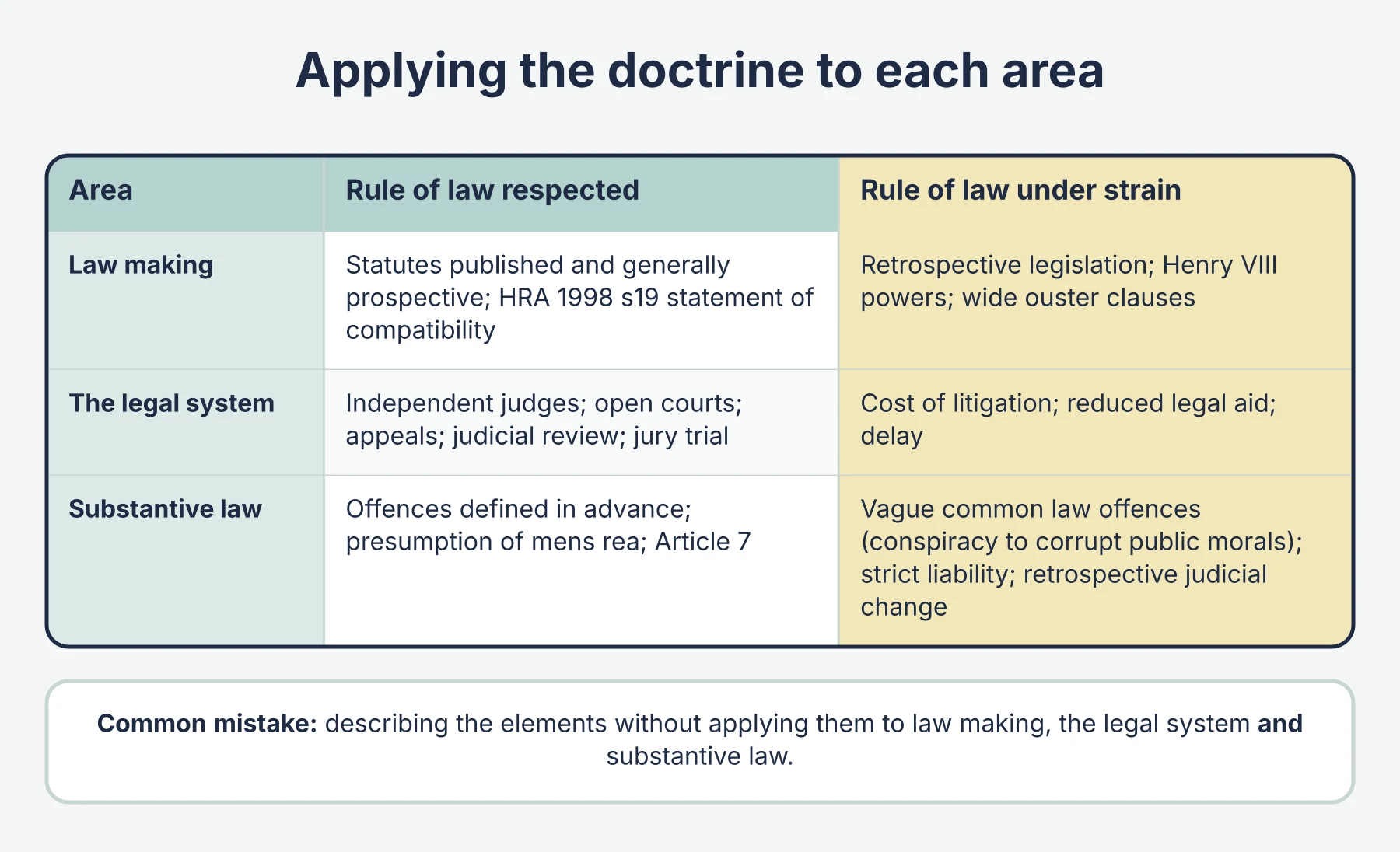
| Law making | Published, prospective statutes; s19 Human Rights Act compatibility statements | Retrospective Acts; Henry VIII powers; ouster clauses |
| Legal system | Independent judiciary; open courts; appeals; judicial review; juries | Cost; legal aid cuts; delay |
| Substantive law | Offences defined in advance; presumption of mens rea; Article 7 | Vague common law offences; strict liability; retrospective judicial change |
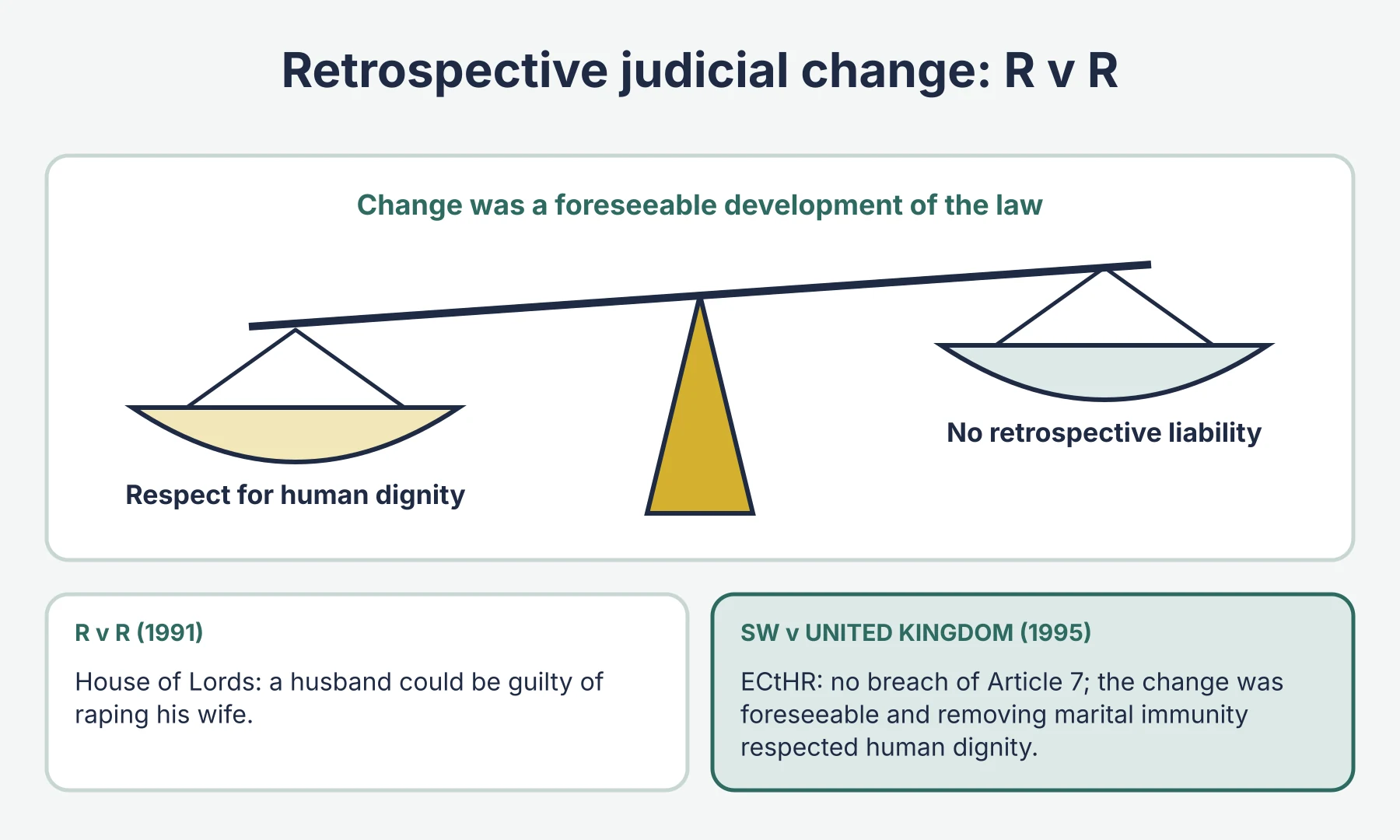
Balanced example: R v R (1991) removed marital immunity for rape; SW v United Kingdom (1995) held no Article 7 breach because the change was foreseeable and consistent with human dignity.
Key terms
| Term | Meaning |
|---|---|
| Rule of law | The constitutional principle that power is exercised according to law and that law is clear, equal and fair |
| Constitutional doctrine | A fundamental principle about how state power should operate |
| Retrospective law | A law that changes the legal effect of past conduct |
| Henry VIII power | A power in an Act allowing ministers to amend or repeal Acts by delegated legislation |
| Ouster clause | A statutory provision attempting to exclude the courts’ review |
| Prorogation | Ending a parliamentary session, suspending sittings |
| Thin and thick accounts | Formal (Raz) versus rights-including (Bingham) versions of the doctrine |
Exam traps
- Dicey’s three points presented as the specification’s three elements.
- No application to all three named areas.
- Treating the rule of law and parliamentary supremacy as the same idea.
- Only historic cases; use modern ones.
- Claiming the rule of law is always achieved.
Self-test
- State the specification’s three elements of the rule of law.
- Which Act recognises the rule of law as an existing constitutional principle?
- What is the main difference between Raz’s and Bingham’s accounts?
- Why was the police action in Laporte unlawful?
- Why is Lord Atkin’s dissent in Liversidge v Anderson significant?
- Which case shows a minister being held in contempt of court?
- What did R v Chaytor decide?
- Why was the override in Evans invalid?
- What did the Supreme Court decide in Miller; Cherry (2019)?
- Give two features of law making that strain the rule of law.
- Give two features of the legal system that support the rule of law.
- Why is SW v United Kingdom useful in evaluation?
Answers: 1. No person shall be sanctioned except in accordance with the law; equality before the law; fairness and clarity. 2. The Constitutional Reform Act 2005, section 1. 3. Raz’s is formal, about law’s capacity to guide conduct; Bingham’s includes substantive values such as human rights. 4. There was no imminent breach of the peace, so the police had no legal authority. 5. He insisted the courts must test whether a minister had reasonable grounds, a view now seen as the correct statement of the rule of law. 6. M v Home Office (1993). 7. That parliamentary privilege did not protect MPs from prosecution for false accounting over expenses. 8. Allowing a minister to overrule a judicial decision simply because he disagreed would undermine the rule of law. 9. That advice to prorogue Parliament for five weeks was unlawful because it frustrated Parliament’s functions without reasonable justification. 10. Any two: retrospective legislation; Henry VIII powers; ouster clauses. 11. Any two: judicial independence; open courts; appeals and judicial review; jury trial. 12. It shows a retrospective-looking judicial change being upheld as foreseeable and consistent with human dignity, so the rule of law was balanced against another value.
More resources on this topic
Rule of Law study guide | Rule of Law practice questions | Rule of Law, Law Reform, the EU and Civil Justice revision notes
Related resources
-
Practice questions
AQA A Level Law: The Nature of Law and the English Legal System — Practice Questions
Original exam-style practice questions with full worked answers on law and morality, law and justice, the rule of law and legal institutions.
Law · AQA · A Level
Try questions -
Revision notes
AQA A Level Law: The Nature of Law and the English Legal System — Revision Notes
Revision notes on law making, precedent, interpretation, courts, legal personnel, access to justice, fault and law and morality for AQA A Level Law 7162.
Law · AQA · A Level
Revise topic -
Study guides
AQA A-Level Law: The Nature of Law and the English Legal System (7162)
Nature of law, the rule of law, law making and the legal system: Section 3.1 of AQA A Level Law 7162, examined at 25 marks on each of the three papers.
Law · AQA · A Level
Read guide
Get free revision emails (optional)
Occasional emails with practice questions, worked explanations and links to free resources for the qualification and subjects you choose. No spam, and you can unsubscribe from any email. The free tools on this site never need an email.