
Study Guides
AQA A Level Law (7162): The Rule of Law
The rule of law for AQA A Level Law 7162: its three elements, Dicey, Raz and Bingham, and how it applies to law making, the legal system and substantive law.
- Subject
- Law
- Level
- A LEVELS
- Topic
- Section 3.1 – The Nature of Law and the English Legal System
- Author
- Marlbridge Academic Team
- Updated
- Reviewed by
- Aizaz Raoof Ali (what this means)
Aligned to AQA A Level Law (7162), For teaching from September 2017 onwards, A-level exams 2019 onwards. Official specification .
Syllabus page (what it covers and how it is assessed): AQA A Level Law.
Syllabus points this page covers
7162
- The rule of law
Found an error? Report a correction.
Need help with this topic? Request a free trial class for A Level Law (7162).
This guide covers The rule of law row of AQA A-level Law (7162) section 3.1. The specification asks for a “basic understanding of the constitutional doctrine of the rule of law and its application to law making, the legal system and substantive law”, through three elements: no person shall be sanctioned except in accordance with the law; equality before the law; and fairness and clarity. The Rule of Law, Parliament, Morality and Justice study guide introduces the three elements with Entick v Carrington, A v Secretary of State for the Home Department, the War Damage Act 1965, UNISON and R v R. This page adds the theory behind the doctrine, a fresh set of authorities, and a method for applying it to each of the three areas the specification names.
What kind of doctrine is it?
The rule of law is a constitutional doctrine: a principle about how power in the state should be exercised, rather than a single rule that a court enforces. The United Kingdom has no single written constitution, so the doctrine works through statutes, judicial decisions and conventions. Section 1 of the Constitutional Reform Act 2005 recognises “the existing constitutional principle of the rule of law”, and the oath of the Lord Chancellor includes a commitment to respect it, but no statute defines it. That is why the theorists matter.
Three accounts of the rule of law
A. V. Dicey (1885)
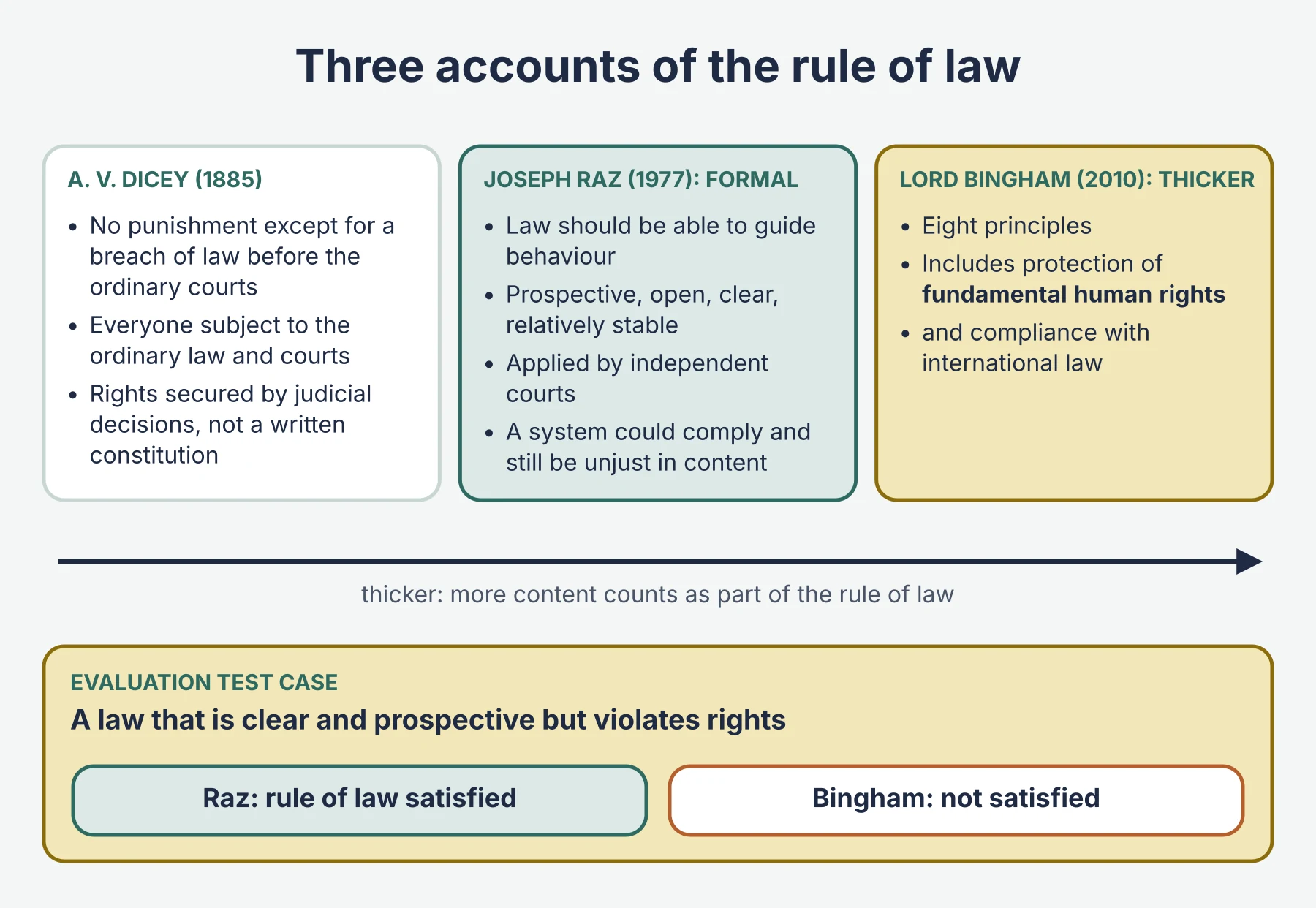
Dicey’s three points were that no one can be punished except for a breach of law established before the ordinary courts; that everyone, whatever their rank, is subject to the ordinary law and the ordinary courts; and that the rights of individuals are secured by judicial decisions rather than by a written constitution. The specification’s first two elements come largely from Dicey. Criticism: Dicey wrote before the growth of the modern administrative state, and his preference for the “ordinary courts” sits awkwardly with tribunals and specialist regulators.
Joseph Raz
Raz, in “The Rule of Law and its Virtue” (1977), offered a formal account: law should be capable of guiding people’s behaviour. Laws should therefore be prospective, open and clear, relatively stable, made under clear general rules, and applied by independent courts. On his view, the rule of law is one virtue a legal system can have; a legal system could comply with it and still be unjust in content. This matches the specification’s element of fairness and clarity in its procedural sense.
Lord Bingham (2010)
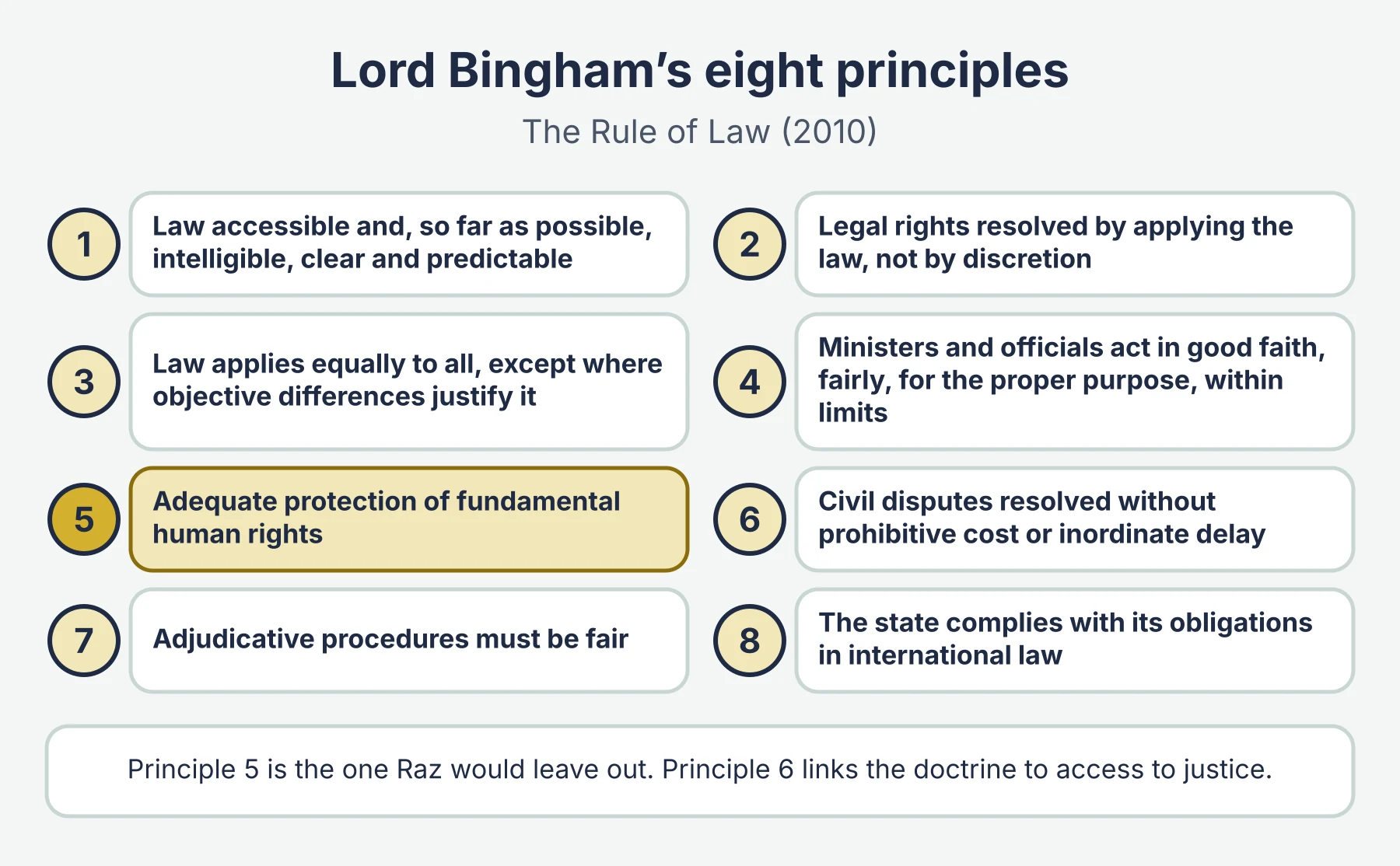
Lord Bingham, in The Rule of Law (2010), set out a thicker account in eight principles:
- The law must be accessible and, so far as possible, intelligible, clear and predictable.
- Questions of legal right should normally be resolved by applying the law, not by discretion.
- The law should apply equally to all, except where objective differences justify differentiation.
- Ministers and officials must exercise their powers in good faith, fairly, for the purpose for which they were conferred, and within their limits.
- The law must afford adequate protection of fundamental human rights.
- There must be means of resolving civil disputes without prohibitive cost or inordinate delay.
- Adjudicative procedures must be fair.
- The state must comply with its obligations in international law.
Using the theories: Raz and Bingham disagree about whether human rights are part of the rule of law. You can use that disagreement in evaluation: a law that is clear and prospective but violates rights satisfies Raz but not Bingham.
Applying the three elements: fresh authorities
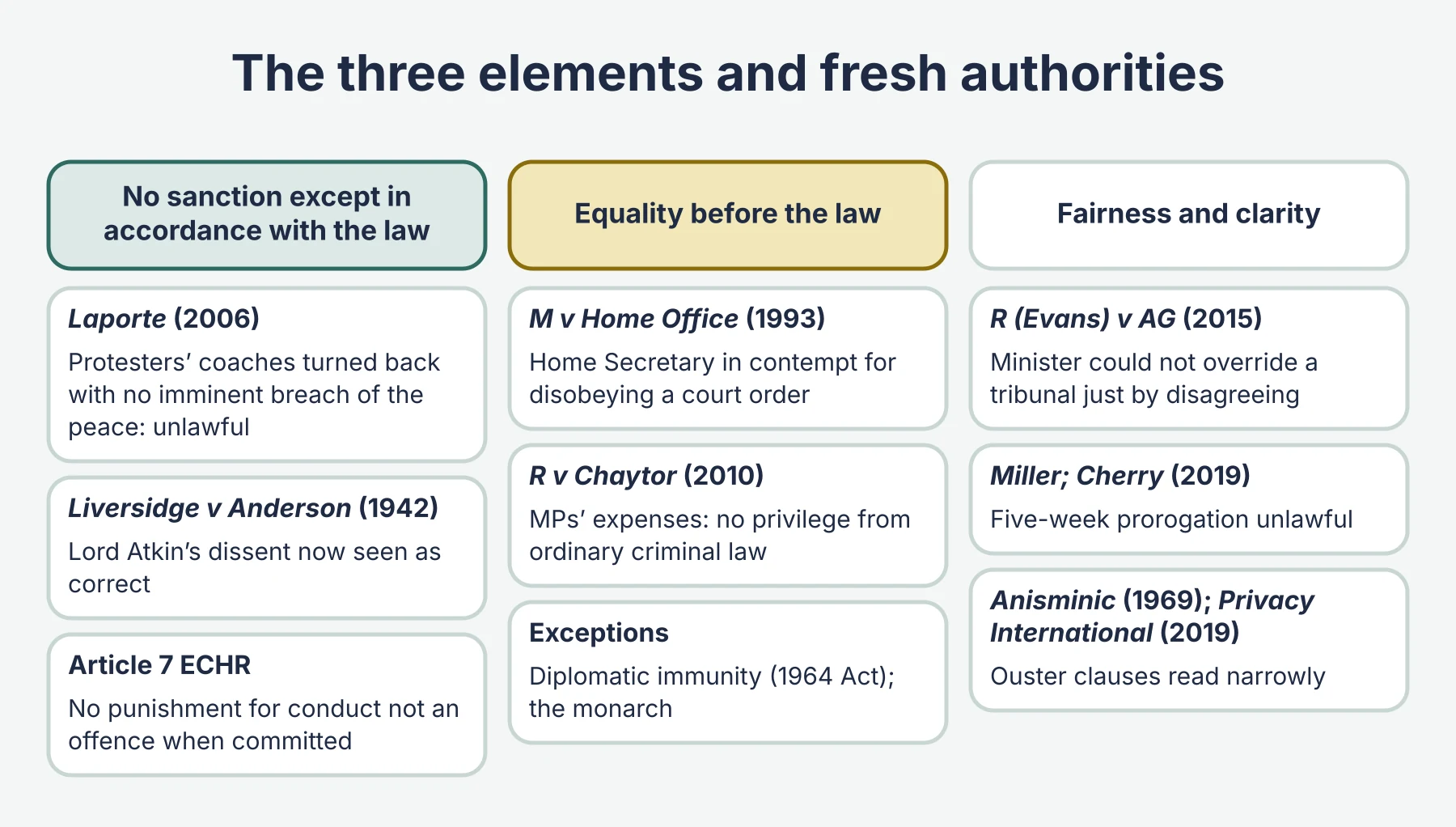
No person shall be sanctioned except in accordance with the law
- R (Laporte) v Chief Constable of Gloucestershire (2006): police stopped coaches carrying protesters and escorted them back to London without any arrest. The House of Lords held the action unlawful because there was no imminent breach of the peace; the police had acted without legal authority.
- Liversidge v Anderson (1942): the majority allowed the Home Secretary to detain a person in wartime if he believed he had “reasonable cause”. Lord Atkin’s dissent, insisting that the courts must test whether there were reasonable grounds, is now regarded as stating the rule of law correctly.
- Article 7 of the European Convention on Human Rights, given effect by the Human Rights Act 1998, prohibits punishment for conduct that was not an offence when committed.
Equality before the law
- M v Home Office (1993): the Home Secretary was held in contempt of court for disobeying a court order to return a deported asylum seeker. Ministers are subject to the courts like anyone else.
- R v Chaytor (2010): MPs charged with false accounting over their expenses argued parliamentary privilege protected them. The Supreme Court held it did not; ordinary criminal law applied.
- Exceptions to discuss: diplomatic immunity under the Diplomatic Privileges Act 1964 and the special position of the monarch show that equality is not absolute. Bingham’s third principle allows differences only where objectively justified.
Fairness and clarity
- R (Evans) v Attorney General (2015): the Attorney General used a statutory power to override a tribunal’s decision that letters from Prince Charles to ministers should be disclosed. The Supreme Court held the override invalid; allowing a minister to overrule a judicial decision simply because he disagreed with it would undermine the rule of law.
- R (Miller) v Prime Minister; Cherry v Advocate General (2019): the Supreme Court held that advice to prorogue Parliament for five weeks was unlawful because it frustrated Parliament’s constitutional functions without reasonable justification. Even the Prime Minister’s prerogative powers have legal limits.
- Anisminic v Foreign Compensation Commission (1969) and R (Privacy International) v Investigatory Powers Tribunal (2019): the courts read clauses that appeared to exclude judicial review narrowly, so that bodies could not make legal errors without any court being able to check them.
Applying the doctrine to each area
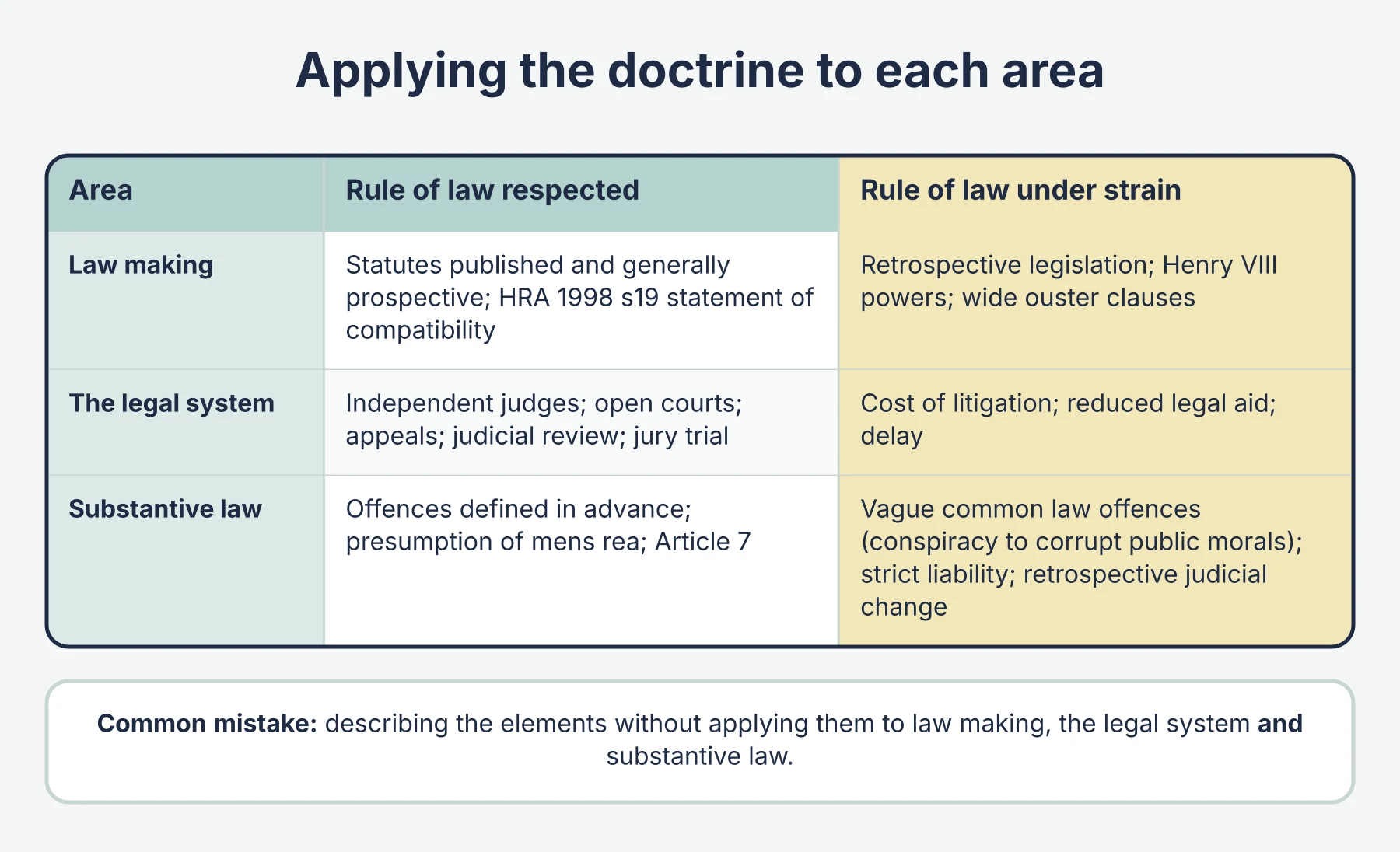
| Area | Rule of law respected | Rule of law under strain |
|---|---|---|
| Law making | Statutes are published and generally prospective; Human Rights Act 1998 section 19 requires a ministerial statement on compatibility | Retrospective legislation; Henry VIII powers allowing ministers to amend Acts by delegated legislation; wide ouster clauses |
| The legal system | Independent judges; open courts; appeals; judicial review; jury trial | Cost of litigation; reduced legal aid; delay |
| Substantive law | Offences defined in advance; presumption of mens rea; Article 7 | Vague common law offences (conspiracy to corrupt public morals); strict liability; retrospective judicial change |
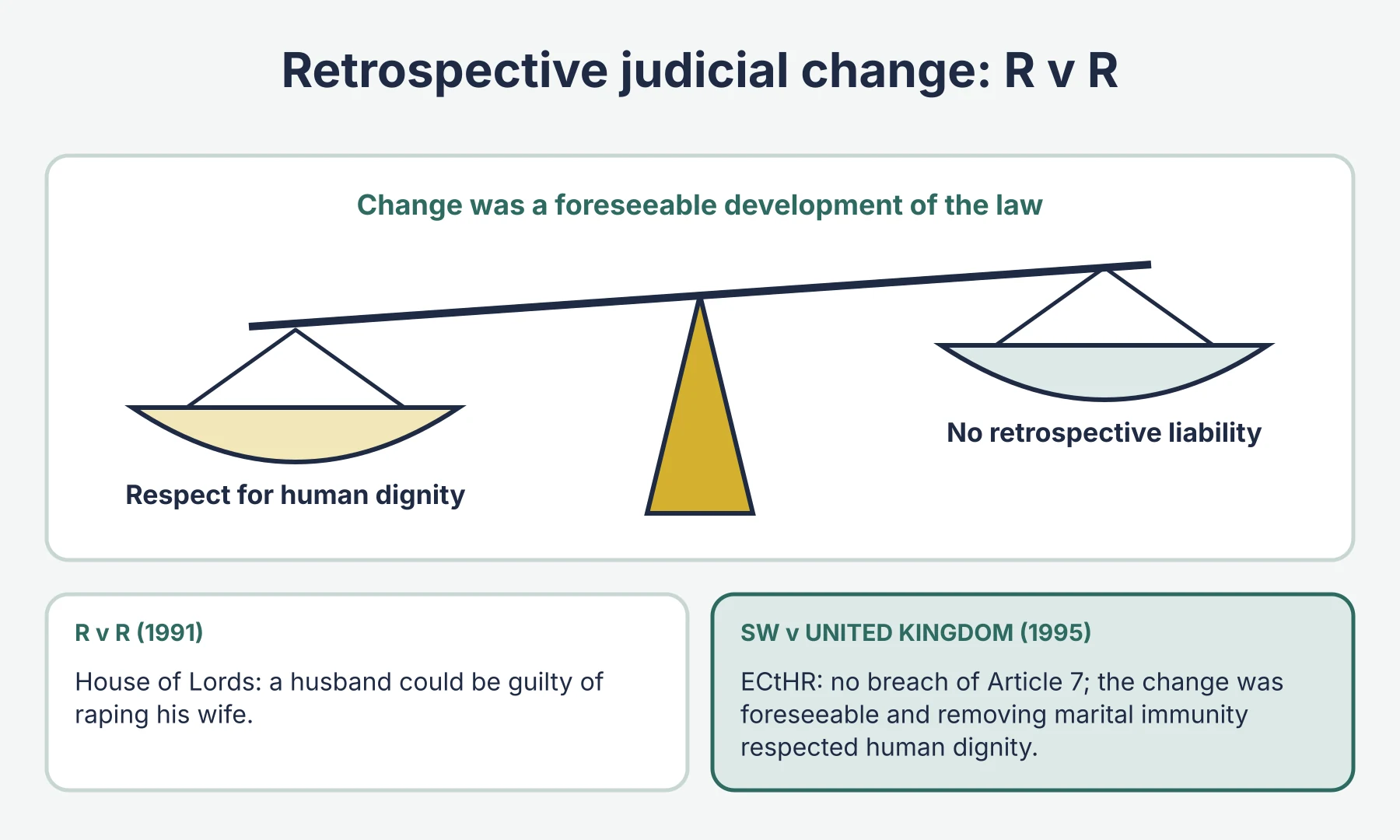
Retrospective judicial change: a balanced example. In R v R (1991) the House of Lords held that a husband could be guilty of raping his wife. The European Court of Human Rights in SW v United Kingdom (1995) held there was no breach of Article 7, because the change was a foreseeable development of the law and the removal of marital immunity was consistent with respect for human dignity. This is a strong evaluation point: a rule of law principle (no retrospective liability) was balanced against another value.
Worked example: annotated answer
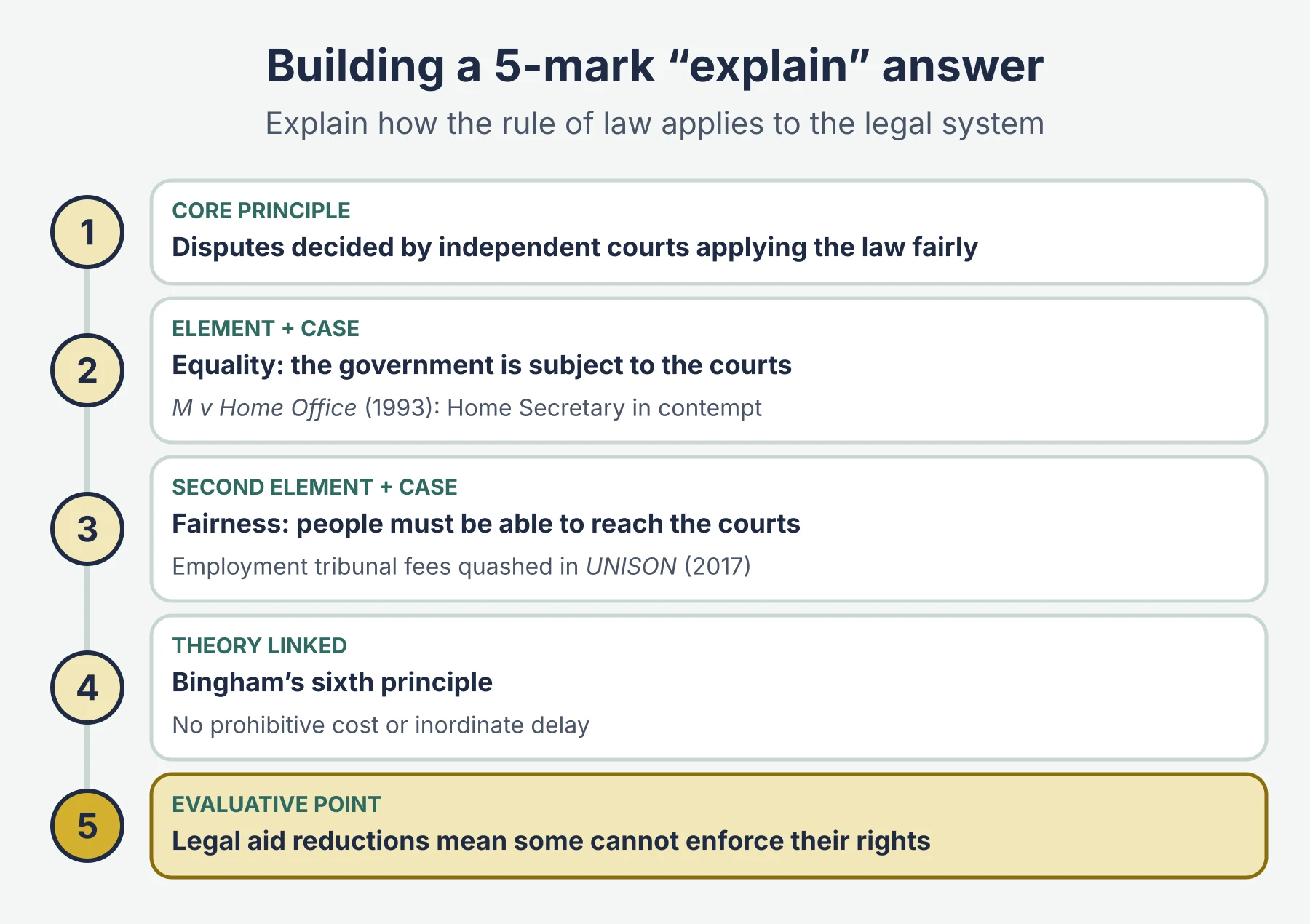
Question: Explain how the rule of law applies to the legal system. (5 marks)
The rule of law requires that disputes about legal rights are decided by independent courts applying the law fairly [core principle]. Equality before the law means the government is subject to the courts’ decisions; in M v Home Office (1993) the Home Secretary was found in contempt for ignoring a court order [element + case]. Fairness requires that people can actually reach the courts, so access to justice is part of the doctrine; this was why employment tribunal fees were quashed in UNISON (2017) [second element + case]. Bingham’s sixth principle, that civil disputes should be resolved without prohibitive cost or inordinate delay, supports this [theory linked], but reductions in legal aid mean that in practice some people cannot enforce their rights [evaluative point].
Common mistakes
- Reciting Dicey’s three points as if they were the specification’s three elements. Use the specification’s wording first.
- Describing the elements without applying them to law making, the legal system and substantive law.
- Confusing the rule of law with parliamentary supremacy; a supreme Parliament can pass laws that strain the rule of law.
- Using only Entick v Carrington; a range of modern cases shows the doctrine is alive.
- Treating the rule of law as always satisfied; the best answers identify tensions.
Exam technique
For explain or outline, name the element, explain what it requires, and give an authority. For discuss or evaluate, show where the system respects the doctrine and where it is under strain, use Raz or Bingham to judge, and conclude.
Condense this with the Rule of Law revision notes and test yourself with the Rule of Law practice questions. The doctrine’s link to Parliament is explored in Parliamentary Law Making.
Related resources
-
Practice questions
AQA A Level Law (7162): The Rule of Law – Practice Questions
Original practice questions with full answers on the rule of law, its three elements, Raz and Bingham, and its application to three areas, for AQA Law 7162.
Law · AQA · A Level
Try questions -
Revision notes
AQA A Level Law (7162): The Rule of Law – Revision Notes
Revision notes on the rule of law: three elements, Dicey, Raz and Bingham, modern cases and its application in three areas, with a self-test for AQA Law 7162.
Law · AQA · A Level
Revise topic -
Practice questions
AQA A Level Law: The Nature of Law and the English Legal System — Practice Questions
Original exam-style practice questions with full worked answers on law and morality, law and justice, the rule of law and legal institutions.
Law · AQA · A Level
Try questions
Get free revision emails (optional)
Occasional emails with practice questions, worked explanations and links to free resources for the qualification and subjects you choose. No spam, and you can unsubscribe from any email. The free tools on this site never need an email.