
Revision Notes
AQA A Level Law (7162): Nature of Law: Law and Justice – Revision Notes
Revision notes on types and theories of justice, natural justice and how far civil and criminal law achieve justice, with a self-test for AQA Law 7162.
- Subject
- Law
- Level
- A LEVELS
- Topic
- Section 3.1 – The Nature of Law and the English Legal System
- Author
- Marlbridge Academic Team
- Updated
- Reviewed by
- Aizaz Raoof Ali (what this means)
Aligned to AQA A Level Law (7162), For teaching from September 2017 onwards, A-level exams 2019 onwards. Official specification .
Syllabus page (what it covers and how it is assessed): AQA A Level Law.
Syllabus points this page covers
7162
- Nature of law: law and justice
Found an error? Report a correction.
Need help with this topic? Request a free trial class for A Level Law (7162).
Condensed notes on Nature of law: law and justice in AQA A-level Law (7162) section 3.1: the meaning of justice, theories of justice, and the extent to which civil and/or criminal law achieves justice. For full explanation and a model conclusion, see the Law and Justice study guide.
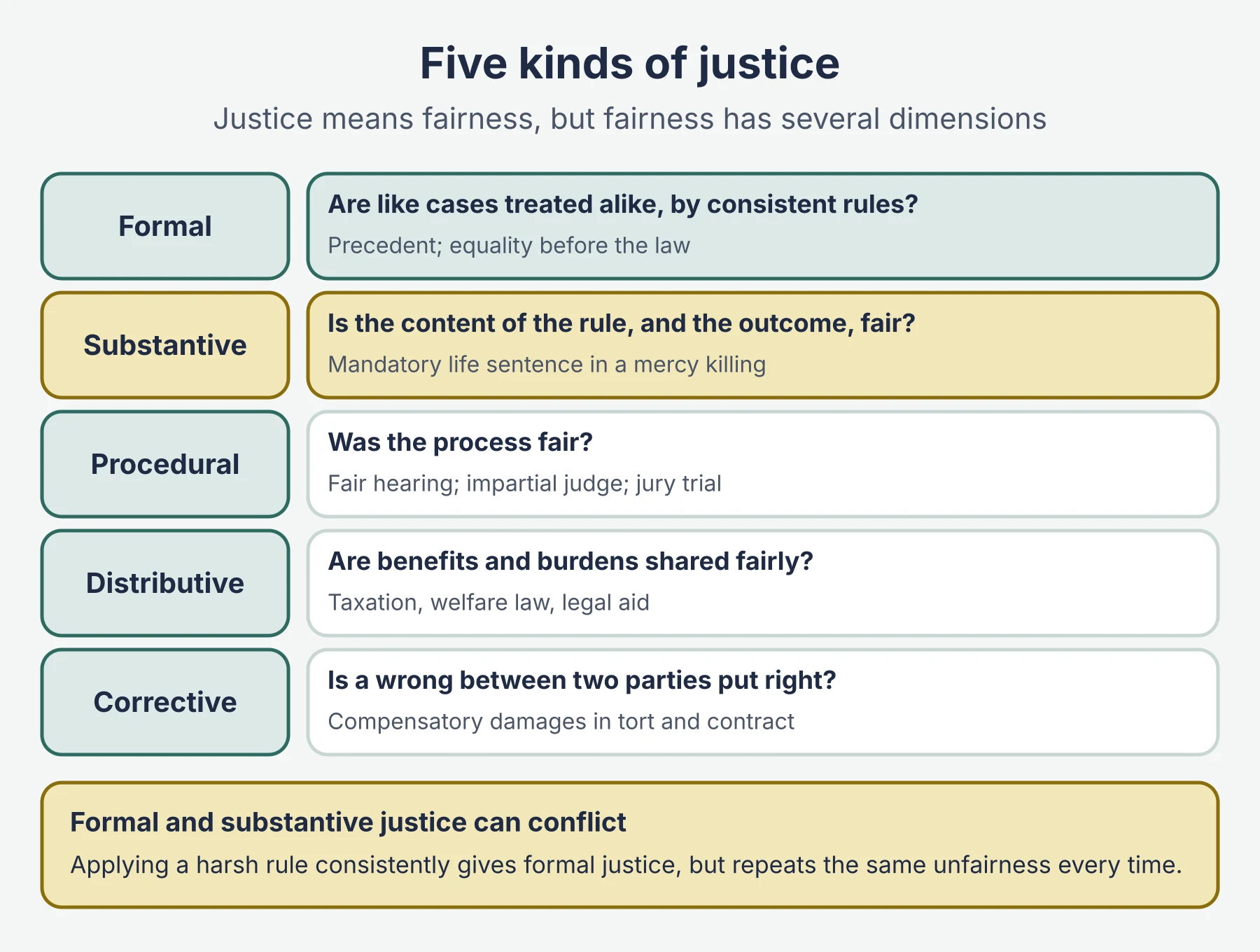
Five types of justice
| Type | Asks | Example |
|---|---|---|
| Formal | Like cases treated alike? | Precedent; equality before the law |
| Substantive | Is the rule or outcome fair? | Mandatory life sentence in a mercy killing |
| Procedural | Was the process fair? | Fair hearing, impartial judge, jury |
| Distributive | Are benefits and burdens shared fairly? | Legal aid, welfare law |
| Corrective | Is a wrong between two parties put right? | Compensatory damages |
Formal versus substantive: a harsh rule applied consistently is formally just but substantively unjust.
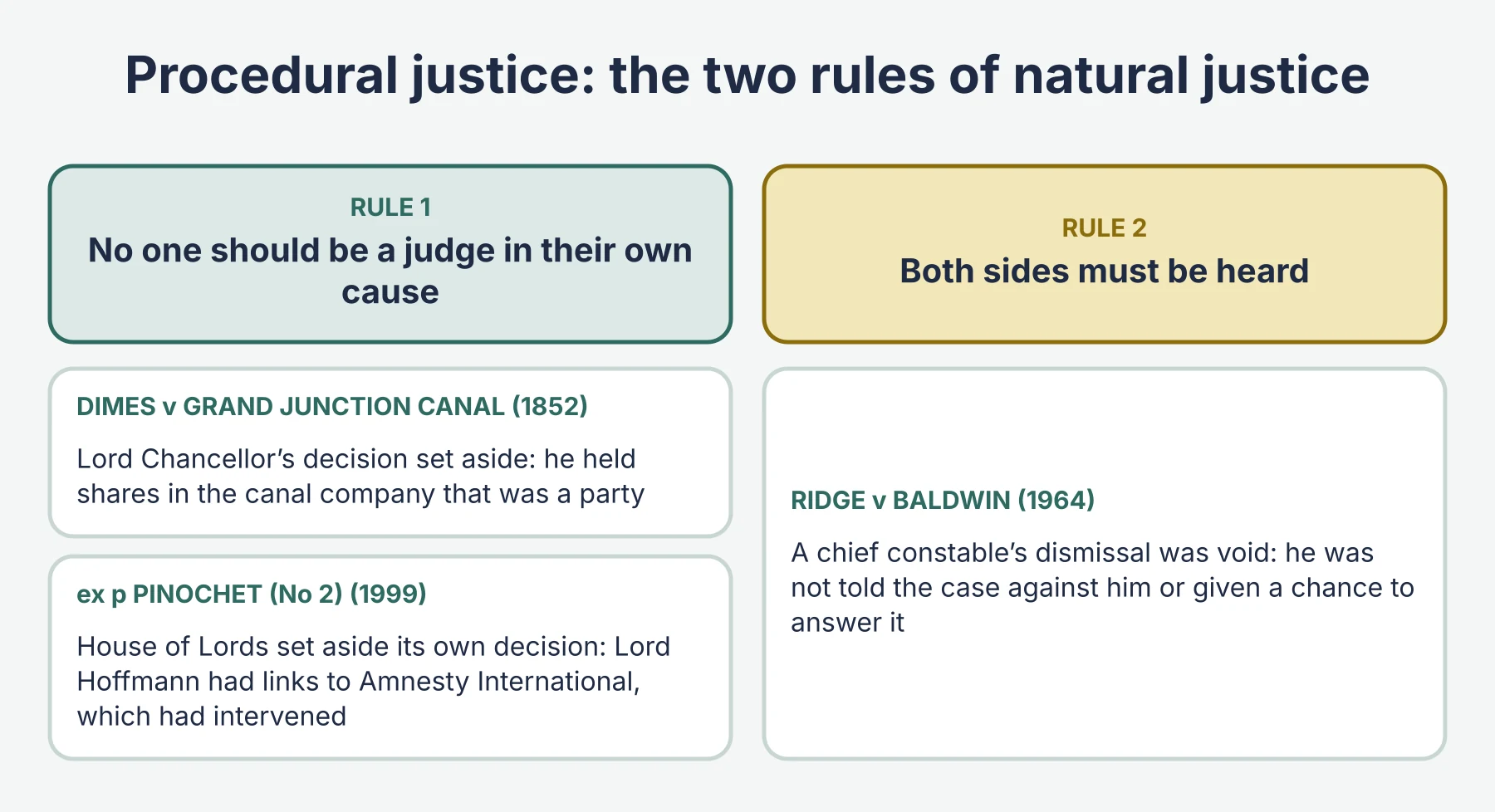
Natural justice (procedural fairness)
- No one a judge in their own cause: Dimes v Grand Junction Canal (1852), Lord Chancellor’s shareholding; ex p Pinochet (No 2) (1999), Lord Hoffmann’s links to Amnesty International.
- Hear both sides: Ridge v Baldwin (1964), chief constable dismissed without a hearing; dismissal void.
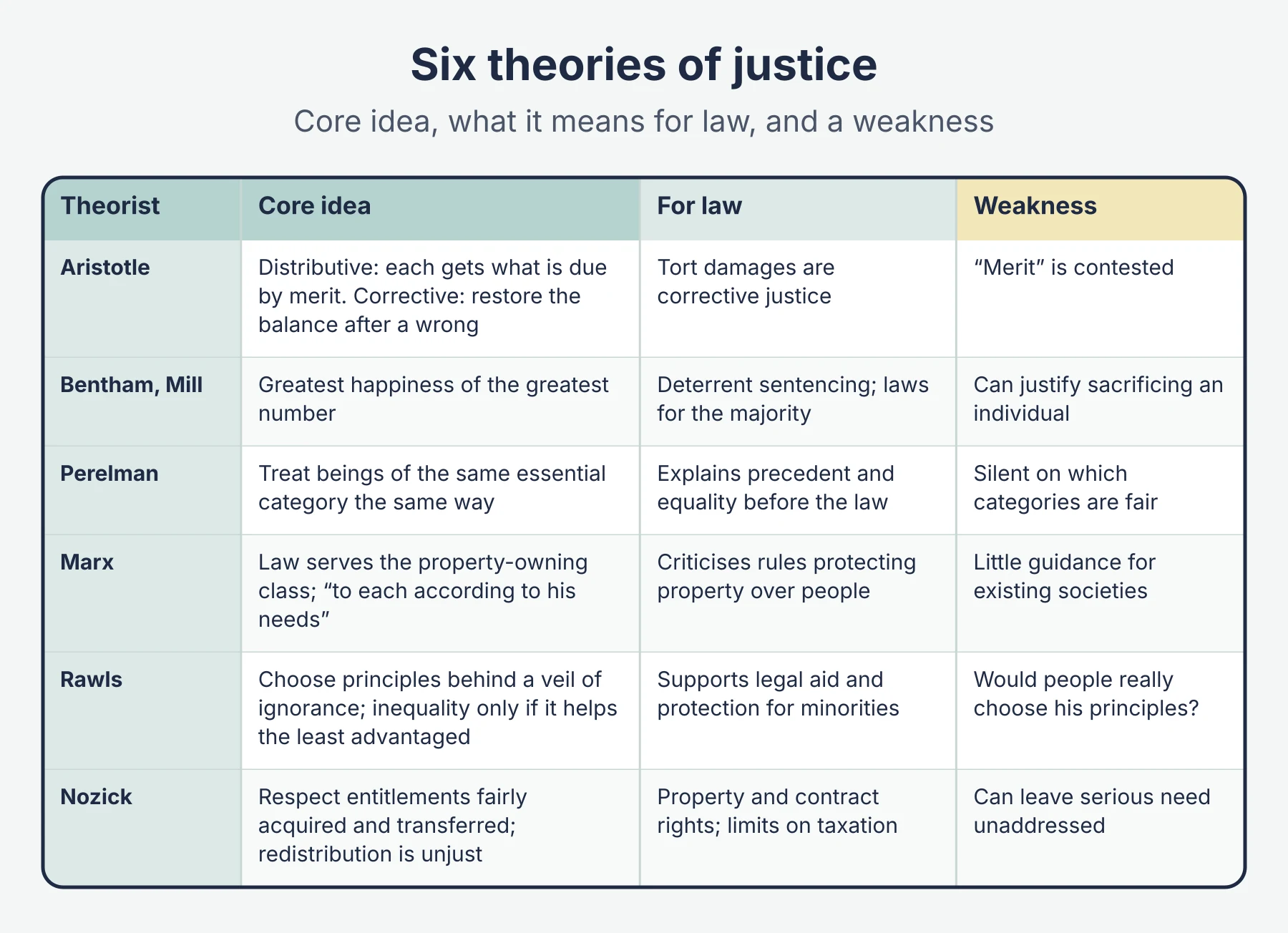
Theories: idea, use, weakness
| Theorist | Core idea | Use in law | Weakness |
|---|---|---|---|
| Aristotle | Distributive (by merit) and corrective justice | Tort damages; proportionate sentences | Merit is contested |
| Bentham, Mill | Greatest happiness of the greatest number | Deterrent sentencing | Can sacrifice individuals |
| Perelman | Treat the same essential category alike | Precedent, equality | Silent on which categories are fair |
| Marx | Law serves the property-owning class; “to each according to his needs” | Critique of property-based rules | Little guidance for existing law |
| Rawls (1971) | Veil of ignorance; inequality only if it helps the least advantaged | Legal aid, minority protection | Would people really choose his principles? |
| Nozick (1974) | Entitlement to fairly acquired holdings | Property and contract rights | Ignores need |
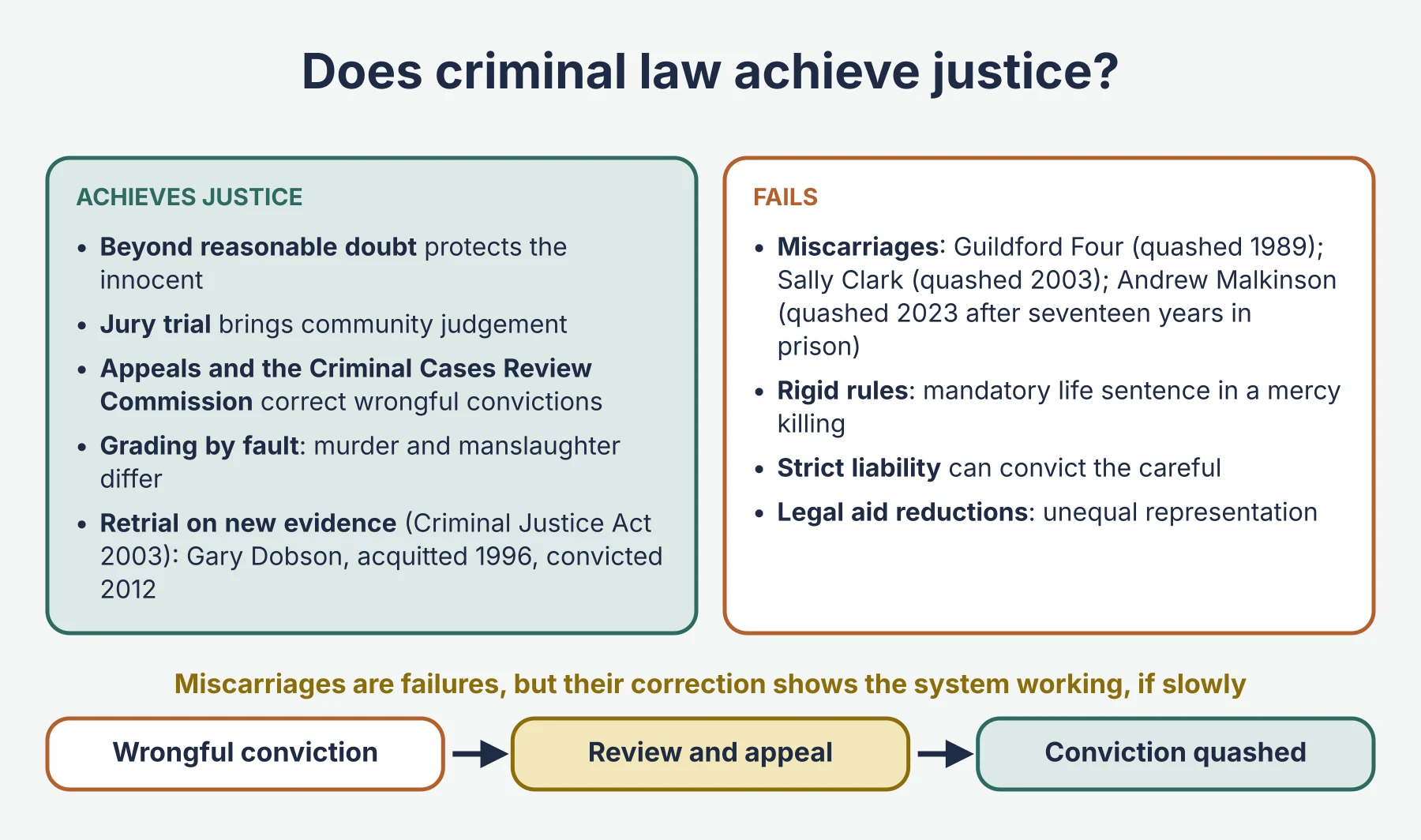
Does criminal law achieve justice?
Yes:
- Burden on prosecution; proof beyond reasonable doubt.
- Jury trial for serious cases.
- Court of Appeal and Criminal Cases Review Commission correct errors.
- Offences and sentences graded by fault.
- Criminal Justice Act 2003 retrial for serious offences on new and compelling evidence: Gary Dobson, acquitted 1996, convicted 2012.
No:
- Miscarriages: Guildford Four (quashed 1989); Sally Clark (quashed 2003; flawed statistics, undisclosed medical evidence); Andrew Malkinson (quashed 2023 after seventeen years in prison; DNA evidence).
- Mandatory life sentence inflexibility.
- Strict liability convicts the careful.
- Legal aid limits create inequality of arms.
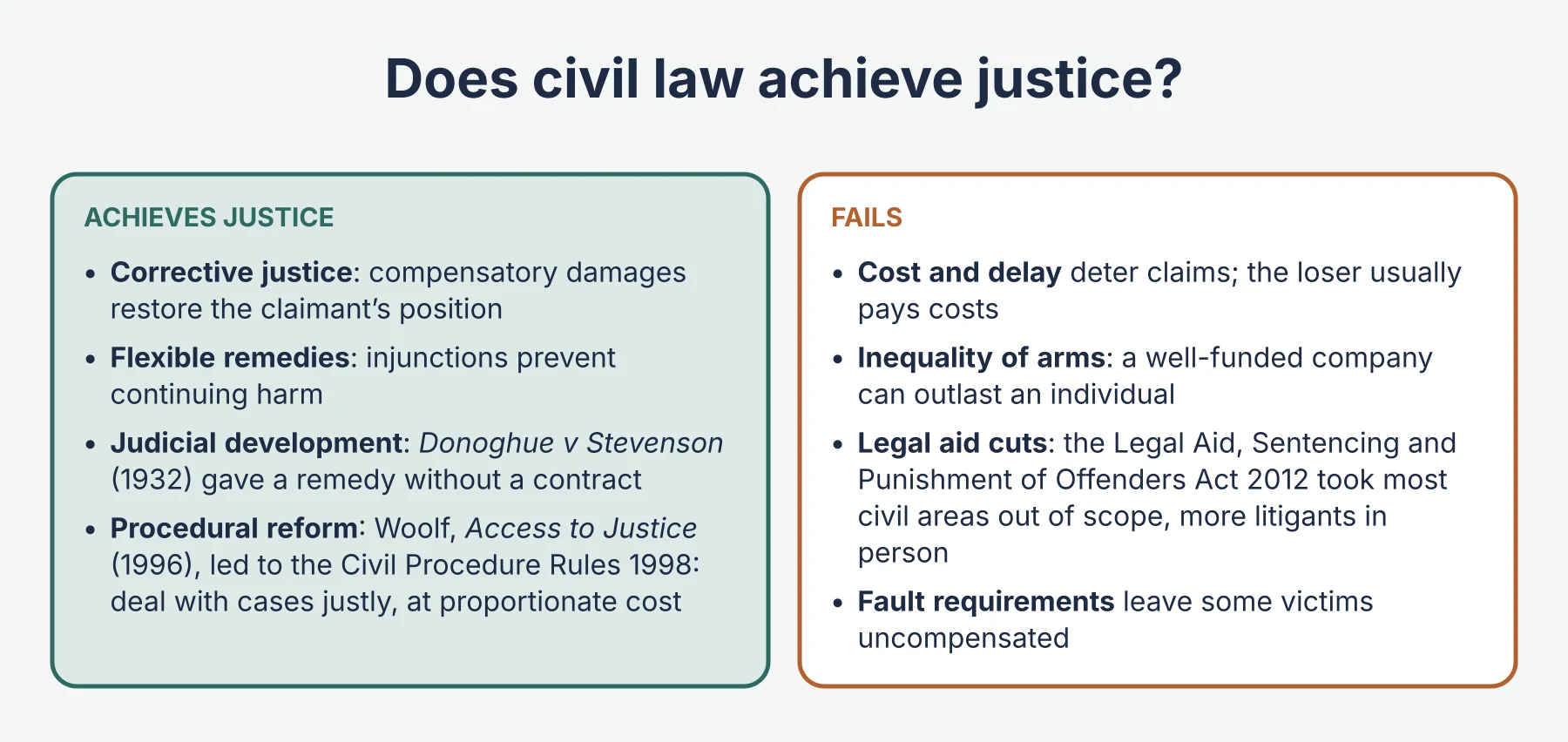
Does civil law achieve justice?
Yes:
- Corrective justice through compensatory damages.
- Tailored injunctions.
- Judicial development filling gaps: Donoghue v Stevenson (1932).
- Woolf, Access to Justice (1996) → Civil Procedure Rules 1998, overriding objective to deal with cases justly and at proportionate cost.
No:
- Cost, delay and costs-shifting deter claims.
- Inequality of arms between companies and individuals.
- LASPO 2012 removed most civil legal aid; more litigants in person.
- Fault requirement leaves some victims uncompensated.
Key terms
| Term | Meaning |
|---|---|
| Justice | Fairness in rules, processes and outcomes |
| Formal justice | Consistent treatment of like cases |
| Substantive justice | Fairness of the content of rules and their outcomes |
| Procedural justice | Fairness of the process used to reach a decision |
| Natural justice | The rules against bias and for a fair hearing |
| Miscarriage of justice | Conviction of a person who should not have been convicted |
| Veil of ignorance | Rawls’s device of choosing principles without knowing one’s place in society |
| Overriding objective | The Civil Procedure Rules’ aim of dealing with cases justly and at proportionate cost |
Exam traps
- Theory without application to a rule or case.
- One undivided idea of justice; use the five types.
- Miscarriages cited only as failure, ignoring that their correction shows the system working.
- Merging civil and criminal evidence; organise by area.
- A conclusion that does not say “how far”.
Self-test
- Distinguish formal from substantive justice.
- Give an example of a rule that is formally just but arguably substantively unjust.
- State the two rules of natural justice.
- Why was the decision in ex p Pinochet (No 2) set aside?
- What did Ridge v Baldwin decide?
- What is corrective justice, and where does civil law deliver it?
- State one weakness of utilitarianism as a theory of justice.
- What is Perelman’s idea of formal justice?
- Explain Rawls’s veil of ignorance.
- Give one miscarriage of justice and what went wrong.
- How does the Criminal Justice Act 2003 promote justice?
- Give two reasons civil law may fail to achieve justice.
Answers: 1. Formal justice is the consistent application of rules to like cases; substantive justice concerns whether the rules and outcomes themselves are fair. 2. The mandatory life sentence for murder applied to a mercy killing. 3. No one should be a judge in their own cause; both sides must be heard. 4. Lord Hoffmann had links to Amnesty International, which had intervened in the case, so there was a risk of bias. 5. A dismissal without telling the person the case against him or letting him answer was void. 6. Putting right a wrong between two parties; through compensatory damages in tort and contract. 7. It can justify sacrificing an individual for the majority’s happiness. 8. Beings of the same essential category should be treated in the same way. 9. People choose principles of justice without knowing their own position in society, so they choose fairly. 10. Sally Clark: flawed statistical evidence and undisclosed medical evidence; convictions quashed in 2003 (or Andrew Malkinson, Guildford Four). 11. It allows retrial for serious offences where new and compelling evidence emerges after an acquittal. 12. Any two: cost and delay; inequality of arms; legal aid cuts under LASPO 2012; fault requirement leaving some victims uncompensated.
More resources on this topic
Law and Justice study guide | Law and Justice practice questions | Law and Morality revision notes
Related resources
-
Study guides
AQA A Level Law (7162): Nature of Law: Law and Morality
Law and morality for AQA A Level Law 7162: the distinction, moral diversity in a pluralist society, natural law, positivism and the legal enforcement of morals.
Law · AQA · A Level
Read guide -
Practice questions
AQA A Level Law (7162): Nature of Law: Law and Morality – Practice Questions
Original practice questions with full answers on law and morality, pluralism, natural law, positivism and the enforcement of moral values for AQA Law 7162.
Law · AQA · A Level
Try questions -
Revision notes
AQA A Level Law (7162): Nature of Law: Law and Morality – Revision Notes
Revision notes on law and morality: pluralism, natural law, positivism, Mill, Devlin, Hart and the cases on enforcing morals, with a self-test for AQA Law 7162.
Law · AQA · A Level
Revise topic
Get free revision emails (optional)
Occasional emails with practice questions, worked explanations and links to free resources for the qualification and subjects you choose. No spam, and you can unsubscribe from any email. The free tools on this site never need an email.