
Revision Notes
AQA A Level Law (7162): Nature of Law: Law and Morality – Revision Notes
Revision notes on law and morality: pluralism, natural law, positivism, Mill, Devlin, Hart and the cases on enforcing morals, with a self-test for AQA Law 7162.
- Subject
- Law
- Level
- A LEVELS
- Topic
- Section 3.1 – The Nature of Law and the English Legal System
- Author
- Marlbridge Academic Team
- Updated
- Reviewed by
- Aizaz Raoof Ali (what this means)
Aligned to AQA A Level Law (7162), For teaching from September 2017 onwards, A-level exams 2019 onwards. Official specification .
Syllabus page (what it covers and how it is assessed): AQA A Level Law.
Syllabus points this page covers
7162
- Nature of law: law and morality
Found an error? Report a correction.
Need help with this topic? Request a free trial class for A Level Law (7162).
Condensed notes on Nature of law: law and morality in AQA A-level Law (7162) section 3.1. The specification’s three strands are the distinction (with moral diversity in a pluralist society), the relationship and its importance, and the legal enforcement of moral values. For full explanation and an annotated paragraph, see the Law and Morality study guide.
Strand 1: the distinction
| Law | Morality | |
|---|---|---|
| Source | Parliament, courts | Religion, culture, conscience |
| Certainty | Precise, written or reported | Unwritten, disputed |
| Enforcement | State sanctions | Disapproval, guilt |
| Change | Immediate, deliberate | Gradual, uneven |
| Scope | Everyone in the jurisdiction | Those who accept it |
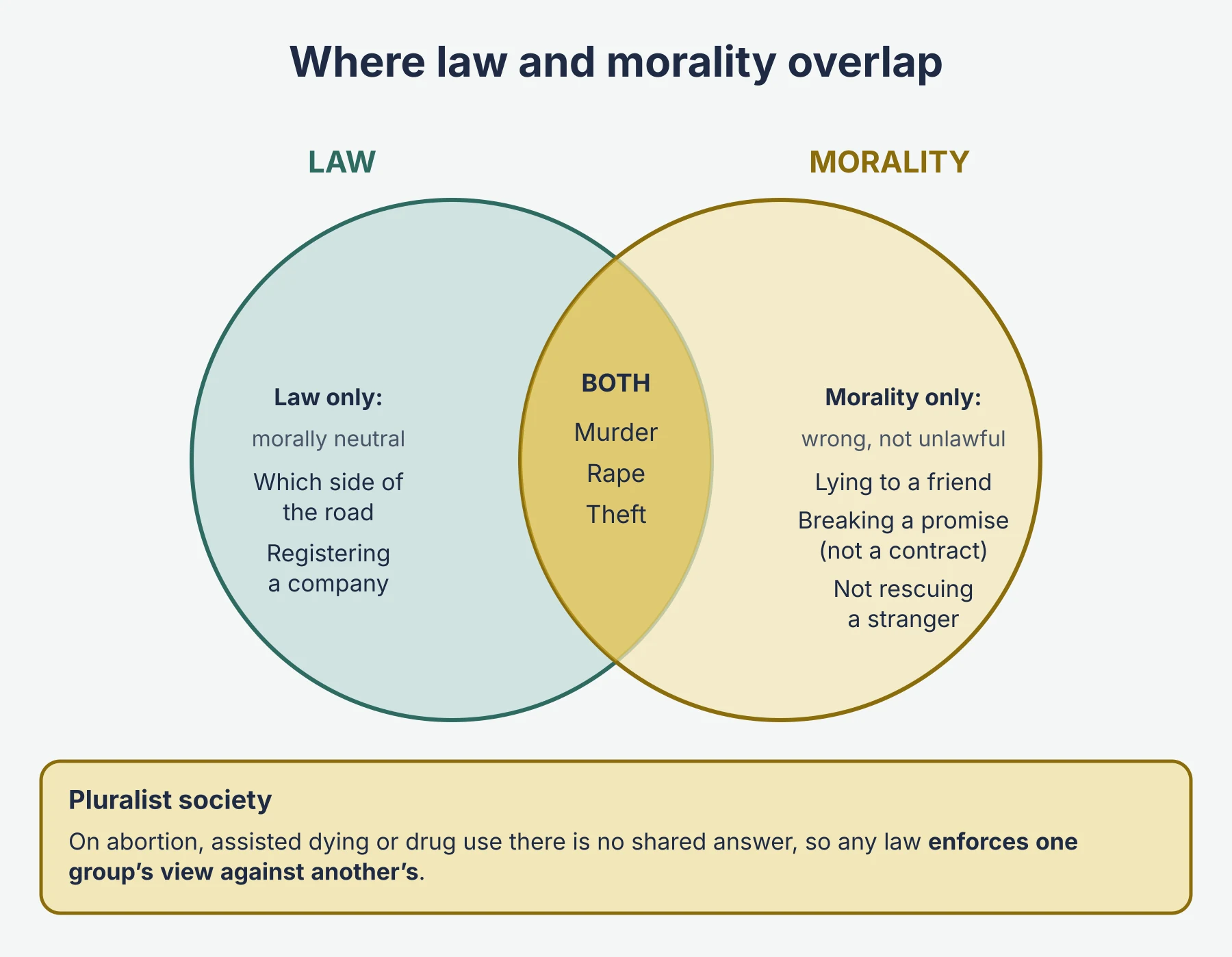
Pluralist society: many faiths and outlooks, no single moral code. Any law on a contested issue (abortion, assisted dying, drugs) enforces one view against others.
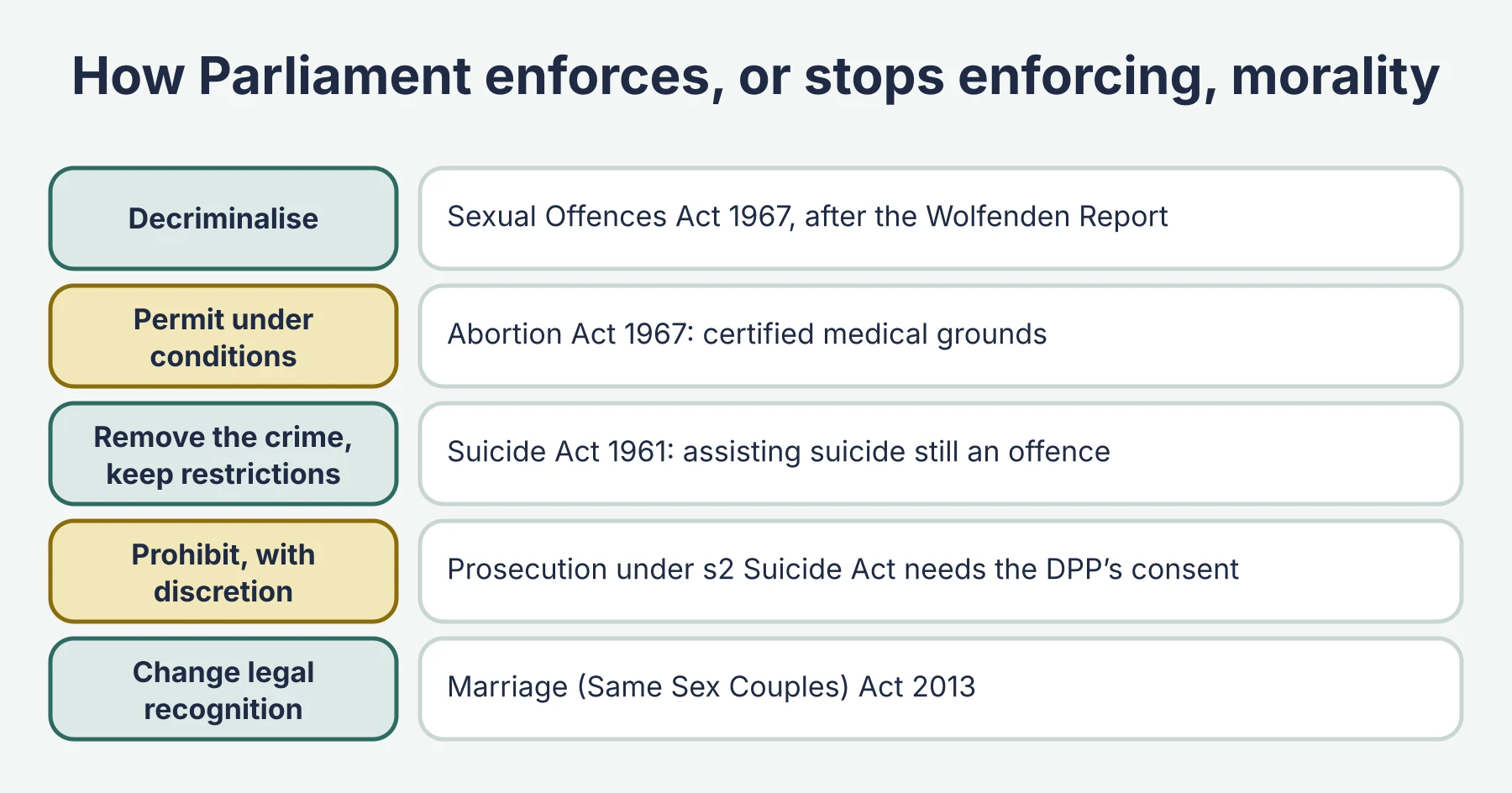
Parliament’s responses to moral diversity:
- Conditional permission: Abortion Act 1967.
- Prohibition with prosecutorial discretion: assisting suicide under section 2 of the Suicide Act 1961 needs the consent of the Director of Public Prosecutions to prosecute.
Strand 2: the relationship
Three overlaps: law and morality coincide (murder, theft); law with no moral content (driving on the left); morality without law (lying, breaking a non-contractual promise, failing to rescue a stranger).
Theories:
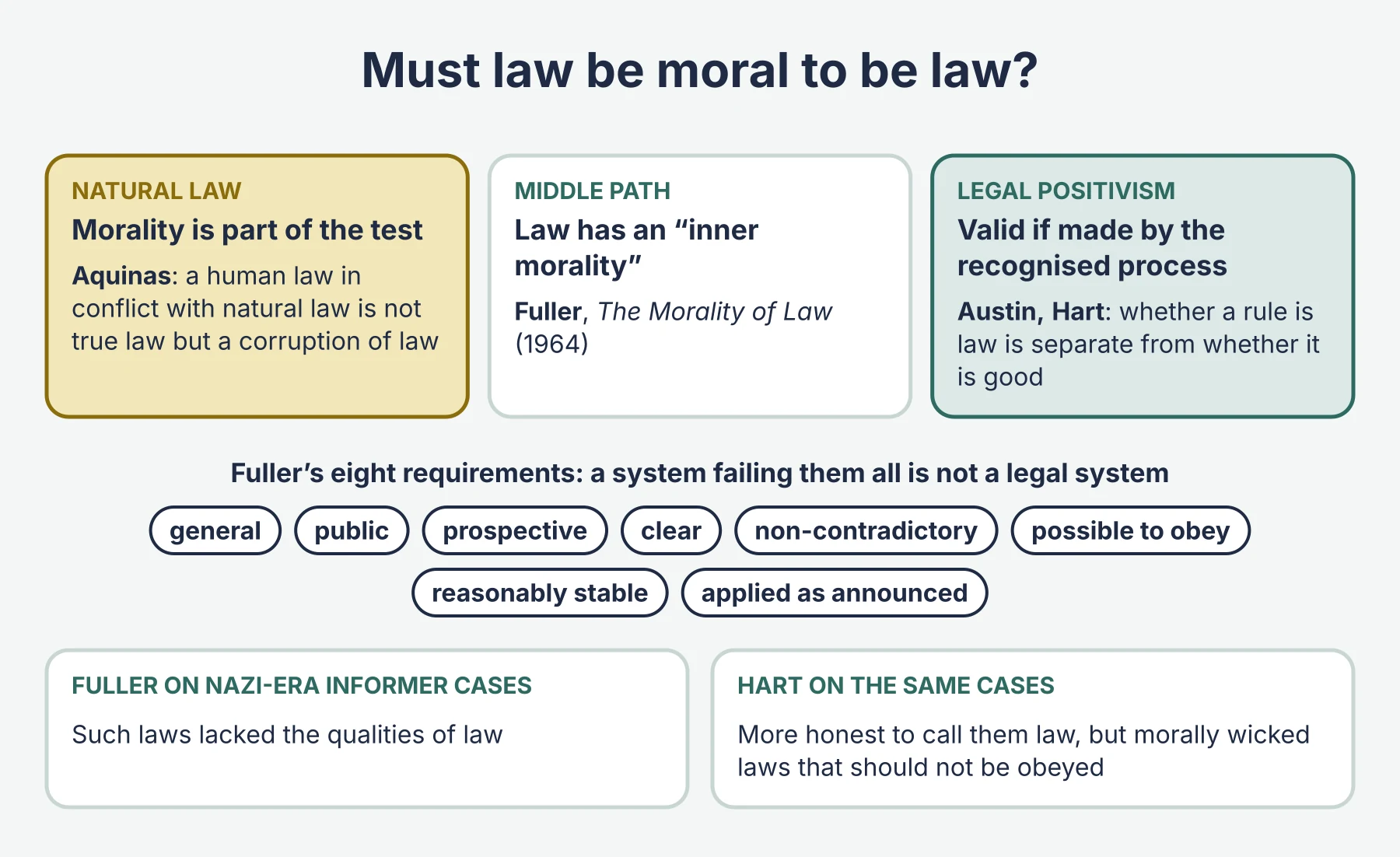
- Natural law (Aquinas): an unjust law is not true law; morality is part of the test of validity.
- Positivism (Austin, Hart): law is valid if made by the recognised process; whether it is moral is a separate question.
- Fuller, The Morality of Law (1964): law’s “inner morality”: rules must be general, public, prospective, clear, non-contradictory, possible to obey, stable, and applied as announced.
- Hart–Fuller debate: over post-war German informer cases. Fuller: Nazi rules lacked the qualities of law. Hart: more honest to call them law, but wicked law that should not be obeyed.
Why it matters:
- Legitimacy: moral law is more readily obeyed.
- Judges use moral ideas: Lord Atkin’s neighbour principle in Donoghue v Stevenson (1932).
- Law can lead morality as well as follow it.
- Hard cases put pressure on judges and Parliament to change the law.
Strand 3: legal enforcement of moral values
| Idea | Holder | Core claim |
|---|---|---|
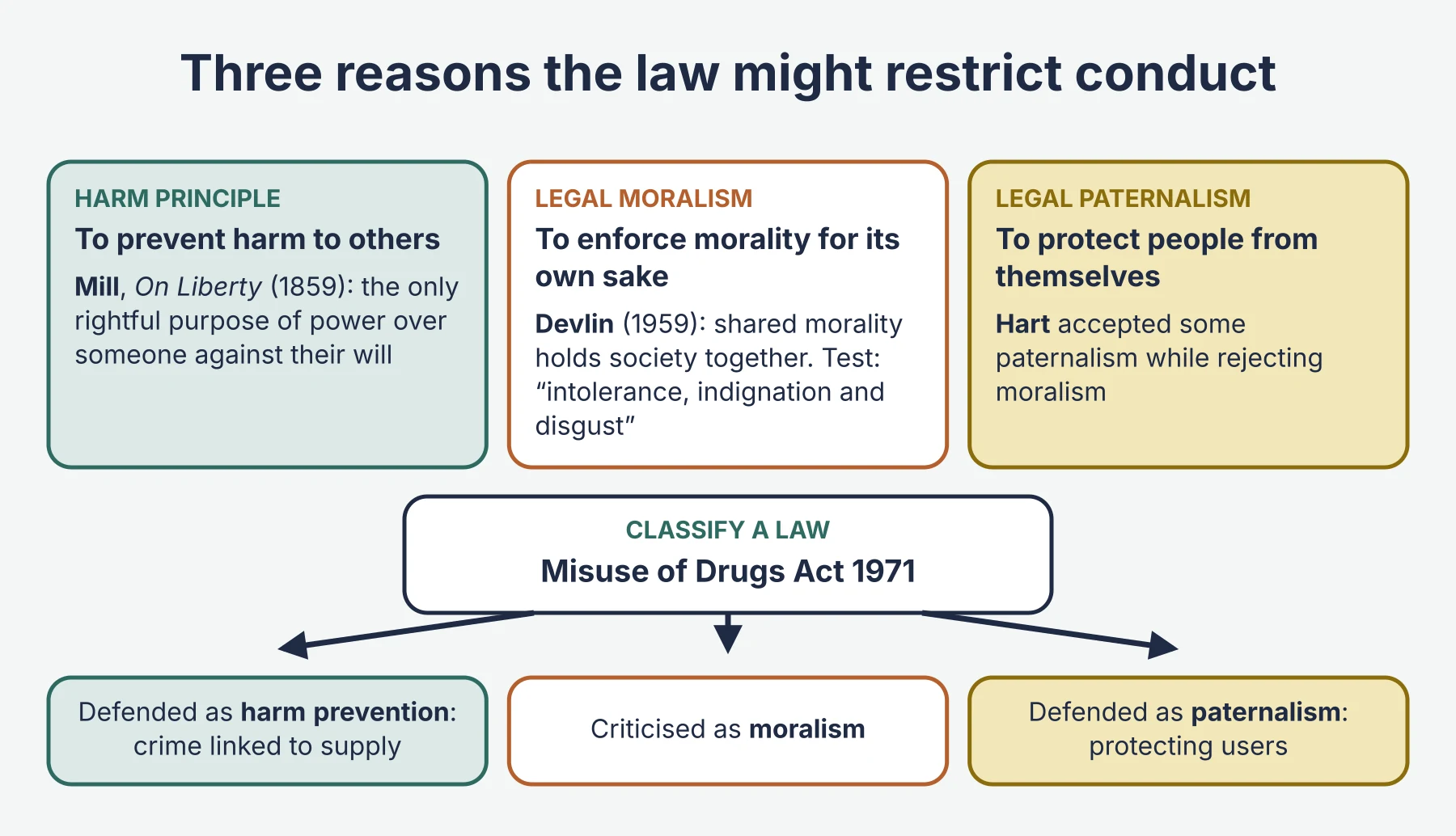
| Harm principle | Mill, On Liberty (1859) | Power over a person against their will is justified only to prevent harm to others |
| Legal moralism | Devlin (1959) | Shared morality holds society together; society may protect it. Test: “intolerance, indignation and disgust” |
| Legal paternalism | Accepted in part by Hart | Law may protect people from harming themselves |
Cases where courts enforced morality:
- Shaw v DPP (1962): conspiracy to corrupt public morals.
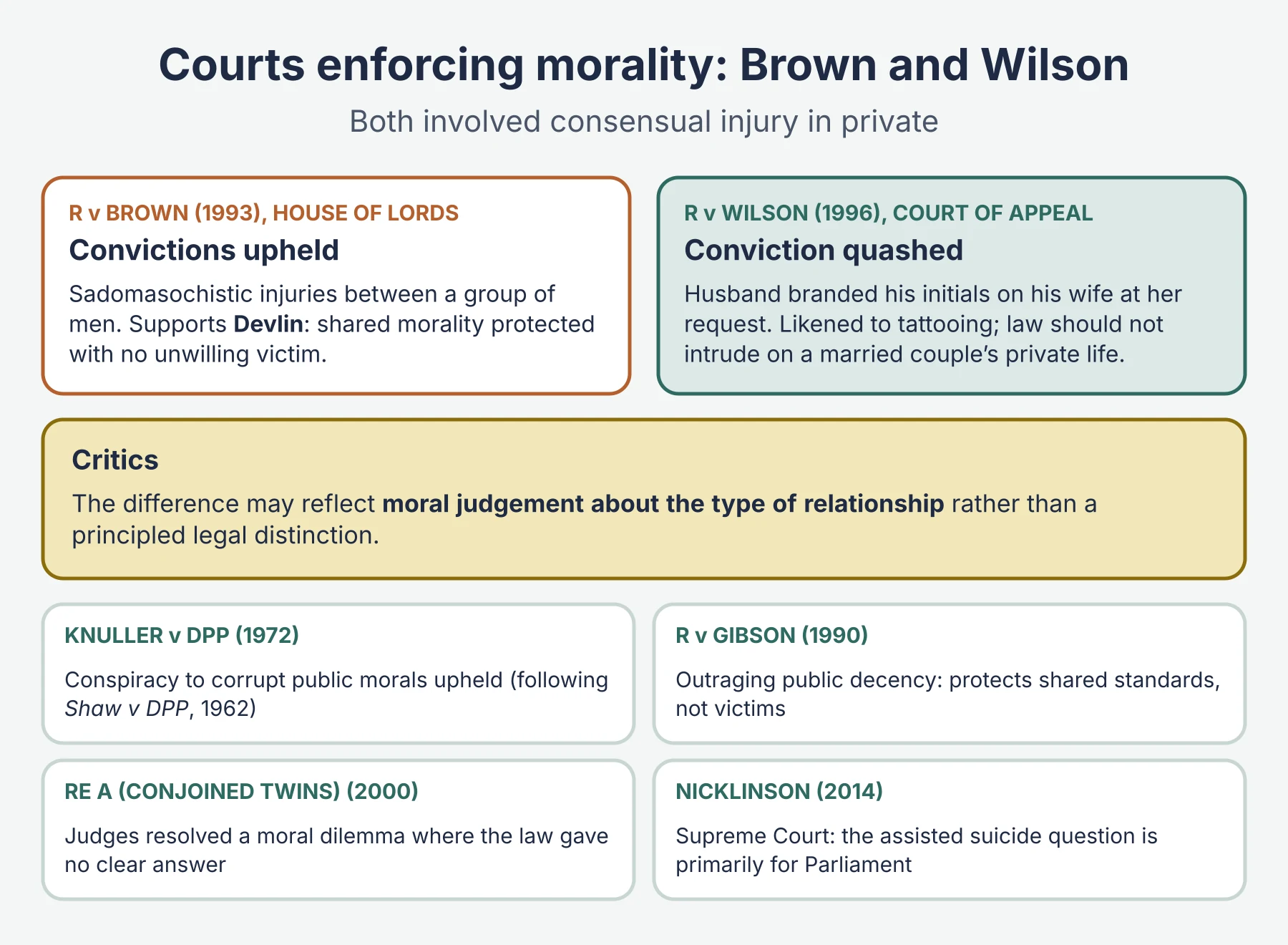
- Knuller v DPP (1972): conviction for conspiracy to corrupt public morals over contact advertisements upheld.
- R v Gibson (1990): earrings made from freeze-dried foetuses; outraging public decency.
- R v Brown (1993): consent no defence to sadomasochistic injury in private.
Cases showing restraint or difficulty:
- R v Wilson (1996): consensual branding between spouses; not liable. Compare with Brown.
- Re A (Conjoined Twins) (2000): separation authorised to save one twin; judges resolved a moral dilemma.
- R (Nicklinson) v Ministry of Justice (2014): Supreme Court left assisted suicide primarily to Parliament.
Parliament changing course: Sexual Offences Act 1967; Suicide Act 1961 (suicide no longer a crime, assisting still is); Marriage (Same Sex Couples) Act 2013.
Key terms
| Term | Meaning |
|---|---|
| Morality | Beliefs about right and wrong that guide conduct |
| Pluralist society | A society containing many different moral and cultural outlooks |
| Natural law | Theory that valid law must conform to a higher moral order |
| Legal positivism | Theory that law’s validity depends on its source, not its morality |
| Inner morality of law | Fuller’s procedural qualities a legal system must have |
| Harm principle | Mill’s limit: law may restrict liberty only to prevent harm to others |
| Legal moralism | Enforcing morality for its own sake |
| Legal paternalism | Restricting liberty to protect people from themselves |
Exam traps
- Confusing paternalism with moralism.
- Using Brown without Wilson: the comparison carries the evaluation.
- Saying Hart denied any overlap between law and morality; he denied a necessary connection.
- Forgetting pluralism when asked about the distinction.
- Reciting theories with no case or statute attached.
Self-test
- Give three differences between law and morality.
- What is a pluralist society, and why does it complicate the enforcement of morality?
- Give an example of a law with no moral content.
- Give an example of immoral conduct that is lawful.
- What did Aquinas say about an unjust law?
- What is the positivist view of the relationship?
- Name three of Fuller’s requirements of the inner morality of law.
- State Mill’s harm principle.
- What test did Devlin propose for conduct the law may punish?
- How does R v Wilson differ from R v Brown?
- Why is Nicklinson relevant to the enforcement of morality?
- How did the Suicide Act 1961 change the law’s approach to a moral issue?
Answers: 1. Any three: source (state versus religion or conscience), certainty, enforcement (sanctions versus disapproval), speed of change, scope. 2. A society of many moral outlooks; there is no shared code, so enforcing one view imposes it on others. 3. Driving on the left, or company registration rules. 4. Lying to a friend, breaking a non-contractual promise, or failing to rescue a stranger. 5. That it is not true law but a corruption of law. 6. Law is valid because of how it was made; its morality is a separate question. 7. Any three: general, public, prospective, clear, non-contradictory, possible to obey, stable, applied as announced. 8. Power can rightly be exercised over a person against their will only to prevent harm to others. 9. Whether the reasonable person would regard it with intolerance, indignation and disgust. 10. In Wilson consensual branding between spouses led to no liability, while in Brown consensual sadomasochistic injury was criminal; critics see the distinction as a moral judgement about the relationship. 11. The Supreme Court treated the moral question of assisted suicide as primarily for Parliament, showing judicial restraint. 12. It abolished the crime of suicide but kept assisting suicide as an offence, withdrawing moral enforcement against the individual while protecting the vulnerable.
More resources on this topic
Law and Morality study guide | Law and Morality practice questions | Law and Justice revision notes
Related resources
-
Study guides
AQA A Level Law (7162): Nature of Law: Law and Society
The role of law in society, enforceable rights, balancing competing interests and the meaning of fault in civil and criminal law, for AQA A Level Law 7162.
Law · AQA · A Level
Read guide -
Practice questions
AQA A Level Law (7162): Nature of Law: Law and Society – Practice Questions
Original practice questions and full answers on the role of law, enforceable rights, competing interests and fault in civil and criminal law for AQA Law 7162.
Law · AQA · A Level
Try questions -
Revision notes
AQA A Level Law (7162): Nature of Law: Law and Society – Revision Notes
Revision notes on the role of law, enforceable rights, competing interests and fault, with cases, key terms, exam traps and a self-test for AQA Law 7162.
Law · AQA · A Level
Revise topic
Get free revision emails (optional)
Occasional emails with practice questions, worked explanations and links to free resources for the qualification and subjects you choose. No spam, and you can unsubscribe from any email. The free tools on this site never need an email.