
Study Guides
AQA A Level Law (7162): Nature of Law: Law and Society
The role of law in society, enforceable rights, balancing competing interests and the meaning of fault in civil and criminal law, for AQA A Level Law 7162.
- Subject
- Law
- Level
- A LEVELS
- Topic
- Section 3.1 – The Nature of Law and the English Legal System
- Author
- Marlbridge Academic Team
- Updated
- Reviewed by
- Aizaz Raoof Ali (what this means)
Aligned to AQA A Level Law (7162), For teaching from September 2017 onwards, A-level exams 2019 onwards. Official specification .
Syllabus page (what it covers and how it is assessed): AQA A Level Law.
Syllabus points this page covers
7162
- Nature of law: law and society
Found an error? Report a correction.
Need help with this topic? Request a free trial class for A Level Law (7162).
This guide covers the Nature of law: law and society row of AQA A-level Law (7162) section 3.1. The specification lists three things: the role law plays in society; the effect of law on enforceable rights and the balance required between competing interests (eg public and private); and the meaning and importance of fault in civil and/or criminal law. This content is examined through short explanations and through extended answers that ask you to judge how well the law performs these roles. The overview of section 3.1 is in the Nature of Law and the English Legal System study guide; this page goes further into theory, cases and evaluation.
The role law plays in society
The usual list is that law maintains order, protects people and property, regulates relationships and resolves disputes. To reach the higher levels you need to show how law does each of these and where it falls short.
| Role | How law performs it | Example |
|---|---|---|
| Social control | Defines unacceptable conduct and attaches sanctions | Offences against the person; the Theft Act 1968 |
| Protecting rights and property | Gives remedies when rights are infringed | Damages in negligence; trespass to land |
| Regulating relationships | Sets rules for contracts, employment, family life | Unfair dismissal rights under the Employment Rights Act 1996 |
| Resolving disputes peacefully | Provides courts, tribunals and alternatives to self-help | The County Court, the small claims track, employment tribunals |
| Reflecting and shaping values | Changes as society changes, and can push change | The Equality Act 2010 prohibiting discrimination at work and in services |
Theories of law’s social role
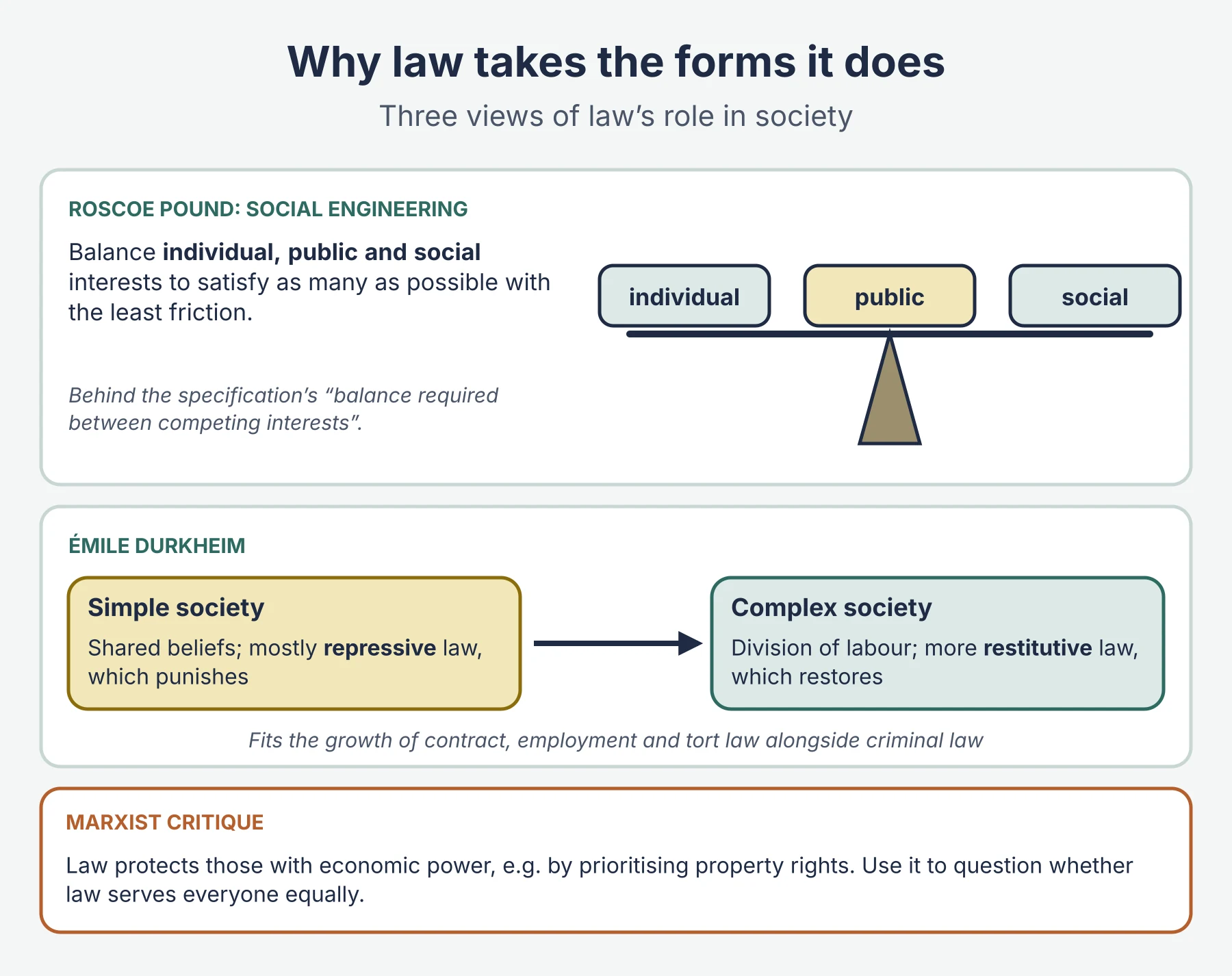
Two theorists help you explain why law takes the forms it does.
- Roscoe Pound, an American jurist, described law as a form of social engineering: its job is to balance individual, public and social interests so as to satisfy as many as possible with the least friction. This idea sits directly behind the specification’s phrase “balance required between competing interests”.
- Émile Durkheim, a sociologist, argued that simple societies held together by shared beliefs rely mostly on repressive law, which punishes, while complex societies with a division of labour rely more on restitutive law, which puts people back in their previous position. The growth of contract, employment and tort law alongside criminal law fits his account.
A Marxist critique offers the counterpoint: law protects the interests of those with economic power, for example by prioritising property rights. You do not need to agree, but using it shows you can question whether law serves everyone equally.
Enforceable rights
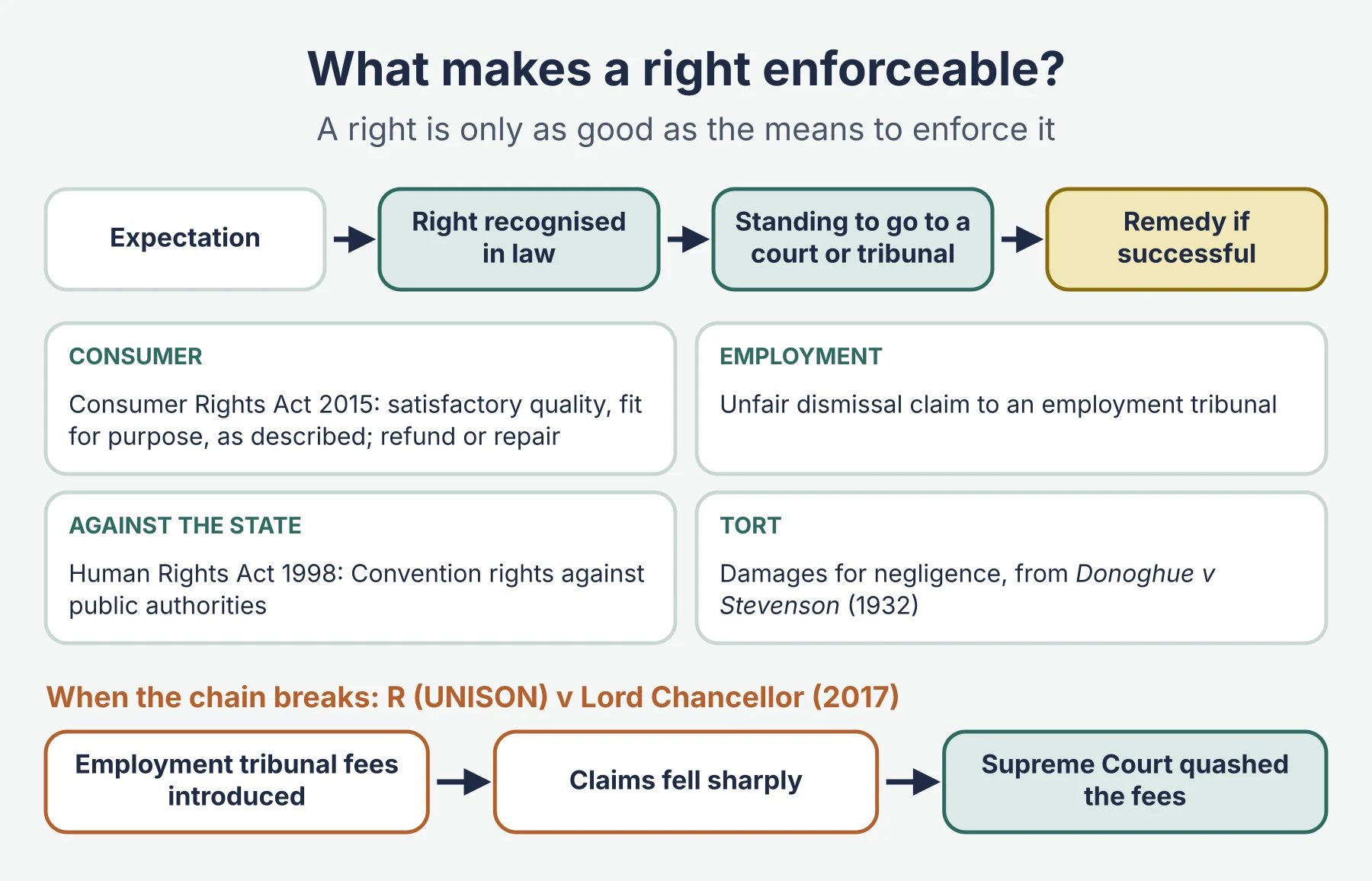
A right is only as good as the means to enforce it. Law turns expectations into enforceable rights by giving a person standing to go to a court or tribunal and a remedy if they succeed.
- Consumer rights: the Consumer Rights Act 2015 gives consumers statutory rights that goods are of satisfactory quality, fit for purpose and as described, with remedies such as a refund or repair.
- Employment rights: a qualifying employee can bring a claim for unfair dismissal to an employment tribunal.
- Rights against the state: the Human Rights Act 1998 allows a person to rely on Convention rights in domestic courts against public authorities.
- Rights in tort: a person injured by negligence can claim damages, a right that exists because of the common law developed from Donoghue v Stevenson (1932).
Evaluation point: rights on paper can be undermined in practice by cost, delay and lack of advice. In R (UNISON) v Lord Chancellor (2017) the Supreme Court quashed employment tribunal fees partly because claims fell sharply once they were introduced, showing that an enforceable right means little if people cannot afford to enforce it.
Balancing competing interests
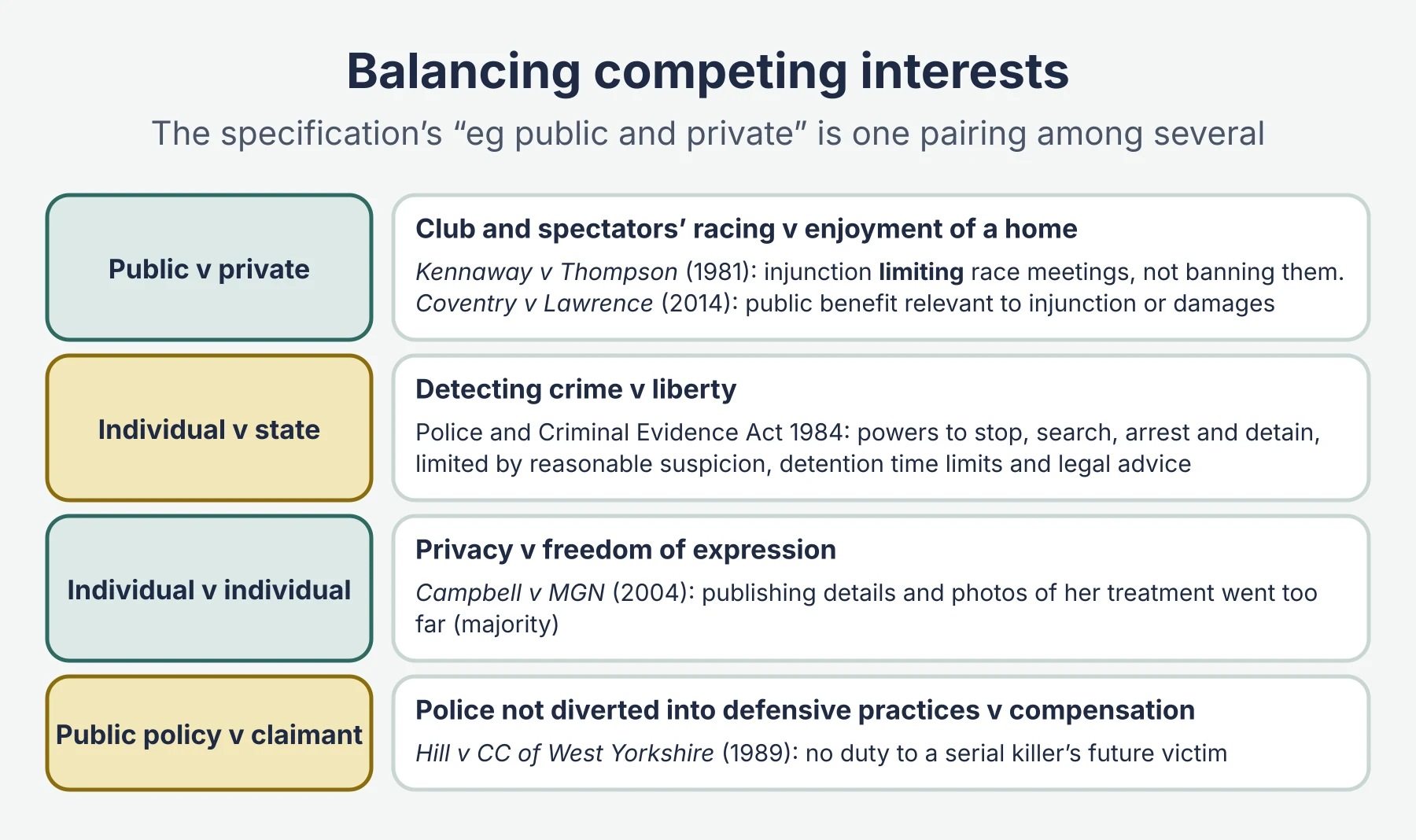
Almost every legal rule balances one interest against another. The specification’s example is public and private interests, but you can also use individual against individual, and individual against state.
Public versus private: nuisance
In Kennaway v Thompson (1981) a claimant living by a lake suffered noise from motorboat racing. The Court of Appeal granted an injunction limiting the number and timing of race meetings rather than banning them, balancing the club’s and spectators’ interest against the claimant’s enjoyment of her home. In Coventry v Lawrence (2014) the Supreme Court held that the public benefit of an activity, such as the fact that it has planning permission, can be relevant to whether an injunction or damages should be awarded, so the court can protect the claimant with money while allowing a useful activity to continue.
Individual versus state: police powers
The Police and Criminal Evidence Act 1984 gives police powers to stop, search, arrest and detain, because the public has an interest in detecting crime. It also limits those powers (reasonable grounds for suspicion, time limits on detention, the right to legal advice) because individuals have an interest in liberty. Every provision is a balance.
Individual versus individual: privacy and expression
In Campbell v MGN Ltd (2004) the House of Lords weighed a model’s right to privacy in her treatment for drug addiction against a newspaper’s freedom of expression, holding by a majority that publishing details and photographs of her attending meetings went too far. This shows balancing between two private interests, structured by the Human Rights Act.
Public policy limiting claims
In Hill v Chief Constable of West Yorkshire (1989) the House of Lords held that the police owed no duty of care to a future victim of a serial killer they had failed to catch. Part of the reasoning was the public interest in the police not being diverted into defensive practices. The individual’s interest in compensation was outweighed by a perceived public interest.
The meaning and importance of fault
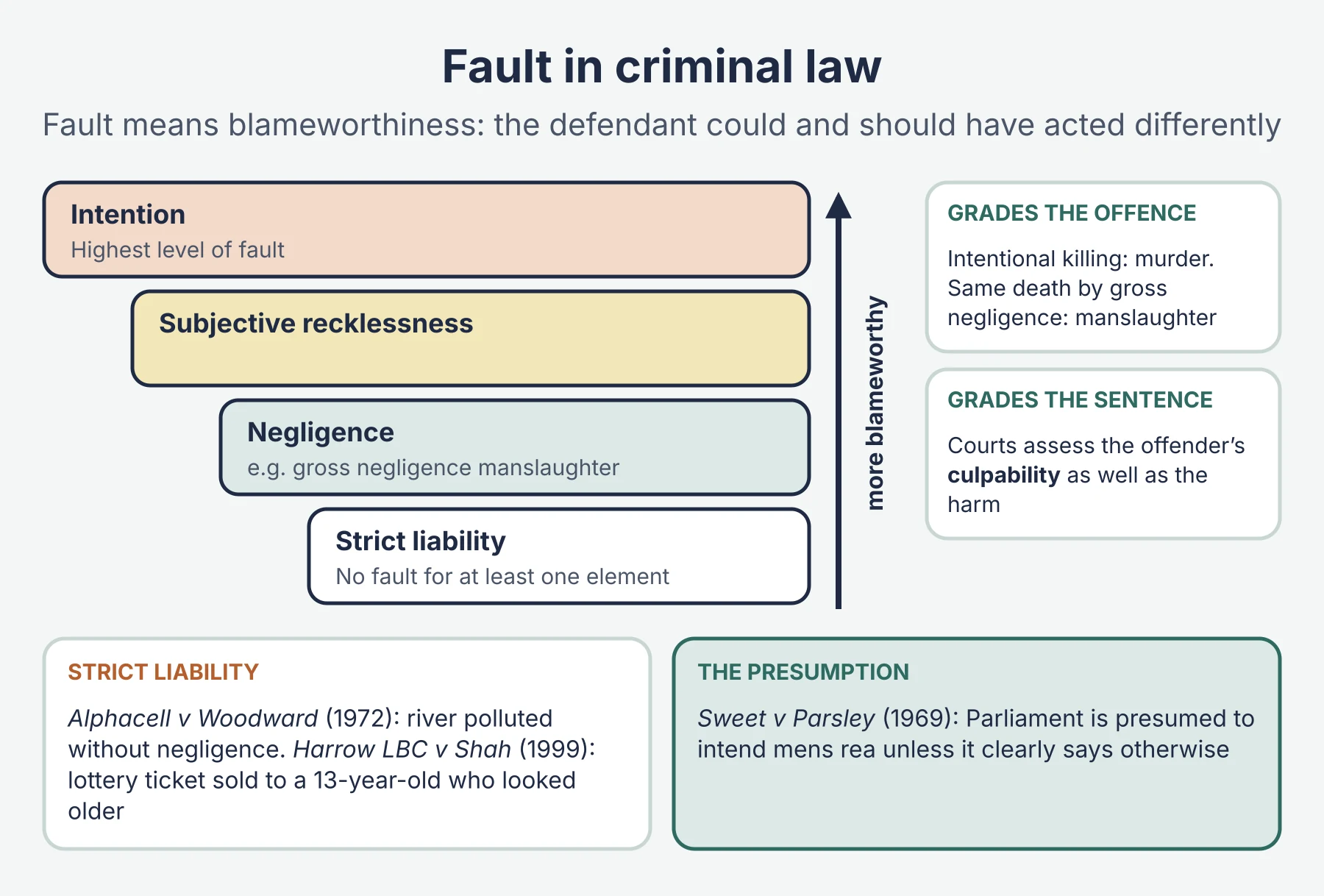
Fault means blameworthiness: the defendant could and should have acted differently. It matters because liability based on fault links legal consequences to moral responsibility, which makes the law seem fair and gives people a reason to take care.
Fault in criminal law
- Fault is expressed through mens rea. Intention is the highest level, then subjective recklessness, then negligence.
- The level of fault decides the offence: an intentional killing is murder; the same death caused by gross negligence is manslaughter.
- Fault affects sentence: the sentencing framework requires courts to assess the offender’s culpability as well as the harm caused.
- Strict liability removes fault for at least one element. In Alphacell v Woodward (1972) a company was liable for polluting a river even though it had not been negligent; in Harrow LBC v Shah (1999) shopkeepers were liable when an employee sold a lottery ticket to a 13-year-old boy who appeared older. In Sweet v Parsley (1969) the House of Lords stressed the presumption that Parliament intends mens rea to be required unless it clearly says otherwise.
Fault in civil law
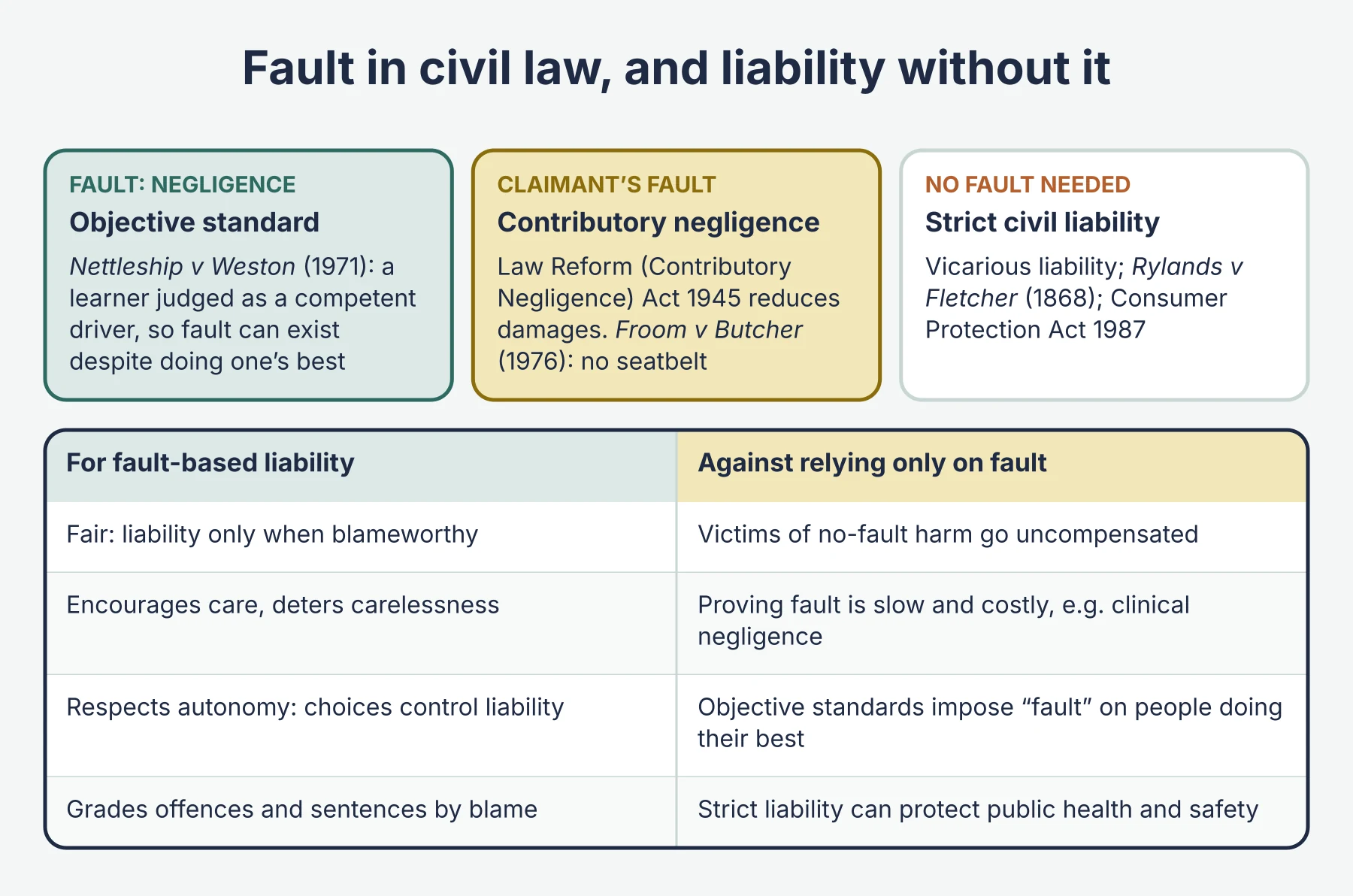
- In negligence fault is objective: did the defendant fall below the standard of the reasonable person? In Nettleship v Weston (1971) a learner driver was held to the standard of a competent driver, showing that “fault” in tort can exist even where the defendant did their personal best.
- Contributory negligence under the Law Reform (Contributory Negligence) Act 1945 reduces damages to reflect the claimant’s own fault; in Froom v Butcher (1976) damages were reduced because the claimant was not wearing a seatbelt.
- Liability without fault exists in civil law too: vicarious liability makes an employer liable for an employee’s tort, Rylands v Fletcher (1868) imposes liability for the escape of dangerous things, and the Consumer Protection Act 1987 makes producers liable for defective products without proof of negligence.
Is fault-based liability the right approach?
| For fault | Against relying only on fault |
|---|---|
| Fair: people are punished or pay only when blameworthy | Victims of no-fault harm go uncompensated |
| Encourages care and deters carelessness | Proving fault can be slow and costly, especially in clinical negligence |
| Respects autonomy: people control their liability by their choices | Objective standards can impose “fault” on people doing their best (Nettleship) |
| Grades offences and sentences by blame | Strict liability can be justified to protect public health and safety |
Worked example: an extended answer plan
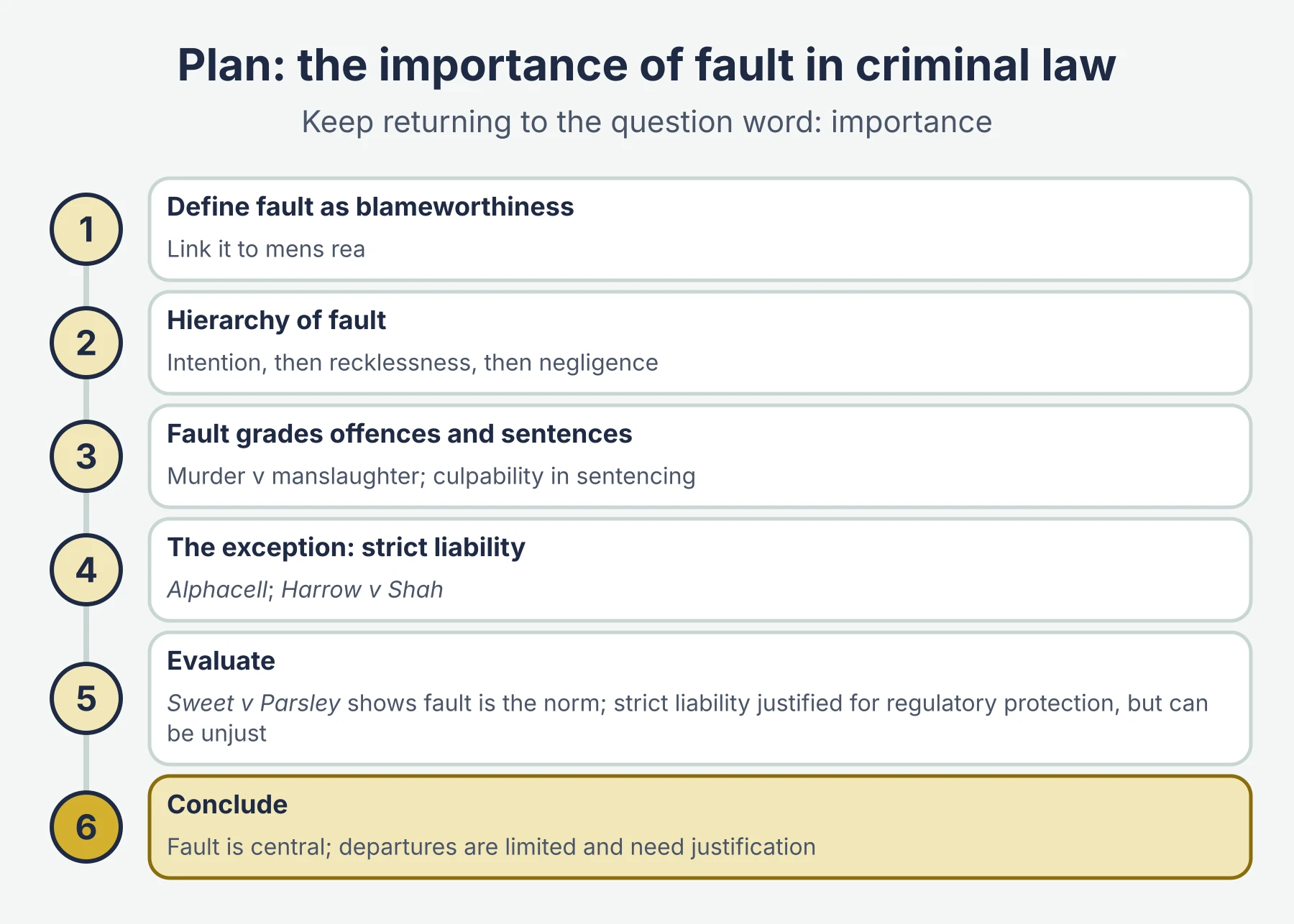
Question: Discuss the importance of fault in criminal law.
1 Define fault as blameworthiness; link to mens rea
2 Hierarchy of fault: intention > recklessness > negligence
3 Fault grades offences (murder v manslaughter) and sentences (culpability)
4 Exception: strict liability; Alphacell, Harrow v Shah
5 Evaluate: Sweet v Parsley presumption shows fault is the norm;
  strict liability justified for regulatory protection, but can be unjust
6 Conclude: fault is central, departures are limited and need justification
A strong answer keeps returning to the question word importance: each point should say why fault matters, not merely that it exists.
Common mistakes
- Listing the roles of law with no example of how a rule performs each one.
- Treating “competing interests” as only public versus private; the specification says “eg”, so other pairings are valid.
- Saying strict liability means the defendant did nothing wrong; there must still be an actus reus.
- Treating negligence in tort as a subjective test.
- Forgetting that the specification says civil and/or criminal: you may choose, but an answer that compares both often scores more highly.
Exam technique
For explain questions, state the role or idea, show how a specific rule achieves it, and add a case or statute. For discuss or evaluate, weigh how well the law achieves the role, using the limits (cost of enforcing rights, unfairness of strict liability), and finish with a judgement that answers the question set.
Revise with the Law and Society revision notes and test yourself with the Law and Society practice questions. Fault links closely to Law and Morality.
Related resources
-
Practice questions
AQA A Level Law (7162): Nature of Law: Law and Society – Practice Questions
Original practice questions and full answers on the role of law, enforceable rights, competing interests and fault in civil and criminal law for AQA Law 7162.
Law · AQA · A Level
Try questions -
Revision notes
AQA A Level Law (7162): Nature of Law: Law and Society – Revision Notes
Revision notes on the role of law, enforceable rights, competing interests and fault, with cases, key terms, exam traps and a self-test for AQA Law 7162.
Law · AQA · A Level
Revise topic -
Practice questions
AQA A Level Law (7162): Nature of Law – Practice Questions
Original practice questions with mark-scheme answers on legal rules and norms, civil and criminal law, and custom, statute and common law for AQA Law 7162.
Law · AQA · A Level
Try questions
Get free revision emails (optional)
Occasional emails with practice questions, worked explanations and links to free resources for the qualification and subjects you choose. No spam, and you can unsubscribe from any email. The free tools on this site never need an email.