
Revision Notes
AQA A Level Law (7162): Nature of Law: Law and Society – Revision Notes
Revision notes on the role of law, enforceable rights, competing interests and fault, with cases, key terms, exam traps and a self-test for AQA Law 7162.
- Subject
- Law
- Level
- A LEVELS
- Topic
- Section 3.1 – The Nature of Law and the English Legal System
- Author
- Marlbridge Academic Team
- Updated
- Reviewed by
- Aizaz Raoof Ali (what this means)
Aligned to AQA A Level Law (7162), For teaching from September 2017 onwards, A-level exams 2019 onwards. Official specification .
Syllabus page (what it covers and how it is assessed): AQA A Level Law.
Syllabus points this page covers
7162
- Nature of law: law and society
Found an error? Report a correction.
Need help with this topic? Request a free trial class for A Level Law (7162).
Condensed notes on Nature of law: law and society in AQA A-level Law (7162) section 3.1: the role law plays in society, enforceable rights, the balance between competing interests, and the meaning and importance of fault. For full explanation and an essay plan, see the Law and Society study guide.
The role of law: five functions with evidence
| Function | Evidence to cite |
|---|---|
| Social control | Criminal offences with sanctions, e.g. the Theft Act 1968 |
| Protecting people and property | Damages in negligence; trespass |
| Regulating relationships | Employment Rights Act 1996 (unfair dismissal) |
| Peaceful dispute resolution | Courts, tribunals, small claims track |
| Reflecting and shaping values | Equality Act 2010 |
Theory in one line each
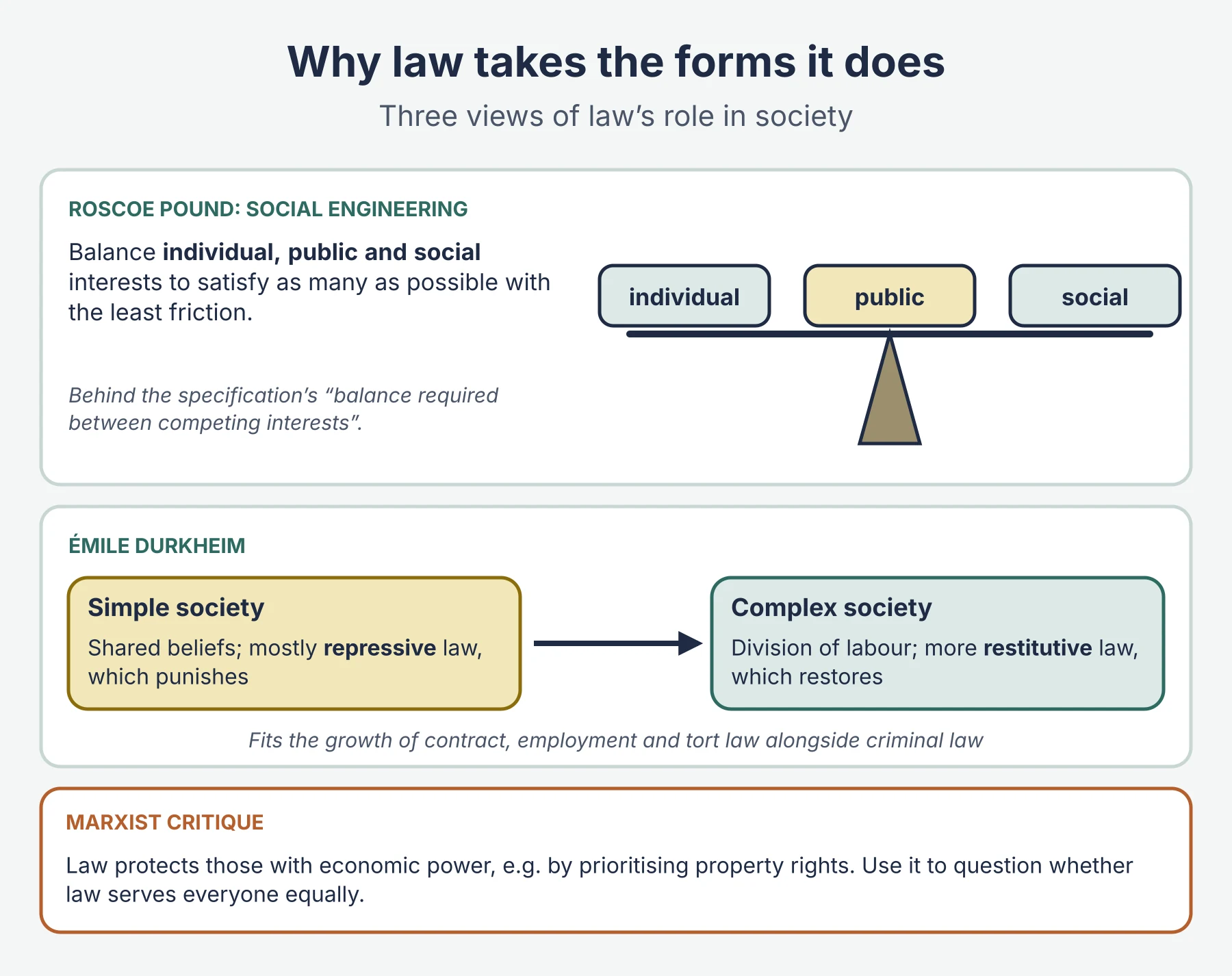
- Pound: law is social engineering, balancing individual, public and social interests with the least friction.
- Durkheim: simple societies use repressive (punitive) law; complex societies increasingly use restitutive law (contract, tort).
- Marxist critique: law protects those with economic power; use it to question whether law serves everyone.
Enforceable rights
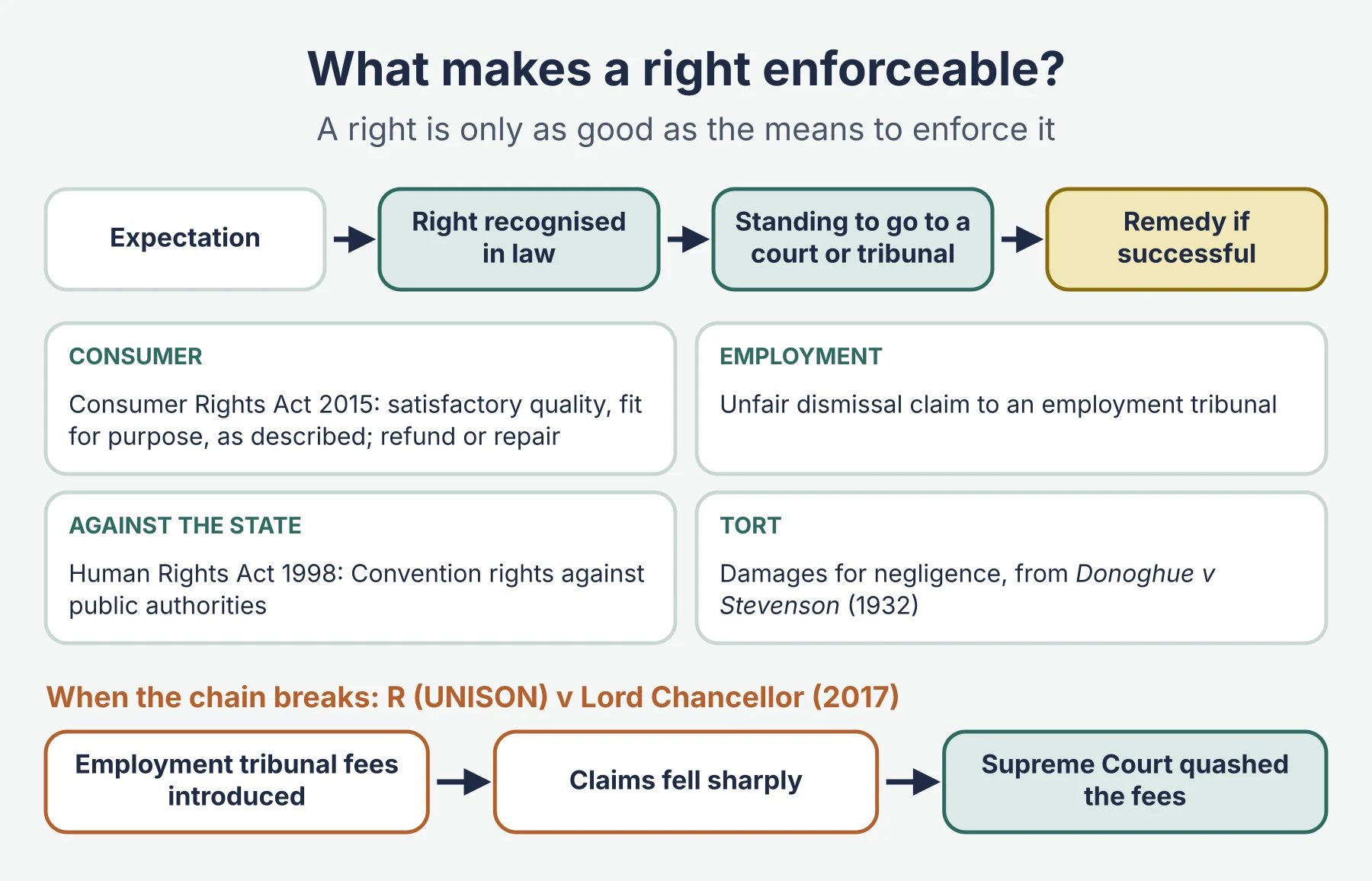
A right is enforceable when the holder can go to a court or tribunal and obtain a remedy.
- Consumer Rights Act 2015: satisfactory quality, fit for purpose, as described.
- Employment tribunal claims for unfair dismissal.
- Human Rights Act 1998: Convention rights against public authorities.
- Negligence damages, from Donoghue v Stevenson (1932).
Limit: cost and access. R (UNISON) v Lord Chancellor (2017): tribunal fees quashed; claims had fallen sharply, so rights were not practically enforceable.
Balancing competing interests
| Interests balanced | Authority | Outcome |
|---|---|---|
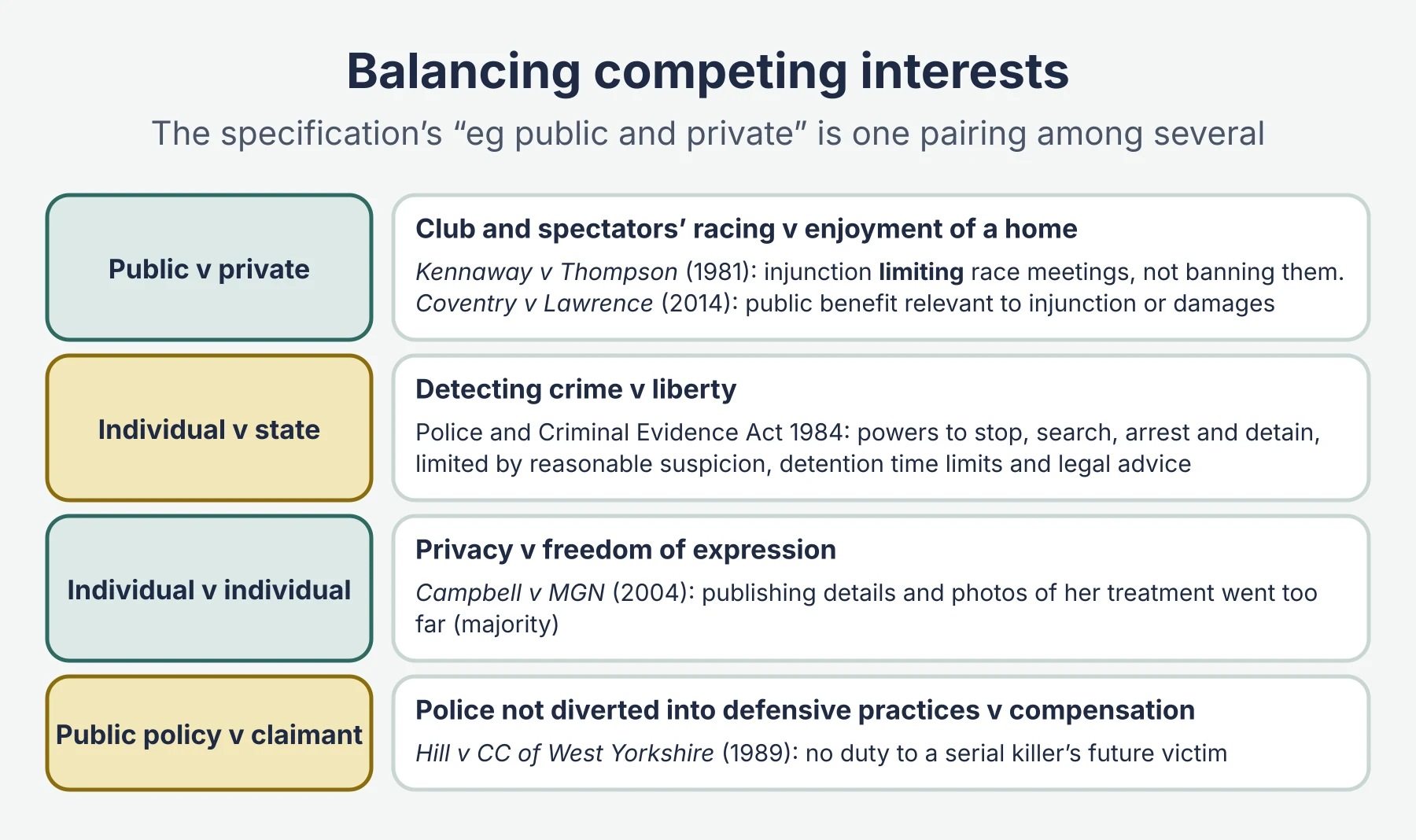
| Public (sport, recreation) v private (home) | Kennaway v Thompson (1981) | Injunction limiting, not banning, motorboat racing |
| Public benefit v neighbour’s enjoyment | Coventry v Lawrence (2014) | Public benefit and planning permission can affect remedy; damages may replace an injunction |
| State (crime control) v individual (liberty) | Police and Criminal Evidence Act 1984 | Powers with safeguards: reasonable suspicion, detention limits, legal advice |
| Privacy v freedom of expression | Campbell v MGN Ltd (2004) | Majority: publication of treatment details and photographs went too far |
| Public interest in policing v individual compensation | Hill v Chief Constable of West Yorkshire (1989) | No duty of care owed to a future victim |
Fault
Definition: blameworthiness; the defendant could and should have acted otherwise.
Why it matters: links liability to moral responsibility; deters carelessness; grades offences and sentences.
Criminal
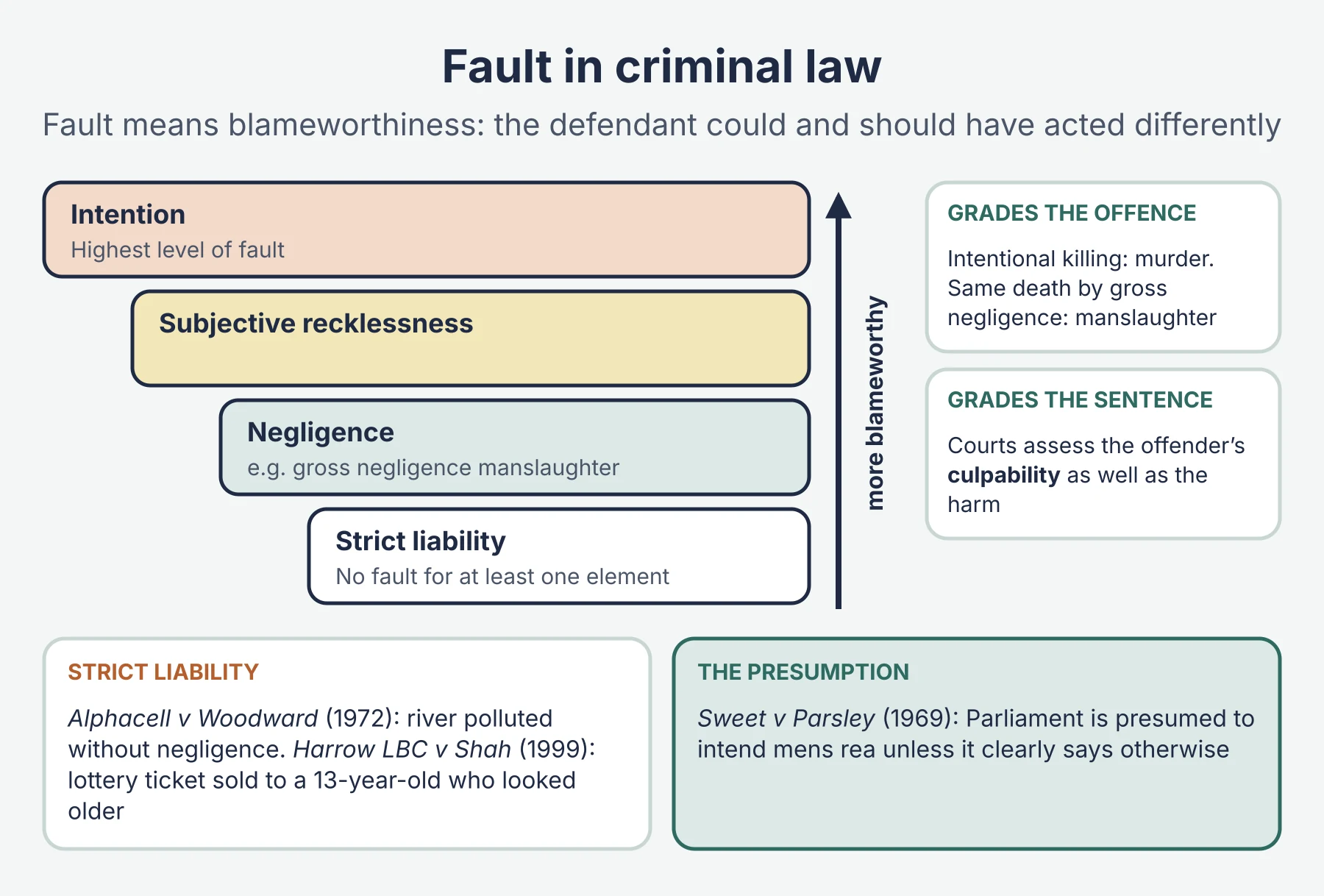
- Mens rea hierarchy: intention > subjective recklessness > negligence.
- Fault grades offences: murder (intention) versus manslaughter (e.g. gross negligence).
- Sentencing assesses culpability and harm.
- Strict liability: Alphacell v Woodward (1972) river pollution; Harrow LBC v Shah (1999) lottery ticket to a 13-year-old.
- Presumption of mens rea: Sweet v Parsley (1969).
Civil
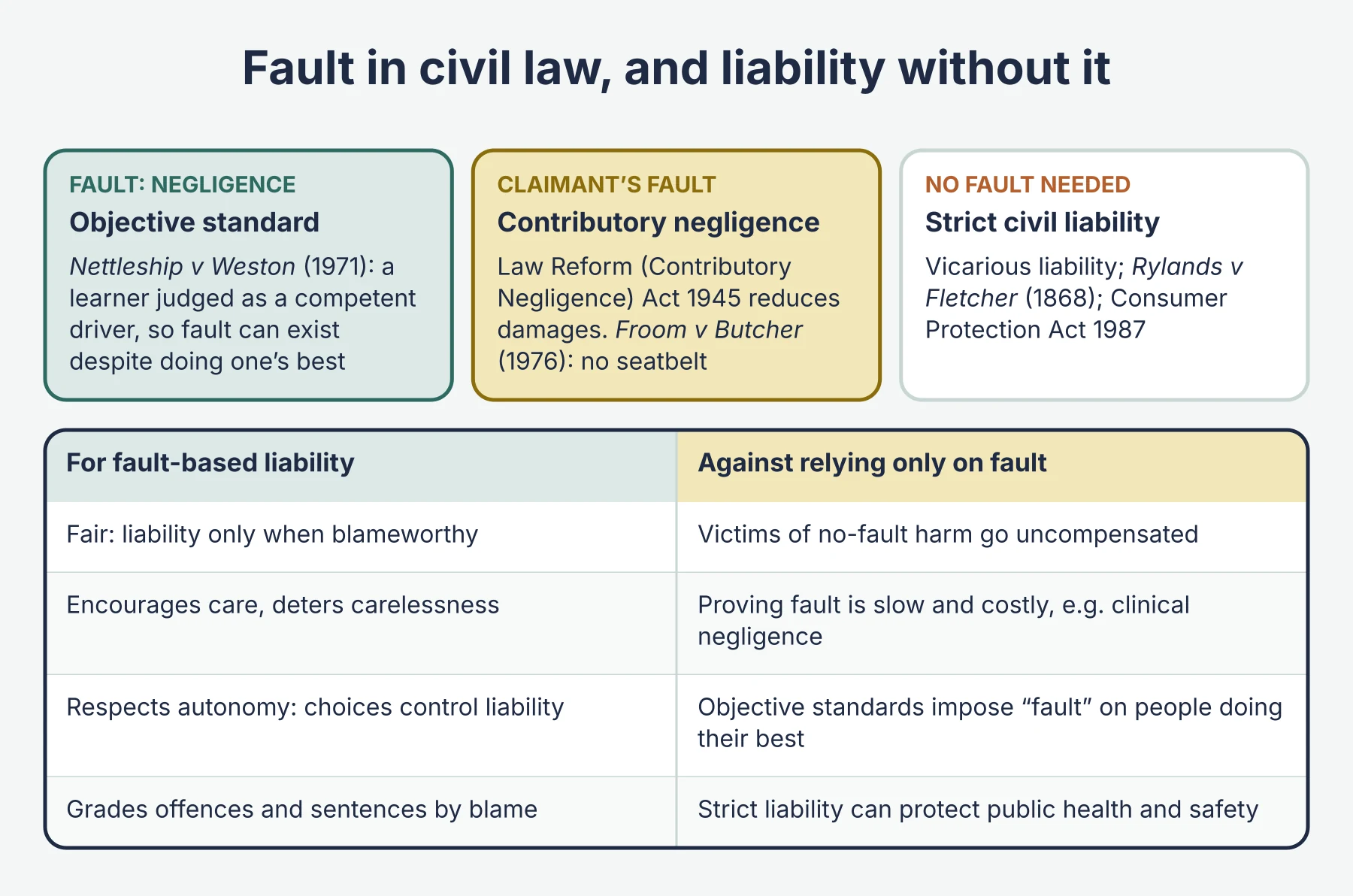
- Negligence is objective: Nettleship v Weston (1971), learner driver held to a competent driver’s standard.
- Contributory negligence reduces damages: Law Reform (Contributory Negligence) Act 1945; Froom v Butcher (1976), no seatbelt.
- No-fault liability: vicarious liability; Rylands v Fletcher (1868); Consumer Protection Act 1987.
Evaluation grid
| For fault-based liability | Against |
|---|---|
| Fair: liability follows blame | No-fault victims go uncompensated |
| Deters carelessness | Proving fault is slow and costly |
| Respects choice and autonomy | Objective tests can label the inexperienced “at fault” |
| Allows grading of offences | Public protection may justify strict liability |
Key terms
| Term | Meaning |
|---|---|
| Social control | Using rules and sanctions to keep behaviour within accepted limits |
| Enforceable right | An entitlement a person can uphold through a court or tribunal |
| Competing interests | Rival claims that the law must weigh, such as public and private |
| Social engineering | Pound’s description of law balancing interests |
| Fault | Blameworthiness for conduct |
| Culpability | The degree of an offender’s blame, assessed in sentencing |
| Strict liability | Liability without proof of fault for at least one element |
| Contributory negligence | The claimant’s own fault, reducing damages |
| Vicarious liability | Liability of one person (usually an employer) for another’s tort |
Exam traps
- Naming a function of law without an example of a rule performing it.
- Reading “public and private” as the only competing interests; the specification says “eg”.
- Saying strict liability needs no actus reus; it removes fault, not conduct.
- Calling negligence in tort subjective.
- Writing about fault in criminal law only when the question says civil and/or criminal and a comparison would strengthen the answer.
- Failing to reach a judgement in a “discuss” question.
Self-test
- What did Pound mean by social engineering?
- Distinguish repressive from restitutive law in Durkheim’s account.
- Name a statute that gives consumers enforceable rights.
- Why does UNISON show the limits of enforceable rights?
- How did the court balance interests in Kennaway v Thompson?
- What did Coventry v Lawrence add about remedies in nuisance?
- Which competing interests were balanced in Campbell v MGN?
- State the hierarchy of criminal fault.
- Give a strict liability case and its facts.
- What presumption did Sweet v Parsley confirm?
- Why is Nettleship v Weston useful in an answer on fault?
- Give two examples of civil liability without fault.
Answers: 1. That law balances individual, public and social interests so as to satisfy as many as possible with the least friction. 2. Repressive law punishes and dominates in simple societies; restitutive law restores people to their position and grows in complex societies. 3. The Consumer Rights Act 2015. 4. Fees made claims unaffordable, so rights existed on paper but could not be enforced in practice. 5. It granted an injunction limiting the number and timing of motorboat races rather than banning them. 6. That the public benefit of an activity, including planning permission, can be relevant to whether damages or an injunction is awarded. 7. Privacy against freedom of expression. 8. Intention, then subjective recklessness, then negligence. 9. Alphacell v Woodward (1972): a company was liable for river pollution without proof of negligence (or Harrow LBC v Shah, 1999). 10. That Parliament is presumed to intend mens rea unless it clearly states otherwise. 11. It shows that fault in tort is objective: a learner doing her best was still at fault. 12. Any two: vicarious liability; Rylands v Fletcher; producer liability under the Consumer Protection Act 1987.
More resources on this topic
Law and Society study guide | Law and Society practice questions | Nature of Law revision notes
Related resources
-
Practice questions
AQA A Level Law (7162): Nature of Law – Practice Questions
Original practice questions with mark-scheme answers on legal rules and norms, civil and criminal law, and custom, statute and common law for AQA Law 7162.
Law · AQA · A Level
Try questions -
Revision notes
AQA A Level Law (7162): Nature of Law – Revision Notes
Condensed recall on legal rules and norms, civil and criminal law, and custom, statute and common law, with a key-terms table and self-test for AQA Law 7162.
Law · AQA · A Level
Revise topic -
Study guides
AQA A Level Law (7162): Access to Justice and Funding
Help lines, Citizens Advice, law centres, trade unions, private funding, conditional fees and civil and criminal legal aid for AQA A Level Law 7162 section 3.1.
Law · AQA · A Level
Read guide
Get free revision emails (optional)
Occasional emails with practice questions, worked explanations and links to free resources for the qualification and subjects you choose. No spam, and you can unsubscribe from any email. The free tools on this site never need an email.