
Study Guides
AQA A Level Law (7162): Access to Justice and Funding
Help lines, Citizens Advice, law centres, trade unions, private funding, conditional fees and civil and criminal legal aid for AQA A Level Law 7162 section 3.1.
- Subject
- Law
- Level
- A LEVELS
- Topic
- Section 3.1 – The Nature of Law and the English Legal System
- Author
- Marlbridge Academic Team
- Updated
- Reviewed by
- Aizaz Raoof Ali (what this means)
Aligned to AQA A Level Law (7162), For teaching from September 2017 onwards, A-level exams 2019 onwards. Official specification .
Syllabus page (what it covers and how it is assessed): AQA A Level Law.
Syllabus points this page covers
7162
- The legal system: access to justice and funding
Found an error? Report a correction.
Need help with this topic? Request a free trial class for A Level Law (7162).
This guide covers the section 3.1 row The legal system: access to justice and funding in AQA A-level Law (7162). The specification asks for three things, each at the level of “basic understanding”: “alternative sources of legal advice: help lines, Citizens Advice Bureau (CAB), law centres and trade unions”; “private funding: own resources, insurance and conditional fee agreements”; and “public funding: criminal and civil state funding”. Questions usually ask you to explain a source or method, or to advise a person in a short scenario on how they could get advice and pay for it. For the whole of section 3.1, see the Nature of Law and the English Legal System study guide.
What “access to justice” means
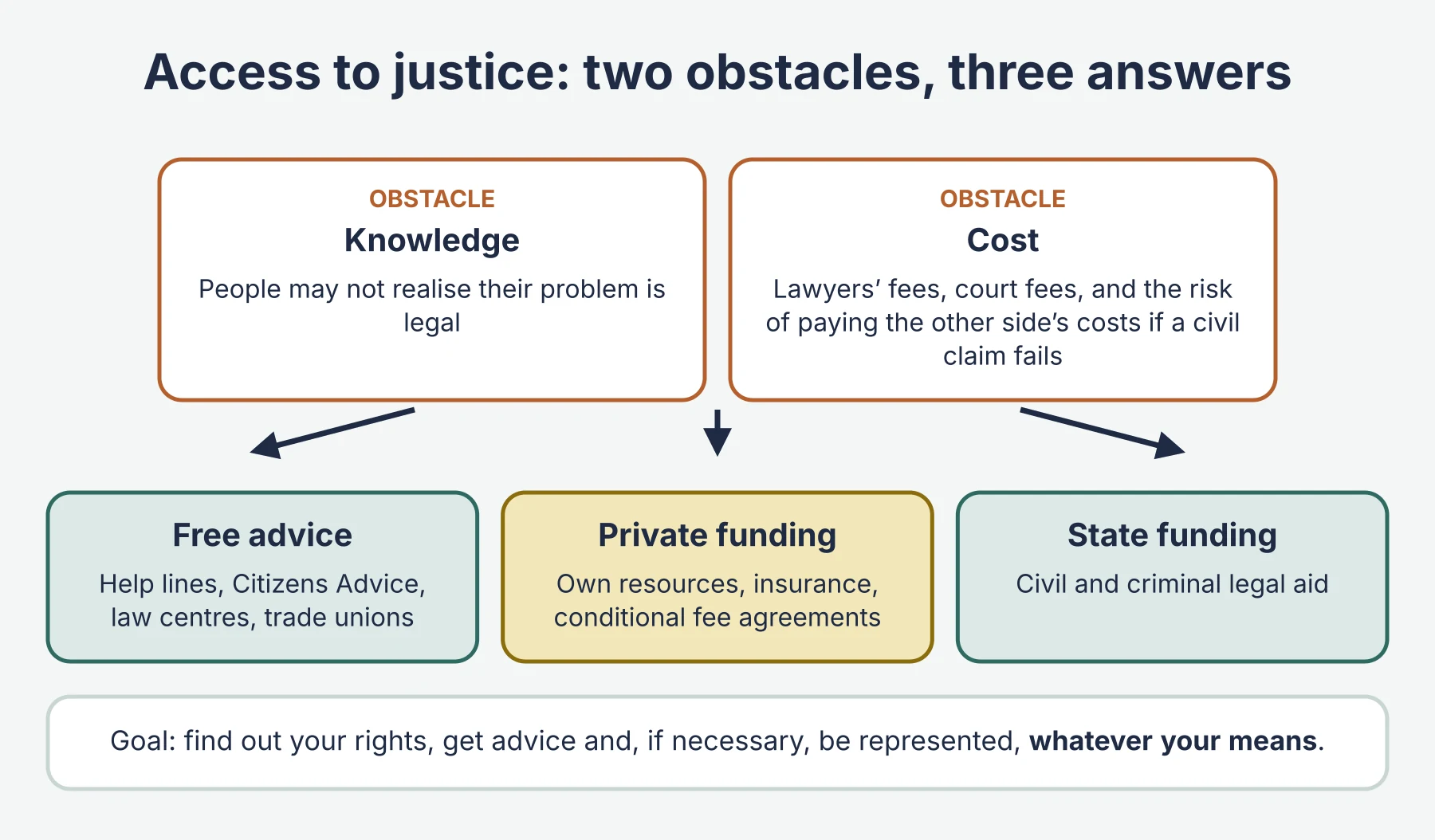
Rights are only useful if people can enforce them. Access to justice means that a person with a legal problem can find out what their rights are, get advice and, if necessary, be represented in a court or tribunal, whatever their means. Two obstacles recur: knowledge (people may not realise their problem is legal) and cost (lawyers’ fees, court fees and the risk of paying the other side’s costs if a civil claim fails). The three specification items answer these obstacles in turn: free advice, private ways of paying, and state funding.
Alternative sources of legal advice
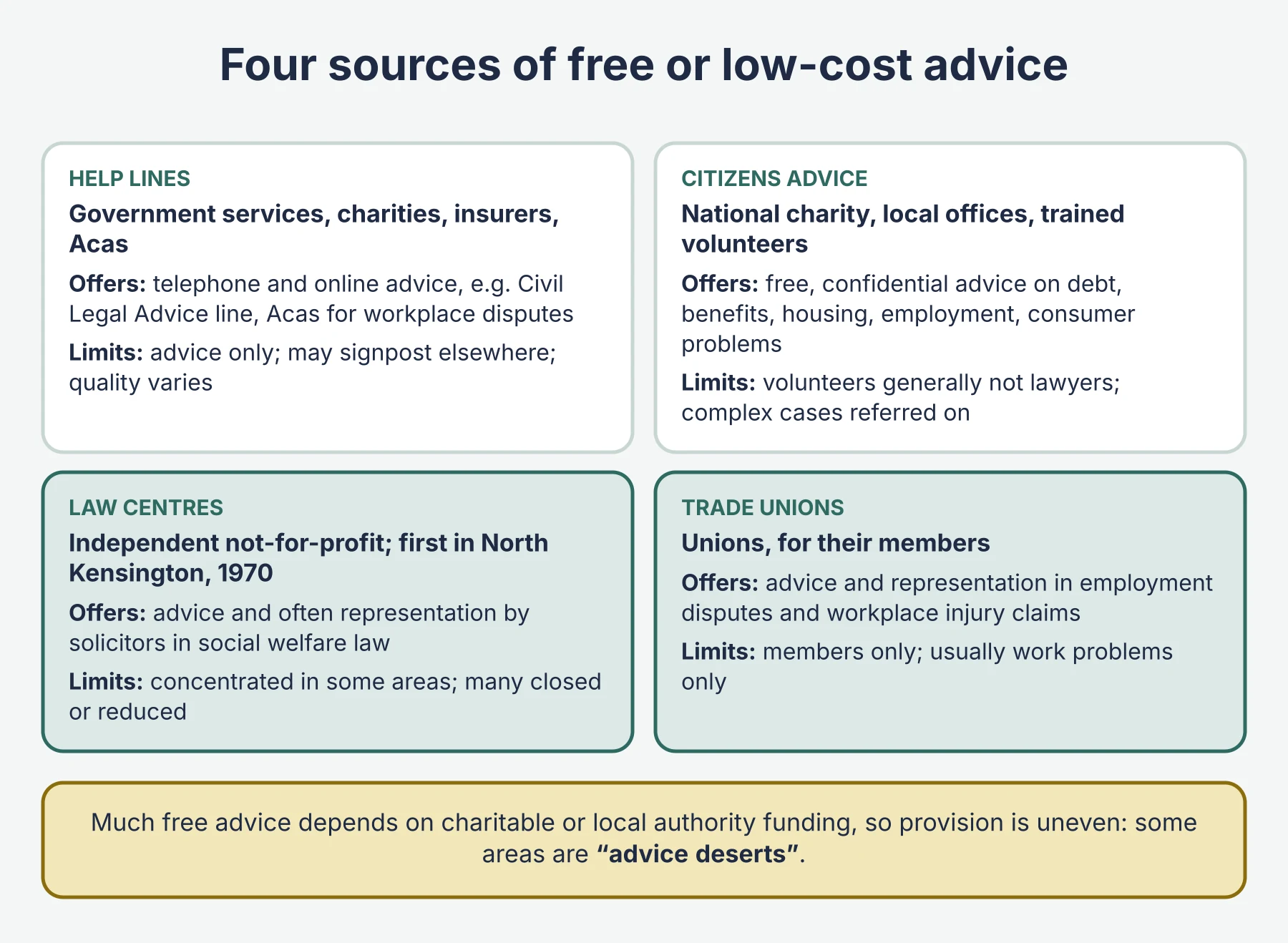
| Source | Who runs it | What it offers | Limits |
|---|---|---|---|
| Help lines | Government services, charities, insurers and bodies such as Acas | Free or low-cost telephone and online advice, for example the Civil Legal Advice line for legal aid matters, Acas for workplace disputes, or a charity housing helpline | Advice only; callers may be signposted elsewhere; quality varies with the provider |
| Citizens Advice (the specification’s CAB) | A national charity with local offices, staffed largely by trained volunteers | Free, confidential, independent advice on debt, benefits, housing, employment and consumer problems, in person, by phone and online | Volunteers are generally not lawyers; complex cases are referred on; local offices depend on funding |
| Law centres | Independent not-for-profit bodies; the first opened in North Kensington in 1970 | Free advice and often representation by solicitors and caseworkers in social welfare law: housing, employment, immigration, welfare benefits and discrimination | Concentrated in some areas; many have closed or reduced services as funding has fallen |
| Trade unions | Unions for their members | Advice and representation in employment disputes and workplace injury claims, often through union solicitors | Only for members, and usually only for work-related problems |
Evaluation points. Free advice is most valuable at an early stage, before a problem becomes a court case. But much of it depends on charitable or local authority funding, so provision is uneven; some parts of the country have little specialist advice, sometimes described as “advice deserts”.
Private funding
Own resources. A client pays the lawyer from savings or income, usually by an hourly rate or a fixed fee. This gives the widest choice of lawyer but is expensive, and in civil litigation the general rule is that the loser pays a large part of the winner’s costs, so a claimant who loses may pay two sets of costs.
Insurance.
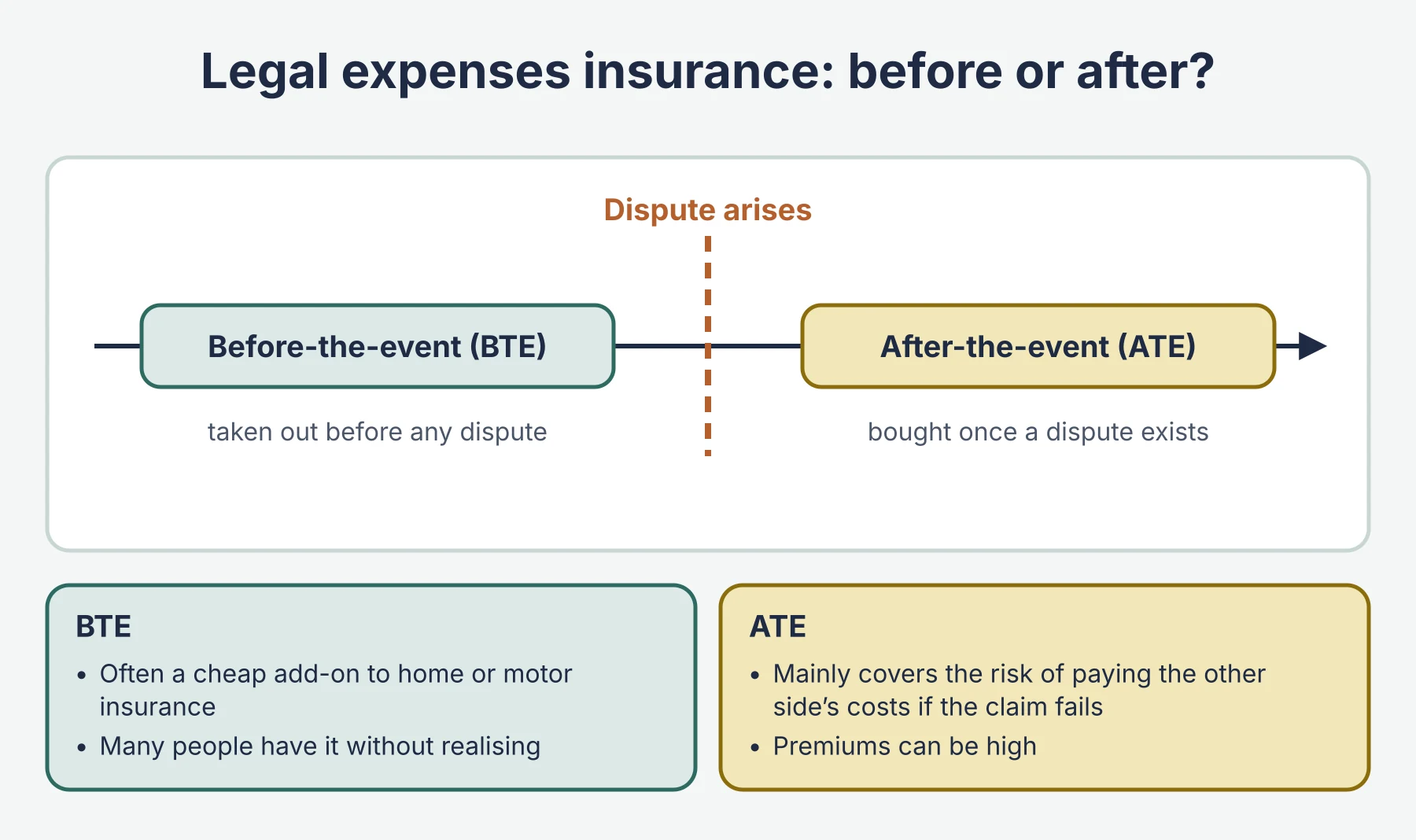
- Before-the-event (BTE) legal expenses insurance is taken out before any dispute arises, often as a cheap add-on to home or motor insurance. Many people have it without realising.
- After-the-event (ATE) insurance is bought once a dispute exists, mainly to cover the risk of paying the other side’s costs if the claim fails. Premiums can be high.
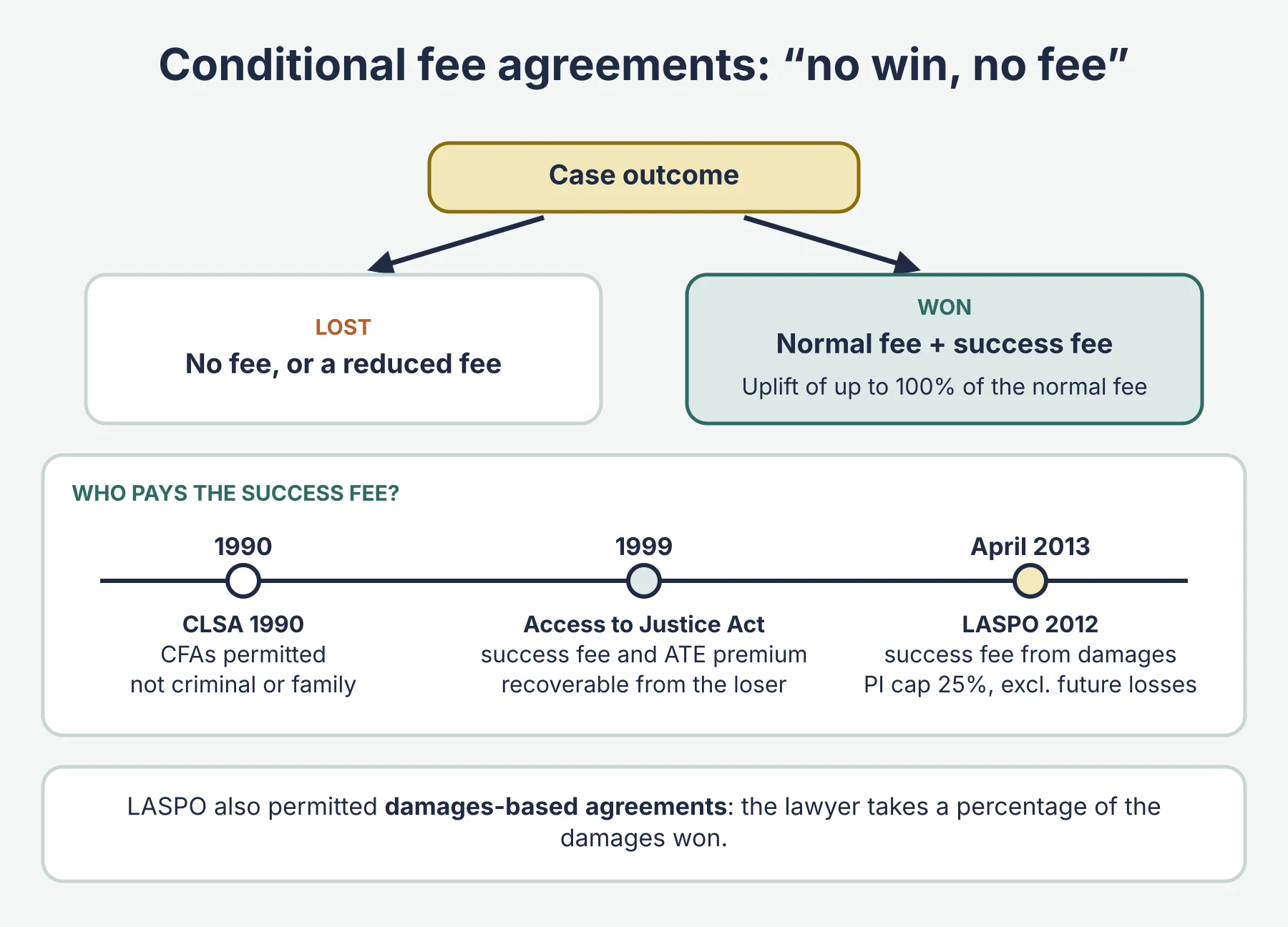
Conditional fee agreements (CFAs). Often called “no win, no fee”:
- The lawyer agrees to take no fee, or a reduced fee, if the case is lost.
- If the case is won, the lawyer receives the normal fee plus a success fee, an uplift of up to 100% of the normal fee.
- CFAs were permitted by the Courts and Legal Services Act 1990 and cannot be used for criminal or family proceedings.
- Under the Access to Justice Act 1999 the success fee and ATE premium could be recovered from the losing side. The Legal Aid, Sentencing and Punishment of Offenders Act 2012 (LASPO) ended this from April 2013, so the success fee now comes out of the winning client’s damages; in personal injury cases it is capped at 25% of damages excluding future losses.
- LASPO also permitted damages-based agreements, where the lawyer takes a percentage of the damages won.
Evaluation points. CFAs have widened access for personal injury claimants, who would never have qualified for legal aid, but lawyers prefer cases with good prospects, so weaker or complex claims may not find a lawyer; and a client who wins still loses part of the damages to the success fee.
Public funding: state legal aid
Legal aid is administered by the Legal Aid Agency, an executive agency of the Ministry of Justice, which replaced the Legal Services Commission under LASPO.
Civil legal aid
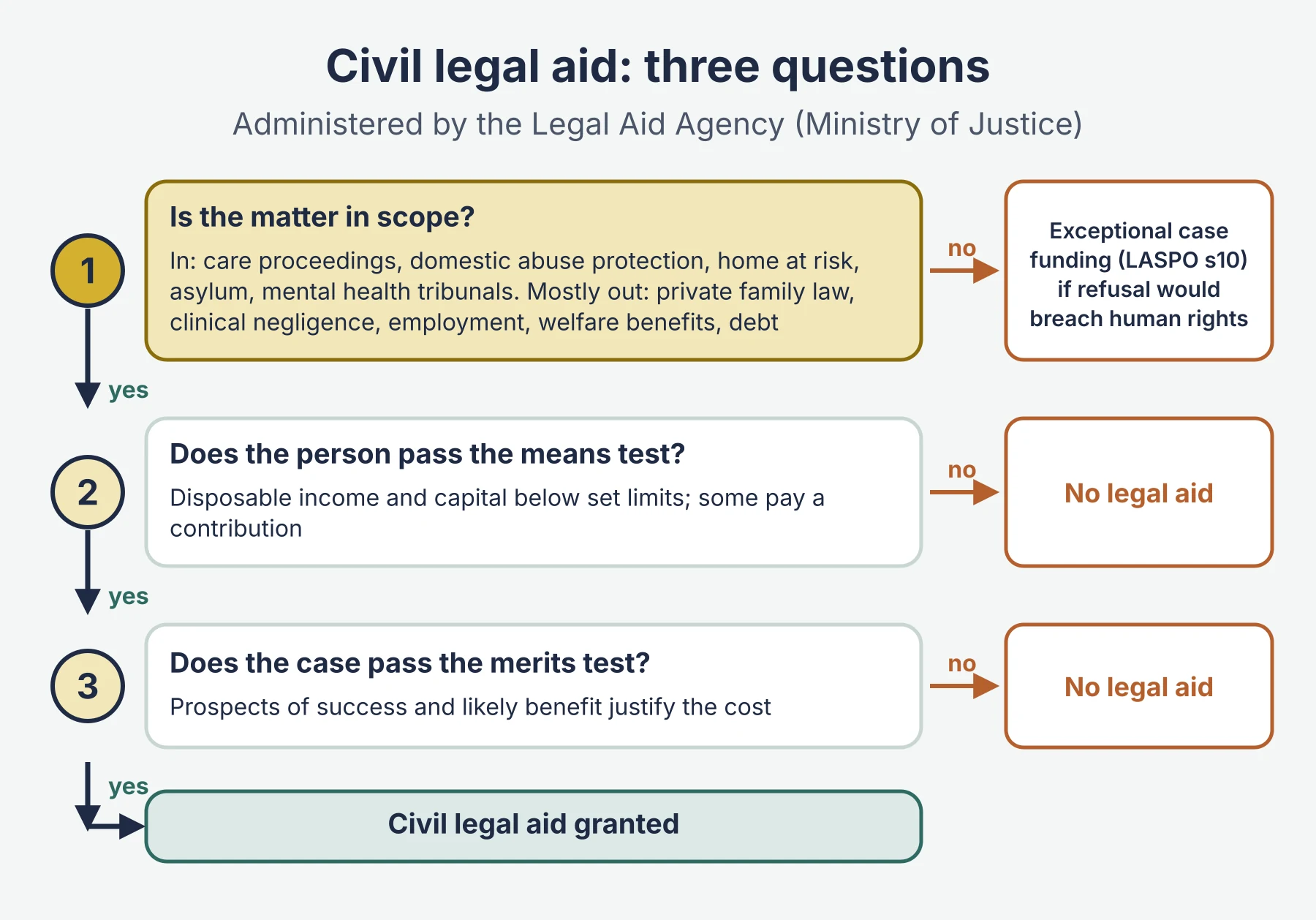
Three questions decide whether a person gets civil legal aid:
- Is the matter in scope? LASPO removed many areas from civil legal aid, such as most private family law (unless there is evidence of domestic abuse or child abuse), most clinical negligence, most employment and welfare benefits matters, and most debt cases. Areas still in scope include care proceedings, domestic abuse protection, cases where a person’s home is at risk, asylum and mental health tribunal cases.
- Does the person pass the means test? Disposable income and disposable capital must be below set limits; some people must pay a contribution.
- Does the case pass the merits test? The prospects of success and the likely benefit must justify the cost.
Where a case is out of scope but refusing funding would breach the person’s human rights, exceptional case funding may be granted under section 10 of LASPO.
Criminal legal aid
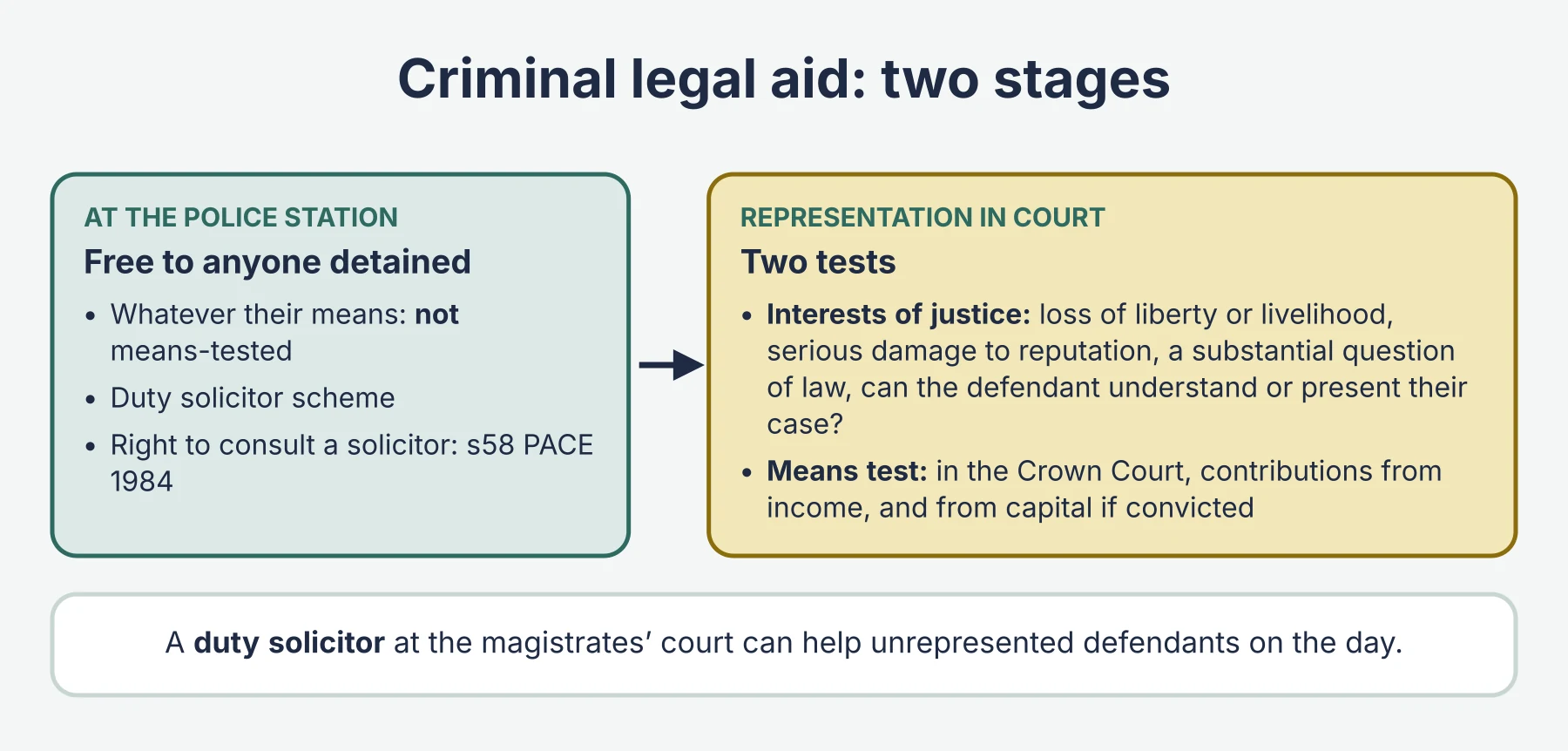
- Advice at the police station is free to anyone detained, whatever their means, through the duty solicitor scheme; the right to consult a solicitor comes from section 58 of the Police and Criminal Evidence Act 1984.
- Representation in court depends on the interests of justice test, which considers factors such as whether the defendant is likely to lose their liberty or livelihood or suffer serious damage to reputation, whether a substantial question of law is involved, and whether the defendant can understand the proceedings or present their own case.
- A means test applies as well. In the Crown Court, defendants above the income threshold may have to pay contributions from income, and from capital if convicted.
- A duty solicitor at the magistrates’ court can help unrepresented defendants on the day.
Evaluation points. Police station advice protects suspects at the most vulnerable stage. But LASPO’s cuts to civil scope have left many people to represent themselves (litigants in person), especially in family courts, which can lengthen hearings and disadvantage the unrepresented side. Fixed legal aid fees have made criminal work less attractive to lawyers, and eligibility limits mean some people who cannot realistically afford a lawyer still do not qualify.
Worked example: advising in a scenario
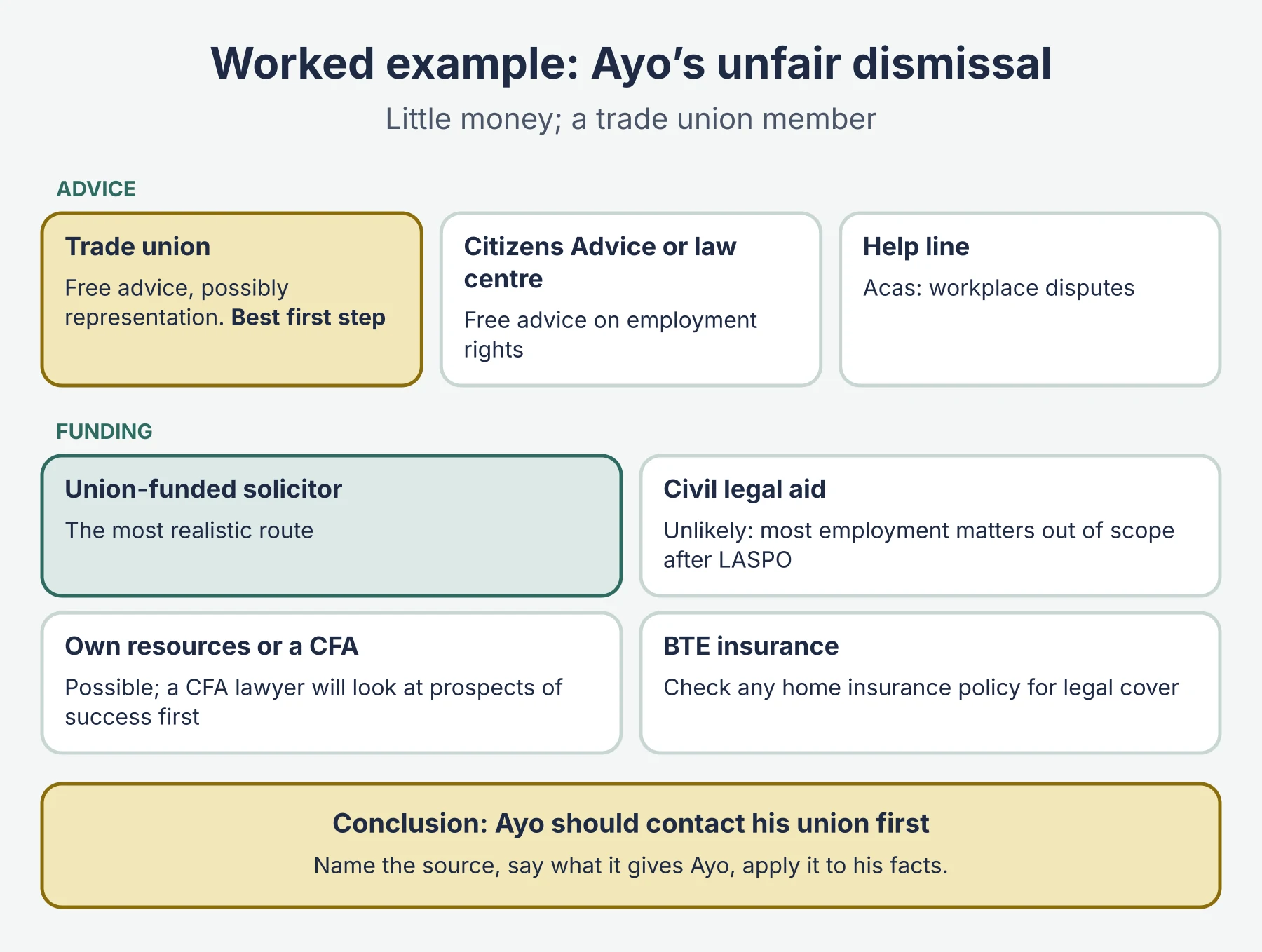
Ayo has been dismissed from his job and thinks it was unfair. He has little money and is a member of a trade union. Advise him on where he could get advice and how his case could be funded. [6]
Advice:     Trade union - free advice and possibly representation for members
            in employment disputes (best first step).
            Citizens Advice or a law centre - free advice on employment rights.
            Help line - Acas offers advice on workplace disputes.
Funding:    Civil legal aid - most employment matters are out of scope after
            LASPO, so unlikely.
            Union-funded solicitor - the most realistic route.
            Own resources or a CFA - possible, but a CFA lawyer will look at
            his prospects of success first.
            BTE insurance - check any home insurance policy for legal cover.
Conclusion: Ayo should contact his union first.
Each point names a source, explains what it gives Ayo and applies it to his facts, which is how application marks are earned.
Common mistakes
- Saying legal aid is available for any civil case: scope is the first test.
- Confusing BTE and ATE insurance.
- Saying a CFA means the client never pays anything: the success fee comes out of damages.
- Saying police station advice is means-tested: it is free to all detainees.
- Describing Citizens Advice as staffed by lawyers.
Exam technique
For “explain” questions, define the source or method and add how it is accessed or paid for. For scenario questions, match each source to the person’s actual problem and means rather than listing everything. For evaluation, pair each benefit with a limitation and reach a view on whether access to justice is adequate.
More resources on this topic
Access to justice and funding revision notes | Access to justice and funding practice questions
Related resources
-
Practice questions
AQA A Level Law (7162): Access to Justice and Funding – Practice Questions
Original practice questions with mark-scheme answers on advice sources, private funding and civil and criminal legal aid for AQA A Level Law 7162.
Law · AQA · A Level
Try questions -
Revision notes
AQA A Level Law (7162): Access to Justice and Funding – Revision Notes
Recall notes on advice sources, own funds, legal expenses insurance, conditional fee agreements and civil and criminal legal aid for AQA A Level Law 7162.
Law · AQA · A Level
Revise topic -
Study guides
AQA A Level Law (7162): Legal Personnel and the Judiciary
Barristers, solicitors and legal executives, their regulation, types of judge, judicial roles and judicial independence for AQA A Level Law 7162 section 3.1.
Law · AQA · A Level
Read guide
Get free revision emails (optional)
Occasional emails with practice questions, worked explanations and links to free resources for the qualification and subjects you choose. No spam, and you can unsubscribe from any email. The free tools on this site never need an email.