
Revision Notes
AQA A Level Law (7162): Access to Justice and Funding – Revision Notes
Recall notes on advice sources, own funds, legal expenses insurance, conditional fee agreements and civil and criminal legal aid for AQA A Level Law 7162.
- Subject
- Law
- Level
- A LEVELS
- Topic
- Section 3.1 – The Nature of Law and the English Legal System
- Author
- Marlbridge Academic Team
- Updated
- Reviewed by
- Aizaz Raoof Ali (what this means)
Aligned to AQA A Level Law (7162), For teaching from September 2017 onwards, A-level exams 2019 onwards. Official specification .
Syllabus page (what it covers and how it is assessed): AQA A Level Law.
Syllabus points this page covers
7162
- The legal system: access to justice and funding
Found an error? Report a correction.
Need help with this topic? Request a free trial class for A Level Law (7162).
Condensed notes for the section 3.1 row The legal system: access to justice and funding: alternative sources of legal advice, private funding and public funding. For explanation and a worked scenario, use the access to justice and funding study guide.
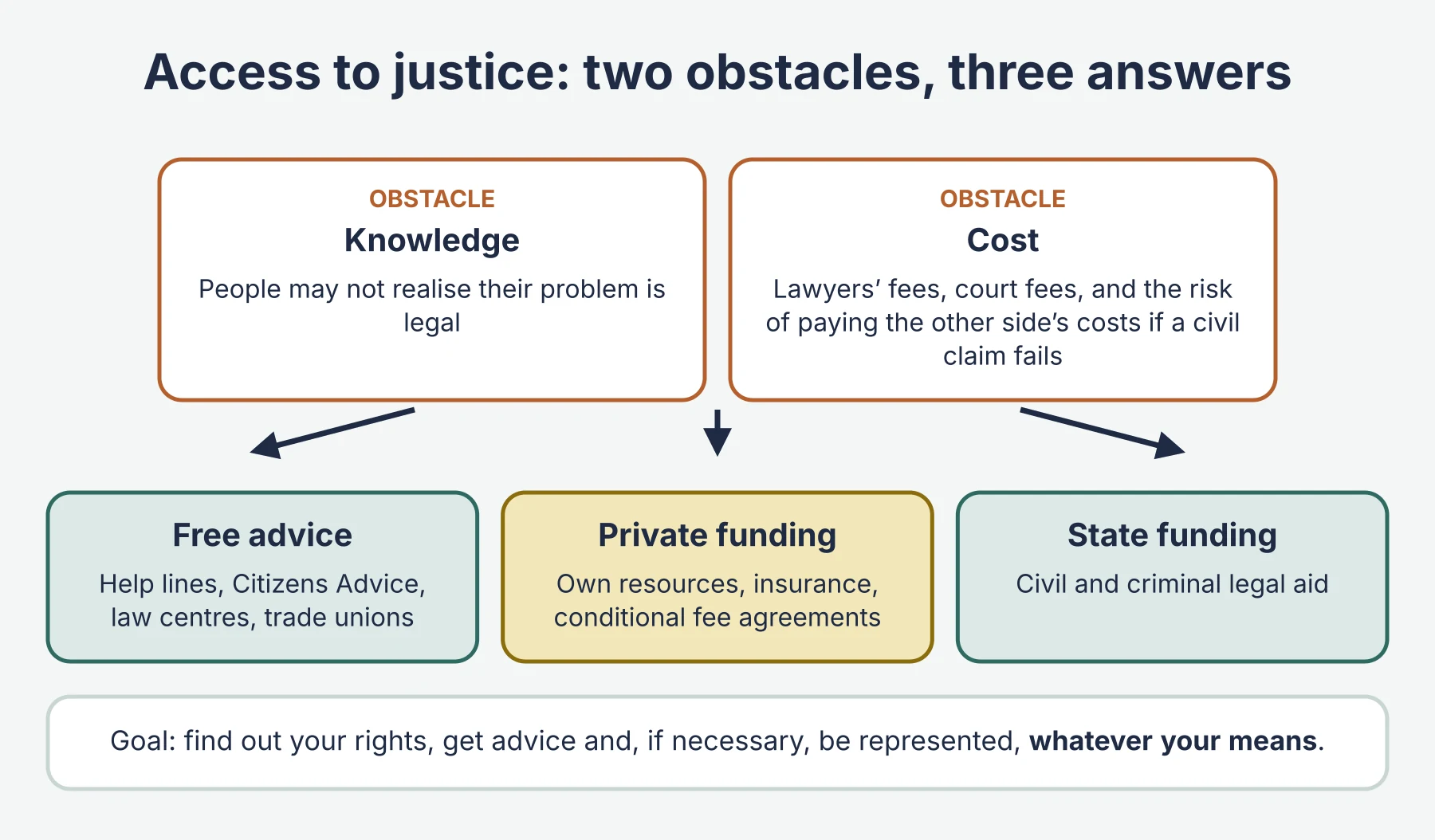
The three questions every scenario raises
- Where can this person get advice?
- Can they pay privately?
- Do they qualify for state funding?
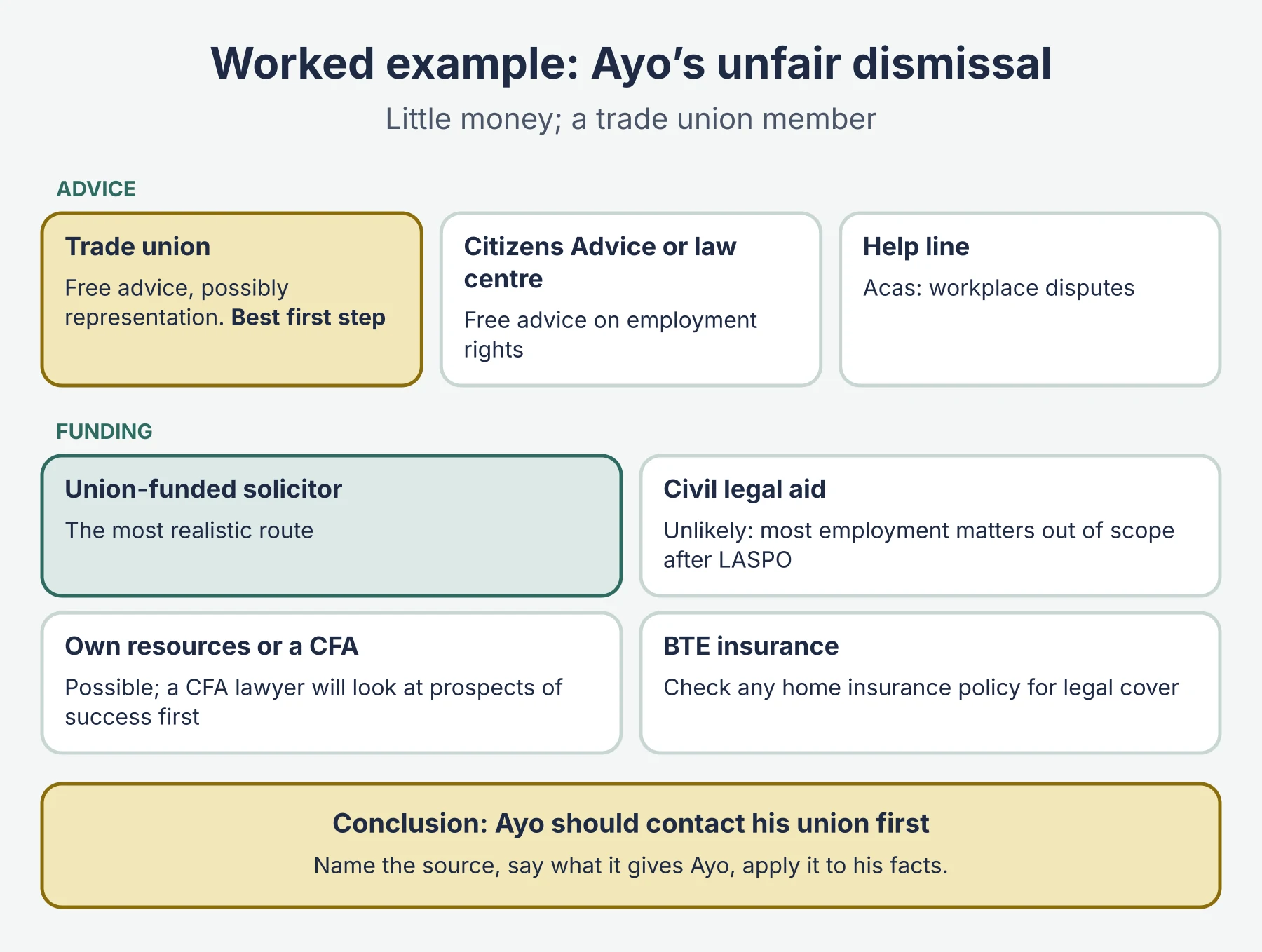
Answer them in that order, applying each to the person’s problem and means.
Alternative sources of advice
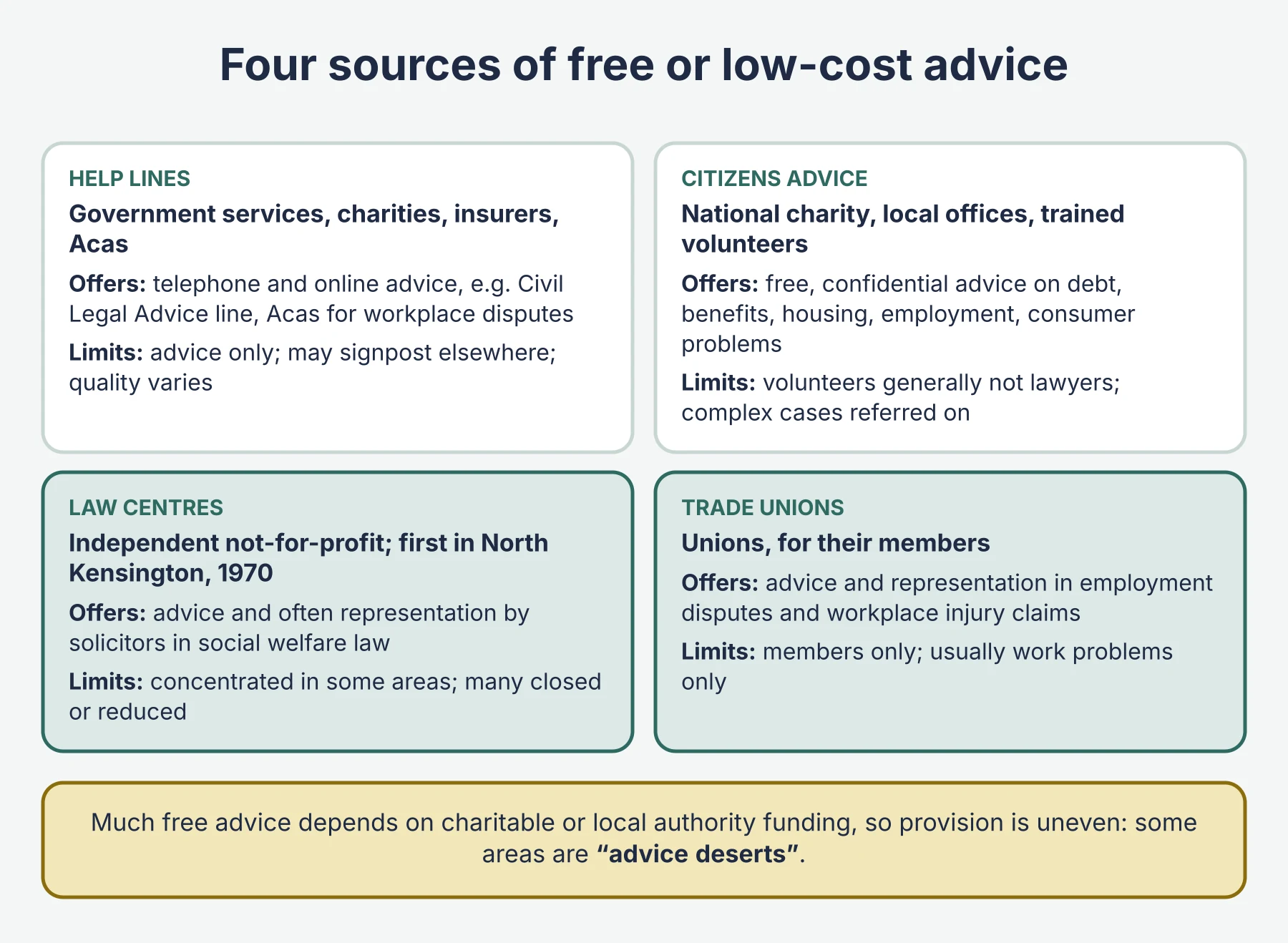
| Source | Key features | Best for |
|---|---|---|
| Help lines | Free telephone and online advice from government, charities, insurers and Acas | Quick first advice and signposting |
| Citizens Advice | National charity, local offices, trained volunteers, free and confidential | Debt, benefits, housing, consumer, employment |
| Law centres | Not-for-profit; solicitors and caseworkers; first in North Kensington in 1970 | Social welfare law, often with representation |
| Trade unions | Advice and representation for members, often union solicitors | Employment disputes, workplace injuries |
Weaknesses: uneven provision and funding; volunteers are not lawyers; union help is for members only.
Private funding
Own resources: hourly or fixed fees; full choice of lawyer; high cost; in civil cases the loser usually pays much of the winner’s costs.
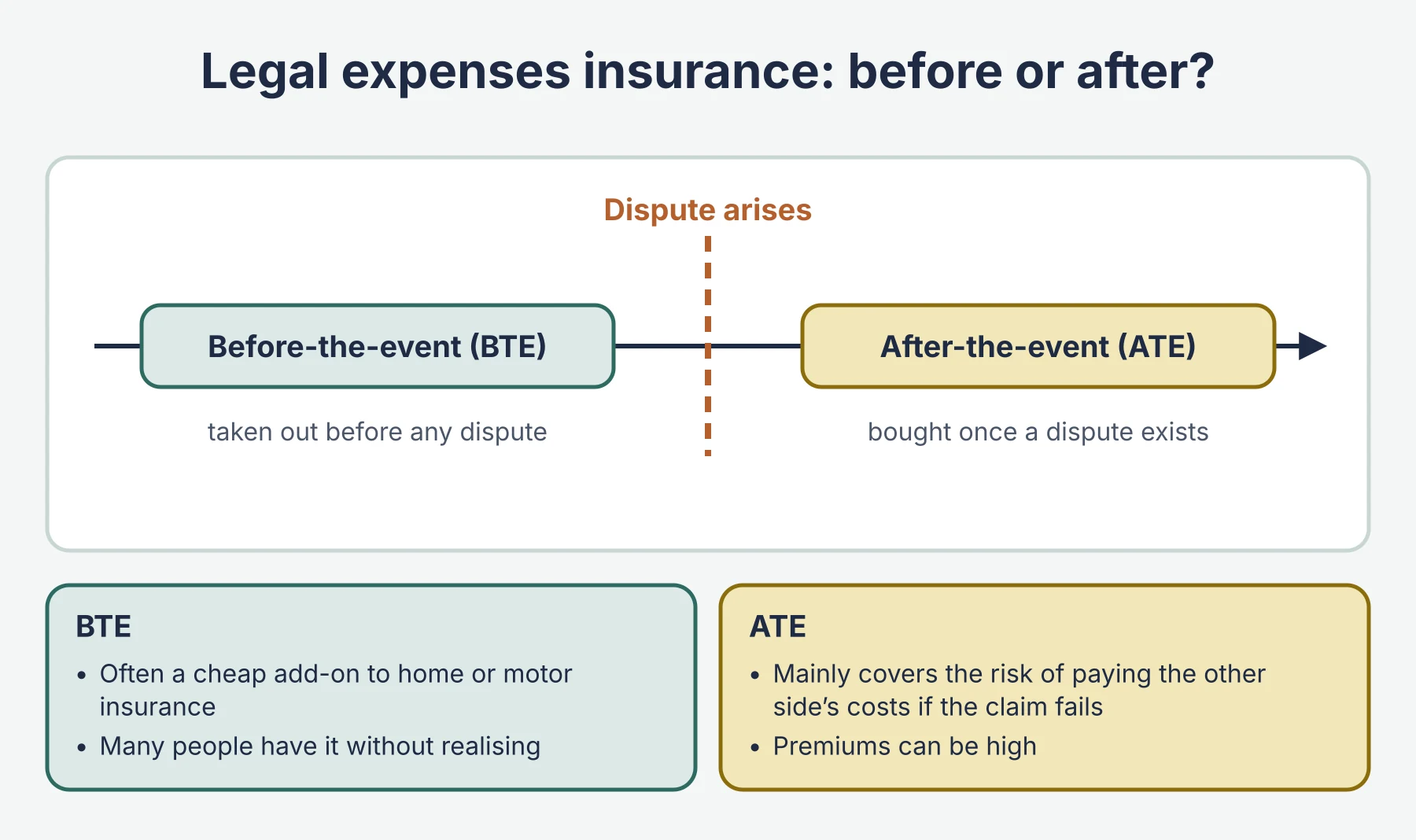
Insurance:
- BTE (before the event): bought before any dispute, often an add-on to home or motor insurance.
- ATE (after the event): bought after a dispute arises, mainly to cover the other side’s costs if the claim fails.
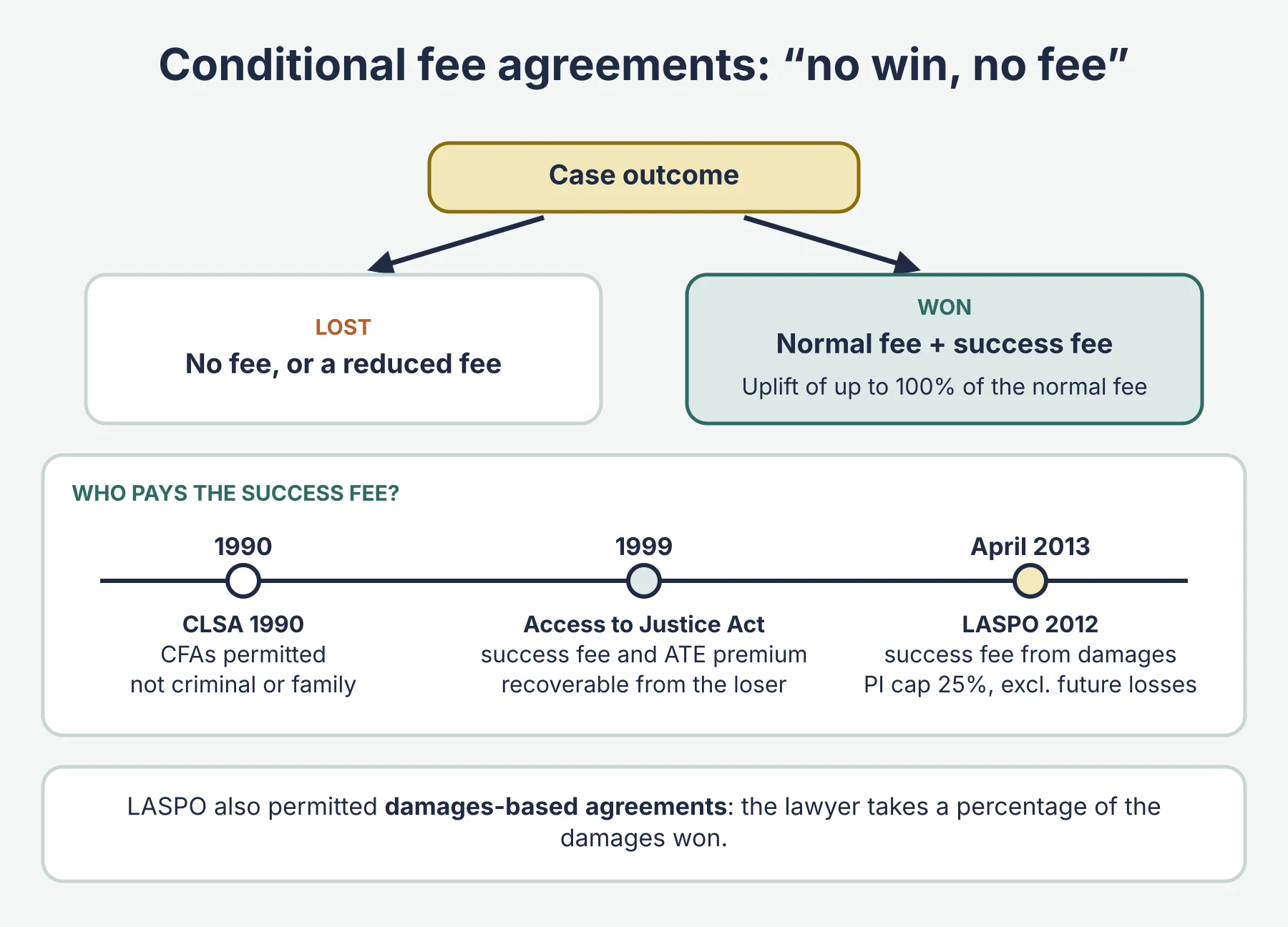
Conditional fee agreements:
| Feature | Detail |
|---|---|
| Basic idea | No fee or reduced fee if lost; normal fee plus success fee if won |
| Success fee | Up to 100% of the normal fee |
| Introduced | Courts and Legal Services Act 1990 |
| Not allowed | Criminal and family proceedings |
| 1999 position | Success fee and ATE premium recoverable from the loser (Access to Justice Act 1999) |
| Since April 2013 | Not recoverable from the loser; paid from damages; capped at 25% of damages (excluding future loss) in personal injury (LASPO) |
| Related | Damages-based agreements: lawyer takes a percentage of damages |
Public funding
Administered by: the Legal Aid Agency (replaced the Legal Services Commission under LASPO 2012).
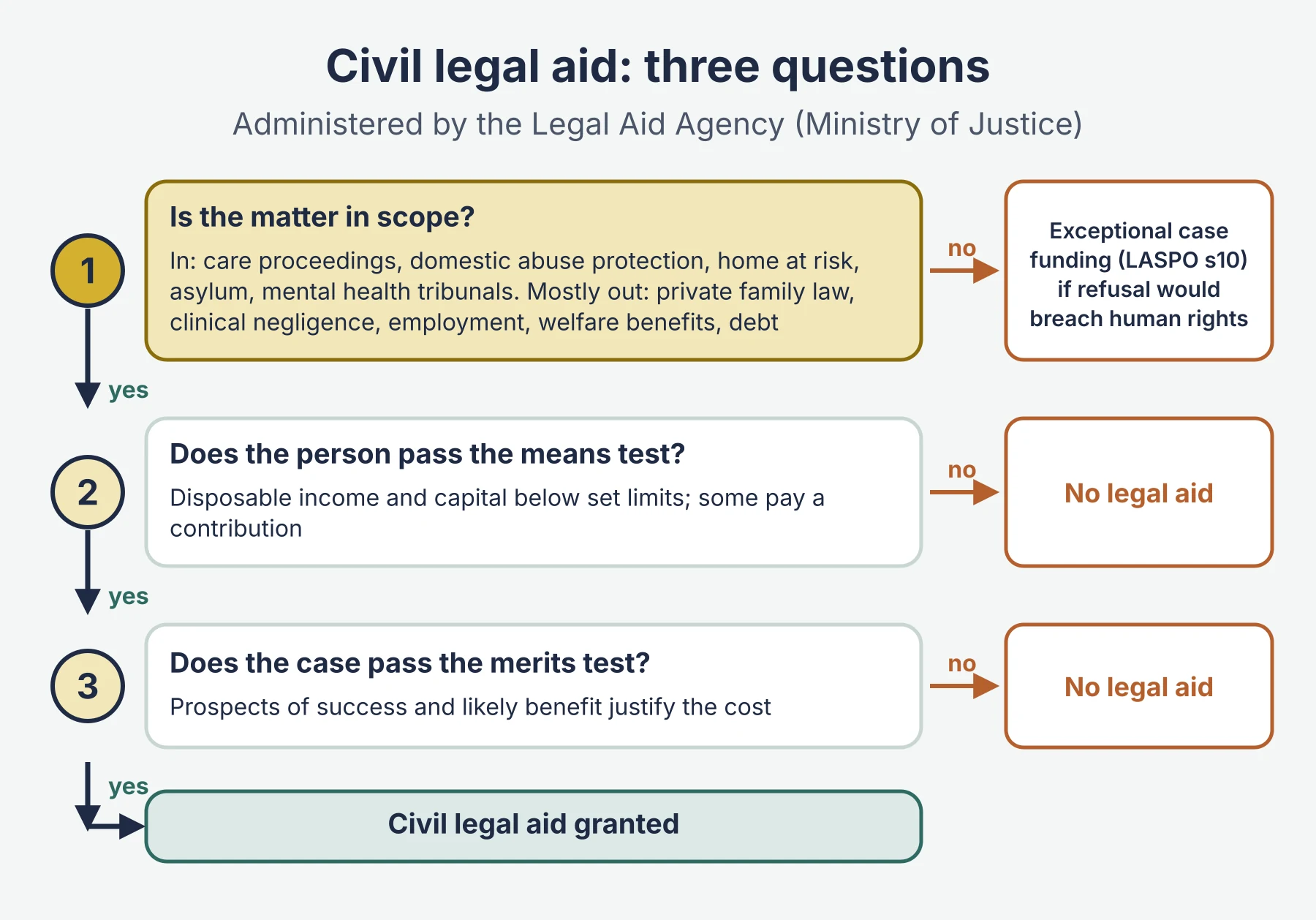
Civil legal aid tests:
- Scope: many areas removed by LASPO (most private family law without abuse evidence, most clinical negligence, most employment, welfare benefits and debt). Still in scope: care proceedings, domestic abuse protection, home at risk, asylum, mental health tribunals.
- Means: disposable income and capital below limits; contributions possible.
- Merits: prospects of success and cost-benefit.
- Exceptional case funding: s10 LASPO where refusal would breach human rights.
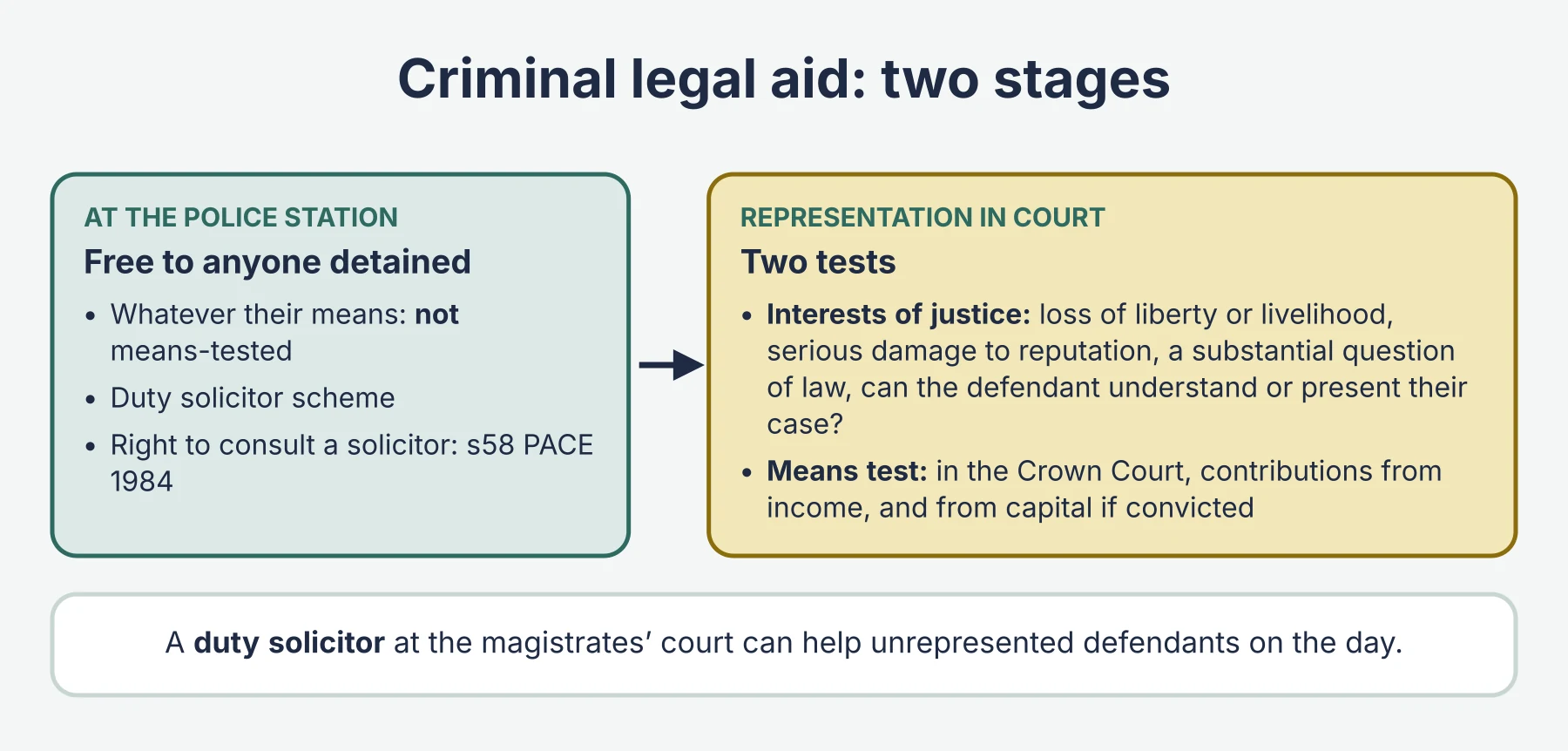
Criminal legal aid:
- Police station advice: free to all detainees (s58 PACE 1984; duty solicitor).
- Court representation: interests of justice test (loss of liberty, livelihood or reputation; substantial point of law; inability to understand or present the case) plus a means test.
- Crown Court: income contributions, and capital contributions if convicted.
- Duty solicitor at the magistrates’ court on the day.
Key terms
| Term | Meaning |
|---|---|
| Access to justice | Being able to find out, assert and enforce legal rights whatever one’s means |
| Litigant in person | A party who represents themselves without a lawyer |
| BTE insurance | Legal expenses cover bought before a dispute arises |
| ATE insurance | Cover bought after a dispute arises, mainly for the opponent’s costs |
| Conditional fee agreement | “No win, no fee” agreement with a success fee if won |
| Success fee | Uplift on the normal fee, up to 100% |
| Means test | Assessment of disposable income and capital |
| Merits test | Assessment of prospects of success and benefit |
| Interests of justice test | Test for criminal legal aid representation in court |
| Exceptional case funding | Civil legal aid outside scope where human rights require it |
Evaluation snapshots
- Advice sources: cheap and early, but patchy and dependent on funding.
- CFAs: opened personal injury claims to people of ordinary means, but lawyers choose strong cases, and winners lose part of their damages.
- Civil legal aid: protects the most vulnerable in scope, but LASPO cuts increased litigants in person, especially in family courts.
- Criminal legal aid: police station advice is a key safeguard, but low fixed fees discourage lawyers from criminal work.
Exam traps
- Skipping the scope question for civil legal aid.
- Reversing BTE and ATE.
- Suggesting a CFA for a criminal or family case.
- Saying a successful CFA client keeps all the damages.
- Calling police station advice means-tested.
- Listing every source of advice without applying any to the facts.
Self-test
- Name the four sources of legal advice in the specification.
- Which sources usually offer representation as well as advice?
- What is the difference between BTE and ATE insurance?
- What is a success fee and what is its maximum?
- In which proceedings is a CFA not allowed?
- What changed for CFAs in April 2013?
- Which body administers legal aid?
- What are the three tests for civil legal aid?
- Give two areas still within civil legal aid scope.
- What is exceptional case funding?
- Is advice at the police station means-tested?
- Name two factors in the interests of justice test.
Answers: 1. Help lines, Citizens Advice, law centres, trade unions. 2. Law centres and trade unions. 3. BTE is bought before any dispute arises; ATE is bought after, mainly to cover the opponent’s costs. 4. An uplift on the normal fee paid if the case is won; up to 100%. 5. Criminal and family proceedings. 6. The success fee and ATE premium could no longer be recovered from the losing side; the success fee in personal injury was capped at 25% of damages excluding future loss. 7. The Legal Aid Agency. 8. Scope, means and merits. 9. Any two of: care proceedings, domestic abuse protection, home at risk, asylum, mental health tribunals. 10. Funding for a case outside scope where refusal would breach human rights (s10 LASPO). 11. No, it is free to all detainees. 12. Any two of: likely loss of liberty, loss of livelihood, serious damage to reputation, a substantial question of law, inability to understand the proceedings.
Test yourself further with the access to justice and funding practice questions.
Related resources
-
Study guides
AQA A Level Law (7162): Legal Personnel and the Judiciary
Barristers, solicitors and legal executives, their regulation, types of judge, judicial roles and judicial independence for AQA A Level Law 7162 section 3.1.
Law · AQA · A Level
Read guide -
Practice questions
AQA A Level Law (7162): Legal Personnel and the Judiciary – Practice Questions
Original practice questions with mark-scheme answers on legal professions, their regulation, types of judge and judicial independence for AQA A Level Law 7162.
Law · AQA · A Level
Try questions -
Revision notes
AQA A Level Law (7162): Legal Personnel and the Judiciary – Revision Notes
Recall notes on solicitors, barristers, legal executives, their regulators, types of judge, judicial roles and judicial independence for AQA A Level Law 7162.
Law · AQA · A Level
Revise topic
Get free revision emails (optional)
Occasional emails with practice questions, worked explanations and links to free resources for the qualification and subjects you choose. No spam, and you can unsubscribe from any email. The free tools on this site never need an email.