
Study Guides
AQA A Level Law (7162): Legal Personnel and the Judiciary
Barristers, solicitors and legal executives, their regulation, types of judge, judicial roles and judicial independence for AQA A Level Law 7162 section 3.1.
- Subject
- Law
- Level
- A LEVELS
- Topic
- Section 3.1 – The Nature of Law and the English Legal System
- Author
- Marlbridge Academic Team
- Updated
- Reviewed by
- Aizaz Raoof Ali (what this means)
Aligned to AQA A Level Law (7162), For teaching from September 2017 onwards, A-level exams 2019 onwards. Official specification .
Syllabus page (what it covers and how it is assessed): AQA A Level Law.
Syllabus points this page covers
7162
- The legal system: legal personnel and the judiciary
Found an error? Report a correction.
Need help with this topic? Request a free trial class for A Level Law (7162).
This guide covers the section 3.1 row The legal system: legal personnel and the judiciary in AQA A-level Law (7162). The specification asks for a “basic understanding of the different roles of barristers, solicitors and legal executives” and “of the regulation of legal personnel”; then, on the judiciary, “types of judge”, “the role of judges in civil and criminal courts”, and “the independence of the judiciary: security of tenure, immunity from suit, independence from the Executive”, including the “reason for and advantages of judicial independence and the methods by which it is achieved”. Judicial independence is the part that supports extended evaluation. For the whole of section 3.1, see the Nature of Law and the English Legal System study guide.
The three branches of the profession
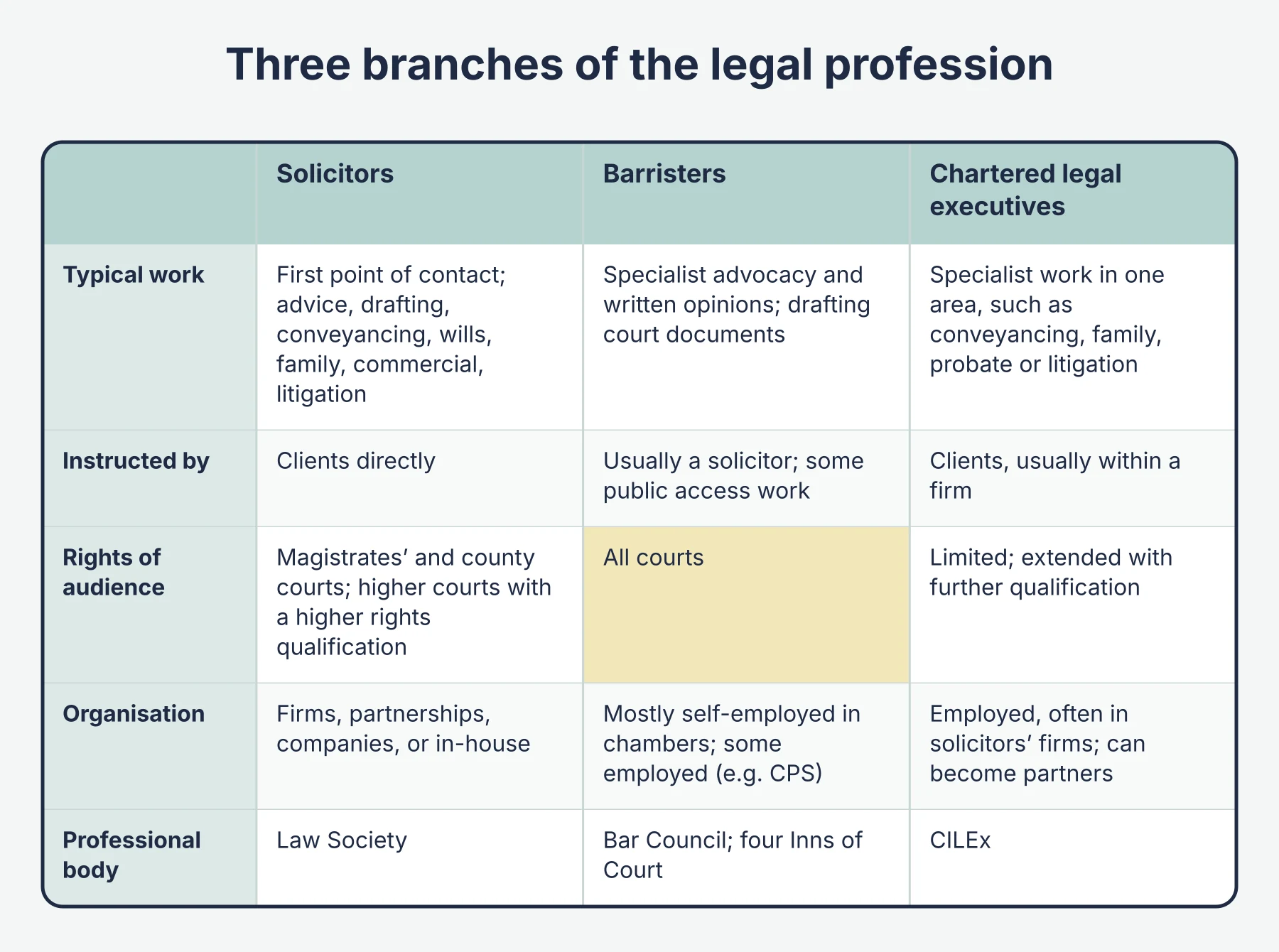
| Solicitors | Barristers | Chartered legal executives | |
|---|---|---|---|
| Typical work | First point of contact; advice, drafting, conveyancing, wills and probate, family, commercial and litigation work | Specialist advocacy and written opinions; drafting court documents | Specialist work in one area, such as conveyancing, family, probate or litigation |
| Who instructs them | Clients directly | Usually a solicitor; some public access work direct from clients | Clients, usually within a firm |
| Rights of audience | Magistrates’ and county courts; higher courts with a higher rights qualification (solicitor-advocates) | All courts | Limited; extended rights with further qualification |
| Organisation | Firms, partnerships, companies, or employed in-house | Mostly self-employed in chambers; some employed (for example by the Crown Prosecution Service) | Employed, often in solicitors’ firms; can become partners |
| Professional body | Law Society | Bar Council; four Inns of Court | CILEx |
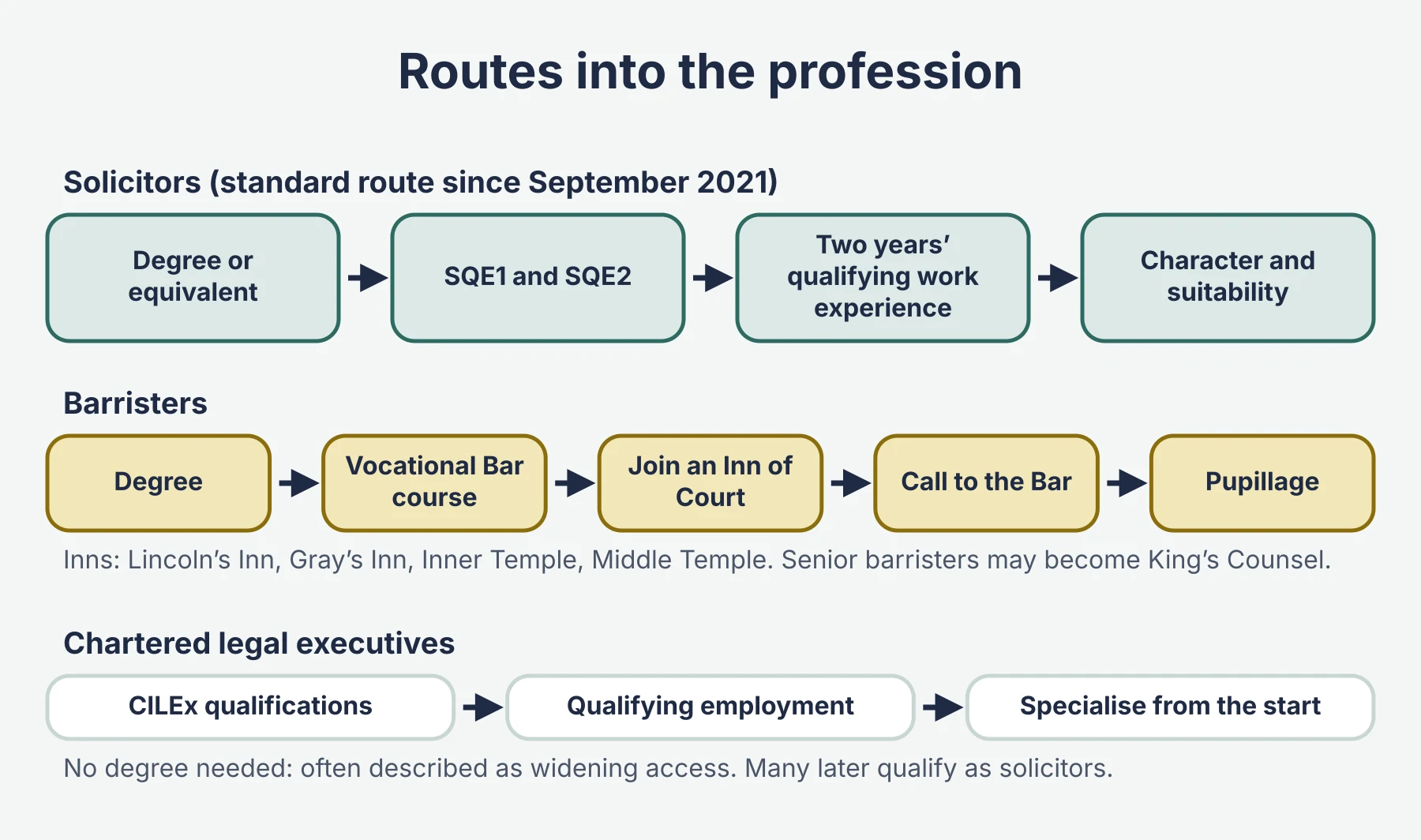
Solicitors. Most legal work never reaches court. Solicitors take instructions, give advice, negotiate settlements and prepare cases. The Courts and Legal Services Act 1990 began opening rights of audience in the higher courts to solicitors who qualify for them. Since September 2021 the standard route has been the Solicitors Qualifying Examination (SQE1 and SQE2), two years of qualifying work experience, and character and suitability requirements, after a degree or equivalent.
Barristers. Barristers are advocates and specialist advisers. Self-employed barristers share chambers and a clerk, and are bound by the cab-rank rule: they must accept work in their field at a proper fee regardless of who the client is. Senior barristers may be appointed King’s Counsel. Training involves a degree, the vocational Bar course, membership of an Inn of Court (Lincoln’s Inn, Gray’s Inn, Inner Temple or Middle Temple), call to the Bar, and pupillage, a period of supervised training with an experienced barrister.
Legal executives. Chartered legal executives qualify through CILEx qualifications combined with qualifying employment. They specialise from the start, may gain extended advocacy rights, may become partners in firms, and since the Tribunals, Courts and Enforcement Act 2007 can apply for some judicial posts, such as district judge. Many later qualify as solicitors. Because entry does not require a degree, the route is often described as widening access to the profession.
Regulation of legal personnel
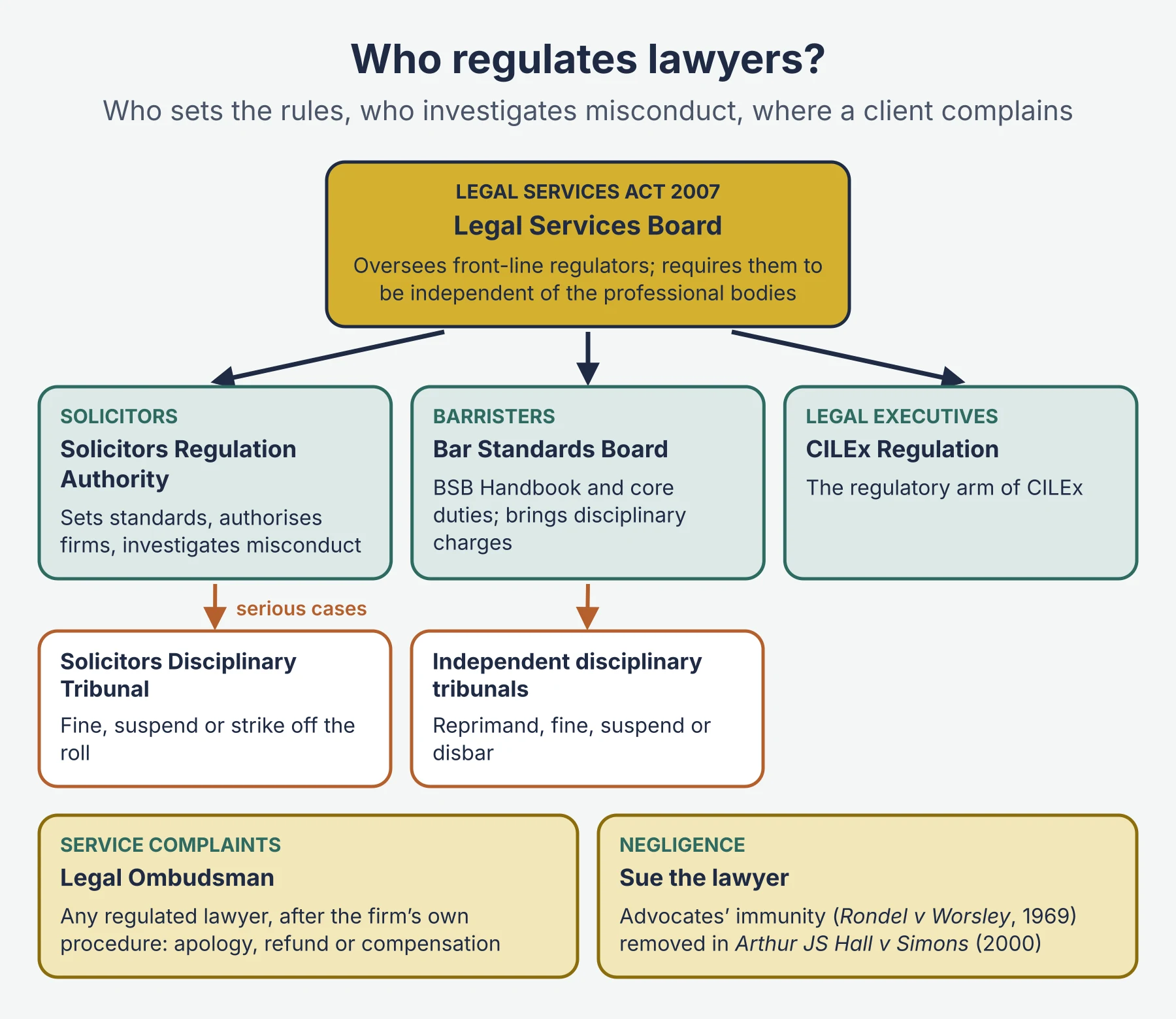
Regulation answers three questions: who sets the rules, who investigates misconduct, and where a client can complain.
- Oversight. The Legal Services Act 2007 created the Legal Services Board, which oversees the front-line regulators and requires them to be independent of the professional bodies that represent lawyers.
- Solicitors. The Solicitors Regulation Authority sets standards, authorises firms and investigates misconduct. Serious cases go to the Solicitors Disciplinary Tribunal, which can fine, suspend or strike a solicitor off the roll.
- Barristers. The Bar Standards Board sets the BSB Handbook and core duties and brings disciplinary charges, heard by independent disciplinary tribunals, which can reprimand, fine, suspend or disbar.
- Legal executives. Regulated by CILEx Regulation, the regulatory arm of CILEx.
- Complaints about service. The Legal Ombudsman deals with complaints about poor service from any regulated lawyer after the firm’s own procedure has been used, and can order an apology, a refund or compensation.
- Negligence. A client can sue a lawyer in negligence. Advocates once had immunity for their conduct of a case in court (Rondel v Worsley, 1969), but the House of Lords removed it in Arthur JS Hall & Co v Simons (2000).
Types of judge
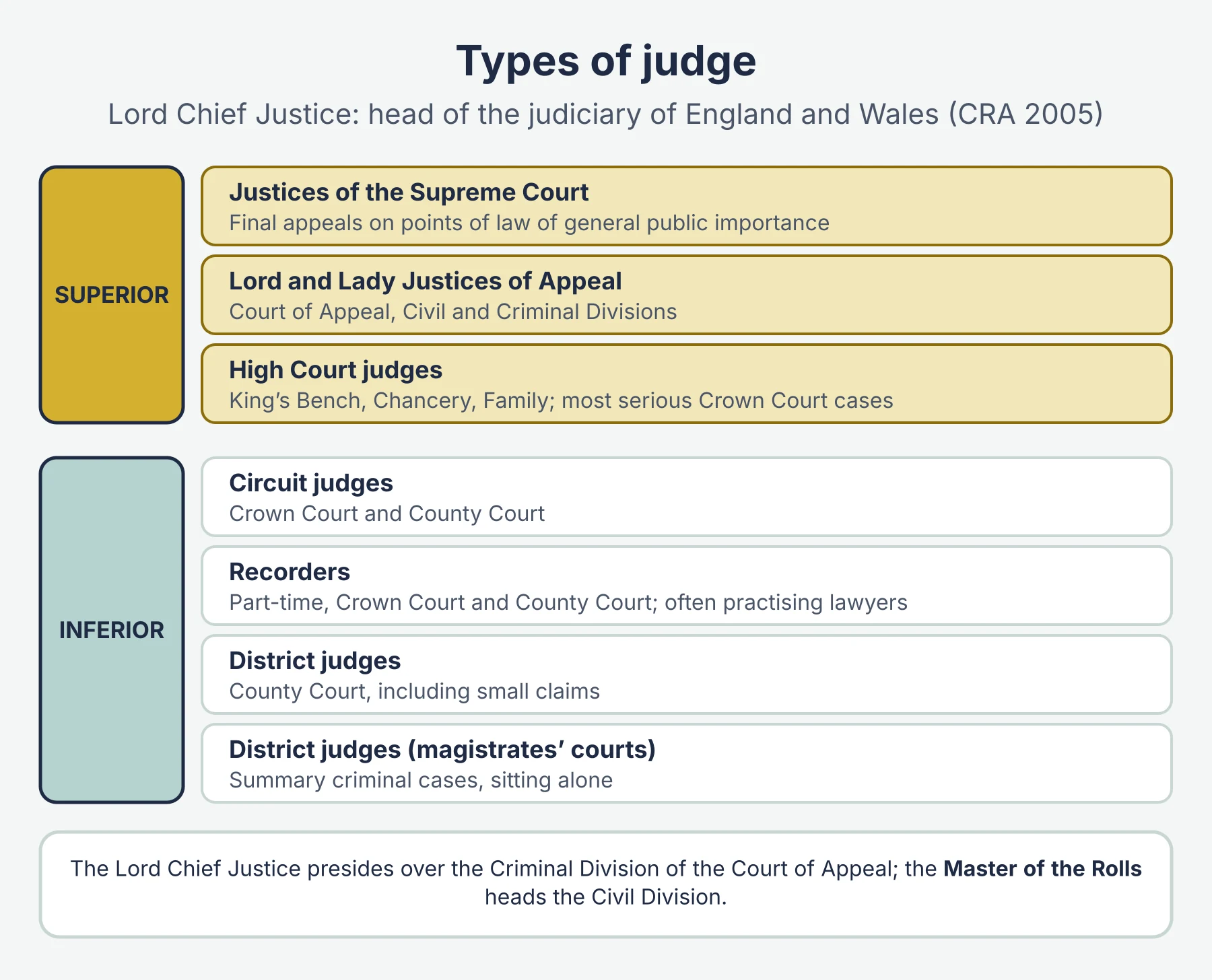
Superior judges
- Justices of the Supreme Court: final appeals on points of law of general public importance.
- Lord and Lady Justices of Appeal: the Court of Appeal, Civil and Criminal Divisions.
- High Court judges: King’s Bench, Chancery and Family Divisions; they also try the most serious cases in the Crown Court.
Inferior judges
- Circuit judges: the Crown Court and the County Court.
- Recorders: part-time judges in the Crown Court and County Court, often practising lawyers.
- District judges: the County Court, including small claims.
- District judges (magistrates’ courts): summary criminal cases, sitting alone.
Heads of the judiciary. Under the Constitutional Reform Act 2005 the Lord Chief Justice is head of the judiciary of England and Wales and presides over the Criminal Division of the Court of Appeal; the Master of the Rolls heads the Civil Division.
The role of judges
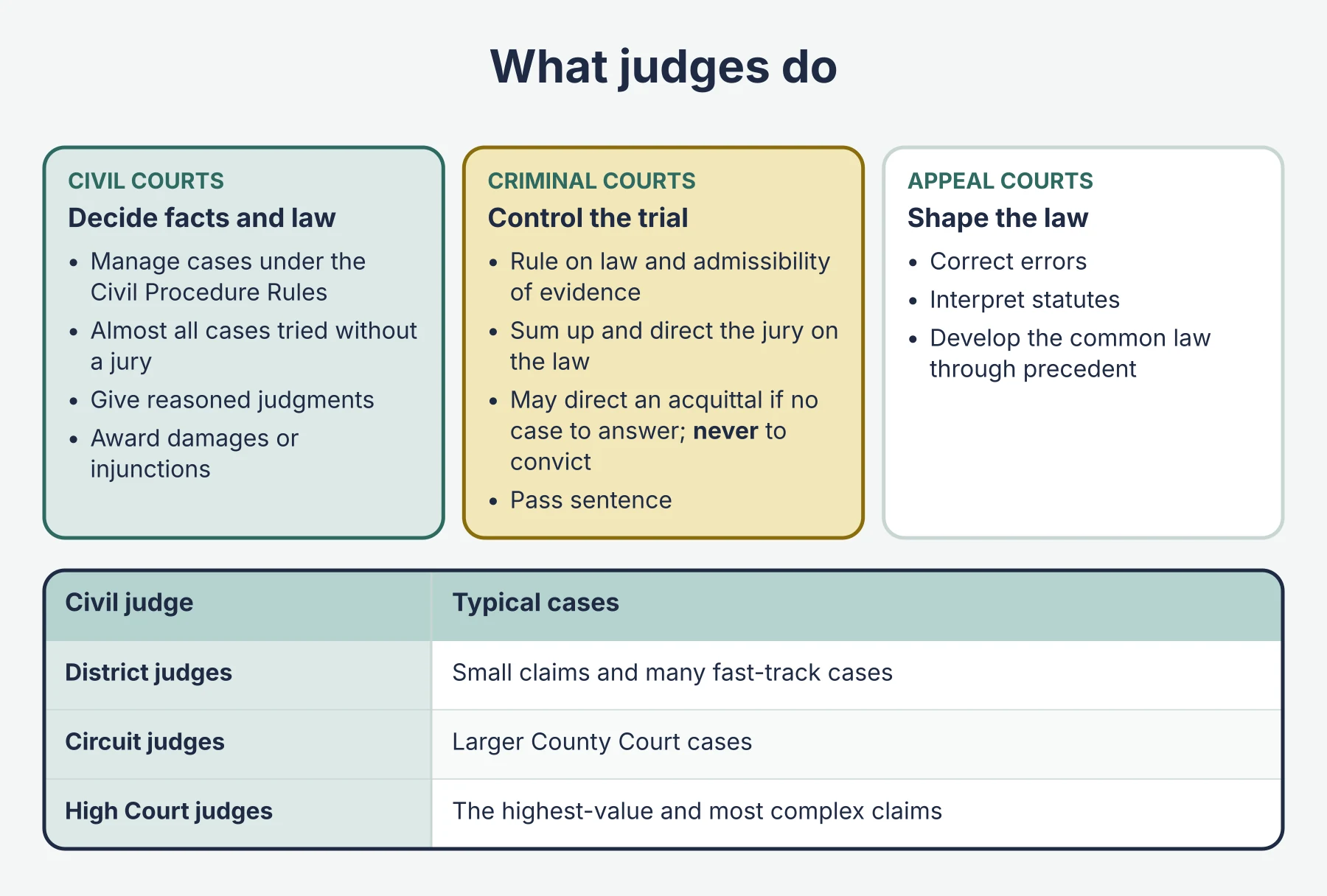
In civil courts judges manage cases under the Civil Procedure Rules, decide facts and law (almost all civil cases are tried without a jury), give reasoned judgments, and award remedies such as damages or injunctions. District judges hear small claims and many fast-track cases; circuit judges hear larger County Court cases; High Court judges hear the highest-value and most complex claims.
In criminal courts the Crown Court judge rules on points of law and the admissibility of evidence, controls the trial, sums up the evidence and directs the jury on the law, may direct an acquittal where there is no case to answer, and passes sentence. A judge may not direct a jury to convict. District judges (magistrates’ courts) try and sentence alone.
In appeal courts judges correct errors, interpret statutes and develop the common law through precedent, so their decisions shape the law for future cases.
Judicial independence
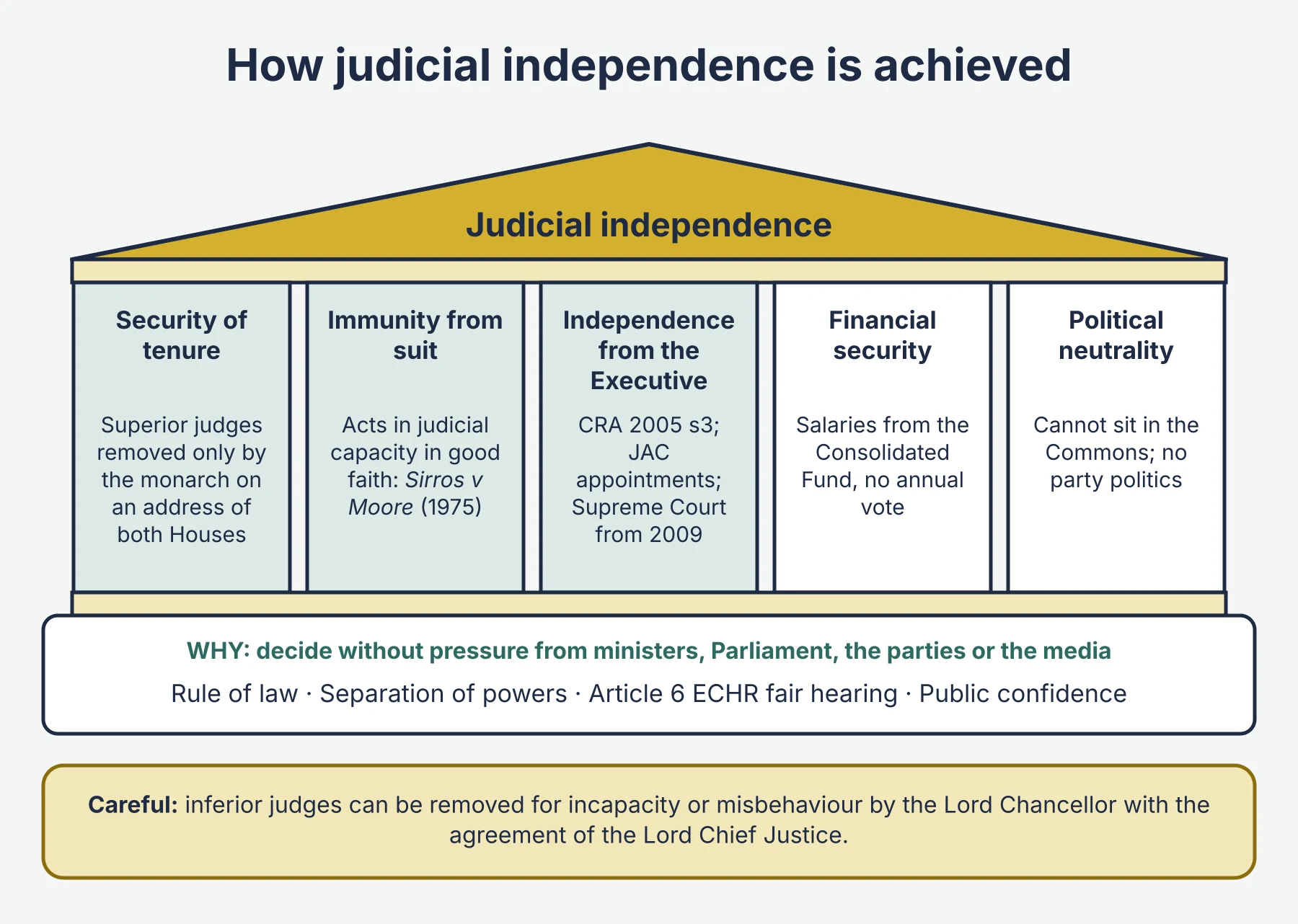
Why it matters. Judges must decide cases, including cases against the government, without pressure from ministers, Parliament, the parties or the media. Independence supports the rule of law (no one is above the law, including the state), the separation of powers, the right to a fair hearing before “an independent and impartial tribunal” under Article 6 of the European Convention on Human Rights, and public confidence in decisions.
How it is achieved
| Method | How it works |
|---|---|
| Security of tenure | Superior judges hold office during good behaviour and can be removed only by the monarch on an address of both Houses of Parliament (Senior Courts Act 1981; Constitutional Reform Act 2005 for the Supreme Court). Inferior judges can be removed for incapacity or misbehaviour by the Lord Chancellor with the agreement of the Lord Chief Justice |
| Immunity from suit | Judges cannot be sued for acts done in their judicial capacity in good faith (Sirros v Moore, 1975), so they can decide without fear of litigation |
| Independence from the Executive | Section 3 of the Constitutional Reform Act 2005 requires ministers to uphold judicial independence; the Lord Chancellor is no longer a judge or head of the judiciary; appointments are recommended by the independent Judicial Appointments Commission; the Supreme Court replaced the Appellate Committee of the House of Lords in 2009 |
| Financial security | Salaries are paid from the Consolidated Fund without an annual vote |
| Political neutrality | Full-time judges cannot sit in the House of Commons and are expected not to take part in party politics |
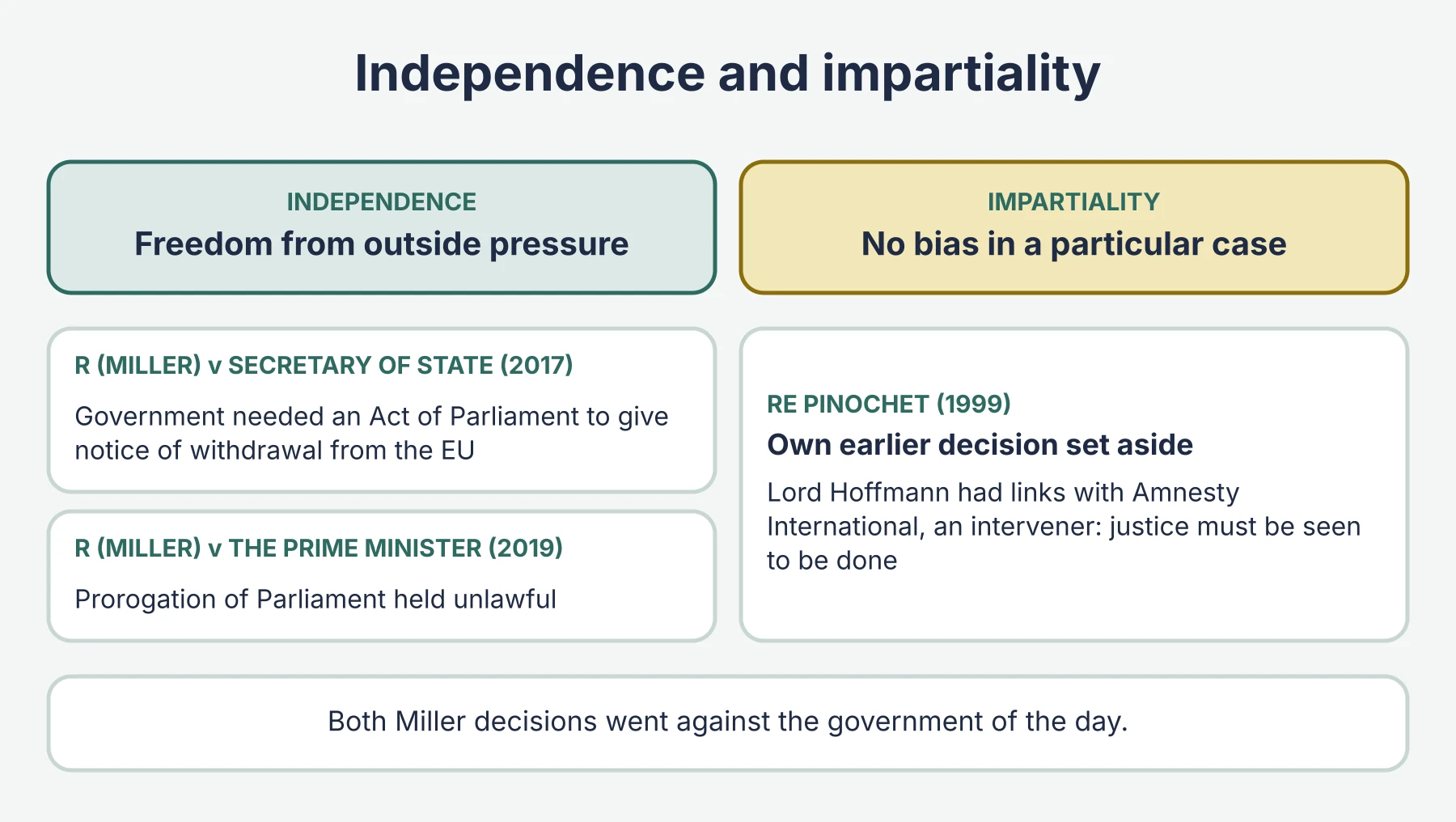
Independence in action. In R (Miller) v Secretary of State for Exiting the European Union (2017) the Supreme Court held that the government needed an Act of Parliament to give notice of withdrawal from the EU, and in R (Miller) v The Prime Minister (2019) it held the prorogation of Parliament unlawful. Both decisions went against the government of the day.
Impartiality as well as independence. In Re Pinochet (1999) the House of Lords set aside its own earlier decision because Lord Hoffmann had links with Amnesty International, an intervener in the case: justice must be seen to be done.
Worked example: an annotated answer
Question: “Explain how judicial independence is protected.” [6]
Superior judges have security of tenure: they can be removed only by the monarch after an address by both Houses of Parliament, so a government cannot dismiss a judge who rules against it. (Method plus why it protects independence.) Judges have immunity from suit for acts in their judicial capacity, as in Sirros v Moore (1975), so they can decide without fear of being sued. (Method, authority, purpose.) The Constitutional Reform Act 2005 separated the judiciary from the Executive: section 3 requires ministers to uphold independence, and the Judicial Appointments Commission selects judges on merit. (Third method with statutory detail.)
Each method is named, explained and linked back to independence, which is what the mark scheme rewards.
Common mistakes
- Saying barristers cannot be instructed directly by the public: public access work exists.
- Saying solicitors can never appear in the higher courts.
- Confusing the Legal Ombudsman (service complaints) with the disciplinary bodies (misconduct).
- Describing security of tenure for inferior judges in the same terms as for superior judges.
- Mixing up independence (freedom from outside pressure) with impartiality (no bias in a particular case).
Exam technique
“Explain” questions want a method plus its purpose, with a statute or case. “Evaluate” questions on independence want strengths, limits (for example the Lord Chancellor’s remaining role in appointments, or media pressure on judges after controversial rulings) and a reasoned conclusion. Keep the roles of the professions separate from their regulation.
More resources on this topic
Legal personnel and the judiciary revision notes | Legal personnel and the judiciary practice questions
Related resources
-
Practice questions
AQA A Level Law (7162): Legal Personnel and the Judiciary – Practice Questions
Original practice questions with mark-scheme answers on legal professions, their regulation, types of judge and judicial independence for AQA A Level Law 7162.
Law · AQA · A Level
Try questions -
Revision notes
AQA A Level Law (7162): Legal Personnel and the Judiciary – Revision Notes
Recall notes on solicitors, barristers, legal executives, their regulators, types of judge, judicial roles and judicial independence for AQA A Level Law 7162.
Law · AQA · A Level
Revise topic -
Study guides
AQA A Level Law (7162): The Legal System: The Civil Courts and Other Forms of Dispute Resolution
Civil courts, the track and appeal systems, the tribunal structure, and the roles of mediation and negotiation, explained for AQA A Level Law 7162 section 3.1.
Law · AQA · A Level
Read guide
Get free revision emails (optional)
Occasional emails with practice questions, worked explanations and links to free resources for the qualification and subjects you choose. No spam, and you can unsubscribe from any email. The free tools on this site never need an email.