
Study Guides
AQA A Level Law (7162): The Legal System: The Civil Courts and Other Forms of Dispute Resolution
Civil courts, the track and appeal systems, the tribunal structure, and the roles of mediation and negotiation, explained for AQA A Level Law 7162 section 3.1.
- Subject
- Law
- Level
- A LEVELS
- Topic
- Section 3.1 – The Nature of Law and the English Legal System
- Author
- Marlbridge Academic Team
- Updated
- Reviewed by
- Aizaz Raoof Ali (what this means)
Aligned to AQA A Level Law (7162), For teaching from September 2017 onwards, A-level exams 2019 onwards. Official specification .
Syllabus page (what it covers and how it is assessed): AQA A Level Law.
Syllabus points this page covers
7162
- The legal system: the civil courts and other forms of dispute resolution
Found an error? Report a correction.
Need help with this topic? Request a free trial class for A Level Law (7162).
This guide covers The legal system: the civil courts and other forms of dispute resolution row of AQA A-level Law (7162) section 3.1. The specification asks for a basic understanding of civil courts, including the track system and the appeal system, and for other forms of dispute resolution: outline of the tribunal structure and the role of tribunals; the roles of mediation and negotiation. The Rule of Law, Law Reform, the EU and Civil Justice revision notes give the track values and the two-tier tribunal structure in outline. This page follows a claim from start to finish, explains how a track is chosen and how appeals work, and compares tribunals, mediation and negotiation so you can advise in a scenario.
The civil courts at first instance
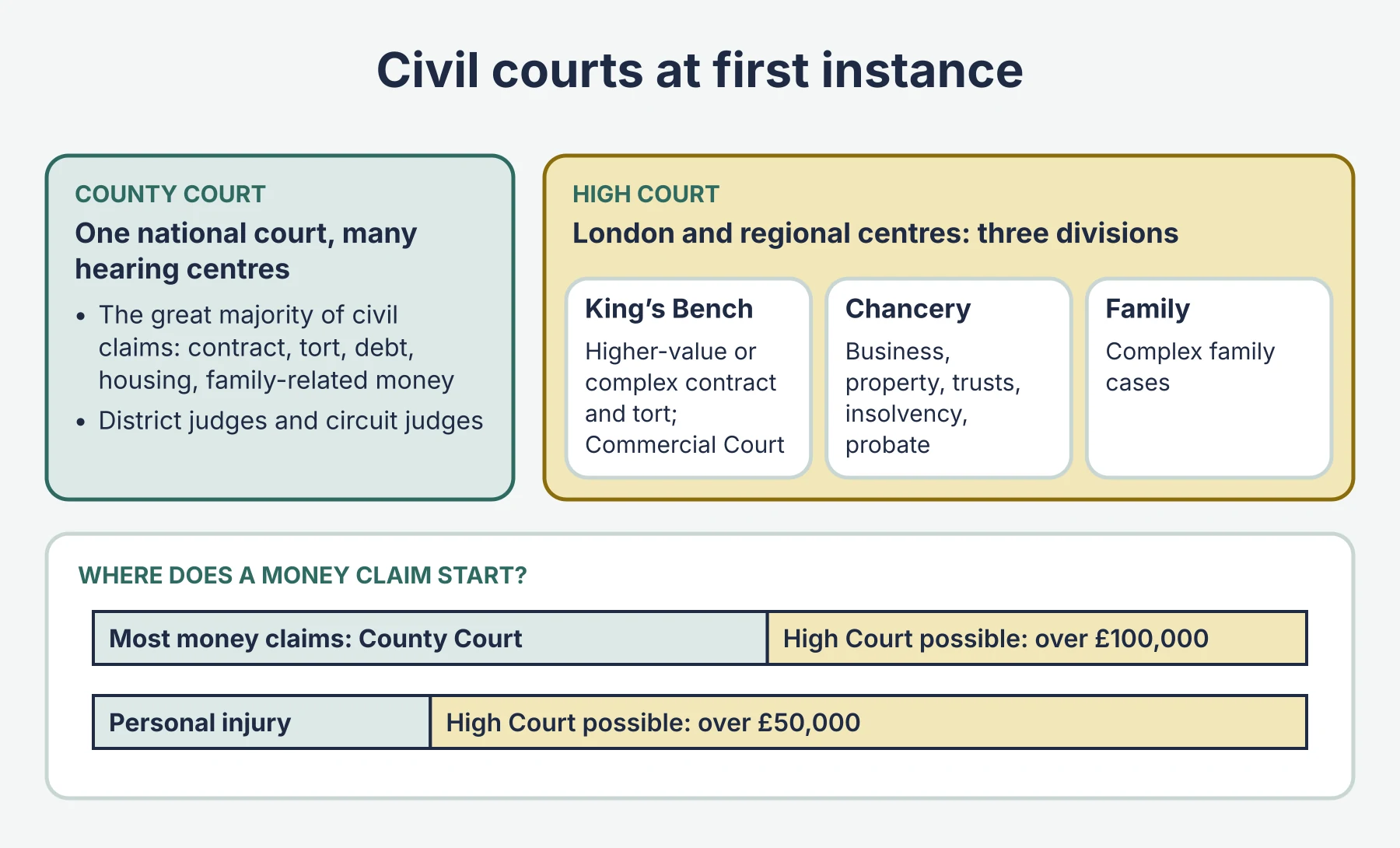
- County Court: a single national court sitting at many hearing centres. It hears the great majority of civil claims, including contract, tort, debt, housing and many family-related money matters. Cases are heard by district judges and circuit judges.
- High Court: sits in London and at regional centres, in three divisions:
- King’s Bench Division: contract and tort claims of higher value or complexity, and specialist courts such as the Commercial Court;
- Chancery Division: business, property, trusts, insolvency and probate disputes;
- Family Division: complex family cases.
- Where to start: a claim for money should not normally be started in the High Court unless it is worth more than £100,000, or more than £50,000 for a personal injury claim. Below those values, claims start in the County Court.
A claim from start to finish
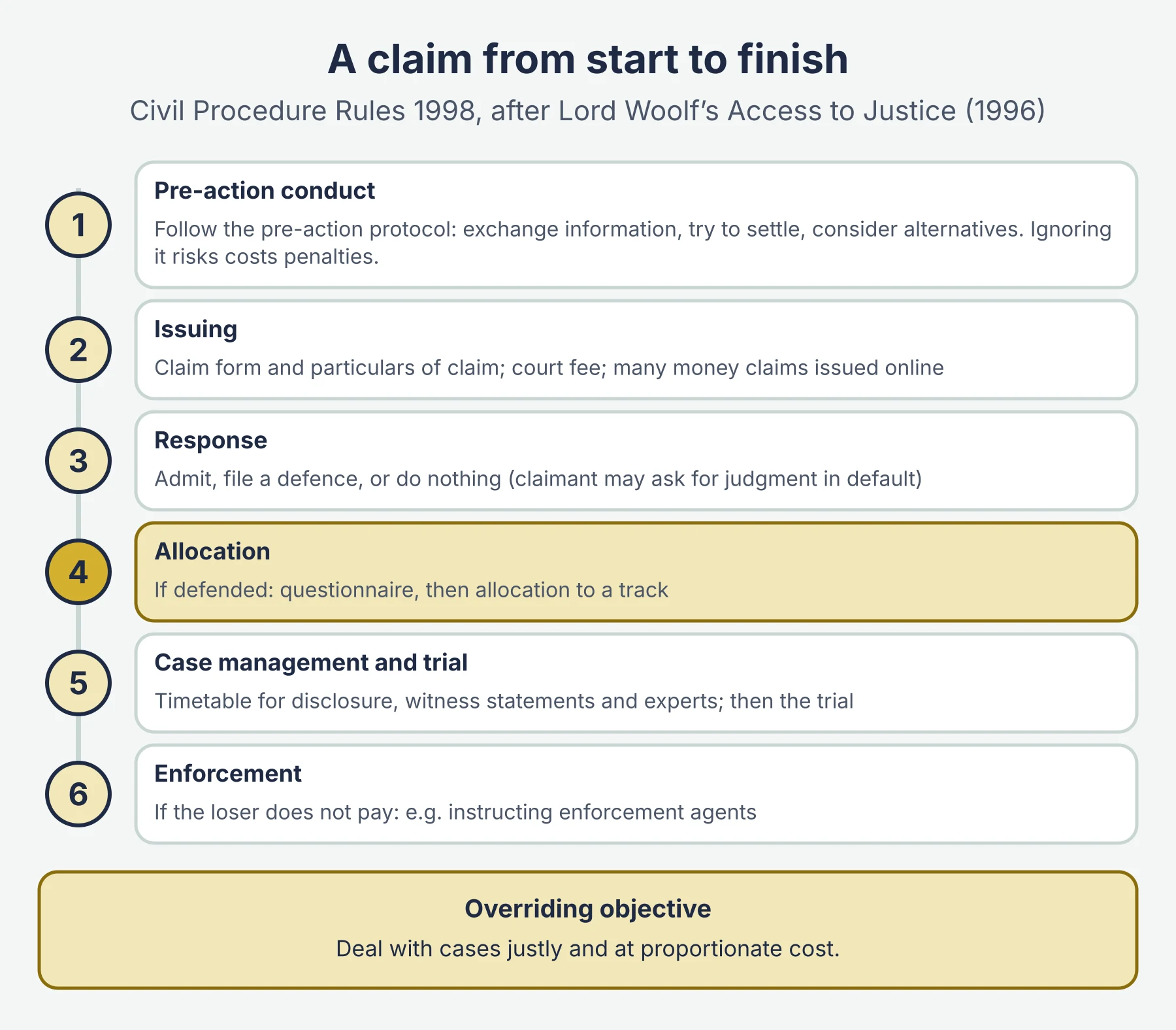
- Pre-action conduct. Before issuing, the parties are expected to follow the relevant pre-action protocol or general practice direction: exchange information, try to settle and consider alternatives to court. Ignoring this can lead to costs penalties.
- Issuing. The claimant files a claim form and particulars of claim and pays a court fee. Many money claims are issued online.
- Response. The defendant may admit the claim, file a defence, or do nothing, in which case the claimant can ask for judgment in default.
- Allocation. If defended, the court sends a questionnaire and allocates the case to a track.
- Case management and trial. The judge sets a timetable for disclosure of documents, witness statements and experts, then hears the trial.
- Enforcement. If the losing party does not pay, the winner can use enforcement methods such as instructing enforcement agents.
These procedures come from the Civil Procedure Rules 1998, introduced after Lord Woolf’s report Access to Justice (1996). The rules’ overriding objective is to deal with cases justly and at proportionate cost.
The track system
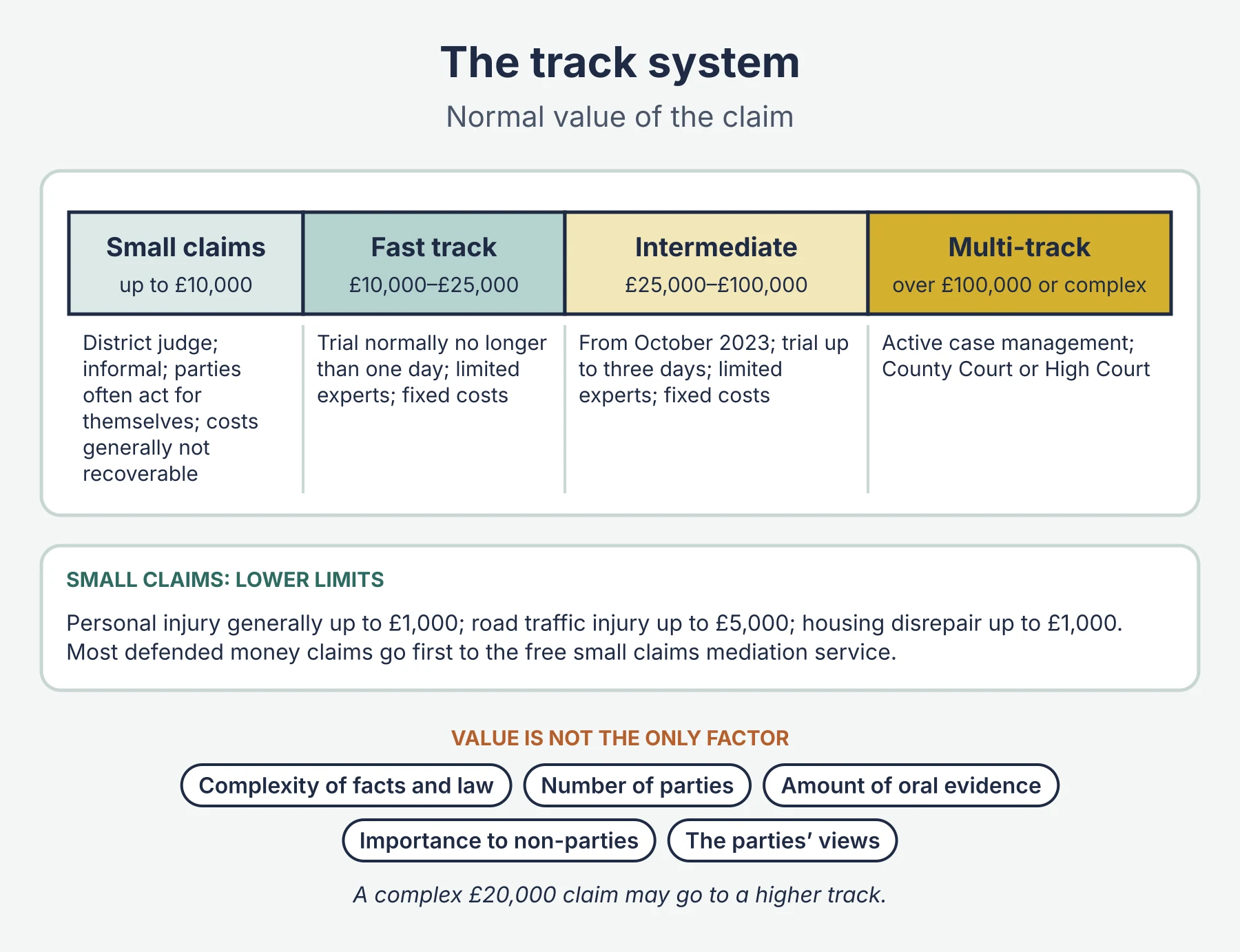
| Track | Normal value | Features |
|---|---|---|
| Small claims | Up to £10,000; personal injury generally up to £1,000, but road traffic injury claims up to £5,000; housing disrepair up to £1,000 | District judge; informal hearing; parties often act for themselves; legal costs generally not recoverable; most defended money claims are now referred to the free small claims mediation service first |
| Fast track | £10,000 to £25,000 | Trial normally no longer than one day; limited expert evidence; fixed recoverable costs |
| Intermediate track (from October 2023) | £25,000 to £100,000 | Trial up to three days; limited experts; fixed recoverable costs |
| Multi-track | Over £100,000, or complex cases | Active case management by the judge; County Court or High Court |
Value is not the only factor. The judge also considers the complexity of the facts and law, the number of parties, the amount of oral evidence, the importance of the claim to people who are not parties, and the parties’ views. A complex £20,000 claim may go to a higher track.
The appeal system
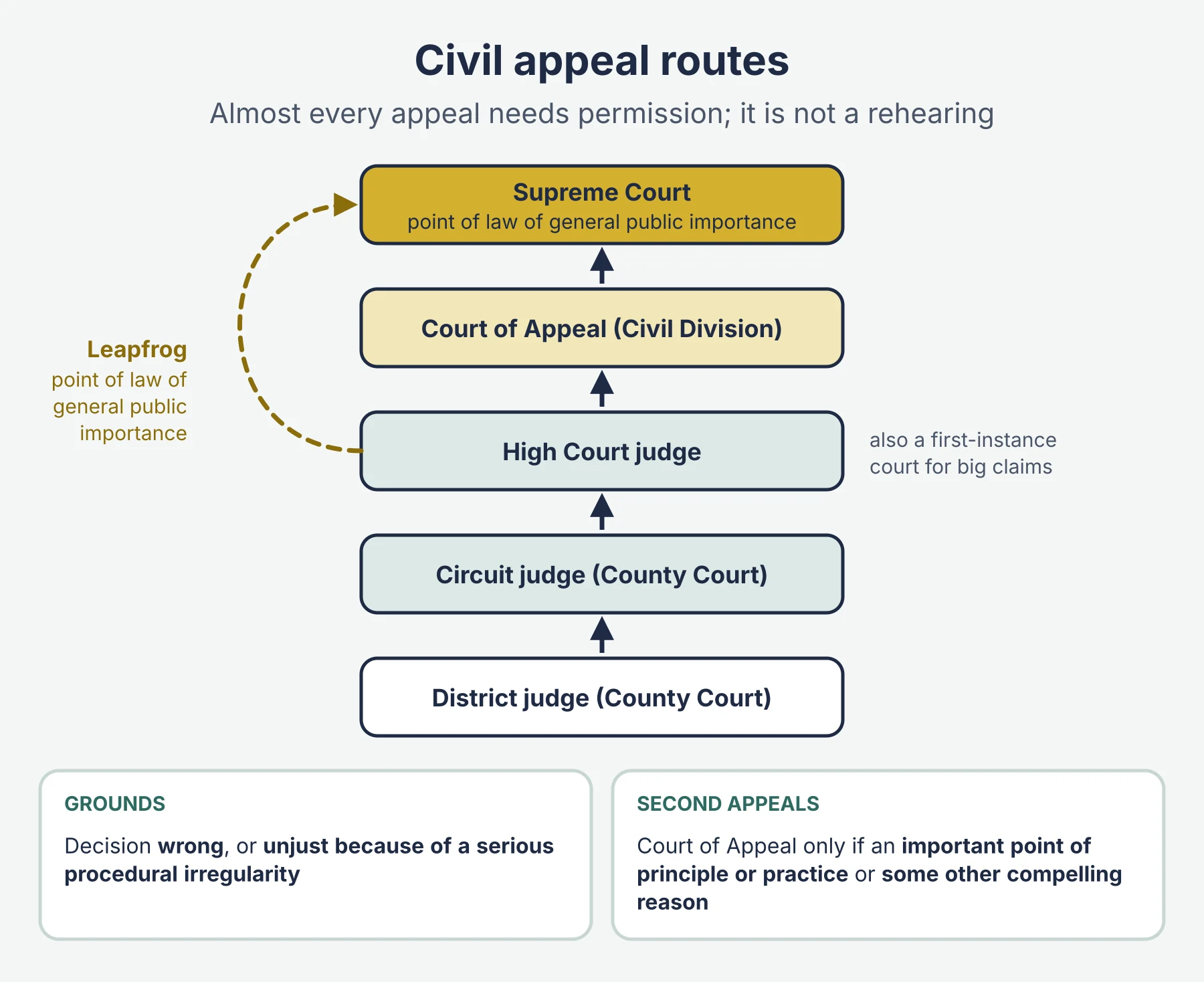
Almost every civil appeal needs permission, from the court that made the decision or from the appeal court. An appeal is usually allowed only if the decision was wrong or unjust because of a serious procedural irregularity; it is not a rehearing of the evidence.
District judge (County Court)  ->  Circuit judge
Circuit judge (County Court)   ->  High Court judge
High Court                      ->  Court of Appeal (Civil Division)
Court of Appeal -> Supreme Court (point of law of general public importance)- Second appeals: where a case has already had one appeal, the Court of Appeal will hear a further appeal only if it raises an important point of principle or practice or there is some other compelling reason.
- Leapfrog appeals: in limited cases an appeal on a point of law of general public importance can go directly from the High Court to the Supreme Court, skipping the Court of Appeal.
Tribunals
Role
Tribunals decide disputes in specialist areas, usually between an individual and the state (social security, immigration, tax) or between private parties in particular fields (employment). They are a core part of the justice system, hearing very large numbers of cases.
Development
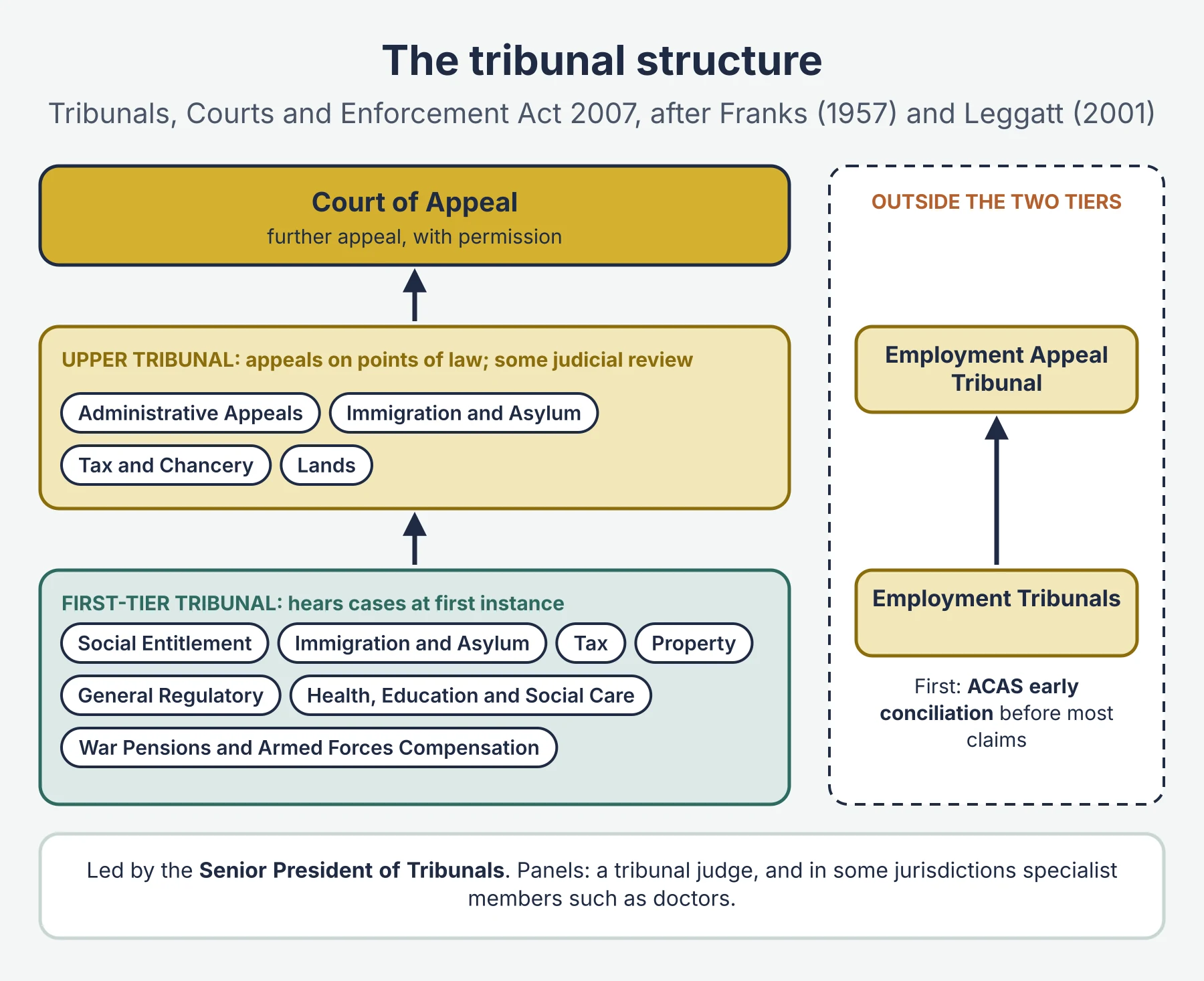
The Franks Report (1957) said tribunals should be marked by openness, fairness and impartiality. The Leggatt Review (2001) criticised a fragmented, user-unfriendly system and recommended a single structure, which led to the Tribunals, Courts and Enforcement Act 2007.
Structure
| Tier | Chambers (examples) | Role |
|---|---|---|
| First-tier Tribunal | Social Entitlement; Immigration and Asylum; Tax; Property; General Regulatory; Health, Education and Social Care; War Pensions and Armed Forces Compensation | Hears cases at first instance |
| Upper Tribunal | Administrative Appeals; Immigration and Asylum; Tax and Chancery; Lands | Hears appeals on points of law from the First-tier Tribunal, and some judicial review |
| Court of Appeal | Further appeal from the Upper Tribunal, with permission |
Employment Tribunals and the Employment Appeal Tribunal sit outside the two-tier structure. Before most employment claims, the claimant must contact ACAS for early conciliation. The tribunal system is led by the Senior President of Tribunals. Panels usually include a tribunal judge and, in some jurisdictions, specialist members such as doctors or people with experience of employment.
Advantages and disadvantages
| Advantages | Disadvantages |
|---|---|
| Cheaper: many tribunals charge no fee, and costs are rarely awarded | Legal aid is rarely available, so individuals may face represented opponents |
| Quicker than courts | Delays and backlogs in busy chambers |
| Specialist expertise of judges and members | Less formal procedure can still intimidate users |
| Informal and accessible | Limited precedent at first-tier level |
Mediation
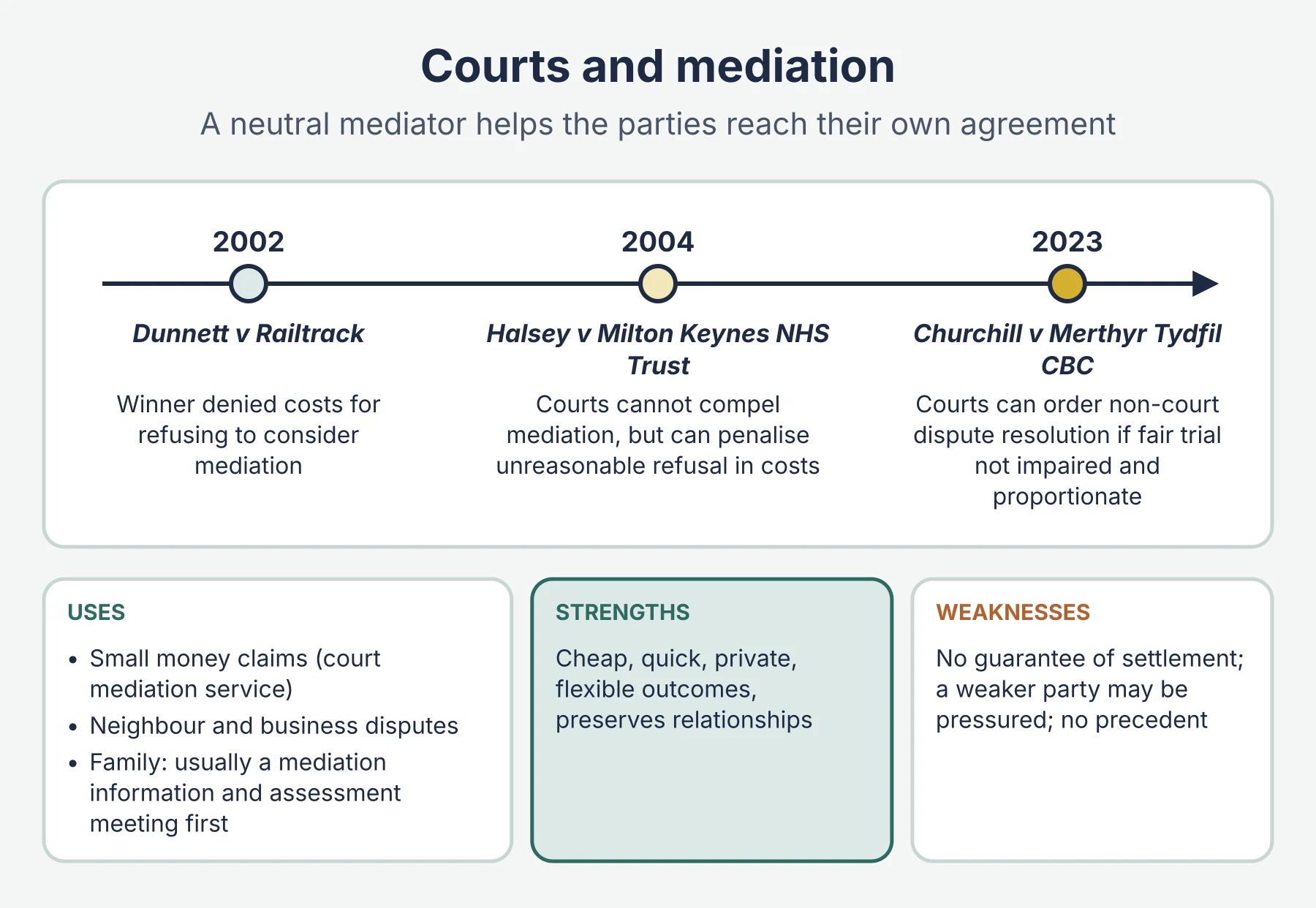
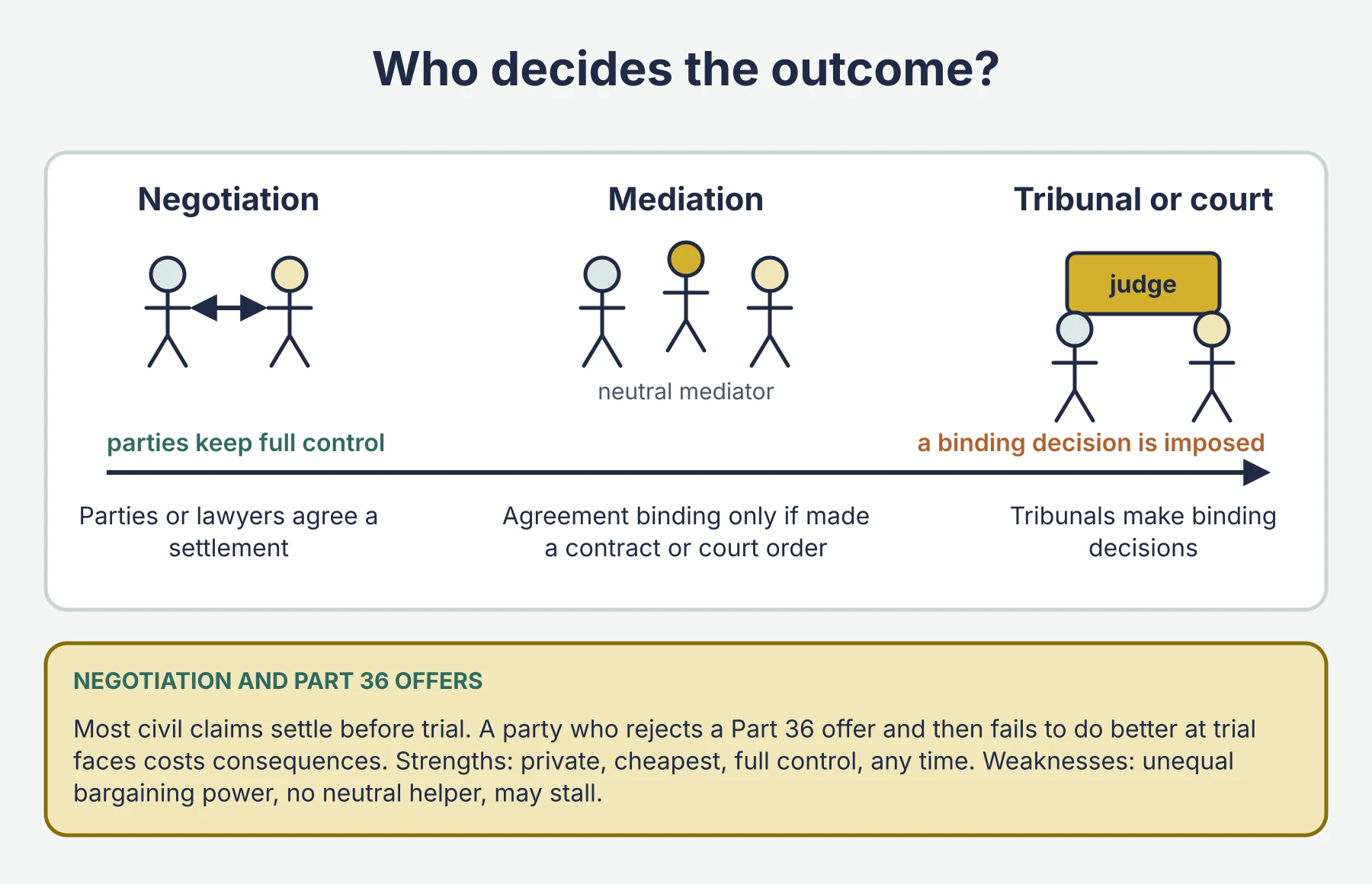
A neutral mediator helps the parties communicate and reach their own agreement; the mediator does not impose a decision. Agreements are not binding unless the parties put them into an enforceable contract or court order.
- Courts encourage it. In Dunnett v Railtrack plc (2002) a successful party was denied its costs because it had refused to consider mediation. In Halsey v Milton Keynes General NHS Trust (2004) the Court of Appeal said courts could not compel mediation, but could penalise an unreasonable refusal through costs.
- Courts can now order it. In Churchill v Merthyr Tydfil County Borough Council (2023) the Court of Appeal held that courts can order parties to engage in non-court dispute resolution, provided this does not impair the right to a fair trial and is proportionate.
- Uses: small money claims through the court’s mediation service; neighbour and business disputes; family disputes, where an applicant must usually attend a mediation information and assessment meeting before applying to court about children or finances.
- Strengths: cheap, quick, private, flexible outcomes, preserves relationships. Weaknesses: no guarantee of settlement; a weaker party may be pressured; no precedent.
Negotiation
The parties, or their lawyers, discuss the dispute directly and agree a settlement. It is the most common way disputes end: most civil claims settle before trial. Part 36 offers under the Civil Procedure Rules encourage this: if a party rejects an offer and then fails to do better at trial, it faces costs consequences.
- Strengths: private, cheapest, the parties keep full control, can happen at any time.
- Weaknesses: unequal bargaining power; no neutral helper; may stall if the parties are hostile.
Worked example: advising on a forum
Scenario: Kim, a self-employed decorator, is owed £6,500 by a client for completed work. The client says the work was poor. Advise Kim.
Negotiation first: letter before claim; try to agree a reduced sum.
Pre-action conduct: expected by the court, avoids costs penalties.
If no settlement: issue in the County Court; small claims track (< £10,000).
Mediation: defended small claim will normally be referred to the
   court's free mediation service; quick, informal, preserves the
   possibility of future work.
If still no agreement: small claims hearing before a district judge;
   informal; Kim can represent herself; costs generally not recoverable.
Appeal: only with permission, to a circuit judge, if the decision was wrong.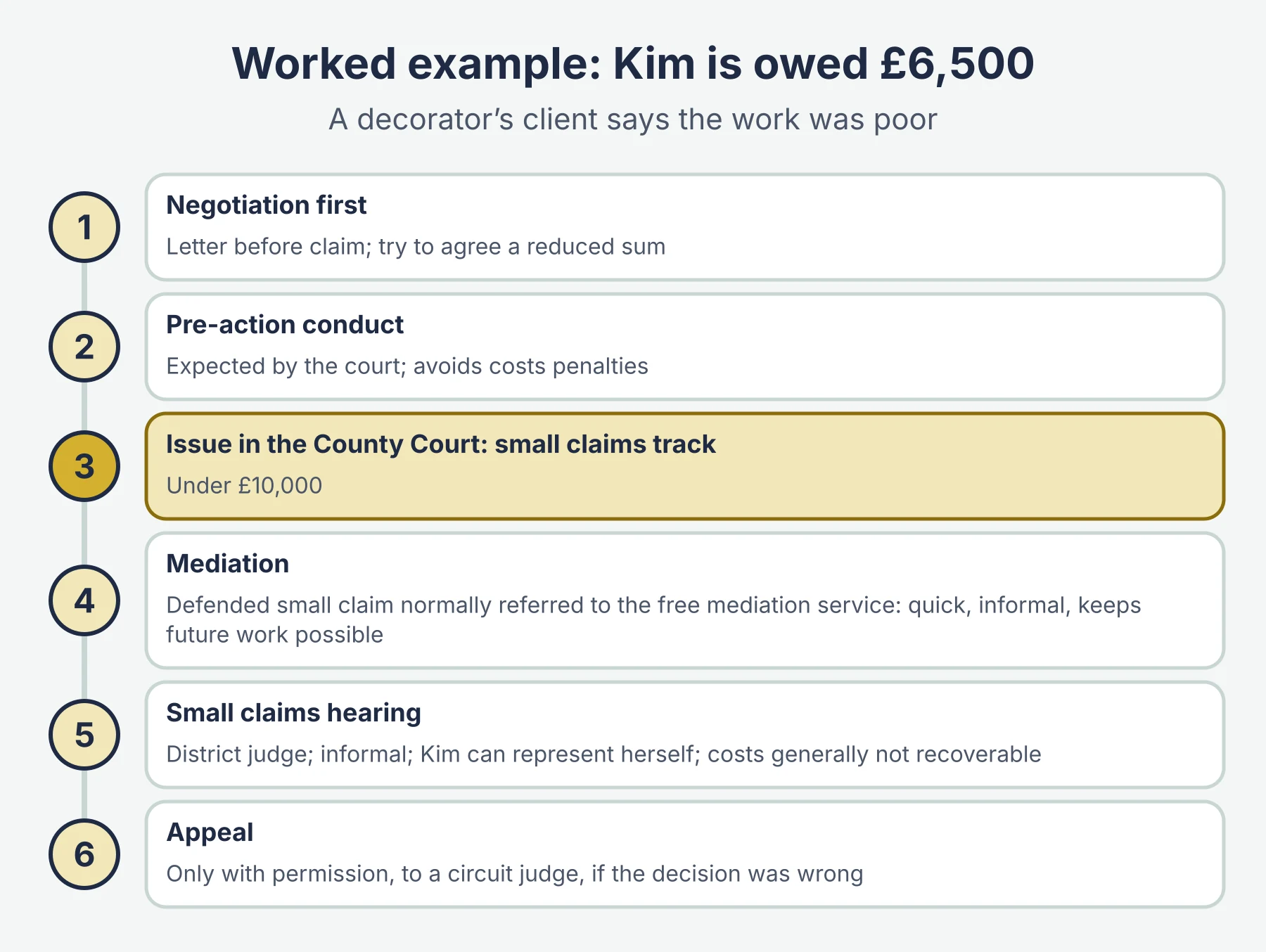
Common mistakes
- Saying all claims start in the High Court, or that the High Court has four divisions.
- Treating value as the only factor in track allocation.
- Saying an appeal is a rehearing of the evidence, or that no permission is needed.
- Describing tribunals as private mediation; tribunals make binding decisions.
- Saying mediators decide the case.
Exam technique
For outline questions, give the structure and the function of each part. For advise scenarios, take the client through negotiation, mediation, the right court and track, and appeal. For evaluate questions, weigh cost, speed, expertise and fairness of each method.
Condensed recall is in the Civil Courts and Dispute Resolution revision notes, and scenario practice is in the Civil Courts and Dispute Resolution practice questions. How civil claims are funded is covered in the Access to Justice and Funding study guide.
Related resources
-
Practice questions
AQA A Level Law (7162): The Legal System: The Civil Courts and Other Forms of Dispute Resolution – Practice Questions
Original practice questions with full answers on civil courts, tracks, appeals, tribunals, mediation and negotiation, with advice scenarios, for AQA Law 7162.
Law · AQA · A Level
Try questions -
Revision notes
AQA A Level Law (7162): The Legal System: The Civil Courts and Other Forms of Dispute Resolution – Revision Notes
Revision notes on civil courts, claim stages, tracks, appeals, tribunals, mediation and negotiation, with key terms, traps and a self-test for AQA Law 7162.
Law · AQA · A Level
Revise topic -
Study guides
AQA A Level Law (7162): The Criminal Courts and Lay People
Classification of offences, criminal appeals, sentencing adult offenders, magistrates and juries, with jury evaluation, for AQA A Level Law 7162 section 3.1.
Law · AQA · A Level
Read guide
Get free revision emails (optional)
Occasional emails with practice questions, worked explanations and links to free resources for the qualification and subjects you choose. No spam, and you can unsubscribe from any email. The free tools on this site never need an email.