
Revision Notes
AQA A Level Law (7162): The Legal System: The Civil Courts and Other Forms of Dispute Resolution – Revision Notes
Revision notes on civil courts, claim stages, tracks, appeals, tribunals, mediation and negotiation, with key terms, traps and a self-test for AQA Law 7162.
- Subject
- Law
- Level
- A LEVELS
- Topic
- Section 3.1 – The Nature of Law and the English Legal System
- Author
- Marlbridge Academic Team
- Updated
- Reviewed by
- Aizaz Raoof Ali (what this means)
Aligned to AQA A Level Law (7162), For teaching from September 2017 onwards, A-level exams 2019 onwards. Official specification .
Syllabus page (what it covers and how it is assessed): AQA A Level Law.
Syllabus points this page covers
7162
- The legal system: the civil courts and other forms of dispute resolution
Found an error? Report a correction.
Need help with this topic? Request a free trial class for A Level Law (7162).
Condensed notes on The legal system: the civil courts and other forms of dispute resolution in AQA A-level Law (7162) section 3.1: civil courts, the track system and the appeal system; the tribunal structure and role; and mediation and negotiation. For full explanation and a worked scenario, see the Civil Courts and Dispute Resolution study guide.
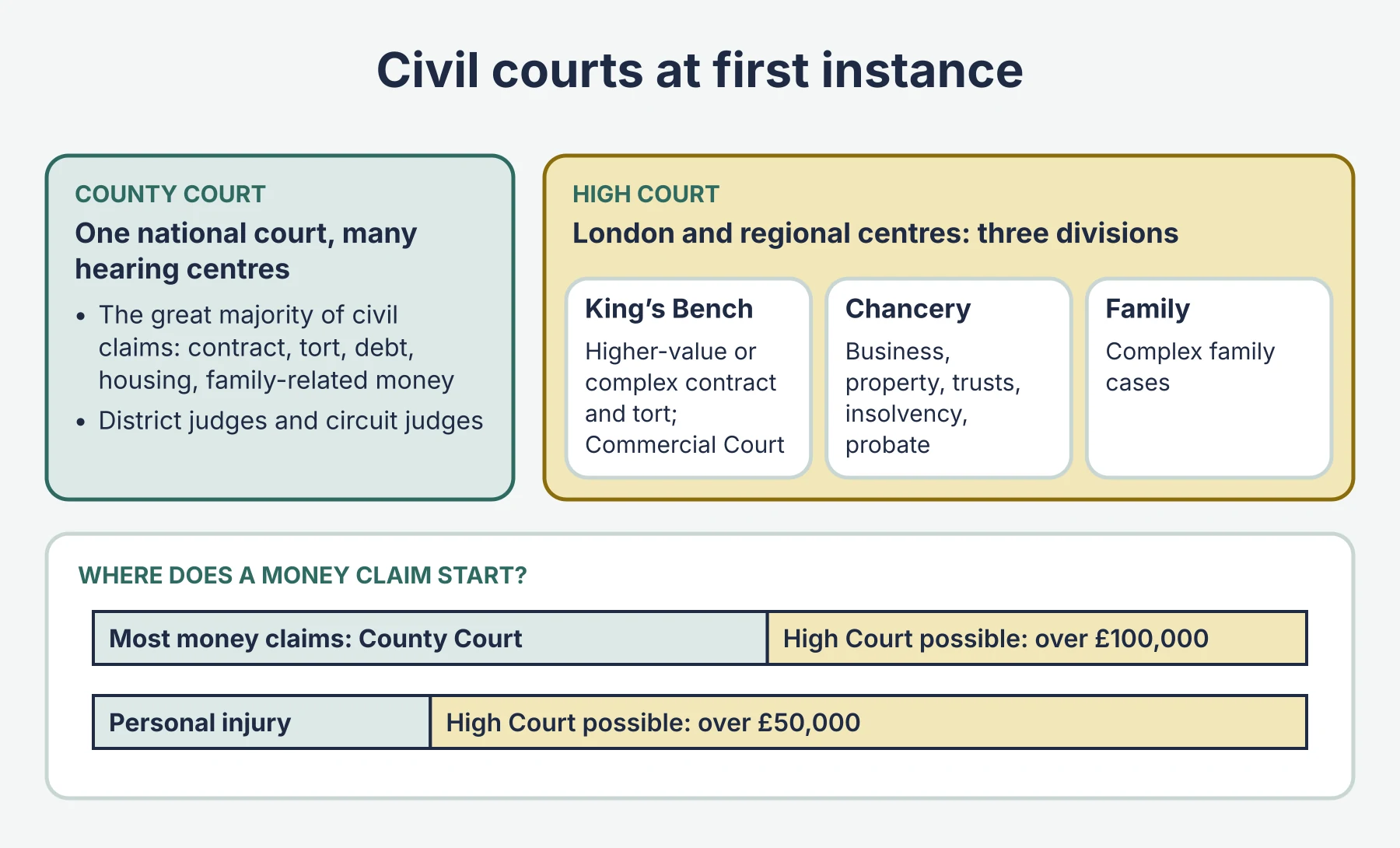
First-instance civil courts
- County Court: most civil claims; district and circuit judges.
- High Court: King’s Bench (contract, tort, Commercial Court), Chancery (business, property, trusts, insolvency, probate), Family.
- Starting point: High Court only for money claims over £100,000 (over £50,000 for personal injury); otherwise County Court.
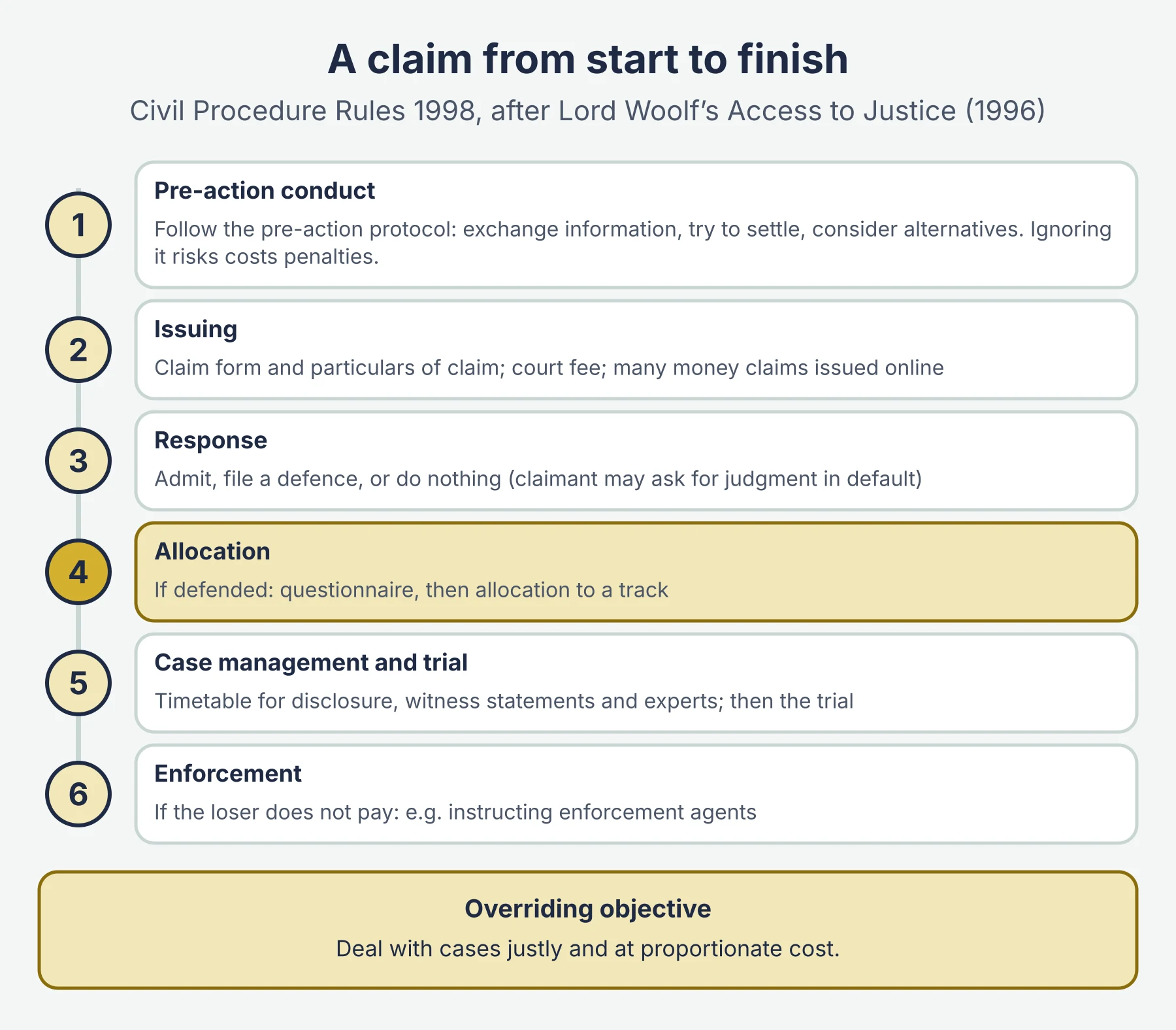
Stages of a claim
- Pre-action protocol: exchange information, try to settle, consider alternatives.
- Claim form and particulars; court fee; often online.
- Defendant admits, defends or does nothing (default judgment).
- Allocation to a track.
- Case management: disclosure, witness statements, experts; trial.
- Enforcement if unpaid.
Framework: Civil Procedure Rules 1998, after Woolf’s Access to Justice (1996). Overriding objective: deal with cases justly and at proportionate cost.
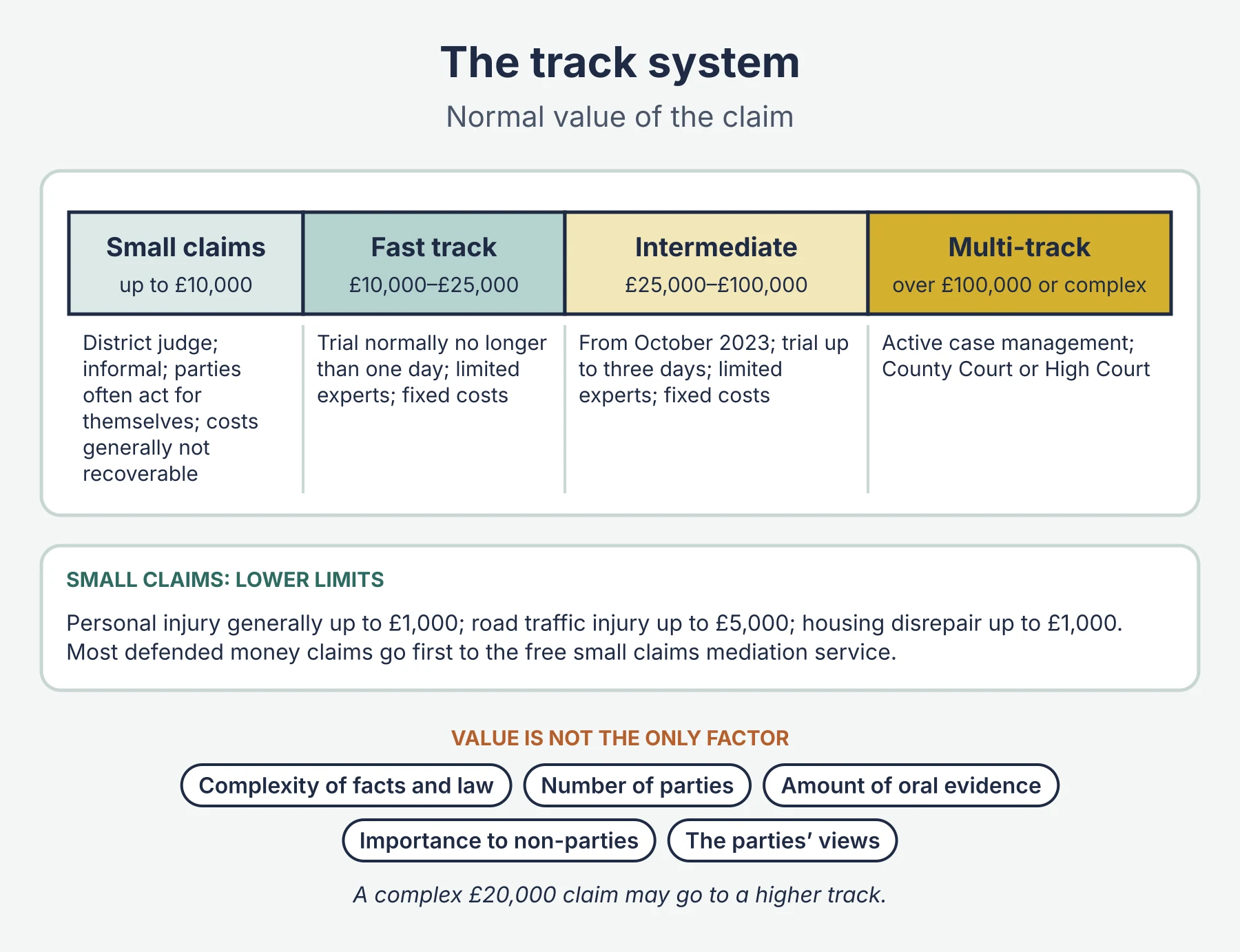
Tracks
| Track | Value | Key features |
|---|---|---|
| Small claims | ≤ £10,000 (personal injury generally ≤ £1,000; road traffic injury ≤ £5,000; housing disrepair ≤ £1,000) | District judge; informal; self-representation common; costs generally not recoverable; mediation service for most defended money claims |
| Fast | £10,000 – £25,000 | One-day trial; limited experts; fixed recoverable costs |
| Intermediate (from October 2023) | £25,000 – £100,000 | Up to three-day trial; fixed recoverable costs |
| Multi | > £100,000 or complex | Judge-managed; County Court or High Court |
Allocation factors besides value: complexity of facts and law; number of parties; amount of oral evidence; importance to non-parties; parties’ views.
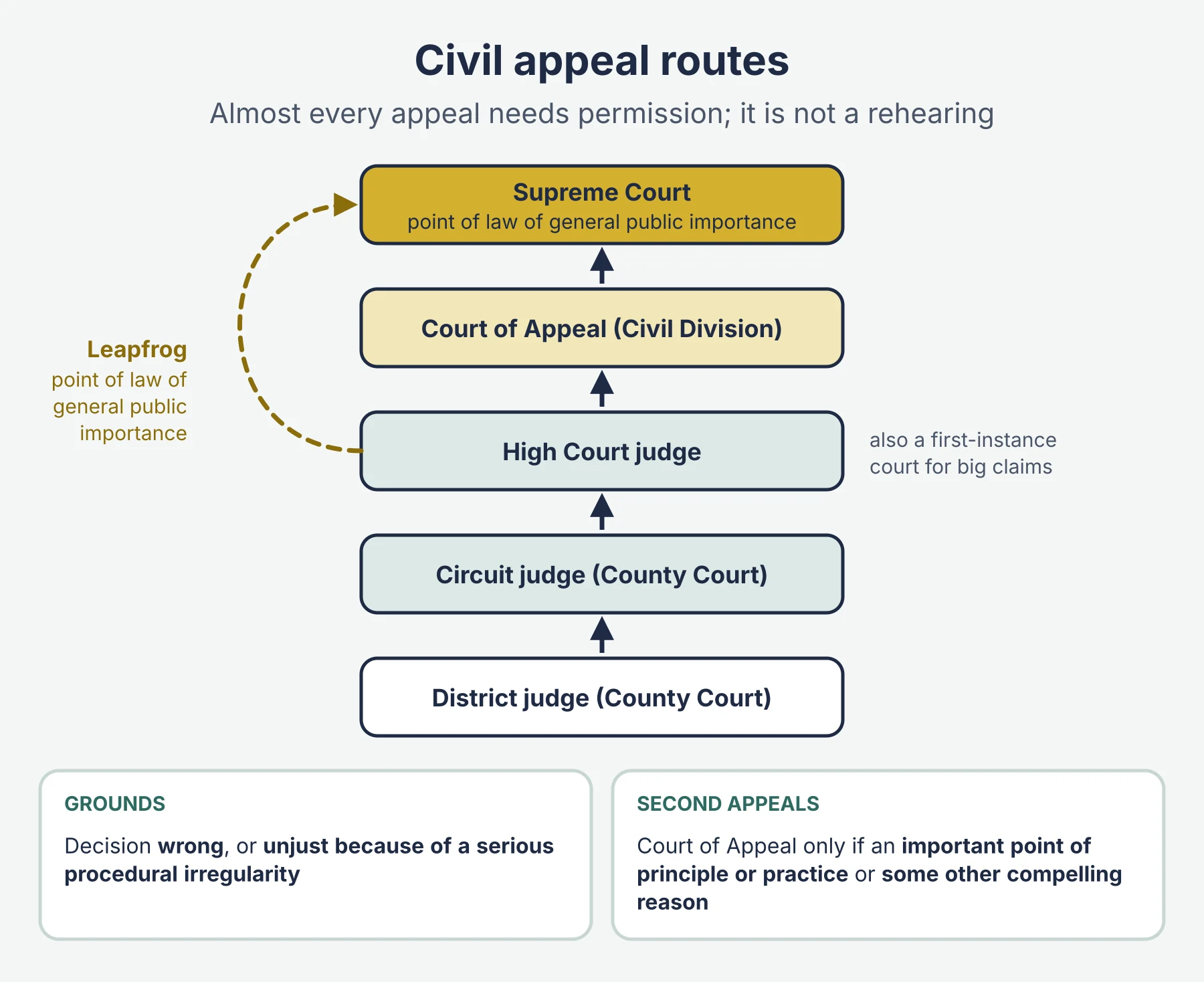
Appeals
- Permission needed; ground: decision wrong or unjust through serious procedural irregularity; not a rehearing.
- Routes: district judge → circuit judge → High Court judge; High Court → Court of Appeal (Civil Division) → Supreme Court.
- Second appeals: important point of principle or practice, or other compelling reason.
- Leapfrog: High Court → Supreme Court on points of general public importance.
Tribunals
- Role: specialist disputes, often individual v state (benefits, immigration, tax), or employment.
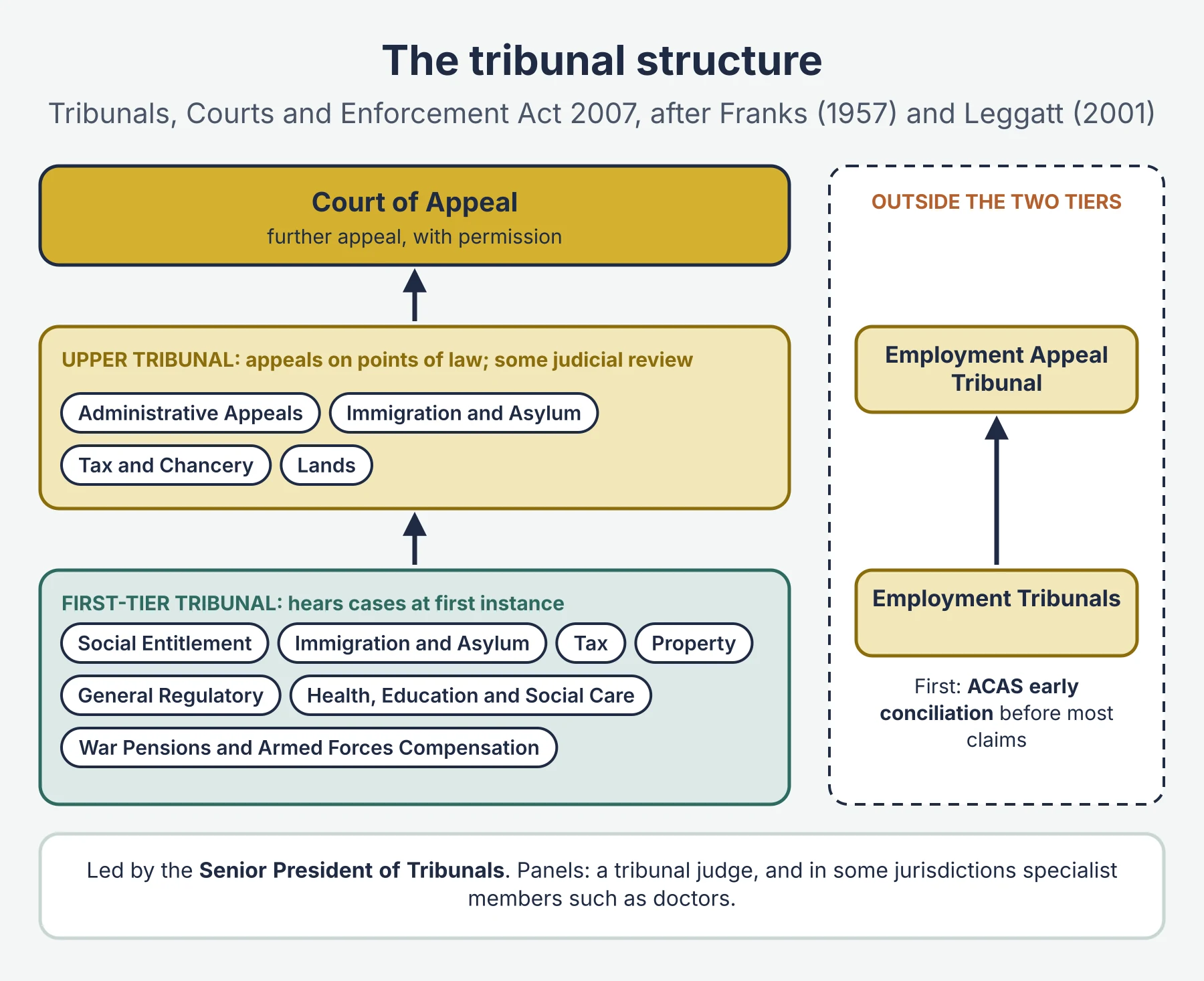
- History: Franks Report (1957): openness, fairness, impartiality. Leggatt Review (2001): fragmented system → Tribunals, Courts and Enforcement Act 2007.
- First-tier Tribunal chambers: Social Entitlement; Immigration and Asylum; Tax; Property; General Regulatory; Health, Education and Social Care; War Pensions and Armed Forces Compensation.
- Upper Tribunal chambers: Administrative Appeals; Immigration and Asylum; Tax and Chancery; Lands. Appeals on points of law; some judicial review.
- Then: Court of Appeal with permission.
- Employment: Employment Tribunals and Employment Appeal Tribunal, outside the two tiers; ACAS early conciliation first.
- Leadership and panels: Senior President of Tribunals; tribunal judge, sometimes with specialist members.
| For tribunals | Against |
|---|---|
| Cheap; costs rarely awarded | Legal aid rarely available |
| Quick | Backlogs |
| Specialist | Users may still find them intimidating |
| Informal | Little binding precedent at first tier |
Mediation
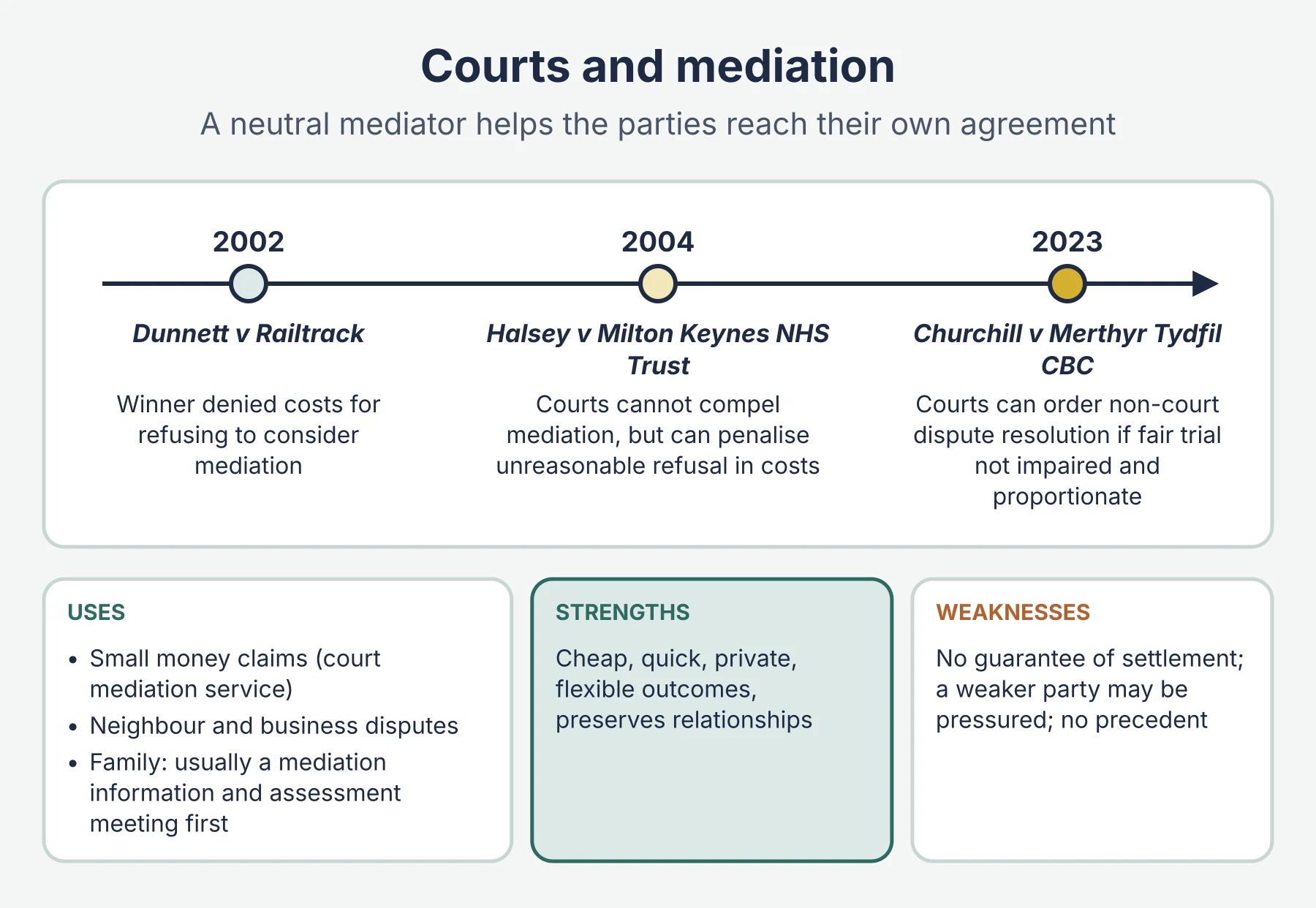
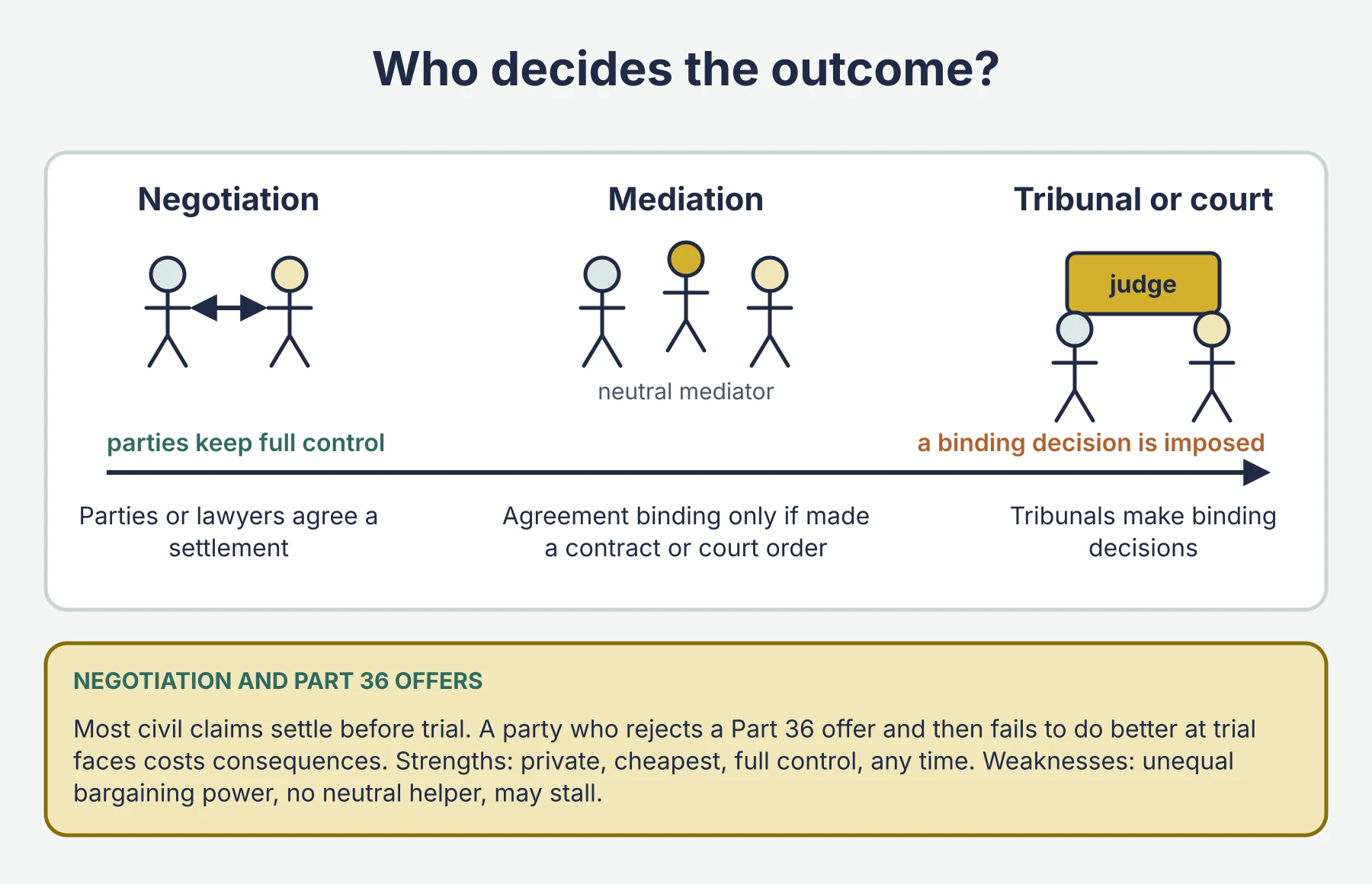
- Neutral mediator helps parties reach their own agreement; no imposed decision.
- Dunnett v Railtrack (2002): costs denied for refusing to consider mediation.
- Halsey v Milton Keynes General NHS Trust (2004): courts could not compel, but could penalise unreasonable refusal.
- Churchill v Merthyr Tydfil CBC (2023): courts can order non-court dispute resolution if proportionate and fair-trial rights are preserved.
- Uses: small claims mediation; neighbour, business, family (mediation information and assessment meeting before most children and finance applications).
- For: cheap, quick, private, flexible, preserves relationships. Against: may not settle; power imbalance; no precedent.
Negotiation
- Parties or lawyers settle directly; most civil claims settle before trial.
- Part 36 offers: rejecting an offer then failing to beat it at trial brings costs consequences.
- For: cheapest, private, full control, any time. Against: unequal bargaining power; no neutral help.
Key terms
| Term | Meaning |
|---|---|
| Pre-action protocol | Steps parties should take before issuing a claim |
| Allocation | Assigning a defended claim to a track |
| Overriding objective | Dealing with cases justly and at proportionate cost |
| Permission to appeal | Leave required before an appeal can proceed |
| Leapfrog appeal | Appeal straight from the High Court to the Supreme Court |
| First-tier Tribunal | First-instance tribunal, organised in chambers |
| Upper Tribunal | Appellate tribunal hearing points of law |
| Mediation | Neutral-assisted settlement by the parties themselves |
| Part 36 offer | Formal settlement offer with costs consequences |
Exam traps
- Value treated as the only allocation factor.
- High Court said to have four divisions.
- Appeal described as an automatic rehearing.
- Tribunals described as a form of mediation.
- Mediator said to decide the dispute.
- Halsey cited as current law on compulsion without Churchill.
Self-test
- Name the three divisions of the High Court.
- Above what value may a non-injury money claim be started in the High Court?
- What is the overriding objective of the Civil Procedure Rules?
- Which track hears a £60,000 claim, and how long is its trial?
- State three allocation factors other than value.
- What must be shown for a civil appeal to succeed?
- What is the test for a second appeal?
- Which report led to the Tribunals, Courts and Enforcement Act 2007?
- Name two chambers of the Upper Tribunal.
- What must most employment claimants do before claiming?
- How did Churchill change Halsey?
- What is a Part 36 offer and why does it encourage settlement?
Answers: 1. King’s Bench, Chancery and Family. 2. £100,000. 3. To deal with cases justly and at proportionate cost. 4. The intermediate track, if it meets the conditions; trial of up to three days. 5. Any three: complexity of facts and law; number of parties; amount of oral evidence; importance to non-parties; parties’ views. 6. That the decision was wrong, or unjust because of a serious procedural irregularity. 7. An important point of principle or practice, or some other compelling reason. 8. The Leggatt Review (2001). 9. Any two: Administrative Appeals; Immigration and Asylum; Tax and Chancery; Lands. 10. Contact ACAS for early conciliation. 11. Halsey said courts could not compel mediation; Churchill held they can order non-court dispute resolution if proportionate and consistent with fair-trial rights. 12. A formal settlement offer; a party who rejects it and fails to do better at trial faces costs consequences, so parties have an incentive to accept reasonable offers.
More resources on this topic
Civil Courts and Dispute Resolution study guide | Civil Courts and Dispute Resolution practice questions | Rule of Law, Law Reform, the EU and Civil Justice revision notes
Related resources
-
Study guides
AQA A Level Law (7162): The Criminal Courts and Lay People
Classification of offences, criminal appeals, sentencing adult offenders, magistrates and juries, with jury evaluation, for AQA A Level Law 7162 section 3.1.
Law · AQA · A Level
Read guide -
Practice questions
AQA A Level Law (7162): The Criminal Courts and Lay People – Practice Questions
Original practice questions with mark-scheme answers on offence classes, criminal appeals, sentencing, magistrates and juries for AQA A Level Law 7162.
Law · AQA · A Level
Try questions -
Revision notes
AQA A Level Law (7162): The Criminal Courts and Lay People – Revision Notes
Recall notes on offence classes, allocation, criminal appeals, sentencing purposes, magistrates, juries and jury evaluation for AQA A Level Law 7162.
Law · AQA · A Level
Revise topic
Get free revision emails (optional)
Occasional emails with practice questions, worked explanations and links to free resources for the qualification and subjects you choose. No spam, and you can unsubscribe from any email. The free tools on this site never need an email.