
Revision Notes
AQA A Level Law (7162): The Criminal Courts and Lay People – Revision Notes
Recall notes on offence classes, allocation, criminal appeals, sentencing purposes, magistrates, juries and jury evaluation for AQA A Level Law 7162.
- Subject
- Law
- Level
- A LEVELS
- Topic
- Section 3.1 – The Nature of Law and the English Legal System
- Author
- Marlbridge Academic Team
- Updated
- Reviewed by
- Aizaz Raoof Ali (what this means)
Aligned to AQA A Level Law (7162), For teaching from September 2017 onwards, A-level exams 2019 onwards. Official specification .
Syllabus page (what it covers and how it is assessed): AQA A Level Law.
Syllabus points this page covers
7162
- The legal system: the criminal courts and lay people
Found an error? Report a correction.
Need help with this topic? Request a free trial class for A Level Law (7162).
Condensed notes for the section 3.1 row The legal system: the criminal courts and lay people. The specification asks for the criminal process (classification of offences and appeals), court powers and sentencing of adult offenders, the role and powers of magistrates, the role of juries, and an evaluation of juries. For explanation and a worked evaluation, use the criminal courts and lay people study guide.
The process from charge to verdict
Charge -> first appearance in the magistrates' court (every adult case)
   Summary offence ........ tried by magistrates
   Either-way offence ..... plea before venue
        guilty  -> magistrates sentence, or commit to Crown Court for sentence
        not guilty -> allocation: magistrates accept or decline jurisdiction
                      if accepted, defendant may still elect jury trial
   Indictable-only offence .. sent to the Crown Court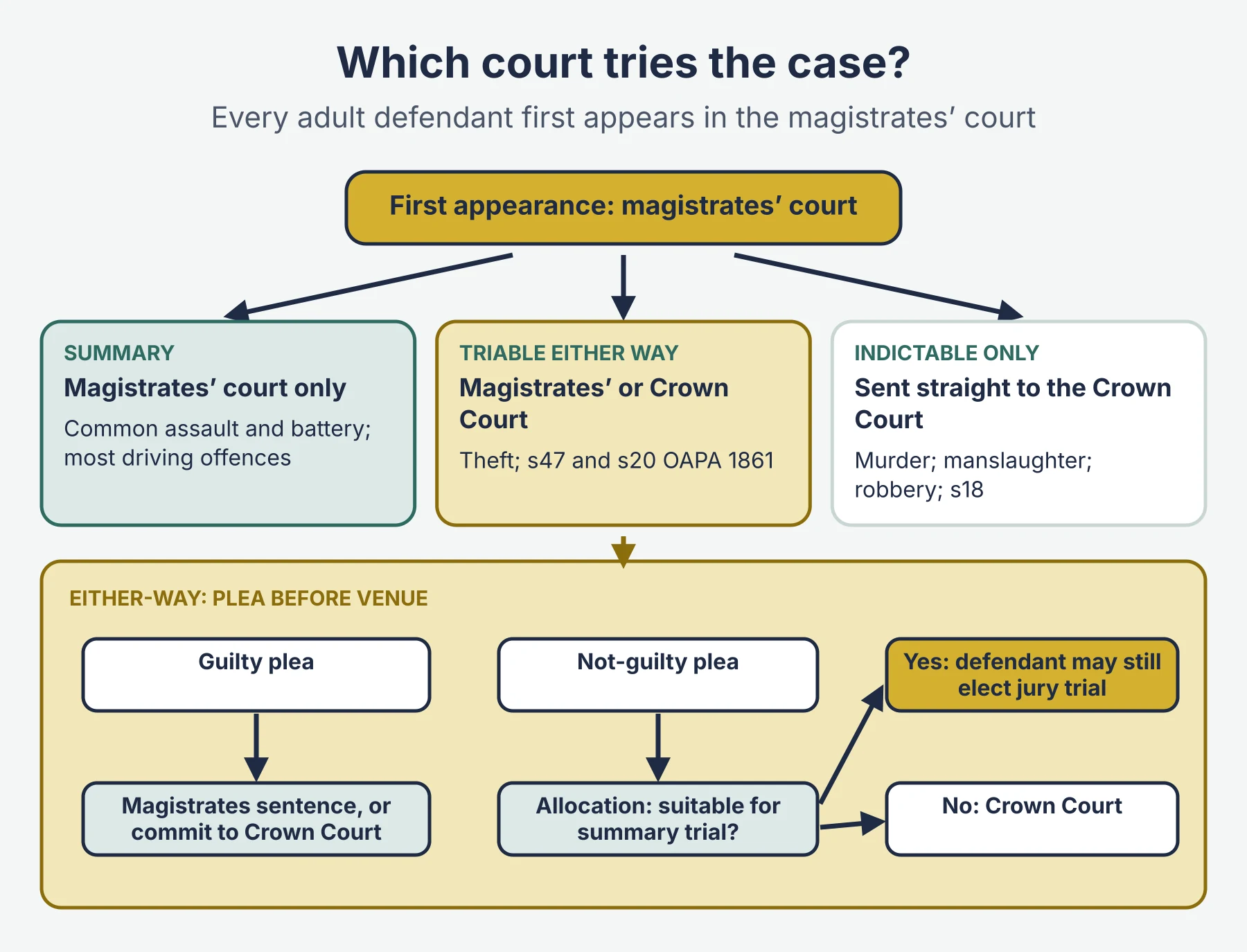
Who hears appeals
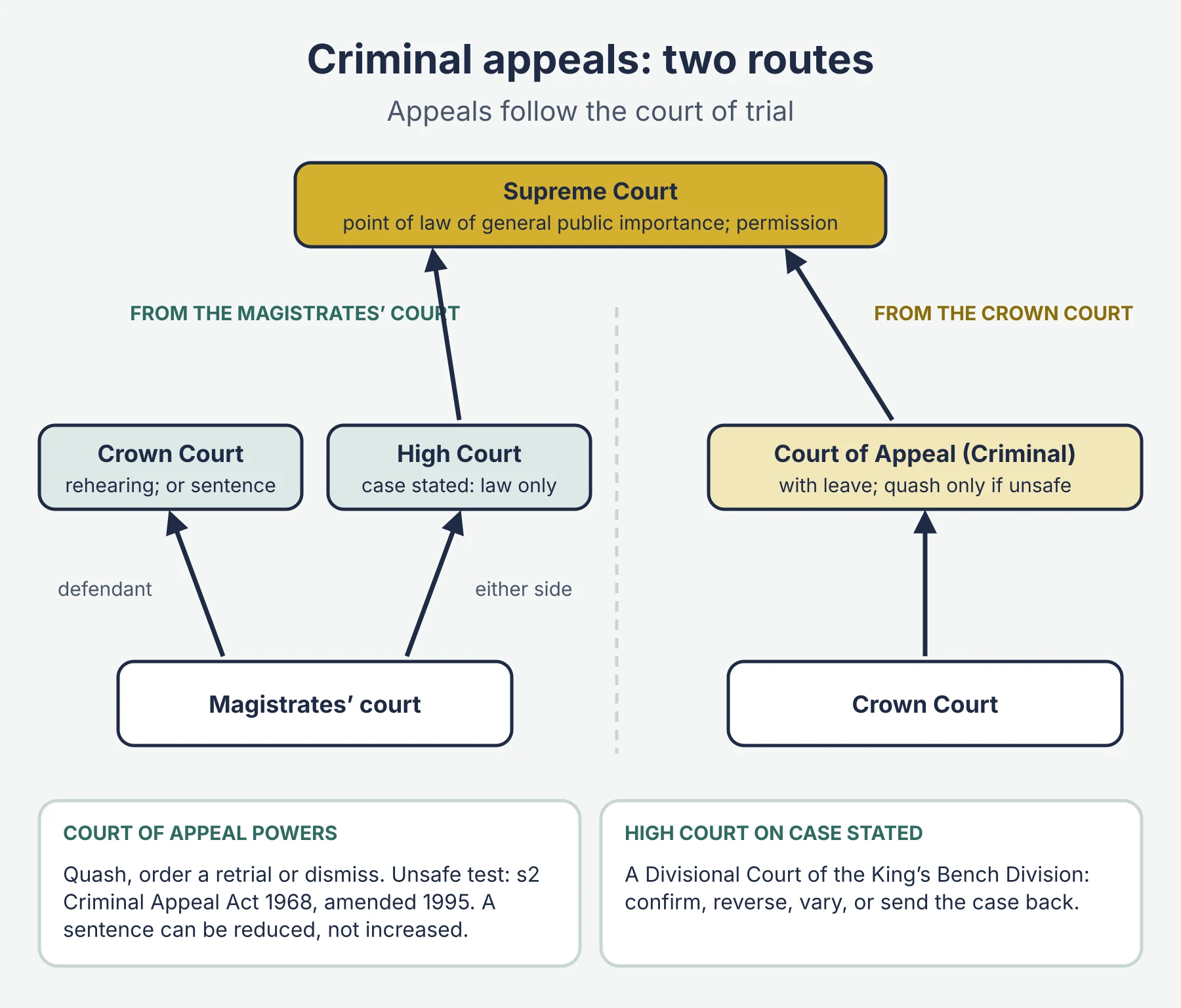
| From | Route | Who can use it | Ground |
|---|---|---|---|
| Magistrates’ court | Crown Court | Defendant only | Conviction (full rehearing) or sentence |
| Magistrates’ court | Case stated to the Divisional Court of the King’s Bench Division | Prosecution or defence | Point of law or excess of jurisdiction |
| Crown Court | Court of Appeal (Criminal Division), with leave | Defendant | Conviction “unsafe” (s2 Criminal Appeal Act 1968); sentence |
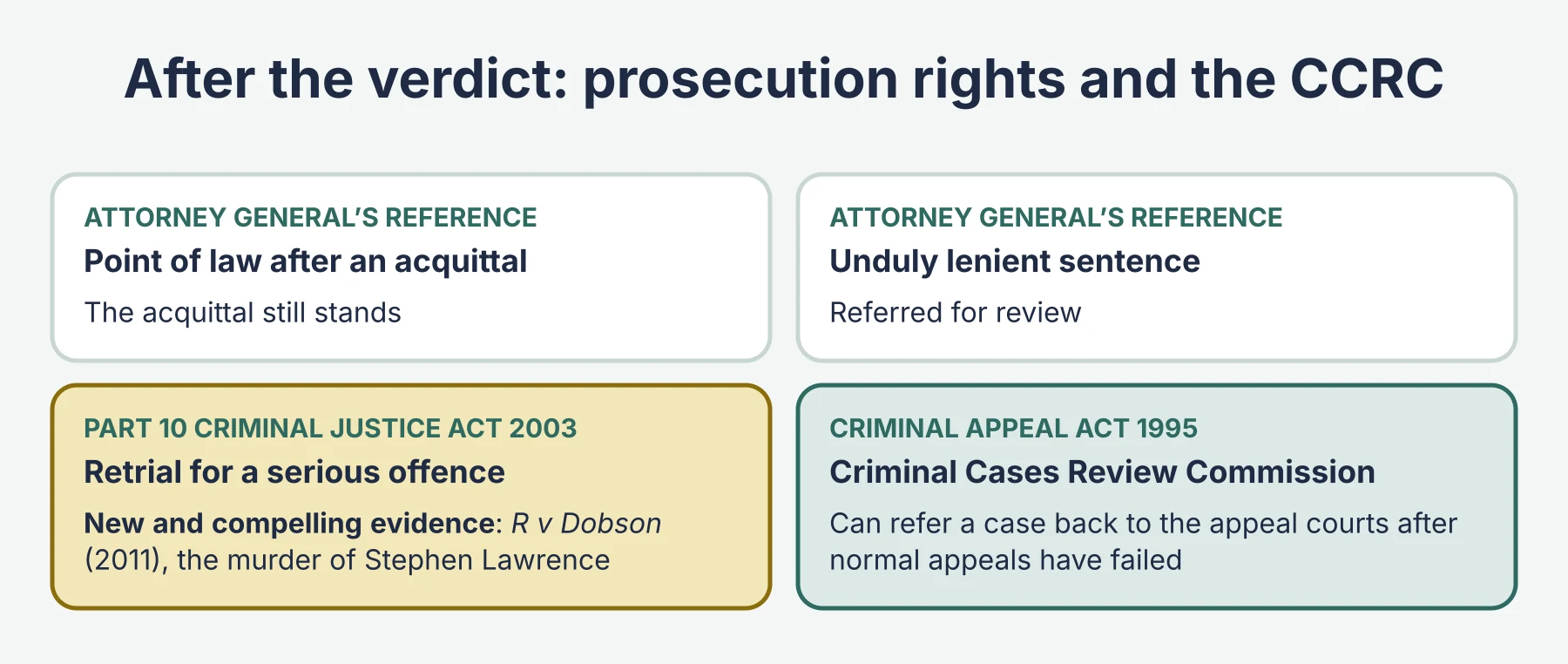
| Crown Court | Attorney General’s reference | Prosecution | Point of law after acquittal (acquittal stands); unduly lenient sentence |
| Crown Court | Retrial under Part 10 Criminal Justice Act 2003 | Prosecution | New and compelling evidence in a serious case (R v Dobson, 2011) |
| Court of Appeal or Divisional Court | Supreme Court, with permission | Either side | Point of law of general public importance |
The Criminal Cases Review Commission (Criminal Appeal Act 1995) can refer a case back after normal appeals are exhausted.
Sentencing adult offenders
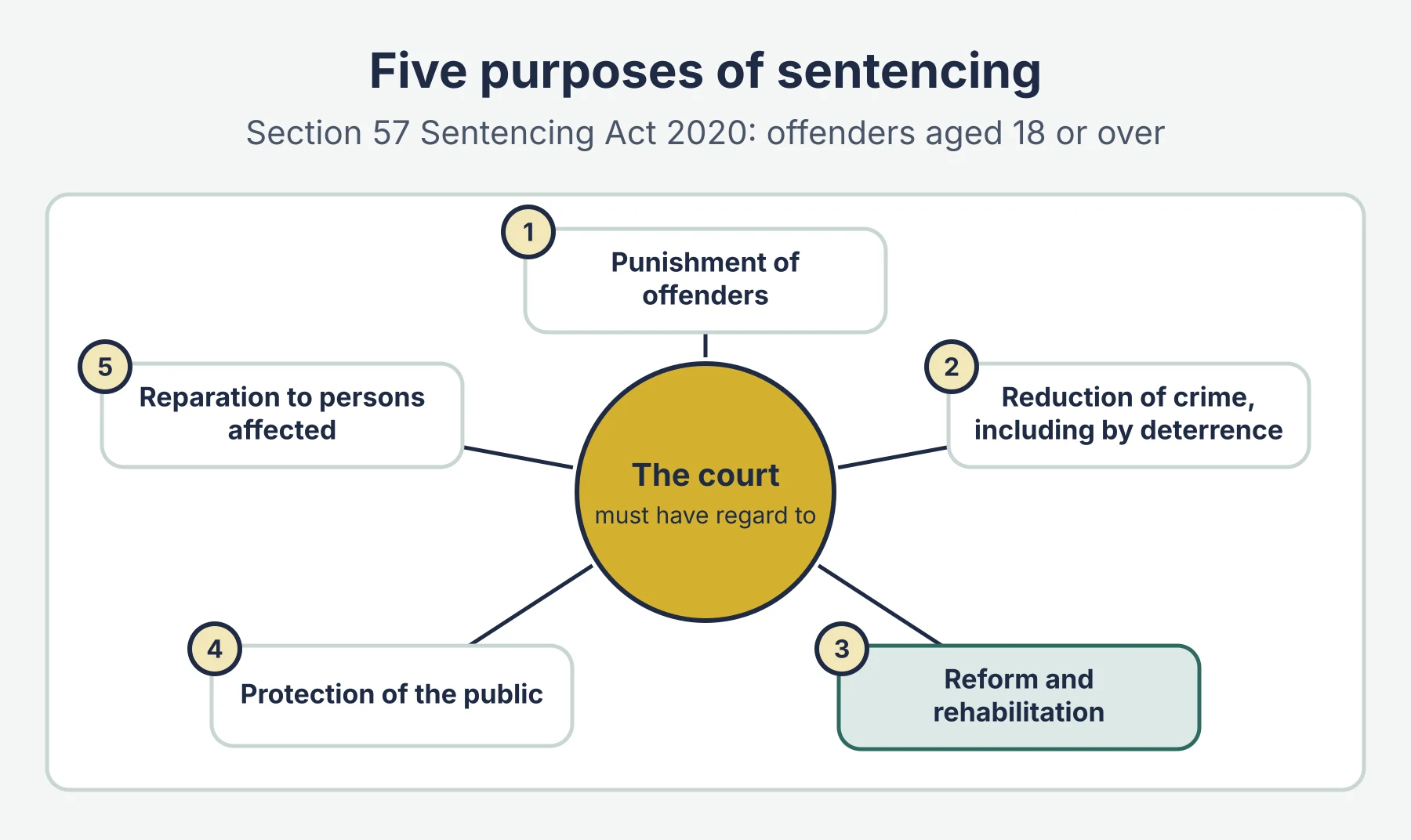
Five purposes, s57 Sentencing Act 2020: punishment; reduction of crime (including deterrence); reform and rehabilitation; protection of the public; reparation.
Four families of sentence: custody (immediate or suspended); community order with requirements; fine; discharge (absolute or conditional).
Decision sequence:
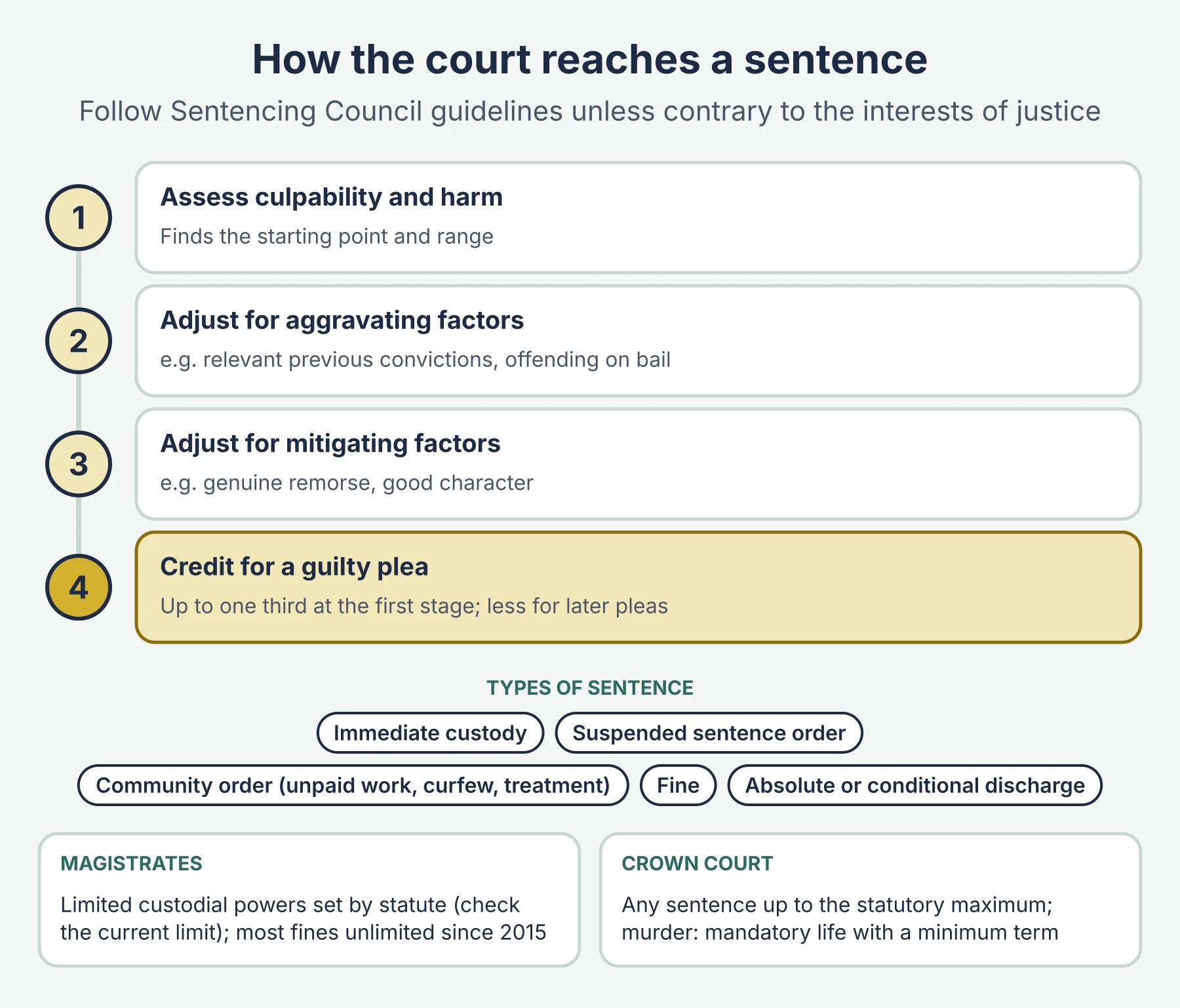
- Find the Sentencing Council guideline; assess culpability and harm.
- Take the starting point and range.
- Adjust for aggravating and mitigating factors.
- Reduce for a guilty plea (maximum one third at the first stage).
- Check the total is proportionate.
Court powers: magistrates have a limited custodial power fixed by statute (check the current limit for either-way offences) and can commit to the Crown Court for sentence; the Crown Court can impose up to the statutory maximum; murder carries a mandatory life sentence with a judge-set minimum term.
Magistrates at a glance
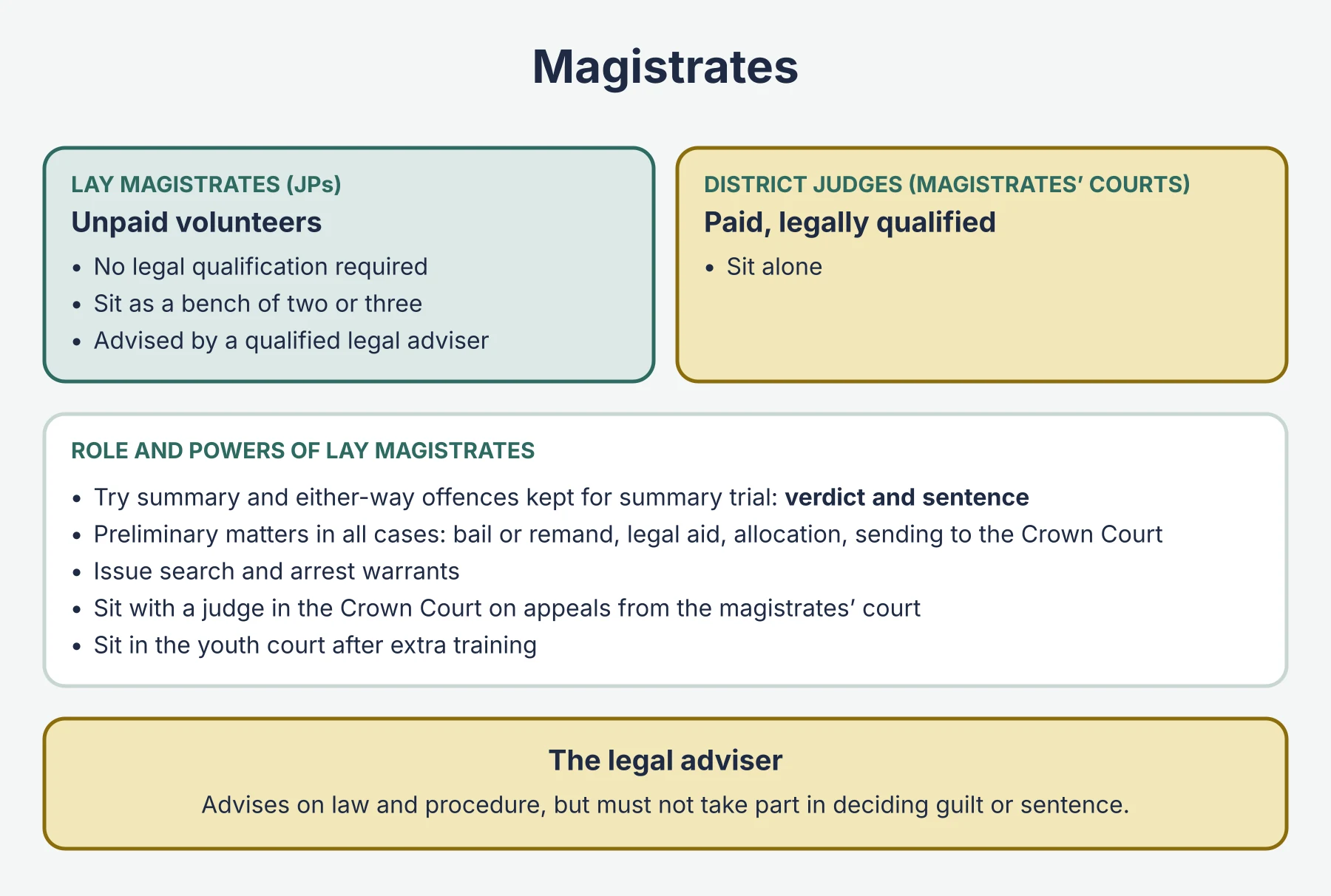
| Lay magistrates (JPs) | District judges (magistrates’ courts) | |
|---|---|---|
| Qualified? | No legal qualification needed | Legally qualified |
| Paid? | Unpaid (expenses only) | Salaried |
| Sit | Bench of two or three | Alone |
| Advice | Legal adviser on law and procedure | Not needed |
Lay magistrates’ criminal work: summary trials and sentencing; bail and remand; allocation; sending indictable cases; warrants; Crown Court appeals sitting with a judge; youth court after further training. The legal adviser must not join in the decision on guilt or sentence.
Juries at a glance
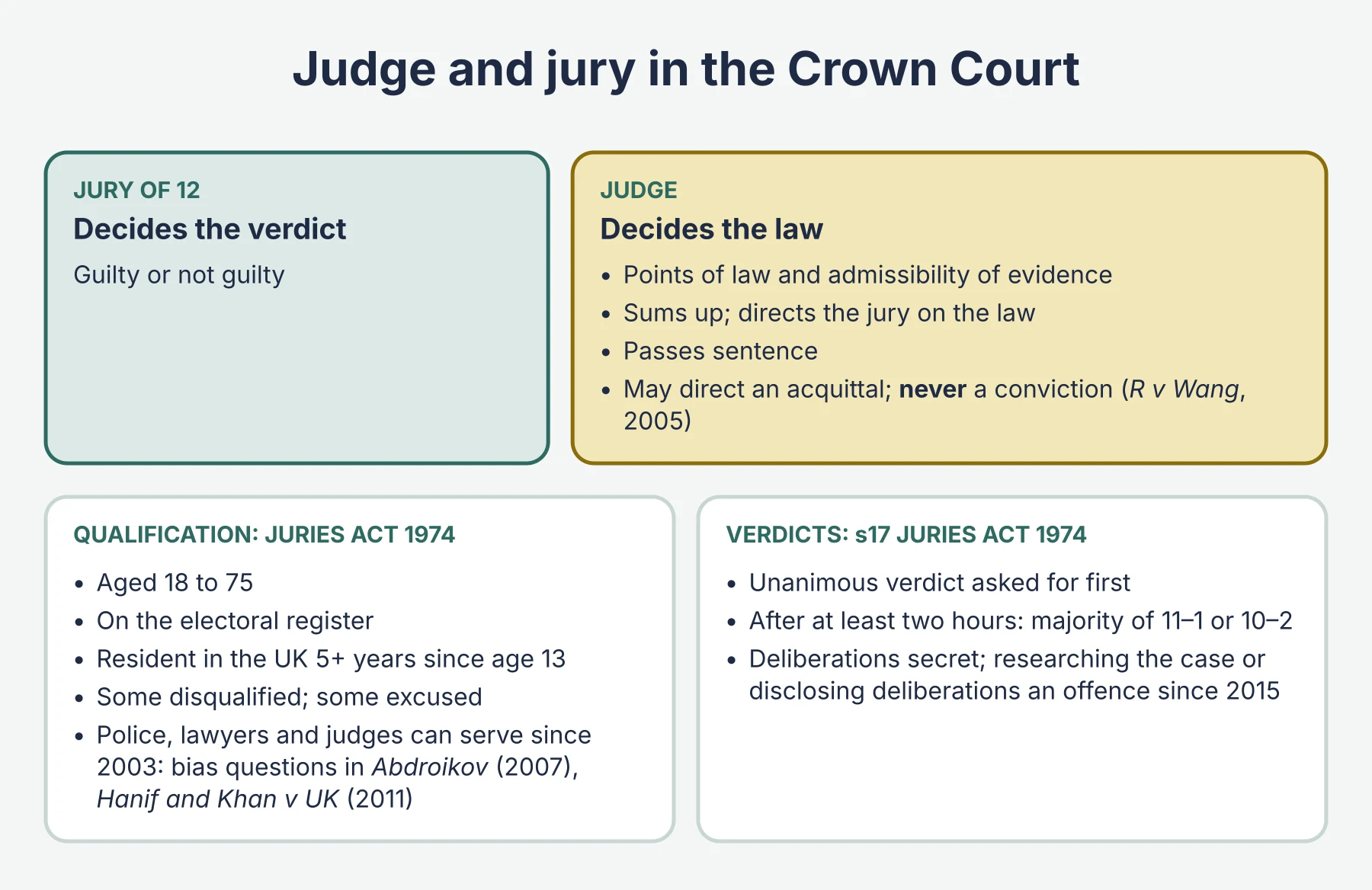
- Qualification (Juries Act 1974): 18–75; on the electoral register; resident in the UK for five years since age 13; not disqualified.
- Role: decide the verdict on the facts. Judge decides law, admissibility, summing-up and sentence.
- Verdicts: unanimous; majority 11–1 or 10–2 after at least two hours (s17).
- No directed conviction: R v Wang (2005).
- Police and lawyers as jurors: allowed since 2003, but see R v Abdroikov (2007) and Hanif and Khan v UK (2011).
- Secrecy: R v Mirza (2004); offences of juror research and disclosure added by the Criminal Justice and Courts Act 2015.
- Judge-alone trial for jury tampering: s44 Criminal Justice Act 2003; R v Twomey (2009).
Key terms
| Term | Meaning |
|---|---|
| Summary offence | Least serious class, tried only in the magistrates’ court |
| Either-way offence | Middle class, tried in either court |
| Indictable-only offence | Most serious class, tried only in the Crown Court |
| Allocation | Hearing deciding the trial court for an either-way offence |
| Case stated | Appeal on a point of law from magistrates to the High Court |
| Unsafe | Test for quashing a conviction in the Court of Appeal |
| Jury equity | A jury acquitting according to conscience rather than the strict law |
| Perverse verdict | A verdict contrary to the evidence and the judge’s directions |
| Majority verdict | 11–1 or 10–2, allowed after at least two hours |
| Legal adviser | Qualified lawyer who advises lay magistrates on law and procedure |
Jury evaluation in one breath
For: public participation and confidence; jury equity (Bushell’s Case, 1670; Ponting, 1985); random selection; the law explained in open court; Thomas (2010) found no evidence of discrimination against ethnic minority defendants.
Against: perverse acquittals (Kronlid, 1996); no reasons and no inquiry into deliberations (Mirza); misconduct (Young, 1995; Fraill, 2011); media prejudice (Taylor and Taylor, 1993); bias in the jury room (Sander v UK, 2000); some jurors misunderstand directions.
Exam traps
- Calling lay magistrates lawyers, or district judges volunteers.
- Saying juries sentence or decide points of law.
- Forgetting that every adult case starts in the magistrates’ court.
- Saying the prosecution can appeal an acquittal freely: only narrow routes exist, and an Attorney General’s reference on a point of law does not overturn the acquittal.
- Writing an evaluation of magistrates when the question asks about juries.
Self-test
- Give one example of each class of offence.
- What happens at an allocation hearing?
- Who may appeal by way of case stated?
- What test does the Court of Appeal apply to a conviction?
- Name the five purposes of sentencing for adults.
- What is the maximum credit for a guilty plea at the first stage?
- State two differences between lay magistrates and district judges.
- What is the role of the legal adviser?
- When can a majority verdict be accepted?
- Which case confirms that a judge cannot direct a jury to convict?
- What does s44 Criminal Justice Act 2003 allow?
- Give one case showing jury equity and one showing jury misconduct.
Answers: 1. Summary: common assault; either way: theft; indictable only: murder. 2. Magistrates decide whether an either-way case is suitable for summary trial; if they accept it, the defendant may still elect Crown Court trial. 3. Prosecution or defence, on a point of law or excess of jurisdiction. 4. Whether the conviction is unsafe. 5. Punishment, reduction of crime, reform and rehabilitation, protection of the public, reparation. 6. One third. 7. Lay magistrates are unqualified and unpaid and sit in benches; district judges are qualified, salaried and sit alone. 8. To advise on law and procedure without taking part in the decision. 9. After at least two hours, by 11–1 or 10–2. 10. R v Wang (2005). 11. Trial by judge alone where there is a real danger of jury tampering. 12. Equity: R v Ponting (1985); misconduct: R v Young (1995) or Attorney General v Fraill (2011).
Test yourself further with the criminal courts and lay people practice questions.
Related resources
-
Study guides
AQA A Level Law (7162): The Rule of Law
The rule of law for AQA A Level Law 7162: its three elements, Dicey, Raz and Bingham, and how it applies to law making, the legal system and substantive law.
Law · AQA · A Level
Read guide -
Practice questions
AQA A Level Law (7162): The Rule of Law – Practice Questions
Original practice questions with full answers on the rule of law, its three elements, Raz and Bingham, and its application to three areas, for AQA Law 7162.
Law · AQA · A Level
Try questions -
Revision notes
AQA A Level Law (7162): The Rule of Law – Revision Notes
Revision notes on the rule of law: three elements, Dicey, Raz and Bingham, modern cases and its application in three areas, with a self-test for AQA Law 7162.
Law · AQA · A Level
Revise topic
Get free revision emails (optional)
Occasional emails with practice questions, worked explanations and links to free resources for the qualification and subjects you choose. No spam, and you can unsubscribe from any email. The free tools on this site never need an email.