
Study Guides
AQA A Level Law (7162): The Criminal Courts and Lay People
Classification of offences, criminal appeals, sentencing adult offenders, magistrates and juries, with jury evaluation, for AQA A Level Law 7162 section 3.1.
- Subject
- Law
- Level
- A LEVELS
- Topic
- Section 3.1 – The Nature of Law and the English Legal System
- Author
- Marlbridge Academic Team
- Updated
- Reviewed by
- Aizaz Raoof Ali (what this means)
Aligned to AQA A Level Law (7162), For teaching from September 2017 onwards, A-level exams 2019 onwards. Official specification .
Syllabus page (what it covers and how it is assessed): AQA A Level Law.
Syllabus points this page covers
7162
- The legal system: the criminal courts and lay people
Found an error? Report a correction.
Need help with this topic? Request a free trial class for A Level Law (7162).
This guide covers the content row of AQA A-level Law (7162) section 3.1 headed The legal system: the criminal courts and lay people. The specification lists four things: a “basic understanding of the criminal process including the classification of offences, and the appeal system”; “criminal court powers and sentencing of adult offenders”; “the role and powers of magistrates in criminal courts and the role of juries in criminal courts”; and “the advantages and disadvantages of using juries in criminal courts”. Only the last item calls for evaluation, so it is the one most likely to carry an extended answer. For the whole of section 3.1, see the Nature of Law and the English Legal System study guide.
Classification of offences
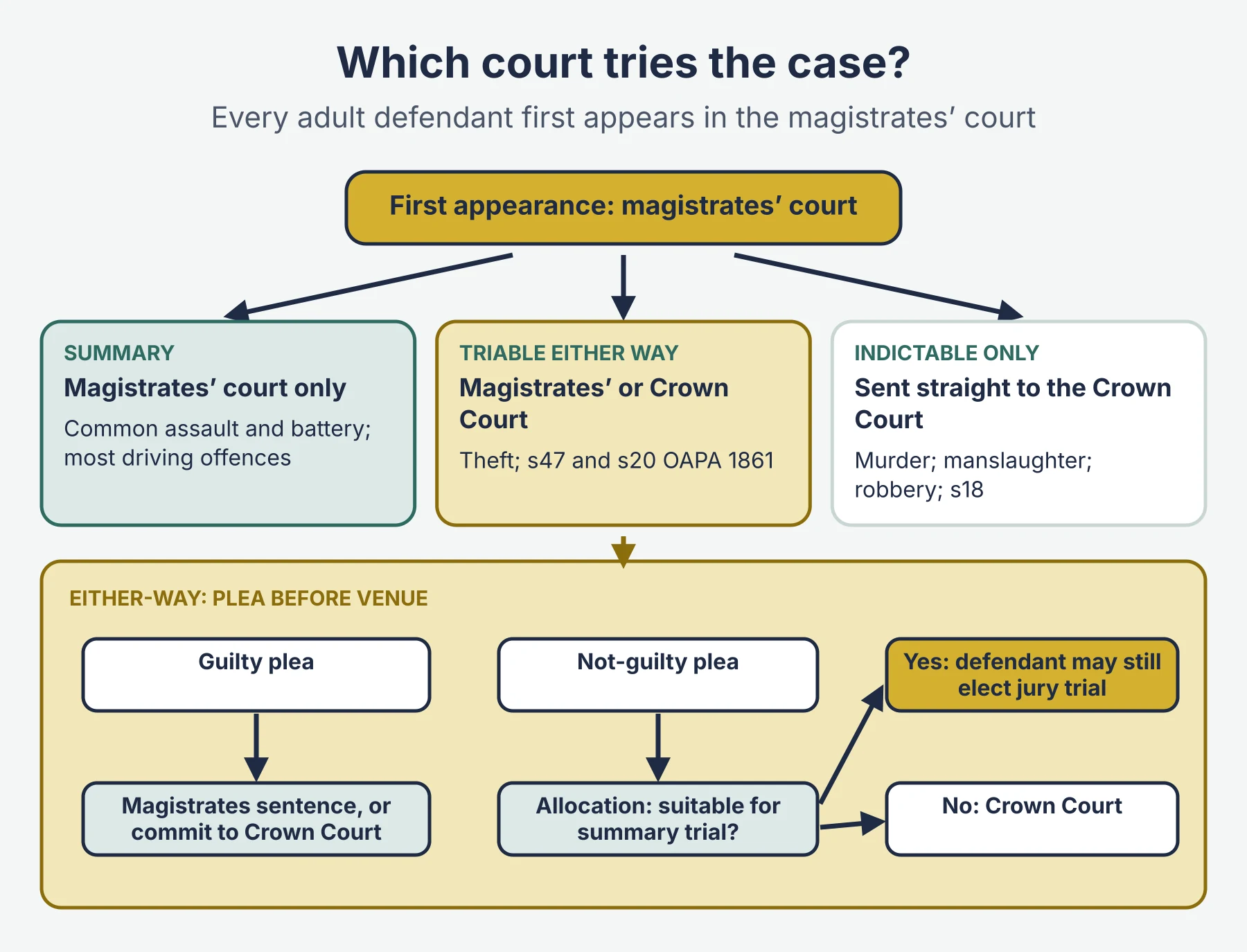
Every criminal offence falls into one of three classes, and the class decides where the case is tried.
| Class | Where tried | Examples |
|---|---|---|
| Summary | Magistrates’ court only | Common assault and battery; most driving offences |
| Triable either way | Magistrates’ court or Crown Court | Theft; s47 and s20 Offences Against the Person Act 1861 |
| Indictable only | Crown Court, after a first appearance before magistrates | Murder; manslaughter; robbery; s18 |
Every adult defendant first appears in the magistrates’ court. Indictable-only cases are sent straight on to the Crown Court. In an either-way case the defendant is first asked to indicate a plea (plea before venue). On a guilty plea the magistrates sentence, or commit to the Crown Court for sentence if their powers are not enough. On a not-guilty plea there is an allocation hearing: the magistrates decide whether the case is suitable for summary trial, and if they accept it the defendant may still elect jury trial in the Crown Court. This right of election is why debates about jury trial so often focus on either-way offences.
The appeal system
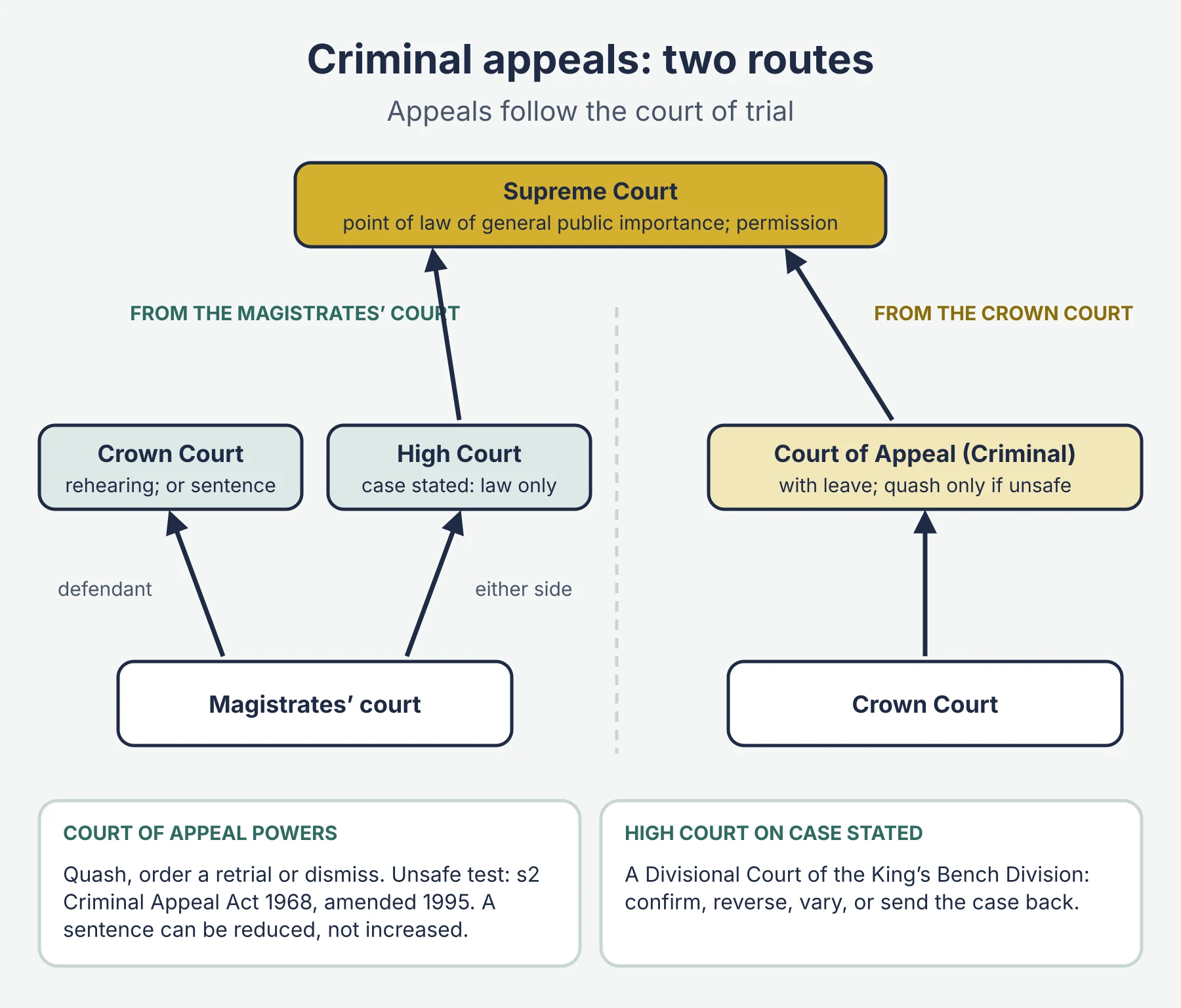
Appeals follow the court of trial, so learn two routes.
From the magistrates’ court
- The defendant may appeal to the Crown Court against conviction (a full rehearing before a judge sitting with lay magistrates) or against sentence.
- Either side may appeal by way of case stated on a point of law to the High Court (a Divisional Court of the King’s Bench Division), which can confirm, reverse or vary the decision or send it back.
- A further appeal on a point of law of general public importance can go to the Supreme Court, with permission.
From the Crown Court
- The defendant appeals to the Court of Appeal (Criminal Division) with leave. A conviction is quashed only if the court thinks it is unsafe (s2 Criminal Appeal Act 1968, as amended in 1995). The court may quash, order a retrial or dismiss the appeal; a sentence appeal can reduce but not increase the sentence.
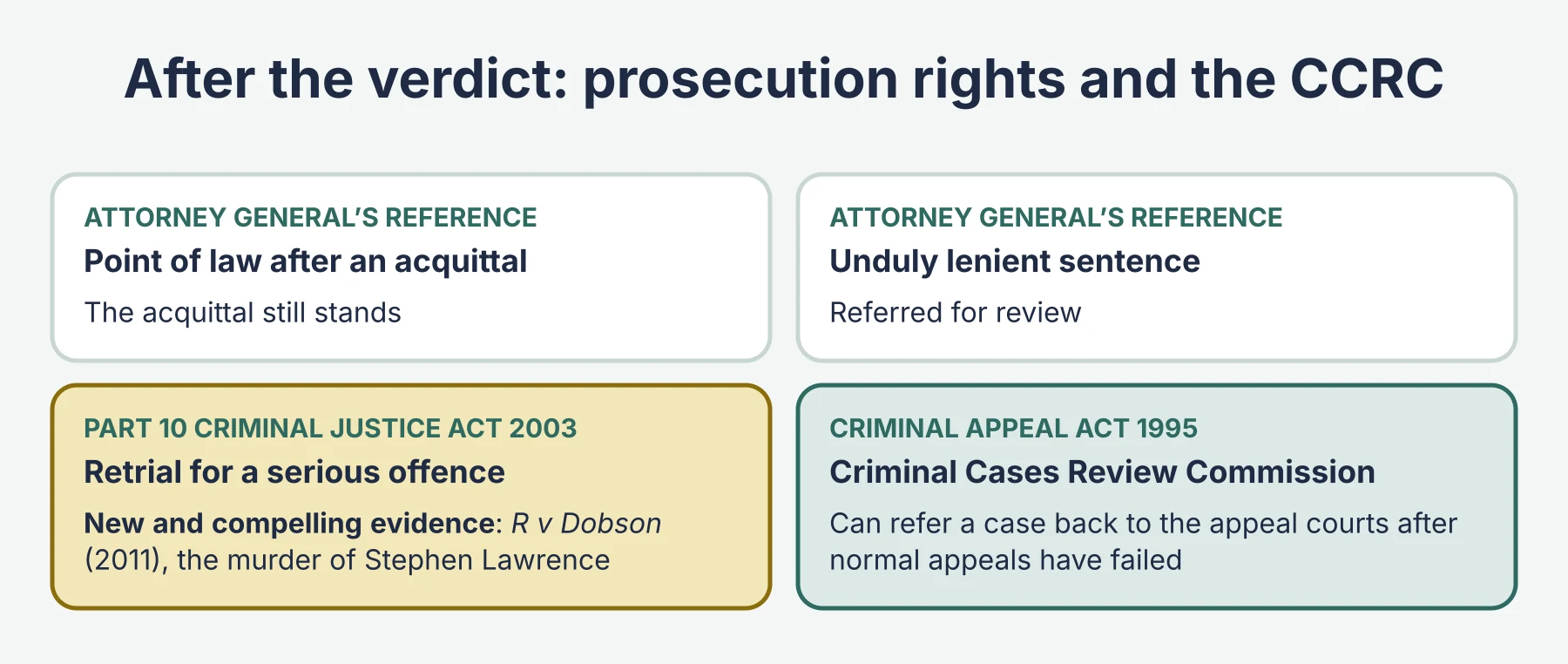
- The prosecution has narrower rights: the Attorney General may refer a point of law after an acquittal (which leaves the acquittal standing), may refer an unduly lenient sentence, and under Part 10 of the Criminal Justice Act 2003 a person acquitted of a serious offence may be retried if there is new and compelling evidence, as in R v Dobson (2011), the retrial over the murder of Stephen Lawrence.
- A further appeal to the Supreme Court needs a point of law of general public importance and permission.
- The Criminal Cases Review Commission, created by the Criminal Appeal Act 1995, can refer a case back to the appeal courts after normal appeals have failed.
Criminal court powers and sentencing adults
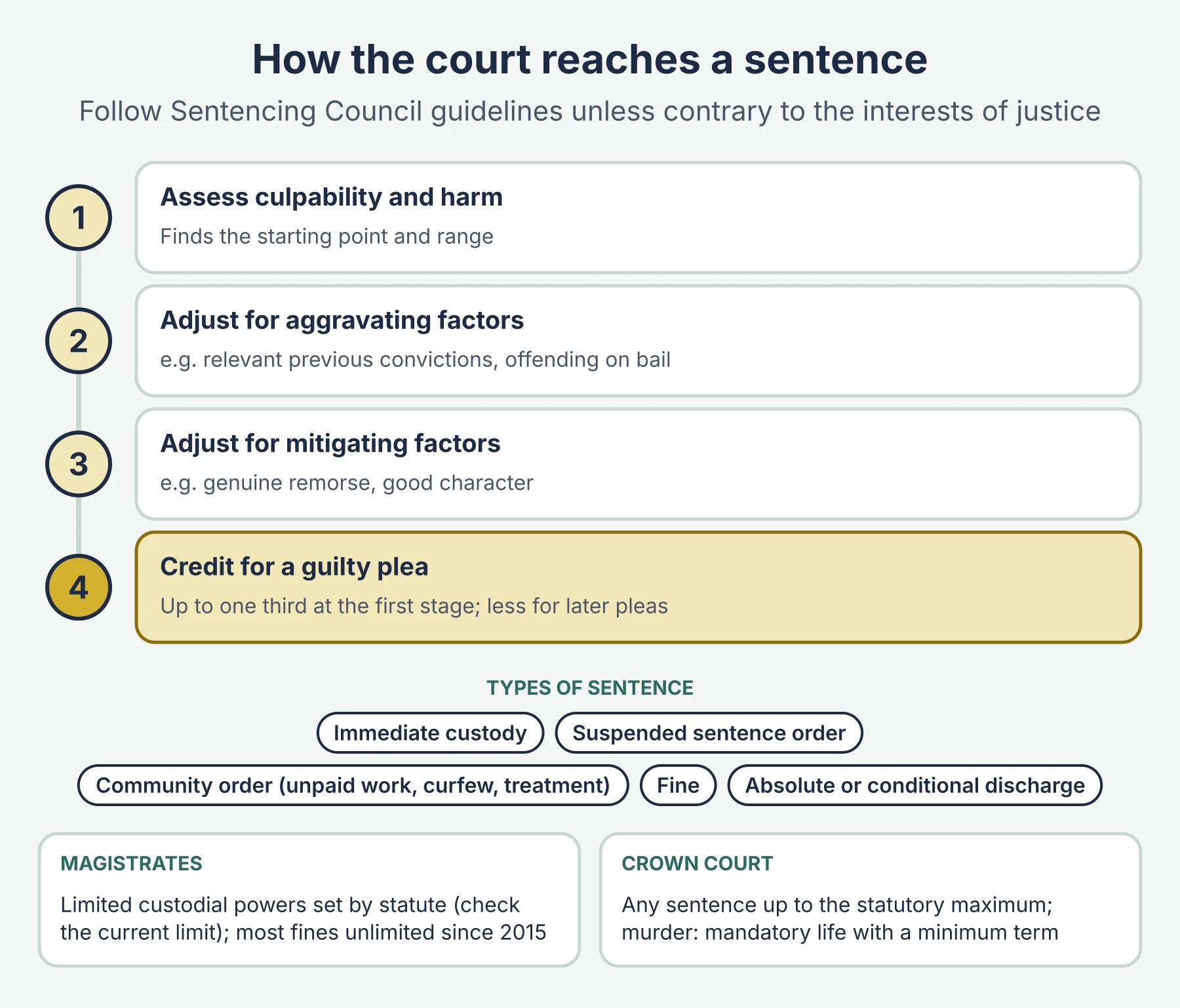
Magistrates have limited custodial powers set by statute; the limit for a single either-way offence has been raised and lowered by order more than once in recent years, so check the current figure. Since 2015 most fines in the magistrates’ court are unlimited. The Crown Court can impose any sentence up to the statutory maximum for the offence, and murder carries a mandatory life sentence with a minimum term set by the judge.
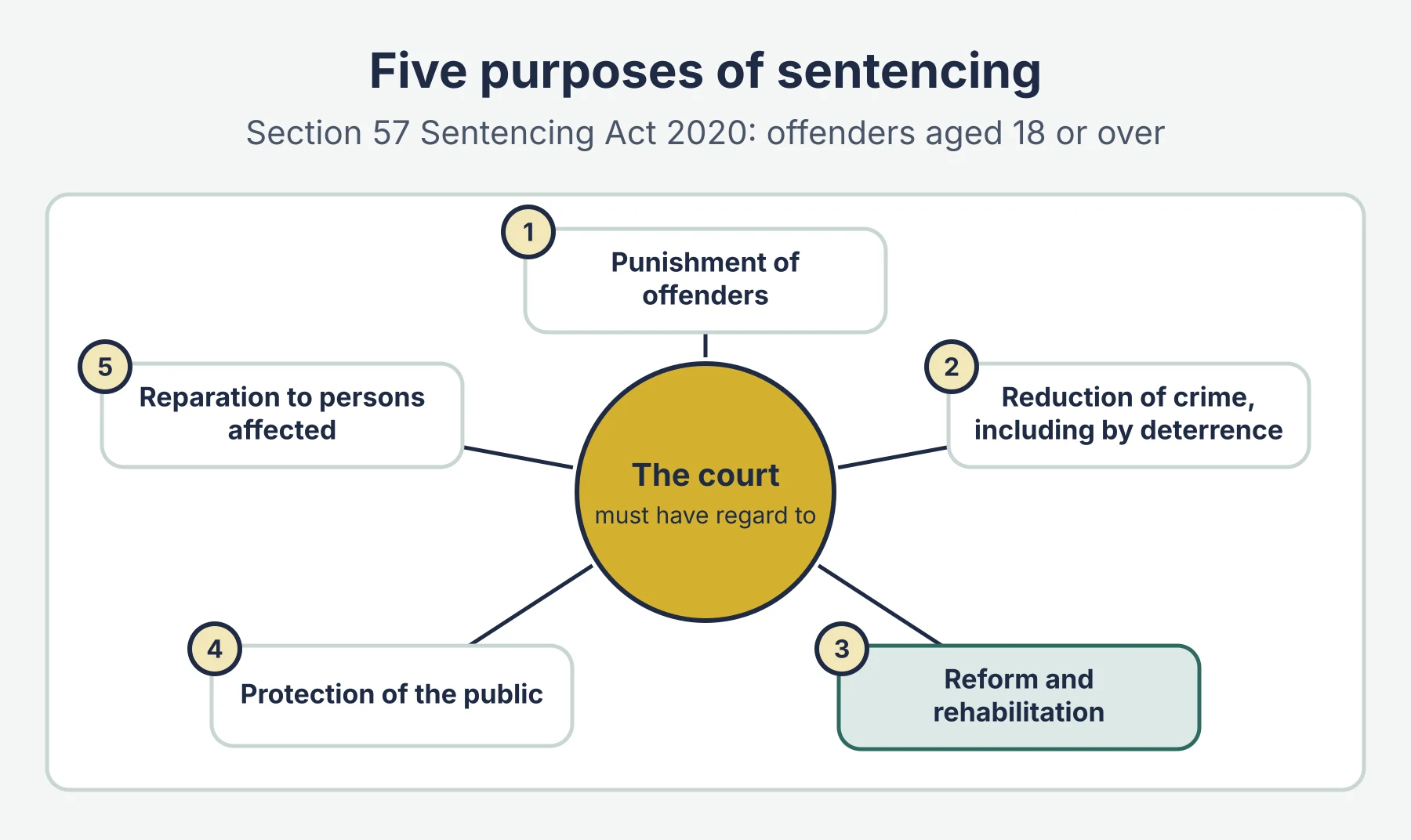
Purposes of sentencing. For offenders aged 18 or over, section 57 of the Sentencing Act 2020 requires the court to have regard to five purposes:
- punishment of offenders;
- reduction of crime, including by deterrence;
- reform and rehabilitation of offenders;
- protection of the public;
- the making of reparation by offenders to persons affected by their offences.
Types of sentence. Custodial sentences (immediate, or a suspended sentence order, where custody is not served unless the offender breaches its terms); community orders with requirements such as unpaid work, curfew or treatment; fines; and absolute or conditional discharges.
How the court decides. Courts must follow Sentencing Council guidelines unless that would be contrary to the interests of justice. The court assesses culpability and harm to find a starting point and range, adjusts for aggravating factors (such as relevant previous convictions or offending on bail) and mitigating factors (such as genuine remorse or good character), and then gives credit for a guilty plea: up to one third for a plea at the first stage, less for later pleas.
Magistrates
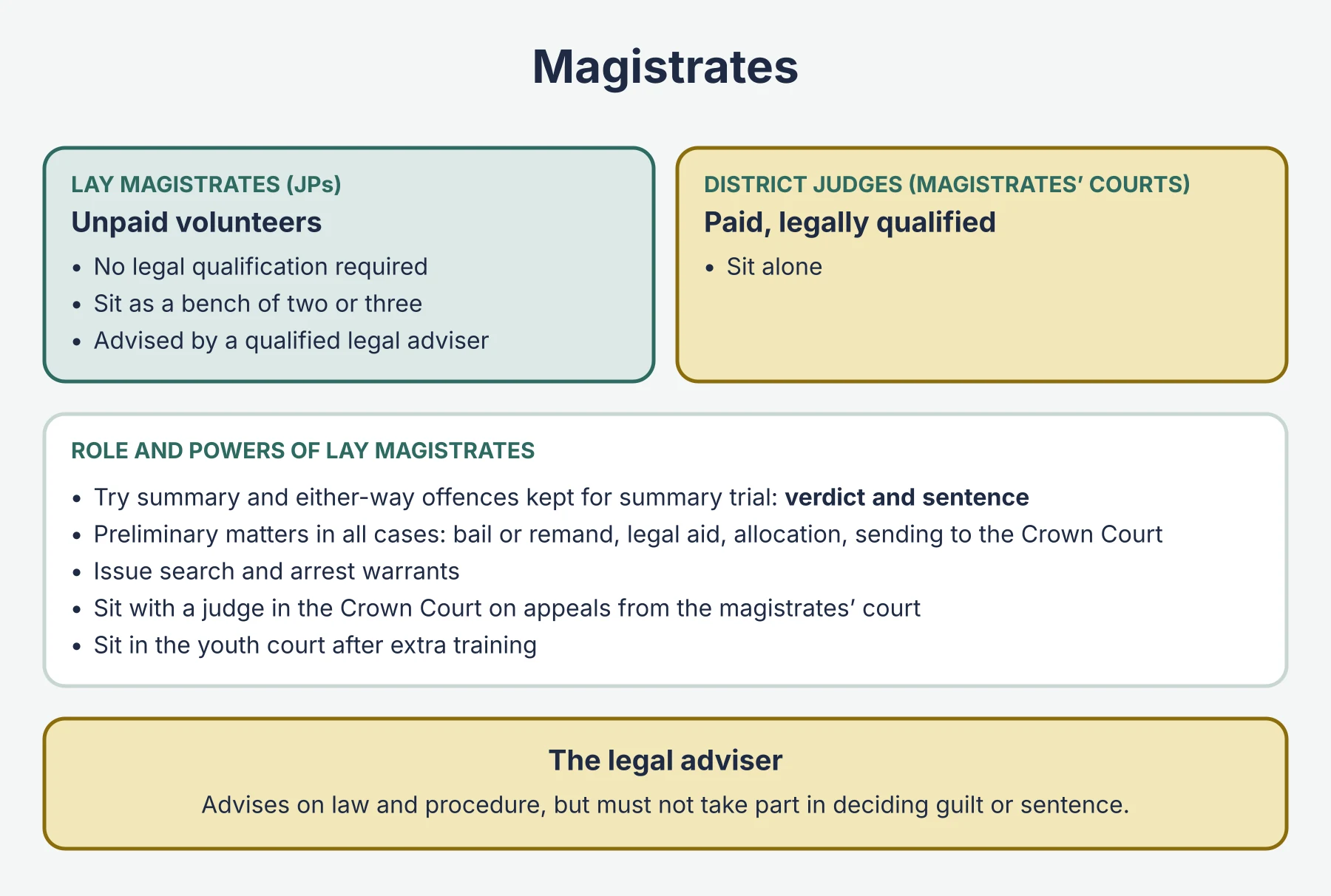
There are two kinds. Lay magistrates (Justices of the Peace) are unpaid volunteers, with no legal qualification required, who sit as a bench of two or three. District judges (magistrates’ courts) are paid, legally qualified judges who sit alone.
Role and powers of lay magistrates in criminal courts
- Try summary offences and either-way offences kept for summary trial, deciding both verdict and sentence.
- Deal with preliminary matters in all cases: bail or remand, legal aid applications, allocation, and sending indictable cases to the Crown Court.
- Issue search and arrest warrants.
- Sit with a judge in the Crown Court on appeals from the magistrates’ court.
- Sit in the youth court after extra training.
Legal adviser. Because lay magistrates are not lawyers, a qualified legal adviser advises them on law and procedure but must not take part in deciding guilt or sentence.
Selection and training in outline. Candidates apply to a local advisory committee, which looks for qualities such as good character, understanding and communication, social awareness, maturity and sound temperament, sound judgement, and commitment and reliability. Training is overseen by the Judicial College, with mentoring and appraisal as a new magistrate sits.
Juries
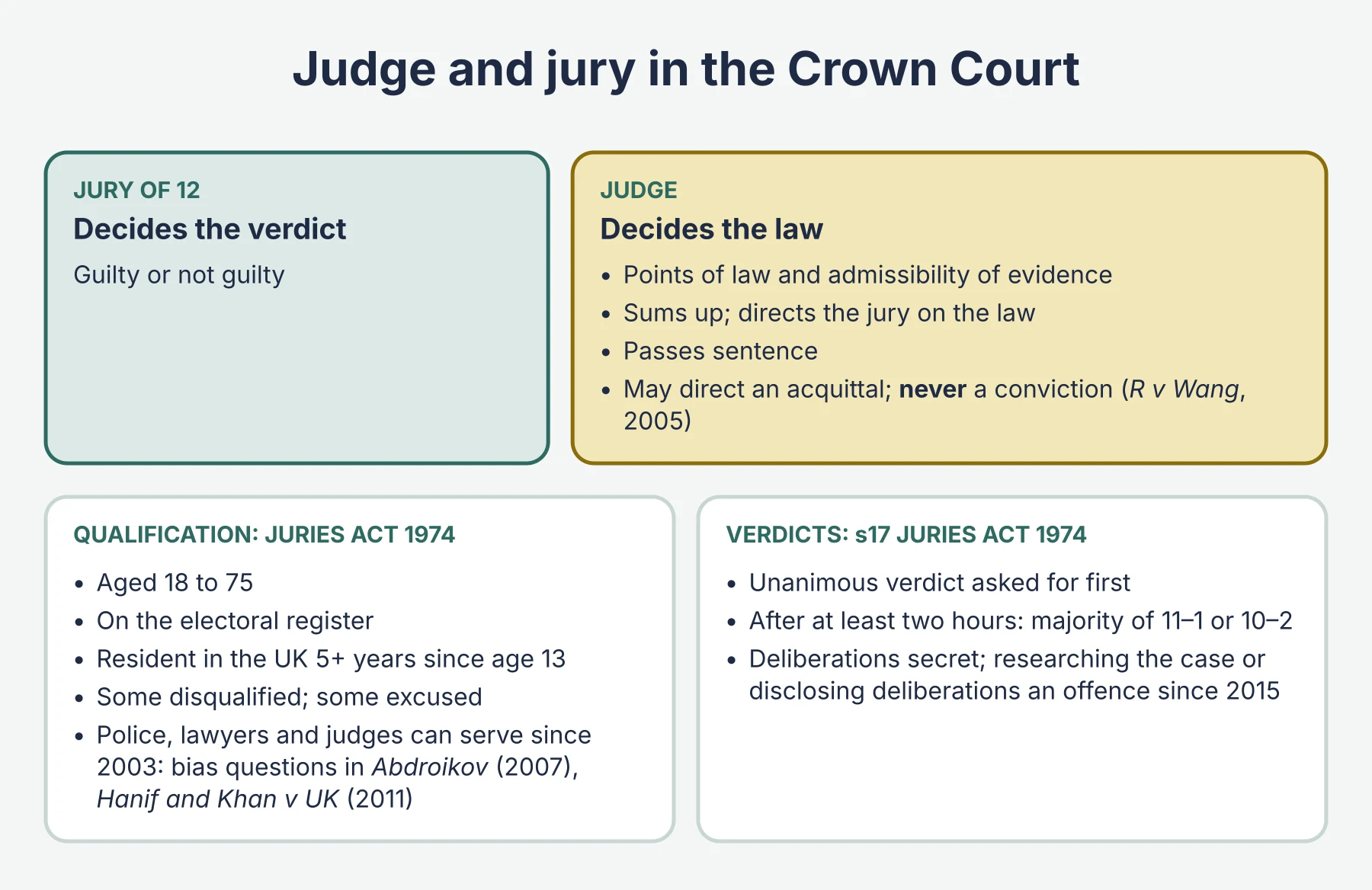
Role. In the Crown Court a jury of 12 decides the verdict: guilty or not guilty. The judge decides points of law and the admissibility of evidence, sums up, directs the jury on the law, and passes sentence. A judge may direct an acquittal if there is no case to answer, but may never direct a jury to convict (R v Wang, 2005). Juries are used in a very small proportion of criminal cases, because most cases end in the magistrates’ court or with a guilty plea.
Qualification. Under the Juries Act 1974 a juror must be 18 to 75, on the electoral register and ordinarily resident in the UK for at least five years since age 13. Some people are disqualified (for example those on bail or with certain custodial sentences) and some may be excused. Since the Criminal Justice Act 2003, police officers, lawyers and judges can serve, which raised bias questions in R v Abdroikov (2007) and Hanif and Khan v UK (2011).
Verdicts. The judge first asks for a unanimous verdict; after at least two hours a majority verdict of 11–1 or 10–2 may be accepted (s17 Juries Act 1974). Deliberations are secret, and since the Criminal Justice and Courts Act 2015 it is an offence for a juror to research the case or disclose deliberations.
Evaluating juries
| Advantages | Disadvantages |
|---|---|
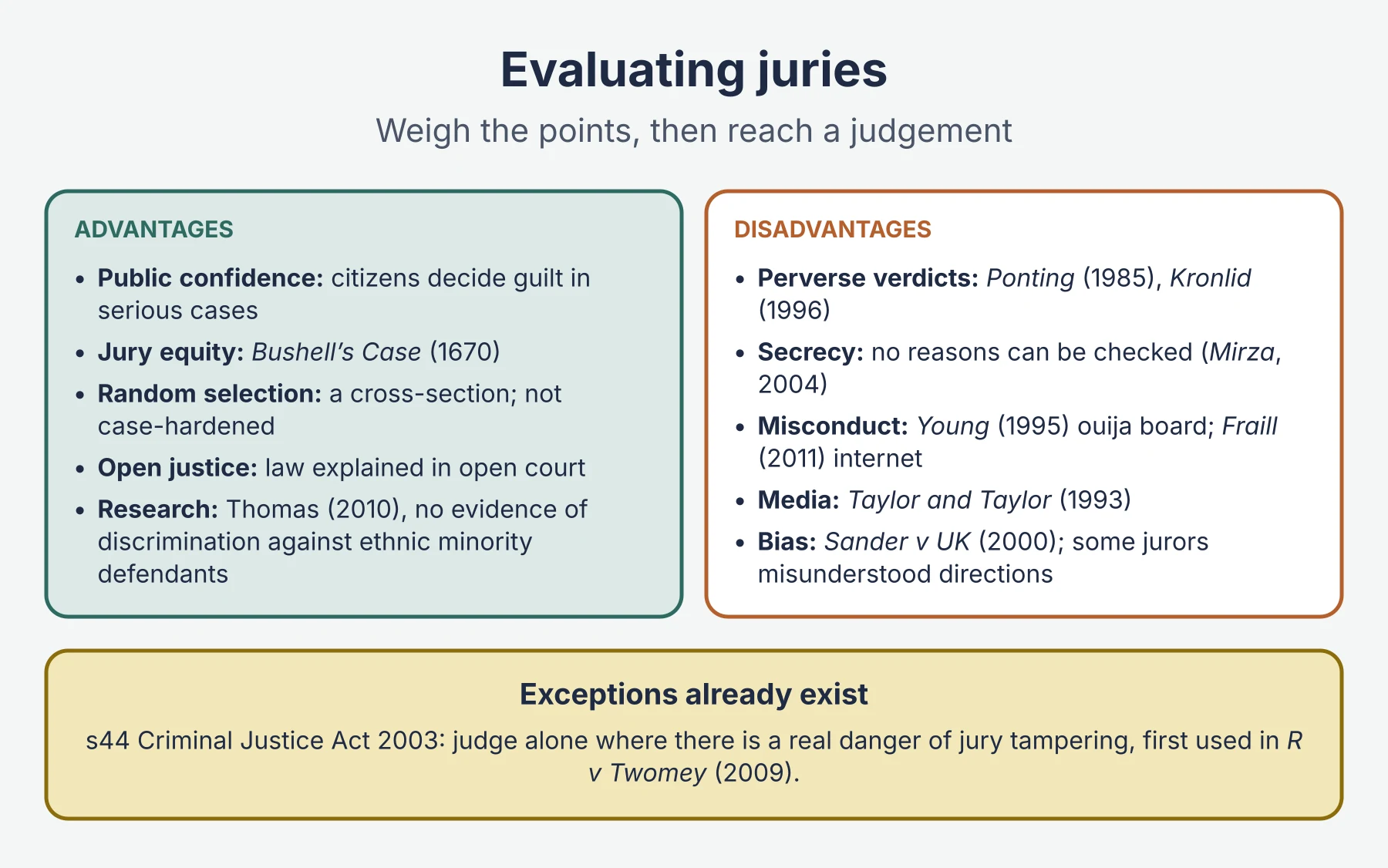
| Public confidence and participation: ordinary citizens decide guilt in serious cases | Perverse verdicts: R v Ponting (1985) and R v Kronlid (1996) acquittals despite the evidence |
| Jury equity: juries can refuse to apply a law they think unjust, protected since Bushell’s Case (1670) | Secrecy means verdicts cannot be checked or explained (R v Mirza, 2004) |
| Random selection gives a cross-section and avoids case-hardened decision-makers | Misconduct: a ouija board in R v Young (1995); internet contact with a defendant in Attorney General v Fraill (2011) |
| Open justice: the judge must explain the law to the jury in open court | Media influence: R v Taylor and Taylor (1993), conviction quashed after prejudicial press coverage |
| Research support: Professor Cheryl Thomas’s 2010 study “Are Juries Fair?” found no evidence that juries discriminated against ethnic minority defendants | Bias: racist remarks in the jury room in Sander v UK (2000) breached Article 6; the same study found some jurors misunderstood directions |
Parliament has already made exceptions: section 44 of the Criminal Justice Act 2003 allows trial by judge alone where there is a real danger of jury tampering, first used in R v Twomey (2009).
Worked example: an evaluation answer
Question: “Evaluate the use of juries in criminal cases.”
A strong answer does not list points; it weighs them.
Point:       Juries give public legitimacy to verdicts in serious cases.
Authority:   Bushell's Case (1670) protects the jury's right to acquit.
Develop:     Ponting (1985) shows jury equity working as a check on the state.
Counter:     The same freedom produces perverse acquittals; secrecy (Mirza)
             means no reasons are given and errors cannot be found.
Weigh:       Thomas (2010) suggests fears of bias are overstated, but cases
             such as Fraill show the internet as a newer risk.
Judgement:   Juries are justified for serious cases, but the s44 exception
             shows the system already accepts limits.
Common mistakes
- Saying magistrates are legally qualified: lay magistrates are not; district judges are.
- Saying juries decide sentence: the judge does.
- Saying a judge can direct a conviction (Wang says no).
- Treating an appeal from the magistrates’ court to the Crown Court as an appeal on law only: it is a rehearing.
- Listing jury advantages and disadvantages without cases, or without a conclusion.
Exam technique
“Explain” questions on this row want a defined term plus an illustration, for example the allocation procedure with a named either-way offence. “Evaluate” questions on juries want a balanced argument supported by cases or research and a reasoned judgement. Keep the four specification items separate: a question on the role of magistrates is not an invitation to evaluate juries.
More resources on this topic
Criminal courts and lay people revision notes | Criminal courts and lay people practice questions
Related resources
-
Practice questions
AQA A Level Law (7162): The Criminal Courts and Lay People – Practice Questions
Original practice questions with mark-scheme answers on offence classes, criminal appeals, sentencing, magistrates and juries for AQA A Level Law 7162.
Law · AQA · A Level
Try questions -
Revision notes
AQA A Level Law (7162): The Criminal Courts and Lay People – Revision Notes
Recall notes on offence classes, allocation, criminal appeals, sentencing purposes, magistrates, juries and jury evaluation for AQA A Level Law 7162.
Law · AQA · A Level
Revise topic -
Study guides
AQA A Level Law (7162): The Rule of Law
The rule of law for AQA A Level Law 7162: its three elements, Dicey, Raz and Bingham, and how it applies to law making, the legal system and substantive law.
Law · AQA · A Level
Read guide
Get free revision emails (optional)
Occasional emails with practice questions, worked explanations and links to free resources for the qualification and subjects you choose. No spam, and you can unsubscribe from any email. The free tools on this site never need an email.