
Revision Notes
AQA A Level Law (7162): Law Making: The European Union – Revision Notes
Revision notes on the EU institutions, treaties, regulations and directives, direct and indirect effect, and impact on English law, for AQA Law 7162.
- Subject
- Law
- Level
- A LEVELS
- Topic
- Section 3.1 – The Nature of Law and the English Legal System
- Author
- Marlbridge Academic Team
- Updated
- Reviewed by
- Aizaz Raoof Ali (what this means)
Aligned to AQA A Level Law (7162), For teaching from September 2017 onwards, A-level exams 2019 onwards. Official specification .
Syllabus page (what it covers and how it is assessed): AQA A Level Law.
Syllabus points this page covers
7162
- Law making: the European Union
Found an error? Report a correction.
Need help with this topic? Request a free trial class for A Level Law (7162).
Condensed notes on Law making: the European Union in AQA A-level Law (7162) section 3.1: the Council, Commission, Parliament and Court of Justice and their functions; treaties, regulations and directives; and the impact of EU law on England and Wales. For full explanation and an annotated answer, see the European Union study guide.
The four institutions
| Institution | Composition | Functions |
|---|---|---|
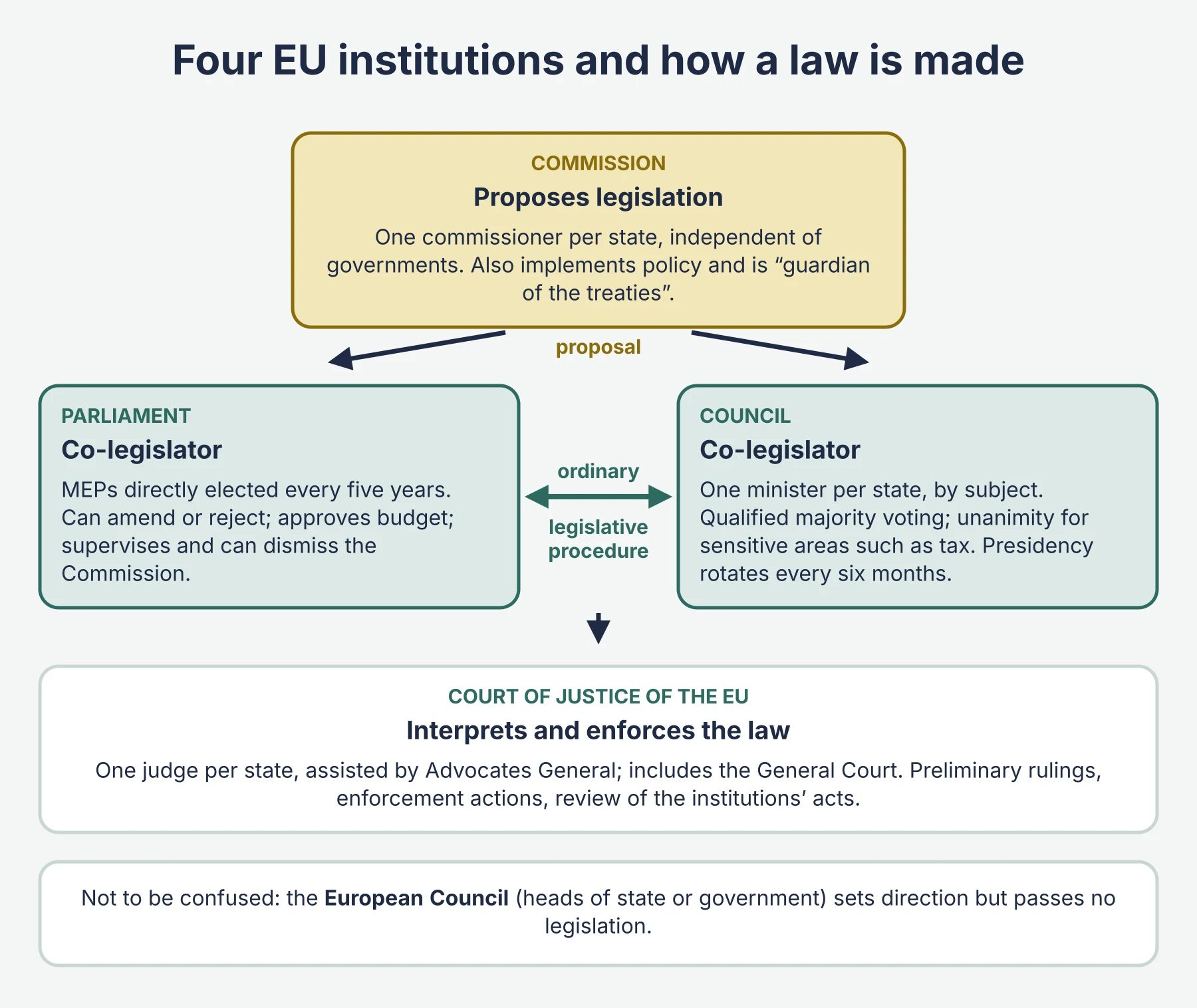
| Council (of the EU) | One minister per state, by subject; presidency rotates every six months | Adopts legislation with the Parliament; coordinates policy; international agreements; budget. Qualified majority voting in many areas, unanimity for sensitive ones |
| Commission | One commissioner per state, independent of national governments; led by a President | Proposes legislation (right of initiative); implements policy and budget; “guardian of the treaties” bringing enforcement actions (Article 258 TFEU), e.g. Commission v UK (Tachographs) (1979); negotiates trade deals |
| Parliament | MEPs directly elected every five years | Co-legislator under the ordinary legislative procedure (can amend or reject); budget; approves and can censure the Commission |
| Court of Justice (CJEU) | One judge per state; Advocates General; includes the General Court | Preliminary rulings (Article 267); enforcement actions; reviewing legality of EU acts |
Do not confuse: the Council of the EU (ministers, legislates) with the European Council (heads of government, sets direction) or the Council of Europe (not an EU body).
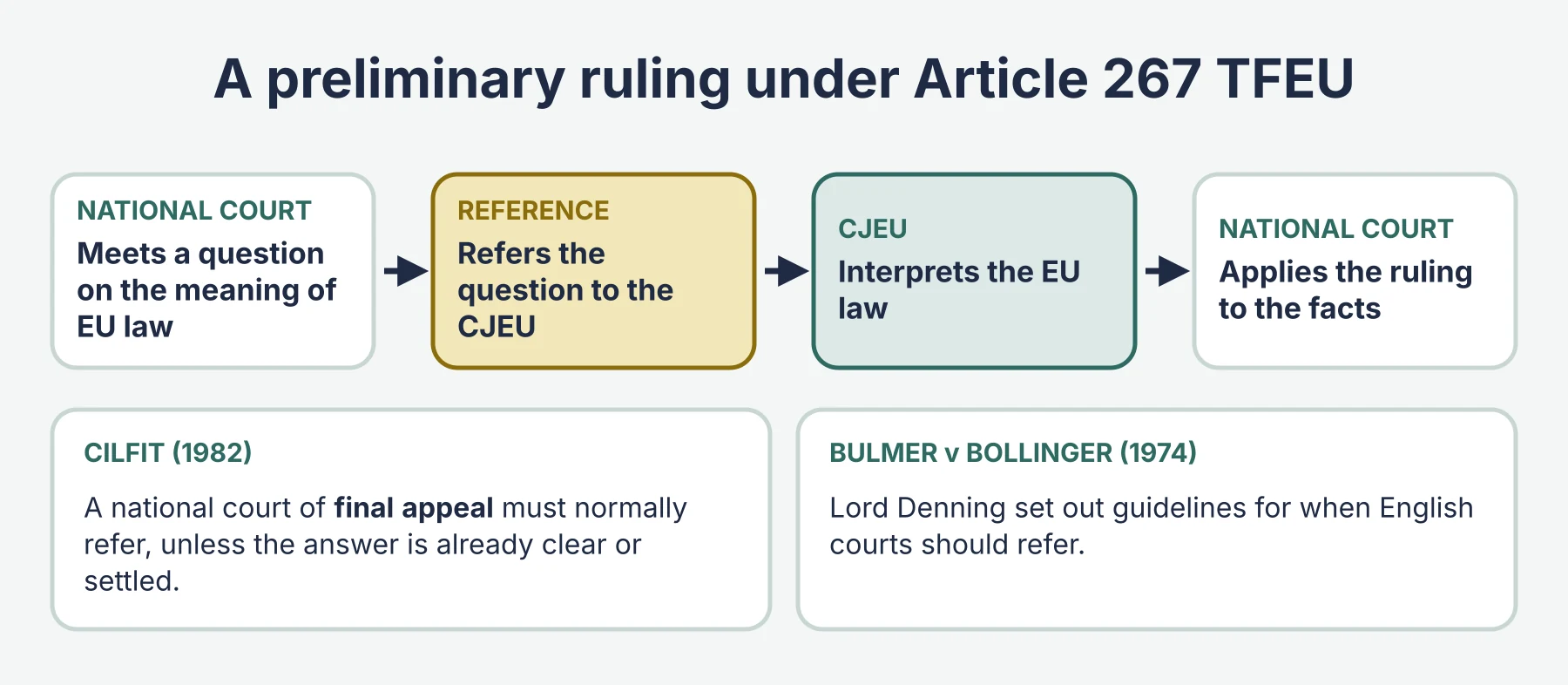
Preliminary references: national court asks, CJEU interprets, national court applies. Final courts must normally refer unless the answer is clear (CILFIT, 1982). English guidelines: Bulmer v Bollinger (1974), Lord Denning.
The sources
Treaties (primary law)
- Treaty of Rome (1957); Maastricht (1992) created the EU; Lisbon (2007) gave today’s TEU and TFEU.
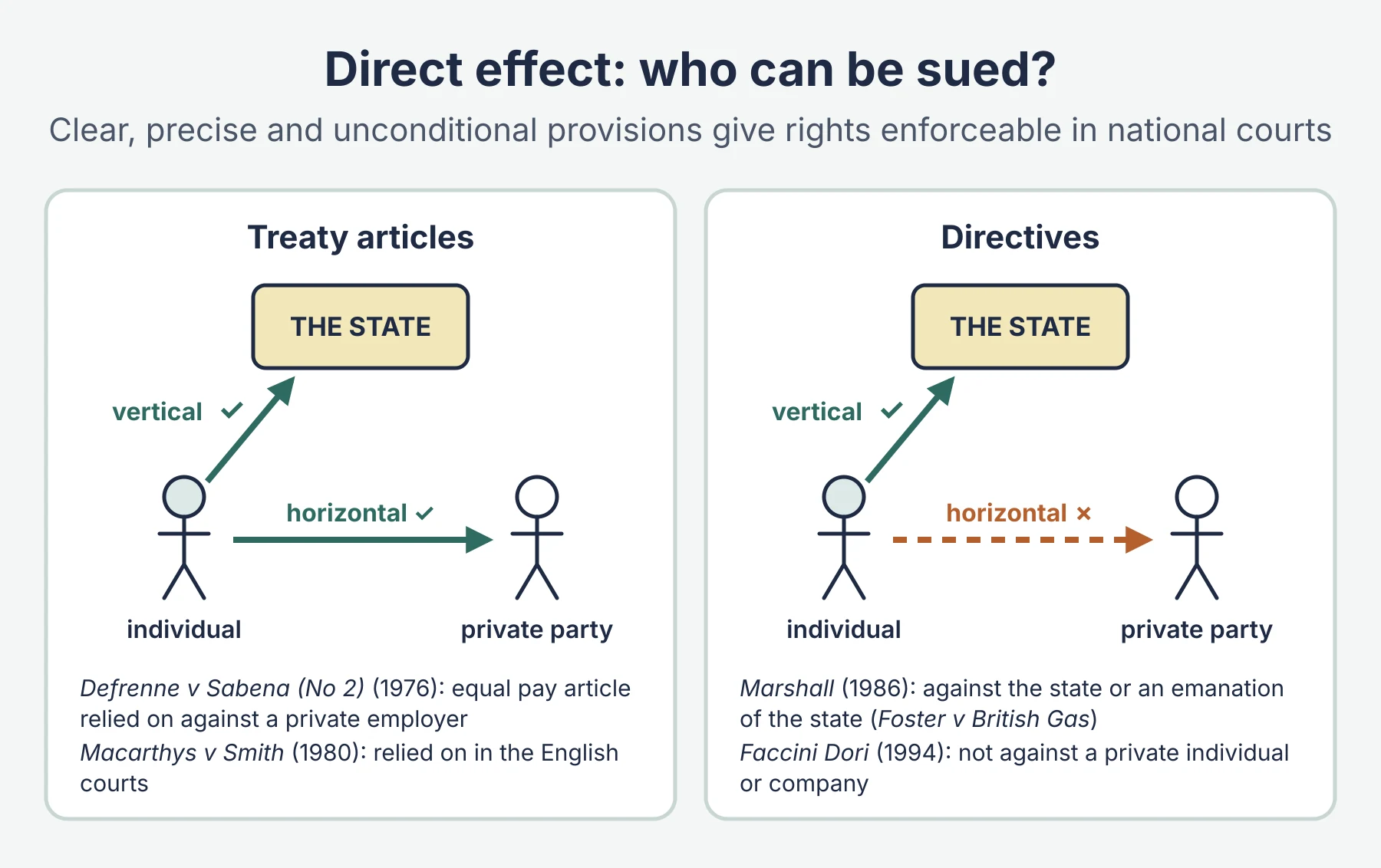
- Clear, precise, unconditional articles have direct effect, vertical and horizontal.
- Defrenne v Sabena (No 2) (1976): equal pay article enforceable against private employers.
- Macarthys v Smith (1980): applied in the English courts.
Regulations
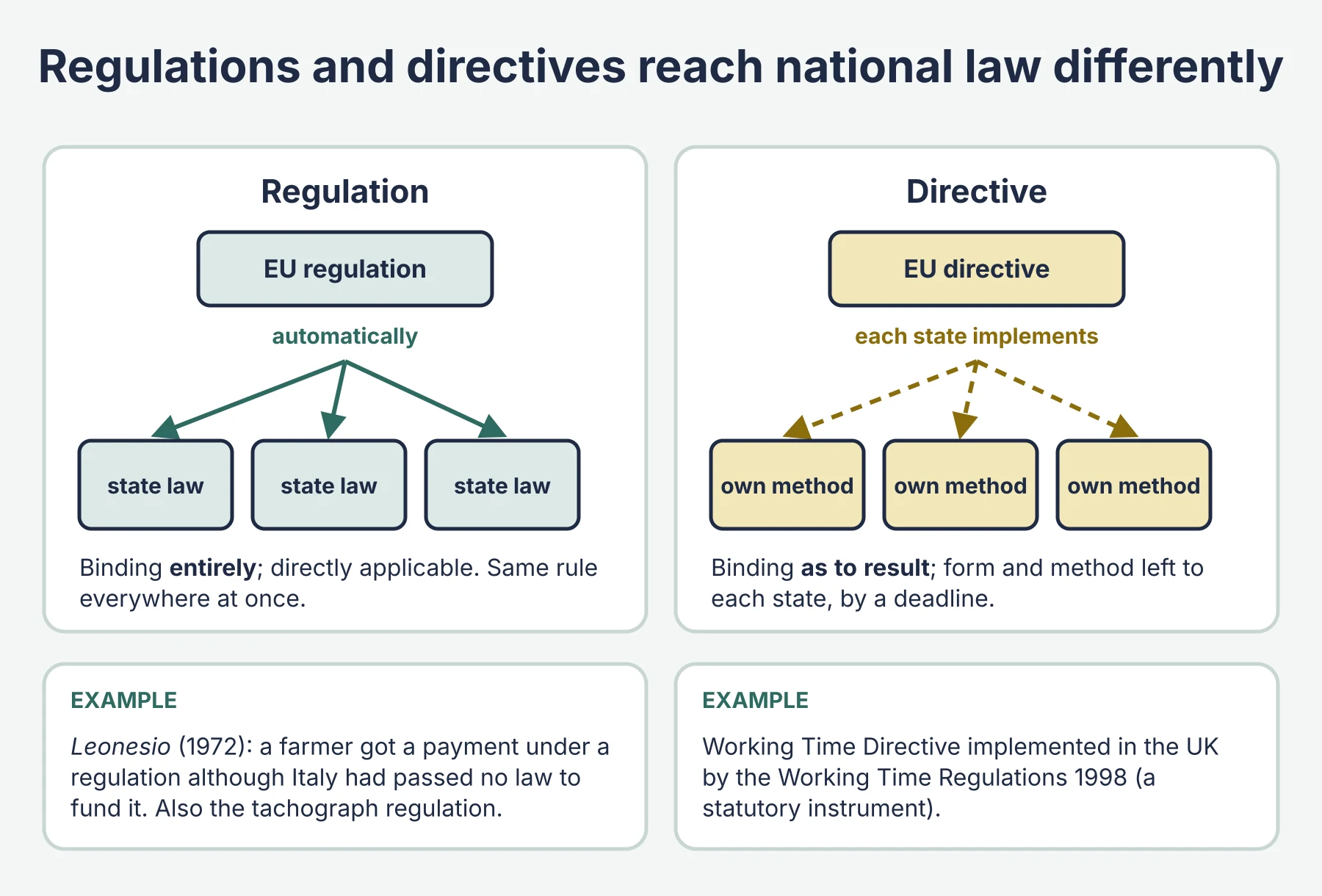
- Binding in their entirety; directly applicable; no national law needed.
- Leonesio (1972): farmer entitled to slaughter payment without Italian implementing law.
- Purpose: identical rules everywhere.
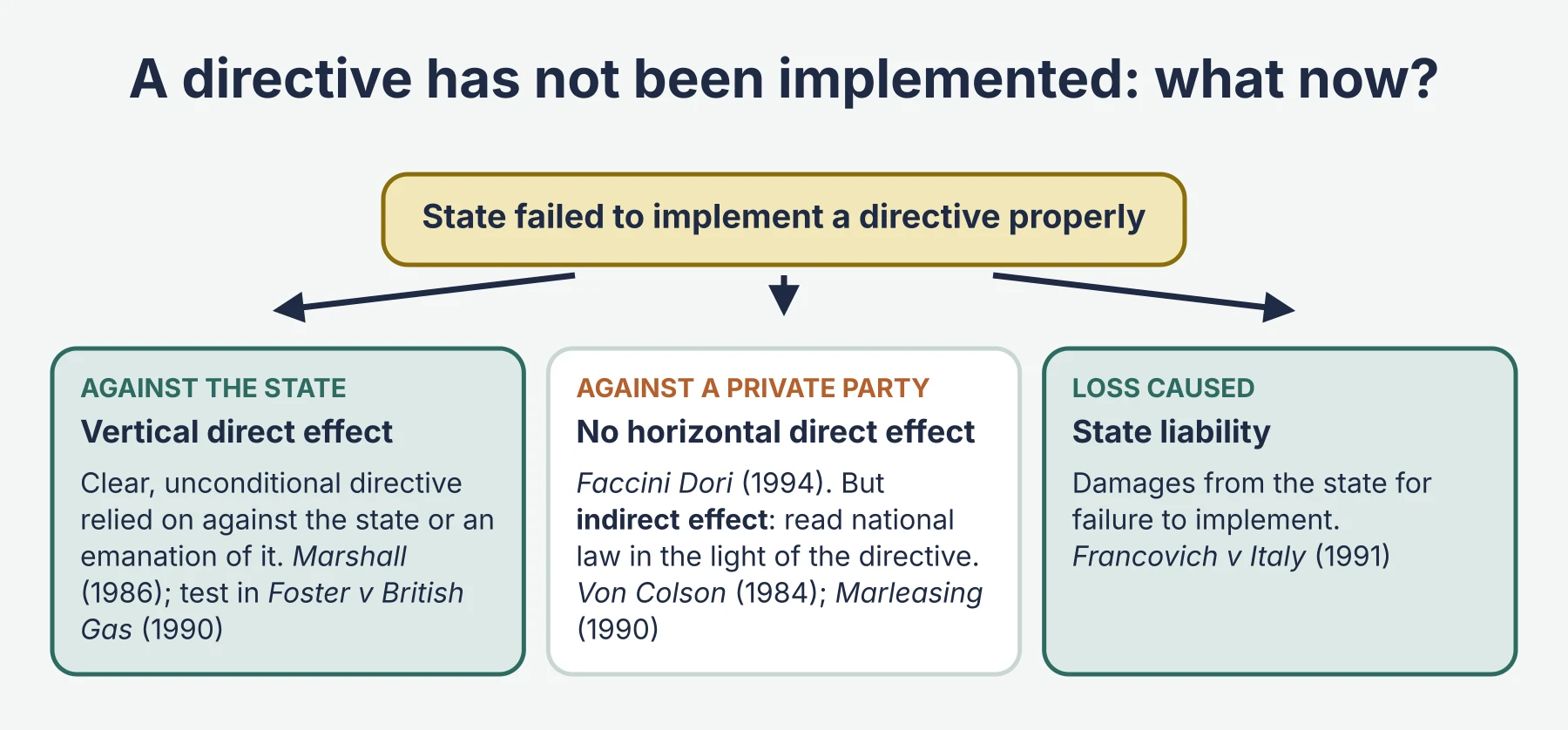
Directives
- Binding as to result; state chooses method by a deadline.
- UK implemented by statutory instrument, e.g. Working Time Regulations 1998.
| Doctrine | Rule | Case |
|---|---|---|
| Vertical direct effect | Enforceable against the state or an emanation of the state | Marshall (1986); Foster v British Gas (1990) test |
| No horizontal direct effect | Not enforceable against private parties | Faccini Dori (1994) |
| Indirect effect | National law read in the light of the directive | Von Colson (1984); Marleasing (1990) |
| State liability | Damages from the state for non-implementation | Francovich (1991) |
Impact on England and Wales
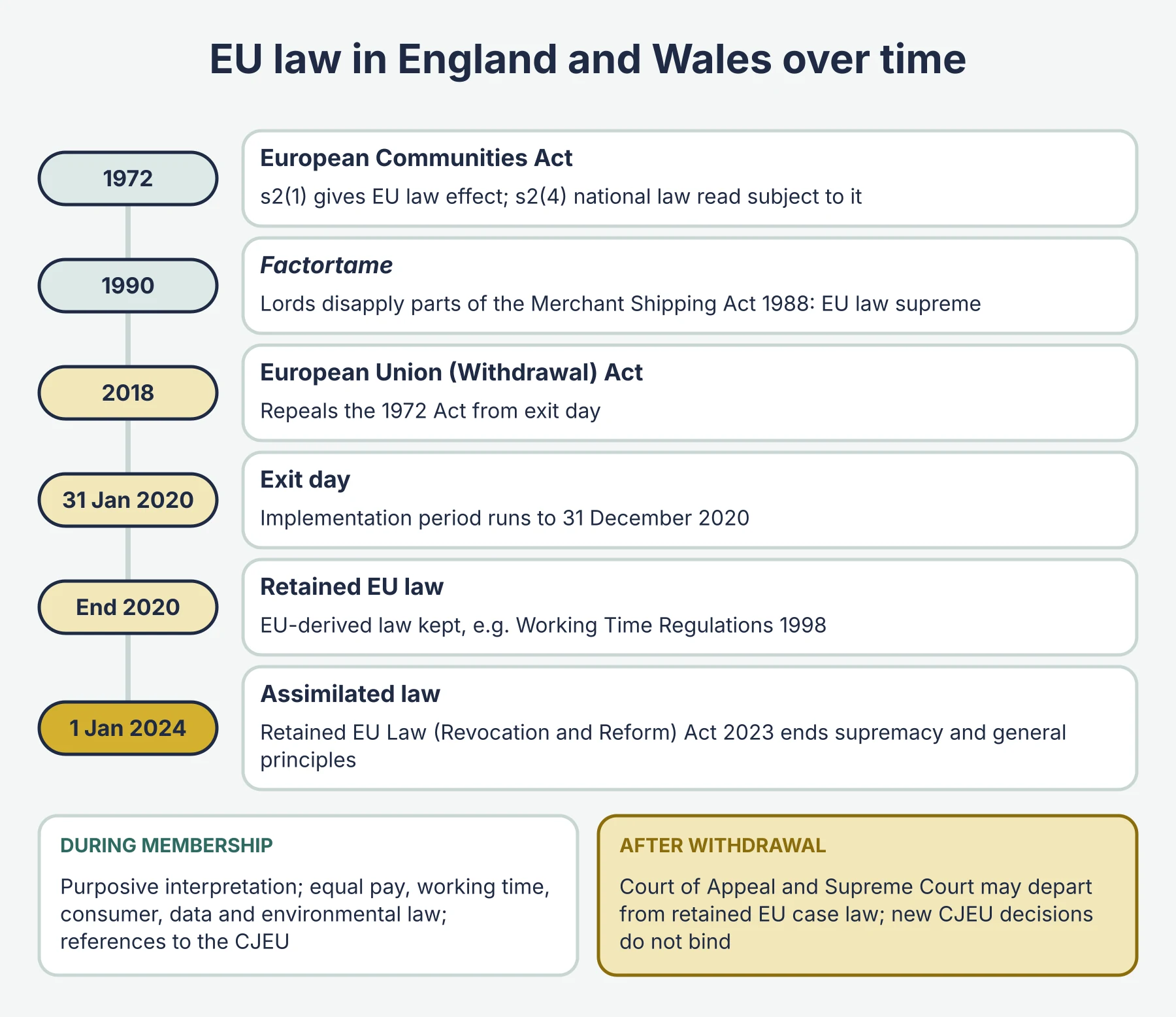
During membership
- European Communities Act 1972: section 2(1) gave EU law effect; section 2(4) subordinated national law to it.
- Supremacy: Factortame (1990) disapplied parts of the Merchant Shipping Act 1988.
- Interpretation: purposive approach.
- Substantive law: equal pay and discrimination; working time and holidays; consumer protection; product safety; data protection; environment.
- Courts: references to the CJEU; bound by its rulings.
After withdrawal
- European Union (Withdrawal) Act 2018: 1972 Act repealed on exit day, 31 January 2020; implementation period to 31 December 2020.
- EU-derived law kept as retained EU law.
- Retained EU Law (Revocation and Reform) Act 2023: renamed assimilated law from 1 January 2024; supremacy and general principles ended.
- Court of Appeal and Supreme Court can depart from retained EU case law; new CJEU rulings do not bind.
- Legacy: EU-origin rights continue; purposive interpretation remains.
Key terms
| Term | Meaning |
|---|---|
| Qualified majority voting | Council voting needing a set share of states and population |
| Right of initiative | The Commission’s power to propose legislation |
| Ordinary legislative procedure | Council and Parliament adopting law jointly as equals |
| Preliminary ruling | CJEU interpretation of EU law on a national court’s request |
| Directly applicable | Law without national implementing measures |
| Direct effect | Creates rights individuals can enforce in national courts |
| Emanation of the state | A body treated as the state for vertical direct effect |
| Indirect effect | Duty to interpret national law consistently with a directive |
| Assimilated law | Name for retained EU law from 2024 |
Exam traps
- Council of the EU confused with the European Council or Council of Europe.
- Parliament said to propose legislation.
- Directives said to be directly applicable.
- EU law described as still supreme in the UK.
- Impact described without examples.
Self-test
- Who sits in the Council of the EU?
- Which institution proposes most EU legislation?
- What is the Commission’s role as “guardian of the treaties”?
- How are MEPs chosen, and what power does the Parliament have over the Commission?
- What is the role of Advocates General?
- Explain the preliminary ruling procedure.
- Distinguish vertical from horizontal direct effect.
- What did Leonesio show about regulations?
- Why could Mrs Marshall rely on a directive against her employer?
- What did Francovich establish?
- How did Factortame affect parliamentary supremacy?
- What did the Retained EU Law (Revocation and Reform) Act 2023 change?
Answers: 1. One government minister from each member state, depending on the subject. 2. The Commission. 3. It monitors compliance and brings enforcement proceedings against member states that fail to meet their obligations. 4. Directly elected every five years; it approves the Commission’s appointment and can dismiss it by a vote of censure. 5. They give independent written opinions to the Court before judgment. 6. A national court refers a question on the meaning of EU law to the CJEU, which interprets it; the national court then applies the ruling to the facts. 7. Vertical: enforceable against the state; horizontal: enforceable against private individuals and companies. 8. They are directly applicable and create rights without national legislation. 9. Her employer, a health authority, was an emanation of the state, so the directive had vertical direct effect. 10. That an individual can claim damages from the state for loss caused by its failure to implement a directive. 11. Courts could disapply an Act of Parliament conflicting with EU law while the UK was a member. 12. It renamed retained EU law as assimilated law from 1 January 2024 and ended supremacy and general principles of EU law for it.
More resources on this topic
European Union study guide | European Union practice questions | Rule of Law, Law Reform, the EU and Civil Justice revision notes
Related resources
-
Study guides
AQA A Level Law (7162): Nature of Law
Legal rules versus other norms, civil versus criminal law, and custom, statute and common law as sources, for the AQA A Level Law 7162 nature of law content.
Law · AQA · A Level
Read guide -
Study guides
AQA A Level Law (7162): Nature of Law: Law and Justice
The meaning of justice, formal, substantive and procedural justice, theories of justice and how far the law achieves it, for AQA A Level Law 7162.
Law · AQA · A Level
Read guide -
Practice questions
AQA A Level Law (7162): Nature of Law: Law and Justice – Practice Questions
Original practice questions with mark-scheme answers on the meaning and theories of justice and how far civil and criminal law achieve it, for AQA Law 7162.
Law · AQA · A Level
Try questions
Get free revision emails (optional)
Occasional emails with practice questions, worked explanations and links to free resources for the qualification and subjects you choose. No spam, and you can unsubscribe from any email. The free tools on this site never need an email.