
Study Guides
AQA A Level Law (7162): Nature of Law
Legal rules versus other norms, civil versus criminal law, and custom, statute and common law as sources, for the AQA A Level Law 7162 nature of law content.
- Subject
- Law
- Level
- A LEVELS
- Topic
- Section 3.1 – The Nature of Law and the English Legal System
- Author
- Marlbridge Academic Team
- Updated
- Reviewed by
- Aizaz Raoof Ali (what this means)
Aligned to AQA A Level Law (7162), For teaching from September 2017 onwards, A-level exams 2019 onwards. Official specification .
Syllabus page (what it covers and how it is assessed): AQA A Level Law.
Syllabus points this page covers
7162
- Nature of law
Found an error? Report a correction.
Need help with this topic? Request a free trial class for A Level Law (7162).
This guide covers the opening content row of AQA A-level Law (7162) section 3.1, headed Nature of law. The specification asks for a “basic understanding” of two things: the distinction between enforceable legal rules and principles and other rules and norms of behaviour; and the differences between criminal and civil law and between sources of law, including custom, statute law and the common law. “Basic” does not mean easy marks: these ideas are the vocabulary for every essay in the course, and short questions often ask you to distinguish or explain with an example. For the whole of section 3.1, see the Nature of Law and the English Legal System study guide.
Legal rules and other rules and norms
Every society runs on rules. A school bans phones in lessons; a football league sends off a player for violent conduct; a religion forbids certain foods; etiquette expects you to queue. These are rules and norms of behaviour, and many are obeyed more faithfully than some laws. What makes a rule a legal rule?
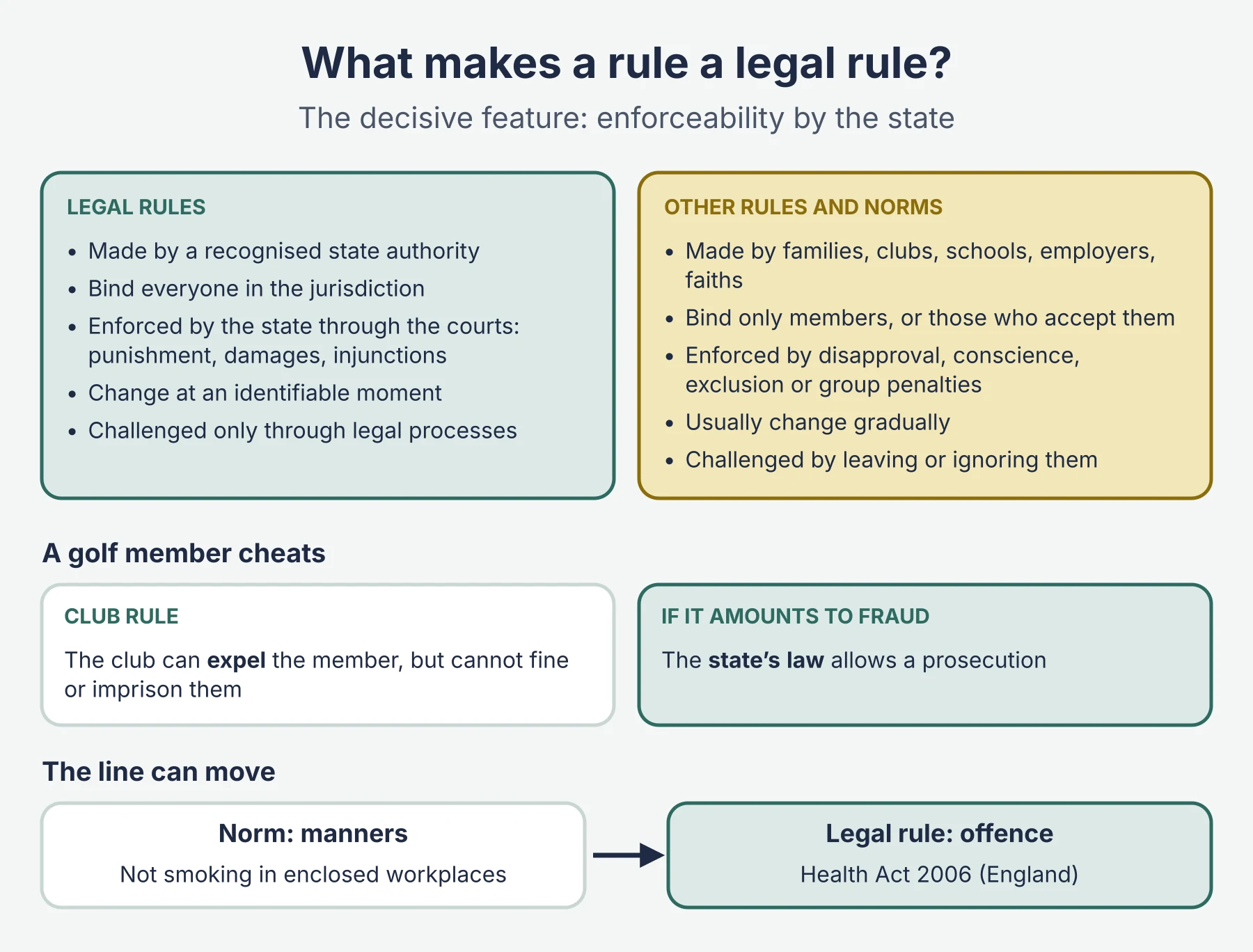
| Feature | Legal rules | Other rules and norms |
|---|---|---|
| Who makes them | A recognised state authority: Parliament, the courts, or a body Parliament has authorised | Families, clubs, schools, employers, faiths, social groups |
| Who is bound | Everyone within the jurisdiction (or a defined class, such as all employers) | Only members of the group, or those who choose to accept them |
| How they are enforced | By the state through the courts, with formal sanctions: punishment, damages, injunctions | By disapproval, conscience, exclusion or the group’s own penalties |
| How they change | At an identifiable moment, by a new Act or a new judgment | Usually gradually, with no single start date |
| Can they be challenged? | Only through legal processes (appeal, judicial review, repeal) | By leaving the group or ignoring the norm |
The decisive feature is enforceability by the state. A golf club can expel a member who cheats, but it cannot fine or imprison them; if the cheating amounts to fraud, it is the state’s law, not the club’s rule, that allows a prosecution. Some rules start as norms and become law: smoking in enclosed workplaces was a matter of manners until Parliament made it an offence in England under the Health Act 2006.
Rules and principles
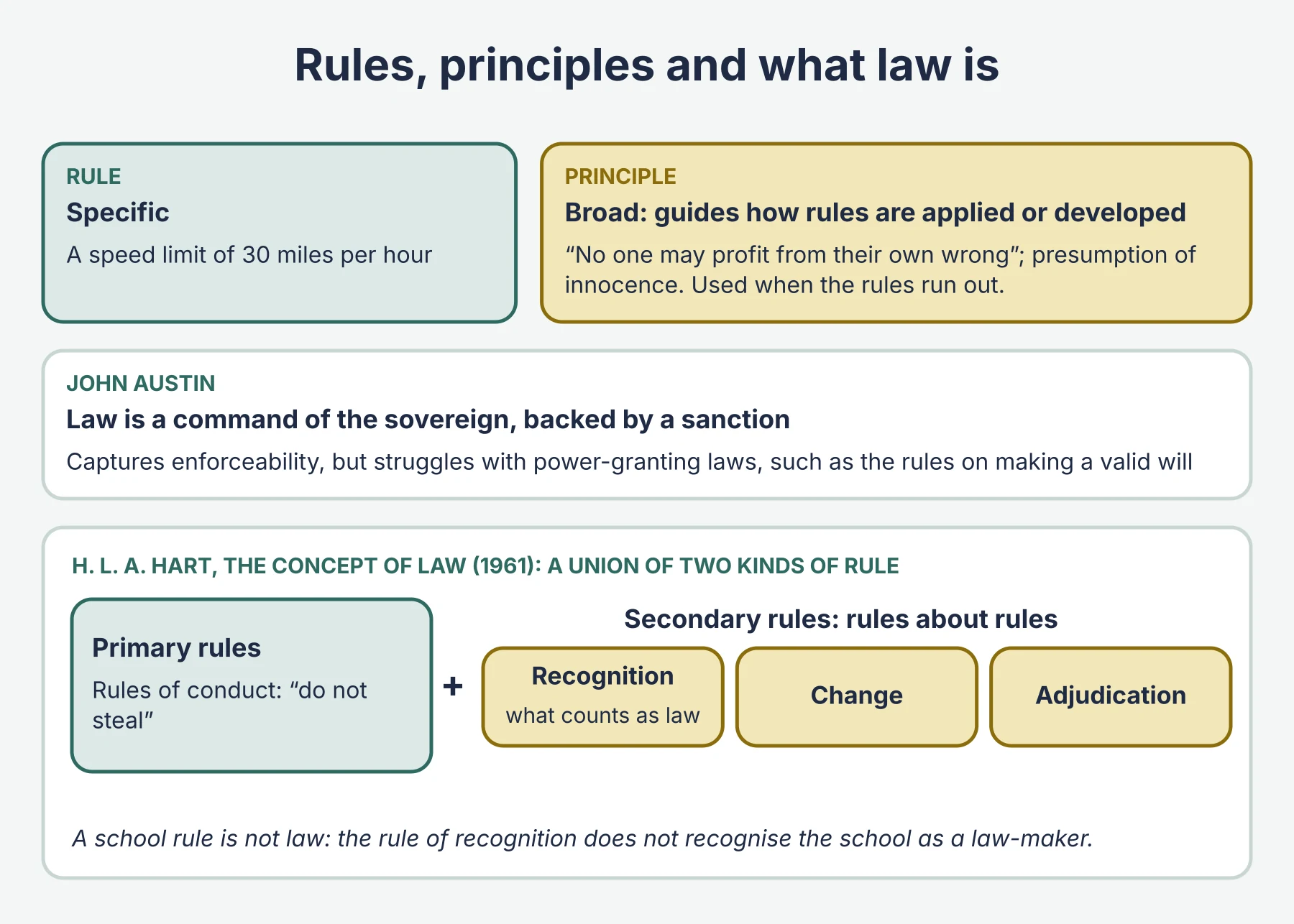
The specification says legal rules and principles. A rule is specific: a speed limit is 30 miles per hour. A principle is broader and guides how rules are applied or developed, such as “no one may profit from their own wrong” or the presumption that a person is innocent until proved guilty. Principles matter because judges use them when the rules run out, which links this content to judicial precedent and to law and morality.
Theories of what law is
You are not required to learn legal theorists for this row, but two ideas help you explain the distinction precisely.
- John Austin described law as a command of the sovereign, backed by a sanction. This captures enforceability but struggles with laws that grant powers rather than order behaviour, such as the rules on making a valid will.
- H. L. A. Hart, in The Concept of Law (1961), described a legal system as a union of primary rules (rules of conduct, such as “do not steal”) and secondary rules (rules about rules): a rule of recognition identifying what counts as law, rules of change, and rules of adjudication. On this view, a school rule is not law because the legal system’s rule of recognition does not recognise the school as a law-maker.
Criminal law and civil law
The comparison table in the main section 3.1 guide covers purpose, parties, standard of proof, courts and outcomes. Four further points earn credit.
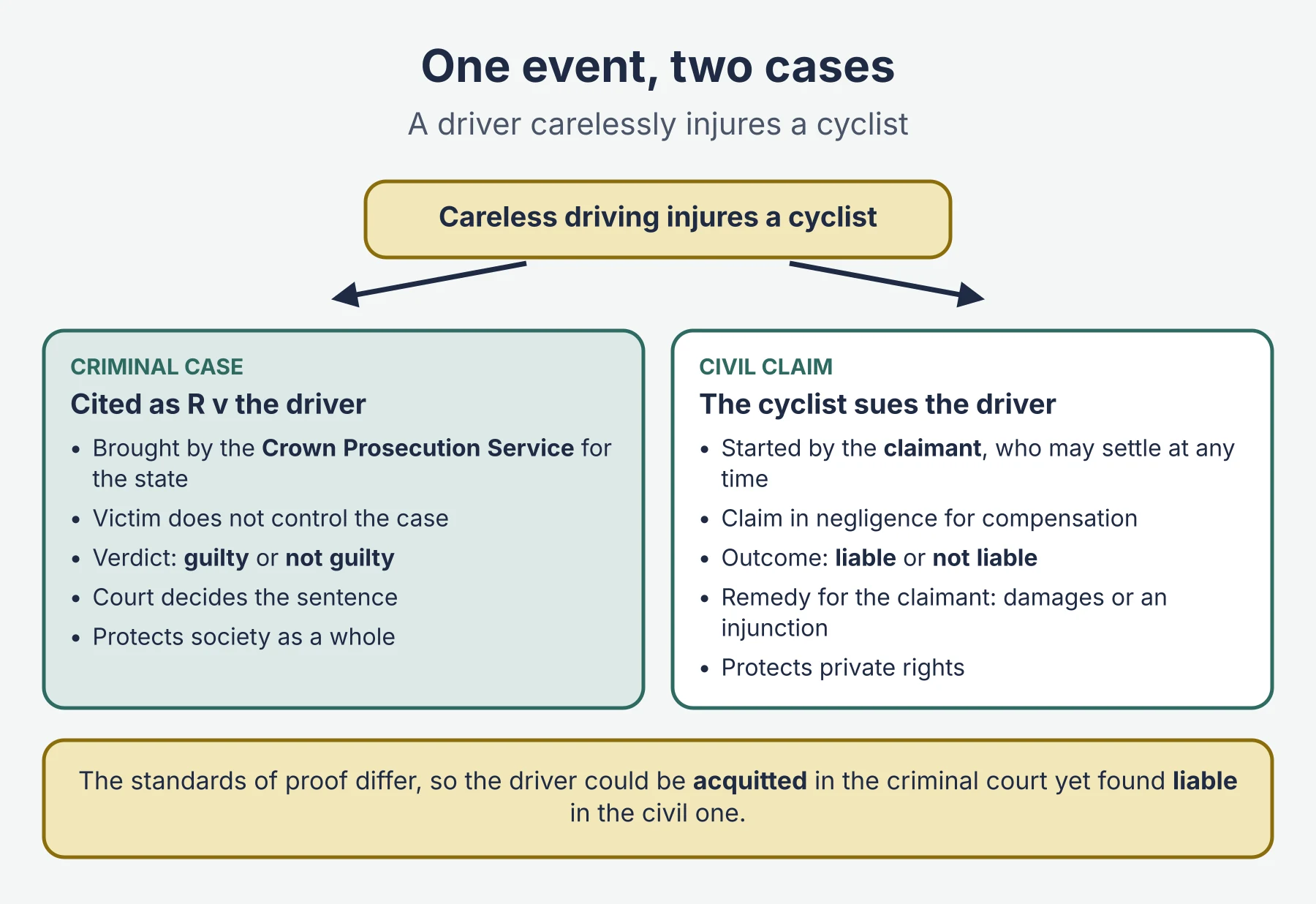
- Who starts the case. Most prosecutions are brought by the Crown Prosecution Service on behalf of the state, which is why cases are cited as R v Smith (R standing for the Crown). A civil claim is started by the person wronged, the claimant, who decides whether to sue and may settle at any time.
- Terminology. A defendant in a criminal case is found guilty or not guilty; in a civil case the defendant is liable or not liable. Using “guilty” for a civil case is a common slip examiners notice.
- One event, two cases. A single incident can lead to both. A driver who injures a cyclist through careless driving may be prosecuted for the driving offence and separately sued in negligence for compensation. Because the standards of proof differ, the driver could be acquitted in the criminal court yet found liable in the civil one.
- Purpose and outcome. Criminal law protects society as a whole, so the victim does not control the case and the sentence is decided by the court. Civil law protects private rights, so the remedy is aimed at the claimant: damages to restore their position, or an injunction to stop the wrong.
Sources of law: custom, statute and common law
Custom
A custom is a practice followed in a locality for so long that the courts recognise it as legally binding. Customs are the oldest source of English law; many were absorbed into the common law by royal judges after the Norman Conquest. Today a local custom is recognised only if it satisfies strict tests:
- it has existed since time immemorial, fixed by law at 1189;
- it has been exercised peaceably, openly and as of right, not by permission;
- it is reasonable and certain as to the locality and the people who benefit;
- it is consistent with statute.
In Mercer v Denne (1905) local fishermen established a customary right to dry their nets on private land by the beach. By contrast, in Simpson v Wells (1872) a claimed custom to set up a stall at a fair failed because the fair could be traced back only to “statute sessions” introduced in the fourteenth century, so the practice did not date from time immemorial. In Wolstanton Ltd v Newcastle-under-Lyme Corporation (1940) a claimed custom allowing the lord of the manor to take minerals from under tenants’ land without paying compensation was held unreasonable. Successful claims are now rare.
Statute law
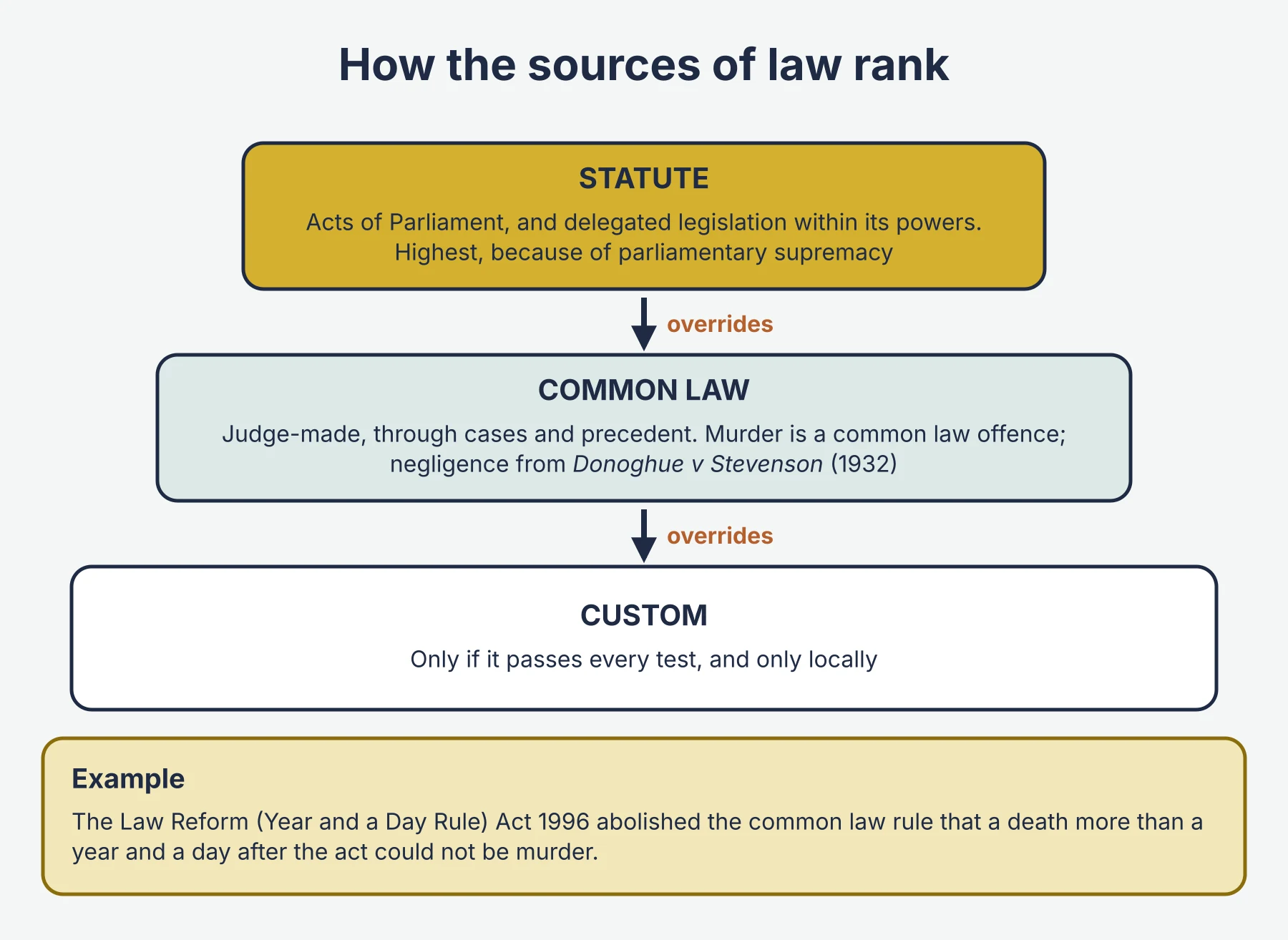
Statute law means Acts of Parliament, together with delegated legislation made under their authority. Statute is the highest source of domestic law because of parliamentary supremacy: an Act can abolish a custom or overturn a common law rule. For example, the Law Reform (Year and a Day Rule) Act 1996 abolished the old common law rule that a death more than a year and a day after the defendant’s act could not be murder.
The common law
The common law is law developed by judges through decided cases and the doctrine of precedent. Murder remains a common law offence, defined by judges rather than by any Act. Much of the law of negligence also comes from cases, beginning with the neighbour principle in Donoghue v Stevenson (1932). Common law fills gaps that statute does not cover, but it gives way to statute where the two conflict.
How the sources rank
Statute (and delegated legislation within its powers)
   overrides
Common law (judicial precedent)
   overrides
Custom (only if it passes every test, and only locally)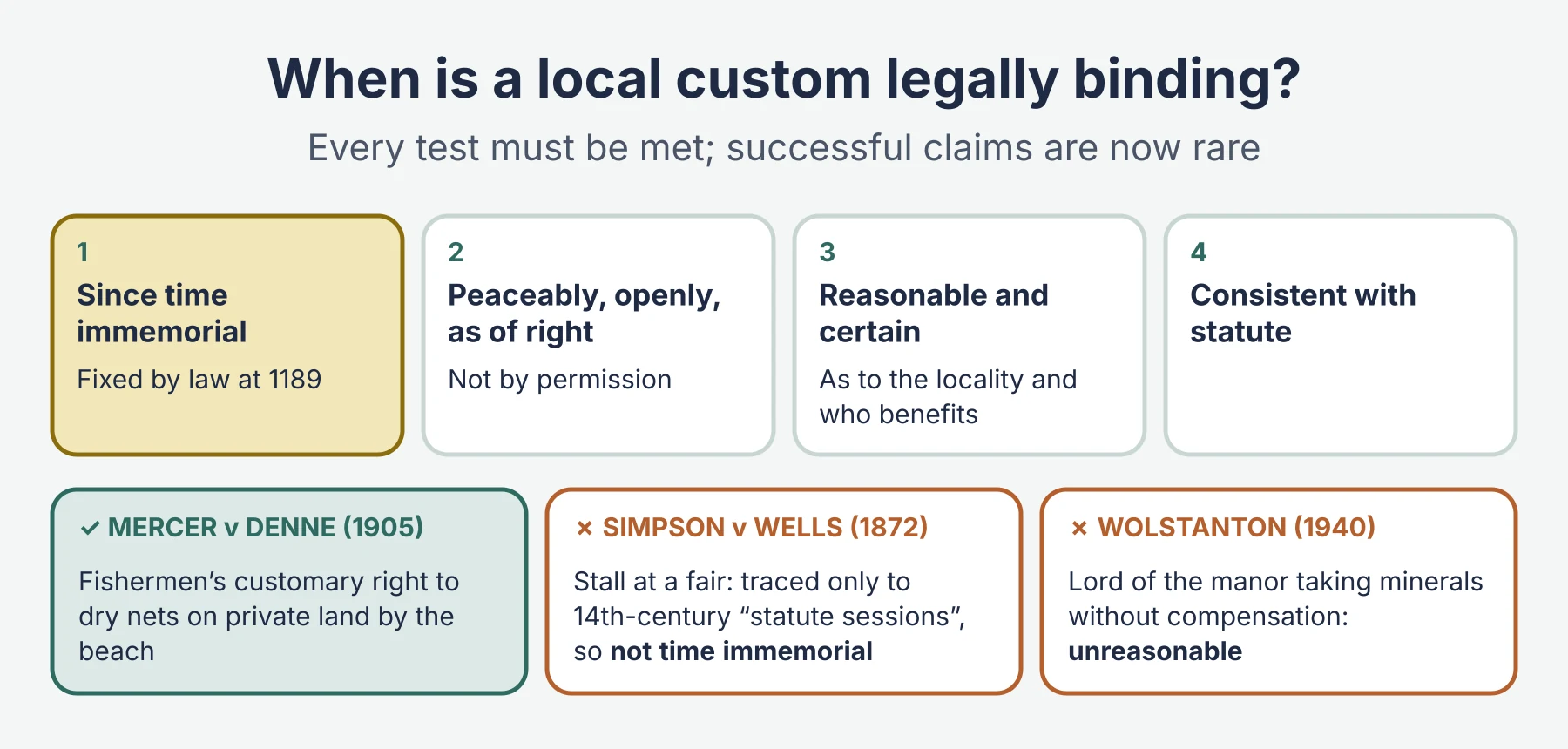
Worked example: a short-answer question
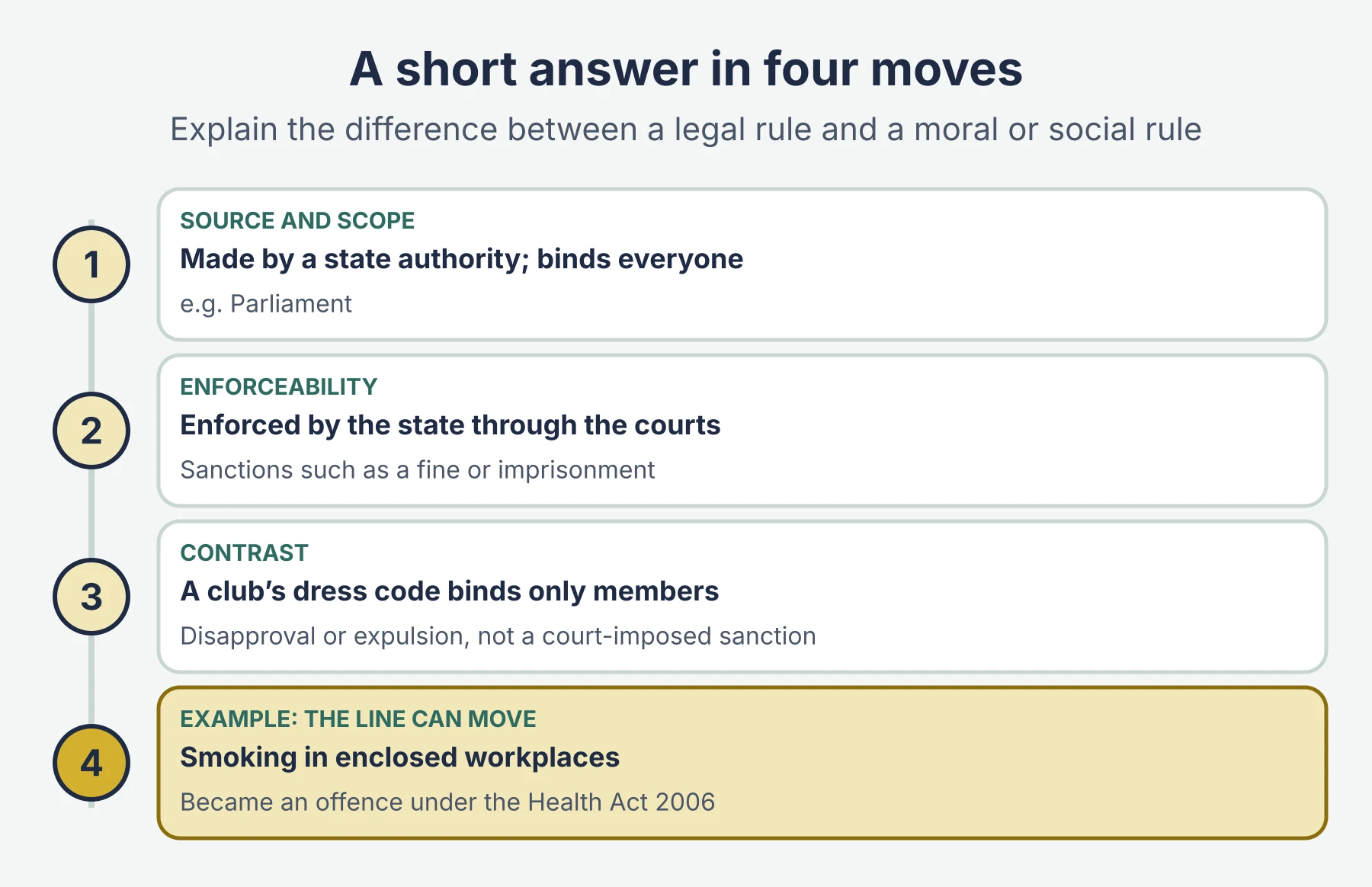
Question: Explain the difference between a legal rule and a moral or social rule, using an example.
Model answer (annotated): A legal rule is made by a recognised state authority, such as Parliament, and is binding on everyone within the jurisdiction [source and scope]. It is enforced by the state through the courts, which can impose sanctions such as a fine or imprisonment [enforceability]. A social rule, such as a club’s dress code, is made by a group and binds only its members; breaking it may lead to disapproval or expulsion, but not to a court-imposed sanction [contrast]. Some social rules become legal rules when Parliament decides they need state enforcement, as when smoking in enclosed workplaces became an offence under the Health Act 2006 [example showing the line can move].
The answer earns its marks by naming a feature, explaining it, and contrasting it, then grounding the point in a real example.
Common mistakes
- Saying a rule is legal because it is important or widely obeyed. Enforcement by the state is the test, not importance.
- Calling a civil defendant “guilty”, or saying the claimant “prosecutes”.
- Treating custom as a major modern source; it survives only in narrow local cases.
- Forgetting the 1189 date or the reasonableness test when explaining custom.
- Stating that common law can override statute.
Exam technique
AQA’s section 3.1 questions use command words such as explain, outline, briefly explain and suggest. For explain, give the point, develop it with reasons, and support it with an example or case. For a distinction question, write in pairs: one feature of legal rules set directly against the matching feature of other rules. In a longer answer on another part of section 3.1, use this vocabulary precisely: an essay on law and morality is stronger if you can say exactly why a moral rule is not a legal one.
Test your recall with the Nature of Law revision notes, then apply it with the Nature of Law practice questions. The wider relationship between law and society is in the Law and Society study guide.
Frequently asked questions
What is the main difference between a legal rule and other rules? A legal rule is made by a recognised state authority, binds everyone in the jurisdiction and is enforced by the state through the courts. Other rules bind only a group and are enforced by social pressure or the group’s own penalties.
What are the tests for a valid local custom? It must have existed since time immemorial (1189), been exercised peaceably, openly and as of right, be reasonable and certain, and be consistent with statute.
Can the same incident lead to criminal and civil cases? Yes. A careless driver can be prosecuted for the driving offence and also sued in negligence by the injured person, and the outcomes can differ because the standards of proof differ.
Related resources
-
Study guides
AQA A Level Law (7162): Nature of Law: Law and Justice
The meaning of justice, formal, substantive and procedural justice, theories of justice and how far the law achieves it, for AQA A Level Law 7162.
Law · AQA · A Level
Read guide -
Practice questions
AQA A Level Law (7162): Nature of Law: Law and Justice – Practice Questions
Original practice questions with mark-scheme answers on the meaning and theories of justice and how far civil and criminal law achieve it, for AQA Law 7162.
Law · AQA · A Level
Try questions -
Revision notes
AQA A Level Law (7162): Nature of Law: Law and Justice – Revision Notes
Revision notes on types and theories of justice, natural justice and how far civil and criminal law achieve justice, with a self-test for AQA Law 7162.
Law · AQA · A Level
Revise topic
Get free revision emails (optional)
Occasional emails with practice questions, worked explanations and links to free resources for the qualification and subjects you choose. No spam, and you can unsubscribe from any email. The free tools on this site never need an email.