
Study Guides
AQA A Level Law (7162): Nature of Law: Law and Justice
The meaning of justice, formal, substantive and procedural justice, theories of justice and how far the law achieves it, for AQA A Level Law 7162.
- Subject
- Law
- Level
- A LEVELS
- Topic
- Section 3.1 – The Nature of Law and the English Legal System
- Author
- Marlbridge Academic Team
- Updated
- Reviewed by
- Aizaz Raoof Ali (what this means)
Aligned to AQA A Level Law (7162), For teaching from September 2017 onwards, A-level exams 2019 onwards. Official specification .
Syllabus page (what it covers and how it is assessed): AQA A Level Law.
Syllabus points this page covers
7162
- Nature of law: law and justice
Found an error? Report a correction.
Need help with this topic? Request a free trial class for A Level Law (7162).
This guide covers the Nature of law: law and justice row of AQA A-level Law (7162) section 3.1. The specification lists two things: the meaning of justice and theories of justice, and the extent to which the law (civil and/or criminal) achieves justice. The second is an evaluation, so this content is usually examined through an extended answer. The Rule of Law, Parliament, Morality and Justice study guide introduces Aristotle, utilitarianism, Rawls and Nozick; this page adds the different types of justice, more theory, and a wider bank of evidence for the “extent” argument.
The meaning of justice
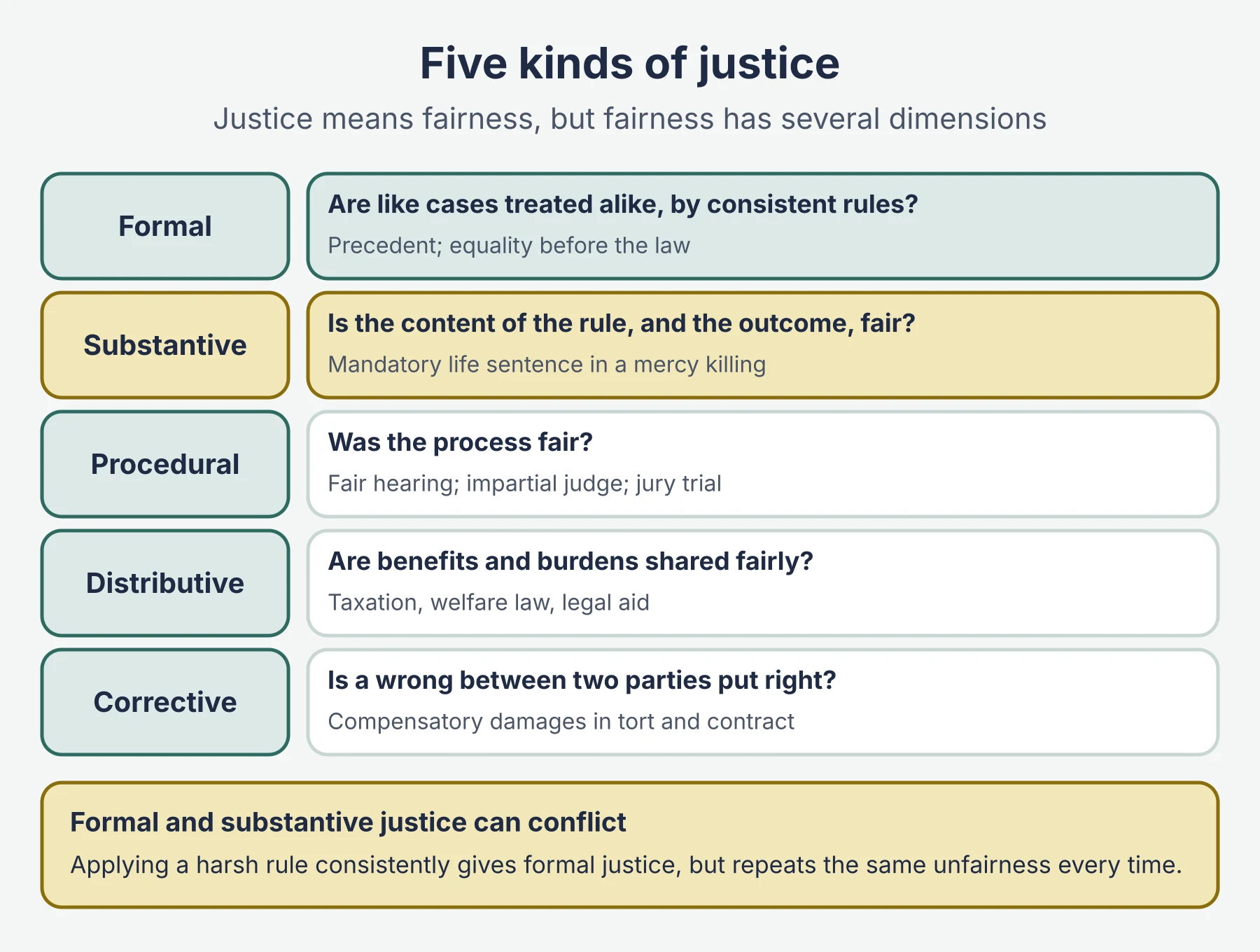
Justice is usually described as fairness, but fairness has several dimensions. Separating them is the quickest way to write a precise answer.
| Type | Question it asks | Legal example |
|---|---|---|
| Formal justice | Are like cases treated alike, by consistent rules? | The doctrine of precedent; equality before the law |
| Substantive justice | Is the content of the rule, and the outcome, fair? | Whether the mandatory life sentence for murder is fair in a mercy killing |
| Procedural justice | Was the process fair? | The right to a fair hearing; an impartial judge; jury trial |
| Distributive justice | Are benefits and burdens shared fairly? | Taxation, welfare law, legal aid |
| Corrective justice | Is a wrong between two parties put right? | Compensatory damages in tort and contract |
Formal and substantive justice can conflict. Applying a rule consistently delivers formal justice, but if the rule itself is harsh, consistency produces the same unfairness every time.
Procedural justice: the rules of natural justice
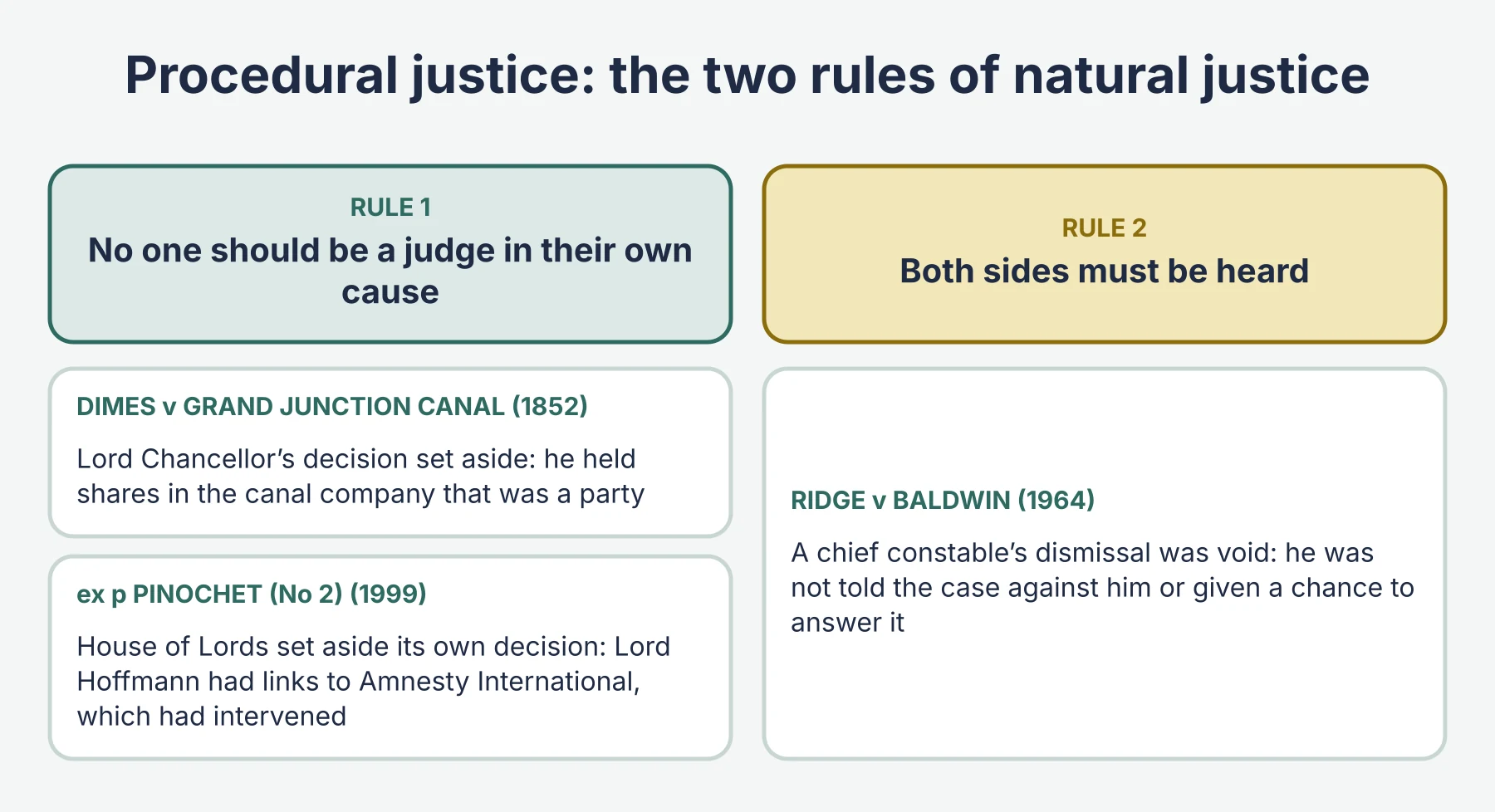
English law protects procedural fairness through two rules of natural justice:
- No one should be a judge in their own cause. In Dimes v Grand Junction Canal (1852) a decision of the Lord Chancellor was set aside because he held shares in the canal company that was a party. In R v Bow Street Magistrate, ex p Pinochet (No 2) (1999) the House of Lords set aside its own earlier decision because Lord Hoffmann had links to Amnesty International, which had intervened in the case.
- Both sides must be heard. In Ridge v Baldwin (1964) a chief constable’s dismissal was void because he had not been told the case against him or given a chance to answer it.
Theories of justice
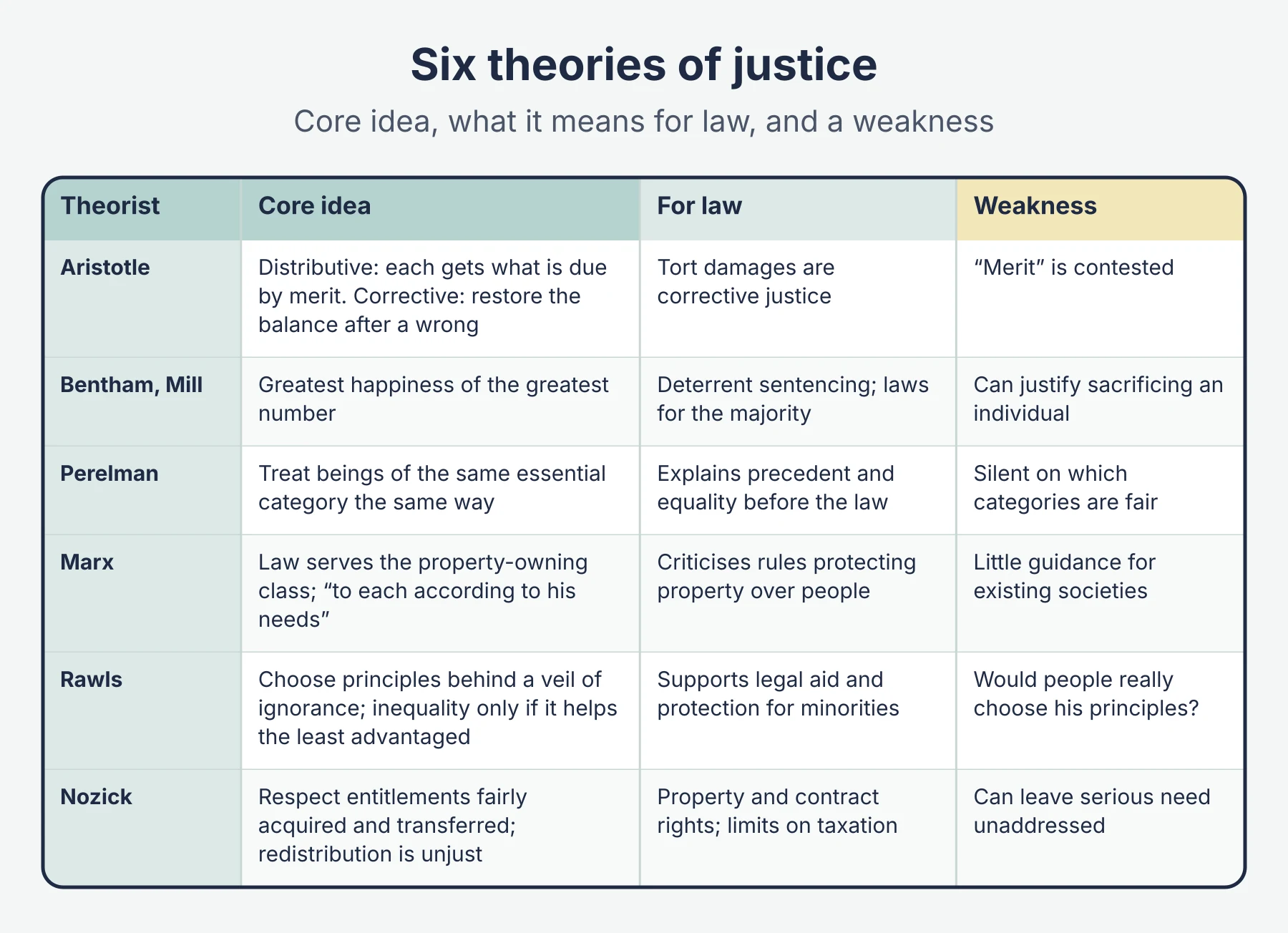
Learn each theory as core idea + what it implies for law + a weakness.
- Aristotle: distributive justice gives each person what is due in proportion to merit; corrective justice restores the balance after a wrong. For law: tort damages are corrective justice. Weakness: “merit” is contested.
- Utilitarianism (Bentham, Mill): the just act or rule produces the greatest happiness of the greatest number. For law: supports deterrent sentencing and laws that benefit the majority. Weakness: it can justify sacrificing an individual, such as punishing an innocent person if it reassured the public.
- Chaim Perelman: formal justice means treating beings of the same essential category in the same way. For law: explains precedent and equality before the law. Weakness: it says nothing about which categories are fair.
- Karl Marx: in a capitalist society law serves the interests of the property-owning class; a just society would distribute “from each according to his ability, to each according to his needs”. For law: invites criticism of rules that protect property over people. Weakness: offers little guidance for law in existing societies.
- John Rawls: principles of justice are those people would choose behind a veil of ignorance, not knowing their position in society; inequalities are acceptable only if they benefit the least advantaged. For law: supports legal aid and protection for minorities. Weakness: critics question whether people behind the veil would really choose his principles.
- Robert Nozick: justice lies in respecting entitlements: property acquired and transferred fairly belongs to its owner, so redistribution is unjust. For law: supports property and contract rights and limits on state taxation. Weakness: it can leave serious need unaddressed.
The extent to which the law achieves justice
A good answer weighs evidence on both sides, in civil and/or criminal law, and reaches a judgement. Choose evidence from the lists below.
Criminal law: where justice is achieved
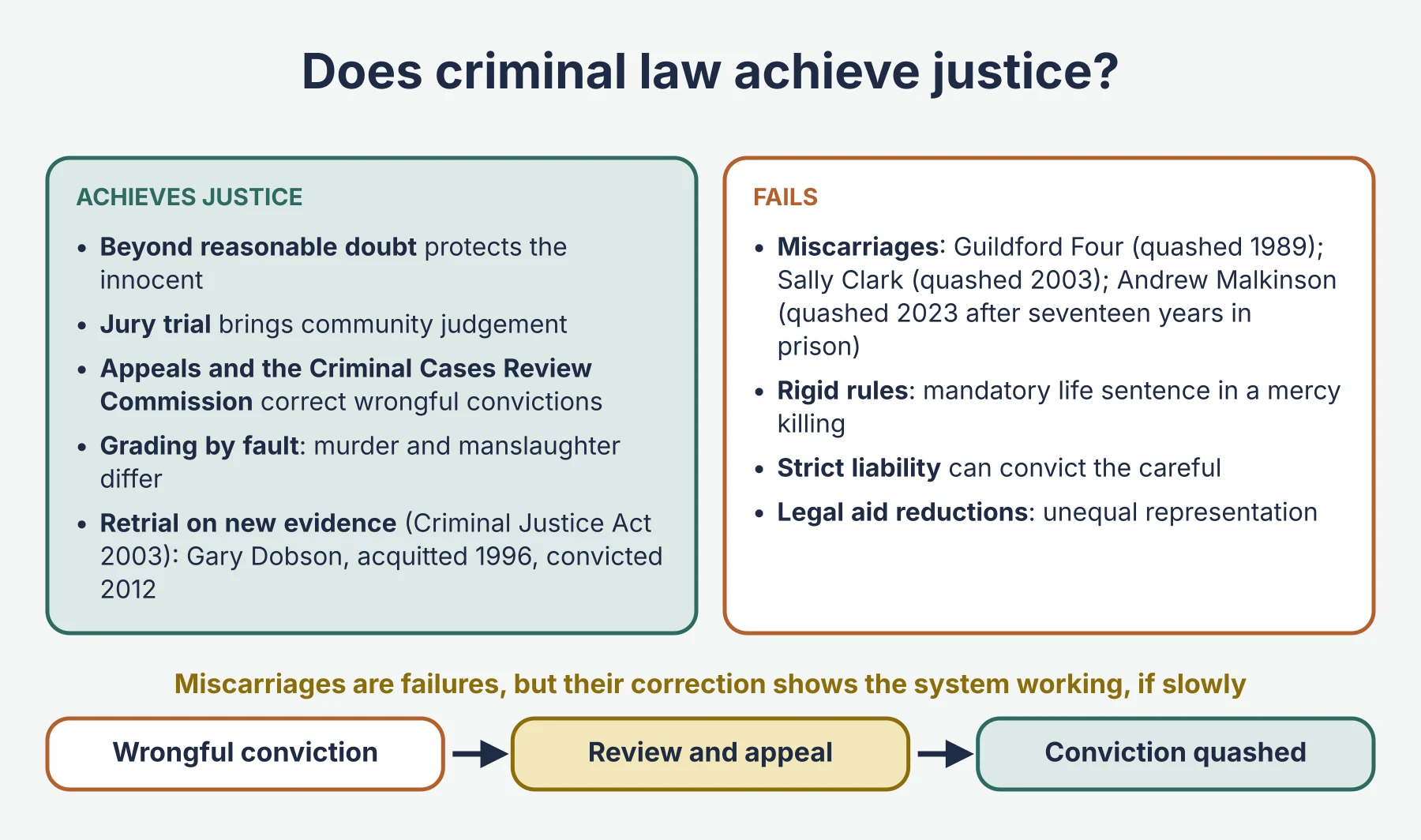
- Burden and standard of proof: the prosecution must prove guilt beyond reasonable doubt, protecting the innocent.
- Jury trial for serious offences brings community judgement; juries can acquit where conviction would feel unjust.
- Appeals and correction: the Court of Appeal (Criminal Division) and the Criminal Cases Review Commission can correct wrongful convictions.
- Grading of offences and sentences by fault reflects distributive justice: murder and manslaughter carry different consequences.
- New evidence after acquittal: under the Criminal Justice Act 2003 a person acquitted of a serious offence can be retried where there is new and compelling evidence. Gary Dobson, acquitted in 1996 of murdering Stephen Lawrence in a private prosecution, was convicted in 2012 after his acquittal was quashed.
Criminal law: where justice fails
- Miscarriages of justice: the Guildford Four’s convictions were quashed in 1989. Sally Clark’s convictions for murdering her two sons were quashed in 2003, after flawed statistical evidence and undisclosed medical evidence came to light. Andrew Malkinson’s rape conviction was quashed in 2023 after he had spent seventeen years in prison, following new DNA evidence.
- Rigid rules: the mandatory life sentence gives the judge no choice of sentence type in a mercy killing.
- Strict liability can convict people who took all reasonable care.
- Inequality of resources: reductions in legal aid mean some defendants are less well represented than the prosecution.
Civil law: where justice is achieved
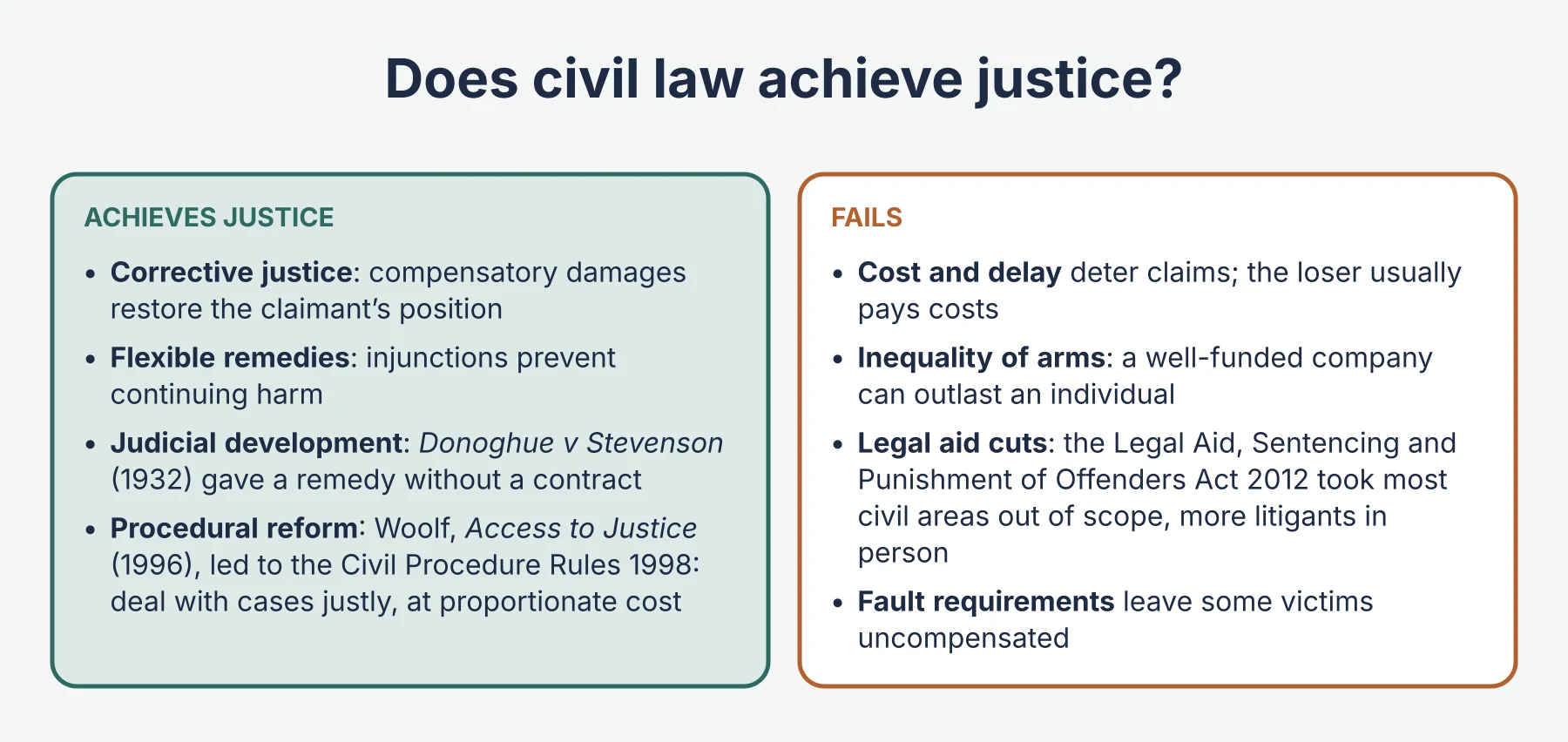
- Corrective justice through compensatory damages aims to put the claimant in the position they would have been in.
- Flexible remedies: injunctions can prevent continuing harm, and courts can tailor them to balance interests.
- Development by judges: Donoghue v Stevenson (1932) gave a remedy to a consumer who had no contract with the manufacturer, closing a gap that left victims without redress.
- Procedural reform: Lord Woolf’s report Access to Justice (1996) led to the Civil Procedure Rules 1998, with an overriding objective of dealing with cases justly and at proportionate cost.
Civil law: where justice fails
- Cost and delay deter claims, and the losing party usually pays costs, so risk falls heavily on individuals.
- Inequality of arms: a well-funded company can outlast an individual claimant.
- Legal aid cuts under the Legal Aid, Sentencing and Punishment of Offenders Act 2012 removed most civil areas from scope, increasing litigants in person.
- Fault requirements leave some victims uncompensated where no one was negligent.
Worked example: a conclusion paragraph
Question: Discuss the extent to which criminal law achieves justice.
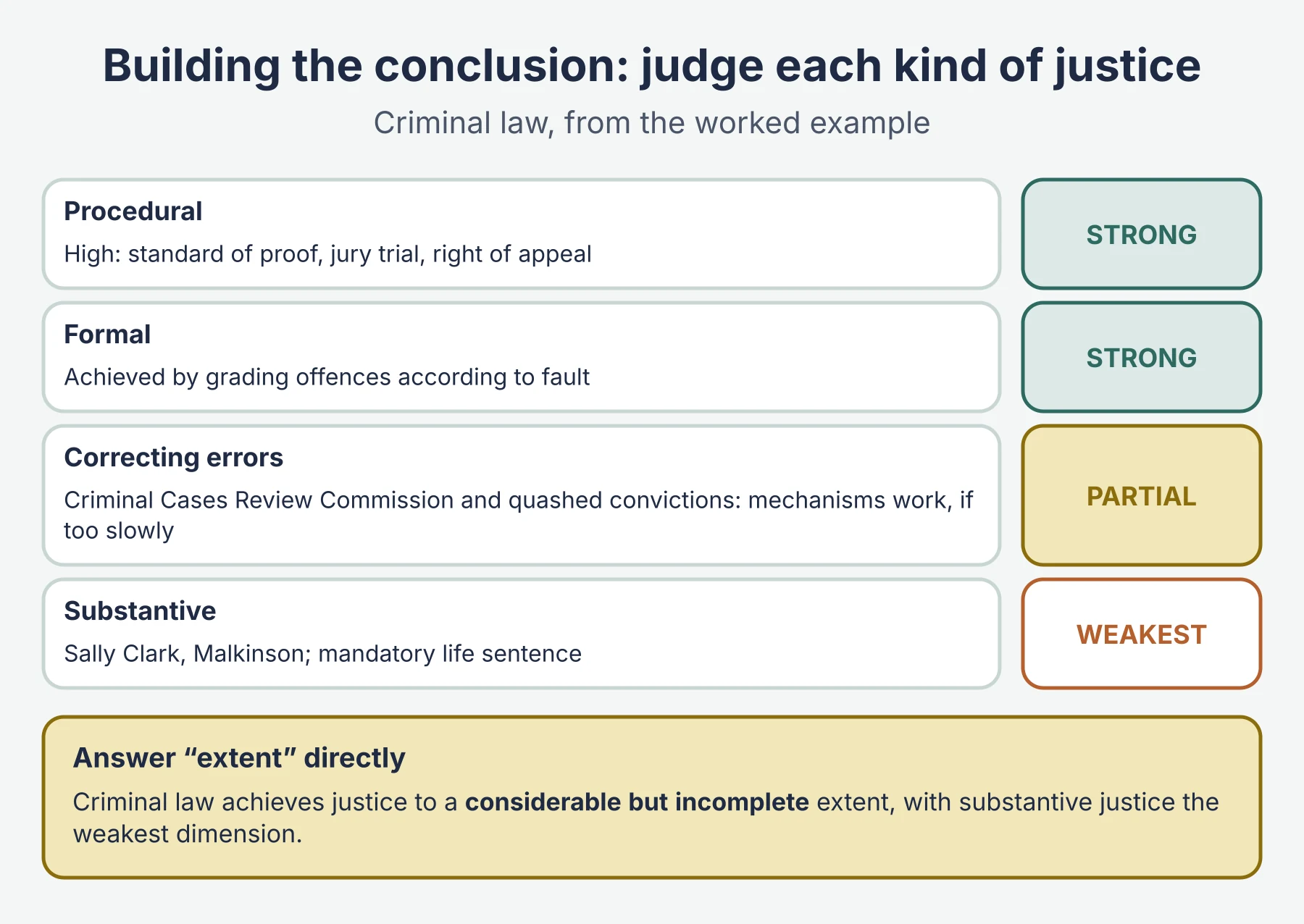
Overall, criminal law achieves a high degree of procedural justice through the standard of proof, jury trial and the right of appeal, and it achieves formal justice by grading offences according to fault. Its failures are real: cases such as Sally Clark and Andrew Malkinson show that procedural safeguards do not always prevent wrongful conviction, and rules such as the mandatory life sentence can produce substantively unjust outcomes. However, the existence of the Criminal Cases Review Commission and the eventual quashing of these convictions shows that the system contains mechanisms to correct injustice, even if too slowly. The law therefore achieves justice to a considerable but incomplete extent, with substantive justice the weakest dimension.
The conclusion uses the types of justice to organise the judgement, refers back to evidence, and answers “extent” directly.
Common mistakes
- Listing theorists with no link to an actual rule or case.
- Treating justice as a single idea; distinguishing formal, substantive and procedural justice adds precision.
- Using miscarriages of justice only as evidence of failure, without noting that their correction shows the system working.
- Writing about criminal and civil law in one blurred list; the specification says civil and/or criminal, so organise by area.
- Concluding “the law sometimes achieves justice”: say how far, and in which sense.
Exam technique
For explain questions on a theory, give the core idea, show how it applies to a legal rule, and add a criticism if the tariff allows. For discuss or evaluate, plan two columns (achieves / fails) for your chosen area, use at least one theory to judge the evidence, and finish with a qualified conclusion.
Condensed recall is in the Law and Justice revision notes, and the Law and Justice practice questions give you scenario and essay practice. Justice links closely to the Rule of Law.
Related resources
-
Practice questions
AQA A Level Law (7162): Nature of Law: Law and Justice – Practice Questions
Original practice questions with mark-scheme answers on the meaning and theories of justice and how far civil and criminal law achieve it, for AQA Law 7162.
Law · AQA · A Level
Try questions -
Revision notes
AQA A Level Law (7162): Nature of Law: Law and Justice – Revision Notes
Revision notes on types and theories of justice, natural justice and how far civil and criminal law achieve justice, with a self-test for AQA Law 7162.
Law · AQA · A Level
Revise topic -
Study guides
AQA A Level Law (7162): Nature of Law: Law and Morality
Law and morality for AQA A Level Law 7162: the distinction, moral diversity in a pluralist society, natural law, positivism and the legal enforcement of morals.
Law · AQA · A Level
Read guide
Get free revision emails (optional)
Occasional emails with practice questions, worked explanations and links to free resources for the qualification and subjects you choose. No spam, and you can unsubscribe from any email. The free tools on this site never need an email.