
Study Guides
AQA A Level Law (7162): Nature of Law: Law and Morality
Law and morality for AQA A Level Law 7162: the distinction, moral diversity in a pluralist society, natural law, positivism and the legal enforcement of morals.
- Subject
- Law
- Level
- A LEVELS
- Topic
- Section 3.1 – The Nature of Law and the English Legal System
- Author
- Marlbridge Academic Team
- Updated
- Reviewed by
- Aizaz Raoof Ali (what this means)
Aligned to AQA A Level Law (7162), For teaching from September 2017 onwards, A-level exams 2019 onwards. Official specification .
Syllabus page (what it covers and how it is assessed): AQA A Level Law.
Syllabus points this page covers
7162
- Nature of law: law and morality
Found an error? Report a correction.
Need help with this topic? Request a free trial class for A Level Law (7162).
This guide covers the Nature of law: law and morality row of AQA A-level Law (7162) section 3.1. The specification names three things: the distinction between law and morality and the diversity of moral views in a pluralist society; the relationship between law and morality and its importance; and the legal enforcement of moral values. It is one of the most common essay themes in section 3.1, and it reappears inside criminal law (consent), tort (duty of care) and human rights. The Rule of Law, Parliament, Morality and Justice study guide introduces the Hart–Devlin debate and the Wolfenden Report; this page adds the theory behind the relationship, a wider range of cases, and a structure for answering.
The distinction between law and morality
Morality is a set of beliefs about right and wrong behaviour, held by individuals or groups, that guides conduct. Law and morality differ in five ways that you can set side by side:
| Law | Morality | |
|---|---|---|
| Source | Parliament and the courts | Religion, culture, upbringing, conscience |
| Certainty | Written, or found in reported cases; can be identified precisely | Often unwritten and disputed |
| Enforcement | State sanctions through the courts | Disapproval, guilt, exclusion |
| Change | Deliberate and immediate, by Act or judgment | Gradual and uneven across society |
| Scope | Binds all within the jurisdiction | Binds those who accept it |
Diversity of moral views in a pluralist society
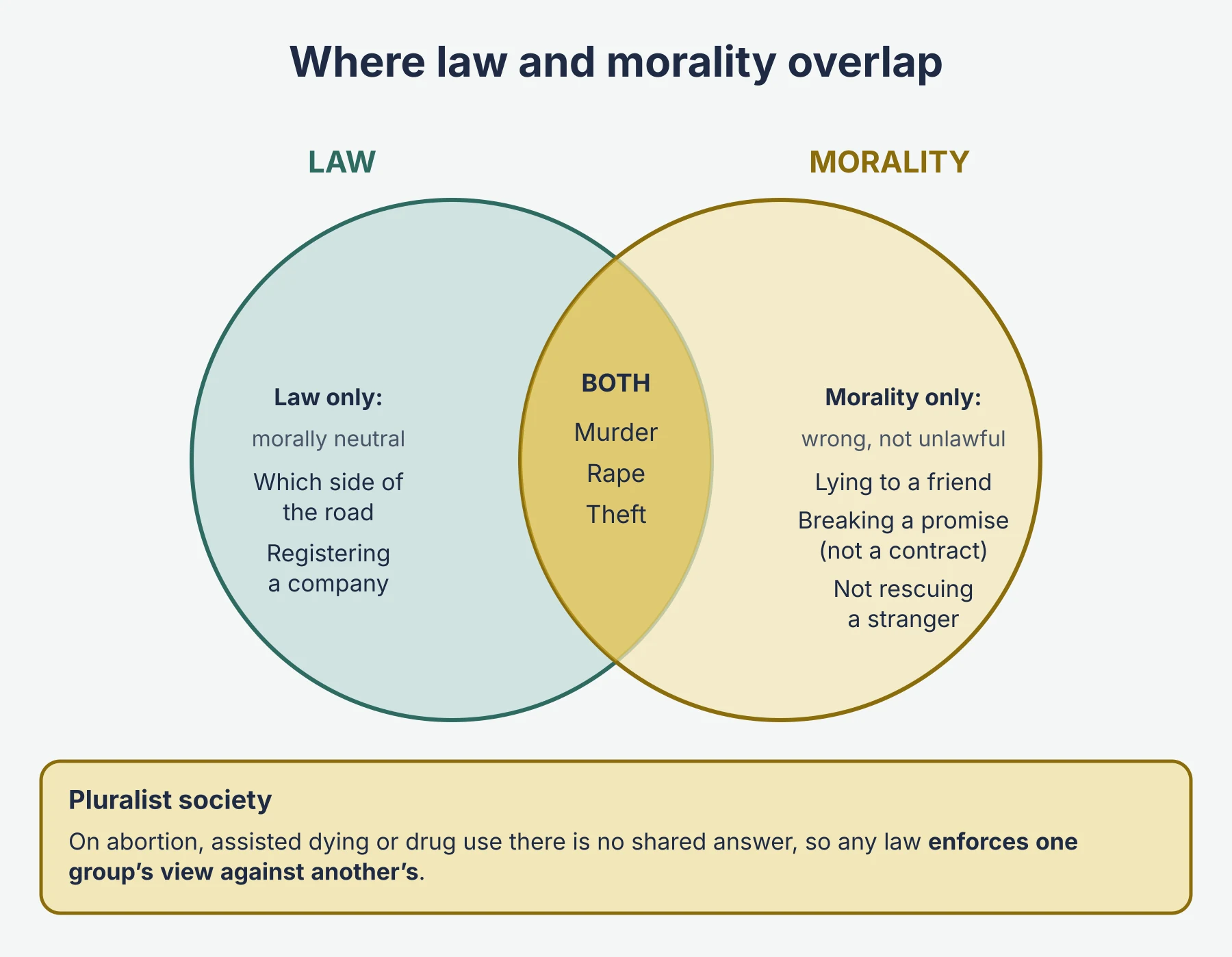
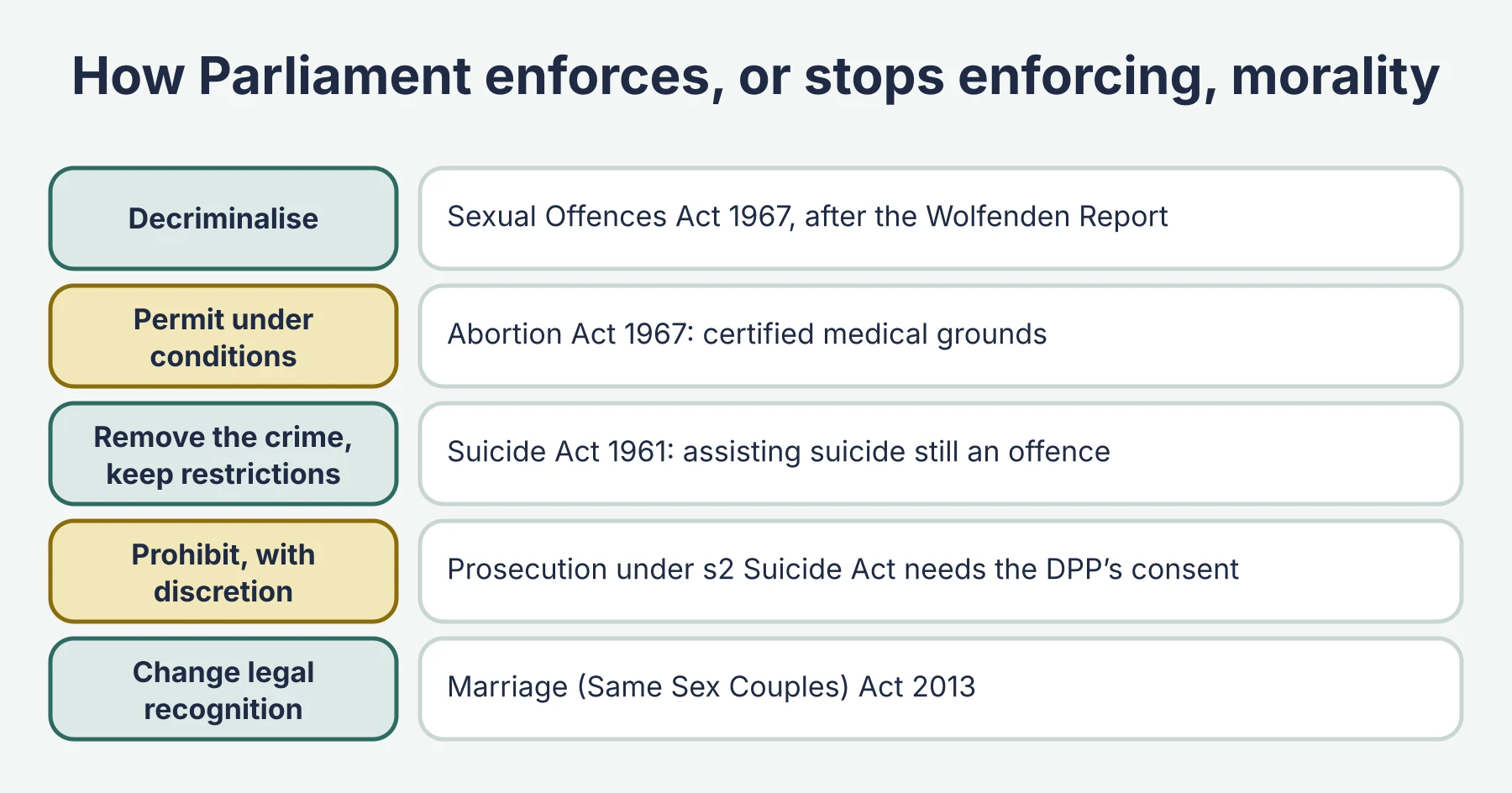
A pluralist society is one in which people of different faiths, cultures and outlooks live together and hold different moral views. England and Wales is pluralist: on abortion, assisted dying, drug use or the treatment of animals, there is no single answer that everyone shares. This matters for law because if there is no consensus, any law on the issue enforces one group’s view against another’s. Parliament has responded in different ways: sometimes by permitting conduct under conditions (the Abortion Act 1967 allows abortion where specified medical grounds are certified), sometimes by keeping a prohibition while allowing discretion in enforcement (prosecutions for assisting suicide under section 2 of the Suicide Act 1961 require the consent of the Director of Public Prosecutions).
The relationship between law and morality
Three possible overlaps
- Law and morality coincide. Murder, rape and theft are both crimes and moral wrongs.
- Law without moral content. Many regulatory rules, such as which side of the road to drive on or how to register a company, are morally neutral; the law needs a rule, not a moral one.
- Morality without law. Lying to a friend, breaking a promise not made as a contract, or failing to rescue a stranger are widely seen as wrong but are generally not unlawful.
Natural law and positivism
The two main theories explain the relationship differently.
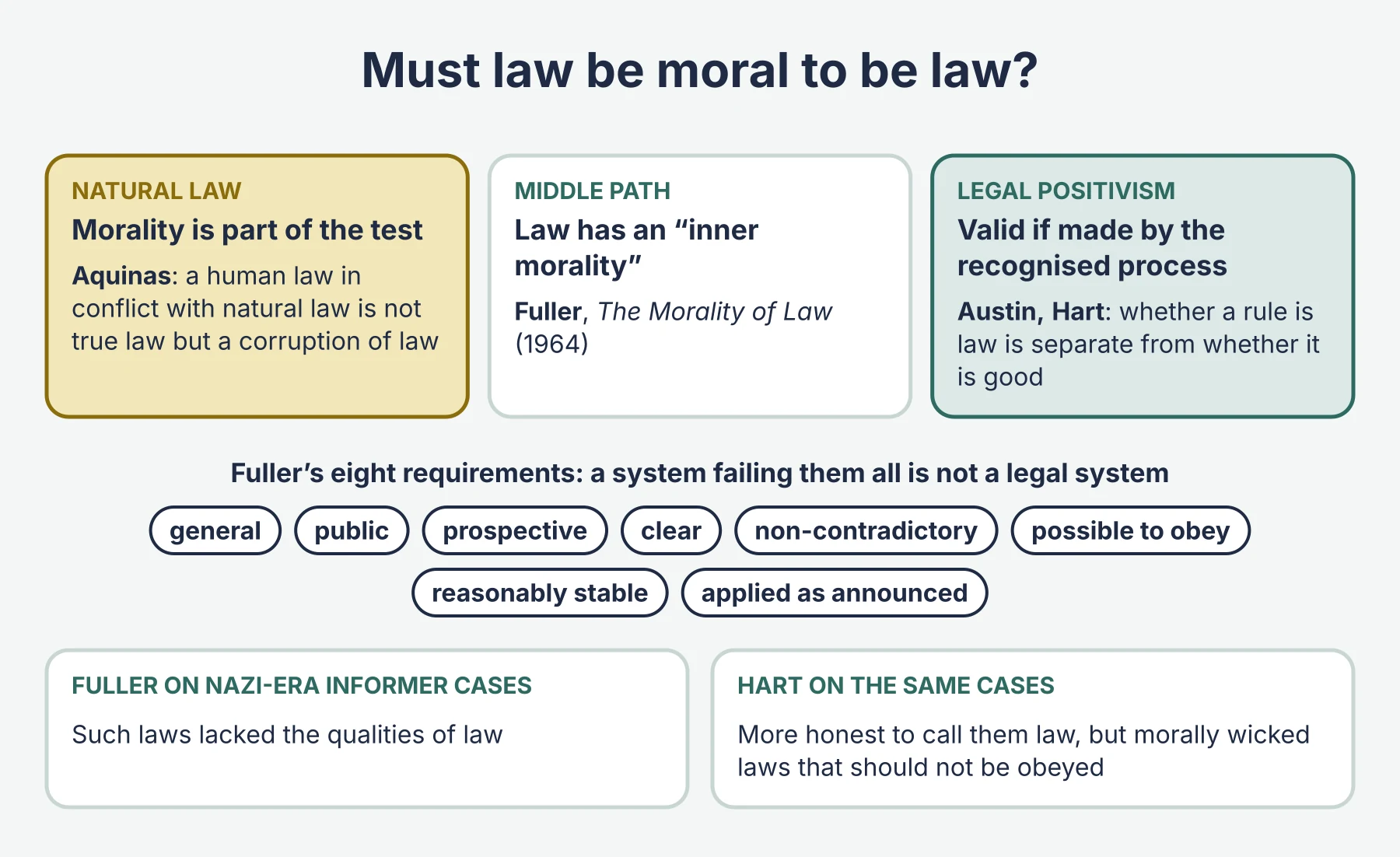
- Natural law holds that law must conform to a higher moral order to be valid. Thomas Aquinas argued that a human law in conflict with natural law is not true law but a corruption of law. On this view, morality is part of the test of what counts as law.
- Legal positivism holds that law is valid because it was made by the recognised process, whatever its moral content. John Austin and H. L. A. Hart are positivists: Hart accepted that law and morality often overlap, but insisted that whether a rule is law is a separate question from whether it is good.
Lon Fuller, in The Morality of Law (1964), took a middle path. He argued that law has an “inner morality”: a system of rules must be general, public, prospective, clear, non-contradictory, possible to obey, reasonably stable, and applied as announced. A system that failed these tests completely would not be a legal system at all. Fuller and Hart debated this after the Second World War, using post-war German cases about people who had informed on others under Nazi laws: Fuller argued such laws lacked the qualities of law, while Hart argued it was more honest to accept that they were law but morally wicked laws that should not be obeyed.
Why the relationship matters
- Legitimacy and obedience. Law that reflects widely held moral views is more likely to be accepted and obeyed.
- Development of the common law. Judges draw on moral ideas. Lord Atkin’s neighbour principle in Donoghue v Stevenson (1932) built a legal duty of care on the moral injunction to love your neighbour.
- Law changing morality. Law can lead as well as follow. Seatbelt and drink-driving laws are often said to have helped make driving without a seatbelt, or after drinking, socially unacceptable.
- Hard cases. When law and morality conflict, judges face pressure to adapt the law, and Parliament faces pressure to act.
The legal enforcement of moral values
Moralism, paternalism and the harm principle
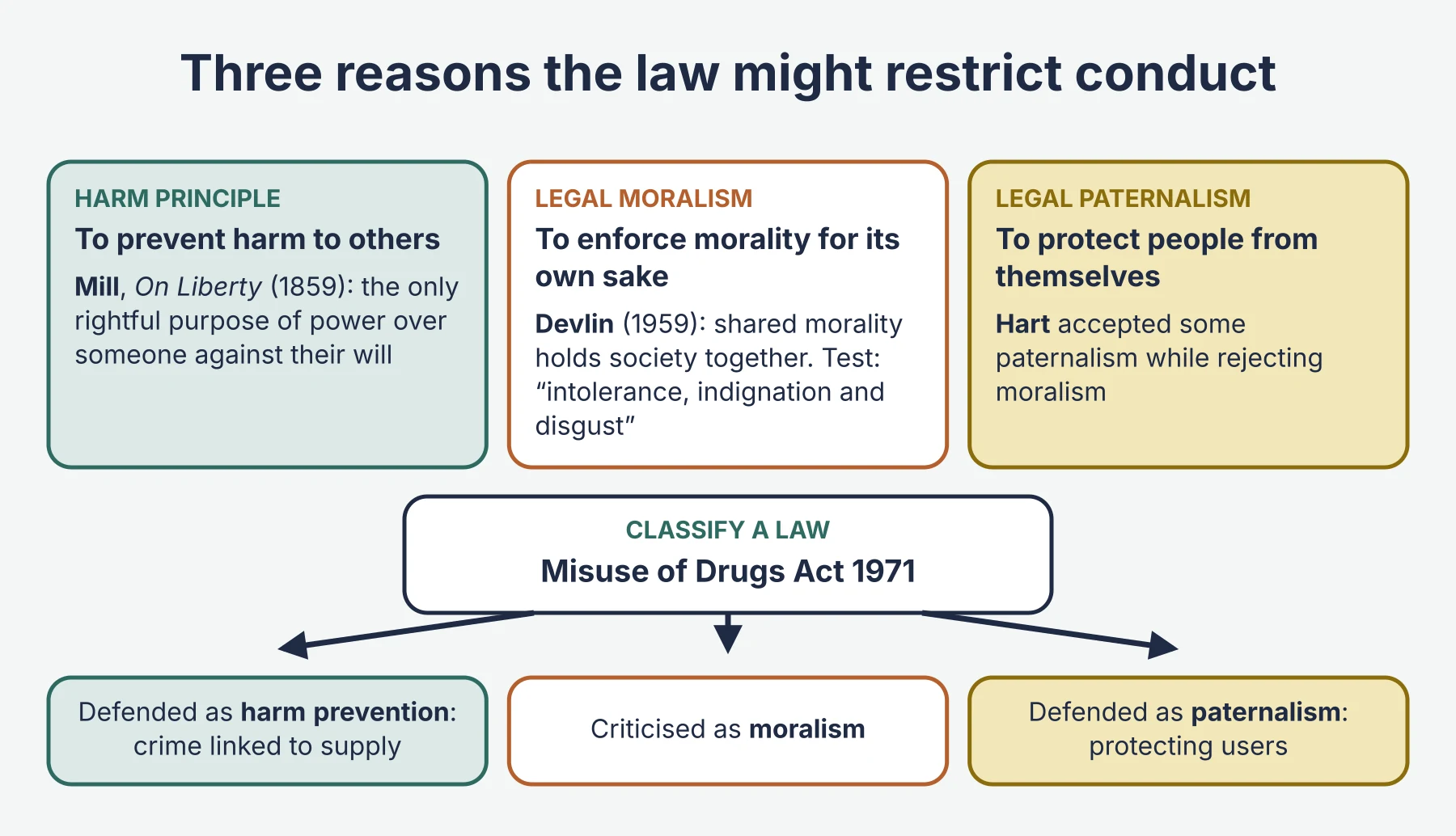
- John Stuart Mill, in On Liberty (1859), set out the harm principle: the only purpose for which power can rightly be exercised over a member of a civilised community, against their will, is to prevent harm to others.
- Legal moralism is the view that law may enforce morality for its own sake. Lord Devlin argued in 1959 that a shared morality holds society together, so society may protect itself against immorality as it would against treason. His test was whether the reasonable person would regard the conduct with “intolerance, indignation and disgust”.
- Legal paternalism is using law to protect people from harming themselves. Hart accepted some paternalism (he regarded laws protecting people from their own harmful choices as justifiable) while rejecting moralism.
Using these three labels lets you classify any law: the Misuse of Drugs Act 1971 can be defended as paternalism (protecting users), as harm prevention (crime linked to supply), or criticised as moralism.
How the courts enforce morality
| Case | What happened | What it shows |
|---|---|---|
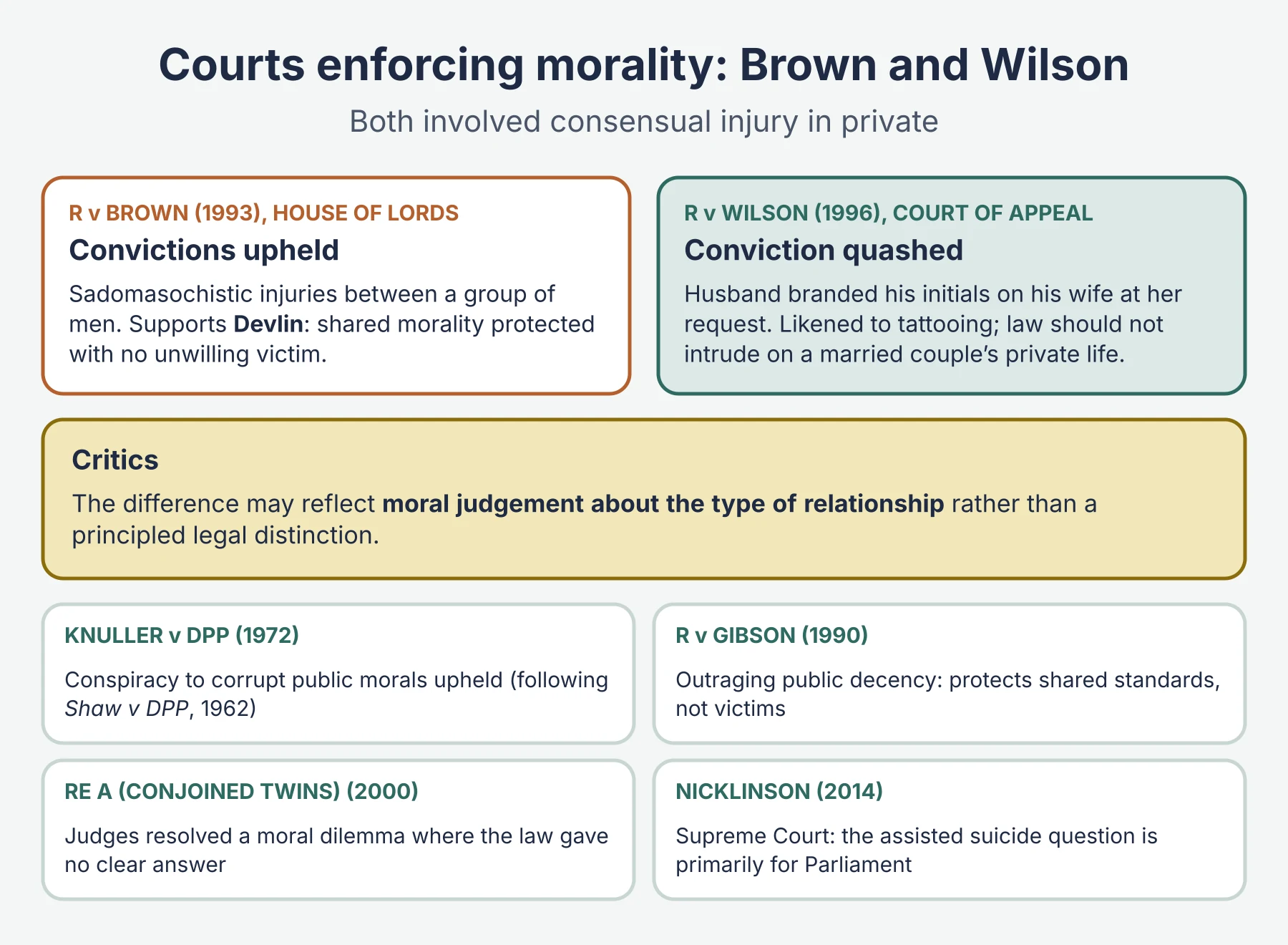
| Knuller v DPP (1972) | Publishers of a magazine carrying contact advertisements for gay men were convicted of conspiracy to corrupt public morals, and the House of Lords upheld the conviction | The courts confirmed the offence recognised in Shaw v DPP (1962), protecting public morals even after the Sexual Offences Act 1967 |
| R v Gibson (1990) | Exhibiting earrings made from freeze-dried human foetuses was outraging public decency | The offence protects shared standards of decency, not victims |
| R v Wilson (1996) | A husband branded his initials on his wife’s buttocks at her request; his conviction was quashed | Consensual activity between spouses in private was treated differently from R v Brown (1993) |
| Re A (Conjoined Twins) (2000) | The Court of Appeal authorised separation surgery that would kill the weaker twin to save the stronger | Judges had to resolve a moral dilemma where the law gave no clear answer |
| R (Nicklinson) v Ministry of Justice (2014) | The Supreme Court refused a declaration that the ban on assisting suicide was incompatible with Article 8 | The majority treated the moral question as primarily one for Parliament |
The contrast between Brown and Wilson is especially useful. Both involved consensual injury in private, yet the outcomes differed. The Court of Appeal in Wilson likened the branding to tattooing and stressed that the law should not intrude into the private life of a married couple. Critics argue the difference reflects moral judgement about the type of relationship rather than any principled legal distinction.
How Parliament enforces, or stops enforcing, morality
- Decriminalisation: the Sexual Offences Act 1967, after the Wolfenden Report.
- Regulated permission: the Abortion Act 1967.
- Removing the crime but keeping restrictions: the Suicide Act 1961 abolished the offence of suicide but kept assisting suicide as an offence.
- Changing the legal recognition of relationships: the Marriage (Same Sex Couples) Act 2013.
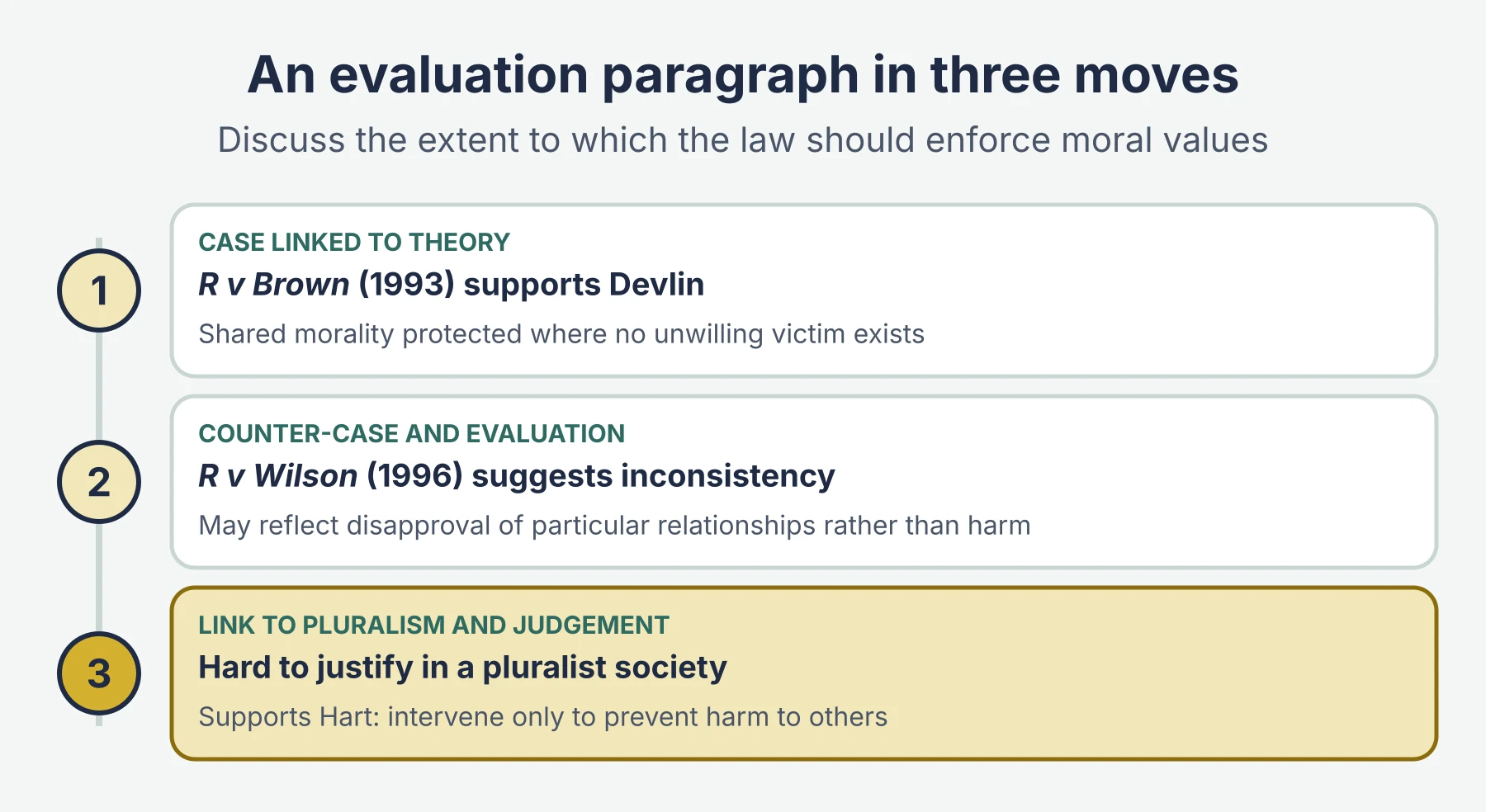
Worked example: annotated paragraph
Question extract: Discuss the extent to which the law should enforce moral values.
In R v Brown (1993) the House of Lords upheld convictions for consensual sadomasochistic injuries inflicted in private, which supports Devlin’s view that society may protect its shared morality even where no unwilling victim exists [case linked to theory]. However, in R v Wilson (1996) a husband who branded his wife at her request was not liable, which suggests the courts’ approach is inconsistent and may reflect disapproval of particular relationships rather than harm [counter-case and evaluation]. In a pluralist society this inconsistency is hard to justify, which supports Hart’s argument that the law should intervene only to prevent harm to others [link to pluralism and judgement].
Common mistakes
- Defining morality as “what is right” without saying whose view, or ignoring pluralism.
- Confusing paternalism (protecting people from themselves) with moralism (enforcing morality for its own sake).
- Presenting natural law and positivism as dates and names without explaining how each sees the relationship.
- Using R v Brown alone; comparing it with Wilson is where evaluation marks lie.
- Ending without answering “to what extent”.
Exam technique
Explain questions want the distinction or relationship stated, developed and illustrated. Discuss and evaluate questions want both sides: cases where the law enforces morality, cases where it has withdrawn, the theories that justify each, and a conclusion on whether the balance is right. Keep cases short: the point they prove matters more than their facts.
Condensed recall is in the Law and Morality revision notes, and you can test yourself with the Law and Morality practice questions. The overlap with fairness is explored in Law and Justice.
Related resources
-
Practice questions
AQA A Level Law (7162): Nature of Law: Law and Morality – Practice Questions
Original practice questions with full answers on law and morality, pluralism, natural law, positivism and the enforcement of moral values for AQA Law 7162.
Law · AQA · A Level
Try questions -
Revision notes
AQA A Level Law (7162): Nature of Law: Law and Morality – Revision Notes
Revision notes on law and morality: pluralism, natural law, positivism, Mill, Devlin, Hart and the cases on enforcing morals, with a self-test for AQA Law 7162.
Law · AQA · A Level
Revise topic -
Study guides
AQA A Level Law (7162): Nature of Law: Law and Society
The role of law in society, enforceable rights, balancing competing interests and the meaning of fault in civil and criminal law, for AQA A Level Law 7162.
Law · AQA · A Level
Read guide
Get free revision emails (optional)
Occasional emails with practice questions, worked explanations and links to free resources for the qualification and subjects you choose. No spam, and you can unsubscribe from any email. The free tools on this site never need an email.