
Revision Notes
AQA A Level Law (7162): Nature of Law – Revision Notes
Condensed recall on legal rules and norms, civil and criminal law, and custom, statute and common law, with a key-terms table and self-test for AQA Law 7162.
- Subject
- Law
- Level
- A LEVELS
- Topic
- Section 3.1 – The Nature of Law and the English Legal System
- Author
- Marlbridge Academic Team
- Updated
- Reviewed by
- Aizaz Raoof Ali (what this means)
Aligned to AQA A Level Law (7162), For teaching from September 2017 onwards, A-level exams 2019 onwards. Official specification .
Syllabus page (what it covers and how it is assessed): AQA A Level Law.
Syllabus points this page covers
7162
- Nature of law
Found an error? Report a correction.
Need help with this topic? Request a free trial class for A Level Law (7162).
Condensed notes on the Nature of law row of AQA A-level Law (7162) section 3.1: legal rules and principles versus other rules and norms; criminal versus civil law; and custom, statute and the common law as sources. For the full explanation and a worked answer, use the Nature of Law study guide.
The one-line test
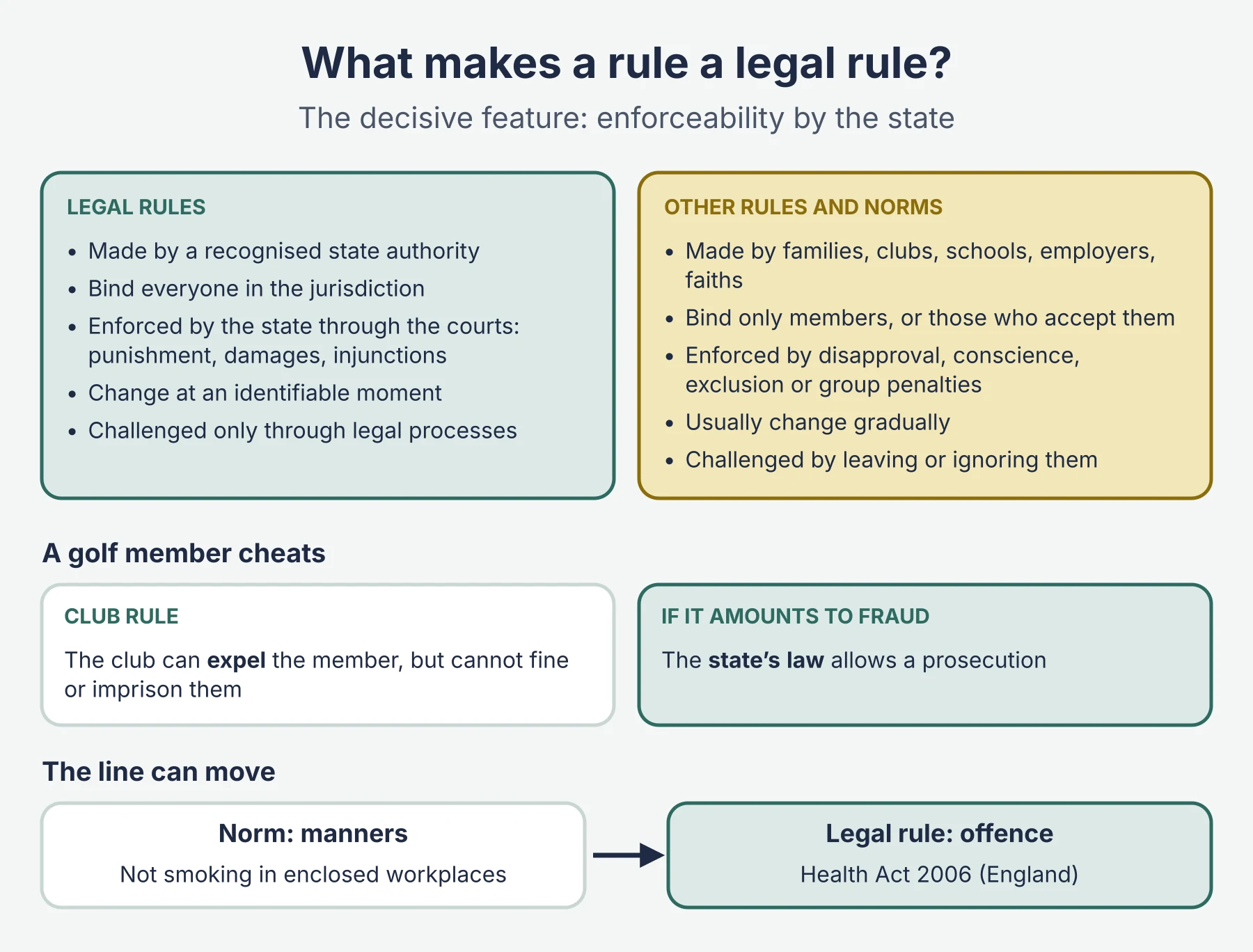
A rule is a legal rule when a recognised state authority made it, it binds everyone in the jurisdiction, and the state enforces it through the courts with formal sanctions. Everything else (school rules, club rules, etiquette, religious codes) is a rule or norm of behaviour, enforced by the group itself or by conscience.
Five contrasts to learn as pairs
- Origin: legal rules are made at an identifiable time by Parliament or the courts; norms evolve gradually.
- Scope: legal rules bind all within the jurisdiction; norms bind members or those who accept them.
- Enforcement: courts, police, fines, imprisonment, damages; versus disapproval, exclusion, guilt.
- Change: an Act can change the law overnight; norms shift slowly and unevenly.
- Challenge: only through legal routes such as appeal or judicial review; norms can simply be ignored at social cost.
A norm can become law. Smoking in enclosed workplaces went from bad manners to an offence under the Health Act 2006.
Rules and principles
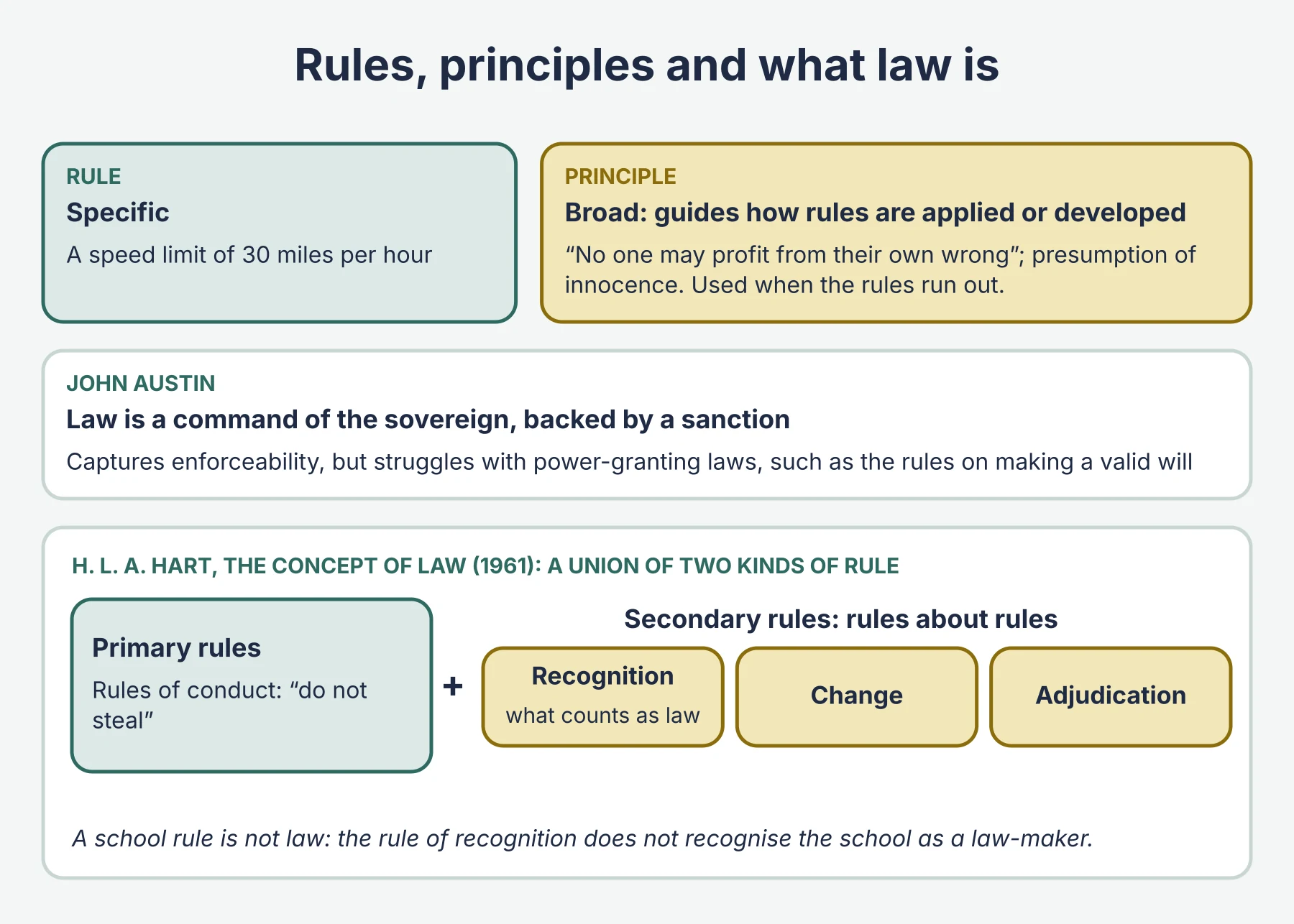
- Rule: specific and mechanical (a 30 mph limit).
- Principle: general and guiding (presumption of innocence; no one profits from their own wrong).
- Judges reach for principles when rules give no answer; this is why the specification names both.
Two theorists for precise explanation
- Austin: law is the sovereign’s command backed by a sanction. Weakness: ignores power-conferring rules such as making a will.
- Hart, The Concept of Law (1961): law is primary rules (conduct) plus secondary rules (recognition, change, adjudication). A school rule is not law because the rule of recognition does not recognise the school as a law-maker.
Criminal versus civil: the extra points
| Point | Criminal | Civil |
|---|---|---|
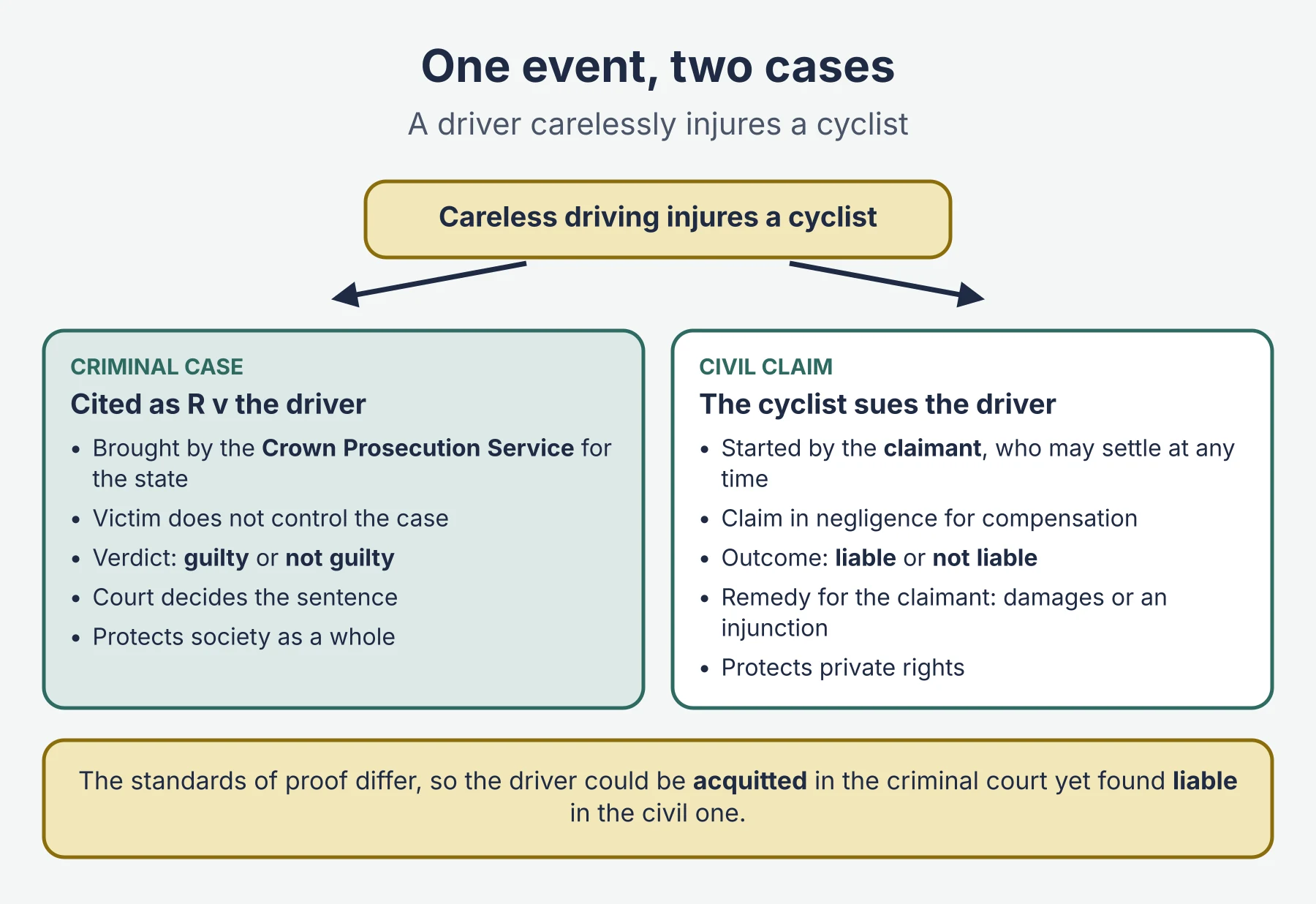
| Who starts it | Usually the Crown Prosecution Service for the state | The claimant |
| Citation | R v Smith | Smith v Jones |
| Verdict wording | Guilty / not guilty | Liable / not liable |
| Who controls it | The state; victim cannot drop it | The claimant; can settle or discontinue |
| Aim | Protect society, punish | Protect private rights, remedy |
Same facts, two cases: careless driving that injures a cyclist can lead to a prosecution and a negligence claim. Different standards of proof mean an acquittal does not prevent civil liability.
Sources of law
Custom
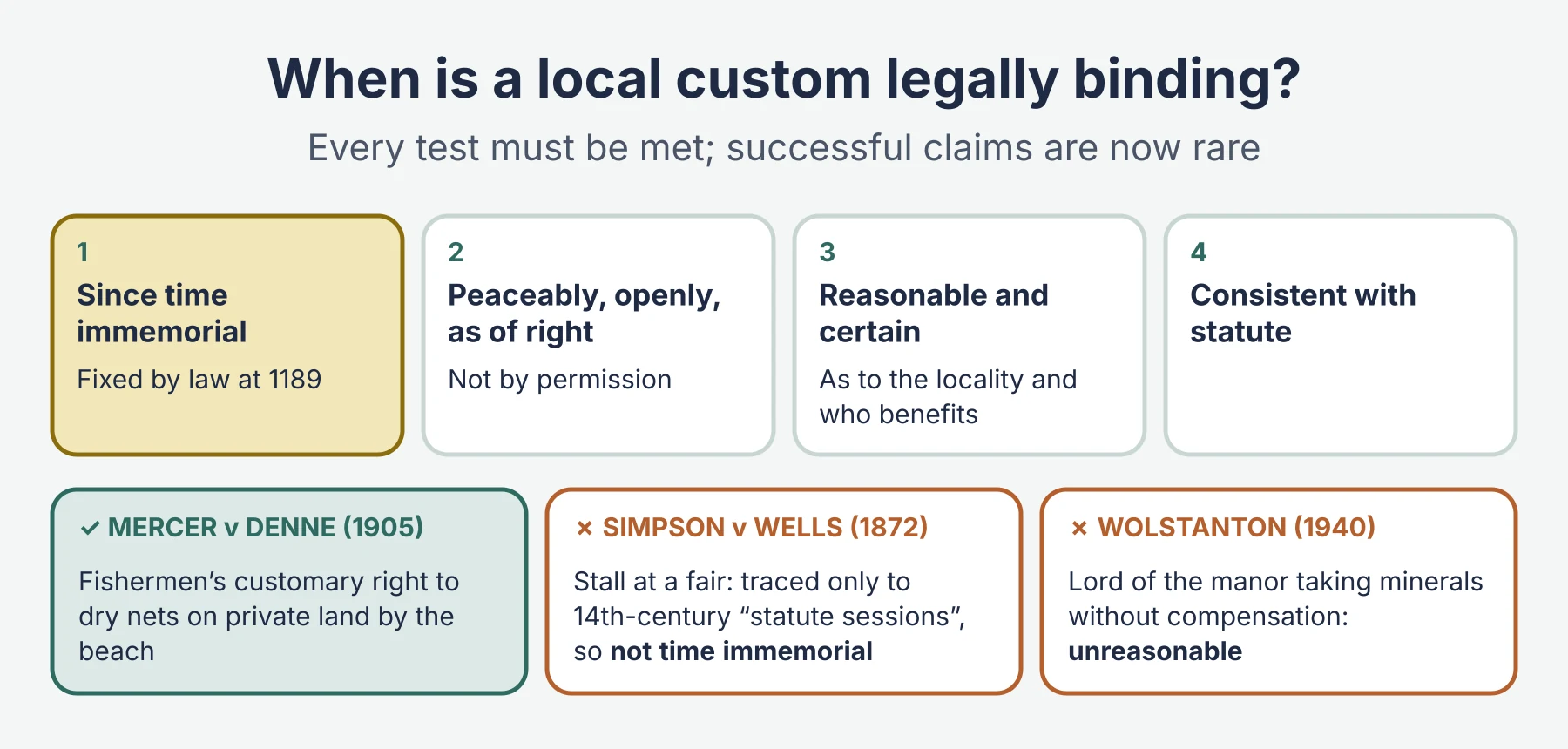
Tests for a valid local custom:
- existed since time immemorial (1189);
- exercised peaceably, openly and as of right;
- reasonable;
- certain as to place and beneficiaries;
- consistent with statute.
| Case | Outcome | Why |
|---|---|---|
| Mercer v Denne (1905) | Custom upheld | Fishermen had long dried nets on the land |
| Simpson v Wells (1872) | Custom failed | Fair traced to fourteenth-century statute sessions, so not time immemorial |
| Wolstanton Ltd v Newcastle-under-Lyme Corporation (1940) | Custom failed | Taking minerals without compensation was unreasonable |
Statute
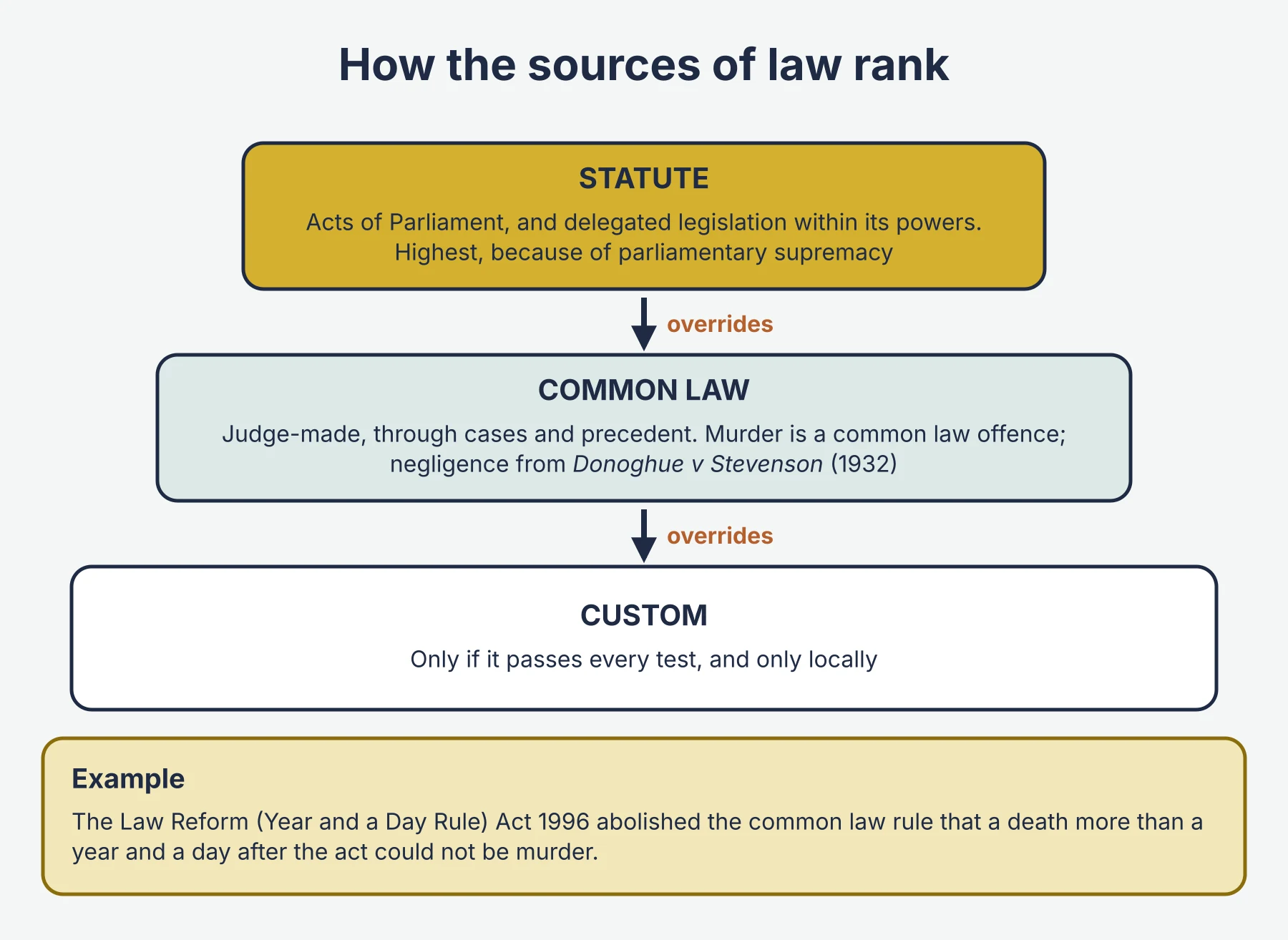
Acts of Parliament (and delegated legislation made under them). Highest domestic source; can abolish custom and reverse common law, e.g. the Law Reform (Year and a Day Rule) Act 1996.
Common law
Judge-made law through precedent. Murder is a common law offence; negligence grew from Donoghue v Stevenson (1932). Yields to statute.
Ranking: statute > common law > custom.
Key terms
| Term | Meaning |
|---|---|
| Legal rule | A rule made by a state authority, binding generally, enforced by the courts |
| Norm | An expected standard of behaviour within a group, not state-enforced |
| Sanction | The consequence imposed for breaking a rule: for law, a court-imposed penalty or remedy |
| Claimant | The person who brings a civil case |
| Prosecution | The party, usually the state, bringing a criminal case |
| Liable | Legally responsible in a civil case |
| Custom | A long-standing local practice recognised as law if it meets the tests |
| Time immemorial | Legal memory, fixed at 1189 |
| Statute | An Act of Parliament |
| Common law | Law developed by judges through decided cases |
Exam traps
- Using importance or popularity as the test for a legal rule.
- “Guilty” in a civil case; “prosecute” for a claimant.
- Giving custom without the tests, or treating it as a significant modern source.
- Saying common law can override statute.
- Listing differences without an example; every “explain” answer needs one.
Self-test
- What single feature most clearly separates legal rules from other norms?
- Give one example of a norm that became a legal rule.
- Distinguish a legal rule from a legal principle.
- What are Hart’s secondary rules?
- Why are criminal cases cited as R v a defendant?
- Can a victim stop a prosecution by refusing to continue?
- Why might a defendant acquitted of careless driving still be liable in negligence?
- What date marks time immemorial?
- Why did the custom in Simpson v Wells fail?
- Why did the custom in Wolstanton fail?
- Which is the highest domestic source of law, and why?
- Give an example of a common law offence.
Answers: 1. Enforcement by the state through the courts with formal sanctions. 2. Smoking in enclosed workplaces, made an offence under the Health Act 2006. 3. A rule is specific and applied directly; a principle is general and guides how rules are applied or developed. 4. Rules about rules: the rule of recognition, rules of change and rules of adjudication. 5. The prosecution is brought in the name of the Crown, representing the state. 6. No; the prosecution belongs to the state, although lack of evidence may lead the prosecutor to discontinue. 7. The civil standard of proof (balance of probabilities) is lower than the criminal standard (beyond reasonable doubt). 8. 1189. 9. The fair dated back only to fourteenth-century statute sessions, so it did not exist from time immemorial. 10. It allowed minerals to be taken without compensation, which was unreasonable. 11. Statute, because of parliamentary supremacy: an Act can override custom and common law. 12. Murder.
More resources on this topic
Nature of Law study guide | Nature of Law practice questions | Rule of Law, Law Reform, the EU and Civil Justice revision notes
Related resources
-
Study guides
AQA A Level Law (7162): Access to Justice and Funding
Help lines, Citizens Advice, law centres, trade unions, private funding, conditional fees and civil and criminal legal aid for AQA A Level Law 7162 section 3.1.
Law · AQA · A Level
Read guide -
Practice questions
AQA A Level Law (7162): Access to Justice and Funding – Practice Questions
Original practice questions with mark-scheme answers on advice sources, private funding and civil and criminal legal aid for AQA A Level Law 7162.
Law · AQA · A Level
Try questions -
Revision notes
AQA A Level Law (7162): Access to Justice and Funding – Revision Notes
Recall notes on advice sources, own funds, legal expenses insurance, conditional fee agreements and civil and criminal legal aid for AQA A Level Law 7162.
Law · AQA · A Level
Revise topic
Get free revision emails (optional)
Occasional emails with practice questions, worked explanations and links to free resources for the qualification and subjects you choose. No spam, and you can unsubscribe from any email. The free tools on this site never need an email.