
Revision Notes
AQA A Level Law (7162): Legal Personnel and the Judiciary – Revision Notes
Recall notes on solicitors, barristers, legal executives, their regulators, types of judge, judicial roles and judicial independence for AQA A Level Law 7162.
- Subject
- Law
- Level
- A LEVELS
- Topic
- Section 3.1 – The Nature of Law and the English Legal System
- Author
- Marlbridge Academic Team
- Updated
- Reviewed by
- Aizaz Raoof Ali (what this means)
Aligned to AQA A Level Law (7162), For teaching from September 2017 onwards, A-level exams 2019 onwards. Official specification .
Syllabus page (what it covers and how it is assessed): AQA A Level Law.
Syllabus points this page covers
7162
- The legal system: legal personnel and the judiciary
Found an error? Report a correction.
Need help with this topic? Request a free trial class for A Level Law (7162).
Condensed notes for the section 3.1 row The legal system: legal personnel and the judiciary: the roles and regulation of barristers, solicitors and legal executives; types of judge; the role of judges in civil and criminal courts; and judicial independence. For explanation and an annotated answer, use the legal personnel and the judiciary study guide.
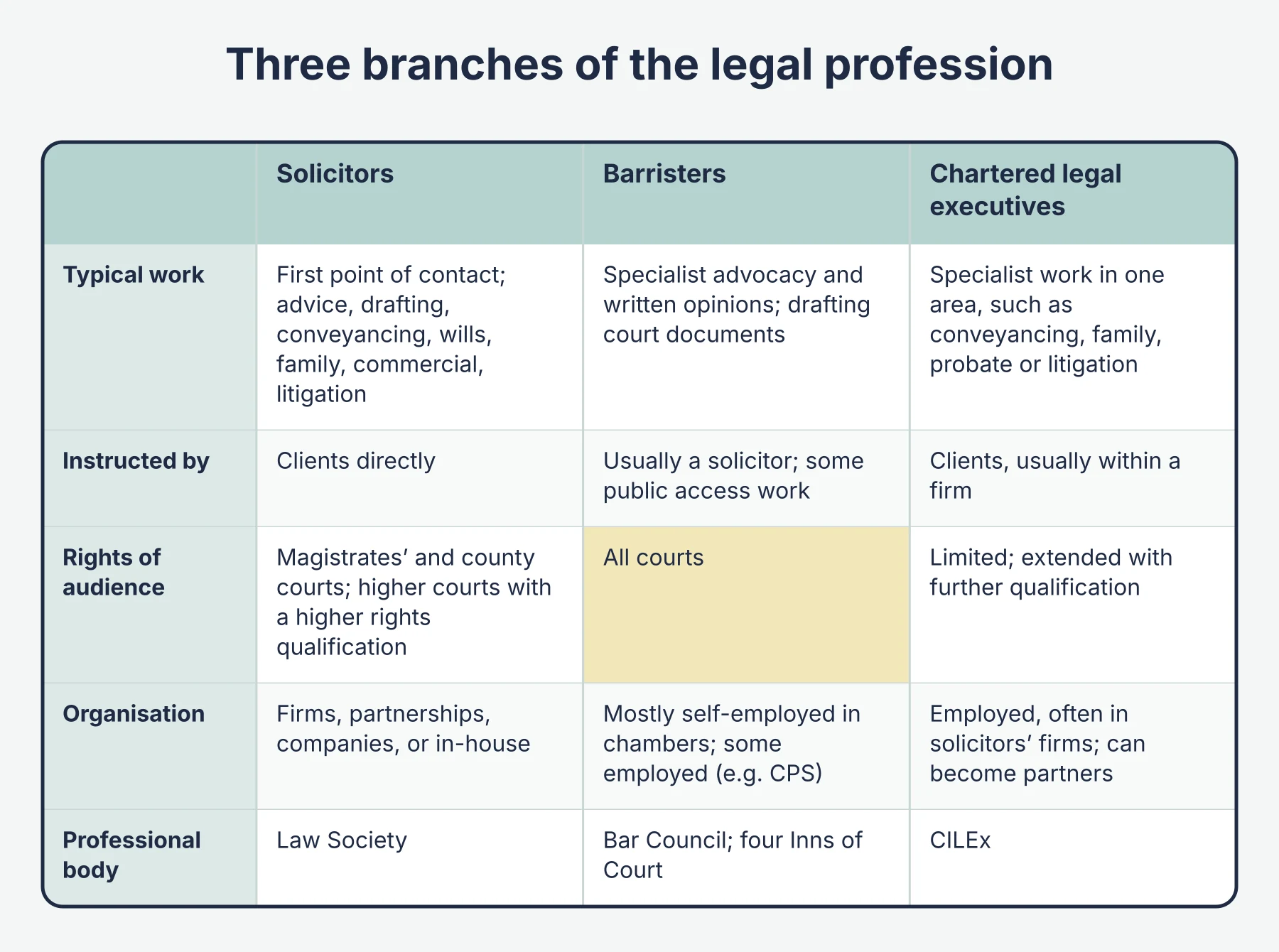
Roles in one line each
- Solicitor: client-facing lawyer who advises, drafts, negotiates and prepares cases; rights of audience in lower courts, higher courts with a higher rights qualification.
- Barrister: specialist advocate and adviser, usually instructed by a solicitor, rights of audience in all courts, mostly self-employed in chambers, bound by the cab-rank rule.
- Chartered legal executive: specialist lawyer qualified through CILEx and work experience, often employed in firms, can become a partner or apply for some judicial posts.
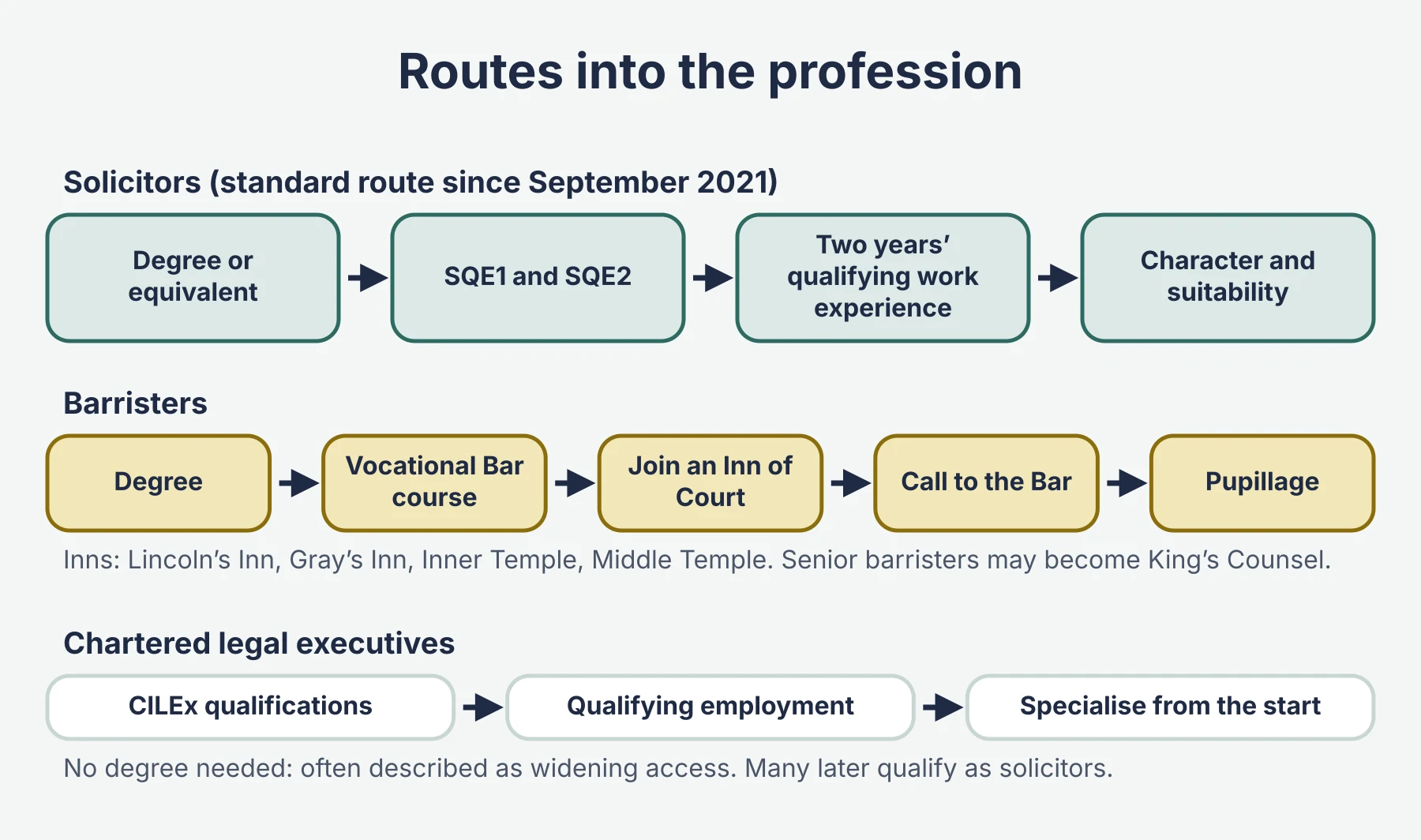
Qualification routes in outline
| Branch | Route |
|---|---|
| Solicitor | Degree or equivalent; SQE1 and SQE2; two years’ qualifying work experience; character and suitability |
| Barrister | Degree; vocational Bar course; join an Inn of Court; call to the Bar; pupillage |
| Legal executive | CILEx qualifications; qualifying employment; no degree required |
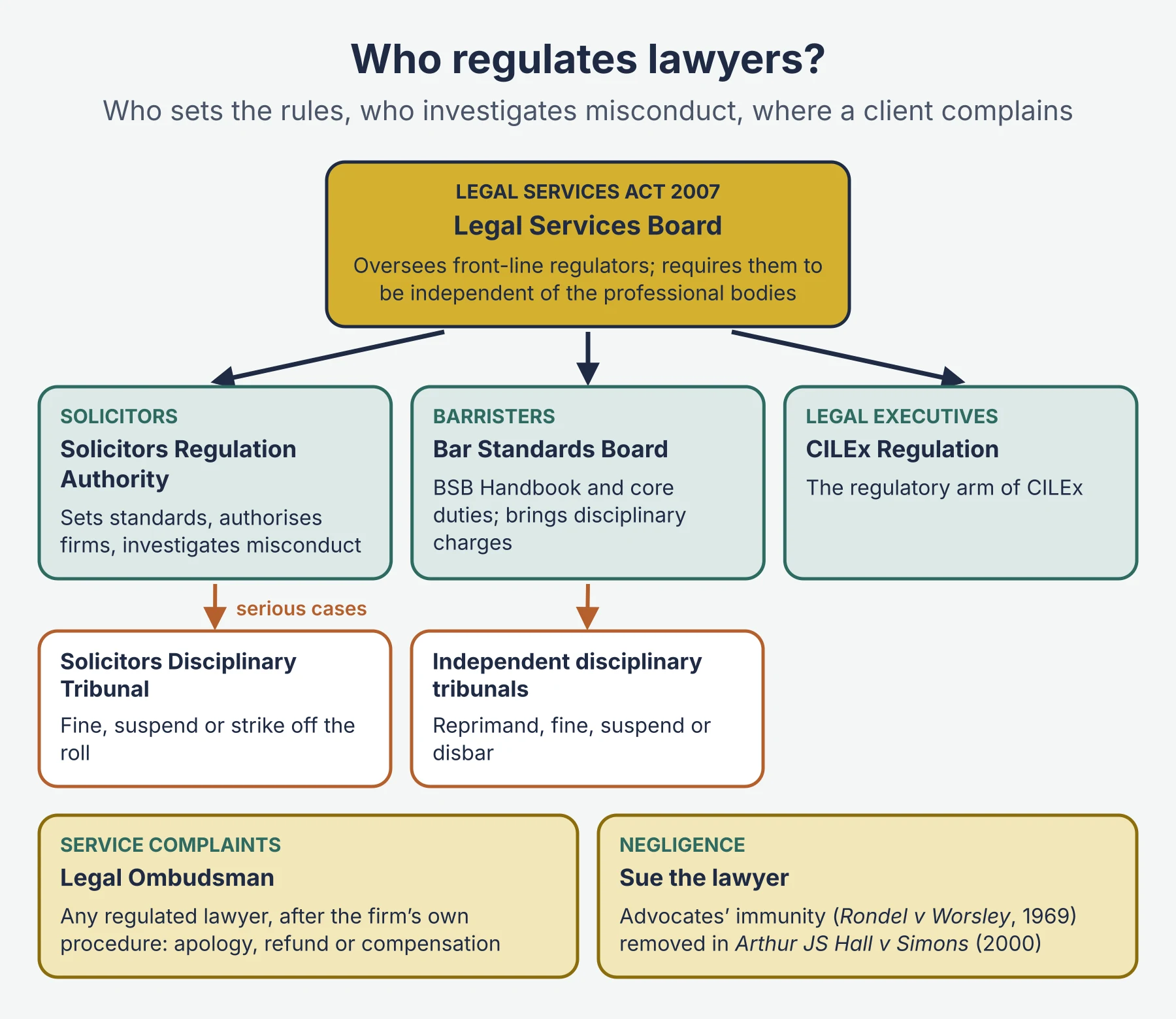
Who regulates whom
| Body | Function |
|---|---|
| Legal Services Board | Oversees the front-line regulators (Legal Services Act 2007) |
| Solicitors Regulation Authority | Sets standards for solicitors and firms; investigates misconduct |
| Solicitors Disciplinary Tribunal | Fines, suspends or strikes off solicitors |
| Bar Standards Board | Sets the BSB Handbook; brings disciplinary charges against barristers |
| CILEx Regulation | Regulates chartered legal executives |
| Legal Ombudsman | Resolves complaints about poor service; can order apology, refund or compensation |
Negligence: advocates’ immunity (Rondel v Worsley, 1969) was removed in Arthur JS Hall & Co v Simons (2000).
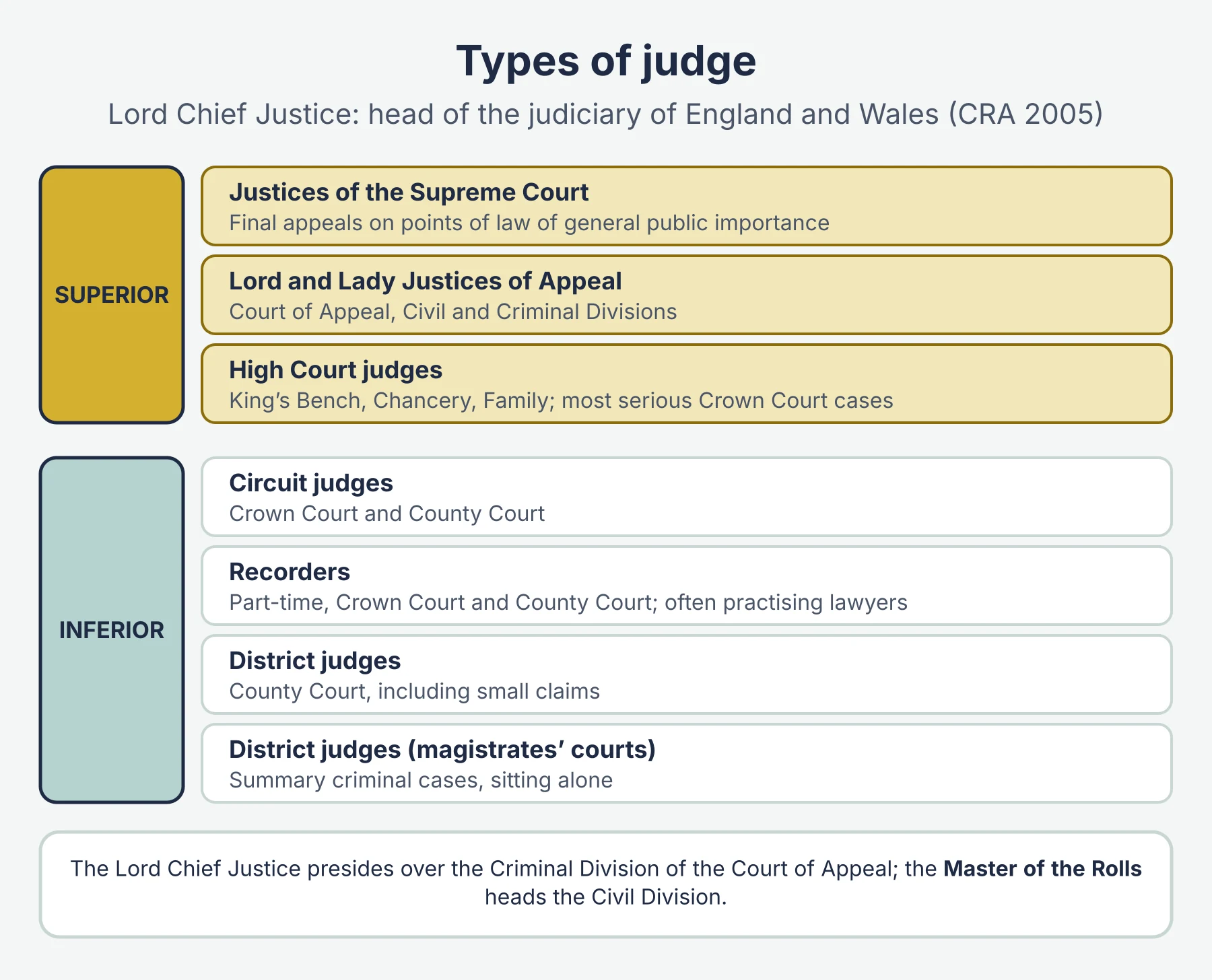
Types of judge
SUPERIOR                                  INFERIOR
Justices of the Supreme Court             Circuit judges (Crown Court, County Court)
Lord/Lady Justices of Appeal              Recorders (part-time)
High Court judges (KBD, Ch, Fam)          District judges (County Court)
                                          District judges (magistrates' courts)
Heads: Lord Chief Justice (head of the judiciary; Criminal Division); Master of the Rolls (Civil Division).
Role of judges
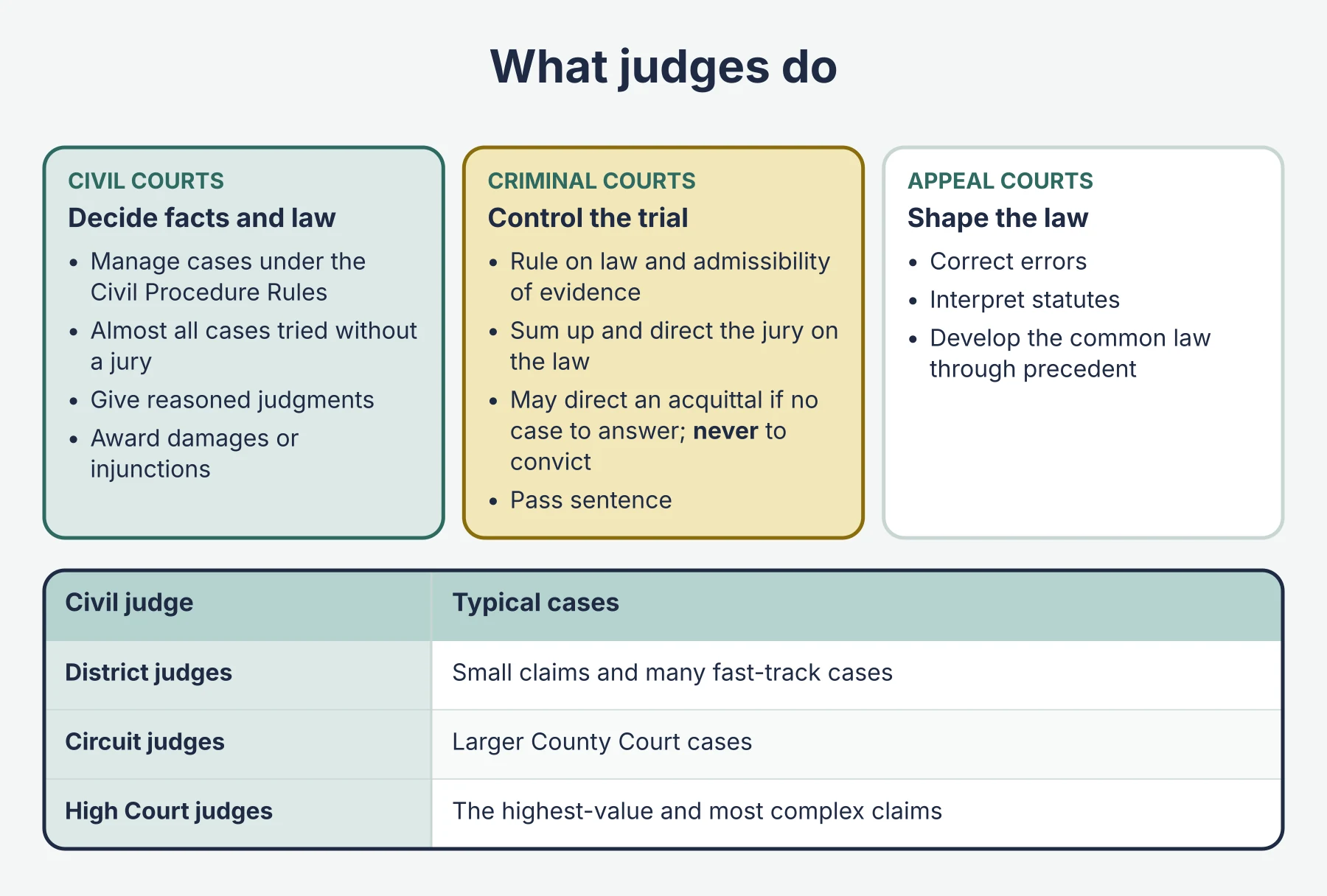
| Civil courts | Criminal courts |
|---|---|
| Case management under the Civil Procedure Rules | Rule on law and admissibility of evidence |
| Decide facts and law, usually without a jury | Sum up and direct the jury on the law |
| Give reasoned judgments | Direct an acquittal if no case to answer; never direct a conviction |
| Award damages or injunctions | Pass sentence |
Appeal judges correct errors, interpret statutes and create precedent.
Judicial independence
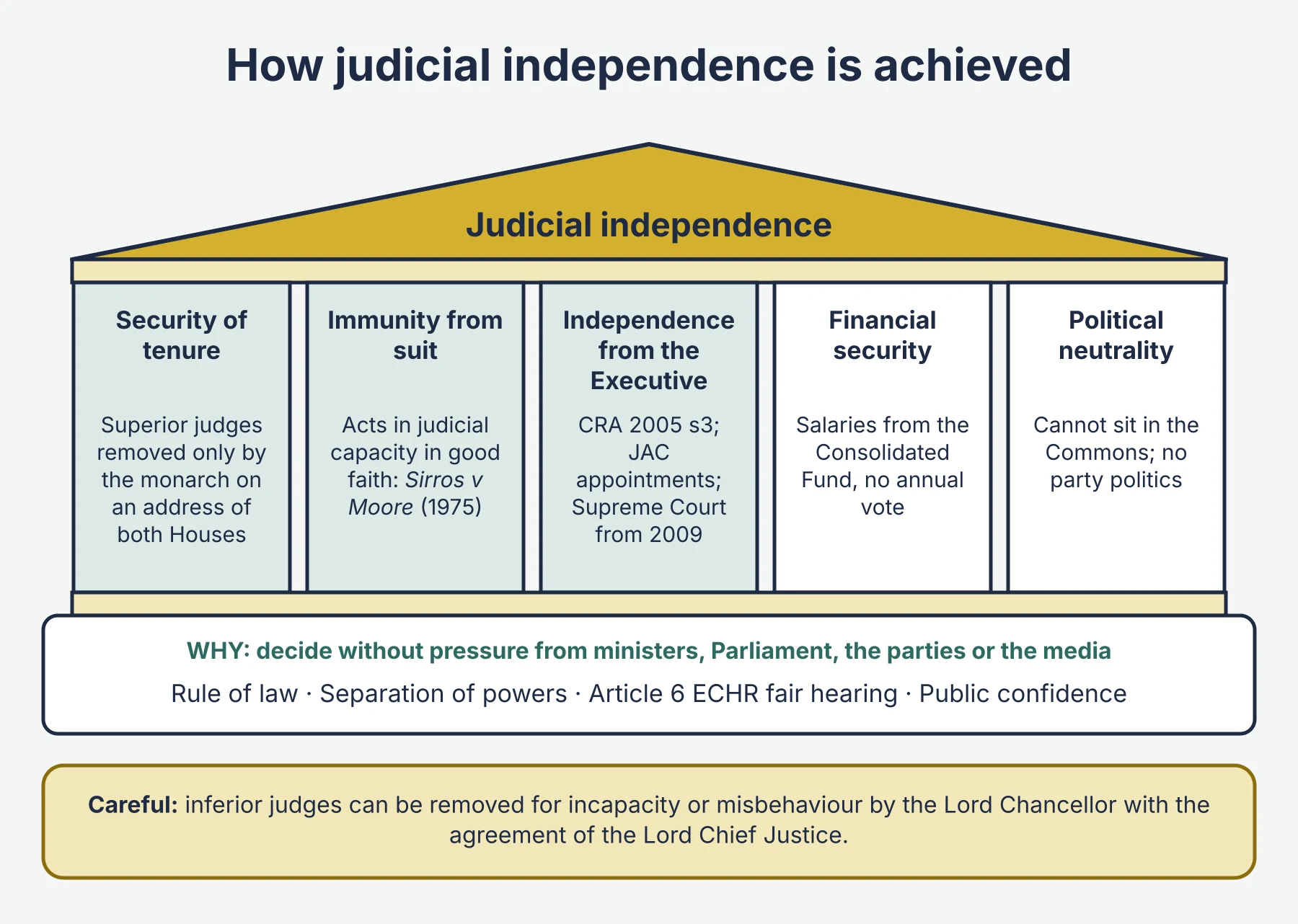
Reasons: rule of law; separation of powers; Article 6 ECHR fair hearing by an independent and impartial tribunal; public confidence; protection of citizens against the state.
Methods:
- Security of tenure: superior judges removable only by the monarch on an address of both Houses; inferior judges removable for incapacity or misbehaviour by the Lord Chancellor with the Lord Chief Justice’s agreement.
- Immunity from suit: Sirros v Moore (1975).
- Independence from the Executive: s3 Constitutional Reform Act 2005; Judicial Appointments Commission; Lord Chancellor no longer a judge; Supreme Court separate from Parliament since 2009.
- Salaries from the Consolidated Fund.
- Political neutrality: judges barred from the House of Commons.
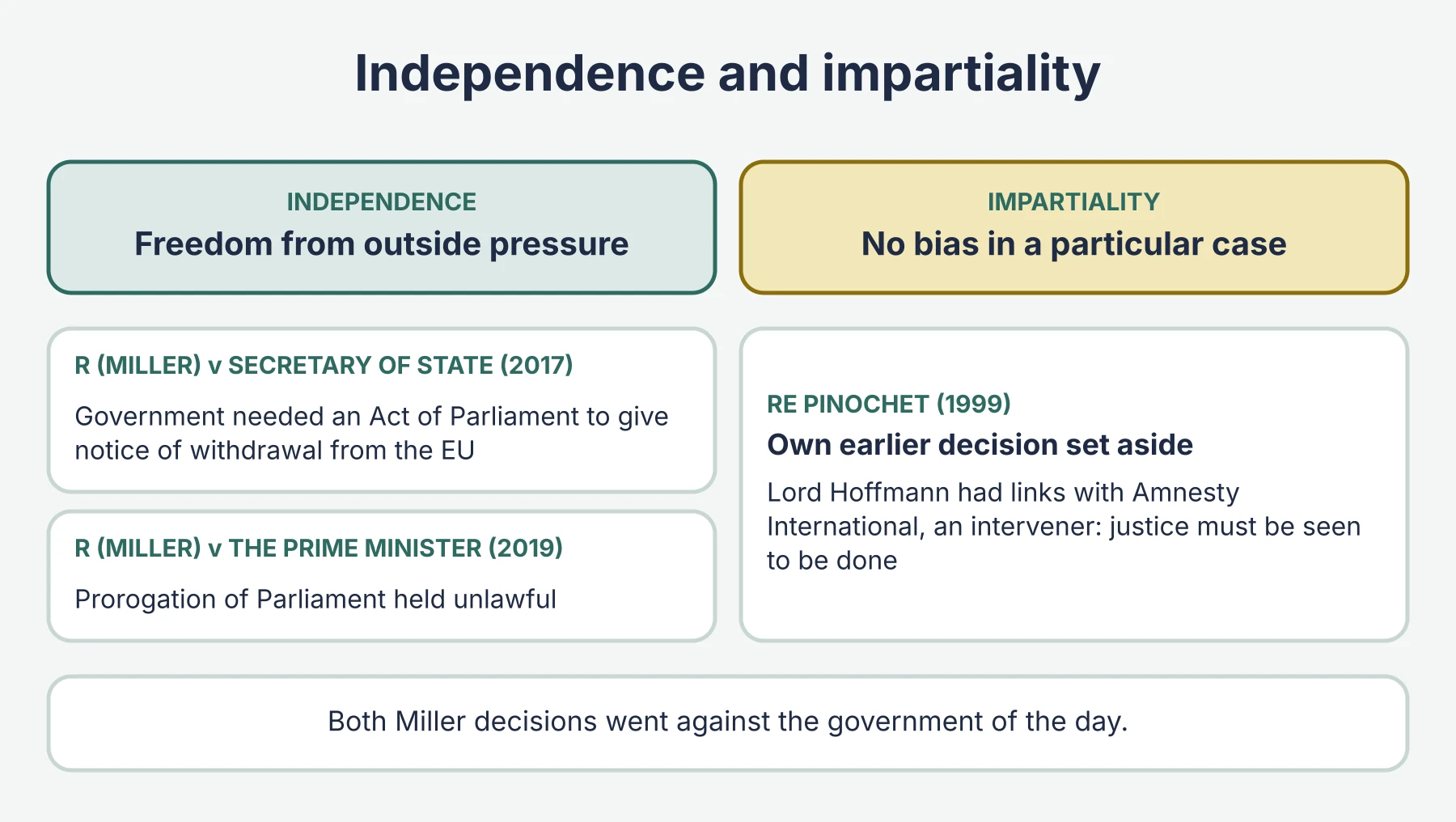
Examples: R (Miller) v Secretary of State for Exiting the European Union (2017) and R (Miller) v The Prime Minister (2019), both against the government. Impartiality: Re Pinochet (1999).
Key terms
| Term | Meaning |
|---|---|
| Rights of audience | The right to appear as an advocate in a court |
| Cab-rank rule | A barrister must accept work in their field at a proper fee whoever the client |
| Pupillage | Supervised training a barrister completes before practising |
| Solicitor-advocate | Solicitor with a higher rights qualification |
| King’s Counsel | Senior advocate appointed for excellence in advocacy |
| Security of tenure | Protection from removal from office except in limited ways |
| Immunity from suit | Judges cannot be sued for acts in their judicial capacity |
| Separation of powers | Legislature, Executive and judiciary kept apart |
| Impartiality | No bias, or appearance of bias, in a particular case |
Exam traps
- Treating the Legal Ombudsman as a disciplinary tribunal.
- Saying legal executives must have a degree.
- Giving superior-judge tenure rules for circuit judges.
- Naming only the methods of independence without explaining why each protects it.
- Forgetting that the Supreme Court, not the House of Lords, has been the final court since 2009.
Self-test
- Who usually instructs a barrister?
- What is the cab-rank rule?
- What examinations do intending solicitors now take?
- Name the regulator of barristers and of solicitors.
- What does the Legal Ombudsman do?
- Which case removed advocates’ immunity from negligence claims?
- Name two superior and two inferior types of judge.
- Give two roles of a Crown Court judge.
- How can a High Court judge be removed?
- Which case gives judges immunity from suit?
- Which section of which Act guarantees judicial independence?
- Give one case showing judges ruling against the government.
Answers: 1. A solicitor, though public access work allows some direct instruction. 2. A barrister must accept work in their field at a proper fee, whoever the client. 3. SQE1 and SQE2. 4. Bar Standards Board; Solicitors Regulation Authority. 5. Resolves complaints about poor service from regulated lawyers. 6. Arthur JS Hall & Co v Simons (2000). 7. Superior: Supreme Court Justices, High Court judges; inferior: circuit judges, district judges. 8. Any two of: rule on law and evidence, direct the jury, sum up, sentence. 9. By the monarch on an address of both Houses of Parliament. 10. Sirros v Moore (1975). 11. Section 3 of the Constitutional Reform Act 2005. 12. R (Miller) v The Prime Minister (2019).
Test yourself further with the legal personnel and the judiciary practice questions.
Related resources
-
Study guides
AQA A Level Law (7162): The Legal System: The Civil Courts and Other Forms of Dispute Resolution
Civil courts, the track and appeal systems, the tribunal structure, and the roles of mediation and negotiation, explained for AQA A Level Law 7162 section 3.1.
Law · AQA · A Level
Read guide -
Practice questions
AQA A Level Law (7162): The Legal System: The Civil Courts and Other Forms of Dispute Resolution – Practice Questions
Original practice questions with full answers on civil courts, tracks, appeals, tribunals, mediation and negotiation, with advice scenarios, for AQA Law 7162.
Law · AQA · A Level
Try questions -
Revision notes
AQA A Level Law (7162): The Legal System: The Civil Courts and Other Forms of Dispute Resolution – Revision Notes
Revision notes on civil courts, claim stages, tracks, appeals, tribunals, mediation and negotiation, with key terms, traps and a self-test for AQA Law 7162.
Law · AQA · A Level
Revise topic
Get free revision emails (optional)
Occasional emails with practice questions, worked explanations and links to free resources for the qualification and subjects you choose. No spam, and you can unsubscribe from any email. The free tools on this site never need an email.