
Revision Notes
AQA A Level Law (7162): Law Making: Parliamentary Law Making – Revision Notes
Revision notes on Green and White Papers, Bill stages, Parliament Acts, influences on Parliament and supremacy's limits, with a self-test for AQA Law 7162.
- Subject
- Law
- Level
- A LEVELS
- Topic
- Section 3.1 – The Nature of Law and the English Legal System
- Author
- Marlbridge Academic Team
- Updated
- Reviewed by
- Aizaz Raoof Ali (what this means)
Aligned to AQA A Level Law (7162), For teaching from September 2017 onwards, A-level exams 2019 onwards. Official specification .
Syllabus page (what it covers and how it is assessed): AQA A Level Law.
Syllabus points this page covers
7162
- Law making: parliamentary law making
Found an error? Report a correction.
Need help with this topic? Request a free trial class for A Level Law (7162).
Condensed notes on Law making: parliamentary law making in AQA A-level Law (7162) section 3.1: Green and White Papers, the formal legislative process, influences on Parliament and their advantages and disadvantages, and parliamentary supremacy with its limits. For full explanation, see the Parliamentary Law Making study guide.
Pre-legislative stage
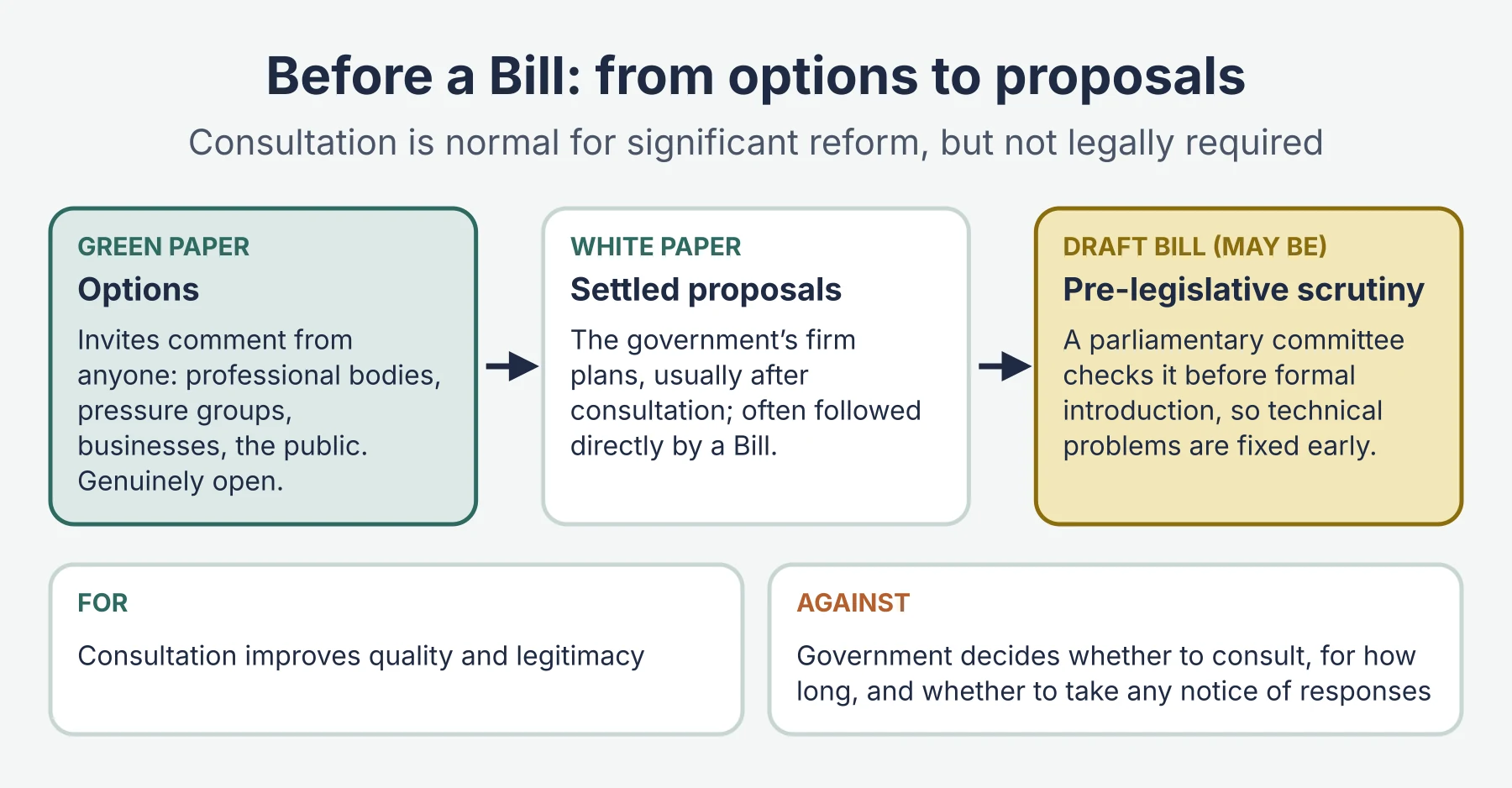
- Green Paper: options for consultation; open to anyone.
- White Paper: settled government proposals, usually after consultation.
- Draft Bill: may receive pre-legislative scrutiny by a committee.
- Evaluation: consultation improves quality and legitimacy, but government controls whether and how it consults.
Types of Bill
| Type | Key point | Example |
|---|---|---|
| Government public Bill | Introduced by a minister | Most major Acts |
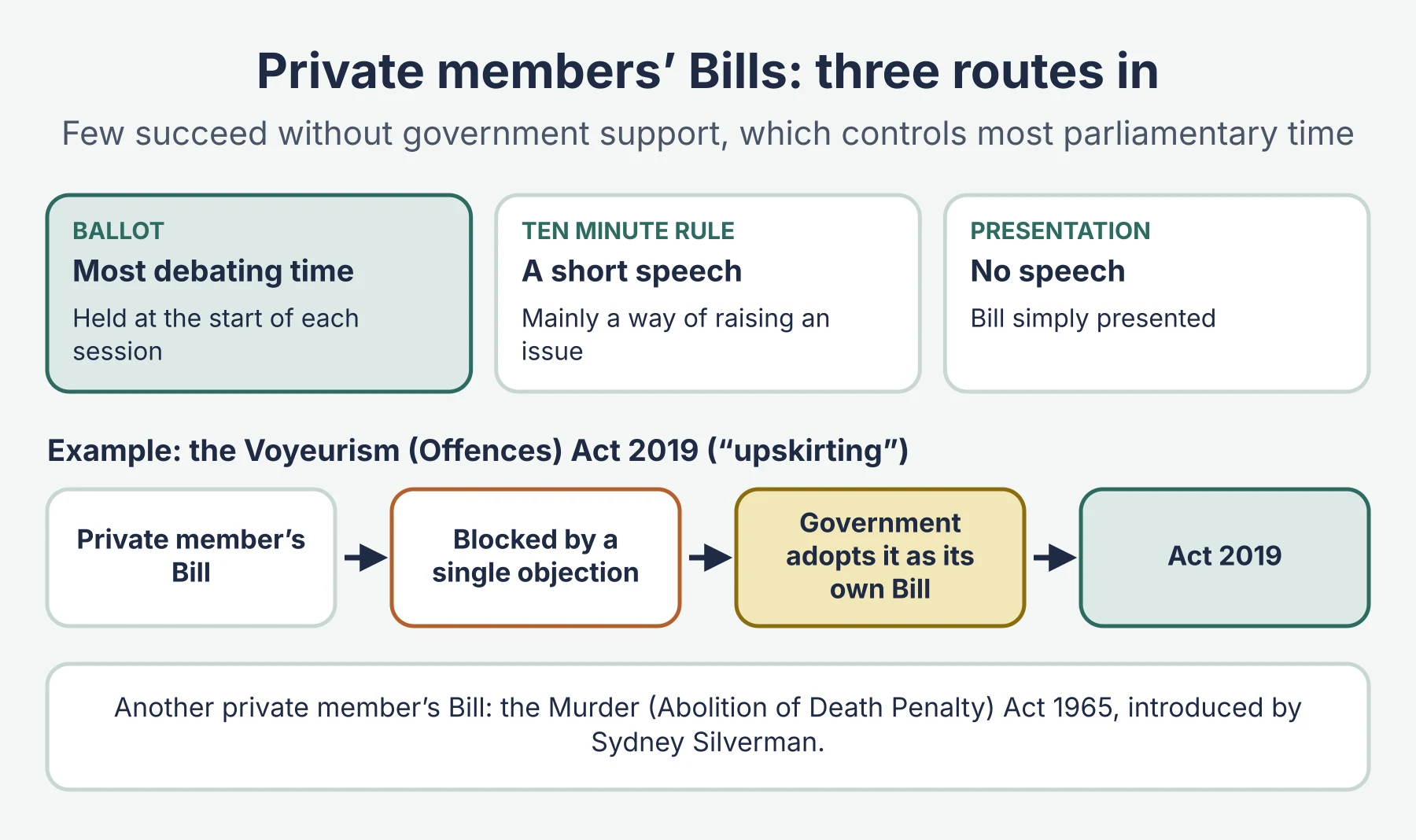
| Private member’s Bill | Backbencher; routes: ballot, Ten Minute Rule, presentation | Murder (Abolition of Death Penalty) Act 1965 |
| Private Bill | Affects a particular body or place | Local authority powers |
| Hybrid Bill | Public Bill affecting particular private interests | High Speed Rail (London - West Midlands) Act 2017 |
Private members’ Bills rarely pass without government support. The Voyeurism (Offences) Act 2019 was adopted by government after a private member’s Bill was blocked.
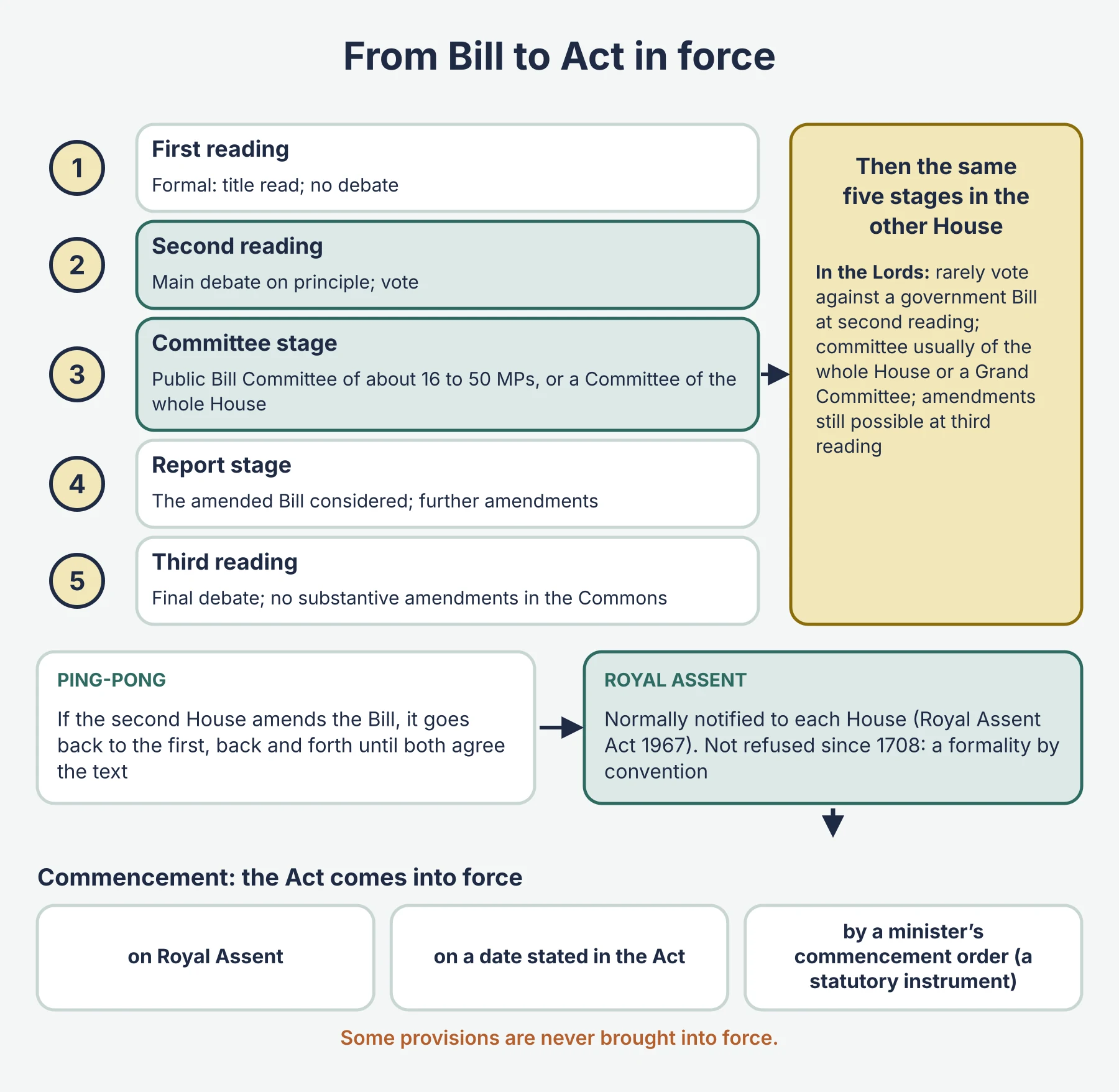
The stages and what happens at each
- First reading: formal; no debate.
- Second reading: debate on principle; vote.
- Committee: line-by-line scrutiny. Commons: Public Bill Committee (16 to 50 MPs) or Committee of the whole House for major constitutional Bills. Lords: usually whole House or Grand Committee.
- Report: amended Bill considered; more amendments.
- Third reading: final vote; no substantive amendments in the Commons, amendments still possible in the Lords.
- Other House: same stages; ping-pong until agreement.
- Royal Assent: notified under the Royal Assent Act 1967; not refused since 1708.
- Commencement: on assent, on a stated date, or by a commencement order (a statutory instrument).
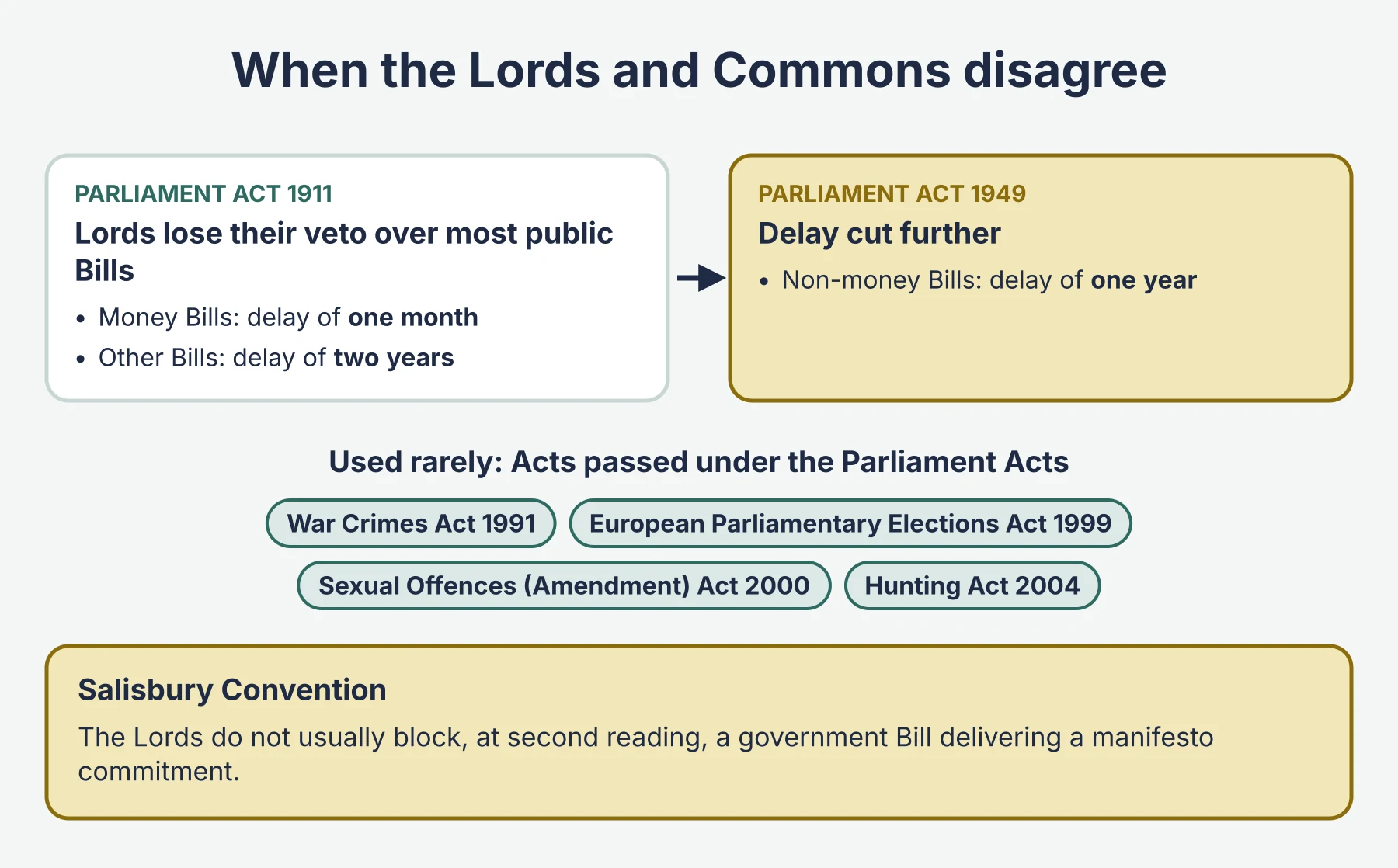
Lords and Commons in conflict
| Measure | Effect |
|---|---|
| Parliament Act 1911 | Lords’ veto removed; delay of one month for money Bills, two years for others |
| Parliament Act 1949 | Delay for non-money Bills cut to one year |
| Uses | War Crimes Act 1991; European Parliamentary Elections Act 1999; Sexual Offences (Amendment) Act 2000; Hunting Act 2004 |
| Salisbury Convention | Lords do not block manifesto Bills at second reading |
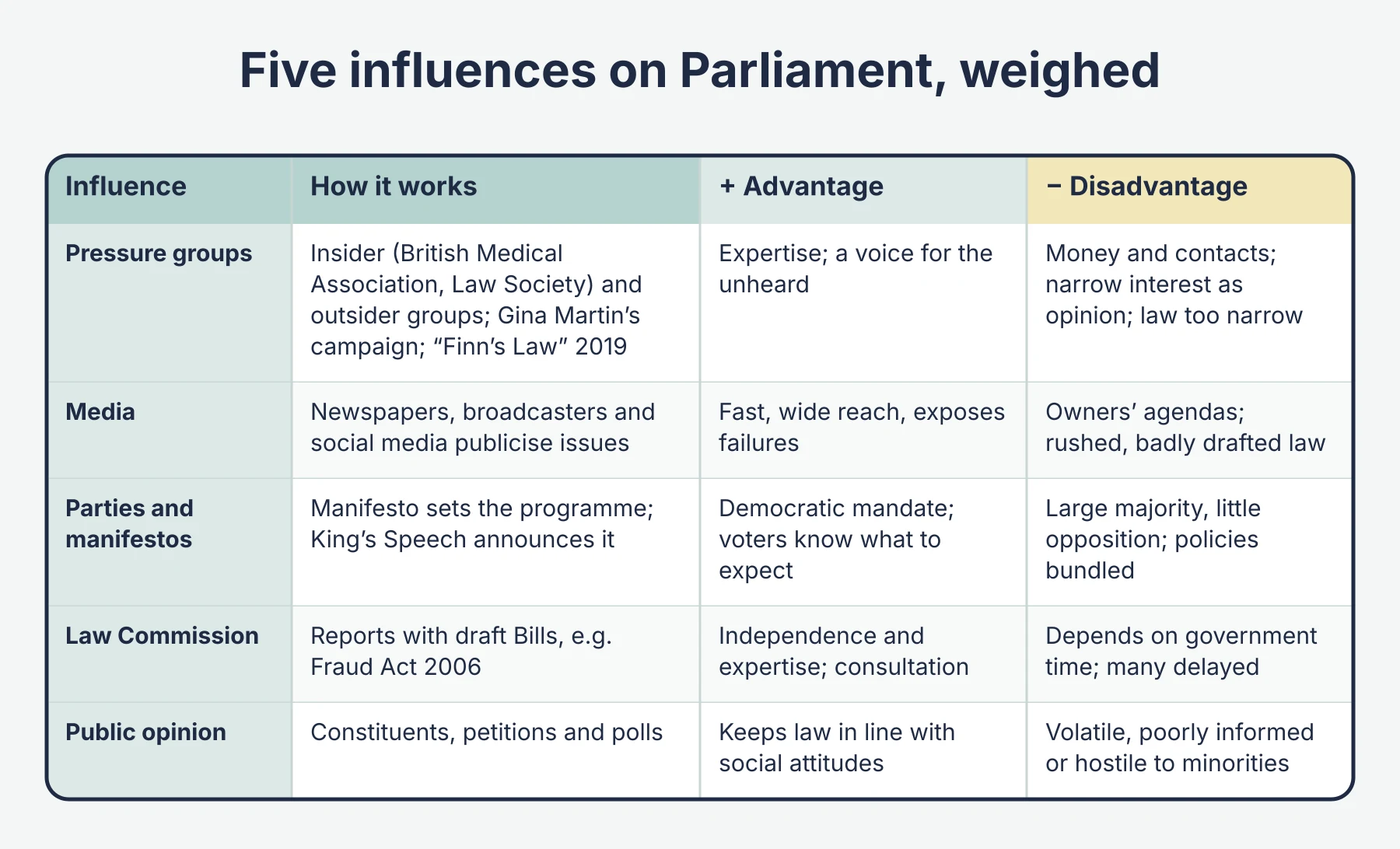
Influences: how, example, for, against
| Influence | Example | Advantage | Disadvantage |
|---|---|---|---|
| Pressure groups (insider and outsider) | Gina Martin’s campaign; Voyeurism (Offences) Act 2019. “Finn’s Law”: Animal Welfare (Service Animals) Act 2019 | Expertise; voice for the unheard | Money and contacts buy influence; one-case laws |
| Media | Campaigns after high-profile failures | Speed; reach; accountability | Owners’ agendas; rushed drafting |
| Political parties | Manifesto; King’s Speech | Democratic mandate | Large majorities weaken scrutiny; manifesto bundles policies |
| Law Commission | Fraud Act 2006 | Independent, expert | Dependent on government time |
| Public opinion | Petitions, constituents | Keeps law in step with society | Volatile; may disregard minorities |
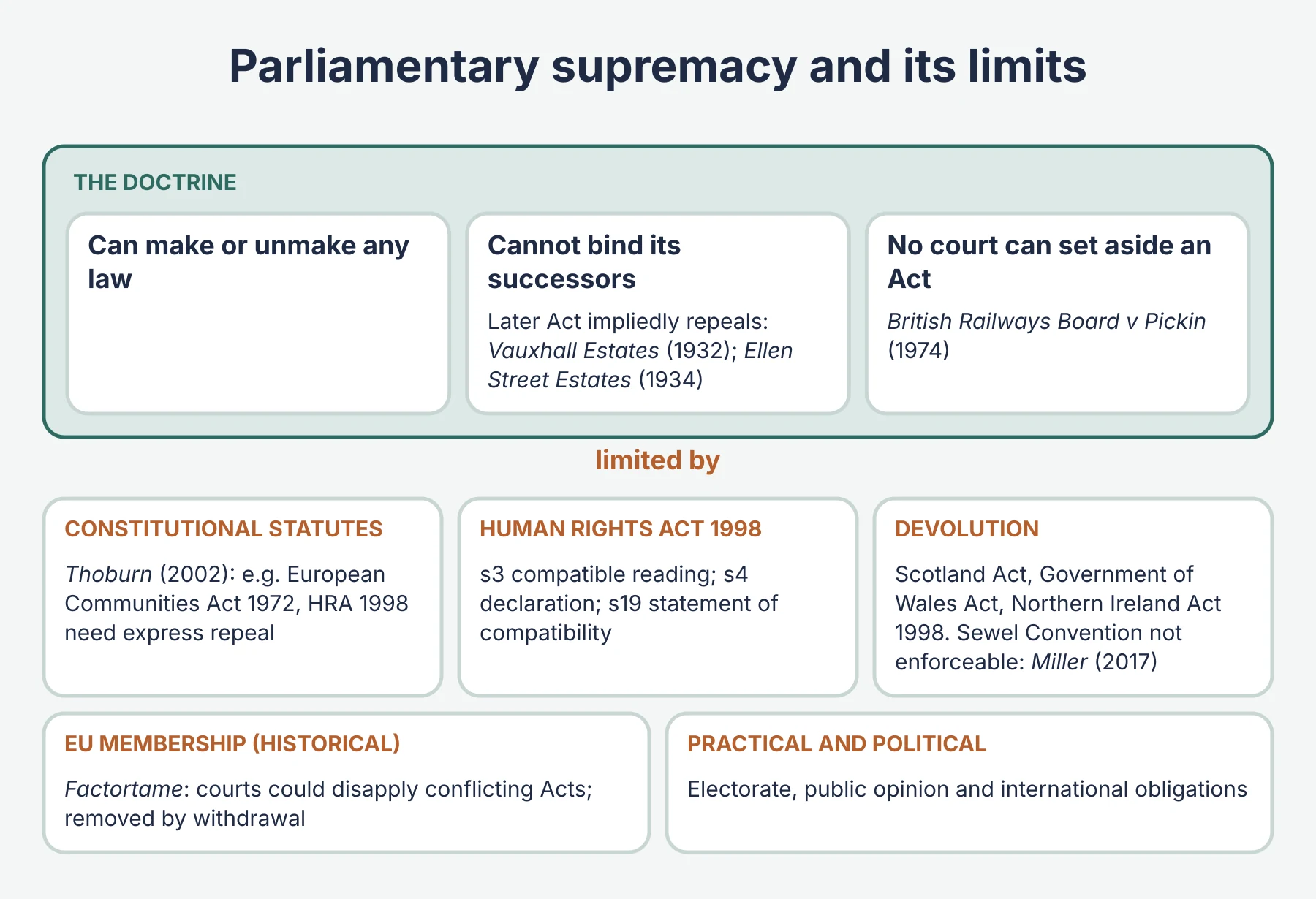
Parliamentary supremacy
Three parts:
- Parliament can make or unmake any law.
- No Parliament can bind its successors: implied repeal, Vauxhall Estates v Liverpool Corporation (1932), Ellen Street Estates v Minister of Health (1934).
- No court can set aside an Act: British Railways Board v Pickin (1974).
Limits:
- Thoburn v Sunderland City Council (2002): constitutional statutes are not impliedly repealed.
- Human Rights Act 1998: section 3 reading; section 4 declaration; section 19 statement of compatibility.
- Devolution: Sewel Convention now in statute, but not legally enforceable: R (Miller) v Secretary of State for Exiting the EU (2017).
- EU membership (historical): Factortame.
- Political: electorate, opinion, international obligations.
Key terms
| Term | Meaning |
|---|---|
| Green Paper | Consultation document setting out options |
| White Paper | Firm government proposals for legislation |
| Public Bill Committee | Commons committee that scrutinises a Bill line by line |
| Ping-pong | Passing a Bill between the Houses until both agree |
| Commencement order | Statutory instrument bringing an Act into force |
| Salisbury Convention | Lords do not block manifesto Bills at second reading |
| Implied repeal | A later Act overriding an inconsistent earlier Act |
| Constitutional statute | A statute that can be repealed only expressly (Thoburn) |
| Sewel Convention | Westminster does not normally legislate on devolved matters without consent |
Exam traps
- Green Paper = firm proposals (wrong: that is a White Paper).
- Lords can veto any Bill (wrong: the Parliament Acts limit them).
- Listing stages without saying what happens at each.
- Influences without advantages and disadvantages.
- Saying the Human Rights Act lets courts strike down Acts.
Self-test
- Distinguish a Green Paper from a White Paper.
- Name the three routes for a private member’s Bill in the Commons.
- What happens at committee stage in the Commons?
- What is ping-pong?
- What did the Royal Assent Act 1967 change?
- What is a commencement order?
- State the delay the Lords can impose on a non-money Bill under the Parliament Act 1949.
- What is the Salisbury Convention?
- Give one example of a pressure group or campaign influencing an Act.
- Explain implied repeal with a case.
- What did Thoburn add to the doctrine of supremacy?
- Why is the Sewel Convention not a legal limit on Parliament?
Answers: 1. A Green Paper sets out options for consultation; a White Paper sets out the government’s firm proposals. 2. The ballot, the Ten Minute Rule and presentation. 3. Line-by-line scrutiny and amendment, usually by a Public Bill Committee, or for major constitutional Bills a Committee of the whole House. 4. Passing a Bill between the two Houses until they agree on the text. 5. Assent is normally notified to each House rather than given in person. 6. A statutory instrument made by a minister to bring an Act or part of it into force. 7. One year. 8. The Lords do not usually block, at second reading, government Bills carrying out manifesto commitments. 9. Gina Martin’s campaign and the Voyeurism (Offences) Act 2019, or Finn’s Law. 10. A later Act overrides an inconsistent earlier one, as in Ellen Street Estates v Minister of Health (1934). 11. That constitutional statutes cannot be impliedly repealed; only express words will do. 12. The Supreme Court in Miller (2017) held it is a political convention the courts cannot enforce, even though it appears in statute.
More resources on this topic
Parliamentary Law Making study guide | Parliamentary Law Making practice questions | Delegated Legislation revision notes
Related resources
-
Study guides
AQA A Level Law (7162): Law Making: Statutory Interpretation
Statutory interpretation for AQA A Level Law 7162: literal, golden and mischief rules, the purposive approach, aids, and the impact of EU law and the HRA.
Law · AQA · A Level
Read guide -
Practice questions
AQA A Level Law (7162): Law Making: Statutory Interpretation – Practice Questions
Original practice questions with full answers on statutory interpretation rules, aids, language rules, EU law and the HRA, with scenarios for AQA Law 7162.
Law · AQA · A Level
Try questions -
Revision notes
AQA A Level Law (7162): Law Making: Statutory Interpretation – Revision Notes
Revision notes on the four approaches to interpretation, aids, language rules, EU law and the HRA, with a case bank, key terms and self-test for AQA Law 7162.
Law · AQA · A Level
Revise topic
Get free revision emails (optional)
Occasional emails with practice questions, worked explanations and links to free resources for the qualification and subjects you choose. No spam, and you can unsubscribe from any email. The free tools on this site never need an email.