
Revision Notes
AQA A Level Law (7162): Law Making: Delegated Legislation – Revision Notes
Revision notes on the three types of delegated legislation, its controls, reasons and evaluation, with cases, key terms and a self-test for AQA Law 7162.
- Subject
- Law
- Level
- A LEVELS
- Topic
- Section 3.1 – The Nature of Law and the English Legal System
- Author
- Marlbridge Academic Team
- Updated
- Reviewed by
- Aizaz Raoof Ali (what this means)
Aligned to AQA A Level Law (7162), For teaching from September 2017 onwards, A-level exams 2019 onwards. Official specification .
Syllabus page (what it covers and how it is assessed): AQA A Level Law.
Syllabus points this page covers
7162
- Law making: delegated legislation
Found an error? Report a correction.
Need help with this topic? Request a free trial class for A Level Law (7162).
Condensed notes on Law making: delegated legislation in AQA A-level Law (7162) section 3.1: the three types, parliamentary and judicial controls, reasons for use, and advantages and disadvantages. For full explanation and a worked scenario, see the Delegated Legislation study guide.
Definition
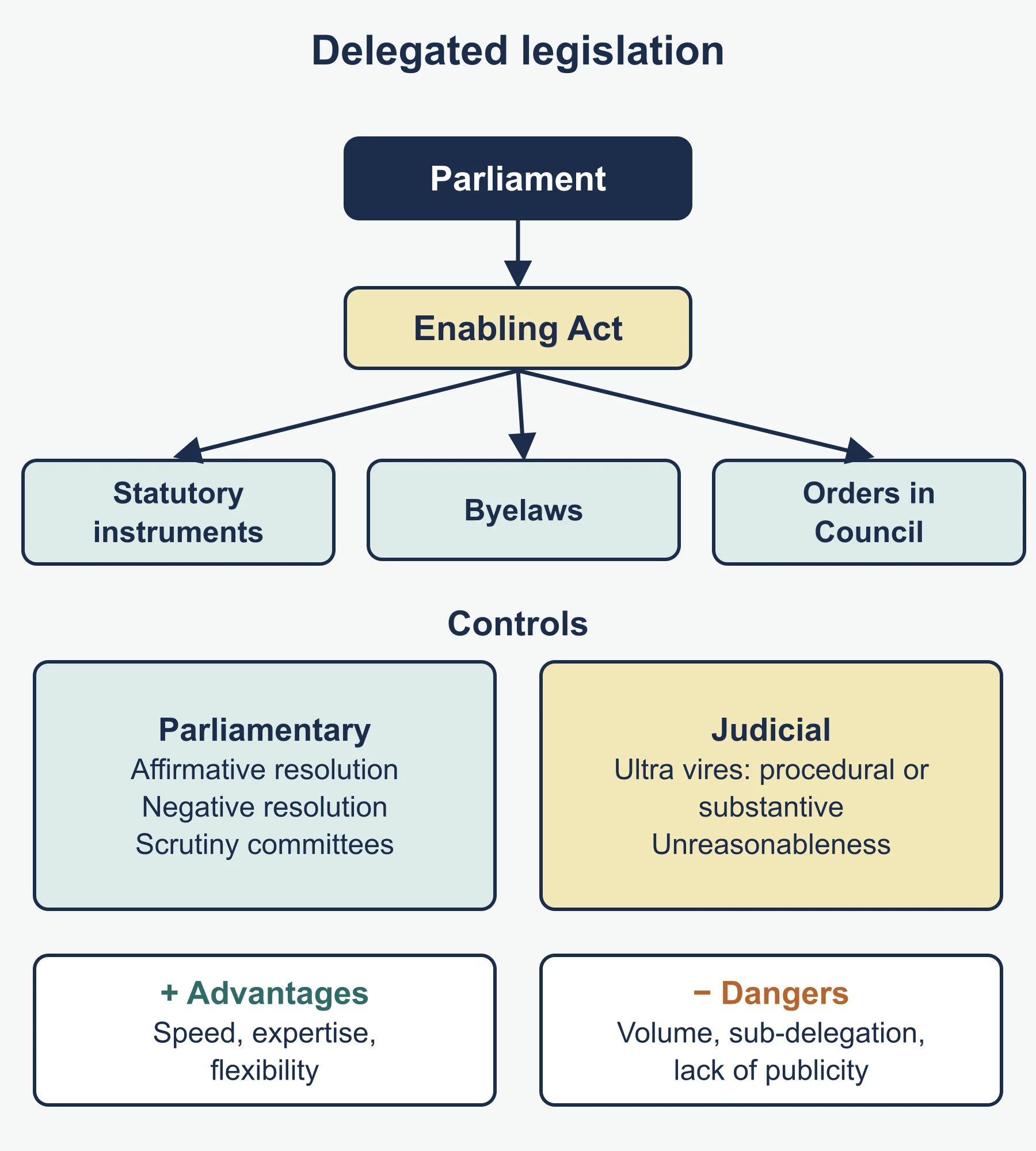
Law made by a person or body other than Parliament, under power granted by an enabling (parent) Act. Valid only within that power.
The three types
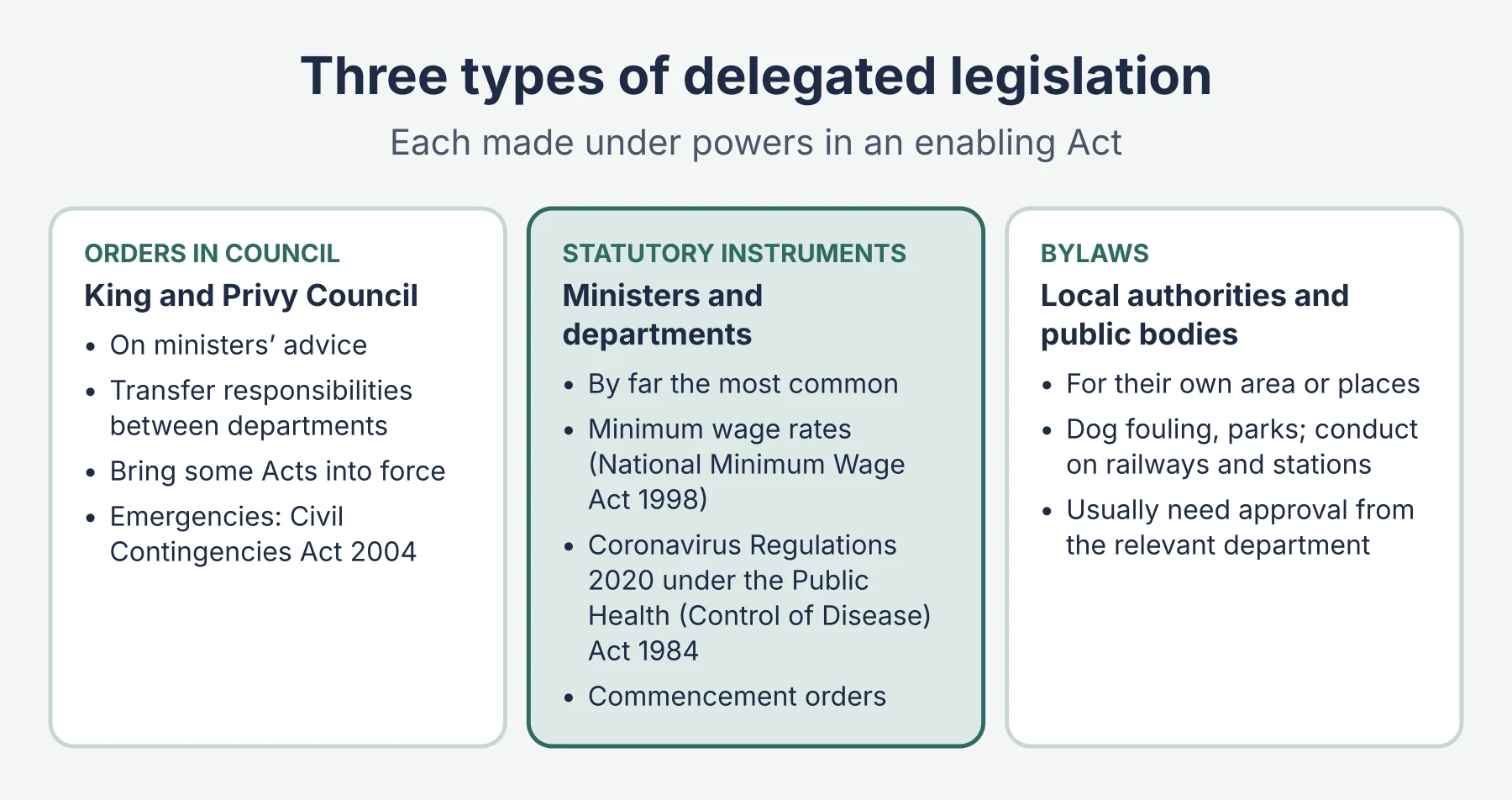
| Type | Made by | Examples |
|---|---|---|
| Order in Council | King and Privy Council, on ministers’ advice | Transferring departmental functions; emergency regulations under the Civil Contingencies Act 2004 |
| Statutory instrument | Ministers and departments | Minimum wage rates under the National Minimum Wage Act 1998; Health Protection (Coronavirus, Restrictions) (England) Regulations 2020; commencement orders |
| Bylaw | Local authorities and public bodies | Park and dog-fouling rules; railway bylaws |
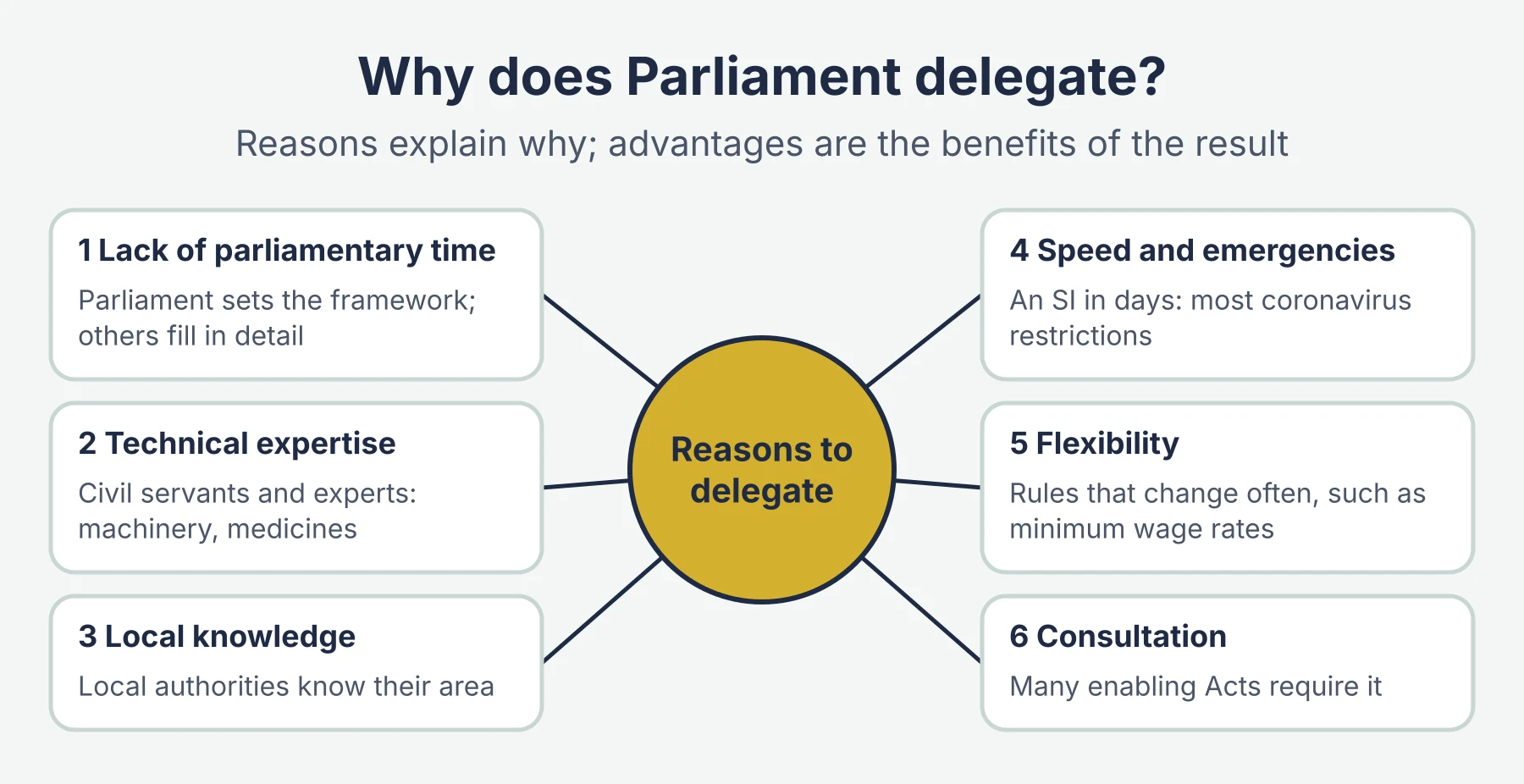
Reasons (why Parliament delegates)
- Not enough parliamentary time.
- Technical expertise.
- Local knowledge.
- Speed, especially in emergencies.
- Flexibility to update.
- Consultation with those affected.
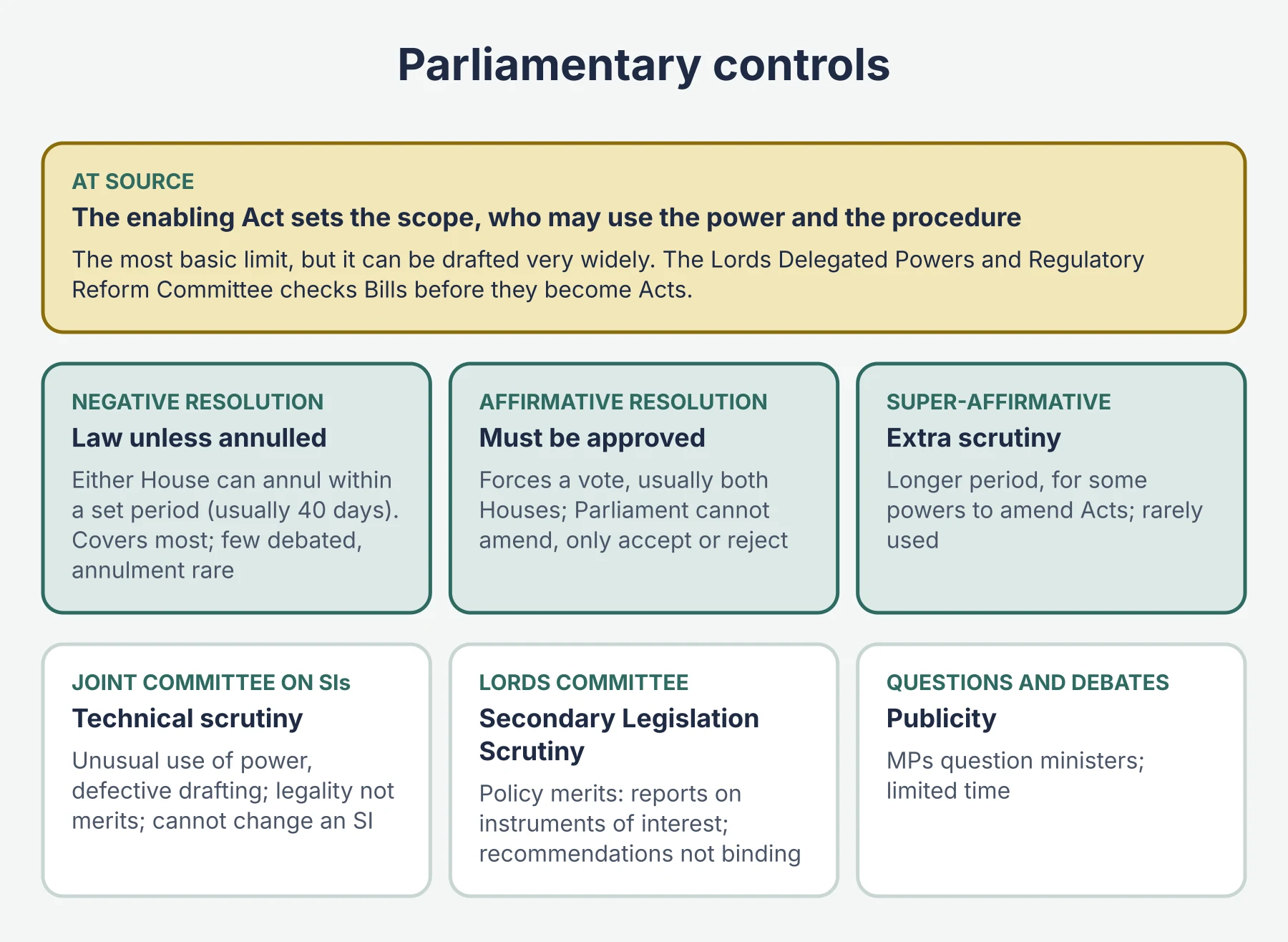
Parliamentary controls
- Enabling Act: sets the limits; the first and most important control.
- Negative resolution: law unless annulled, usually within 40 days. Most instruments; rarely debated.
- Affirmative resolution: must be approved. Forces a vote, but no power to amend.
- Super-affirmative: extra scrutiny for some powers to amend Acts.
- Joint Committee on Statutory Instruments: technical scrutiny; reports only.
- Lords Secondary Legislation Scrutiny Committee: considers policy merits; reports only.
- Lords Delegated Powers and Regulatory Reform Committee: checks the powers in Bills before they are passed.
- Questions and debates on ministers’ use of powers.
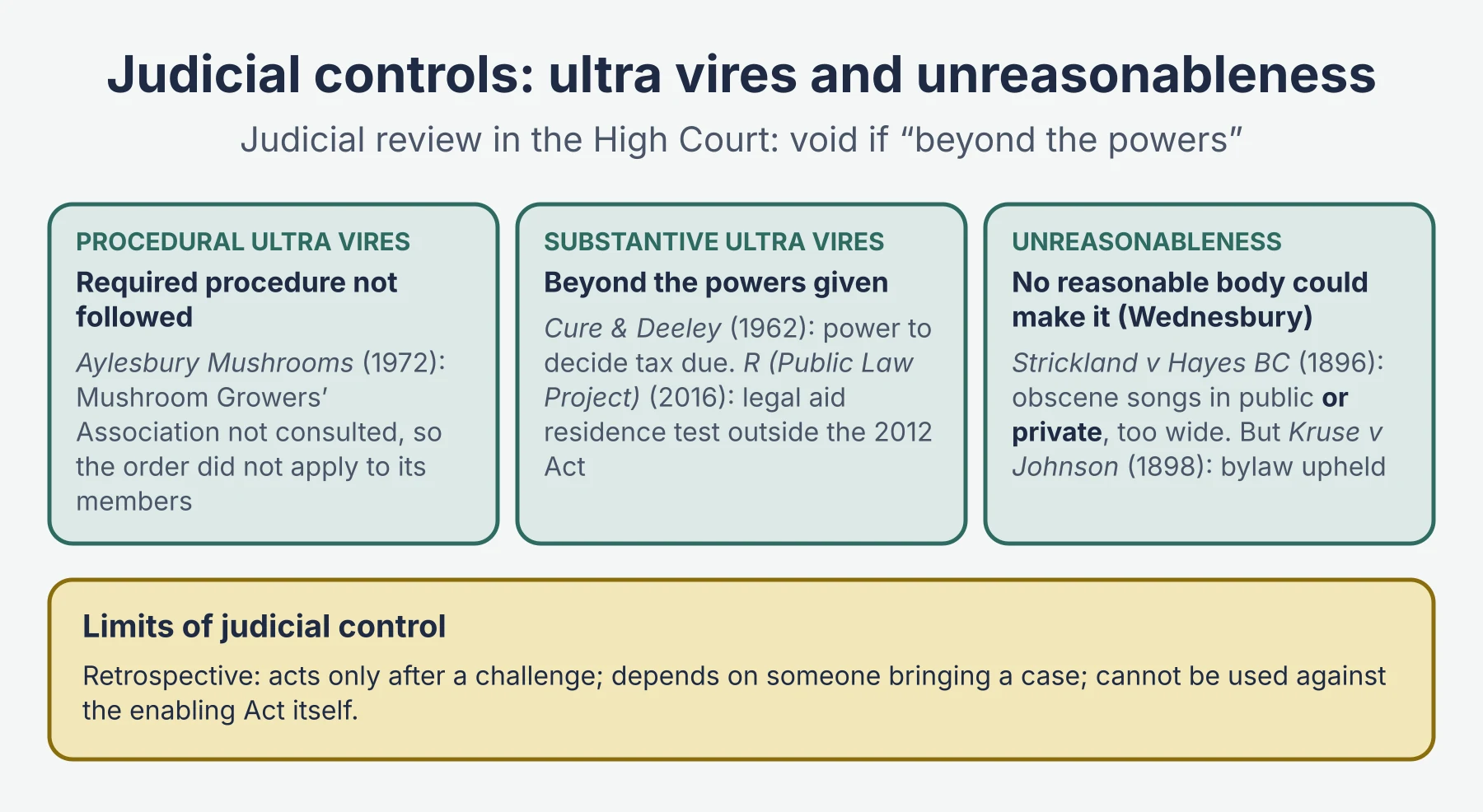
Judicial controls (judicial review in the High Court)
| Ground | Meaning | Case |
|---|---|---|
| Procedural ultra vires | Required procedure not followed | Aylesbury Mushrooms (1972): Mushroom Growers’ Association not consulted |
| Substantive ultra vires | Beyond the powers granted | Cure & Deeley (1962): commissioners gave themselves power to decide tax due; R (Public Law Project) v Lord Chancellor (2016): legal aid residence test outside the Act’s powers |
| Unreasonableness | No reasonable body could have made it (Wednesbury, 1948) | Strickland v Hayes BC (1896): bylaw banning obscene songs in private places too wide |
| Reasonableness upheld | Courts slow to interfere | Kruse v Johnson (1898): bylaw on music near houses upheld |
Limits of judicial control: only after a challenge; needs a claimant with sufficient interest; cannot challenge the enabling Act itself.
Evaluation
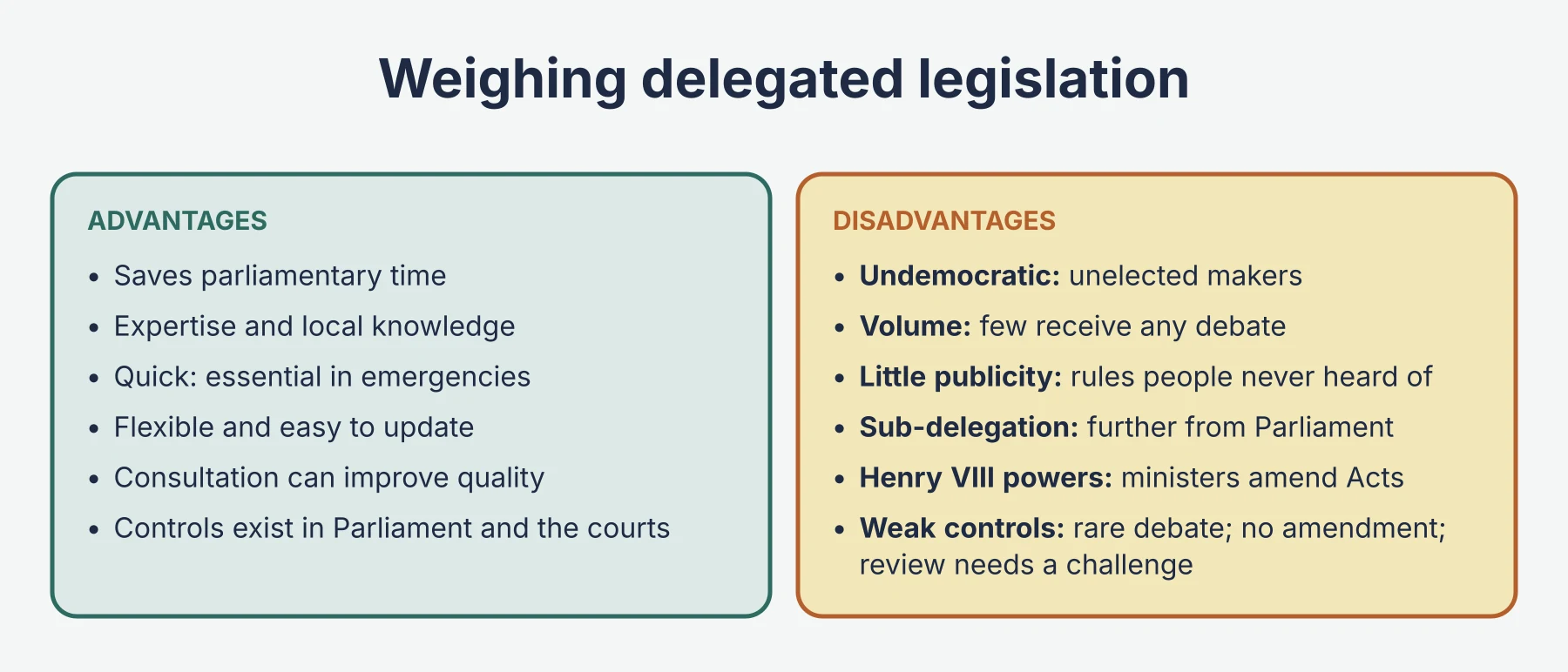
| Advantages | Disadvantages |
|---|---|
| Saves parliamentary time | Undemocratic: unelected makers |
| Expertise and local knowledge | Volume: few debated |
| Speed in emergencies | Lack of publicity |
| Flexibility | Sub-delegation |
| Consultation | Henry VIII powers amend Acts |
| Controls exist | Controls are weak in practice |
Judgement line: delegated legislation is necessary for modern government; the real question is whether controls are strong enough, and the negative procedure and lack of amendment powers suggest they are not.
Key terms
| Term | Meaning |
|---|---|
| Enabling Act | The Act giving the power to make delegated legislation |
| Statutory instrument | Delegated legislation made by a minister or department |
| Order in Council | Delegated legislation made by the monarch and Privy Council |
| Bylaw | Delegated legislation made by a local authority or public body |
| Negative resolution | Instrument stands unless annulled within a set period |
| Affirmative resolution | Instrument needs positive approval |
| Ultra vires | Beyond the powers granted |
| Sub-delegation | Passing delegated power further down |
| Henry VIII power | Power to amend or repeal an Act by delegated legislation |
Exam traps
- “Made by Parliament”: no, made under its authority.
- Reversing affirmative and negative procedures.
- Saying committees can amend or veto instruments.
- Giving procedural and substantive ultra vires without cases.
- Treating reasons and advantages as one list.
Self-test
- Define delegated legislation.
- Who makes an Order in Council?
- Give an example of a statutory instrument and its enabling Act.
- Who makes bylaws?
- Give three reasons for using delegated legislation.
- Distinguish affirmative from negative resolution.
- What is the main weakness of the affirmative procedure?
- What does the Joint Committee on Statutory Instruments do?
- Explain procedural ultra vires with a case.
- Explain substantive ultra vires with a case.
- Why was the bylaw in Strickland v Hayes invalid?
- Give two weaknesses of judicial control.
Answers: 1. Law made by a person or body other than Parliament under power granted by an enabling Act. 2. The King and the Privy Council, on the advice of ministers. 3. Minimum wage rates under the National Minimum Wage Act 1998, or the 2020 coronavirus regulations under the Public Health (Control of Disease) Act 1984. 4. Local authorities and public bodies. 5. Any three: lack of parliamentary time; expertise; local knowledge; speed; flexibility; consultation. 6. Negative: law unless annulled within a set period. Affirmative: must be approved by Parliament to take or keep effect. 7. Parliament cannot amend; it can only accept or reject the whole instrument. 8. Scrutinises instruments on technical grounds and reports to Parliament; it cannot change them. 9. The required procedure was not followed: in Aylesbury Mushrooms (1972) the duty to consult was ignored, so the order did not bind the unconsulted mushroom growers. 10. The body went beyond its powers: Cure & Deeley (1962), where commissioners gave themselves power to decide the tax due (or Public Law Project, 2016). 11. It banned obscene songs in private as well as public places, so it was too wide and unreasonable. 12. Any two: acts only after a challenge; needs someone to bring a case; cannot question the enabling Act; costs and delay.
More resources on this topic
Delegated Legislation study guide | Delegated Legislation practice questions | Parliamentary Law Making revision notes
Related resources
-
Study guides
AQA A Level Law (7162): Law Making: Judicial Precedent
Judicial precedent for AQA A Level Law 7162: court hierarchy, stare decisis, ratio and obiter, law reporting, and following, overruling and distinguishing.
Law · AQA · A Level
Read guide -
Practice questions
AQA A Level Law (7162): Law Making: Judicial Precedent – Practice Questions
Original practice questions with full answers on the court hierarchy, ratio and obiter, law reporting, overruling and distinguishing, for AQA Law 7162.
Law · AQA · A Level
Try questions -
Revision notes
AQA A Level Law (7162): Law Making: Judicial Precedent – Revision Notes
Revision notes on the court hierarchy, stare decisis, ratio and obiter, law reporting, the Practice Statement and the operation of precedent for AQA Law 7162.
Law · AQA · A Level
Revise topic
Get free revision emails (optional)
Occasional emails with practice questions, worked explanations and links to free resources for the qualification and subjects you choose. No spam, and you can unsubscribe from any email. The free tools on this site never need an email.