
Revision Notes
AQA A Level Law (7162): Law Making: Judicial Precedent – Revision Notes
Revision notes on the court hierarchy, stare decisis, ratio and obiter, law reporting, the Practice Statement and the operation of precedent for AQA Law 7162.
- Subject
- Law
- Level
- A LEVELS
- Topic
- Section 3.1 – The Nature of Law and the English Legal System
- Author
- Marlbridge Academic Team
- Updated
- Reviewed by
- Aizaz Raoof Ali (what this means)
Aligned to AQA A Level Law (7162), For teaching from September 2017 onwards, A-level exams 2019 onwards. Official specification .
Syllabus page (what it covers and how it is assessed): AQA A Level Law.
Syllabus points this page covers
7162
- Law making: judicial precedent
Found an error? Report a correction.
Need help with this topic? Request a free trial class for A Level Law (7162).
Condensed notes on Law making: judicial precedent in AQA A-level Law (7162) section 3.1: the doctrine, the hierarchy including the Supreme Court, stare decisis, ratio and obiter, law reporting, following, overruling and distinguishing, and evaluation. For full explanation and a worked application, see the Judicial Precedent study guide.
Core vocabulary
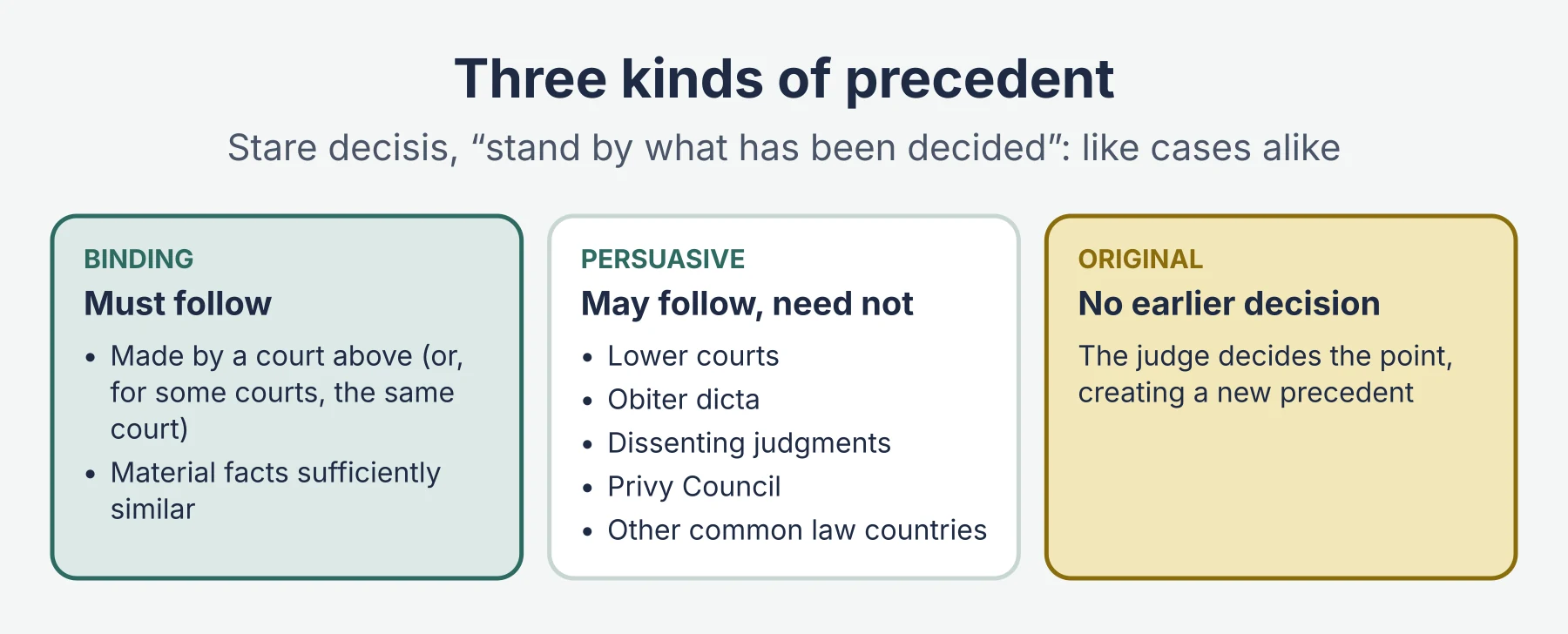
- Stare decisis: stand by what has been decided; like cases alike.
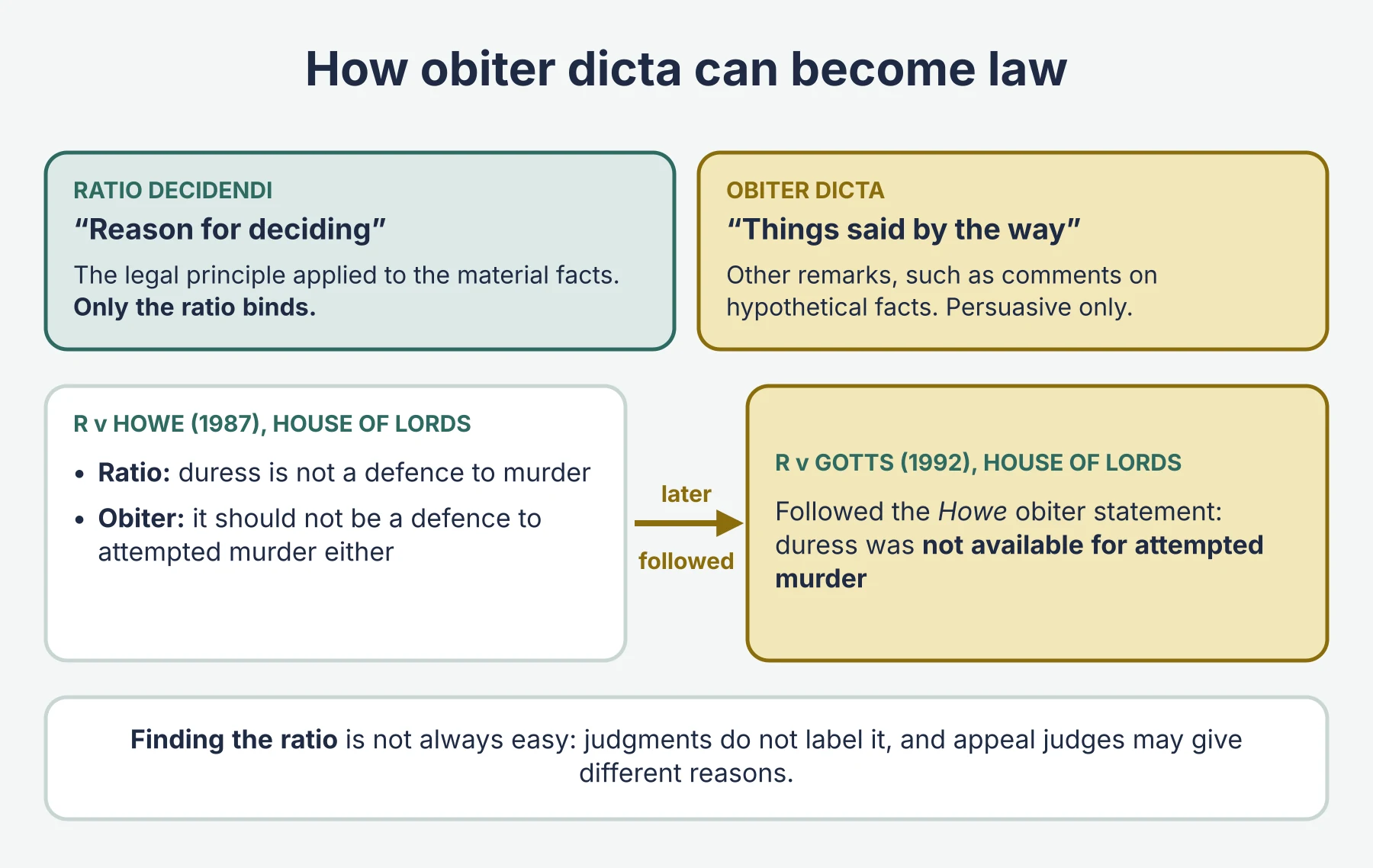
- Ratio decidendi: the legal principle on which the decision rests, applied to the material facts. Binds.
- Obiter dicta: other remarks, including hypothetical points. Persuasive.
- Binding / persuasive / original precedent.
Obiter becoming law: R v Howe (1987) said obiter that duress should not be a defence to attempted murder; R v Gotts (1992) adopted it.
Persuasive sources: lower courts; obiter; dissenting judgments; the Privy Council; other common law countries.
Hierarchy summary
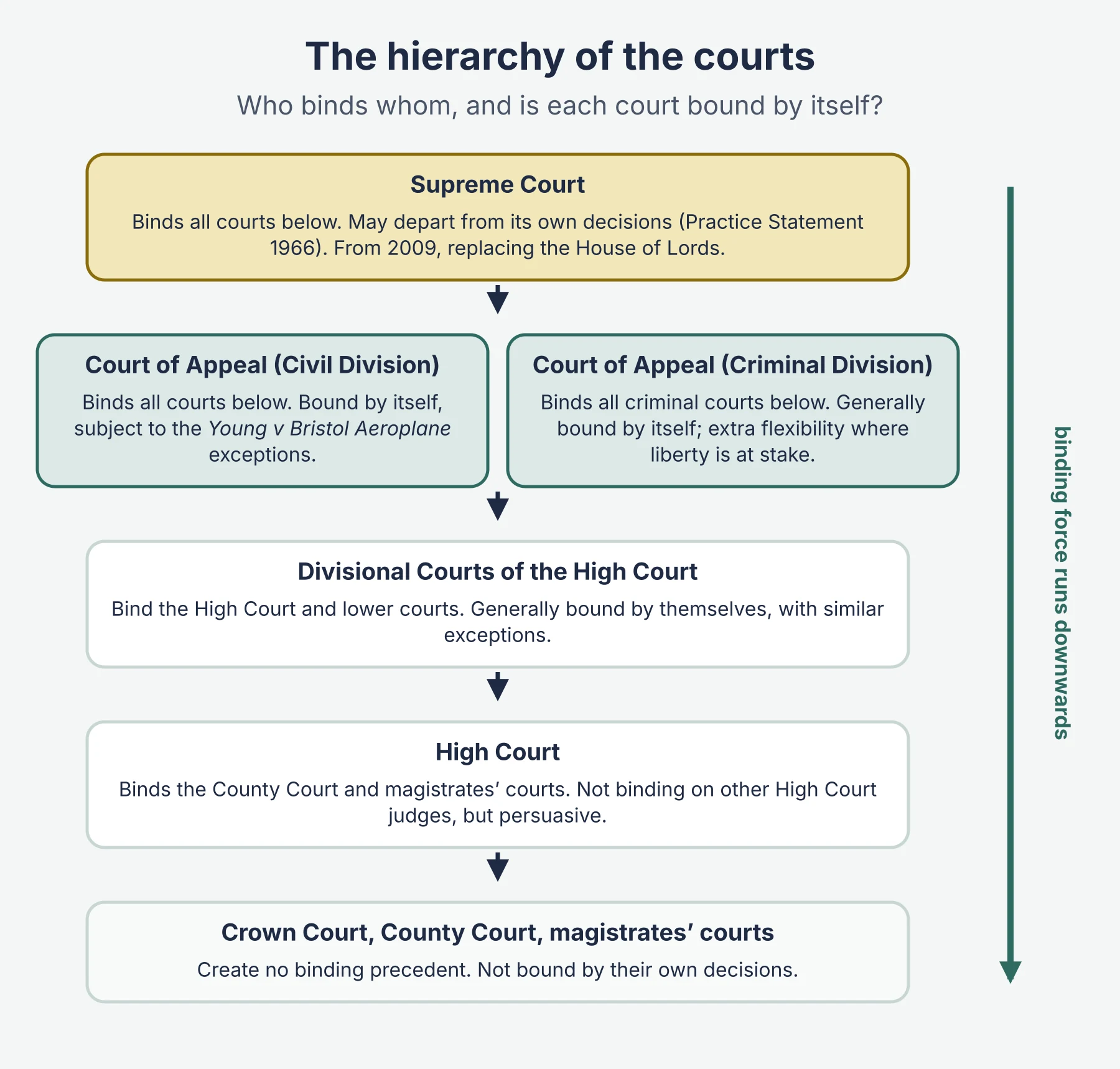
| Court | Binds | Own decisions |
|---|---|---|
| Supreme Court (from 2009) | All below | May depart: Practice Statement 1966 |
| Court of Appeal (Civil) | All below | Bound, except Young exceptions |
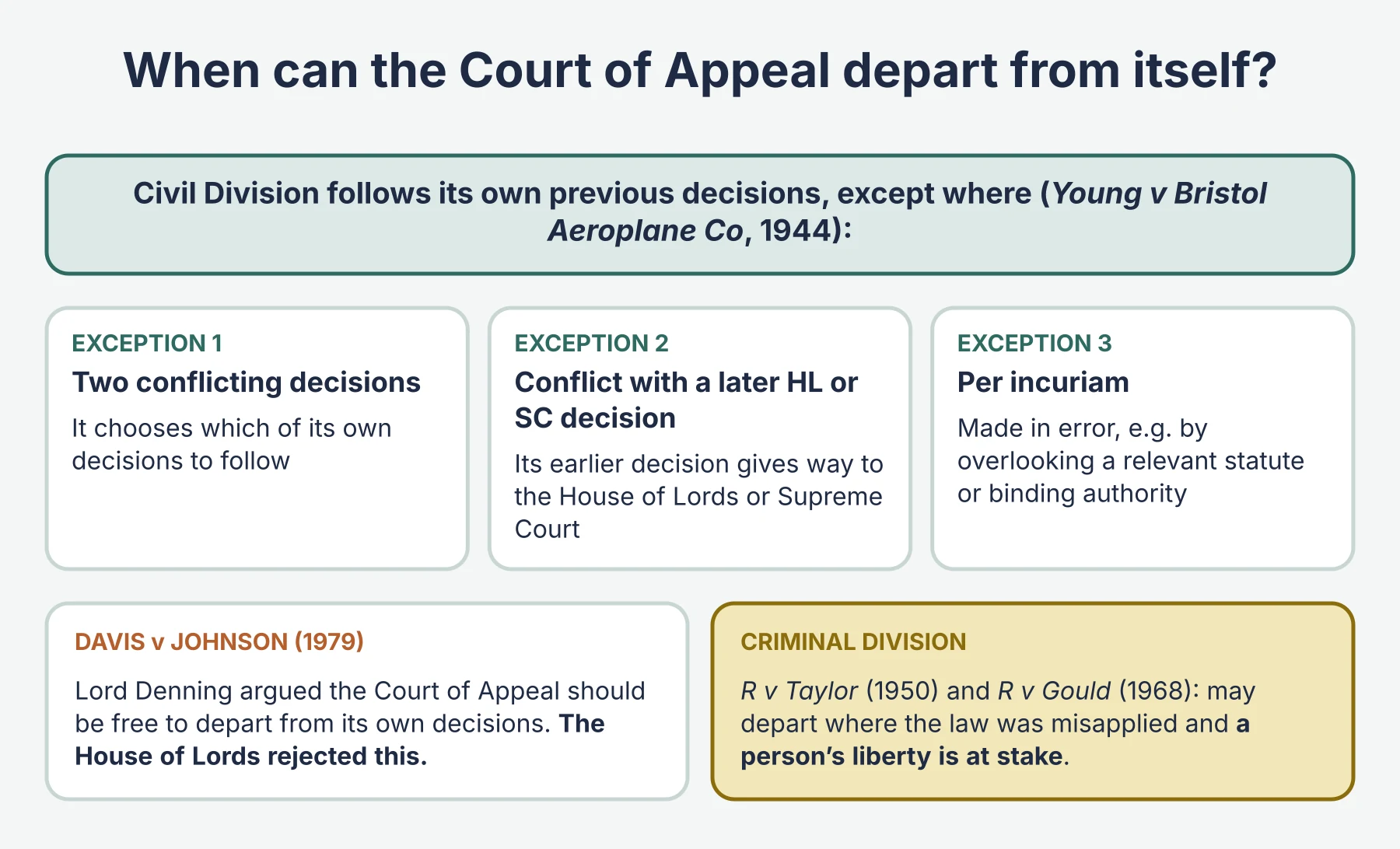
| Court of Appeal (Criminal) | Criminal courts below | Bound, but more flexible where liberty at stake (R v Taylor, 1950; R v Gould, 1968) |
| Divisional Courts | High Court and below | Generally bound |
| High Court | County Court, magistrates | Persuasive between High Court judges |
| Crown, County, magistrates’ | None | Not bound |
Practice Statement 1966
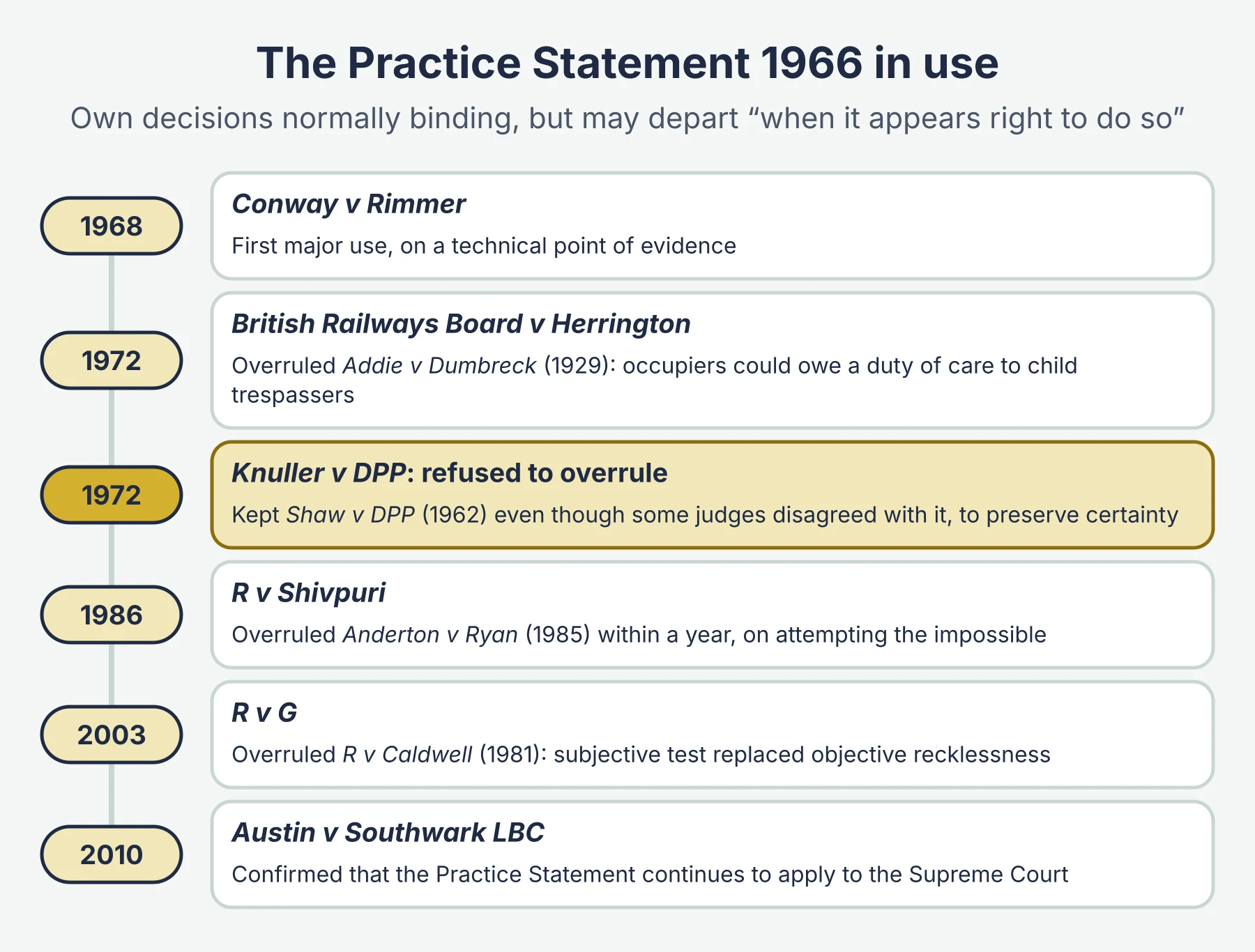
- Lord Gardiner: depart “when it appears right to do so”.
- Still applies to the Supreme Court: Austin v Southwark LBC (2010).
- Uses: Conway v Rimmer (1968); Herrington (1972) overruling Addie v Dumbreck (1929); Shivpuri (1986) overruling Anderton v Ryan (1985); R v G (2003) overruling Caldwell (1981).
- Restraint: Knuller v DPP (1972) declined to overrule Shaw v DPP.
Young v Bristol Aeroplane (1944): three exceptions
- Two conflicting Court of Appeal decisions: choose one.
- Earlier decision inconsistent with a later House of Lords or Supreme Court decision.
- Earlier decision made per incuriam (overlooking a statute or binding case).
Davis v Johnson (1979): Lord Denning’s attempt to free the Court of Appeal rejected by the House of Lords.
Privy Council
- Normally persuasive: The Wagon Mound (No 1) (1961) followed in England.
- R v James (2006): Court of Appeal followed AG for Jersey v Holley (2005) over the House of Lords.
- Willers v Joyce (2016): Privy Council may direct that its decision represents English law.
Law reporting
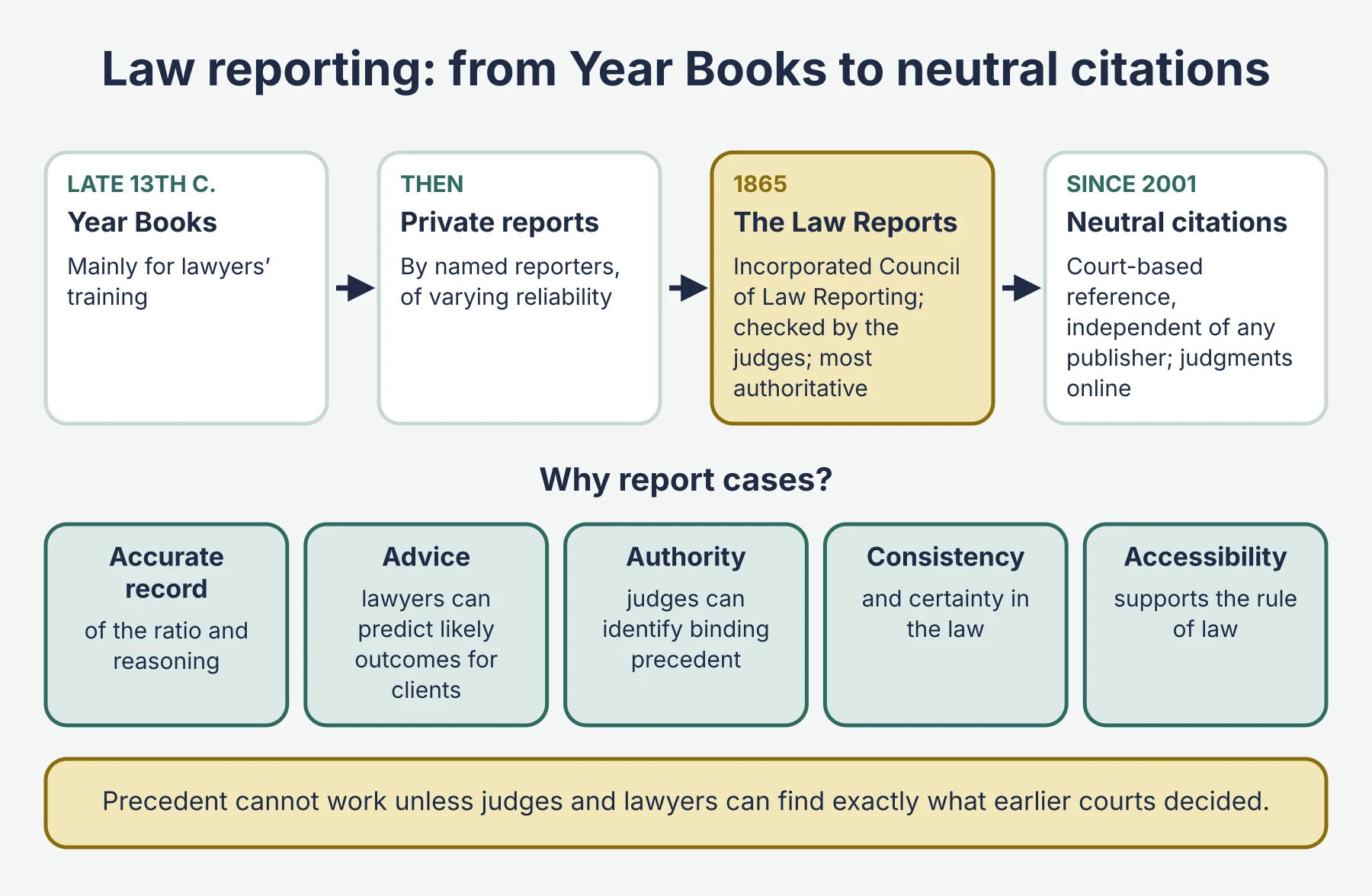
- Year Books (from the late thirteenth century) → private reports → Incorporated Council of Law Reporting (1865), The Law Reports.
- Neutral citations since 2001; judgments published online.
- Reasons: accurate record of ratio; advice to clients; identifying binding authority; consistency and certainty; accessibility.
Operation of precedent
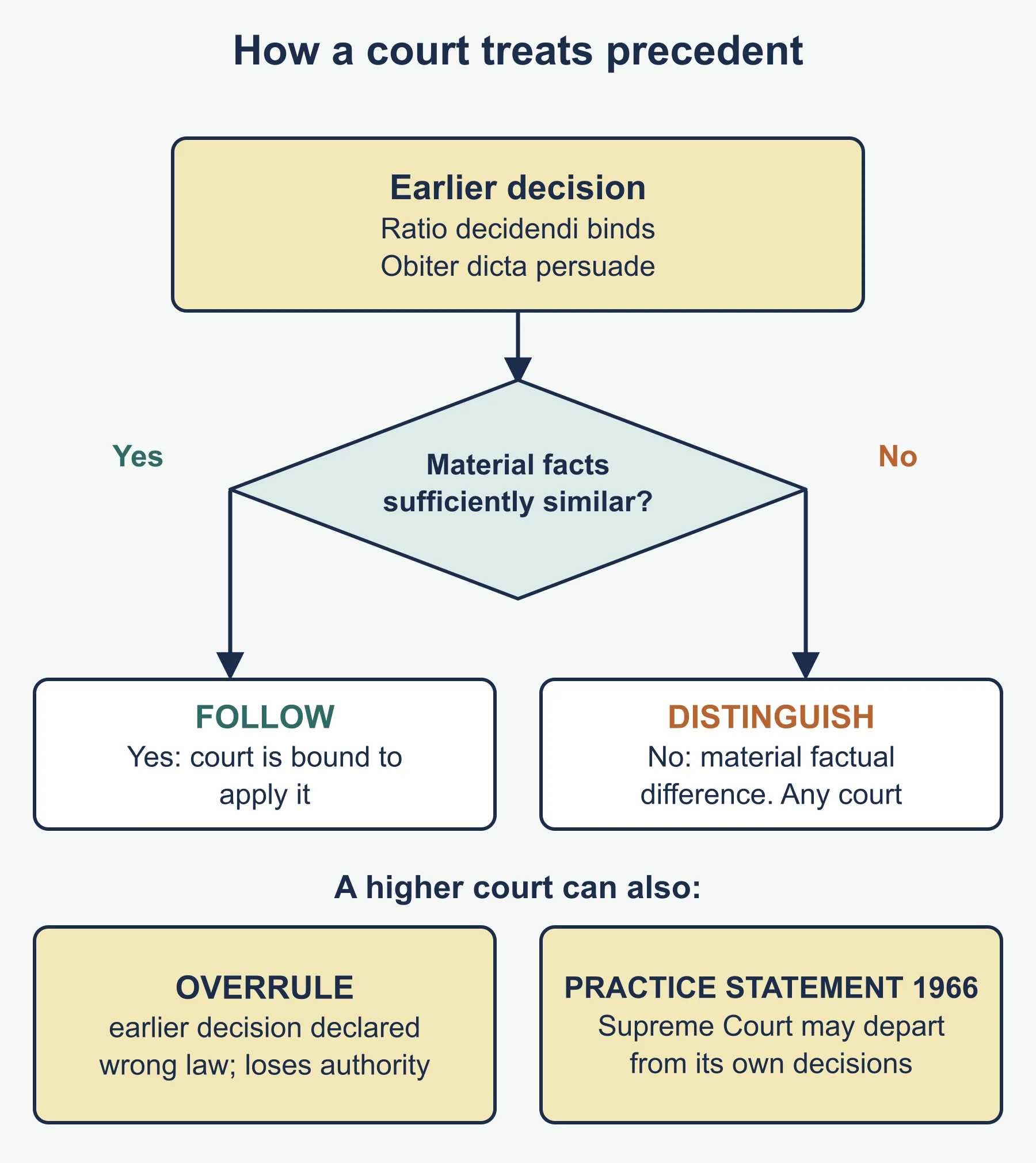
| Operation | Who | What | Case |
|---|---|---|---|
| Following | Any court | Applies precedent on similar material facts | Routine |
| Distinguishing | Any court | Material facts differ, so ratio not applied | R v Wilson (1996) distinguishing R v Brown (1993) |
| Overruling | Higher court, or Supreme Court of its own decision | Earlier rule in a different case declared wrong | Herrington overruling Addie |
Not on this list: reversing (same case changed on appeal).
Evaluation
| Advantages | Disadvantages |
|---|---|
| Certainty | Rigidity |
| Consistency, fairness | Complexity, volume |
| Flexibility (distinguishing, Practice Statement) | Slow: depends on cases reaching senior courts |
| Practical, real-case rules | Retrospective effect of overruling |
| Saves time | Undemocratic judge-made law |
| Detailed rules | Illogical fine distinctions |
Key terms
| Term | Meaning |
|---|---|
| Stare decisis | Standing by decided cases |
| Ratio decidendi | The binding legal principle of a decision |
| Obiter dicta | Non-binding remarks made by the way |
| Persuasive precedent | A decision a court may, but need not, follow |
| Original precedent | A decision on a point never decided before |
| Per incuriam | Made in error, overlooking relevant law |
| Distinguishing | Avoiding a precedent because material facts differ |
| Overruling | A higher court declaring an earlier rule wrong |
| Neutral citation | A publisher-independent case reference |
Exam traps
- Obiter treated as binding.
- Practice Statement applied to the Court of Appeal.
- Overruling confused with reversing.
- Young exceptions named but not explained.
- Privy Council said always to bind.
- Advantages listed with no judgement.
Self-test
- Define ratio decidendi and obiter dicta.
- How did obiter in R v Howe become law?
- Which court replaced the House of Lords, and when?
- What did Austin v Southwark confirm?
- Which case overruled Addie v Dumbreck?
- State the three Young exceptions.
- Why does the Criminal Division have extra flexibility?
- What did R v James (2006) show about the Privy Council?
- Give three reasons for law reporting.
- Which court can distinguish?
- How does overruling differ from reversing?
- Give two disadvantages of precedent.
Answers: 1. Ratio: the legal principle on which the decision is based, which binds; obiter: other remarks, which are persuasive only. 2. R v Gotts (1992) adopted it, holding duress unavailable for attempted murder. 3. The Supreme Court, in 2009, under the Constitutional Reform Act 2005. 4. That the Practice Statement 1966 continues to apply to the Supreme Court. 5. British Railways Board v Herrington (1972). 6. Conflicting Court of Appeal decisions; inconsistency with a later House of Lords or Supreme Court decision; earlier decision made per incuriam. 7. Because a person’s liberty is at stake, so it may depart where the law was misapplied (R v Taylor; R v Gould). 8. That the Court of Appeal may follow a Privy Council decision over a House of Lords decision in exceptional circumstances, here where nine judges had sat to settle the law. 9. Any three: accurate record of ratio; advice to clients; finding binding authority; consistency; accessibility. 10. Any court. 11. Overruling declares an earlier rule in a different case wrong; reversing changes the outcome of the same case on appeal. 12. Any two: rigidity; complexity; slow development; retrospective effect; undemocratic; illogical distinctions.
More resources on this topic
Judicial Precedent study guide | Judicial Precedent practice questions | Statutory Interpretation revision notes
Related resources
-
Study guides
AQA A Level Law (7162): Law Making: Law Reform
Law reform for AQA A Level Law 7162: how the Law Commission works, reform, codification, consolidation and repeal, its successes and failures, and evaluation.
Law · AQA · A Level
Read guide -
Practice questions
AQA A Level Law (7162): Law Making: Law Reform – Practice Questions
Original practice questions with full answers on the Law Commission's reform, codification, consolidation and repeal work and its evaluation, for AQA Law 7162.
Law · AQA · A Level
Try questions -
Revision notes
AQA A Level Law (7162): Law Making: Law Reform – Revision Notes
Revision notes on the Law Commission's process and its reform, codification, consolidation and repeal work, with evaluation and a self-test for AQA Law 7162.
Law · AQA · A Level
Revise topic
Get free revision emails (optional)
Occasional emails with practice questions, worked explanations and links to free resources for the qualification and subjects you choose. No spam, and you can unsubscribe from any email. The free tools on this site never need an email.