
Study Guides
AQA A Level Law (7162): Law Making: Judicial Precedent
Judicial precedent for AQA A Level Law 7162: court hierarchy, stare decisis, ratio and obiter, law reporting, and following, overruling and distinguishing.
- Subject
- Law
- Level
- A LEVELS
- Topic
- Section 3.1 – The Nature of Law and the English Legal System
- Author
- Marlbridge Academic Team
- Updated
- Reviewed by
- Aizaz Raoof Ali (what this means)
Aligned to AQA A Level Law (7162), For teaching from September 2017 onwards, A-level exams 2019 onwards. Official specification .
Syllabus page (what it covers and how it is assessed): AQA A Level Law.
Syllabus points this page covers
7162
- Law making: judicial precedent
Found an error? Report a correction.
Need help with this topic? Request a free trial class for A Level Law (7162).
This guide covers the Law making: judicial precedent row of AQA A-level Law (7162) section 3.1. The specification lists: the doctrine of judicial precedent; the hierarchy of the courts including the Supreme Court; stare decisis, ratio decidendi and obiter dicta; law reporting in outline and the reasons for it; the operation of judicial precedent: following, overruling and distinguishing; and the advantages and disadvantages of the doctrine of judicial precedent and the operation of precedent. The Nature of Law and the English Legal System study guide explains the three operations in outline. This page gives the court-by-court rules, the cases that show each rule in action, and the evaluation points examiners look for.
The doctrine
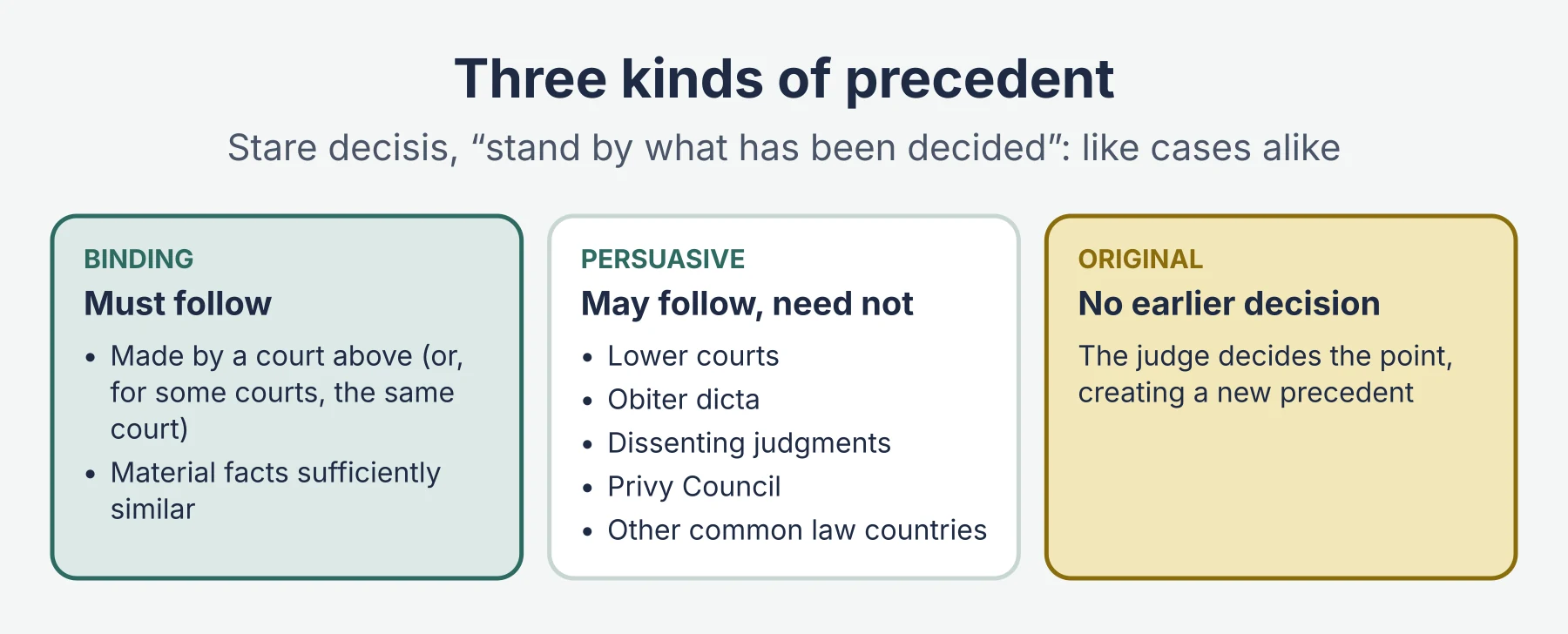
Judicial precedent is the system by which decisions of judges in earlier cases are used to decide later cases. Its foundation is stare decisis, “stand by what has been decided”: like cases should be decided alike. Precedent may be:
- binding: a court must follow it, because it was made by a court above it (or, for some courts, by the same court) and the material facts are sufficiently similar;
- persuasive: a court may follow it but need not. Persuasive sources include decisions of lower courts, obiter dicta, dissenting judgments, decisions of the Judicial Committee of the Privy Council, and decisions from other common law countries;
- original: where there is no earlier decision on the point, the judge decides it, creating a new precedent.
Ratio decidendi and obiter dicta
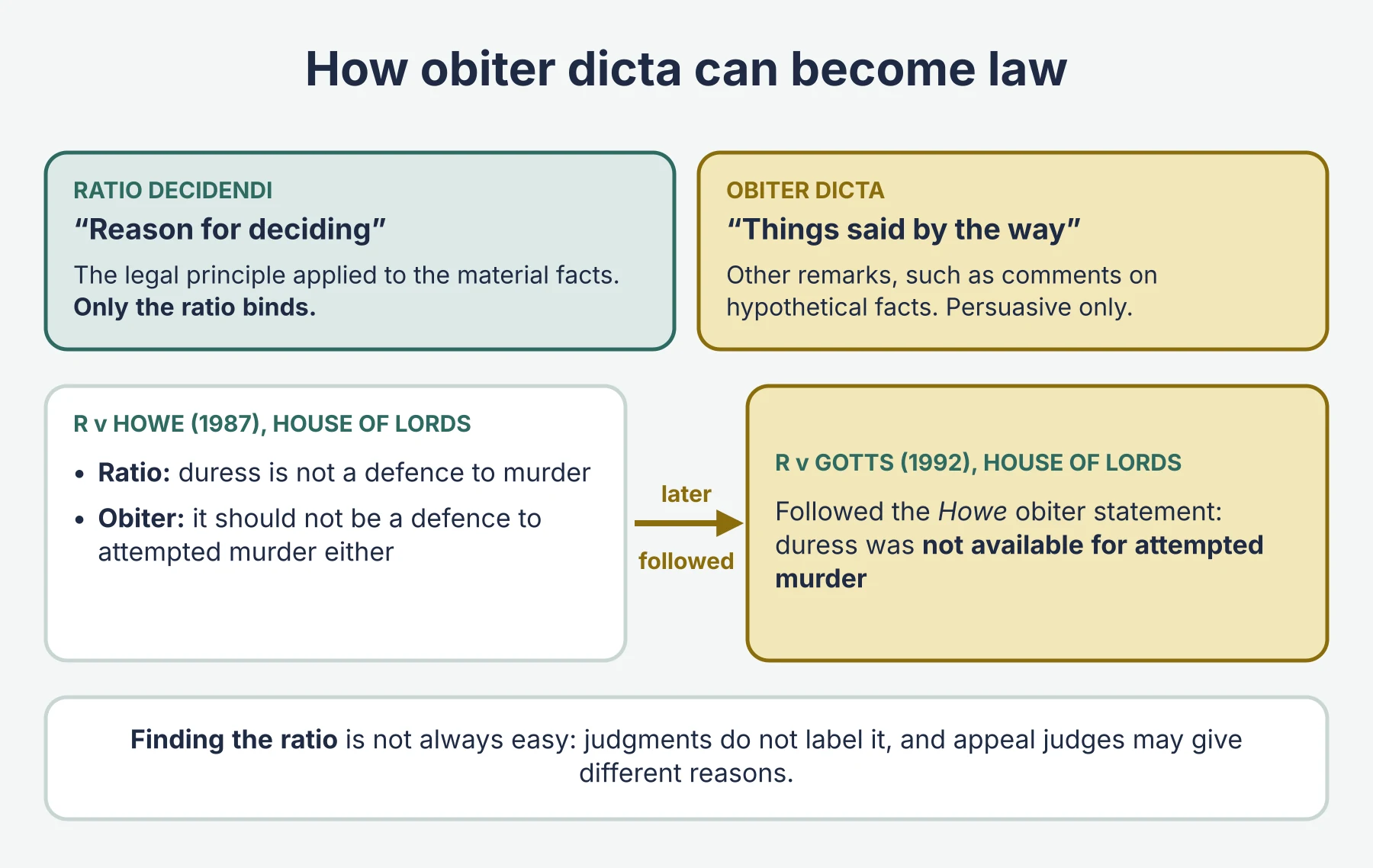
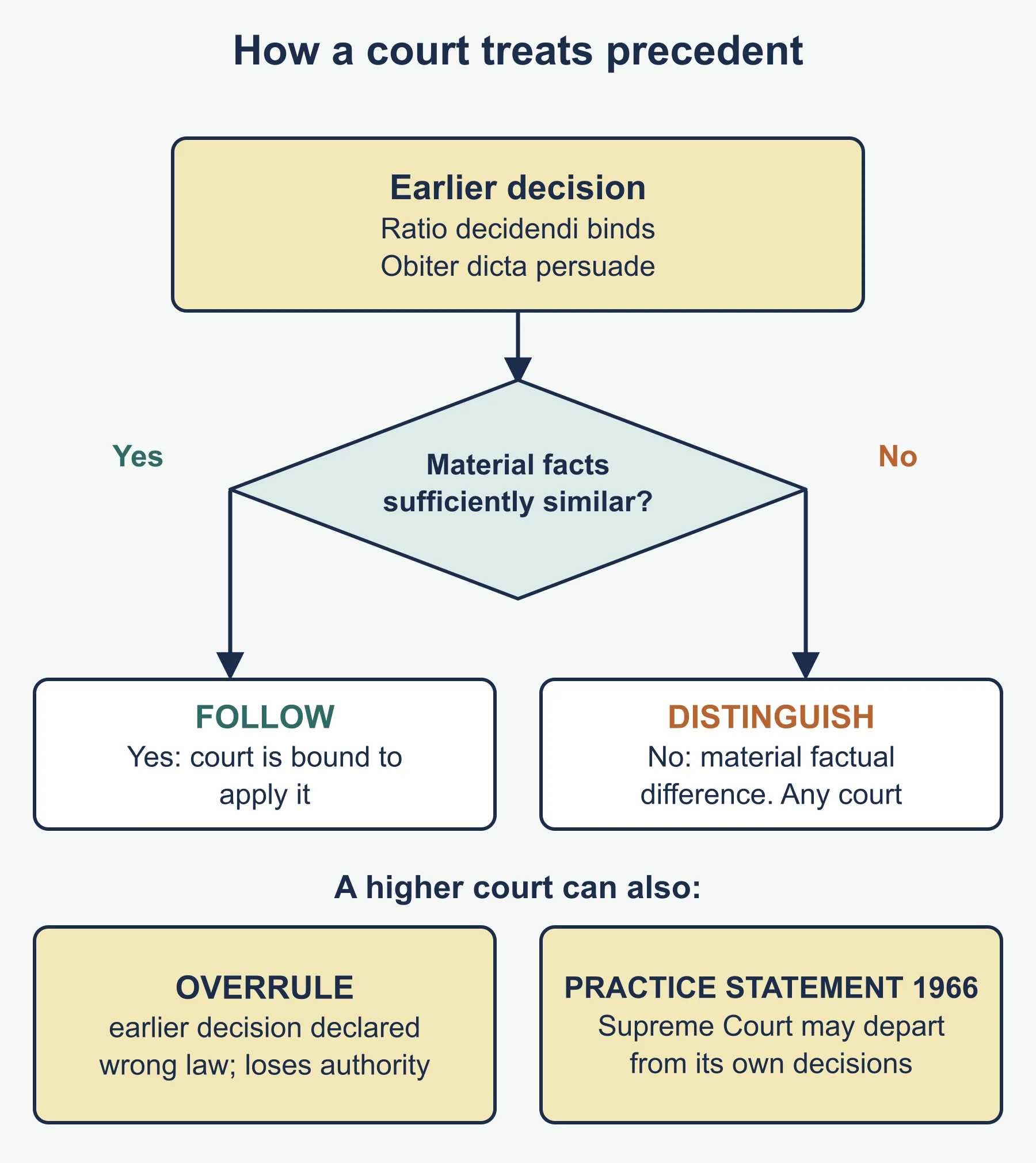
The ratio decidendi (“reason for deciding”) is the legal principle on which the decision is based, applied to the material facts. Only the ratio binds. Obiter dicta (“things said by the way”) are other remarks, such as comments on hypothetical facts.
Obiter can later become law. In R v Howe (1987) the House of Lords held that duress is not a defence to murder, and said obiter that it should not be a defence to attempted murder either. In R v Gotts (1992) the House of Lords followed that obiter statement and held that duress was not available for attempted murder.
Finding the ratio is not always easy: judgments do not label it, and in an appeal court each judge may give different reasons, so later courts sometimes disagree about what the ratio was.
The hierarchy of the courts
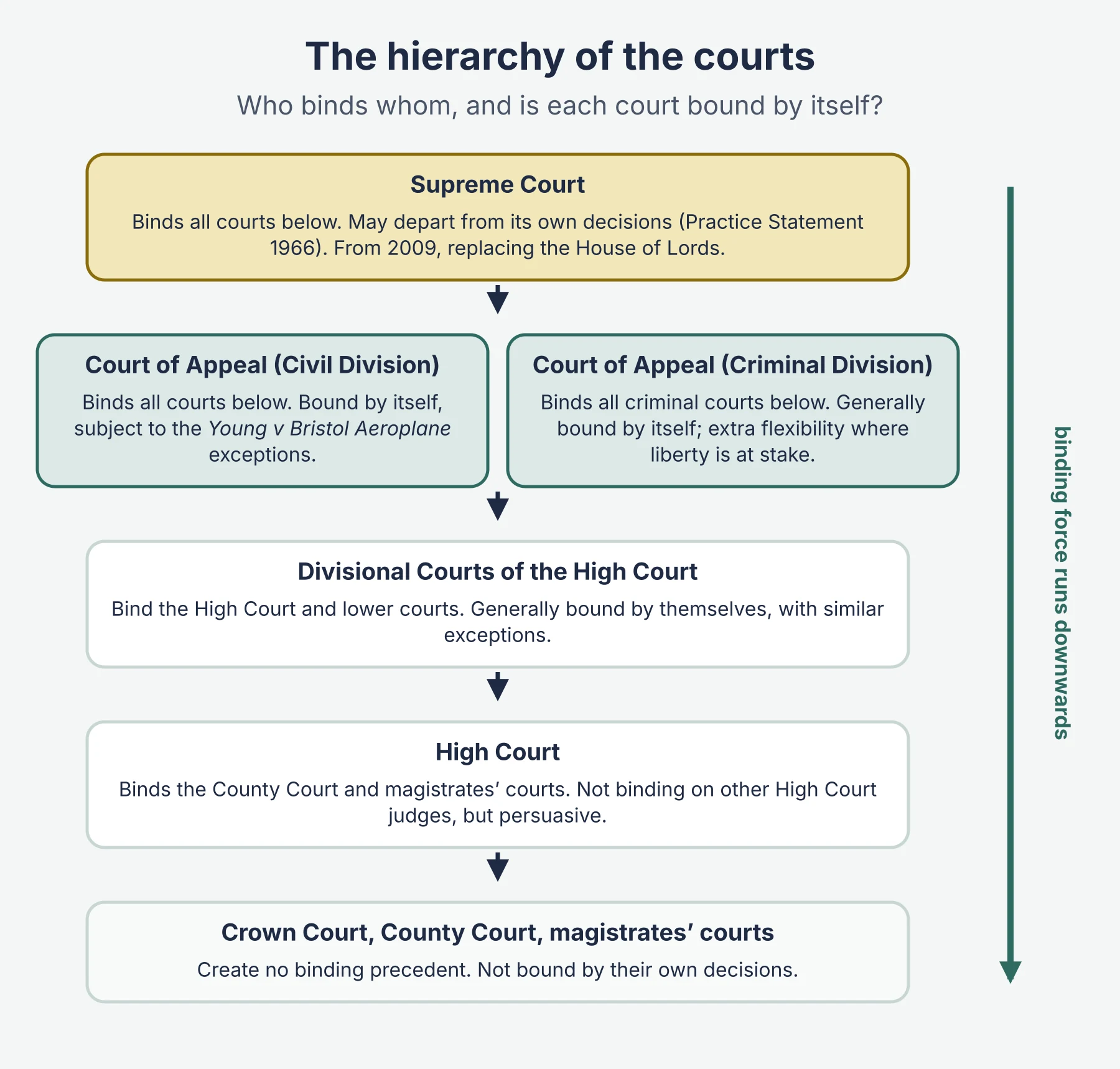
| Court | Binds | Bound by itself? |
|---|---|---|
| Supreme Court (from 2009, created by the Constitutional Reform Act 2005, replacing the House of Lords) | All courts below | Not strictly: may depart under the Practice Statement 1966 |
| Court of Appeal (Civil Division) | All courts below | Yes, subject to the exceptions in Young v Bristol Aeroplane Co (1944) |
| Court of Appeal (Criminal Division) | All criminal courts below | Generally yes, with extra flexibility where liberty is at stake |
| Divisional Courts of the High Court | High Court and lower courts | Generally yes, with similar exceptions |
| High Court | County Court and magistrates’ courts | Not binding on other High Court judges, but persuasive |
| Crown Court, County Court, magistrates’ courts | No binding precedent | Not bound by their own decisions |
The Supreme Court and the Practice Statement 1966
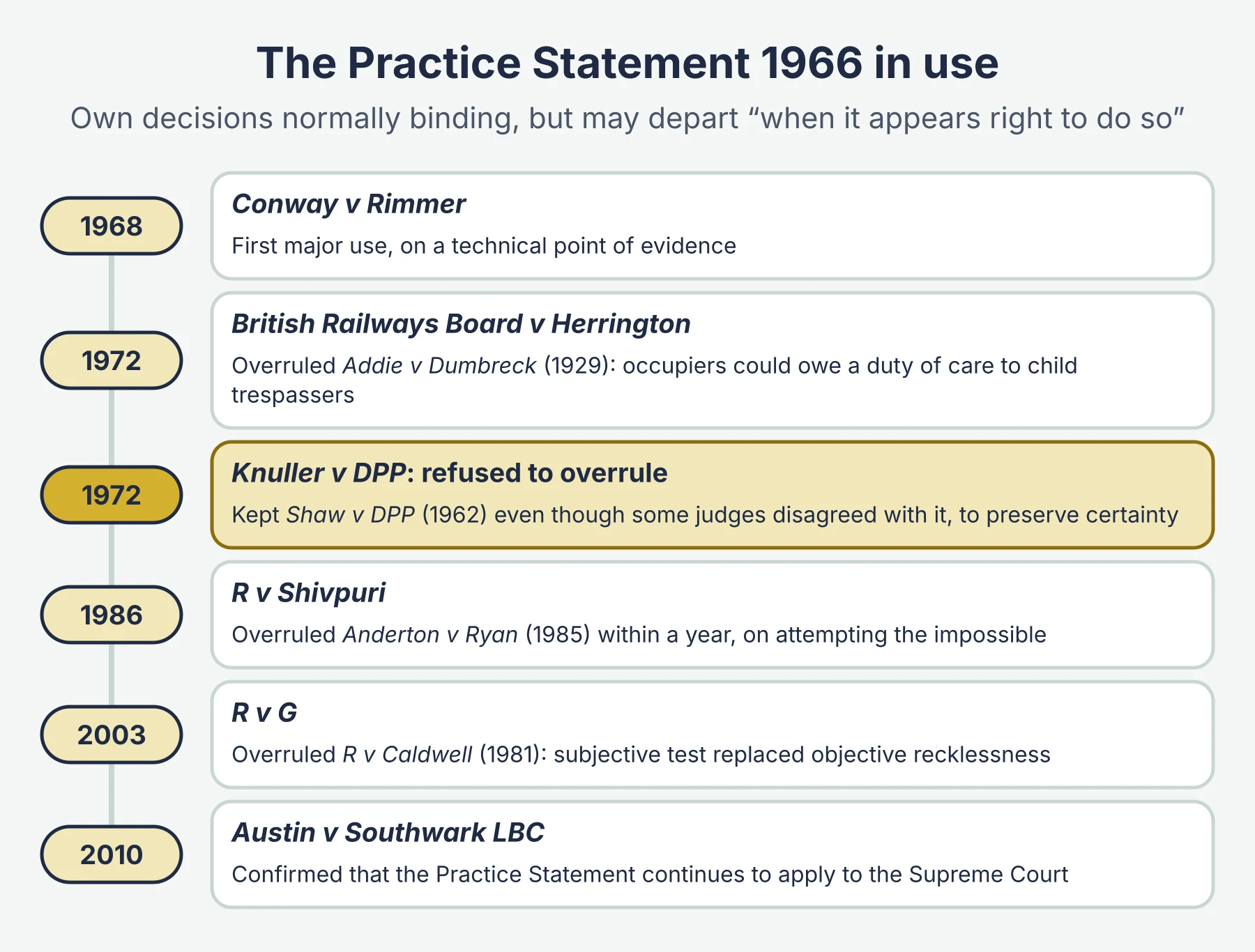
In 1966 Lord Gardiner announced that the House of Lords would treat its own decisions as normally binding but would depart from them “when it appears right to do so”. In Austin v Southwark London Borough Council (2010) the Supreme Court confirmed that the Practice Statement continues to apply to it. Examples of its use:
- Conway v Rimmer (1968): first major use, on a technical point of evidence.
- British Railways Board v Herrington (1972): overruled Addie v Dumbreck (1929), so occupiers could owe a duty of care to child trespassers.
- R v Shivpuri (1986): overruled Anderton v Ryan (1985) within a year, on attempting the impossible.
- R v G (2003): overruled R v Caldwell (1981), replacing objective recklessness with a subjective test.
The power is used sparingly to preserve certainty. In Knuller v DPP (1972) the House refused to overrule Shaw v DPP (1962) even though some judges disagreed with it.
The Court of Appeal and Young v Bristol Aeroplane
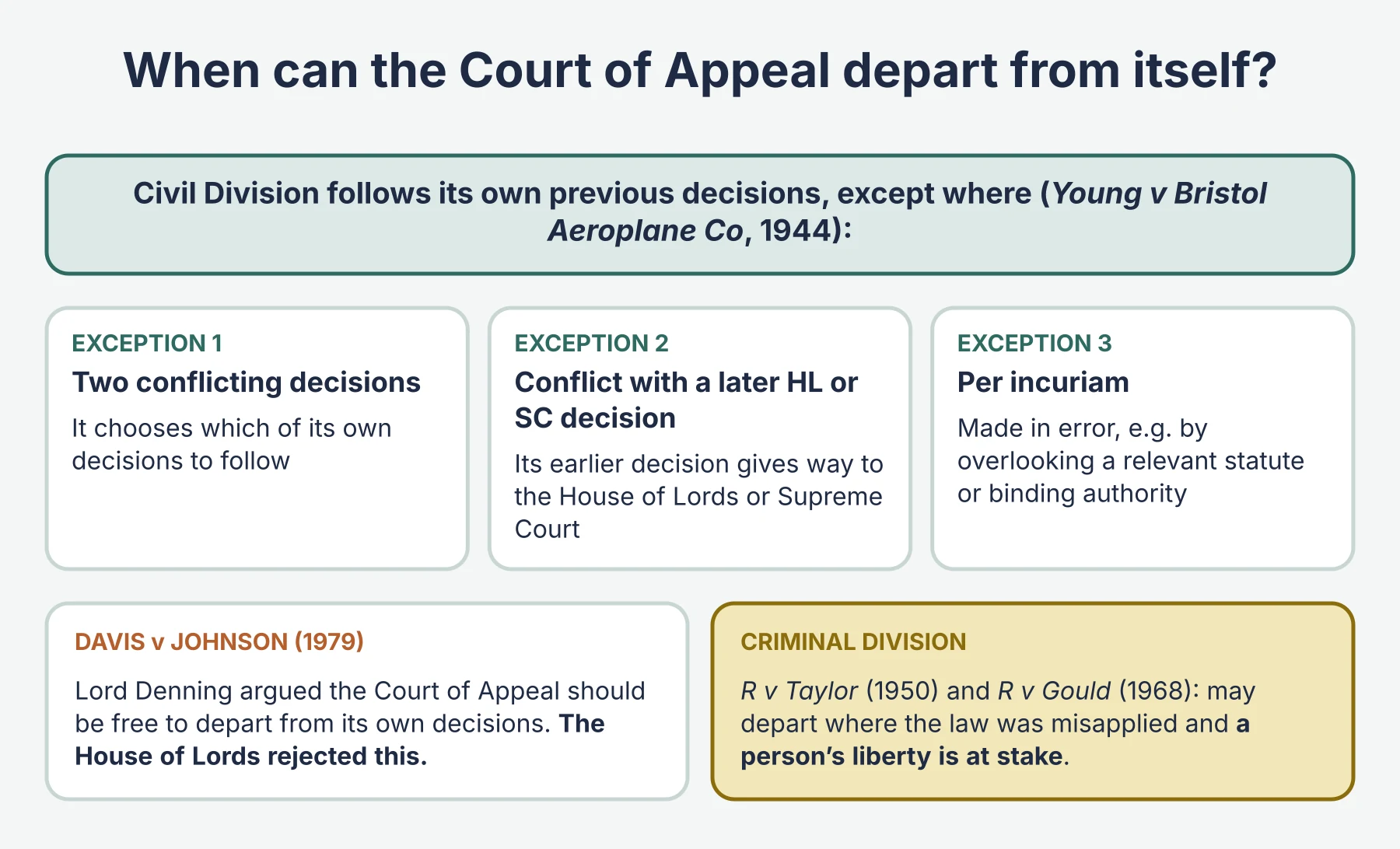
The Court of Appeal (Civil Division) must follow its own previous decisions except where:
- there are two conflicting decisions of its own, when it chooses which to follow;
- its earlier decision conflicts with a later decision of the House of Lords or Supreme Court;
- the earlier decision was made per incuriam, in error, for example by overlooking a relevant statute or binding authority.
Lord Denning argued in Davis v Johnson (1979) that the Court of Appeal should be free to depart from its own decisions, but the House of Lords rejected this. The Criminal Division has additional flexibility: in R v Taylor (1950) and R v Gould (1968) it accepted that it may depart from a previous decision where the law was misapplied and a person’s liberty is at stake.
The Privy Council
The Judicial Committee of the Privy Council hears appeals from some Commonwealth countries and overseas territories. Its decisions are normally persuasive only, but highly so because its judges are usually Supreme Court justices. The Wagon Mound (No 1) (1961), a Privy Council case on remoteness of damage, was followed by English courts. In R v James (2006) the Court of Appeal followed the Privy Council in Attorney General for Jersey v Holley (2005) rather than an earlier House of Lords decision, because the Privy Council had sat with nine judges to settle the point. In Willers v Joyce (2016) the Supreme Court confirmed that the Privy Council can expressly direct that its decision represents English law, in which case English courts should follow it.
Law reporting: outline and reasons
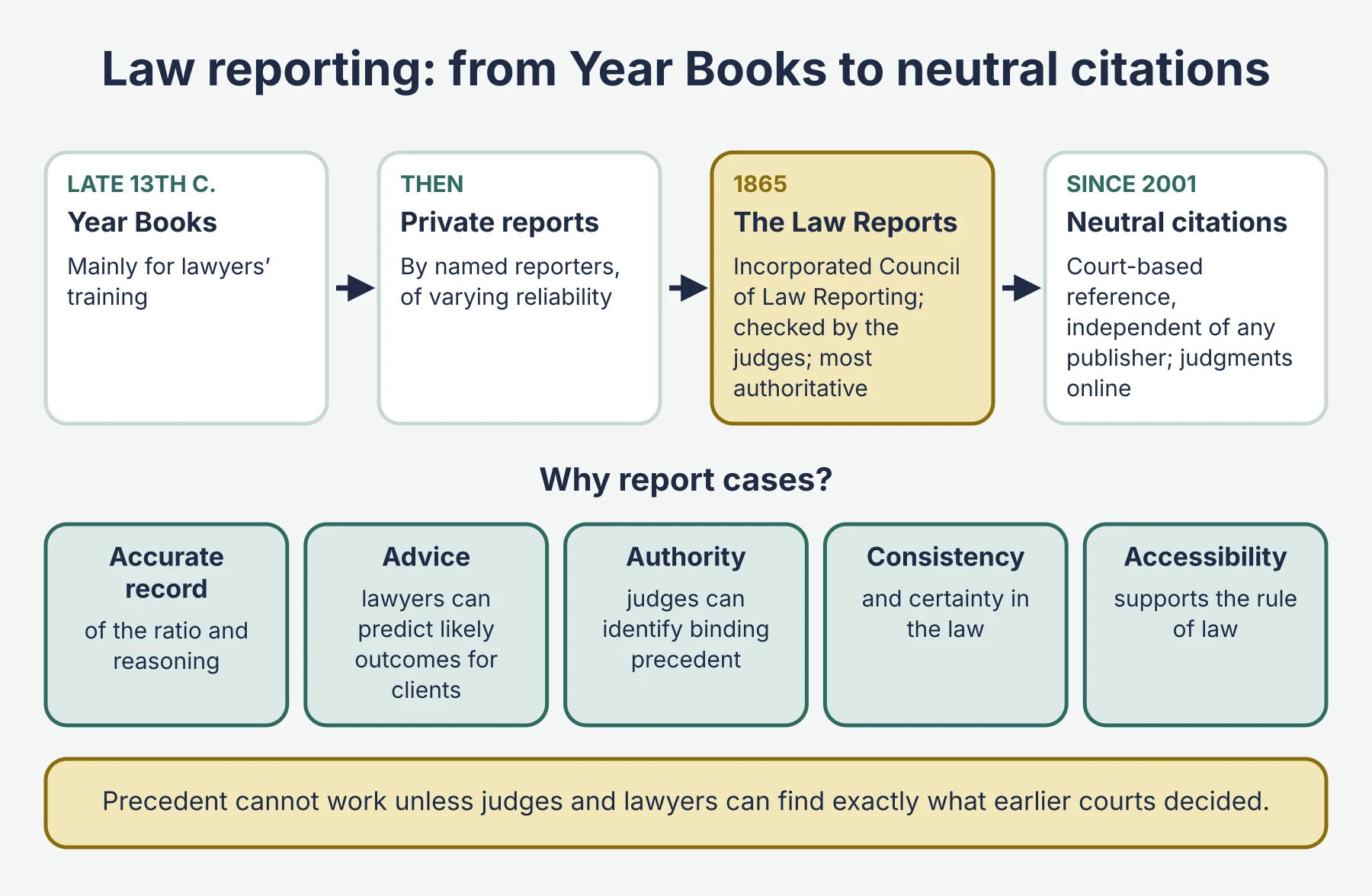
Precedent cannot work unless judges and lawyers can find exactly what earlier courts decided.
- Year Books recorded cases from the late thirteenth century, mainly for lawyers’ training.
- Private reports by named reporters followed, of varying reliability.
- The Incorporated Council of Law Reporting, founded in 1865, publishes The Law Reports, which are checked by the judges and are the most authoritative series.
- Since 2001 judgments carry neutral citations, a court-based reference that does not depend on any publisher. Judgments are now published online, including by the National Archives.
Reasons for law reporting: to provide an accurate record of the ratio and reasoning; to allow lawyers to advise clients on the likely outcome; to allow judges to identify binding authority; to promote consistency and certainty; and to make the law accessible, which supports the rule of law.
The operation of precedent
Following
A court applies an earlier decision because it is bound, or chooses to follow a persuasive one, because the material facts are sufficiently similar.
Distinguishing
A court finds that the material facts of the present case differ from the earlier one, so the earlier ratio does not apply. Any court can distinguish. In R v Wilson (1996) the Court of Appeal distinguished R v Brown (1993): consensual branding between a married couple in private was treated differently from sadomasochistic injuries between a group of men. Critics say distinguishing on narrow facts can make the law inconsistent.
Overruling
A higher court holds that a legal rule in an earlier, different case was wrong, so it ceases to be law, as Herrington overruled Addie. The Supreme Court can also overrule its own earlier decisions using the Practice Statement. Because overruling operates retrospectively, the parties in the later case are bound by a rule that did not exist when they acted.
Advantages and disadvantages
| Advantages | Disadvantages |
|---|---|
| Certainty: lawyers can predict outcomes and advise | Rigidity: lower courts must follow decisions they think wrong |
| Consistency and fairness: like cases treated alike | Complexity: a vast number of reported cases; ratio can be hard to find |
| Flexibility: distinguishing and the Practice Statement allow development | Slow growth: change depends on a suitable case reaching a senior court |
| Practical: rules come from real cases | Retrospective effect of overruling |
| Saves time: settled points need not be argued again | Undemocratic: unelected judges make law; Parliament is the proper law-maker |
| Detailed rules develop case by case | Illogical distinctions where courts distinguish on small factual differences |
Worked example: answering an application question
Question: A High Court judge is faced with a Court of Appeal decision she considers wrong. Explain her options.
Hierarchy: High Court is bound by the Court of Appeal -> must follow
   if material facts are sufficiently similar
Option 1: distinguish on material facts -> any court can distinguish
Option 2: follow, but criticise the earlier decision in her judgment,
   inviting an appeal
She cannot overrule: only a higher court can
Long term: the Court of Appeal (via Young exceptions) or the
   Supreme Court (Practice Statement / overruling) can change the rule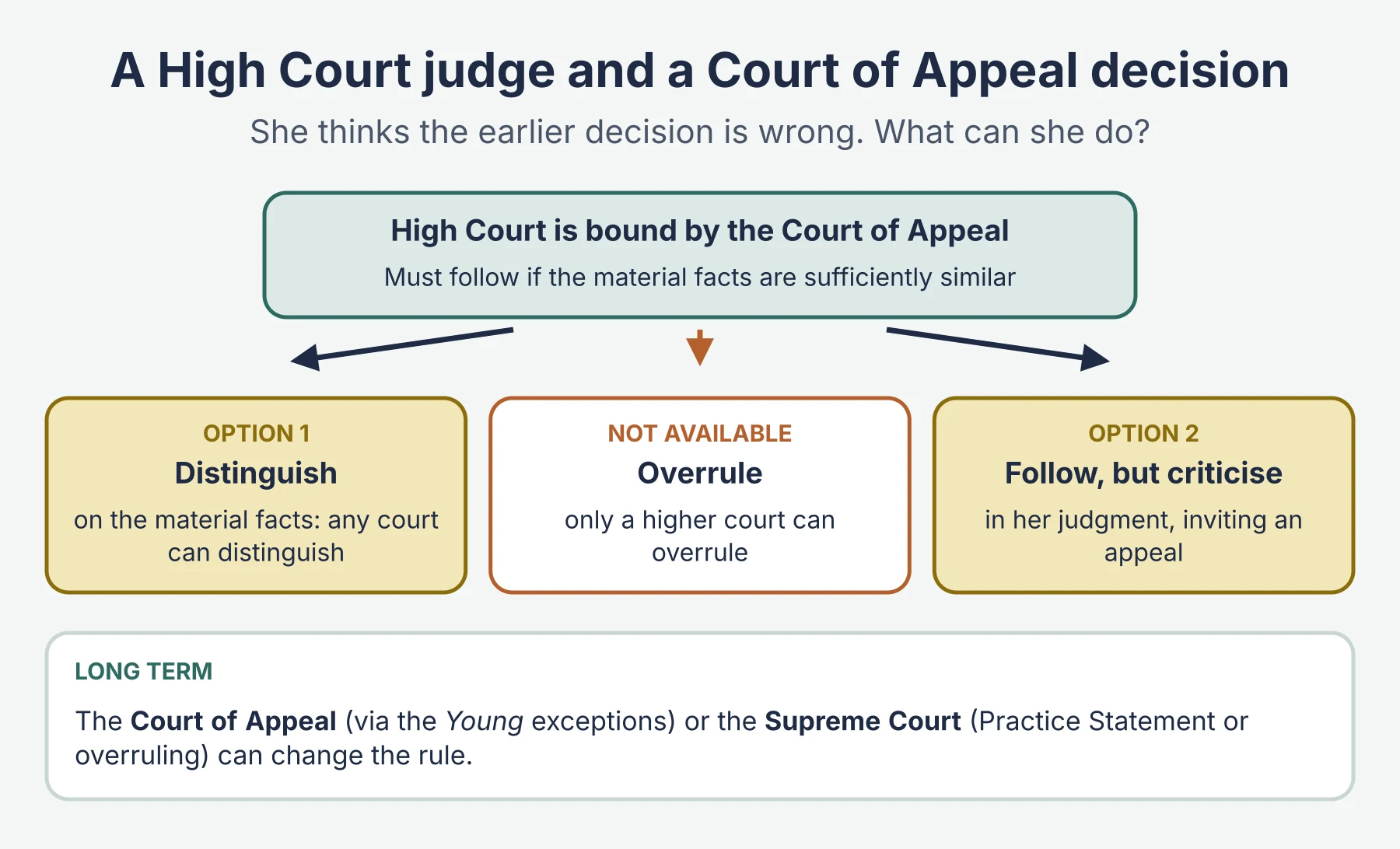
Common mistakes
- Treating obiter dicta as binding.
- Saying the Practice Statement applies to the Court of Appeal.
- Confusing overruling (a different, earlier case) with reversing (the same case on appeal); reversing is not one of the specification’s operations.
- Listing the Young exceptions without explaining them.
- Saying the Privy Council binds English courts in every case.
Exam technique
For explain questions, define the term, then show how it works with a case. For evaluate questions, weigh certainty against flexibility and include the democratic argument, then judge whether the balance is right.
Condensed recall is in the Judicial Precedent revision notes, and application practice is in the Judicial Precedent practice questions. Precedents on the meaning of Acts link to Statutory Interpretation.
Related resources
-
Practice questions
AQA A Level Law (7162): Law Making: Judicial Precedent – Practice Questions
Original practice questions with full answers on the court hierarchy, ratio and obiter, law reporting, overruling and distinguishing, for AQA Law 7162.
Law · AQA · A Level
Try questions -
Revision notes
AQA A Level Law (7162): Law Making: Judicial Precedent – Revision Notes
Revision notes on the court hierarchy, stare decisis, ratio and obiter, law reporting, the Practice Statement and the operation of precedent for AQA Law 7162.
Law · AQA · A Level
Revise topic -
Study guides
AQA A Level Law (7162): Law Making: Law Reform
Law reform for AQA A Level Law 7162: how the Law Commission works, reform, codification, consolidation and repeal, its successes and failures, and evaluation.
Law · AQA · A Level
Read guide
Get free revision emails (optional)
Occasional emails with practice questions, worked explanations and links to free resources for the qualification and subjects you choose. No spam, and you can unsubscribe from any email. The free tools on this site never need an email.