
Revision Notes
AQA A Level Law (7162): Law Making: Statutory Interpretation – Revision Notes
Revision notes on the four approaches to interpretation, aids, language rules, EU law and the HRA, with a case bank, key terms and self-test for AQA Law 7162.
- Subject
- Law
- Level
- A LEVELS
- Topic
- Section 3.1 – The Nature of Law and the English Legal System
- Author
- Marlbridge Academic Team
- Updated
- Reviewed by
- Aizaz Raoof Ali (what this means)
Aligned to AQA A Level Law (7162), For teaching from September 2017 onwards, A-level exams 2019 onwards. Official specification .
Syllabus page (what it covers and how it is assessed): AQA A Level Law.
Syllabus points this page covers
7162
- Law making: statutory interpretation
Found an error? Report a correction.
Need help with this topic? Request a free trial class for A Level Law (7162).
Condensed notes on Law making: statutory interpretation in AQA A-level Law (7162) section 3.1: the literal, golden and mischief rules and the purposive approach; intrinsic and extrinsic aids; the impact of EU law and the Human Rights Act 1998; and advantages and disadvantages. For full explanation and a worked application, see the Statutory Interpretation study guide.
Why interpretation is needed
Broad terms; ambiguity; drafting errors; new technology or social change; unforeseen situations. General help: Interpretation Act 1978 (masculine includes feminine; singular includes plural, unless contrary intention).
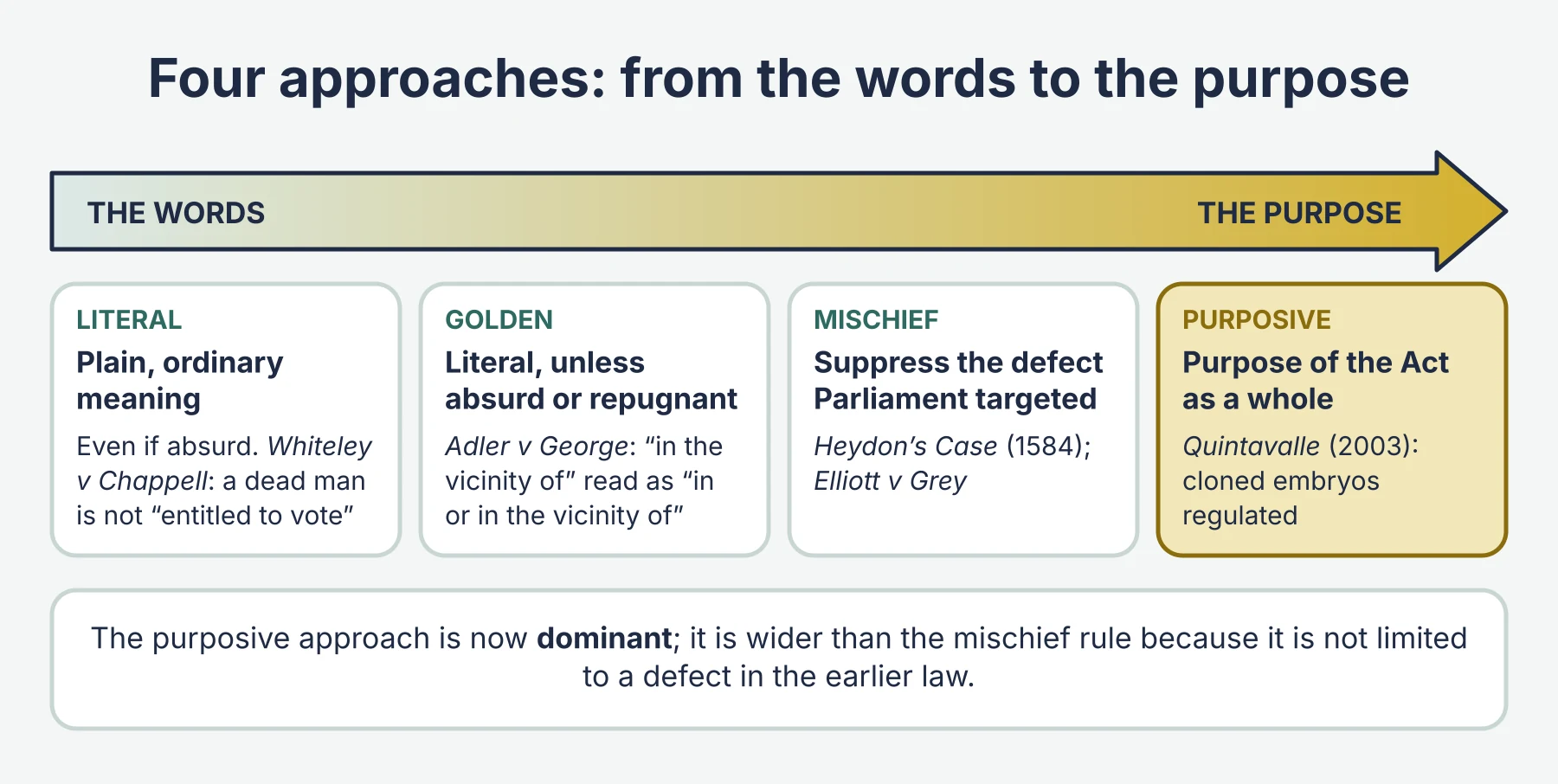
Case bank by rule
Literal rule: plain meaning, even if absurd
| Case | Words | Result |
|---|---|---|
| Whiteley v Chappell (1868) | “any person entitled to vote” | Impersonating a dead voter not an offence |
| Fisher v Bell (1960) | “offer for sale” | Knife in window is an invitation to treat; not guilty |
| LNER v Berriman (1946) | “relaying or repairing” | Oiling points was maintenance; no compensation |
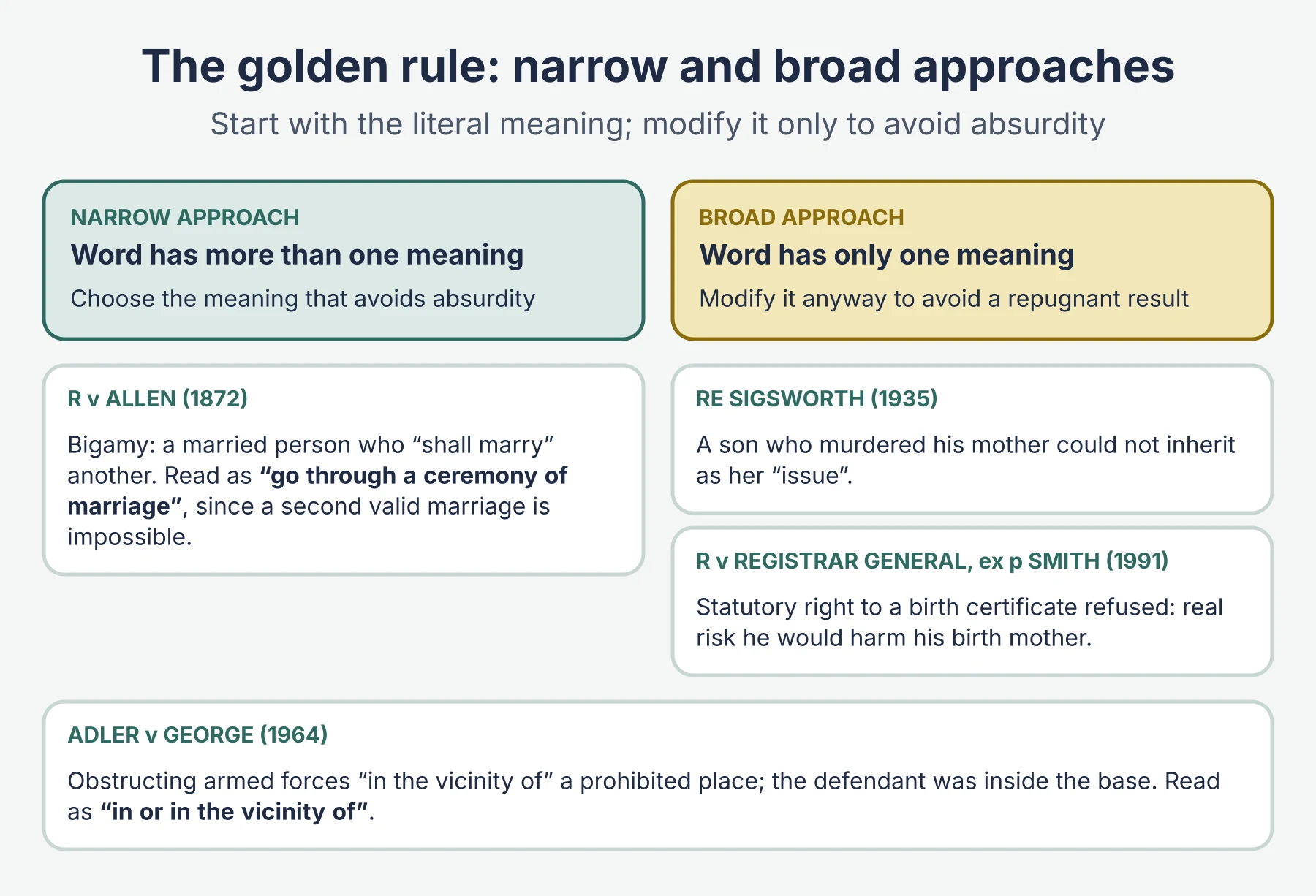
Golden rule: modify to avoid absurdity
| Case | Approach | Result |
|---|---|---|
| R v Allen (1872) | Narrow | “Marry” read as go through a ceremony of marriage |
| Adler v George (1964) | Narrow | “In the vicinity of” read as “in or in the vicinity of” |
| Re Sigsworth (1935) | Broad | Murderer son could not inherit as “issue” |
| R v Registrar General, ex p Smith (1991) | Broad | Birth certificate refused because of risk to birth mother |
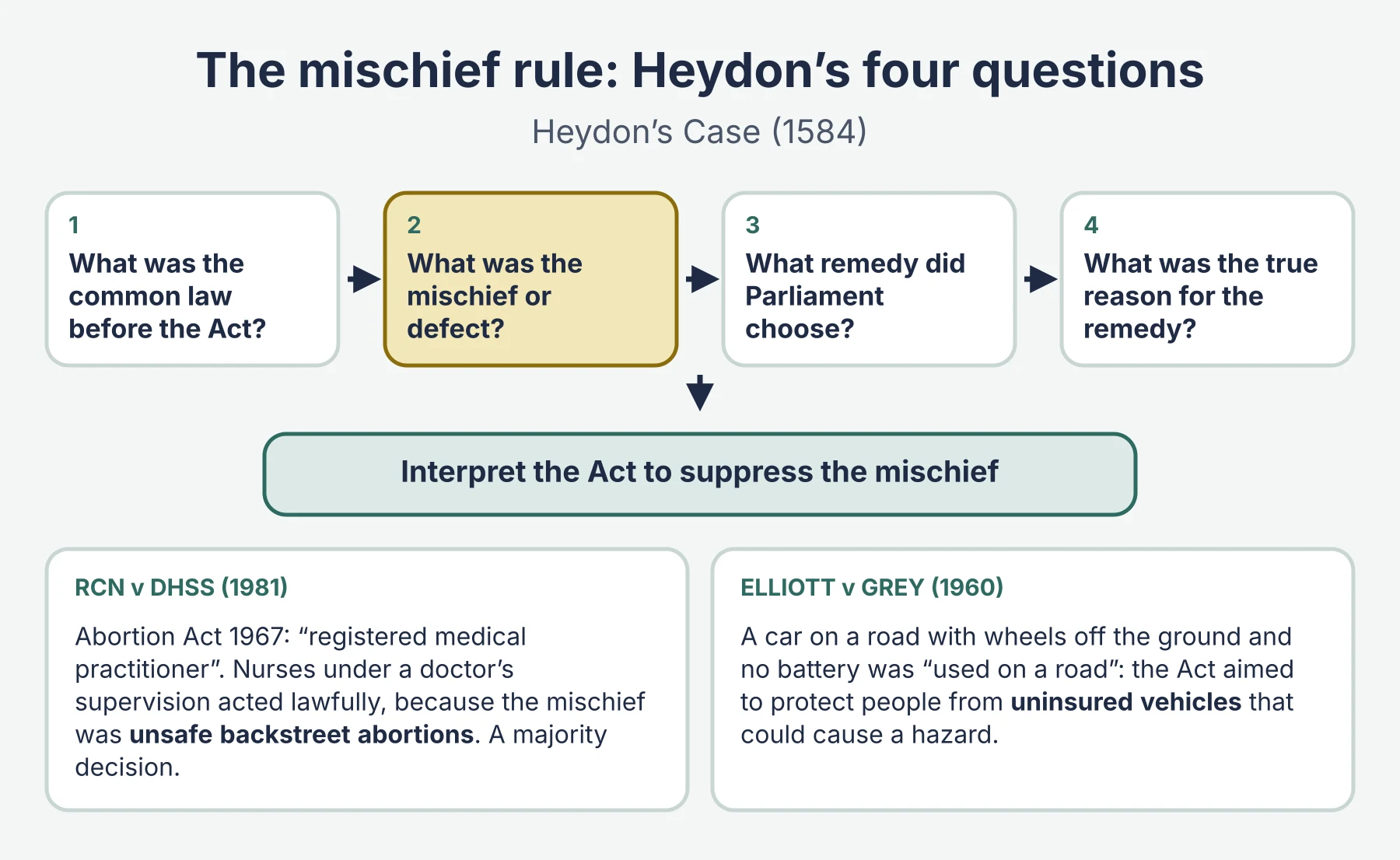
Mischief rule: Heydon’s Case (1584)
Four questions: the common law before the Act; the mischief; the remedy; the reason for the remedy.
- Royal College of Nursing v DHSS (1981): nurses’ role lawful; Act aimed at unsafe abortions (3–2).
- Elliott v Grey (1960): jacked-up car without a battery was “used on a road”.
Purposive approach: purpose of the Act as a whole
- Jones v Tower Boot (1997): “in the course of employment” read broadly to fulfil anti-discrimination purpose.
- R (Quintavalle) v Secretary of State for Health (2003): cloned embryos regulated.
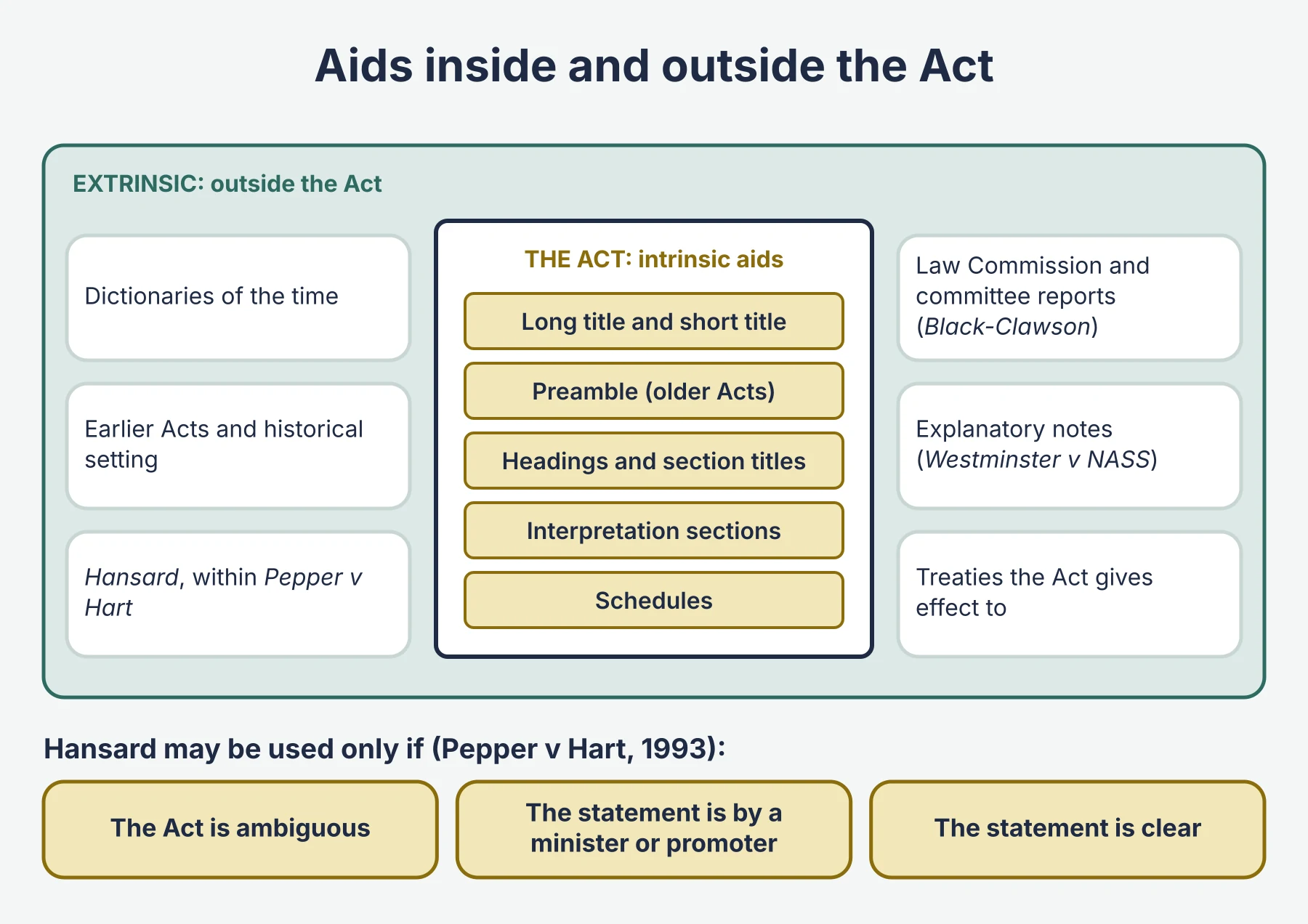
Aids
| Intrinsic | Extrinsic |
|---|---|
| Long and short title | Dictionaries |
| Preamble | Earlier Acts, historical setting |
| Headings | Hansard (Pepper v Hart, 1993): ambiguity, minister or promoter, clear statement |
| Interpretation sections | Law Commission and committee reports (Black-Clawson, 1975) |
| Schedules | Explanatory notes (Westminster CC v NASS, 2002) |
| Treaties |
Rules of language
| Rule | Meaning | Case |
|---|---|---|
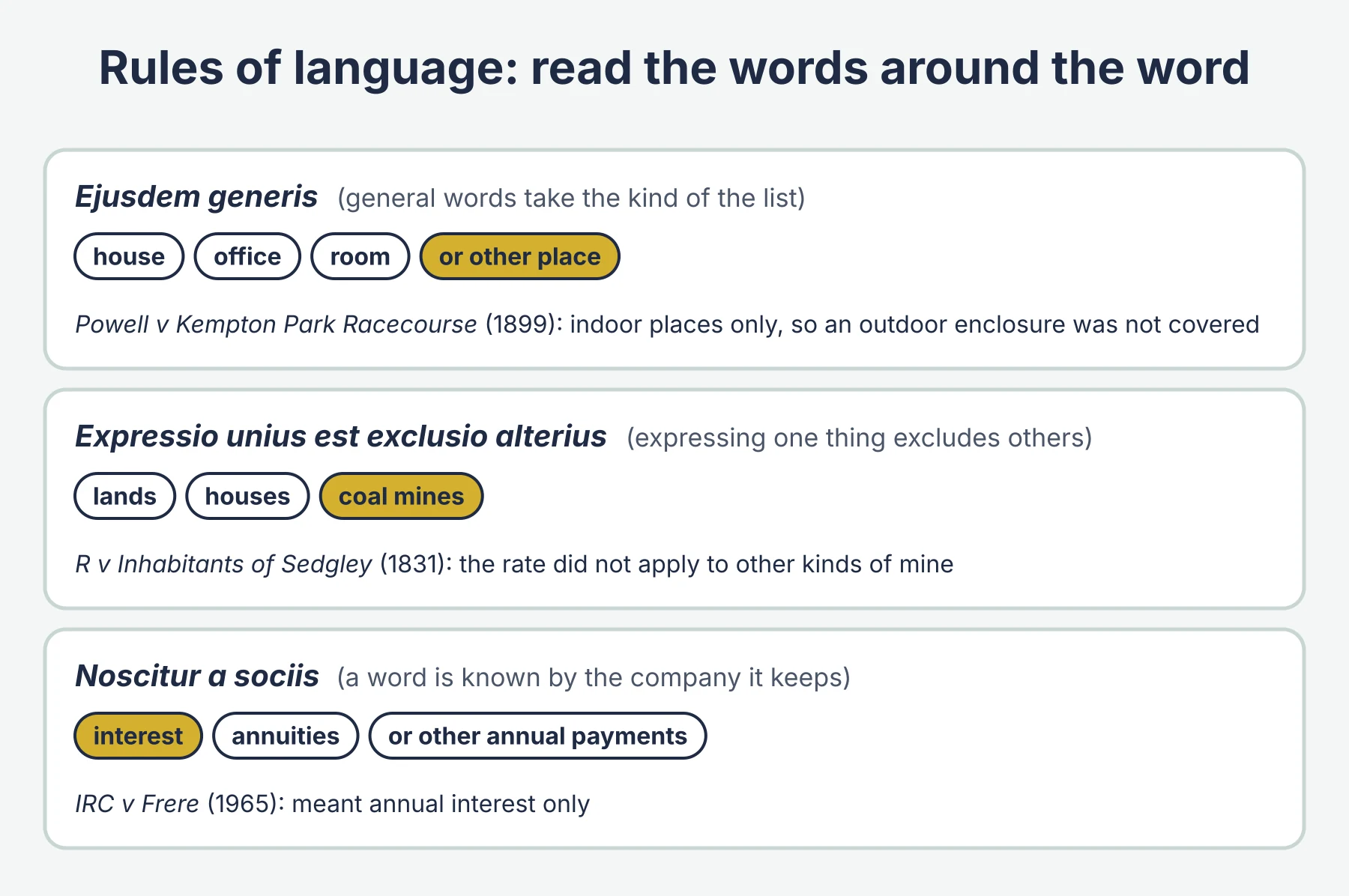
| Ejusdem generis | General words after a list take the same kind | Powell v Kempton Park (1899): indoor places only |
| Expressio unius | Listing some excludes others | R v Inhabitants of Sedgley (1831): coal mines only |
| Noscitur a sociis | Words read in context | IRC v Frere (1965): annual interest only |
EU law and the Human Rights Act
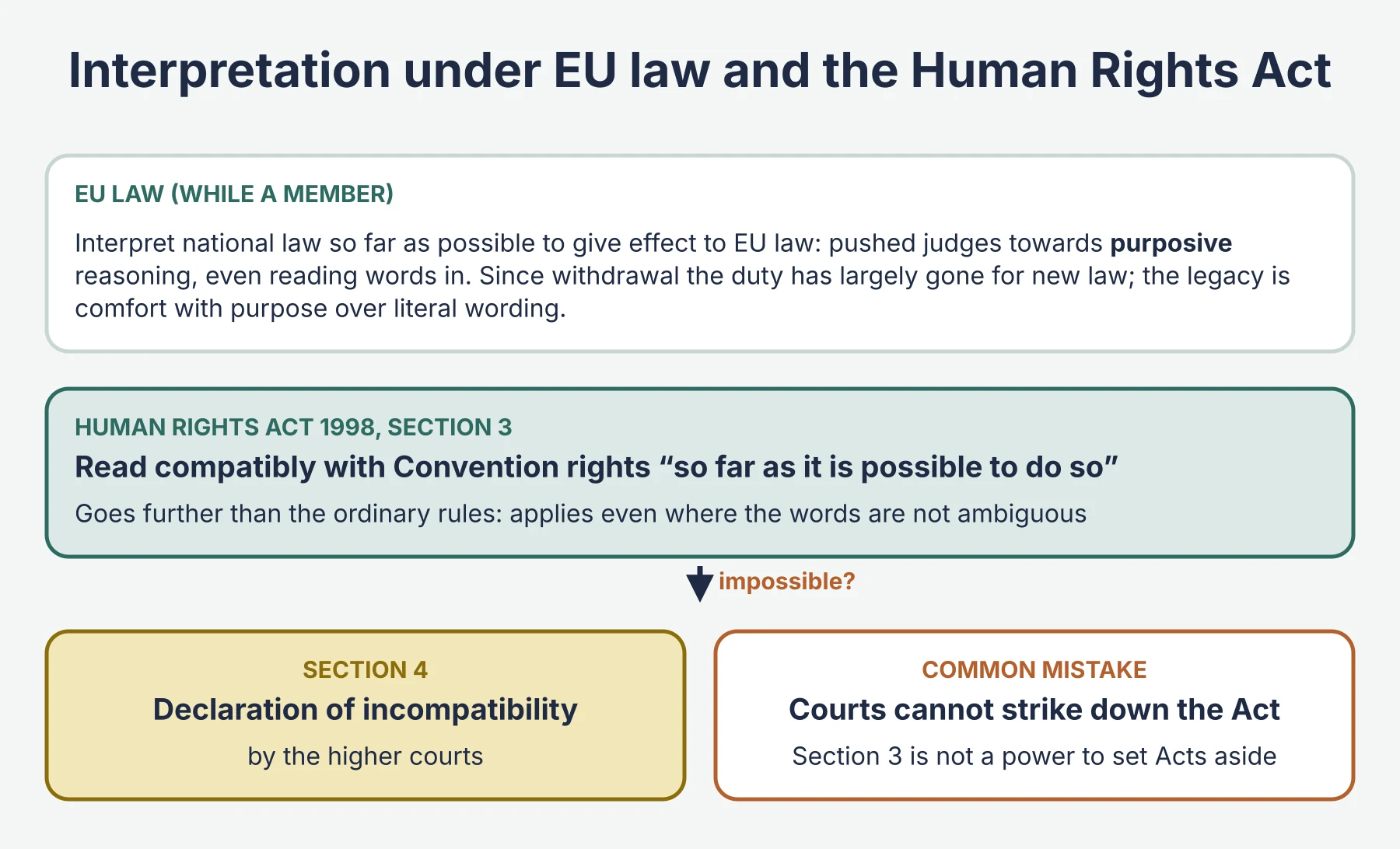
- EU law (membership): duty to interpret national law, as far as possible, to give effect to EU law; encouraged purposive interpretation. Largely historical since withdrawal.
- Human Rights Act 1998 section 3: read compatibly “so far as it is possible to do so”, even without ambiguity.
- Section 4: declaration of incompatibility if impossible; the Act stays in force.
Evaluation
| Approach | For | Against |
|---|---|---|
| Literal | Supremacy; certainty | Absurd or unjust results |
| Golden | Avoids absurdity | “Absurd” undefined |
| Mischief | Fills gaps; Parliament’s aim | Dated; looks like judicial law-making |
| Purposive | Flexible; modern | Purpose hard to find; less predictable |
Central tension: respect for Parliament’s words versus achieving Parliament’s purpose and justice.
Key terms
| Term | Meaning |
|---|---|
| Literal rule | Plain ordinary meaning of words |
| Golden rule | Literal meaning modified to avoid absurdity |
| Mischief rule | Interpretation to suppress the defect the Act targeted |
| Purposive approach | Interpretation to achieve the purpose of the Act |
| Intrinsic aid | Help found within the Act itself |
| Extrinsic aid | Help found outside the Act |
| Ejusdem generis | General words limited to the same kind as specific words before them |
| Noscitur a sociis | A word known by its context |
| Expressio unius | Express mention of one thing excludes others |
Exam traps
- Defining rules with no application to the facts.
- Golden rule confused with mischief rule.
- Hansard treated as always usable.
- Section 3 described as striking down Acts.
- EU interpretive duty treated as still applying in full.
Self-test
- Why was the defendant in Whiteley v Chappell not guilty?
- Which rule was used in Fisher v Bell, and why was the result criticised?
- Distinguish the narrow and broad golden rule with one case each.
- State the four questions in Heydon’s Case.
- How did the mischief rule apply in RCN v DHSS?
- How does the purposive approach differ from the mischief rule?
- Give three intrinsic aids.
- State the three conditions in Pepper v Hart.
- Explain ejusdem generis with a case.
- Explain noscitur a sociis with a case.
- How does section 3 of the Human Rights Act 1998 go further than the ordinary rules?
- Give one advantage and one disadvantage of the literal rule.
Answers: 1. A dead person is not “entitled to vote”, so impersonating one was not literally within the offence. 2. The literal rule; the shopkeeper escaped although the Act was clearly aimed at stopping the sale of such knives. 3. Narrow: choose between meanings, R v Allen; broad: modify a single meaning to avoid a repugnant result, Re Sigsworth. 4. What was the common law before the Act; what was the mischief; what remedy did Parliament provide; what was the reason for the remedy. 5. The Act aimed to end unsafe backstreet abortions, so nurses acting under a doctor’s supervision were within it. 6. The purposive approach considers the purpose of the Act as a whole and a wider range of material, not just the defect in earlier law. 7. Any three: long title, short title, preamble, headings, interpretation sections, schedules. 8. The legislation is ambiguous or obscure or leads to absurdity; the statement relied on was made by a minister or other promoter; the statement is clear. 9. General words after a list are limited to the same kind: Powell v Kempton Park (1899), “other place” meant indoor places. 10. A word is read in the light of the words around it: IRC v Frere (1965), “other annual payments” read with “interest” and “annuities”. 11. It requires a compatible reading so far as possible even where the words are not ambiguous. 12. Advantage: respects parliamentary supremacy and gives certainty. Disadvantage: can produce absurd or unjust results, as in Berriman.
More resources on this topic
Statutory Interpretation study guide | Statutory Interpretation practice questions | Judicial Precedent revision notes
Related resources
-
Study guides
AQA A Level Law (7162): Law Making: The European Union
EU law making for AQA A Level Law 7162: the four institutions and their functions, treaties, regulations and directives, and the impact on England and Wales.
Law · AQA · A Level
Read guide -
Practice questions
AQA A Level Law (7162): Law Making: The European Union – Practice Questions
Original practice questions with full answers on EU institutions, treaties, regulations, directives and EU law's impact on English law, for AQA Law 7162.
Law · AQA · A Level
Try questions -
Revision notes
AQA A Level Law (7162): Law Making: The European Union – Revision Notes
Revision notes on the EU institutions, treaties, regulations and directives, direct and indirect effect, and impact on English law, for AQA Law 7162.
Law · AQA · A Level
Revise topic
Get free revision emails (optional)
Occasional emails with practice questions, worked explanations and links to free resources for the qualification and subjects you choose. No spam, and you can unsubscribe from any email. The free tools on this site never need an email.