
Study Guides
AQA A Level Law (7162): Law Making: Statutory Interpretation
Statutory interpretation for AQA A Level Law 7162: literal, golden and mischief rules, the purposive approach, aids, and the impact of EU law and the HRA.
- Subject
- Law
- Level
- A LEVELS
- Topic
- Section 3.1 – The Nature of Law and the English Legal System
- Author
- Marlbridge Academic Team
- Updated
- Reviewed by
- Aizaz Raoof Ali (what this means)
Aligned to AQA A Level Law (7162), For teaching from September 2017 onwards, A-level exams 2019 onwards. Official specification .
Syllabus page (what it covers and how it is assessed): AQA A Level Law.
Syllabus points this page covers
7162
- Law making: statutory interpretation
Found an error? Report a correction.
Need help with this topic? Request a free trial class for A Level Law (7162).
This guide covers the Law making: statutory interpretation row of AQA A-level Law (7162) section 3.1. The specification lists four things: the rules of statutory interpretation: literal, golden and mischief rules; the purposive approach; internal (intrinsic) and external (extrinsic) aids; the impact of European Union law and of the Human Rights Act 1998 on statutory interpretation; and the advantages and disadvantages of the different approaches. The main Nature of Law revision notes summarise the rules in a table and cover Heydon’s Case, Pepper v Hart, Pickstone, Ghaidan and Bellinger. This page adds a bank of cases for each rule, the cases on the language rules, and a method for applying the rules to an unseen statute, which is how this content is most often tested.
Why interpretation is needed
Judges must apply the words of an Act to facts Parliament may not have foreseen. Problems arise from broad terms (what is a “vehicle”?), ambiguity (a word with two meanings), drafting errors, changes in technology or society after the Act was passed, and unforeseen situations. The Interpretation Act 1978 gives some general help: for example, words importing the masculine include the feminine, and the singular includes the plural, unless the contrary intention appears.
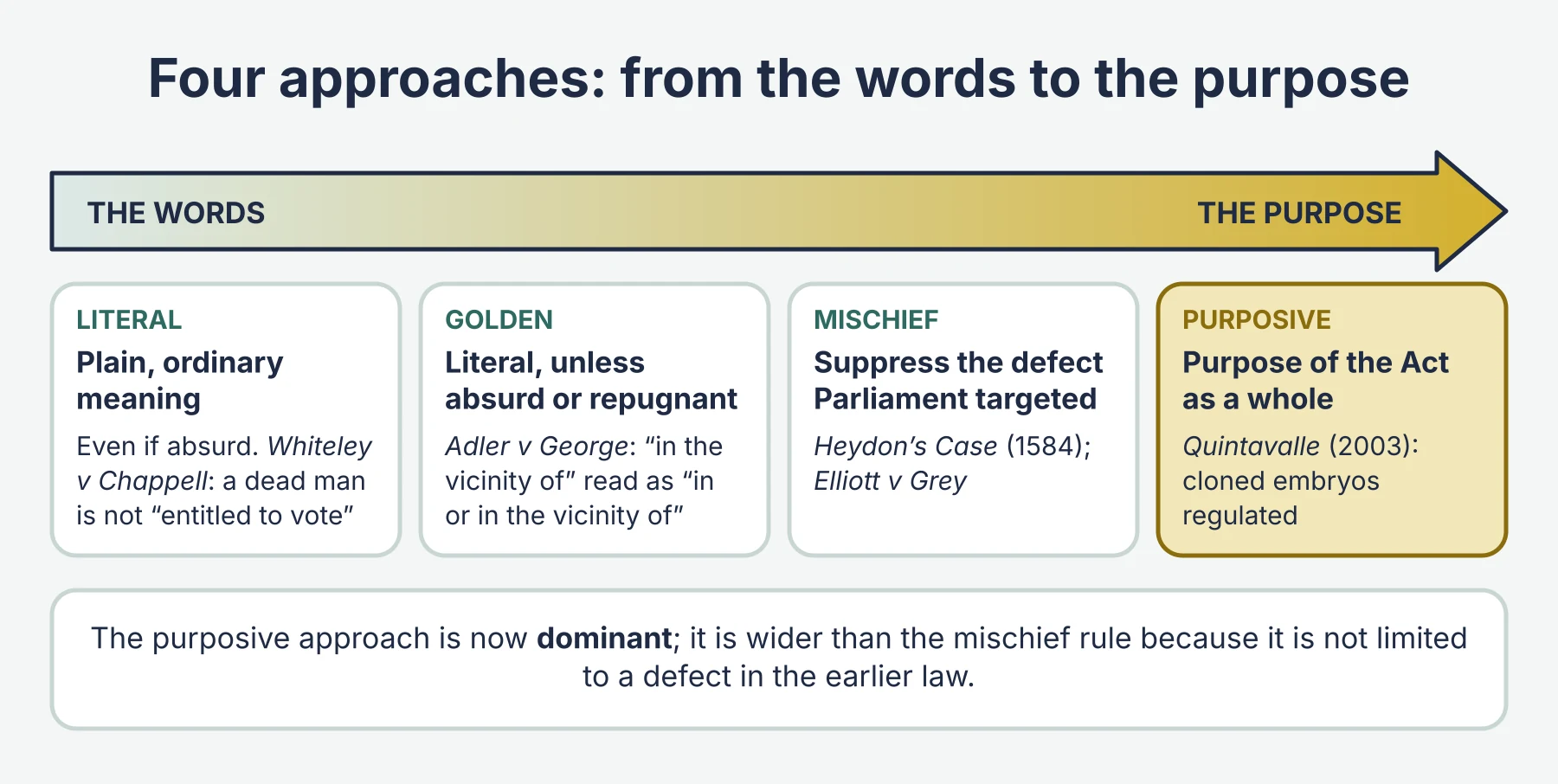
The literal rule
Words are given their plain, ordinary, dictionary meaning, even if the result is absurd. The judge’s job is to apply what Parliament said, not what it might have meant.
- Whiteley v Chappell (1868): it was an offence to impersonate “any person entitled to vote”. The defendant impersonated a dead man. A dead person is not entitled to vote, so he was not guilty.
- Fisher v Bell (1960): displaying a flick knife in a shop window was not “offering it for sale”, because in contract law a display is an invitation to treat, not an offer.
- London and North Eastern Railway Co v Berriman (1946): a lookout had to be provided for workers “relaying or repairing” track. A worker killed while oiling points was doing maintenance, not relaying or repairing, so his widow received no compensation.
The golden rule
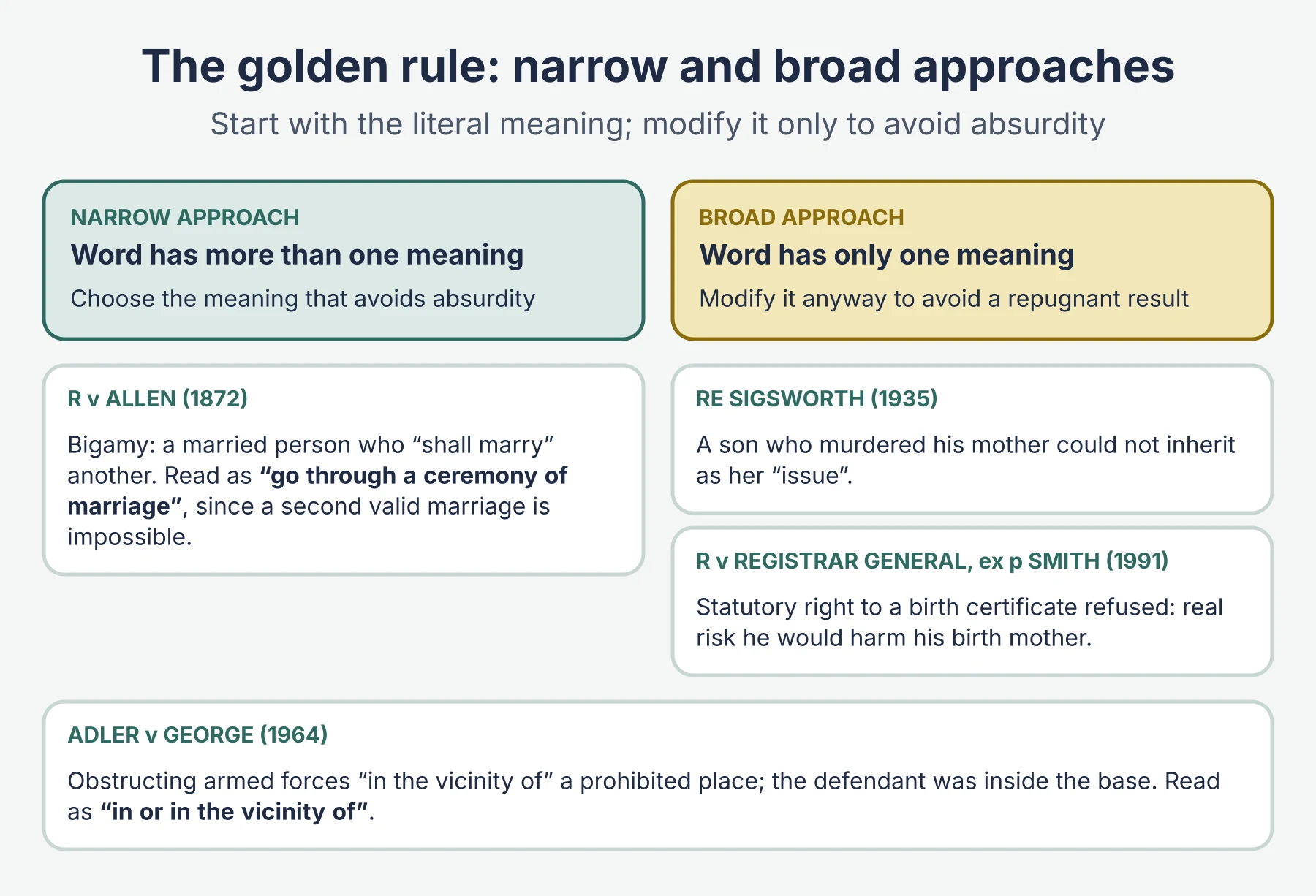
Start with the literal meaning, but if that leads to an absurd or repugnant result, modify it to avoid the absurdity.
- Narrow approach: where a word has more than one meaning, choose the one that avoids absurdity. In R v Allen (1872) the offence of bigamy, where a married person “shall marry” another, was read as “go through a ceremony of marriage”, because a second legally valid marriage is impossible.
- Broad approach: even where the words have only one meaning, modify them to avoid a repugnant result. In Re Sigsworth (1935) a son who murdered his mother was not allowed to inherit her estate, even though the Administration of Estates Act 1925 gave her estate to her “issue”. In R v Registrar General, ex p Smith (1991) a man with a history of serious violence was refused his birth certificate, despite a statutory right to it, because of a real risk he would harm his birth mother.
- Adler v George (1964): it was an offence to obstruct a member of the armed forces “in the vicinity of” a prohibited place. The defendant was inside the base. The court read the words as “in or in the vicinity of”.
The mischief rule
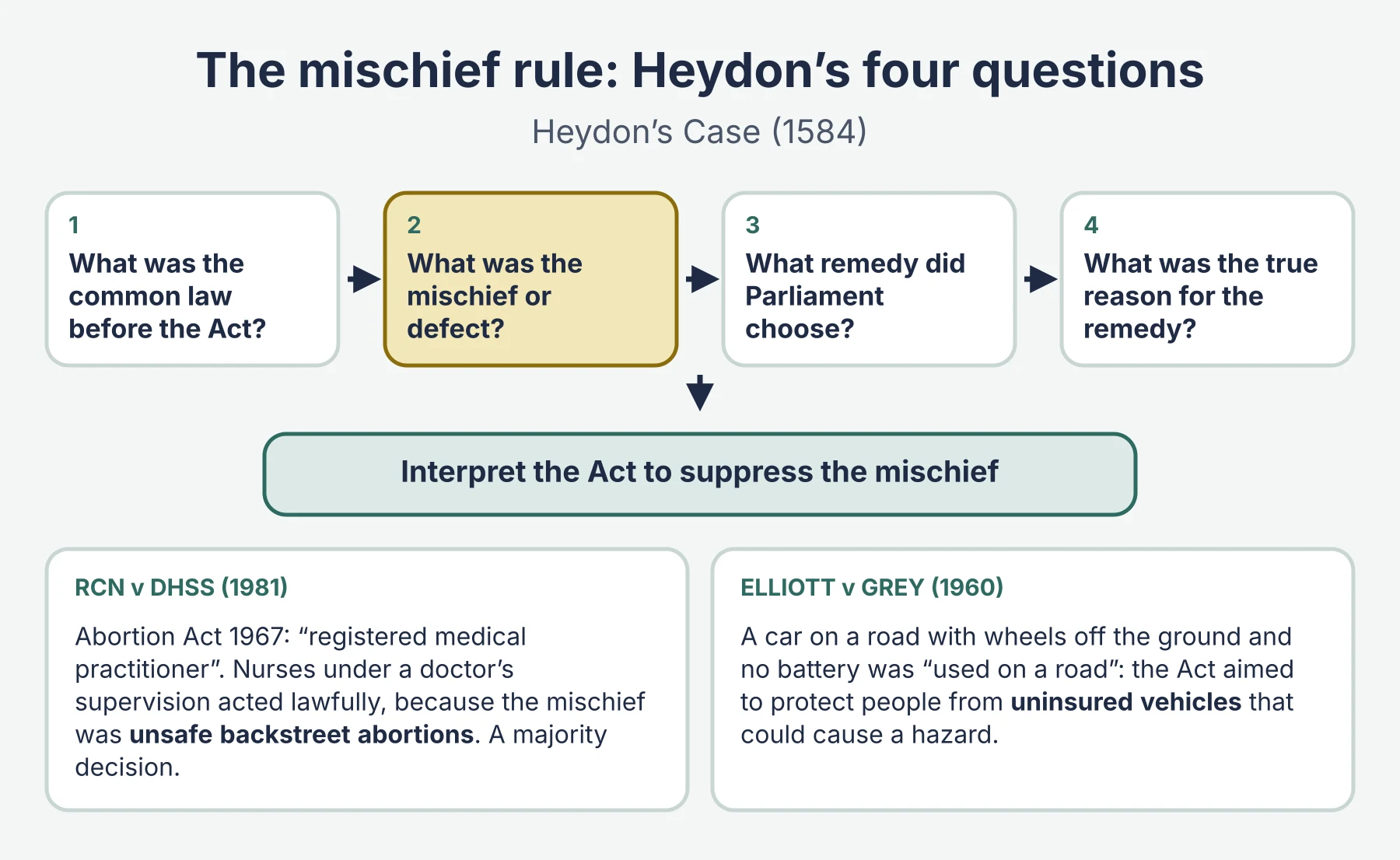
From Heydon’s Case (1584): the court asks what the common law was before the Act, what the mischief or defect was, what remedy Parliament chose, and the true reason for the remedy, and then interprets the Act to suppress the mischief.
- Royal College of Nursing v DHSS (1981): the Abortion Act 1967 required abortions to be carried out by a “registered medical practitioner”. Nurses carried out part of a newer procedure under a doctor’s supervision. The House of Lords, by a majority, held this lawful because the Act was aimed at unsafe backstreet abortions.
- Elliott v Grey (1960): a car parked on a road with its wheels off the ground and no battery was “used on a road” for insurance purposes, because the Act aimed to protect people from uninsured vehicles that could cause a hazard.
The purposive approach
The court looks for the purpose of the Act as a whole and reads the words to achieve it. It is broader than the mischief rule because it is not limited to a defect in the earlier law, and it allows reference to a wide range of material. It is now the dominant approach.
- Jones v Tower Boot Co Ltd (1997): an employee suffered racial harassment from colleagues. Read literally, the harassment was not done “in the course of employment”. The Court of Appeal gave the words a broad meaning to fulfil the anti-discrimination purpose of the Race Relations Act 1976.
- R (Quintavalle) v Secretary of State for Health (2003) is the leading modern example; cloned embryos fell within the Act’s regulation because Parliament’s purpose was to regulate all live human embryos created outside the body.
Intrinsic and extrinsic aids
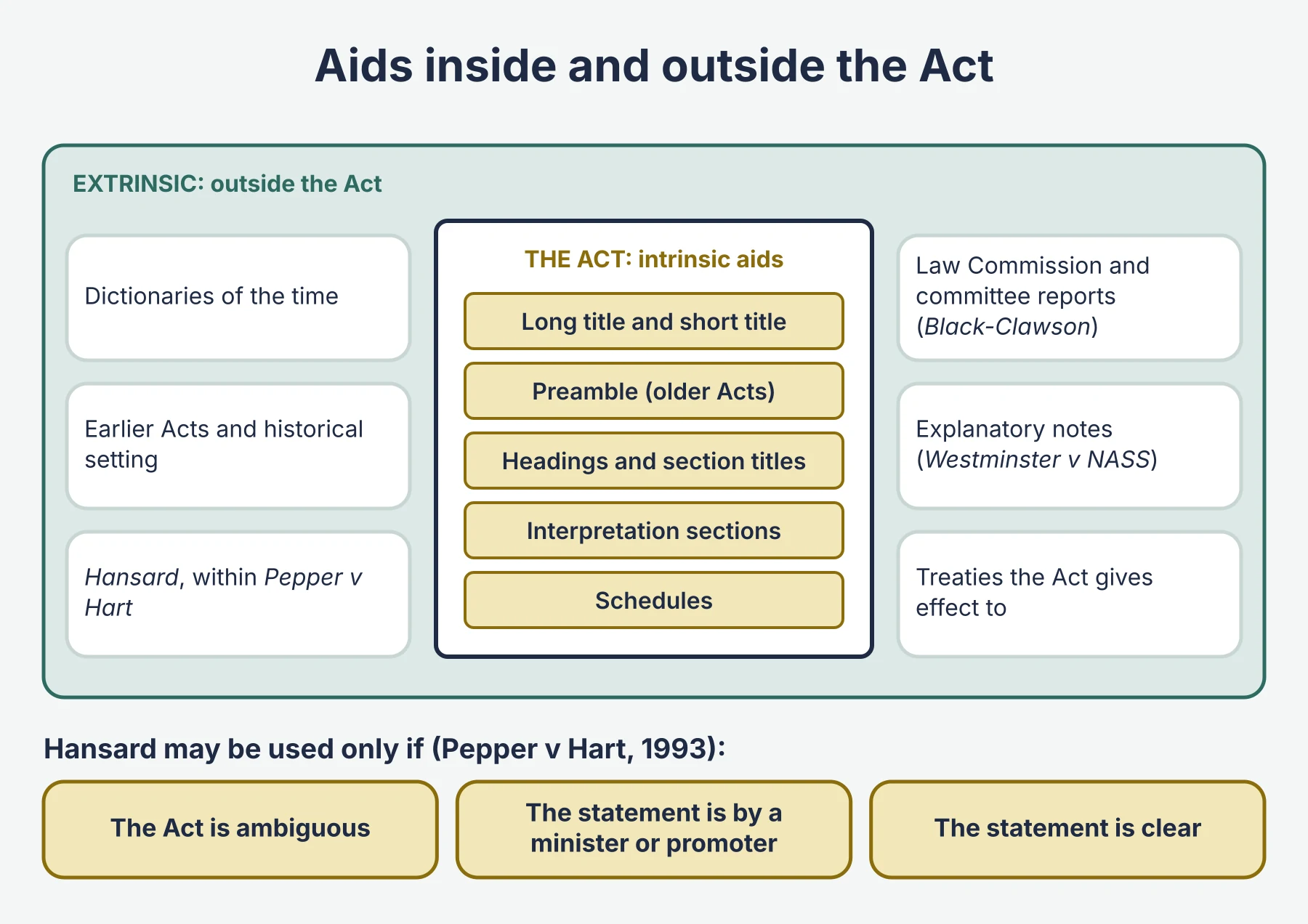
| Intrinsic (within the Act) | Extrinsic (outside the Act) |
|---|---|
| Long title and short title | Dictionaries of the time the Act was passed |
| Preamble (in older Acts) | Earlier Acts on the same topic and the historical setting |
| Headings and section titles | Hansard, subject to the limits in Pepper v Hart (1993): the Act is ambiguous, the statement is by a minister or promoter, and it is clear |
| Interpretation sections defining terms | Law Commission and official committee reports, used to identify the mischief (Black-Clawson, 1975) |
| Schedules | Explanatory notes, used as context (R (Westminster City Council) v NASS, 2002) |
| International treaties the Act gives effect to |
Rules of language
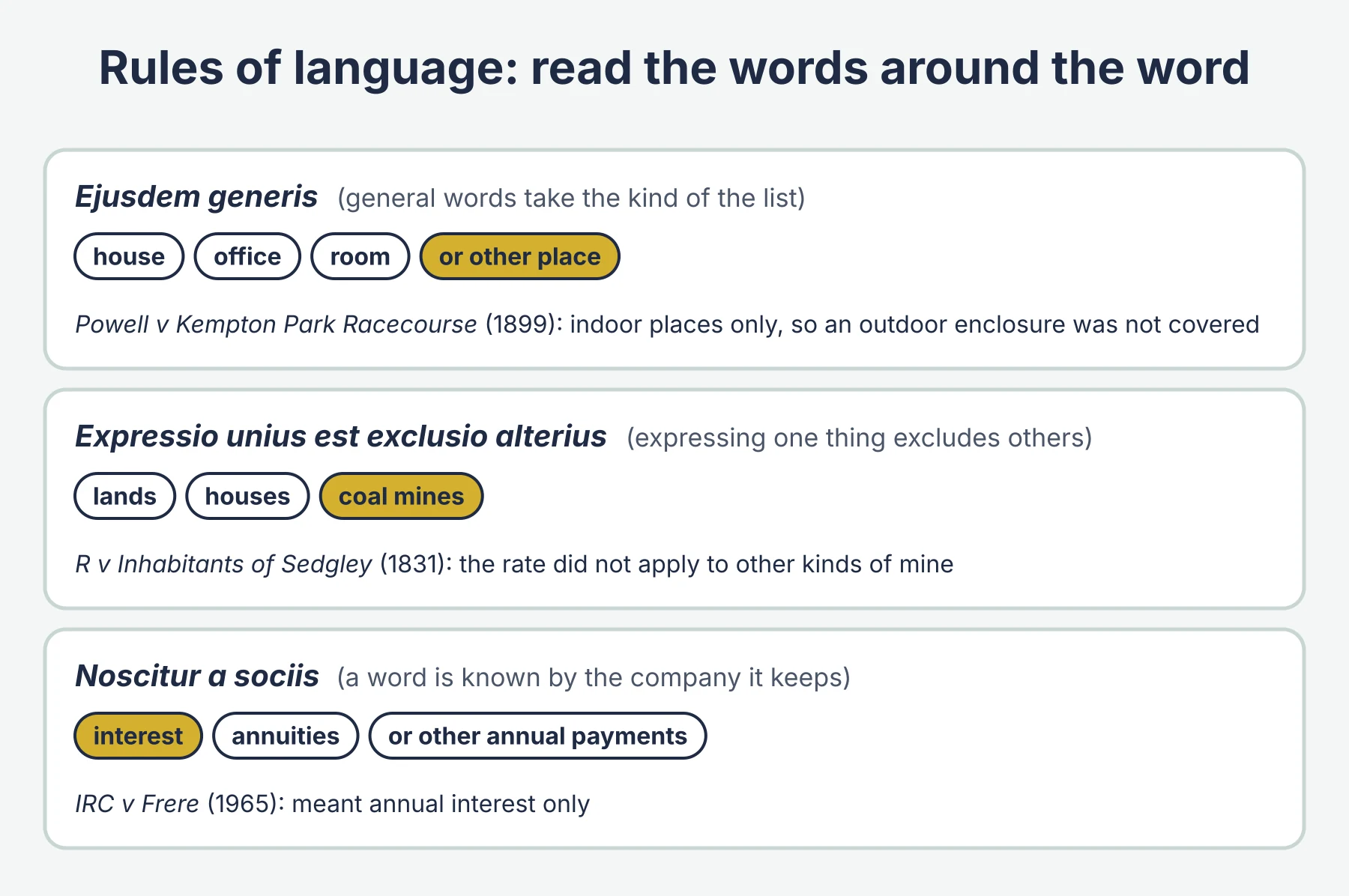
- Ejusdem generis (of the same kind): general words after a list of specific words are limited to the same kind. In Powell v Kempton Park Racecourse (1899) “house, office, room or other place” for betting covered indoor places only, so an outdoor enclosure was not included.
- Expressio unius est exclusio alterius (expressing one thing excludes others). In R v Inhabitants of Sedgley (1831) a rate on “lands, houses and coal mines” did not apply to other kinds of mine.
- Noscitur a sociis (a word is known by the company it keeps). In Inland Revenue Commissioners v Frere (1965) “interest, annuities or other annual payments” meant annual interest only, because of the surrounding words.
Impact of EU law and the Human Rights Act 1998
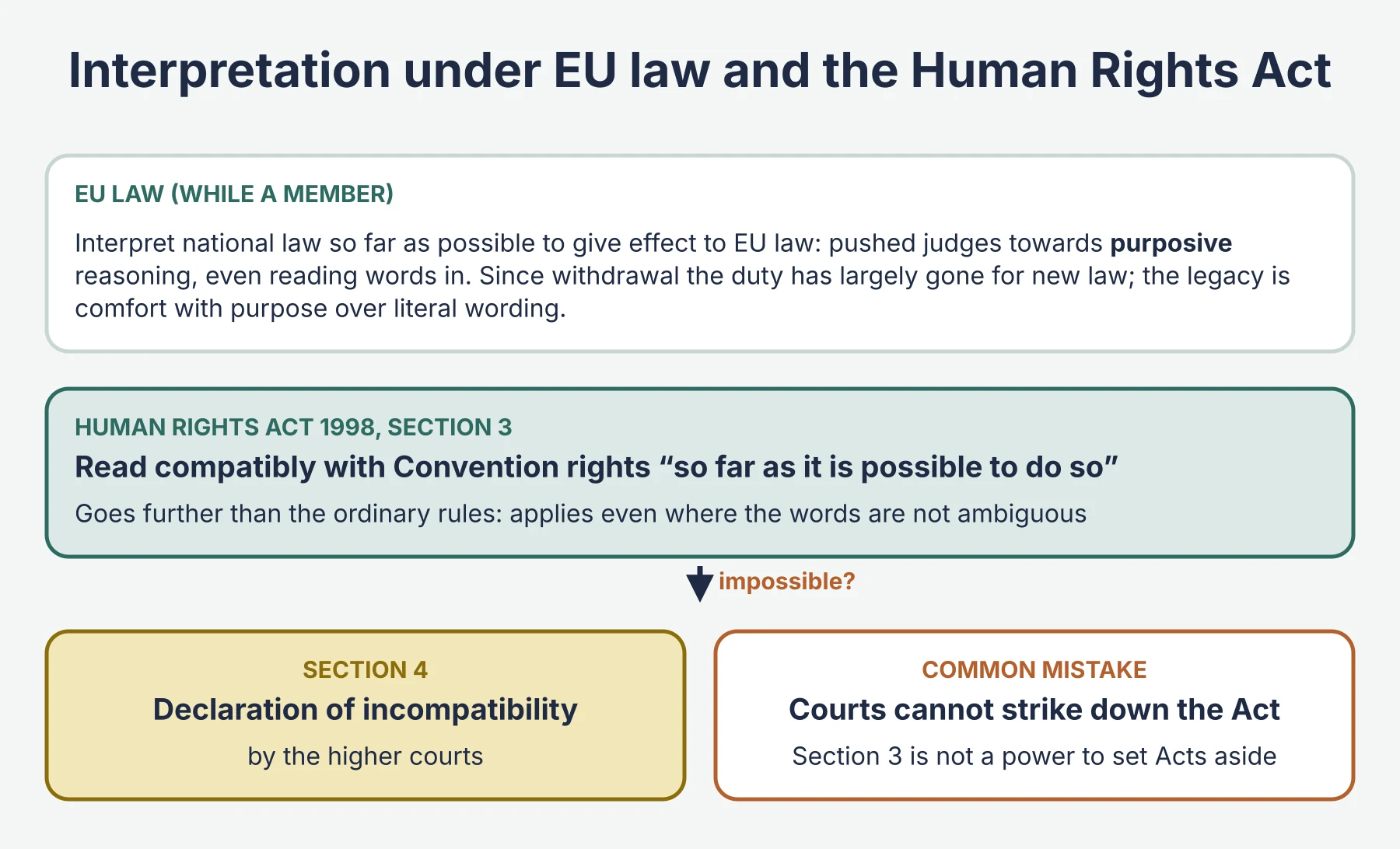
While the UK was a member, courts had to interpret national law so far as possible to give effect to EU law, which pushed English judges towards purposive reasoning and even reading words into legislation. Since withdrawal, this duty has largely gone for new law, but its legacy is a judiciary comfortable with purpose over literal wording. Under section 3 of the Human Rights Act 1998, courts must read legislation compatibly with Convention rights “so far as it is possible to do so”, which goes further than the ordinary rules because it can apply even where the words are not ambiguous. Where this is impossible, the higher courts may make a declaration of incompatibility under section 4.
Advantages and disadvantages
| Approach | Advantages | Disadvantages |
|---|---|---|
| Literal | Respects parliamentary supremacy; certainty; judges do not make law | Can produce absurd or unjust results (Whiteley, Berriman); assumes words have one clear meaning |
| Golden | Avoids absurdity; still starts from the words | No test of what counts as “absurd”; judges’ views vary |
| Mischief | Fills gaps; achieves what Parliament wanted | Based on old reasoning; can seem like judge-made law (RCN was a 3–2 decision) |
| Purposive | Flexible; deals with new technology (Quintavalle); fits EU and human rights approaches | Purpose can be hard to find; risks judges substituting their view for Parliament’s; less predictable |
Worked example: applying the rules to an unseen statute
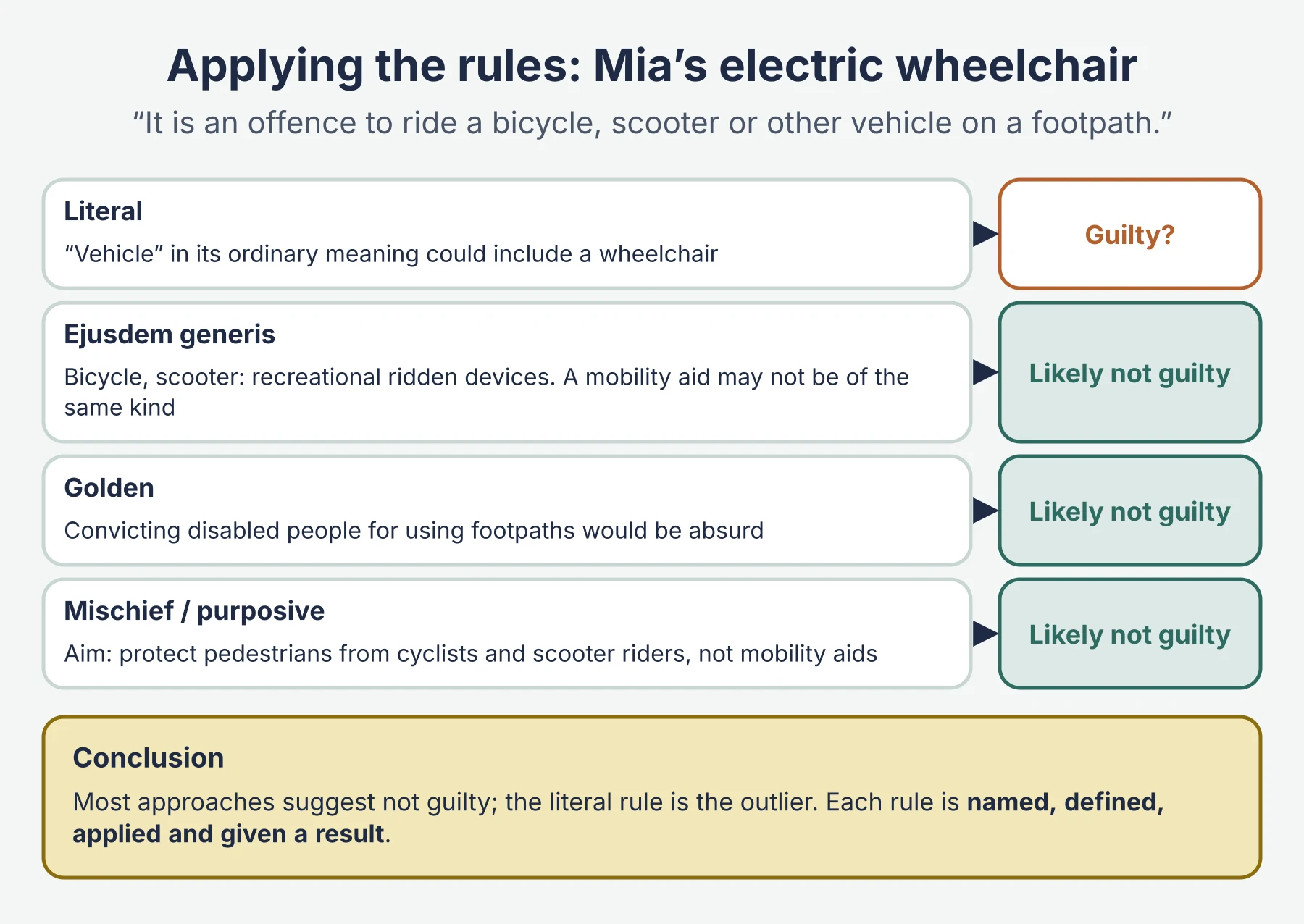
Fictional Act: “It is an offence to ride a bicycle, scooter or other vehicle on a footpath.” Mia rides an electric wheelchair on a footpath.
Literal: "vehicle" in ordinary meaning could include a wheelchair -> guilty?
Ejusdem generis: list = bicycle, scooter -> recreational ridden devices;
   a mobility aid may not be "of the same kind"
Golden: convicting disabled people for using footpaths would be absurd
Mischief/purposive: Act aims to protect pedestrians from cyclists and
   scooter riders; it was not aimed at mobility aids
Conclusion: most approaches suggest not guilty; literal is the outlier
The method earns marks because each rule is named, defined, applied to the facts and given a result.
Common mistakes
- Defining each rule without applying it to the facts in the question.
- Confusing the golden rule with the mischief rule.
- Saying Hansard can always be used; Pepper v Hart sets conditions.
- Treating section 3 of the Human Rights Act as allowing courts to strike down Acts.
- Writing about EU law as if it still binds interpretation of all legislation.
Exam technique
For application questions, take each rule in turn: state it, apply it, give the likely outcome. For evaluate questions, weigh certainty and supremacy (literal) against justice and flexibility (purposive), and conclude.
Condensed recall is in the Statutory Interpretation revision notes, and scenario practice is in the Statutory Interpretation practice questions. Interpretation decisions become binding through Judicial Precedent.
Related resources
-
Practice questions
AQA A Level Law (7162): Law Making: Statutory Interpretation – Practice Questions
Original practice questions with full answers on statutory interpretation rules, aids, language rules, EU law and the HRA, with scenarios for AQA Law 7162.
Law · AQA · A Level
Try questions -
Revision notes
AQA A Level Law (7162): Law Making: Statutory Interpretation – Revision Notes
Revision notes on the four approaches to interpretation, aids, language rules, EU law and the HRA, with a case bank, key terms and self-test for AQA Law 7162.
Law · AQA · A Level
Revise topic -
Study guides
AQA A Level Law (7162): Law Making: The European Union
EU law making for AQA A Level Law 7162: the four institutions and their functions, treaties, regulations and directives, and the impact on England and Wales.
Law · AQA · A Level
Read guide
Get free revision emails (optional)
Occasional emails with practice questions, worked explanations and links to free resources for the qualification and subjects you choose. No spam, and you can unsubscribe from any email. The free tools on this site never need an email.