
Revision Notes
AQA A Level Law (7162): Remedies in Tort – Revision Notes
Recall notes on compensatory damages for injury, property and economic loss, mitigation, types of injunction and damages in lieu, for AQA A Level Law 7162.
- Subject
- Law
- Level
- A LEVELS
- Topic
- Tort
- Author
- Marlbridge Academic Team
- Updated
- Reviewed by
- Aizaz Raoof Ali (what this means)
Aligned to AQA A Level Law (7162), For teaching from September 2017 onwards, A-level exams 2019 onwards. Official specification .
Syllabus page (what it covers and how it is assessed): AQA A Level Law.
Syllabus points this page covers
7162
- Remedies
Found an error? Report a correction.
Need help with this topic? Request a free trial class for A Level Law (7162).
Condensed notes for the section 3.3 row Remedies: “compensatory damages for physical injury to people, damage to property and economic loss”, “the principle of mitigation of loss” and “Injunctions”. For explanation and worked examples, use the remedies in tort study guide.
The aim of compensatory damages
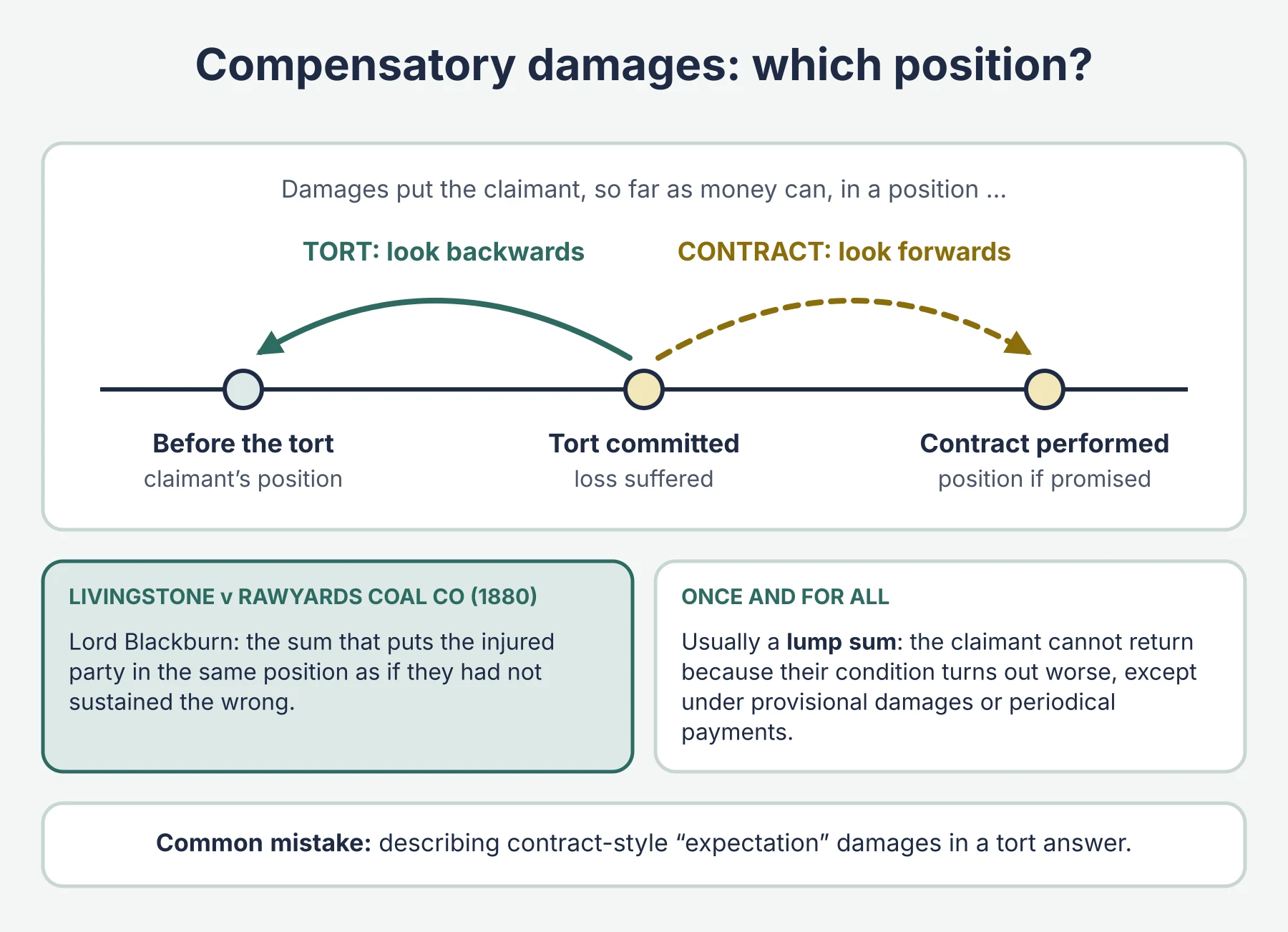
- Put the claimant, so far as money can, in the position they would have been in if the tort had not been committed: Livingstone v Rawyards Coal Co (1880).
- Tort damages look back to the pre-tort position; contract damages look forward to performance.
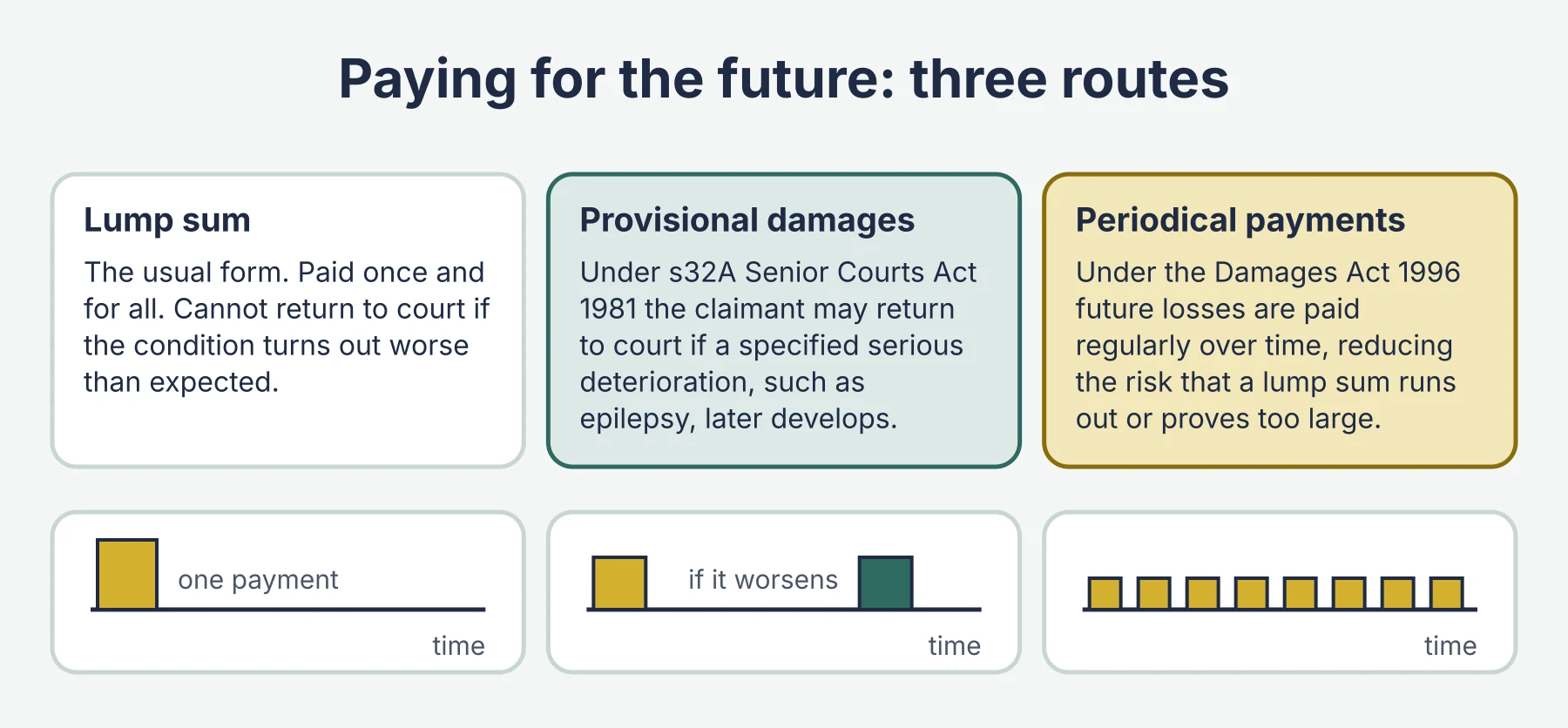
- Usually a lump sum, once and for all.
Personal injury
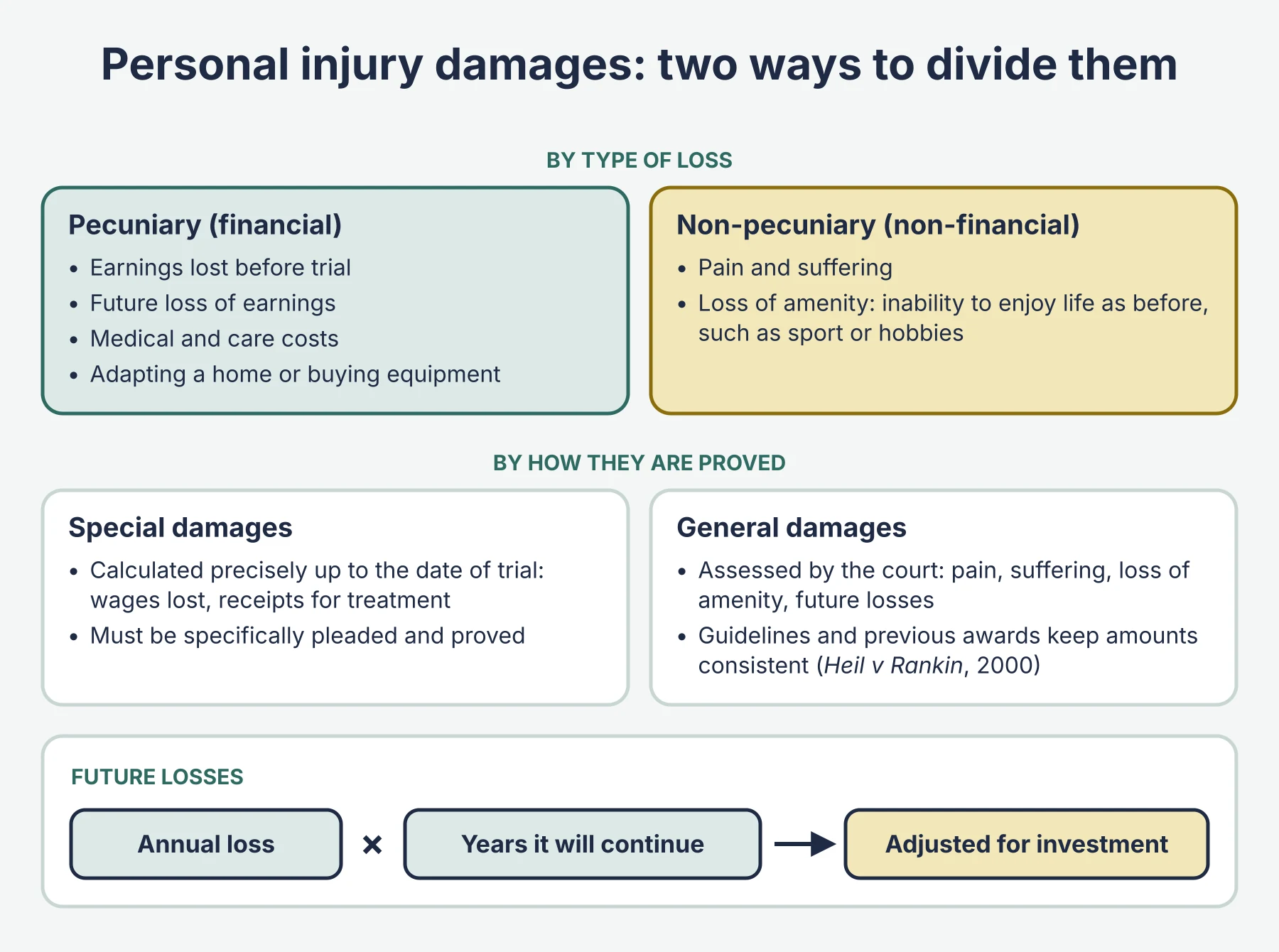
| Head | Type | Proof |
|---|---|---|
| Earnings lost before trial | Pecuniary | Special damages |
| Medical and care costs to trial | Pecuniary | Special damages |
| Future loss of earnings and care | Pecuniary | General damages (estimated) |
| Pain and suffering | Non-pecuniary | General damages |
| Loss of amenity | Non-pecuniary | General damages |
- Loss of amenity: loss of enjoyment of life, such as sport or hobbies.
- Future loss: annual loss multiplied by a figure for the years it will last, adjusted for investment of the lump sum.
- Consistency: guideline awards; Heil v Rankin (2000) increased the highest non-pecuniary awards.
- Provisional damages: s32A Senior Courts Act 1981, return to court on a specified serious deterioration.
- Periodical payments: Damages Act 1996, future losses paid over time.
Property damage
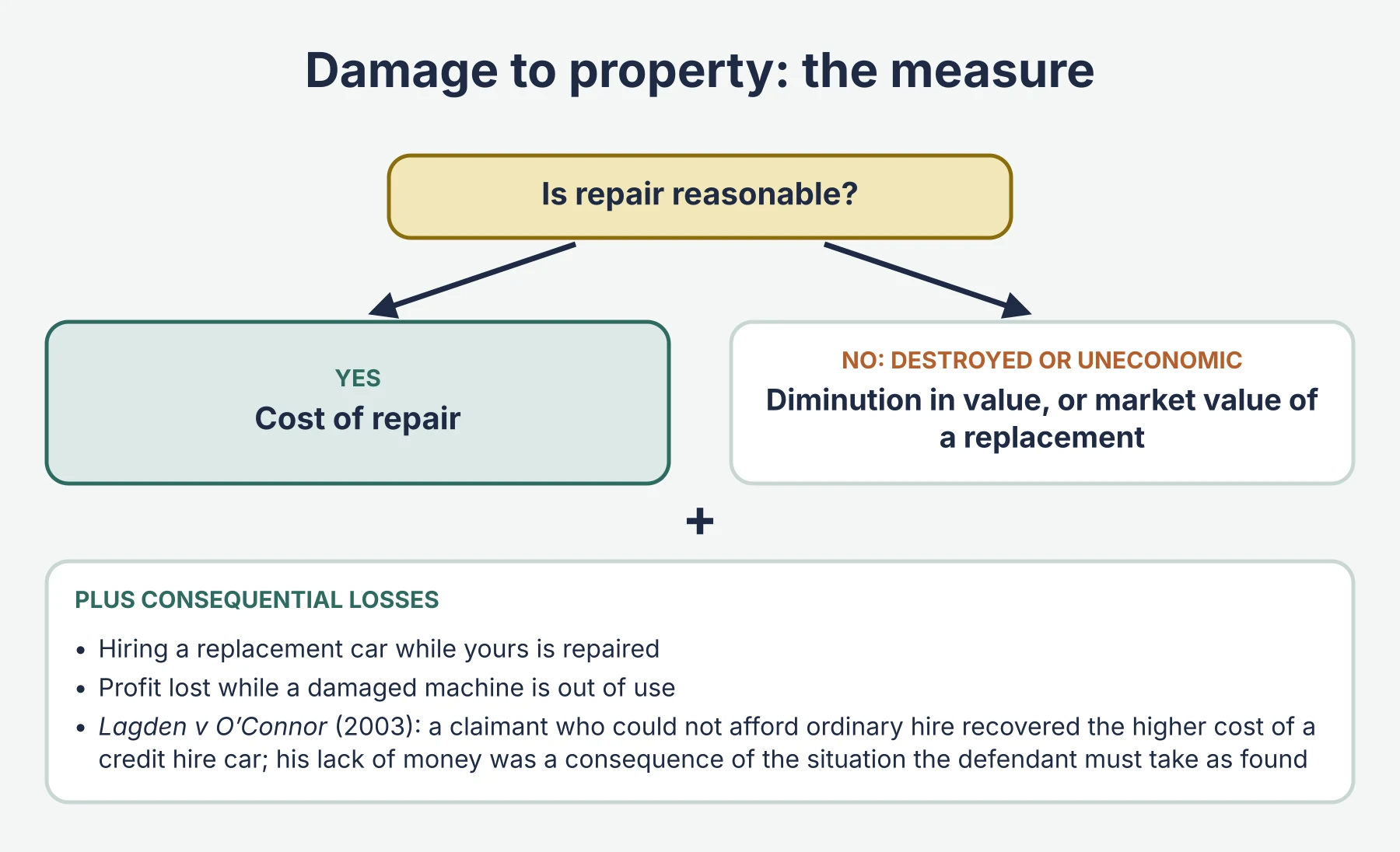
| Situation | Measure |
|---|---|
| Repairable at reasonable cost | Cost of repair |
| Destroyed or uneconomic to repair | Market value of replacement / diminution in value |
| Loss of use | Consequential losses, such as hire of a replacement |
| Impecunious claimant | Higher credit hire costs recoverable: Lagden v O’Connor (2003) |
Economic loss
- Consequential economic loss: recoverable (Spartan Steel, 1973: damaged melt and its profit).
- Negligent misstatement: loss caused by reliance on the advice.
Mitigation
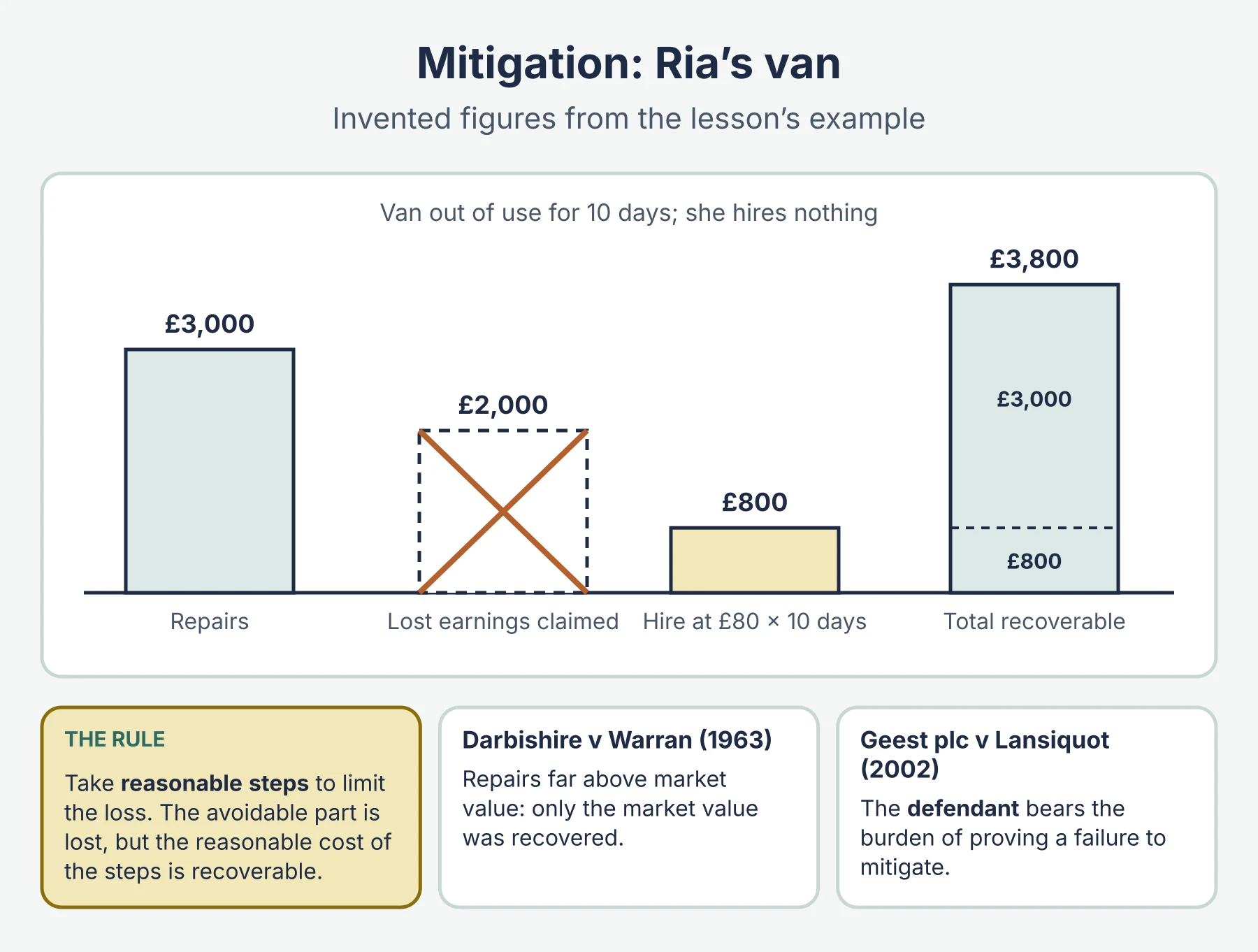
- Claimant must take reasonable steps to limit the loss.
- Cannot recover the part of the loss reasonable steps would have avoided.
- Can recover the reasonable cost of mitigating.
- Darbishire v Warran (1963): repair cost above market value; only market value recoverable.
- Burden on the defendant: Geest plc v Lansiquot (2002).
- Standard is not demanding: the claimant need only act reasonably.
Injunctions
| Type | Purpose |
|---|---|
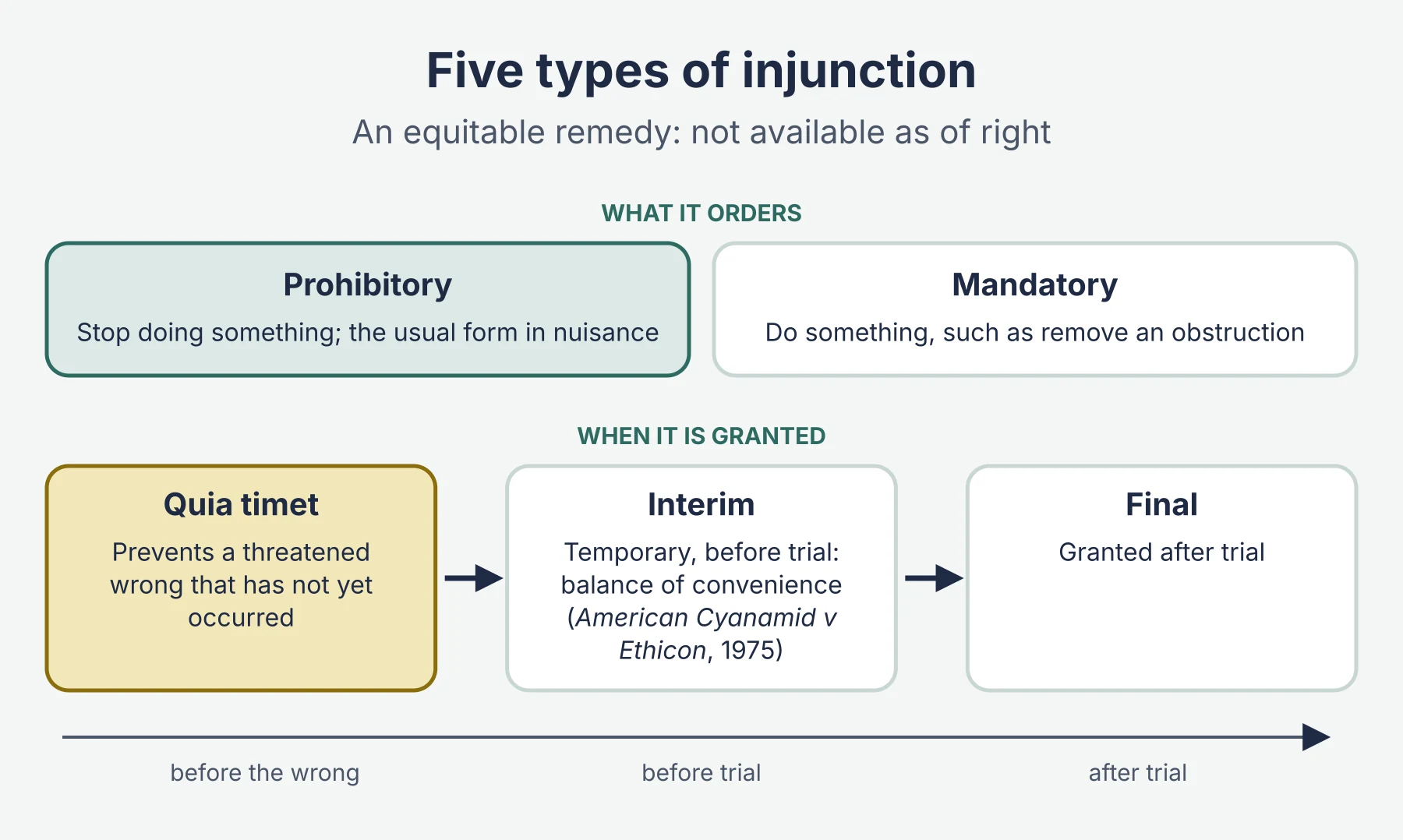
| Prohibitory | Stop doing something |
| Mandatory | Do something |
| Interim | Before trial; balance of convenience (American Cyanamid, 1975) |
| Final | After trial |
| Quia timet | Prevent a threatened wrong |
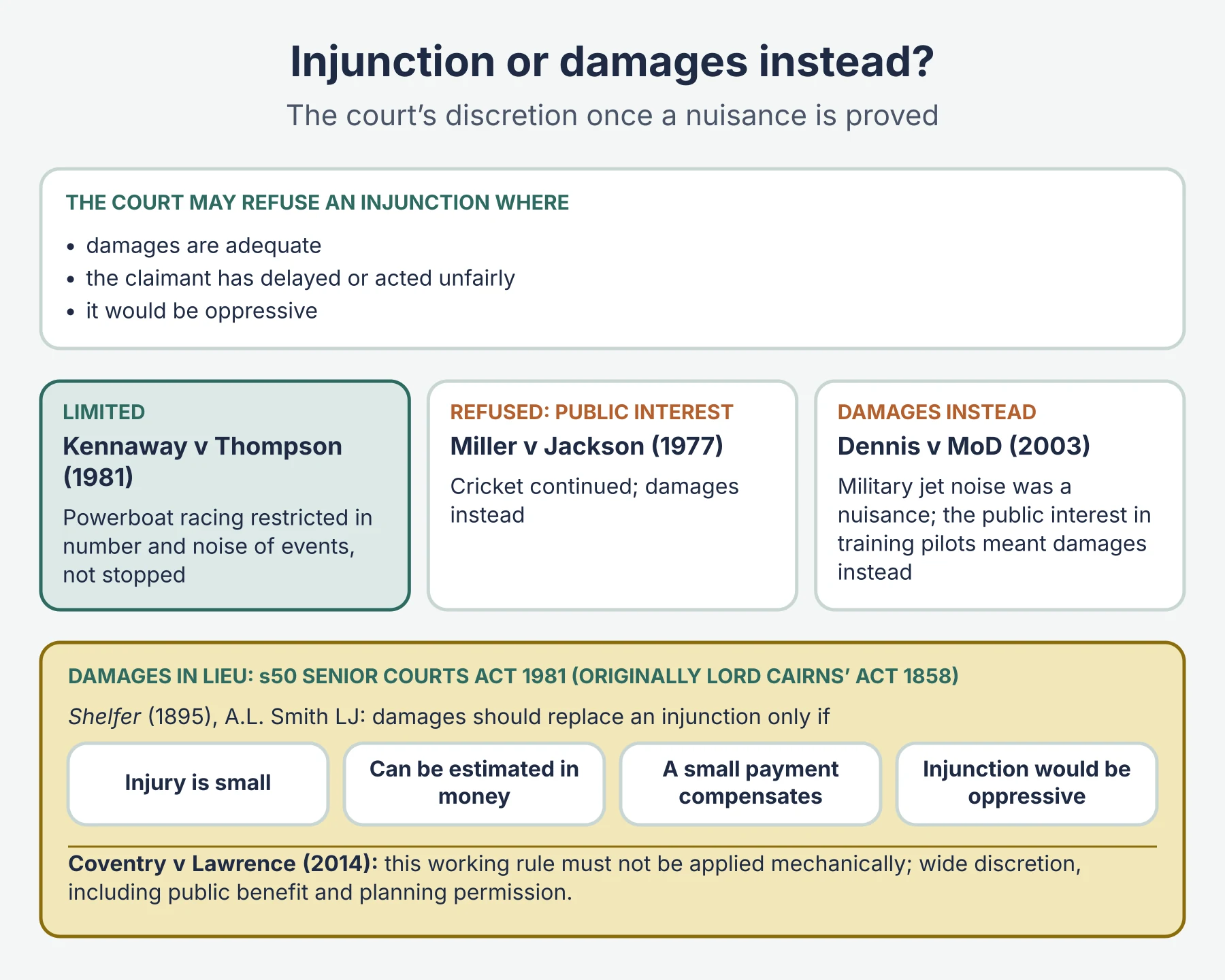
Discretionary (equitable): may be refused for delay, unfairness, adequacy of damages or oppression.
| Case | Outcome |
|---|---|
| Kennaway v Thompson (1981) | Limited injunction on powerboat events |
| Miller v Jackson (1977) | Refused; damages instead |
| Dennis v Ministry of Defence (2003) | Military jet noise; damages instead in the public interest |
Damages in lieu: s50 Senior Courts Act 1981 (originally Lord Cairns’ Act 1858).
- Shelfer (1895) working rule: injury small; estimable in money; adequately compensated by small payment; injunction oppressive.
- Coventry v Lawrence (2014): not to be applied mechanically; wide discretion; public benefit and planning permission may be considered.
Interaction with defences
- Contributory negligence reduces the total by the claimant’s share.
- Consent and the nuisance or Rylands defences remove damages entirely.
Evaluation points
- Lump sums give finality but rest on guesses about the future; periodical payments and provisional damages reduce the risk of under- or over-compensation.
- Non-pecuniary loss cannot truly be measured in money; guideline awards give consistency rather than accuracy.
- Mitigation is fair to defendants but applied gently because the defendant created the problem.
- Injunctions protect property rights, but damages in lieu after Coventry let important activities continue at a price.
Key terms
| Term | Meaning |
|---|---|
| Compensatory damages | Money to restore the claimant to the pre-tort position |
| Pecuniary loss | Financial loss, such as earnings |
| Non-pecuniary loss | Non-financial loss, such as pain and loss of amenity |
| Special damages | Precisely calculable losses up to trial |
| General damages | Losses assessed by the court, including future losses |
| Mitigation | Duty to take reasonable steps to limit loss |
| Prohibitory injunction | Order to stop an activity |
| Damages in lieu | Damages awarded instead of an injunction |
Exam traps
- Do not use contract’s expectation measure in tort.
- Failure to mitigate removes only the avoidable loss.
- An injunction is never automatic.
- Coventry softened Shelfer, not abolished it.
- Remember that the defendant must prove failure to mitigate.
Self-test
- What is the aim of compensatory damages in tort? To put the claimant in the position they would have been in had the tort not occurred.
- Which case is the classic statement of this aim? Livingstone v Rawyards Coal Co (1880).
- Distinguish special and general damages. Special: calculable losses to trial; general: assessed by the court, including pain, suffering and future loss.
- What is loss of amenity? Loss of the ability to enjoy life as before.
- What do provisional damages allow? A return to court if a specified serious deterioration develops.
- What is the usual measure for repairable property damage? The reasonable cost of repair.
- What did Lagden v O’Connor decide? An impecunious claimant can recover higher credit hire costs.
- Why was recovery limited in Darbishire v Warran? A reasonable person would have bought a replacement rather than pay more than market value for repairs.
- Who must prove failure to mitigate? The defendant (Geest v Lansiquot).
- What is a quia timet injunction? One that prevents a threatened wrong before it happens.
- Name the four Shelfer conditions. Small injury; estimable in money; adequately compensated by a small payment; injunction oppressive.
- What did Coventry v Lawrence say about Shelfer? It should not be applied mechanically; the court has a wide discretion.
More resources on this topic
Related resources
-
Study guides
AQA A Level Law (7162): The Rules of Tort Law
How tort rules work: sources, burden of proof, fault and strict liability across the torts, defences and remedies, and a method for problems, for AQA Law 7162.
Law · AQA · A Level
Read guide -
Practice questions
AQA A Level Law (7162): The Rules of Tort Law – Practice Questions
Original practice questions with mark-scheme answers on tort sources, burden of proof, fault, defences and remedies for AQA A Level Law 7162.
Law · AQA · A Level
Try questions -
Revision notes
AQA A Level Law (7162): The Rules of Tort Law – Revision Notes
Recall notes on tort sources, the claimant's burden, fault and strict liability, defences, remedies and the problem method, for AQA A Level Law 7162.
Law · AQA · A Level
Revise topic
Get free revision emails (optional)
Occasional emails with practice questions, worked explanations and links to free resources for the qualification and subjects you choose. No spam, and you can unsubscribe from any email. The free tools on this site never need an email.