
Study Guides
AQA A Level Law (7162): The Rules of Tort Law
How tort rules work: sources, burden of proof, fault and strict liability across the torts, defences and remedies, and a method for problems, for AQA Law 7162.
- Subject
- Law
- Level
- A LEVELS
- Topic
- Tort
- Author
- Marlbridge Academic Team
- Updated
- Reviewed by
- Aizaz Raoof Ali (what this means)
Aligned to AQA A Level Law (7162), For teaching from September 2017 onwards, A-level exams 2019 onwards. Official specification .
Syllabus page (what it covers and how it is assessed): AQA A Level Law.
Syllabus points this page covers
7162
- The rules of tort law
Found an error? Report a correction.
Need help with this topic? Request a free trial class for A Level Law (7162).
This guide covers the opening row of AQA A-level Law (7162) section 3.3, The rules of tort law. The specification describes it as “rules and principles concerning liability and fault in actions for negligence, occupiers’ liability, nuisance and vicarious liability, and associated defences and remedies”. The detailed rules for each tort have their own pages. This guide explains the framework that connects them: what a tort claim is, where the rules come from, who must prove what, how much fault each tort requires, and how defences and remedies fit in. For the detail of each tort, see the Tort study guide.
What a tort claim is
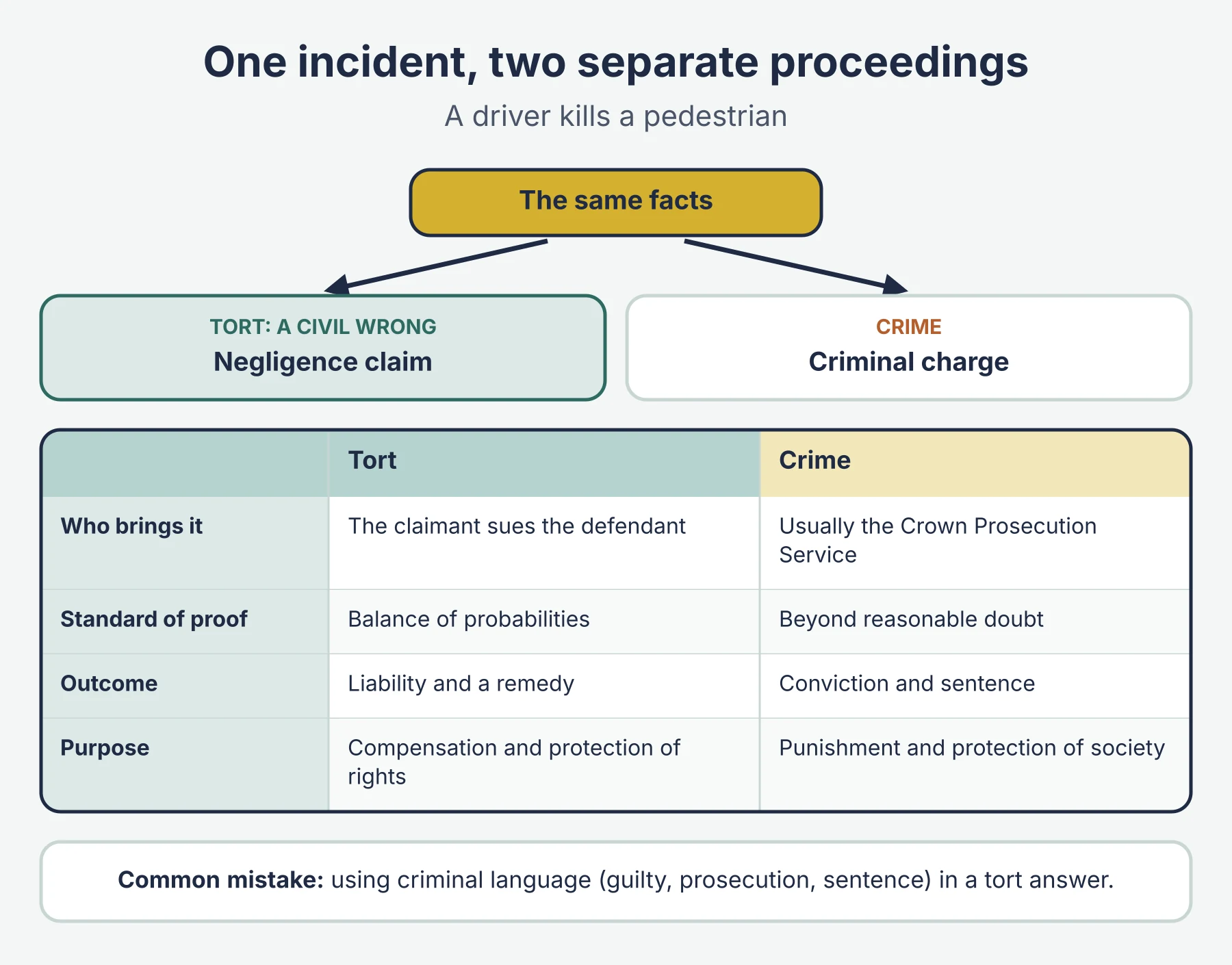
A tort is a civil wrong, other than a breach of contract, for which the person wronged can sue for a remedy. The claimant sues the defendant; there is no prosecution, no conviction and no sentence. The aim is to put right the harm, usually by compensatory damages, or to stop it continuing, by an injunction. The same facts can also be a crime (a driver who kills a pedestrian may face a criminal charge and a negligence claim), but the two proceedings are separate and follow different rules.
| Tort | Crime | |
|---|---|---|
| Who brings it | The claimant | Usually the Crown Prosecution Service |
| Standard of proof | Balance of probabilities | Beyond reasonable doubt |
| Outcome | Liability and a remedy | Conviction and sentence |
| Purpose | Compensation and protection of rights | Punishment and protection of society |
Where the rules come from
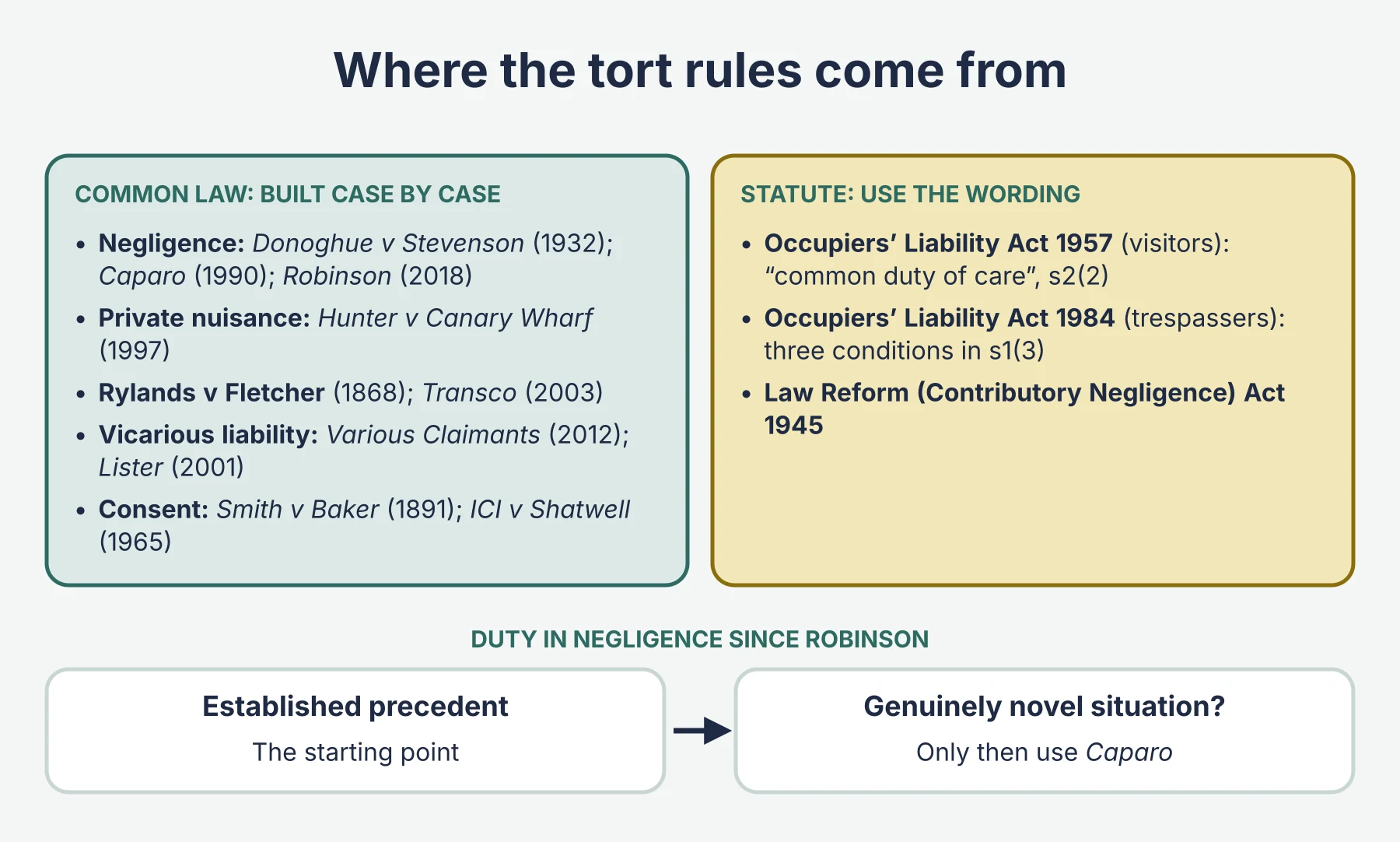
| Tort | Main source | Key authority |
|---|---|---|
| Negligence | Common law | Donoghue v Stevenson (1932); Caparo v Dickman (1990); Robinson v Chief Constable of West Yorkshire (2018) |
| Occupiers’ liability | Statute | Occupiers’ Liability Act 1957 (visitors); Occupiers’ Liability Act 1984 (trespassers) |
| Private nuisance | Common law | Hunter v Canary Wharf (1997) |
| Rylands v Fletcher | Common law | Rylands v Fletcher (1868); Transco v Stockport MBC (2003) |
| Vicarious liability | Common law | Various Claimants v Catholic Child Welfare Society (2012); Lister v Hesley Hall (2001) |
| Contributory negligence | Statute | Law Reform (Contributory Negligence) Act 1945 |
| Consent | Common law | Smith v Baker (1891); ICI v Shatwell (1965) |
Two consequences follow. In negligence, the courts build the rules case by case: since Robinson the starting point for duty is established precedent, with Caparo used only for genuinely novel situations. In occupiers’ liability, you must use the wording of the Acts, such as the “common duty of care” in s2(2) of the 1957 Act and the three conditions in s1(3) of the 1984 Act, before applying cases.
Who has to prove what
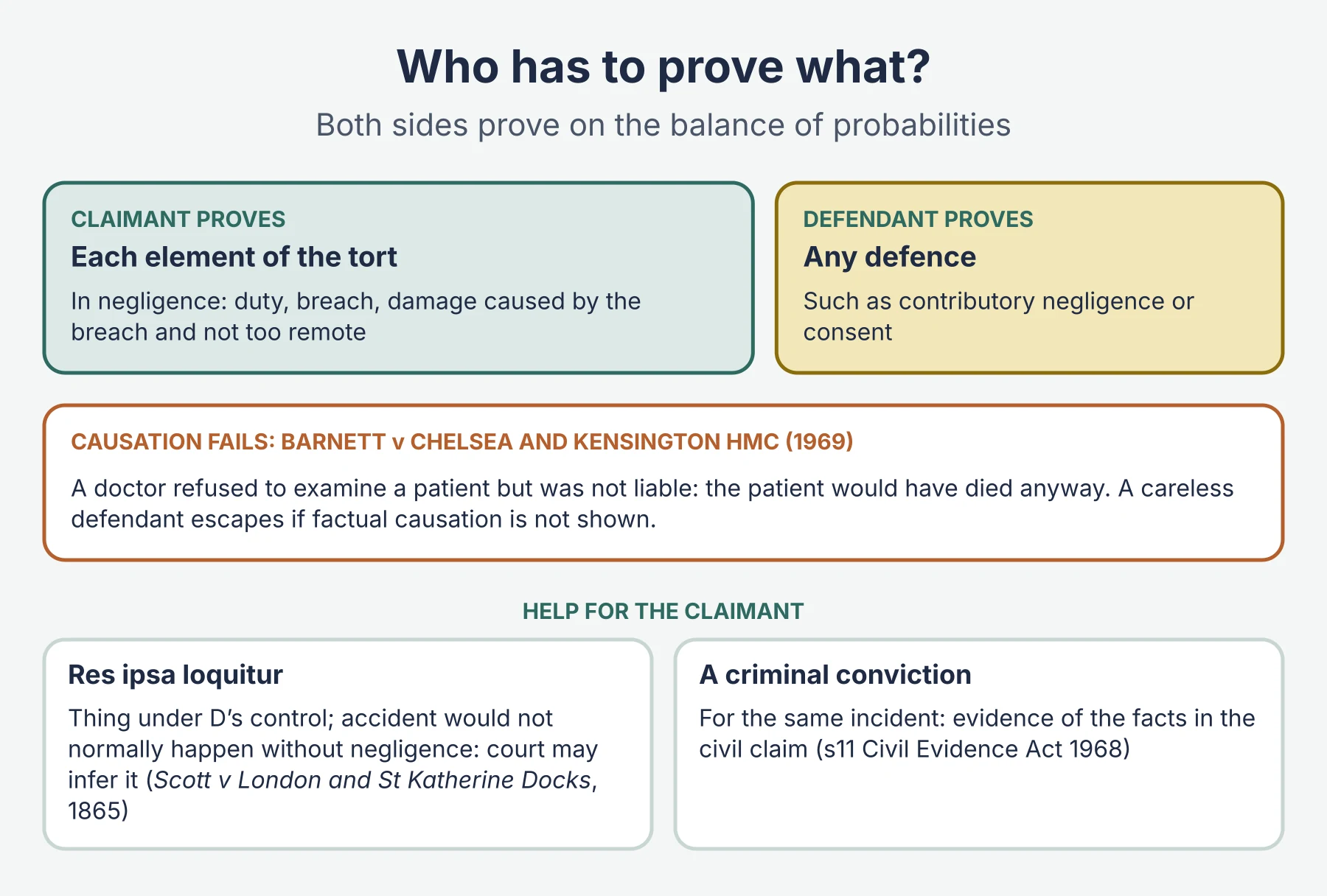
The claimant must prove each element of the tort on the balance of probabilities: that it is more likely than not.
- In negligence that means duty, breach, and damage caused by the breach that is not too remote. If the claimant cannot show factual causation, the claim fails even if the defendant was careless: in Barnett v Chelsea and Kensington Hospital Management Committee (1969) a doctor who refused to examine a patient was not liable because the patient would have died anyway.
- Res ipsa loquitur (“the thing speaks for itself”) helps where the claimant cannot know exactly what went wrong: if the thing that caused harm was under the defendant’s control and the accident would not normally happen without negligence, the court may infer negligence (Scott v London and St Katherine Docks, 1865).
- A criminal conviction for the same incident can be used as evidence of the facts in the civil claim (s11 Civil Evidence Act 1968).
The defendant must prove any defence on the balance of probabilities, such as the claimant’s contributory negligence or consent.
Liability and fault across the torts
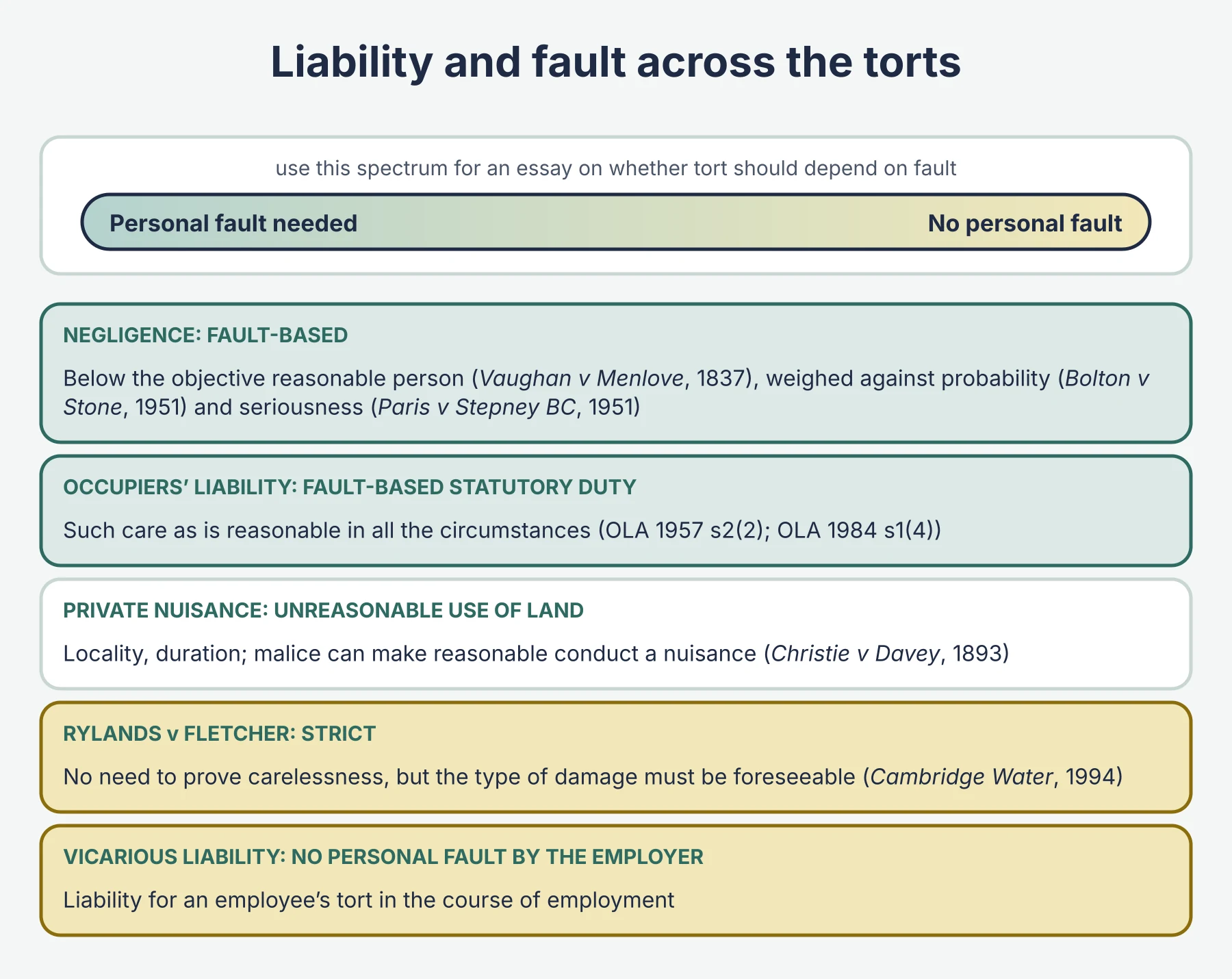
The specification’s phrase “liability and fault” invites comparison. The torts sit on a spectrum:
| Tort | Role of fault |
|---|---|
| Negligence | Fault-based: the defendant must fall below the objective standard of the reasonable person (Vaughan v Menlove, 1837), weighed against risk factors such as probability (Bolton v Stone, 1951) and seriousness of harm (Paris v Stepney BC, 1951) |
| Occupiers’ liability | Fault-based statutory duty: to take such care as is reasonable in all the circumstances (OLA 1957 s2(2); OLA 1984 s1(4)) |
| Private nuisance | The question is whether the defendant’s use of land was unreasonable, weighed by factors such as locality and duration; malice can make otherwise reasonable conduct a nuisance (Christie v Davey, 1893) |
| Rylands v Fletcher | Strict: no need to prove carelessness, but the type of damage must be foreseeable (Cambridge Water v Eastern Counties Leather, 1994) |
| Vicarious liability | No personal fault by the employer: liability for an employee’s tort committed in the course of employment |
This spectrum is a useful structure for an essay on whether tort law should depend on fault.
Defences and remedies as part of the rules
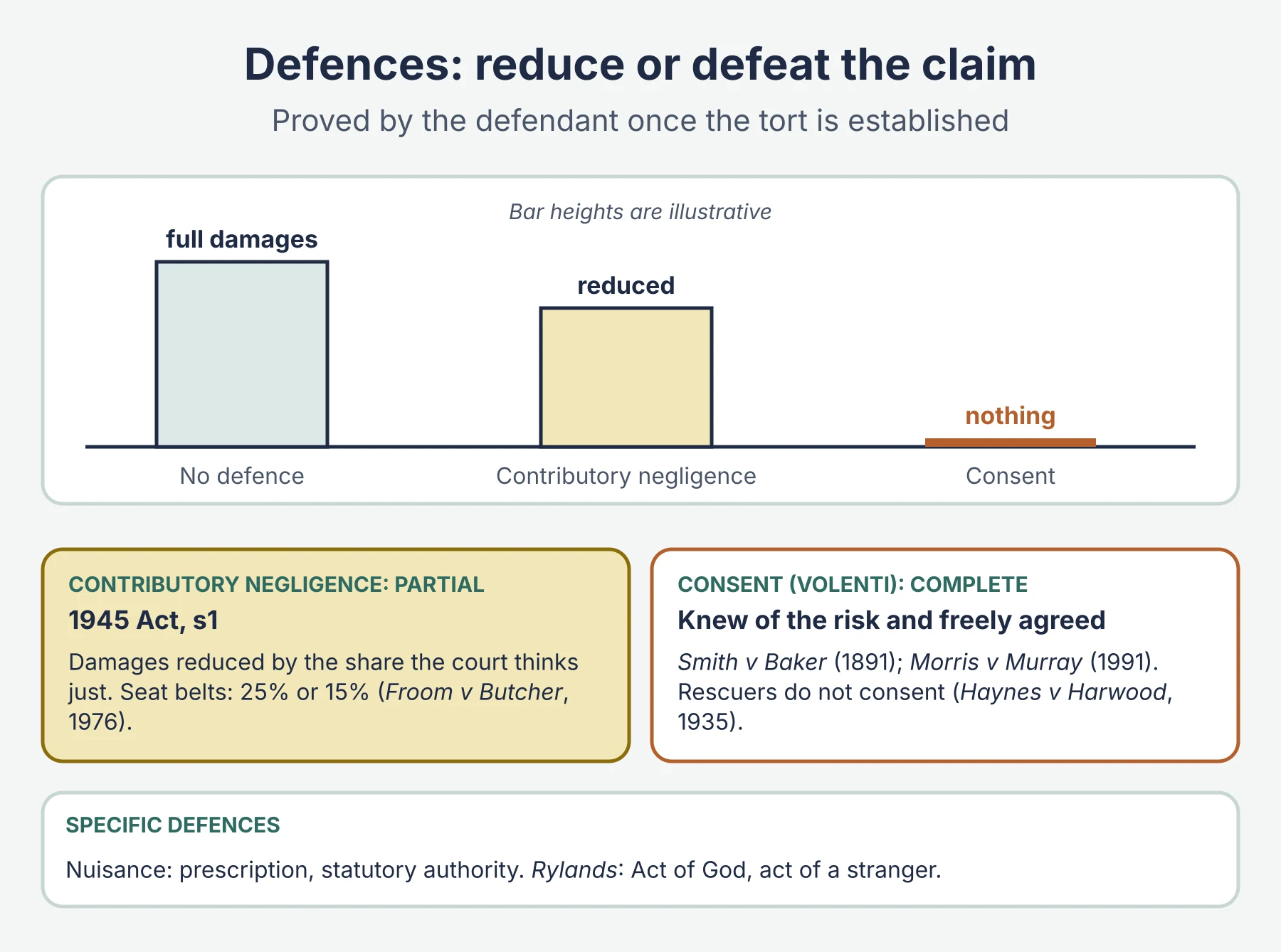
Defences are the defendant’s answer once the claimant has proved the tort:
- Contributory negligence reduces damages by the share of responsibility the court thinks just (1945 Act, s1); for failing to wear a seat belt, Froom v Butcher (1976) suggested reductions of 25% or 15%.
- Consent (volenti non fit injuria) is a complete defence where the claimant knew of the risk and freely agreed to it (Smith v Baker, 1891; Morris v Murray, 1991). Rescuers are not treated as consenting (Haynes v Harwood, 1935).
- Specific defences apply to nuisance (such as prescription and statutory authority) and to Rylands (such as Act of God and act of a stranger).
Remedies follow liability:
- Compensatory damages aim to put the claimant in the position he would have been in had the tort not been committed, covering personal injury, property damage and consequential economic loss; the claimant must mitigate his loss.
- Injunctions are discretionary orders, most often used in nuisance, to stop or limit the defendant’s activity.
Applying the rules: a method for problem questions
- Identify the parties: who might sue whom? Is there an employer behind the wrongdoer?
- Choose the tort: injury on premises (occupiers’ liability), interference with land (nuisance or Rylands), careless conduct generally (negligence).
- State the elements with their source.
- Apply each element with an authority, using the facts.
- Consider vicarious liability if the wrongdoer was an employee.
- Consider defences.
- Consider remedies.
- Conclude on who is liable for what.
Worked example
Jas, a delivery driver for SpeedyParcels Ltd, reverses into a garden wall while looking at his phone. The wall falls on Kit, a neighbour, breaking his leg. Kit was sitting on the wall, which had a sign saying “Do not sit on this wall”.
Parties:    Kit v Jas; and Kit v SpeedyParcels Ltd (vicarious liability).
Tort:       negligence - careless driving causing injury.
Duty:       established - road users owe a duty to those nearby (no need
            for Caparo: Robinson).
Breach:     looking at a phone while reversing falls below the reasonable
            driver (Vaughan v Menlove applied to drivers).
Damage:     but for the reversing, no injury (Barnett); broken leg is a
            foreseeable type of harm (Wagon Mound).
VL:         Jas is an employee acting in the course of employment.
Defences:   contributory negligence - Kit ignored a warning sign; damages
            reduced (1945 Act). Consent unlikely: he did not agree to
            the risk of being hit by a van.
Remedy:     compensatory damages for injury and losses, reduced.
Conclusion: SpeedyParcels is likely to be vicariously liable; damages
            reduced for Kit's contributory negligence.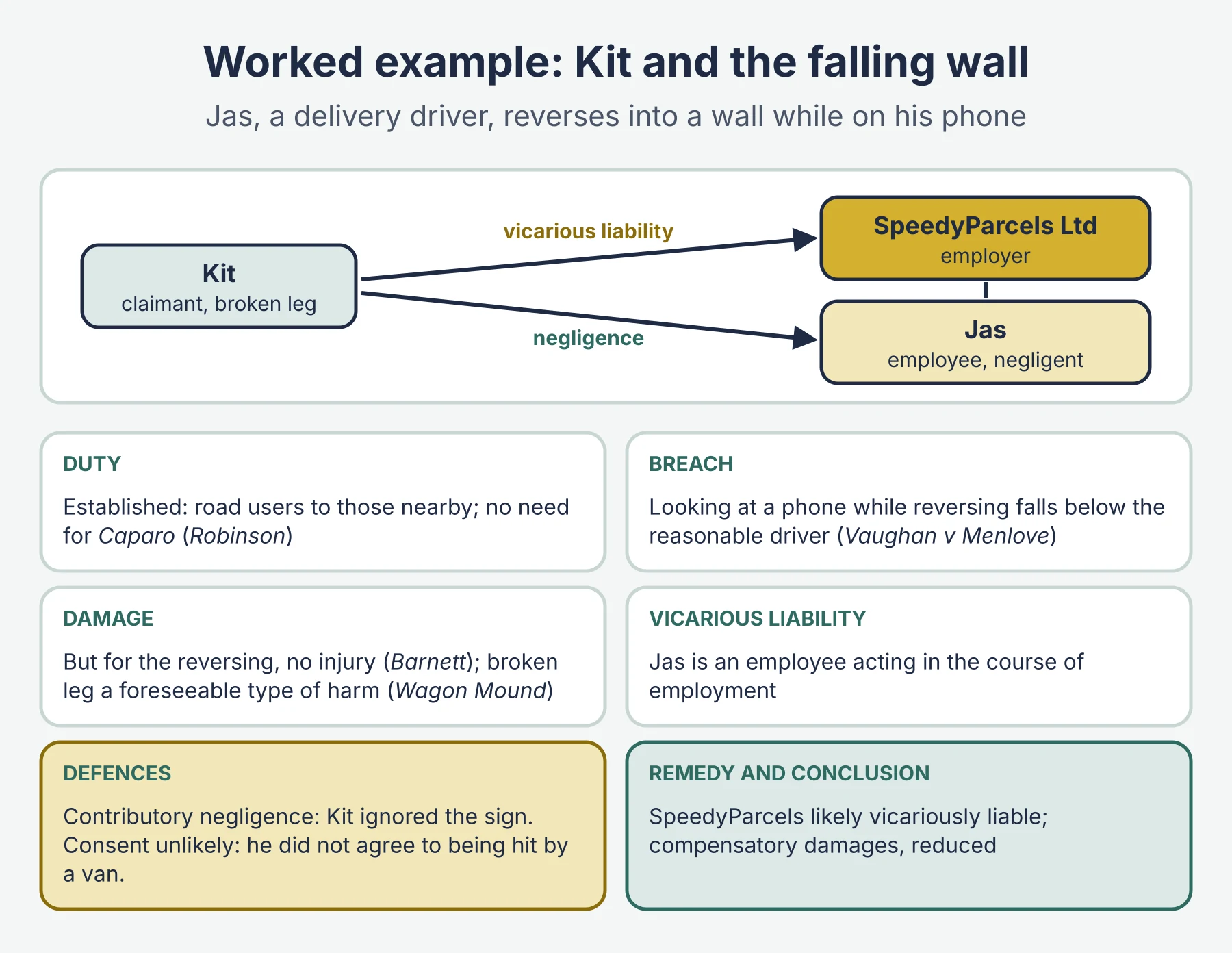
Common mistakes
- Using criminal language (guilty, prosecution, sentence) in a tort answer.
- Forgetting that the claimant must prove each element, including causation.
- Treating vicarious liability as a separate tort; it is a way of making someone else liable for a tort.
- Saying Rylands needs no foreseeability at all.
- Ending a problem answer before defences and remedies.
Exam technique
Short questions on this row may ask you to explain the standard of proof, compare fault in two torts, or explain the purpose of a remedy: define, give an authority, illustrate. In problem questions the framework above is the skeleton of the answer; AQA rewards a conclusion on liability that accounts for defences and remedies.
More resources on this topic
Rules of tort law revision notes | Rules of tort law practice questions | Tort cases, defences and remedies study guide
Related resources
-
Practice questions
AQA A Level Law (7162): The Rules of Tort Law – Practice Questions
Original practice questions with mark-scheme answers on tort sources, burden of proof, fault, defences and remedies for AQA A Level Law 7162.
Law · AQA · A Level
Try questions -
Revision notes
AQA A Level Law (7162): The Rules of Tort Law – Revision Notes
Recall notes on tort sources, the claimant's burden, fault and strict liability, defences, remedies and the problem method, for AQA A Level Law 7162.
Law · AQA · A Level
Revise topic -
Study guides
AQA A Level Law (7162): Theory of Tort Law
The policy behind duty of care, economic loss, psychiatric injury, the standard of care, injunctions and vicarious liability, for AQA A Level Law 7162 essays.
Law · AQA · A Level
Read guide
Get free revision emails (optional)
Occasional emails with practice questions, worked explanations and links to free resources for the qualification and subjects you choose. No spam, and you can unsubscribe from any email. The free tools on this site never need an email.