
Revision Notes
AQA A Level Law (7162): The Rules of Tort Law – Revision Notes
Recall notes on tort sources, the claimant's burden, fault and strict liability, defences, remedies and the problem method, for AQA A Level Law 7162.
- Subject
- Law
- Level
- A LEVELS
- Topic
- Tort
- Author
- Marlbridge Academic Team
- Updated
- Reviewed by
- Aizaz Raoof Ali (what this means)
Aligned to AQA A Level Law (7162), For teaching from September 2017 onwards, A-level exams 2019 onwards. Official specification .
Syllabus page (what it covers and how it is assessed): AQA A Level Law.
Syllabus points this page covers
7162
- The rules of tort law
Found an error? Report a correction.
Need help with this topic? Request a free trial class for A Level Law (7162).
Condensed notes for the section 3.3 row The rules of tort law: “rules and principles concerning liability and fault in actions for negligence, occupiers’ liability, nuisance and vicarious liability, and associated defences and remedies”. These notes cover the framework; each tort’s elements are in the Tort revision notes. For explanation and a worked problem, use the rules of tort law study guide.
Tort in one line
A civil wrong, other than breach of contract, for which the claimant sues the defendant for a remedy (damages or an injunction).
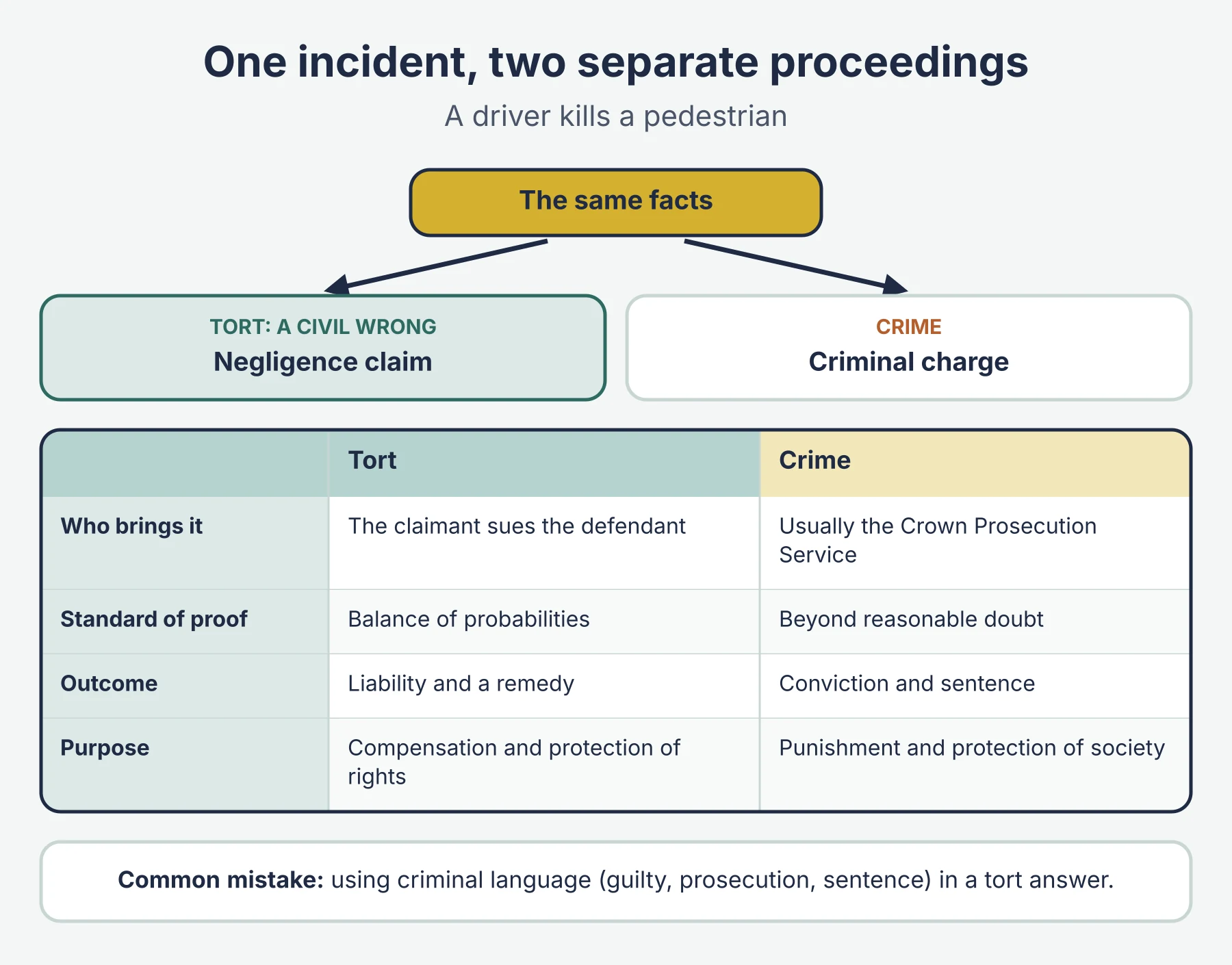
Tort versus crime
| Tort | Crime | |
|---|---|---|
| Parties | Claimant v defendant | Prosecution v defendant |
| Standard | Balance of probabilities | Beyond reasonable doubt |
| Result | Liable; damages or injunction | Guilty; sentence |
| Vocabulary | Sue, liable, claimant, damages | Prosecute, guilty, defendant, sentence |
Sources
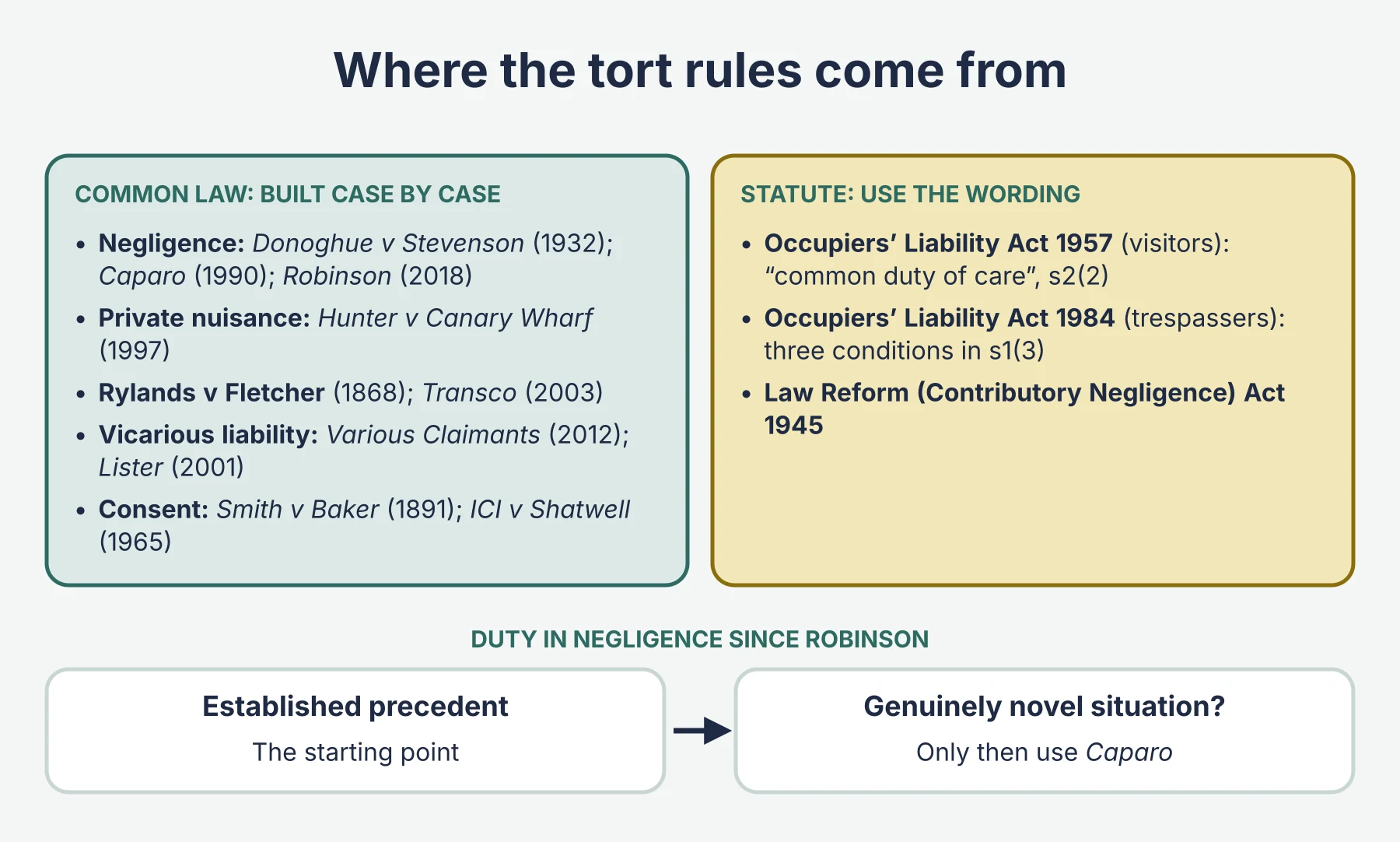
| Rule | Source |
|---|---|
| Negligence | Common law: Donoghue v Stevenson (1932); Caparo (1990); Robinson (2018) |
| Visitors | Occupiers’ Liability Act 1957 |
| Trespassers | Occupiers’ Liability Act 1984 |
| Private nuisance | Common law |
| Rylands v Fletcher | Common law (1868); Transco (2003) |
| Vicarious liability | Common law |
| Contributory negligence | Law Reform (Contributory Negligence) Act 1945 |
| Consent | Common law |
Using the source: for statute-based torts, quote the section first (OLA 1957 s2(2) common duty of care; OLA 1984 s1(3) conditions). For common law torts, state the test from the leading case.
Burden and proof
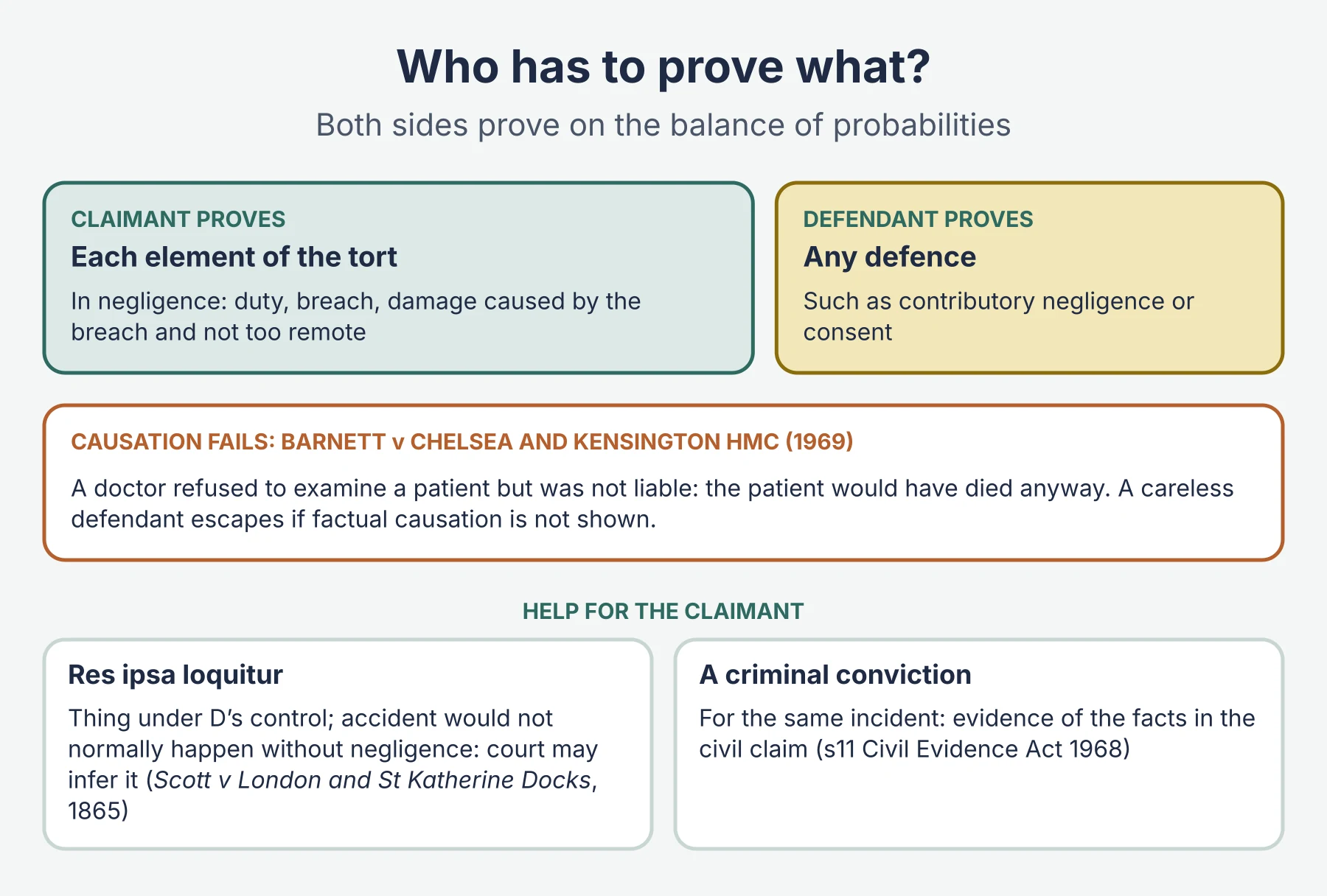
- Claimant proves every element on the balance of probabilities.
- No causation, no claim: Barnett v Chelsea and Kensington HMC (1969).
- Res ipsa loquitur: inference of negligence where the thing was under D’s control and the accident would not normally happen without negligence (Scott v London and St Katherine Docks, 1865).
- Criminal conviction can be used as evidence (s11 Civil Evidence Act 1968).
- Defendant proves defences on the balance of probabilities.
The fault spectrum
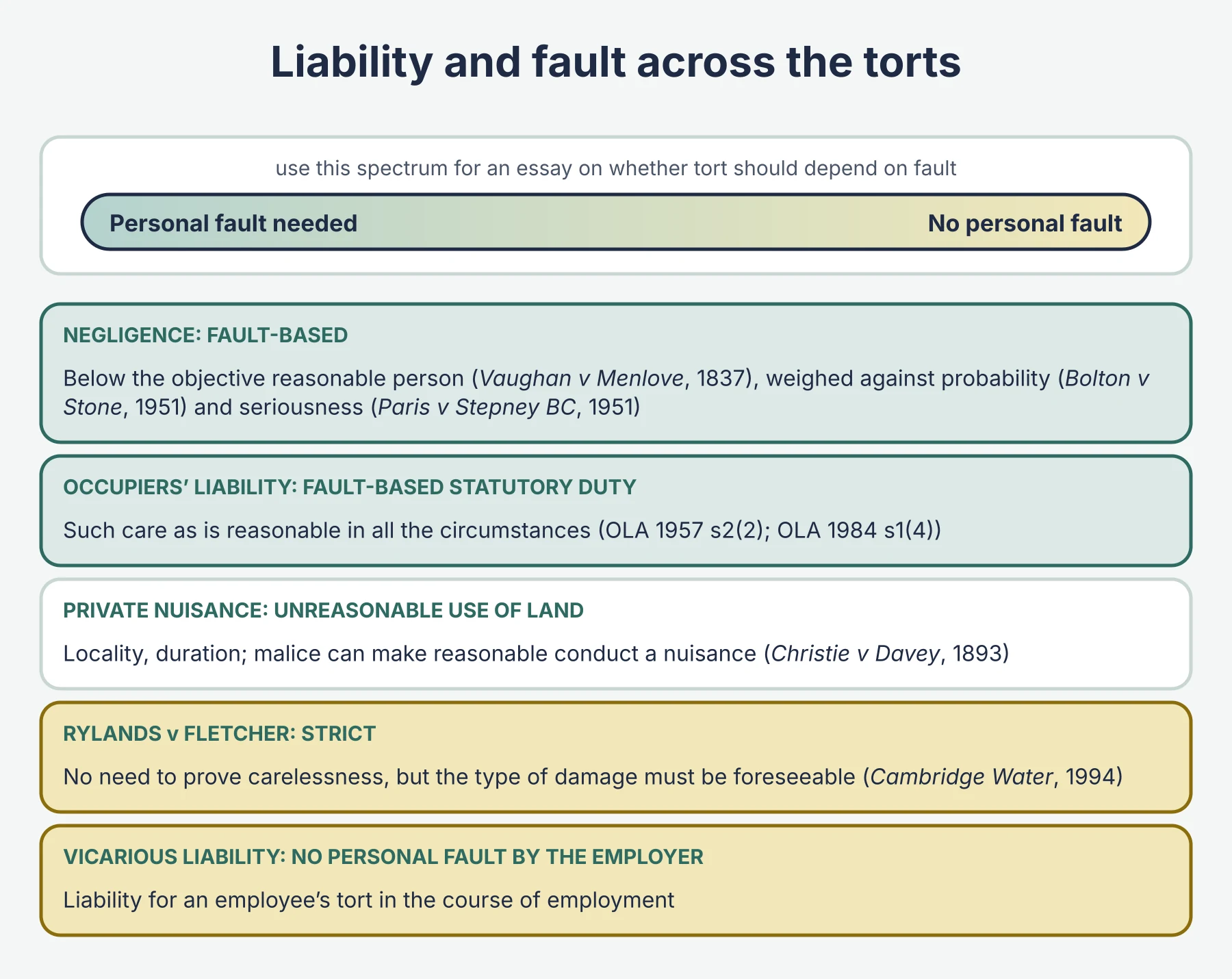
MOST FAULT NEEDED ............................................ NO PERSONAL FAULT
Negligence      Occupiers' liability    Private nuisance     Rylands      Vicarious
(reasonable     (reasonable care in     (unreasonable        (strict;     liability
 person)         all circumstances)      use of land)        foreseeable  (employer
                                                             type of      liable for
                                                             damage)      employee)
Fault authorities: Vaughan v Menlove (1837) reasonable person; Bolton v Stone (1951) probability; Paris v Stepney (1951) seriousness; Christie v Davey (1893) malice in nuisance; Cambridge Water (1994) foreseeability in Rylands.
Defences at a glance
| Defence | Effect | Authority |
|---|---|---|
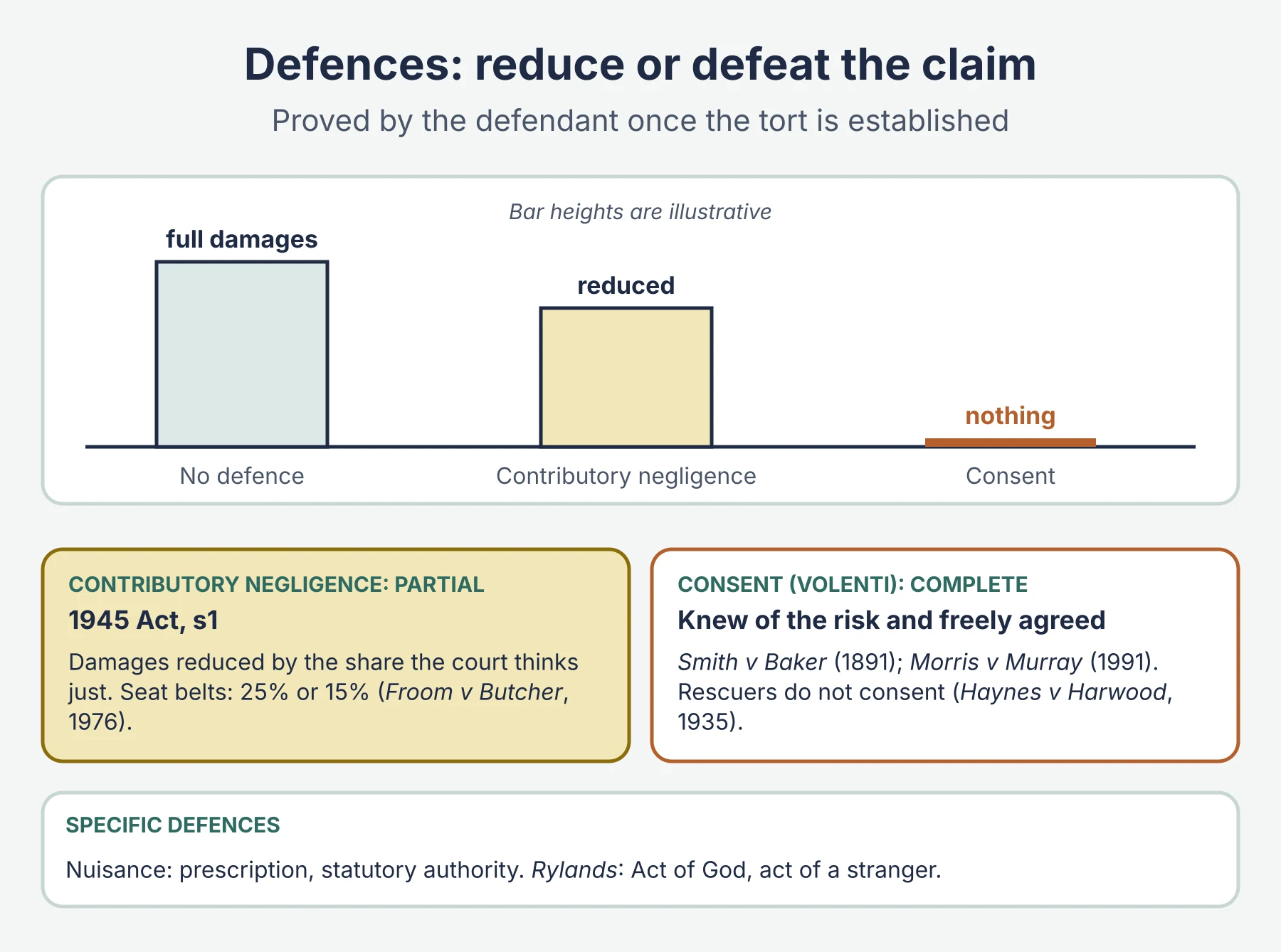
| Contributory negligence | Damages reduced | 1945 Act s1; Froom v Butcher (1976): 25% or 15% for no seat belt |
| Consent (volenti) | Complete defence | Smith v Baker (1891); ICI v Shatwell (1965); Morris v Murray (1991) |
| Rescuers | Not consenting | Haynes v Harwood (1935) |
| Nuisance-specific | Prescription; statutory authority | — |
| Rylands-specific | Act of God; act of a stranger; consent; statutory authority | — |
Remedies at a glance
- Compensatory damages: put C in the position as if the tort had not happened; personal injury, property damage, consequential economic loss.
- Mitigation: C cannot recover loss he could reasonably have avoided.
- Injunction: discretionary; stops or limits the activity; common in nuisance.
Problem method
- Parties (and any employer).
- Tort.
- Elements and source.
- Apply with authority.
- Vicarious liability.
- Defences.
- Remedies.
- Conclusion.
Key terms
| Term | Meaning |
|---|---|
| Tort | A civil wrong, other than breach of contract |
| Claimant | The person who sues |
| Liable | Legally responsible in a civil case |
| Balance of probabilities | More likely than not |
| Res ipsa loquitur | “The thing speaks for itself”: inference of negligence |
| Fault-based liability | Liability only if D fell below a standard of care |
| Strict liability | Liability without proof of carelessness |
| Vicarious liability | Liability for another person’s tort |
| Volenti non fit injuria | No wrong is done to one who consents |
| Mitigation | C’s duty to take reasonable steps to limit his loss |
Exam traps
- Criminal vocabulary in a tort answer (“guilty”, “prosecuted”).
- Forgetting the claimant’s burden on causation.
- Treating vicarious liability as a separate tort.
- Saying Rylands has no foreseeability requirement.
- Treating contributory negligence as a complete defence.
- Stopping before defences and remedies.
Self-test
- Define a tort.
- What is the standard of proof in tort, and who bears it?
- Why did the claim fail in Barnett?
- When does res ipsa loquitur apply?
- Which Acts govern occupiers’ liability?
- Which tort is described as strict, and what limit did Cambridge Water add?
- Is vicarious liability based on the employer’s fault?
- What is the effect of contributory negligence? Name the Act.
- What must be shown for consent?
- Why are rescuers not treated as consenting?
- What is the aim of compensatory damages?
- What is mitigation of loss?
Answers: 1. A civil wrong, other than breach of contract, for which the person wronged can sue for a remedy. 2. Balance of probabilities; the claimant. 3. The patient would have died even with proper treatment, so the negligence did not cause the death. 4. When the thing was under the defendant’s control and the accident would not normally happen without negligence. 5. Occupiers’ Liability Act 1957 (visitors) and 1984 (trespassers). 6. Rylands v Fletcher; the type of damage must be foreseeable. 7. No, the employer is liable without personal fault. 8. Damages are reduced; Law Reform (Contributory Negligence) Act 1945. 9. Knowledge of the risk and free agreement to it. 10. Their act is a foreseeable response to the danger, not a free acceptance of the risk (Haynes v Harwood). 11. To put the claimant in the position he would have been in had the tort not been committed. 12. The claimant’s duty to take reasonable steps to reduce his loss.
Test yourself further with the rules of tort law practice questions.
Related resources
-
Study guides
AQA A Level Law (7162): Theory of Tort Law
The policy behind duty of care, economic loss, psychiatric injury, the standard of care, injunctions and vicarious liability, for AQA A Level Law 7162 essays.
Law · AQA · A Level
Read guide -
Practice questions
AQA A Level Law (7162): Theory of Tort Law – Practice Questions
Original practice questions with mark-scheme answers on policy behind duty, economic loss, the standard of care, injunctions and vicarious liability, AQA 7162.
Law · AQA · A Level
Try questions -
Revision notes
AQA A Level Law (7162): Theory of Tort Law – Revision Notes
Recall notes on the policy behind Caparo, economic loss, psychiatric injury, the standard of care, injunctions and vicarious liability for AQA Law 7162.
Law · AQA · A Level
Revise topic
Get free revision emails (optional)
Occasional emails with practice questions, worked explanations and links to free resources for the qualification and subjects you choose. No spam, and you can unsubscribe from any email. The free tools on this site never need an email.