
Revision Notes
AQA A Level Law (7162): Theory of Tort Law – Revision Notes
Recall notes on the policy behind Caparo, economic loss, psychiatric injury, the standard of care, injunctions and vicarious liability for AQA Law 7162.
- Subject
- Law
- Level
- A LEVELS
- Topic
- Tort
- Author
- Marlbridge Academic Team
- Updated
- Reviewed by
- Aizaz Raoof Ali (what this means)
Aligned to AQA A Level Law (7162), For teaching from September 2017 onwards, A-level exams 2019 onwards. Official specification .
Syllabus page (what it covers and how it is assessed): AQA A Level Law.
Syllabus points this page covers
7162
- Theory of tort law
Found an error? Report a correction.
Need help with this topic? Request a free trial class for A Level Law (7162).
Condensed notes for the section 3.3 row Theory of tort law: “analysis and evaluation of when tort law imposes liability”, focused on five named issues. For the full explanation and a model paragraph, use the theory of tort law study guide.
The five issues in one line each
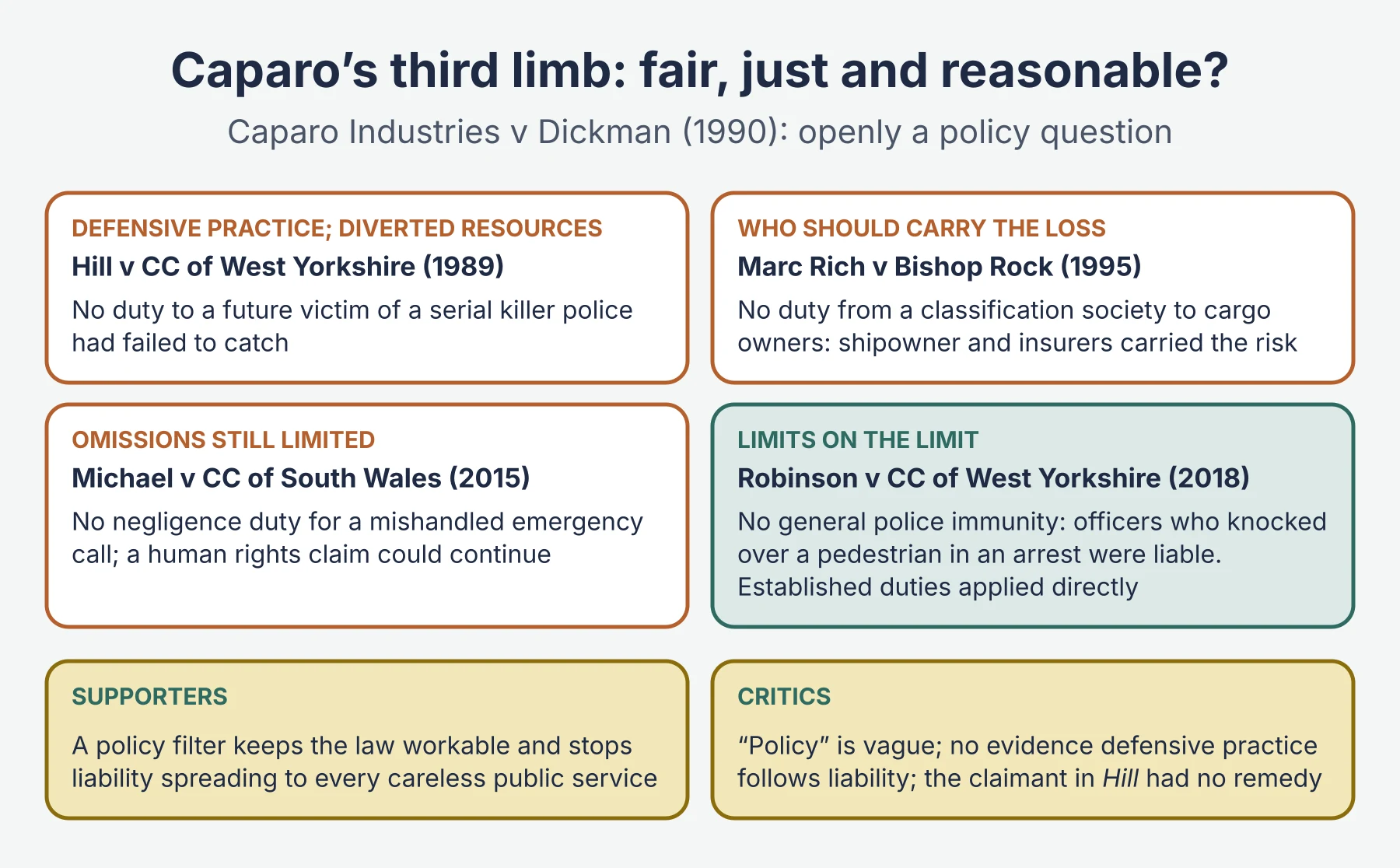
- Caparo policy: the “fair, just and reasonable” limb lets courts refuse a duty for policy reasons.
- Economic loss and psychiatric injury: restricted to avoid indeterminate liability and floods of claims.
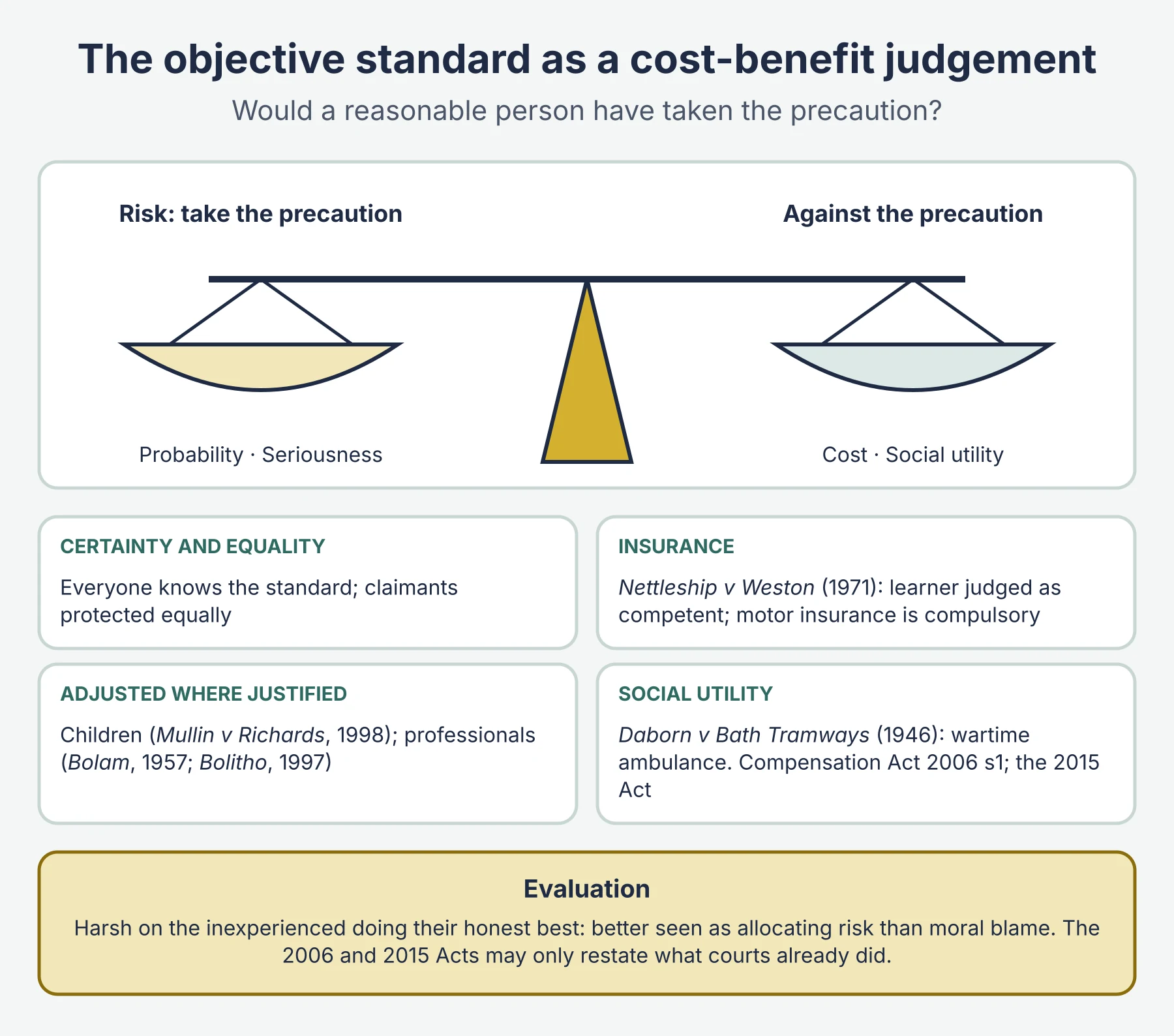
- Objective standard of care: one standard for all, adjusted only for children and professionals, balancing risk against cost and utility.
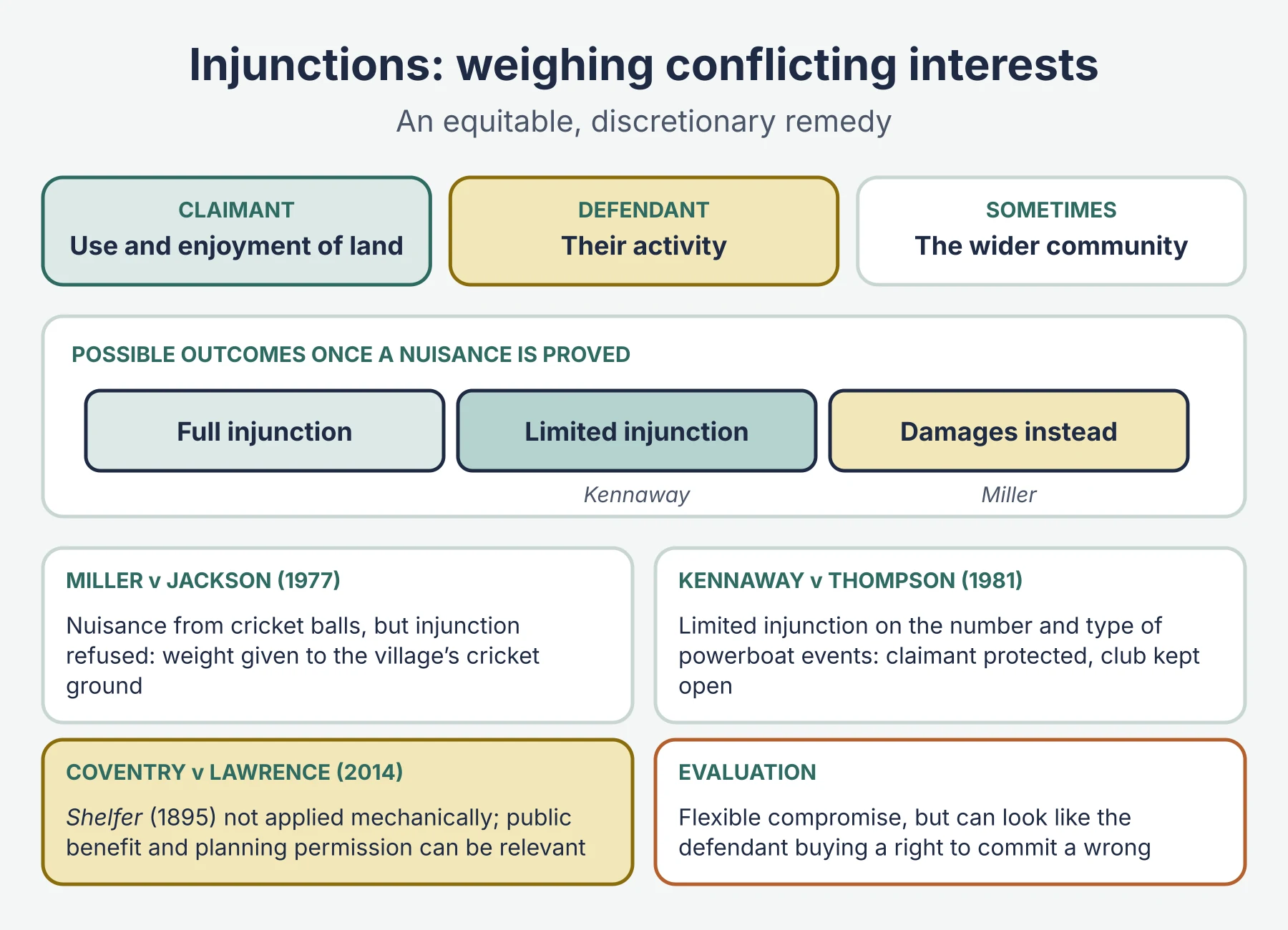
- Injunctions: discretionary; the court balances the claimant’s use of land against the defendant’s activity and the public interest.
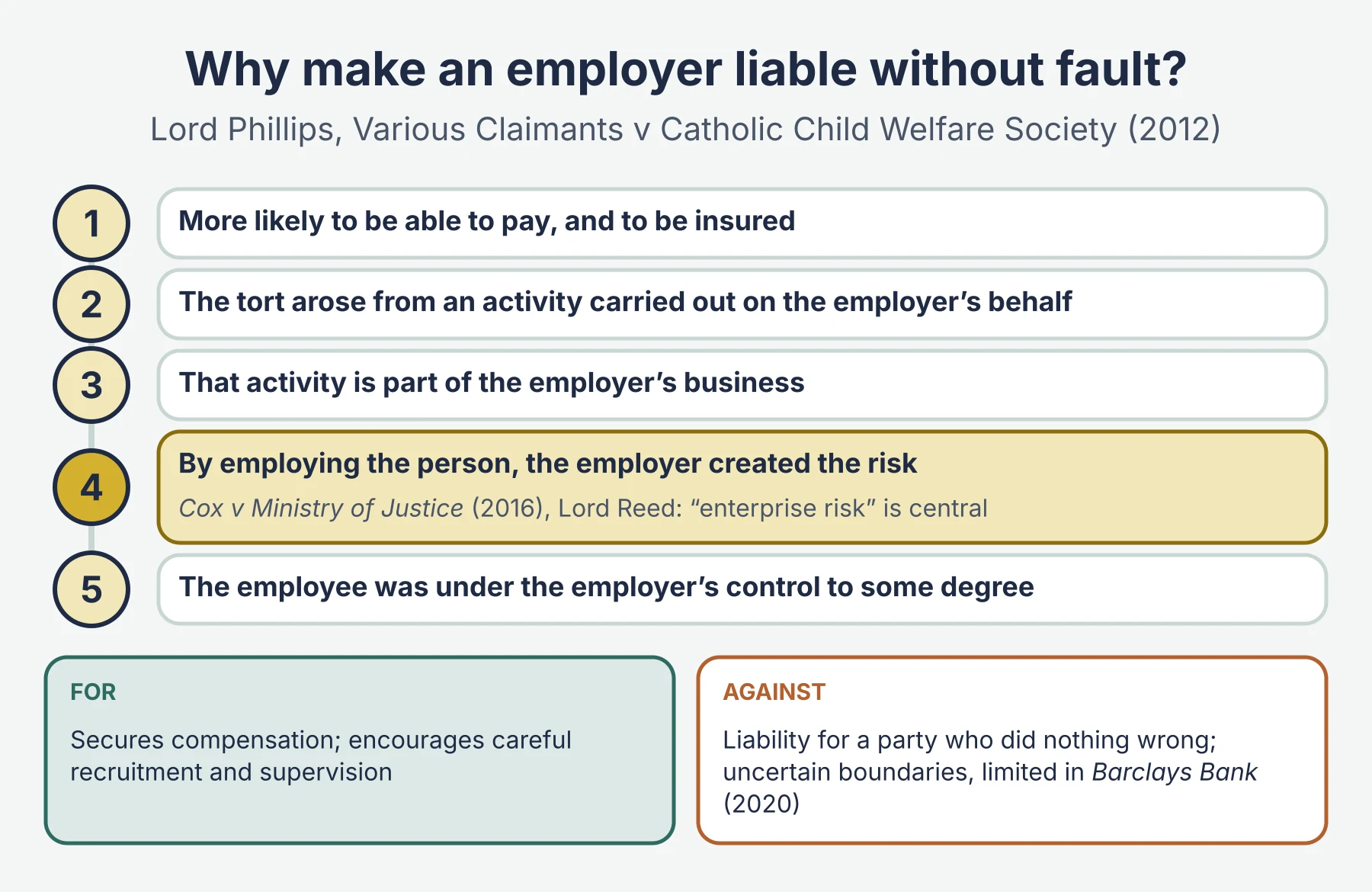
- Vicarious liability: strict liability of employers, justified by ability to pay, insurance, enterprise risk and control.
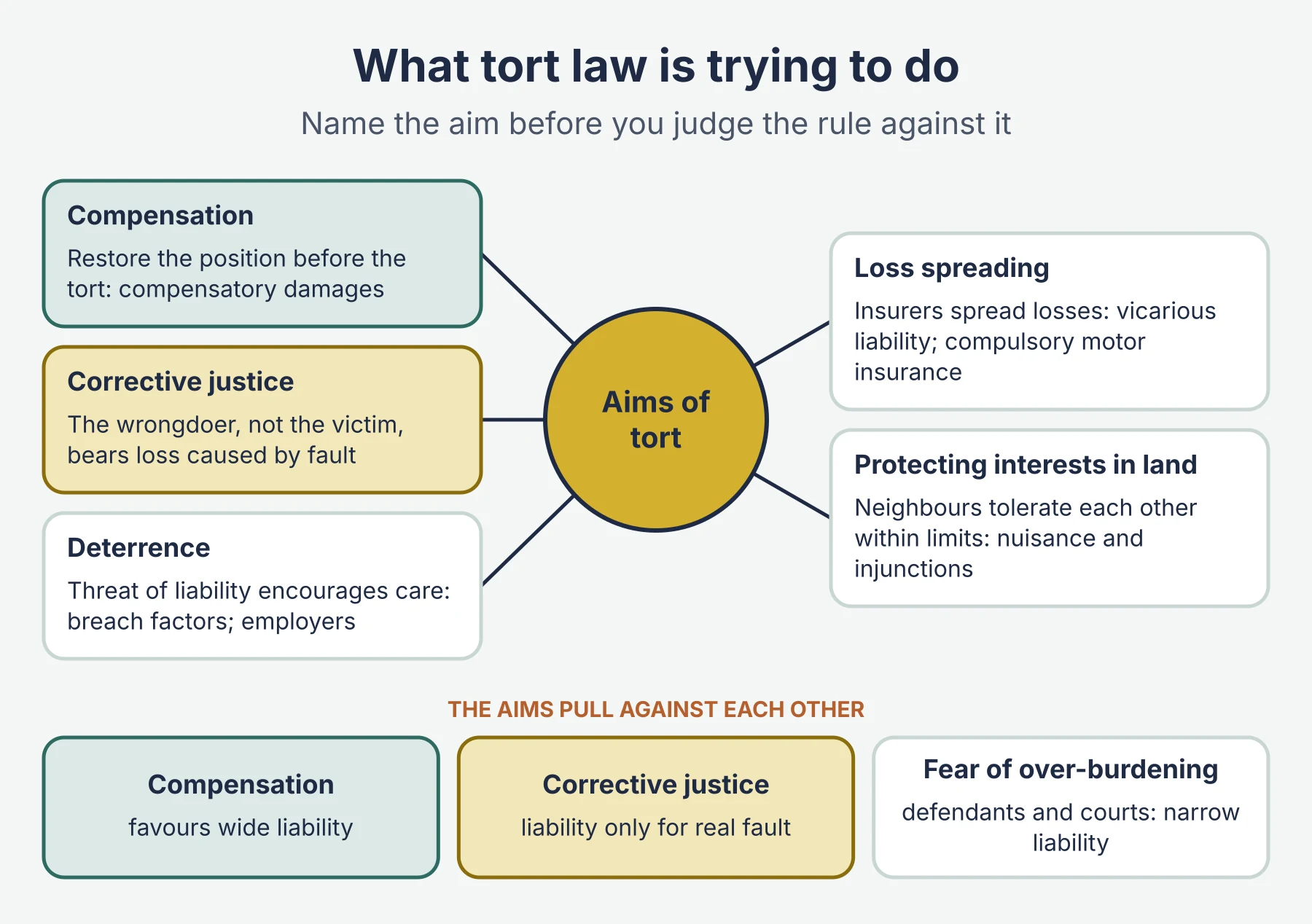
Aims of tort law
- Compensation for loss.
- Corrective justice: the wrongdoer pays for loss caused by fault.
- Deterrence: liability encourages care.
- Loss spreading: insurers spread the cost across premium payers.
- Balancing rights over land: neighbours must give and take.
Issue 1: Caparo and policy
| Policy reason | Authority |
|---|---|
| Fear of defensive practice; diversion of police resources | Hill v CC West Yorkshire (1989) |
| Loss already allocated by insurance and contract | Marc Rich v Bishop Rock Marine (1995) |
| No duty for failing to protect from a third party | Michael v CC South Wales (2015) |
| But no blanket immunity for positive acts | Robinson v CC West Yorkshire (2018) |
Evaluation points: policy filter keeps liability manageable; but “policy” is vague and evidence of defensive practice is thin; victims can be left without a remedy in negligence.
Issue 2: economic loss and psychiatric injury
Economic loss
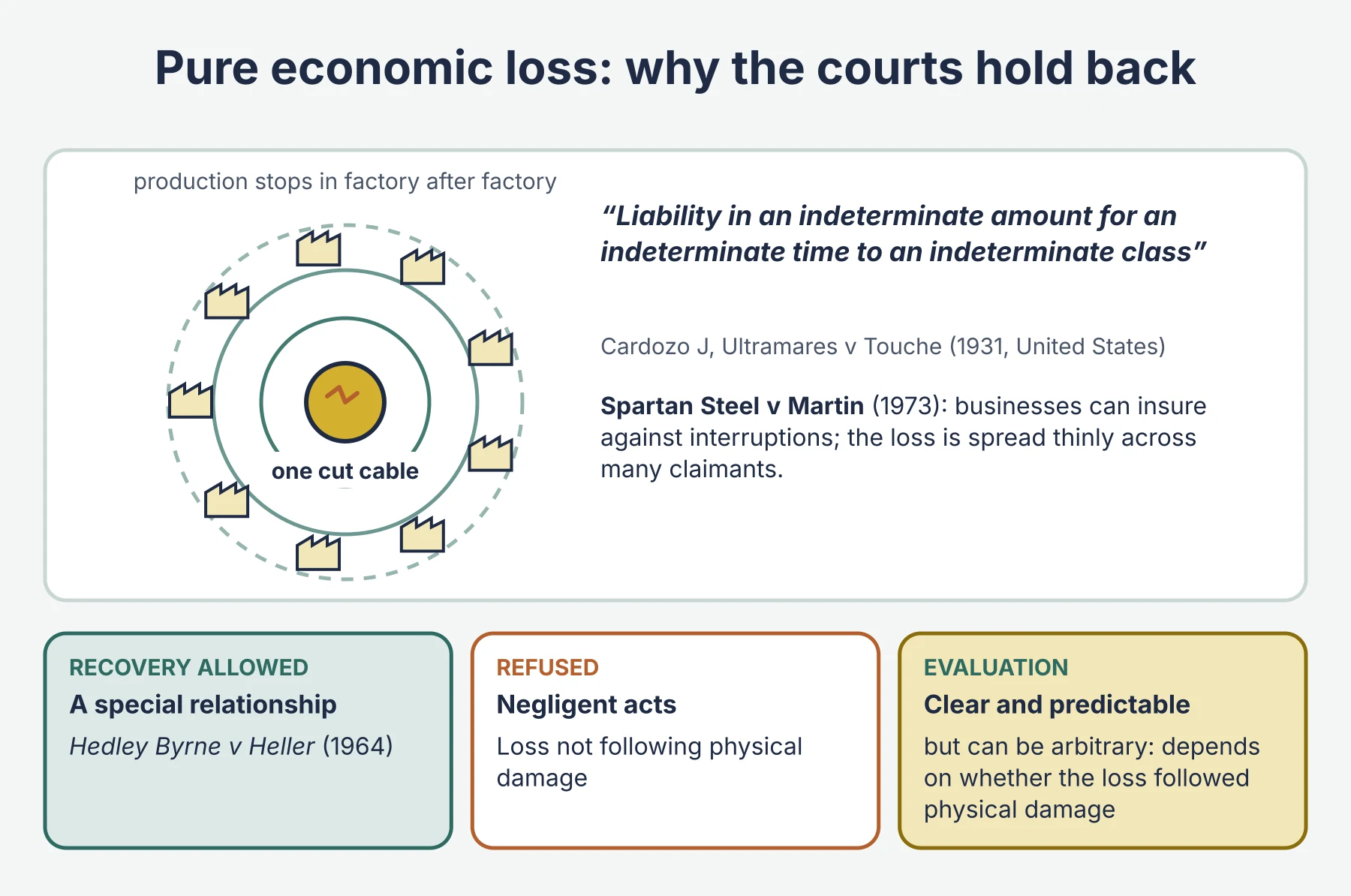
- Fear: “liability in an indeterminate amount for an indeterminate time to an indeterminate class” (Cardozo J, Ultramares v Touche, 1931, a US case).
- Negligent acts: pure economic loss not recoverable (Spartan Steel, 1973); businesses can insure; loss spread thinly.
- Misstatements: recoverable only within a special relationship (Hedley Byrne, 1964).
- Criticism: recovery can depend on the accident of whether physical damage came first.
Psychiatric injury
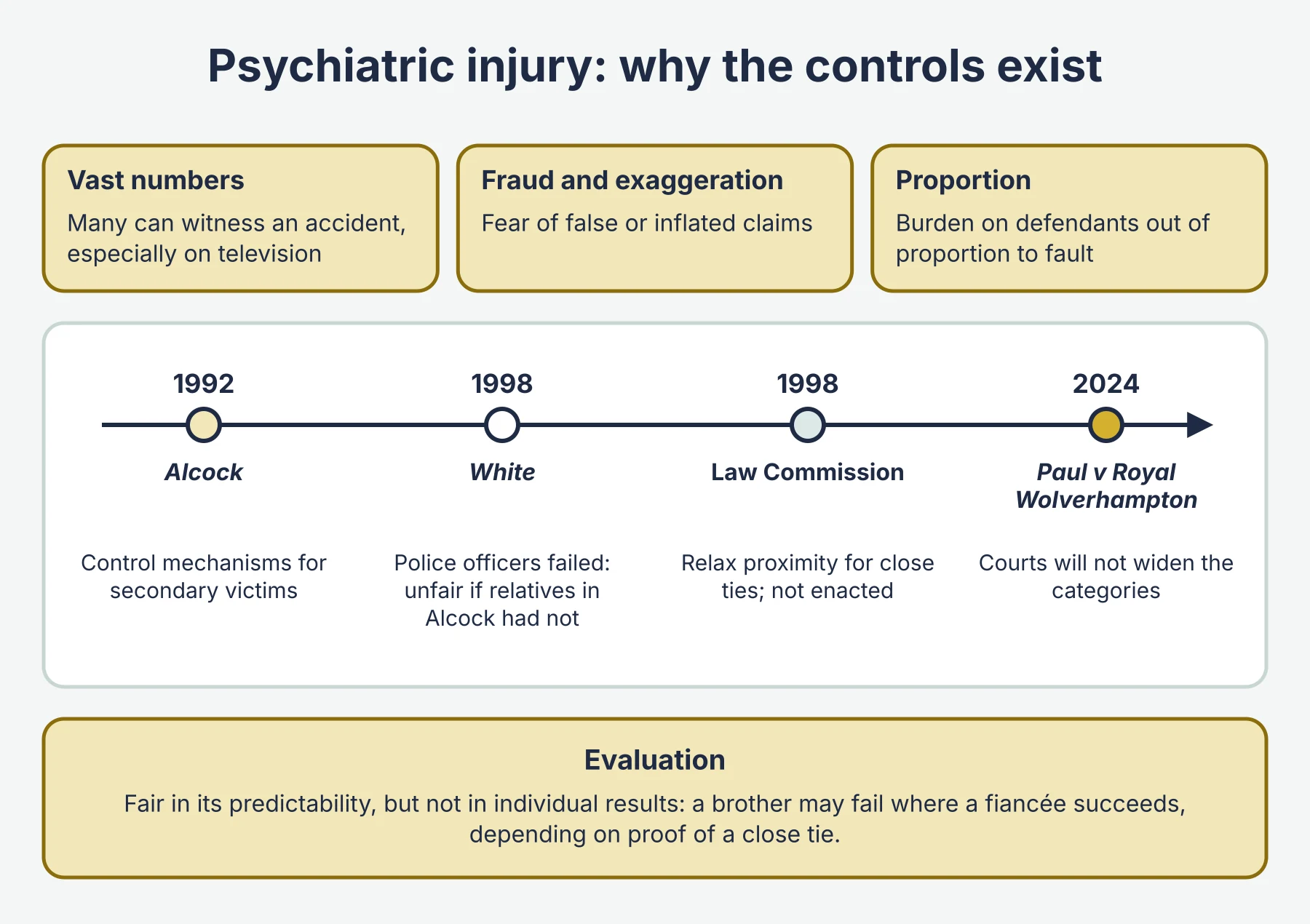
- Fear: huge numbers of potential witnesses, especially via broadcast; fraud; disproportionate burden.
- Control mechanisms: Alcock (1992).
- Consistency between claimants: officers refused in White (1998) because relatives had failed in Alcock.
- Reform: Law Commission report (1998) recommended relaxing proximity for those with a close tie; not enacted.
- Courts will not widen categories themselves: Paul v Royal Wolverhampton NHS Trust (2024).
Issue 3: objective standard of care
| Factor | Policy | Authority |
|---|---|---|
| One standard for all | Certainty; equal protection | Blyth v Birmingham Waterworks (1856) |
| Learners judged as competent | Insurance carries loss | Nettleship v Weston (1971) |
| Children judged by age | Fairness to the young | Mullin v Richards (1998) |
| Professionals judged by a responsible body | Respect for expertise | Bolam (1957), Bolitho (1997) |
| Social utility | Worthwhile activities can justify risk | Daborn v Bath Tramways (1946); s1 Compensation Act 2006 |
Statute: Compensation Act 2006 s1 (desirable activities); Social Action, Responsibility and Heroism Act 2015.
Evaluation: the standard allocates risk rather than moral blame; harsh on the inexperienced; the statutes may add little to what courts already did.
Issue 4: injunctions
- Equitable and discretionary: not available as of right.
- Refused for public interest: Miller v Jackson (1977), cricket.
- Limited, not total: Kennaway v Thompson (1981), powerboat racing.
- Shelfer (1895) guidance not to be applied mechanically: Coventry v Lawrence (2014).
- Evaluation: flexible compromise, but damages in lieu can let a defendant “buy” the right to continue a nuisance.
Issue 5: vicarious liability
Lord Phillips’ five factors (Catholic Child Welfare Society, 2012):
- Employer more likely to have the means to compensate and to be insured.
- Tort committed through activity done on the employer’s behalf.
- Activity is part of the employer’s business.
- Employer created the risk by employing the person.
- Employee under the employer’s control to some degree.
Enterprise risk: Cox v Ministry of Justice (2016). Limits: Various Claimants v Barclays Bank (2020), no liability for a genuinely independent contractor.
Evaluation: secures compensation and encourages supervision; but imposes liability without fault, and expansion has reduced certainty.
Key terms
| Term | Meaning |
|---|---|
| Policy | Considerations about the effects of a rule on society, beyond the parties |
| Floodgates | Fear that a rule will produce an unmanageable number of claims |
| Indeterminate liability | Liability to an unknown number of people for an unknown amount |
| Defensive practice | Professionals acting to avoid claims rather than to serve the public |
| Enterprise risk | The idea that a business should bear risks its activity creates |
| Loss spreading | Passing loss to insurers and so to many premium payers |
| Equitable remedy | A remedy granted at the court’s discretion, such as an injunction |
| Damages in lieu | Money awarded instead of an injunction |
Exam traps
- A policy point without a case scores as assertion. Pair each policy with an authority.
- “Floodgates” is not one argument for everything: for economic loss it is about chains of financial loss; for psychiatric injury it is about numbers of witnesses.
- Do not say the claimant in Miller v Jackson lost on liability: there was a nuisance, but no injunction.
- Vicarious liability is not a tort of the employer; it is liability for the employee’s tort.
- “Evaluate” requires a conclusion: say whether the balance struck is justified.
Self-test
- Which limb of Caparo is the policy limb? Whether it is fair, just and reasonable to impose a duty.
- What policy reason was given in Hill (1989)? Fear of defensive policing and diversion of resources.
- What did Robinson (2018) decide about police liability? There is no general immunity; police are liable for positive acts causing injury.
- Which judge warned of “liability in an indeterminate amount for an indeterminate time to an indeterminate class”? Cardozo J in Ultramares v Touche (1931).
- Give one reason from Spartan Steel for refusing pure economic loss. Businesses can insure against interruption; the loss is spread thinly.
- Why did the officers’ claims fail in White (1998)? Partly because recovery by officers would be unfair when relatives in Alcock had failed.
- Why was a learner driver held to the competent standard in Nettleship? Certainty, and compulsory insurance means the loss falls on an insurer.
- What does s1 Compensation Act 2006 allow a court to consider? Whether requiring precautions would discourage a desirable activity.
- What did the court do in Kennaway v Thompson? Granted a limited injunction restricting the powerboat events.
- What did Coventry v Lawrence say about Shelfer? It should not be applied mechanically; public interest and planning permission may be relevant.
- Name two of Lord Phillips’ five policy factors. Any two: ability to pay/insurance; activity on employer’s behalf; part of business; risk created; control.
- Which case limited vicarious liability for independent contractors? Various Claimants v Barclays Bank (2020).
More resources on this topic
Related resources
-
Study guides
AQA A Level Law (7162): Vicarious Liability
The two-stage test for vicarious liability: employment status tests, relationships akin to employment, course of employment and close connection, AQA Law 7162.
Law · AQA · A Level
Read guide -
Practice questions
AQA A Level Law (7162): Vicarious Liability – Practice Questions
Original practice questions with mark-scheme answers on the nature, purpose and two-stage test of vicarious liability, with problem scenarios, for AQA Law 7162.
Law · AQA · A Level
Try questions -
Revision notes
AQA A Level Law (7162): Vicarious Liability – Revision Notes
Recall notes on the purpose of vicarious liability, employment status tests, akin to employment and close connection, for AQA A Level Law 7162.
Law · AQA · A Level
Revise topic
Get free revision emails (optional)
Occasional emails with practice questions, worked explanations and links to free resources for the qualification and subjects you choose. No spam, and you can unsubscribe from any email. The free tools on this site never need an email.