
Revision Notes
AQA A Level Law (7162): Vicarious Liability – Revision Notes
Recall notes on the purpose of vicarious liability, employment status tests, akin to employment and close connection, for AQA A Level Law 7162.
- Subject
- Law
- Level
- A LEVELS
- Topic
- Tort
- Author
- Marlbridge Academic Team
- Updated
- Reviewed by
- Aizaz Raoof Ali (what this means)
Aligned to AQA A Level Law (7162), For teaching from September 2017 onwards, A-level exams 2019 onwards. Official specification .
Syllabus page (what it covers and how it is assessed): AQA A Level Law.
Syllabus points this page covers
7162
- Vicarious liability
Found an error? Report a correction.
Need help with this topic? Request a free trial class for A Level Law (7162).
Condensed notes for the section 3.3 row Vicarious liability: “Nature and purpose of vicarious liability”, “Testing employment status” and “Other areas of vicarious liability”. For explanation and a worked problem, use the vicarious liability study guide.
Nature and purpose
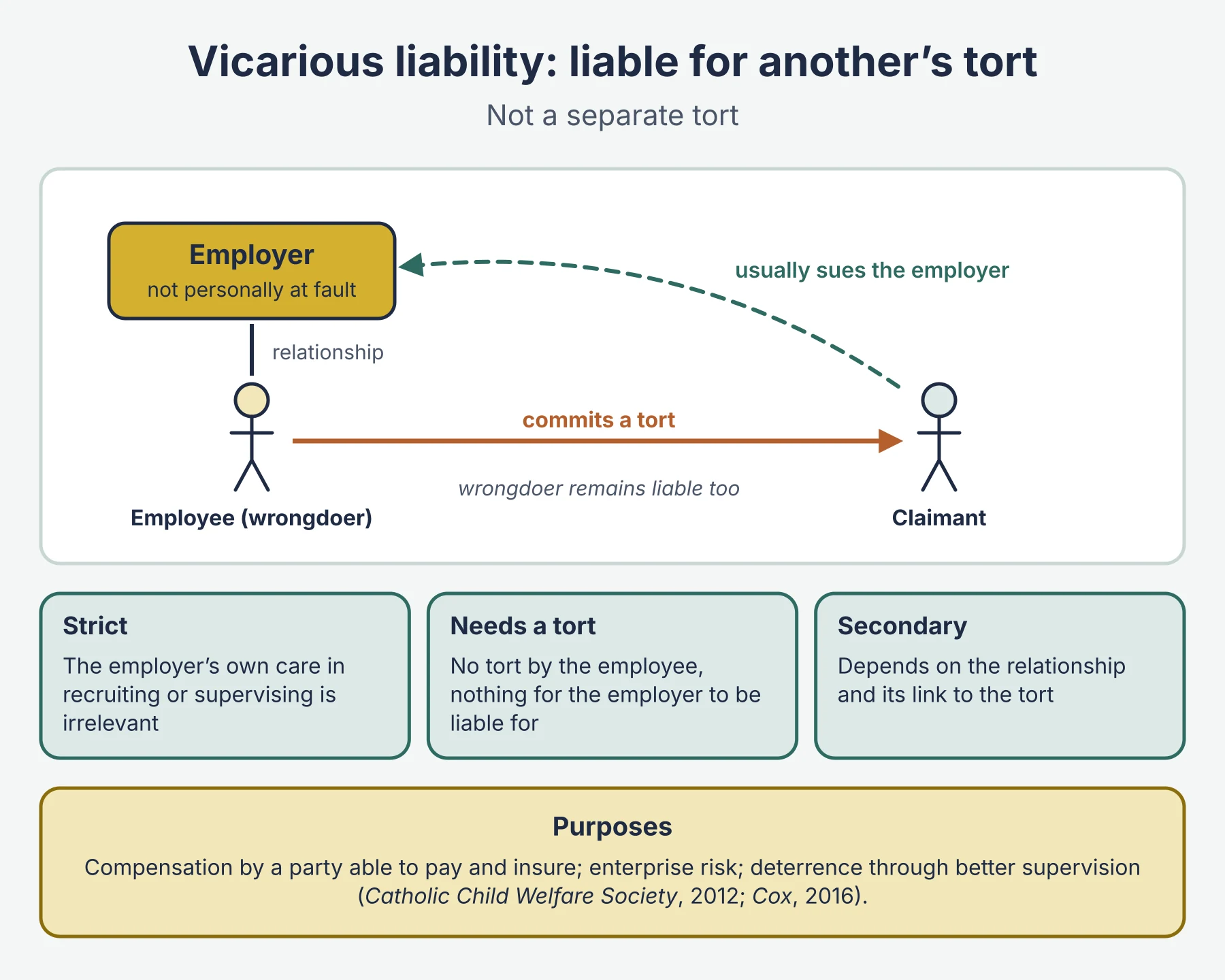
- Liability of one person (D) for a tort committed by another (the wrongdoer).
- Strict: D’s own care is irrelevant.
- Wrongdoer remains personally liable.
- Purposes (Catholic Child Welfare Society, 2012; Cox, 2016): ability to pay and insurance; enterprise risk; activity done for D’s benefit; D created the risk; control and deterrence.
The two-stage test (Barclays Bank, 2020)
Stage 1  RELATIONSHIP   employee, or relationship akin to employment?
Stage 2  CONNECTION     tort in course of employment / closely connected?
Both yes -> D vicariously liable for the wrongdoer's tort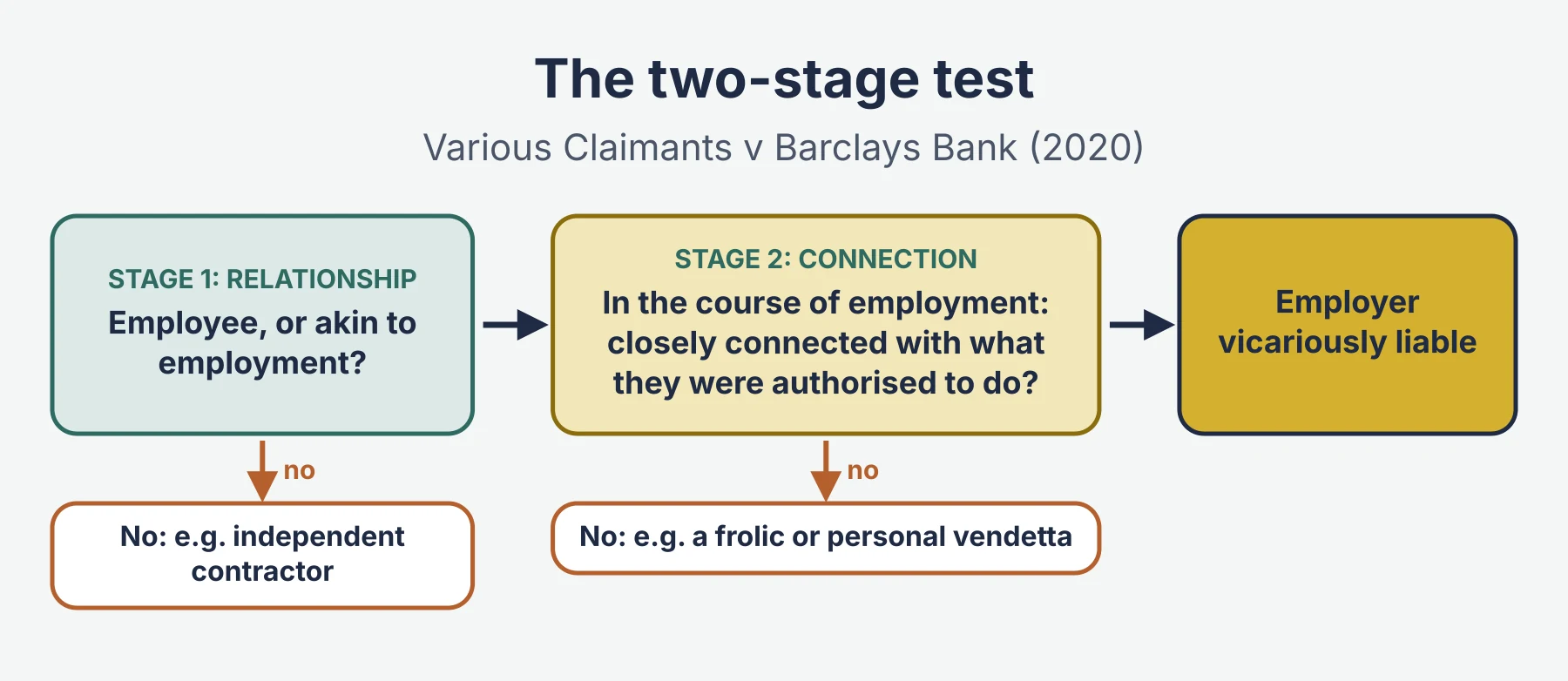
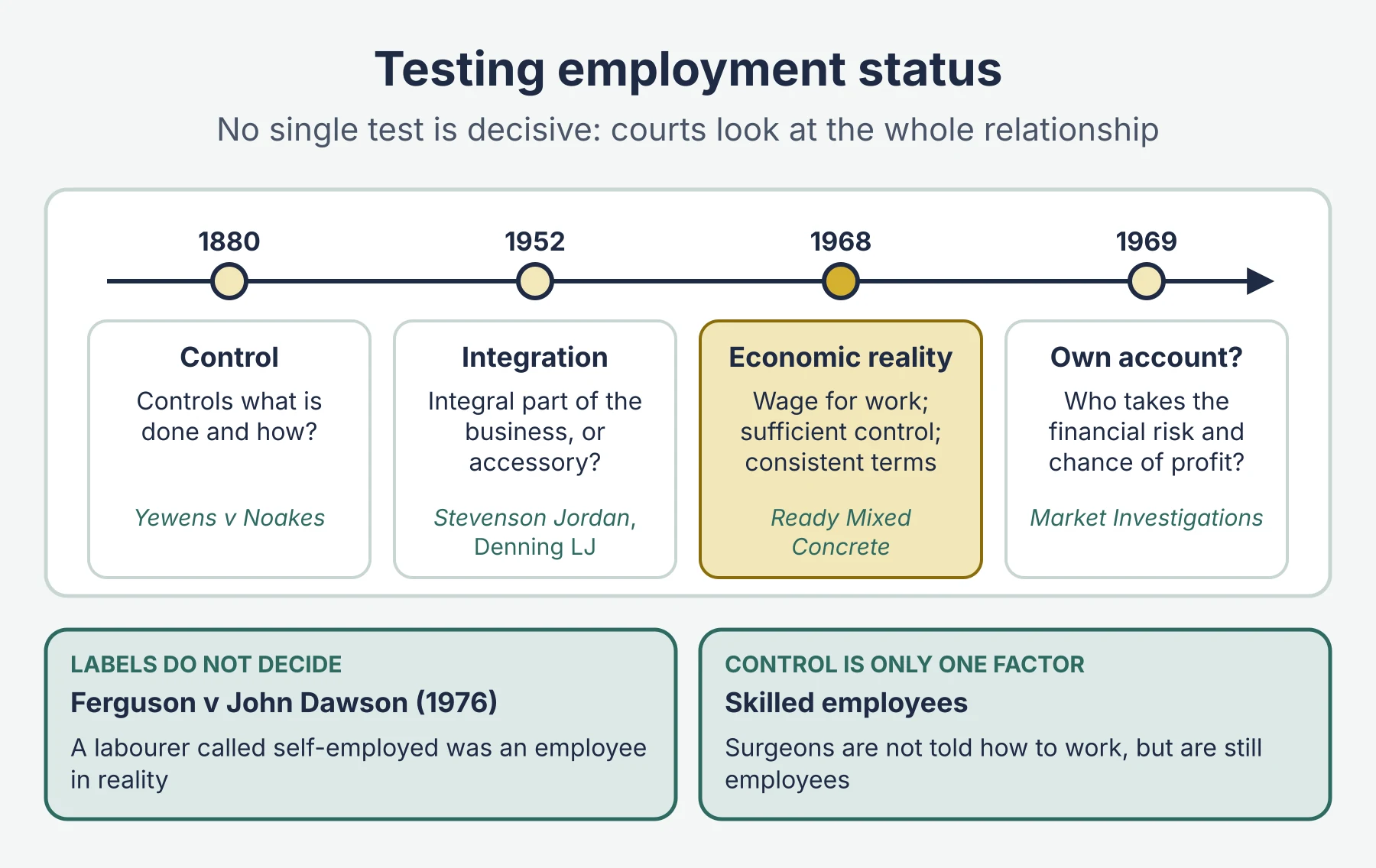
Stage 1: employment status
| Test | Question | Case |
|---|---|---|
| Control | Does D control what and how? | Yewens v Noakes (1880) |
| Integration | Is the work integral to the business? | Stevenson Jordan & Harrison v Macdonald & Evans (1952) |
| Multiple/economic reality | Wage for work; sufficient control; terms consistent | Ready Mixed Concrete (1968) |
| Own account | Who takes the financial risk? | Market Investigations (1969) |
| Labels | Not decisive | Ferguson v John Dawson (1976) |
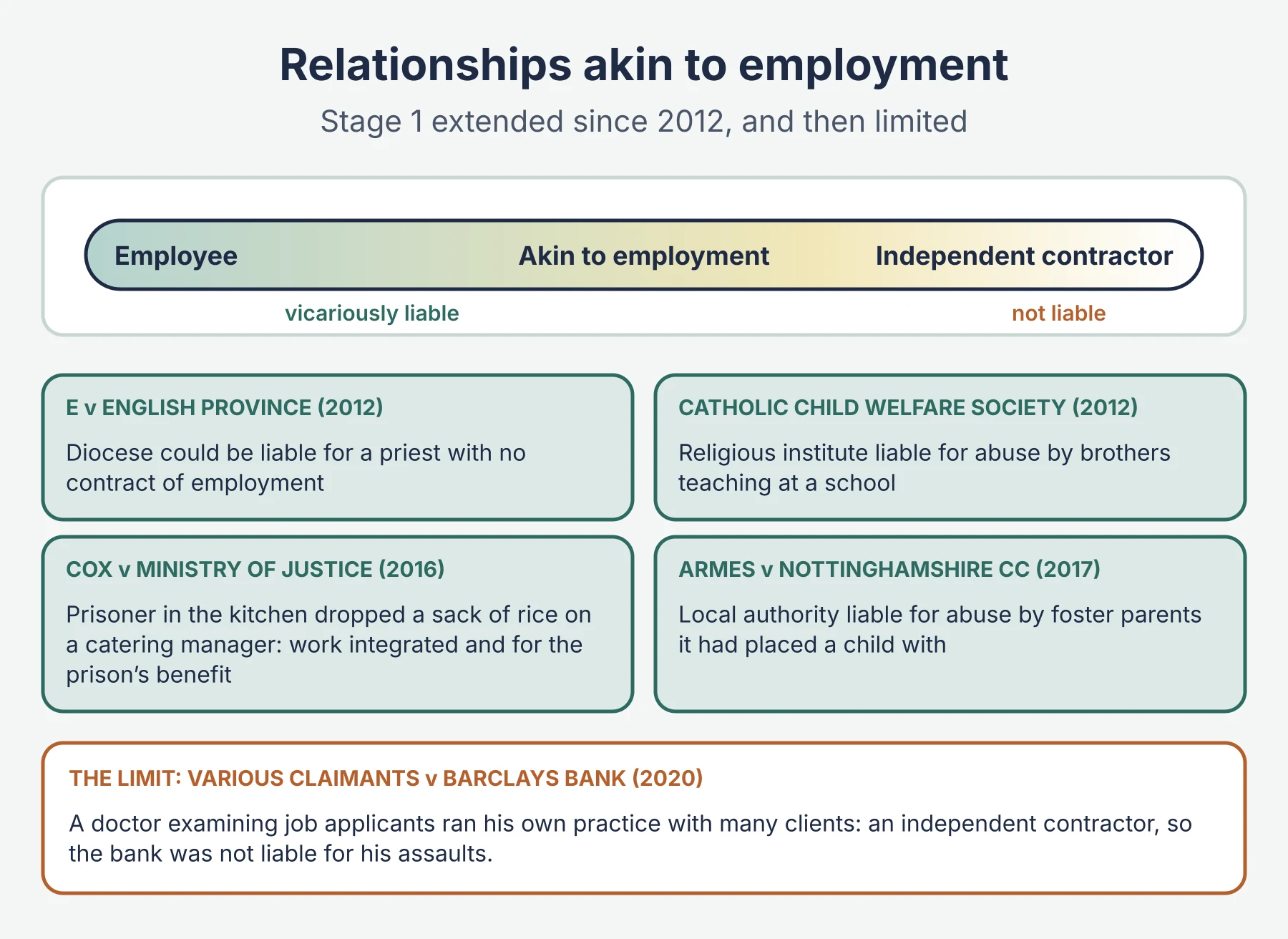
Akin to employment:
| Case | Relationship | Result |
|---|---|---|
| E v English Province (2012) | Priest and diocese | Capable of VL |
| Catholic Child Welfare Society (2012) | Brothers and religious institute | Liable |
| Cox v MoJ (2016) | Prisoner working in kitchen | Liable |
| Armes v Nottinghamshire CC (2017) | Foster parents and local authority | Liable |
| Barclays Bank (2020) | Independent doctor with many clients | Not liable |
Stage 2: course of employment
In the course:
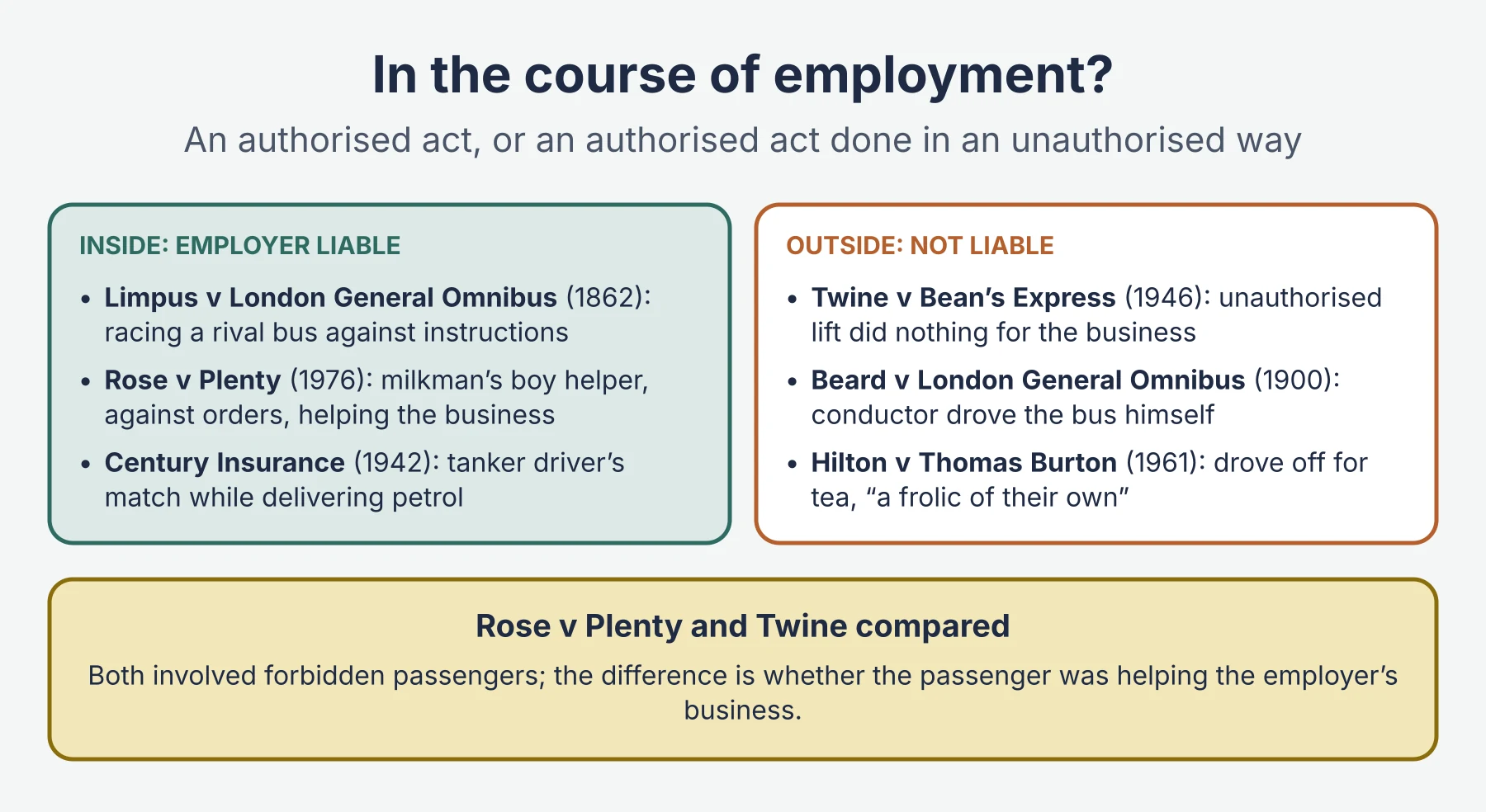
- Prohibited way of doing the job: Limpus v London General Omnibus (1862), racing buses; Rose v Plenty (1976), boy helping milkman.
- Careless act at work: Century Insurance (1942), match thrown away while delivering petrol.
Outside the course:
- Unauthorised passenger not helping the business: Twine v Bean’s Express (1946).
- Act wholly outside the job: Beard v London General Omnibus (1900), conductor driving.
- Frolic of his own: Hilton v Thomas Burton (1961).
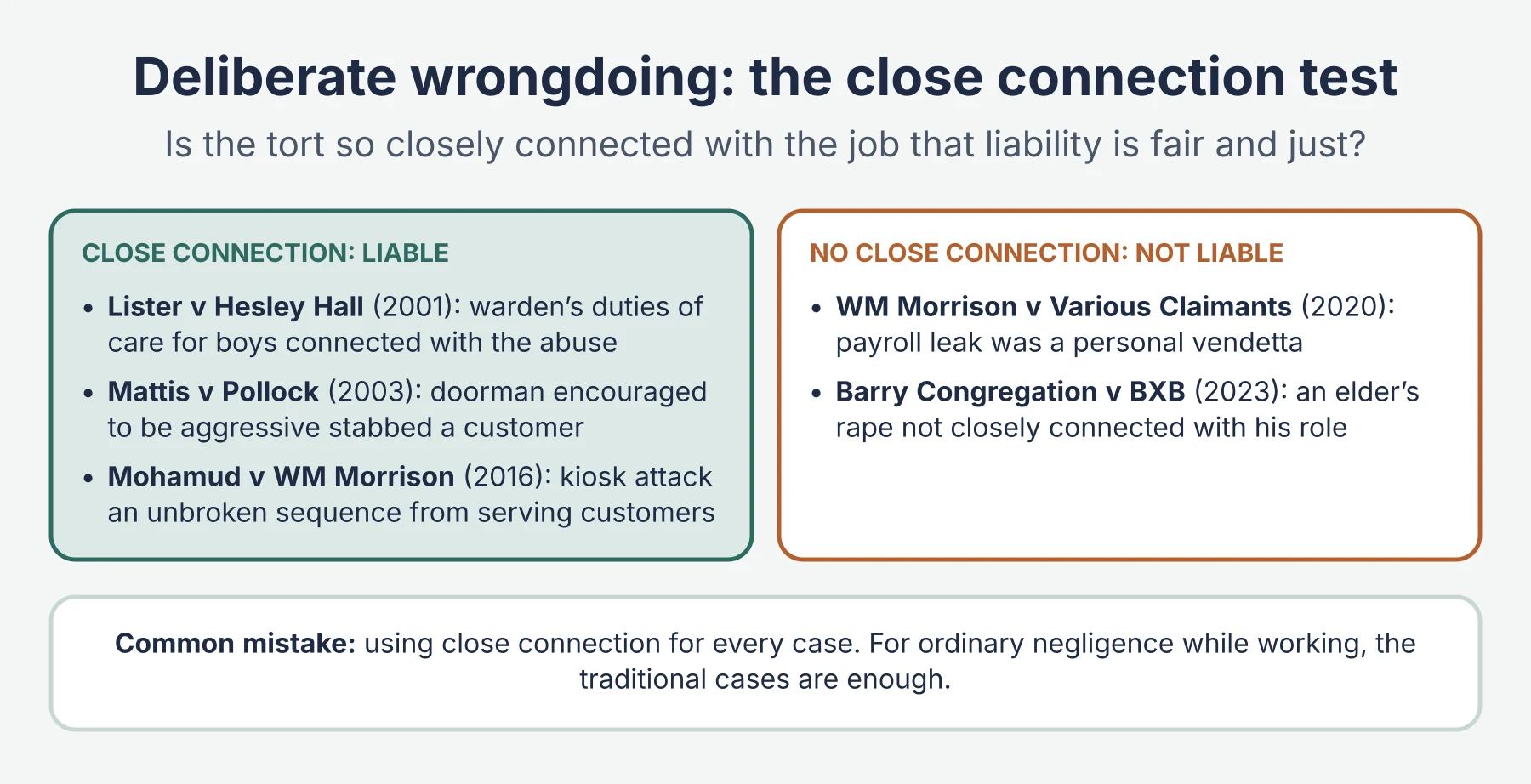
Close connection (deliberate wrongs):
| Case | Outcome |
|---|---|
| Lister v Hesley Hall (2001), warden abuse | Liable |
| Mattis v Pollock (2003), doorman stabbing | Liable |
| Mohamud v WM Morrison (2016), kiosk attack | Liable: unbroken sequence |
| WM Morrison v Various Claimants (2020), data leak | Not liable: personal vendetta |
| Barry Congregation v BXB (2023), elder’s assault | Not liable: no close connection |
Other areas
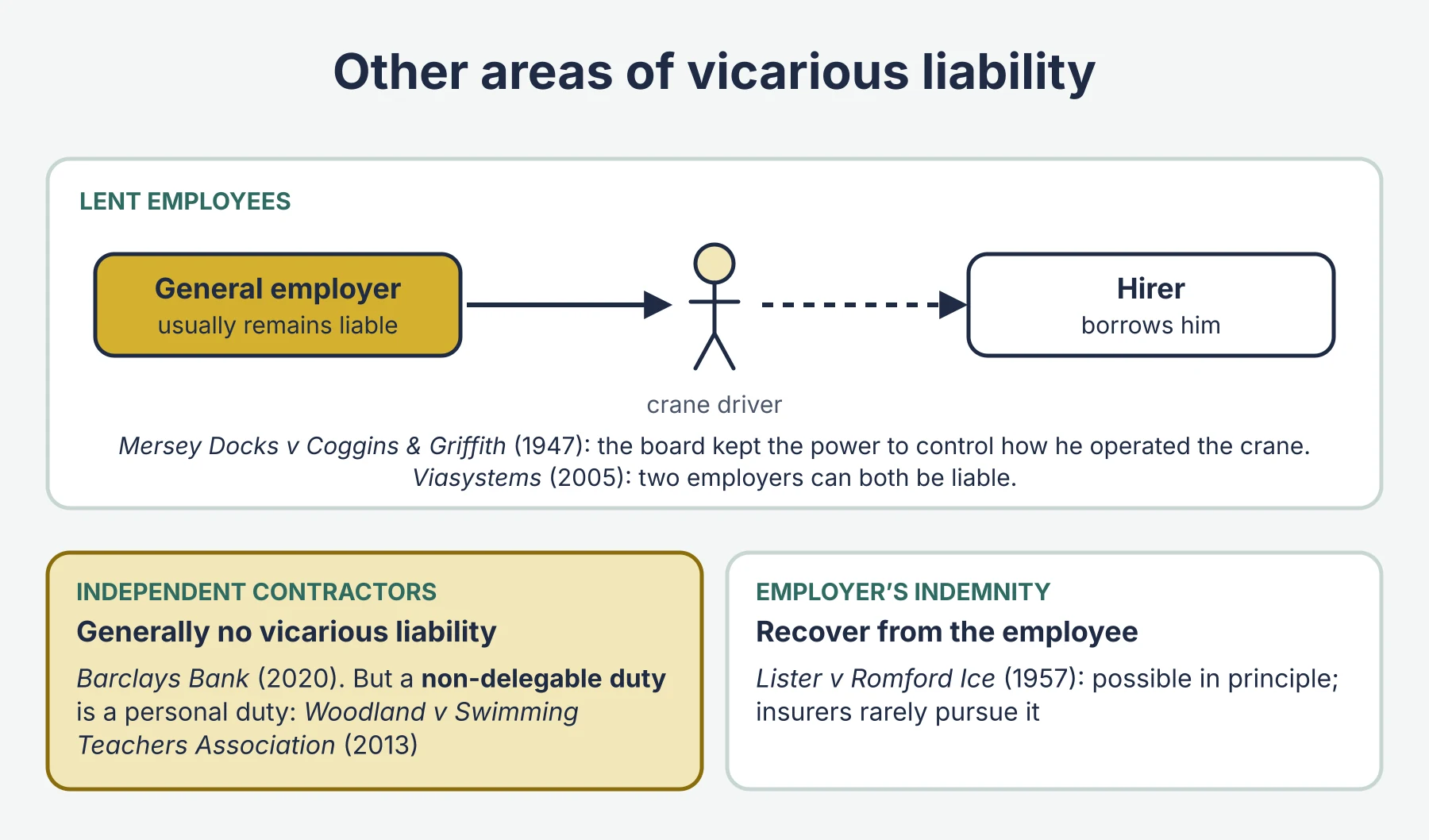
- Lent employees: general employer usually stays liable: Mersey Docks v Coggins & Griffith (1947). Dual liability possible: Viasystems (2005).
- Independent contractors: no vicarious liability (Barclays). A non-delegable duty is a separate, personal duty: Woodland v Swimming Teachers Association (2013).
- Employer’s indemnity: employer can recover from negligent employee: Lister v Romford Ice (1957).
Evaluation points
- For: compensates victims from a party able to pay and insure; places risk on the enterprise that profits from the activity (Cox); encourages careful recruitment and supervision.
- Against: liability without fault conflicts with corrective justice; “fair and just” in the close connection test is open-ended.
- Abuse cases: Lister and Catholic Child Welfare Society filled a gap for victims, but extended liability to organisations far from traditional employers.
- Certainty restored? Barclays and Morrison (2020) drew limits, but cases such as Mohamud and BXB show how fine the line remains.
- Gig economy: workers labelled self-employed but controlled through an app sit close to the boundary; Ferguson means the label will not protect the business.
Key terms
| Term | Meaning |
|---|---|
| Vicarious liability | Liability for a tort committed by another |
| Akin to employment | A relationship close enough in character to employment |
| Course of employment | Doing the job, even in an unauthorised way |
| Frolic of his own | An activity unconnected with the job |
| Close connection | Link between job and tort making liability fair and just |
| Enterprise risk | The business benefiting from an activity bears its risks |
| Non-delegable duty | A personal duty that cannot be discharged by hiring a contractor |
| Indemnity | Recovery by the employer of its loss from the employee |
Exam traps
- Always identify the wrongdoer’s tort first.
- Do not decide status from the contract’s label.
- One act may be in the course of employment for one claimant but not another.
- Rose v Plenty (boy helping the round) and Twine (hitch-hiker) are distinguished by benefit to the business.
- Woodland is not vicarious liability.
Self-test
- Is vicarious liability fault-based? No; it is strict.
- State the two stages. Relationship of employment or akin to it; close connection between relationship and tort.
- Which case gives the multiple test? Ready Mixed Concrete (1968).
- What did Ferguson v John Dawson decide? A self-employed label does not decide status.
- Why was the prison liable in Cox? The prisoner’s work was integrated into the prison’s activities and for its benefit.
- Why was the bank not liable in Barclays? The doctor was an independent contractor in business on his own account.
- Distinguish Rose v Plenty and Twine v Bean’s Express. The boy helped the employer’s business; the hitch-hiker did not.
- What was the frolic in Hilton v Thomas Burton? Workmen driving off for tea in working hours.
- What test applies to deliberate wrongdoing? Close connection (Lister).
- Why was Morrison not liable in 2020? The employee was pursuing a personal vendetta.
- Who is liable for a lent employee in Mersey Docks? The general employer, the harbour board.
- What did Lister v Romford Ice decide? An employer can recover its loss from the negligent employee.
More resources on this topic
Vicarious liability practice questions | Tort revision notes
Related resources
-
Study guides
AQA A-Level Law: Tort (7162)
Negligence, occupiers' liability, nuisance, vicarious liability, defences and remedies – the full content of Section 3.3 for AQA A-Level Law (7162).
Law · AQA · A Level
Read guide -
Study guides
AQA A Level Law (7162): Tort Rules, Cases, Defences and Remedies – Study Guide
Cases for negligence, economic loss, psychiatric injury, occupiers' liability, nuisance, Rylands, vicarious liability, defences and remedies in AQA Law 7162.
Law · AQA · A Level
Read guide -
Practice questions
AQA A-Level Law: Tort — Practice Questions
Exam-style AQA A-level Law 7162 tort questions with worked answers: negligence, misstatement, nervous shock, occupiers, nuisance and vicarious liability.
Law · AQA · A Level
Try questions
Get free revision emails (optional)
Occasional emails with practice questions, worked explanations and links to free resources for the qualification and subjects you choose. No spam, and you can unsubscribe from any email. The free tools on this site never need an email.