
Study Guides
AQA A Level Law (7162): Vicarious Liability
The two-stage test for vicarious liability: employment status tests, relationships akin to employment, course of employment and close connection, AQA Law 7162.
- Subject
- Law
- Level
- A LEVELS
- Topic
- Tort
- Author
- Marlbridge Academic Team
- Updated
- Reviewed by
- Aizaz Raoof Ali (what this means)
Aligned to AQA A Level Law (7162), For teaching from September 2017 onwards, A-level exams 2019 onwards. Official specification .
Syllabus page (what it covers and how it is assessed): AQA A Level Law.
Syllabus points this page covers
7162
- Vicarious liability
Found an error? Report a correction.
Need help with this topic? Request a free trial class for A Level Law (7162).
This guide covers the section 3.3 row Vicarious liability in AQA A-level Law (7162). The specification lists three headings: “Nature and purpose of vicarious liability”, “Testing employment status” and “Other areas of vicarious liability”. Vicarious liability is not a separate tort: it is a way of making one person liable for a tort committed by another. The Tort cases, defences and remedies study guide summarises the rules; this page takes each heading in turn, adds the cases needed for problem questions, and sets out a two-stage method.
Nature and purpose
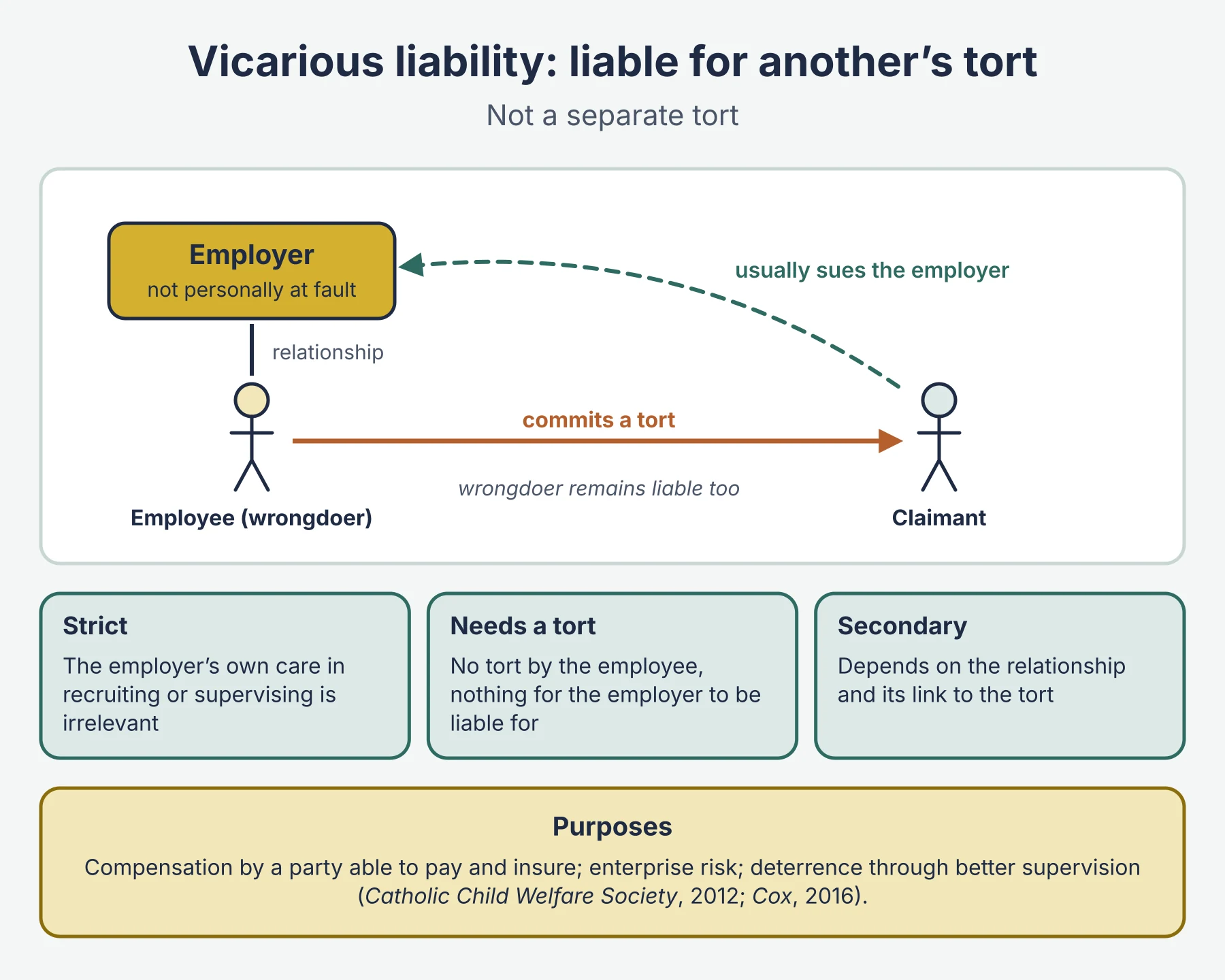
Vicarious liability makes a defendant (usually an employer) liable for a tort committed by another person (usually an employee), even though the defendant was not personally at fault. The wrongdoer remains liable too; the claimant may sue either or both, but in practice sues the employer.
Three points about its nature:
- It is strict: the employer’s own care in recruiting or supervising is irrelevant.
- It needs a tort by the wrongdoer: if the employee committed no tort, there is nothing for the employer to be liable for.
- It is secondary: it depends on a relationship between defendant and wrongdoer and a link between that relationship and the tort.
The purposes, set out by Lord Phillips in Various Claimants v Catholic Child Welfare Society (2012) and Lord Reed in Cox v Ministry of Justice (2016), are compensation by a party able to pay and insure, enterprise risk (the business that benefits from an activity should bear its risks), and deterrence through better supervision. These are explored as theory in the theory of tort law study guide.
The two-stage test
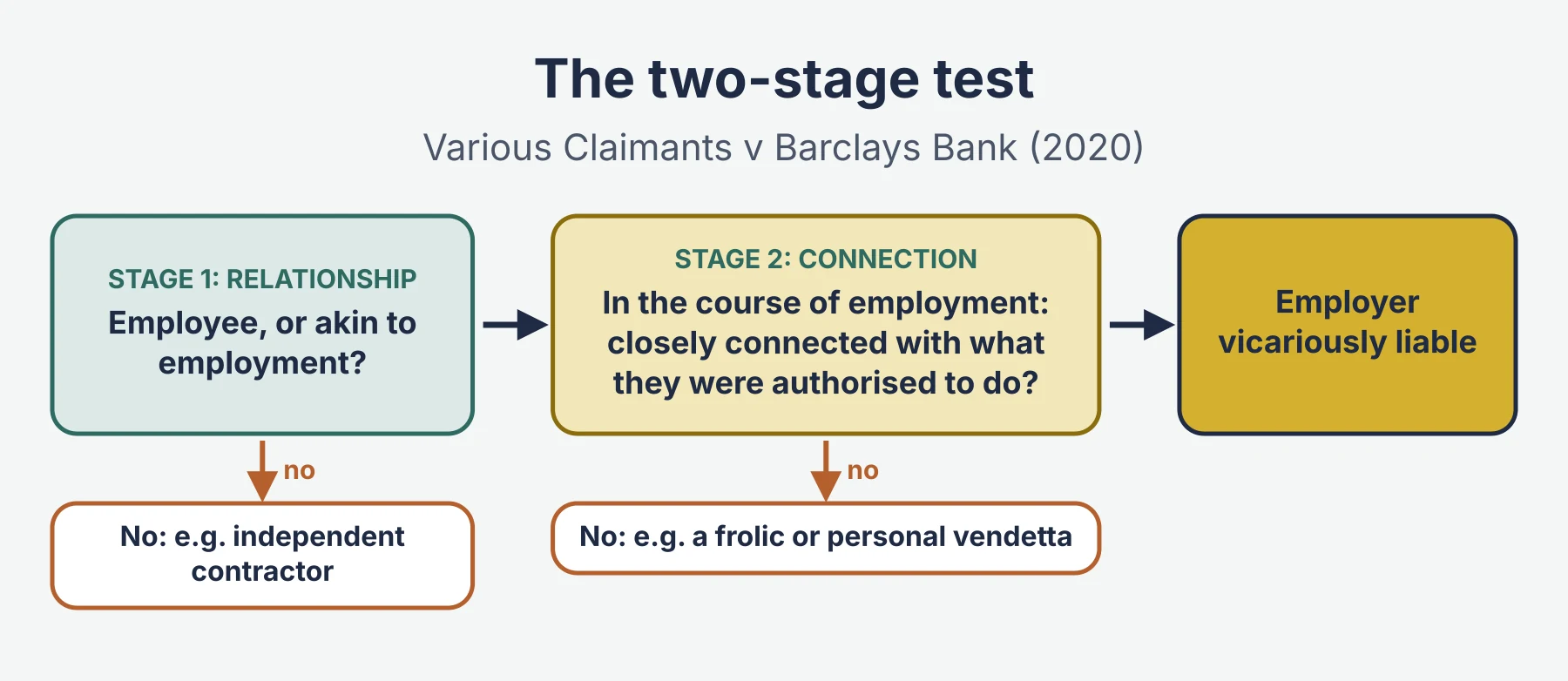
The Supreme Court in Various Claimants v Barclays Bank (2020) confirmed the structure:
- Relationship: is the wrongdoer an employee, or in a relationship sufficiently akin to employment?
- Connection: was the tort committed in the course of employment, meaning closely connected with what the wrongdoer was authorised to do?
Stage 1: testing employment status
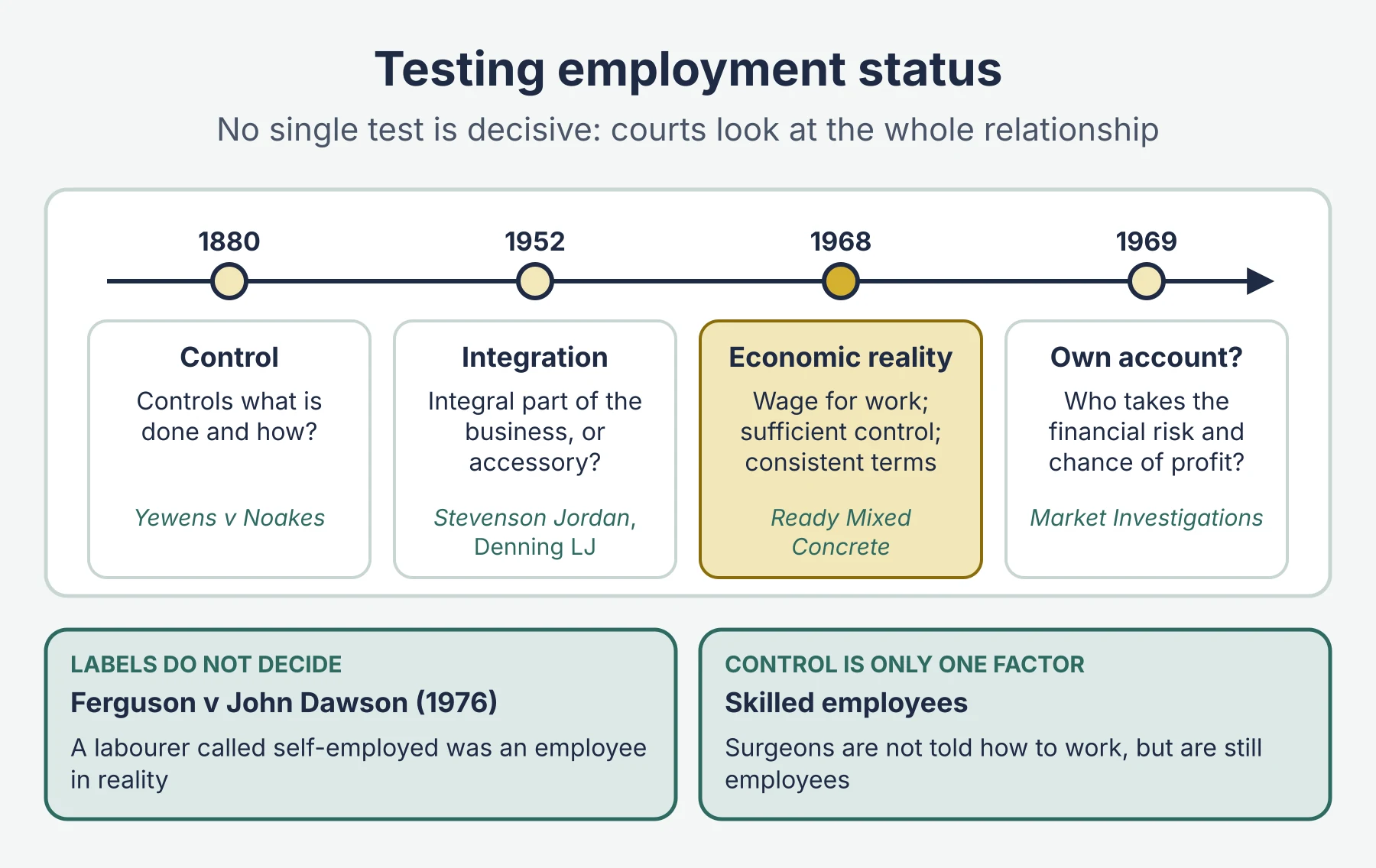
Courts have used several tests over time. No single test is decisive; modern courts look at the whole relationship.
| Test | Question | Authority |
|---|---|---|
| Control | Does the employer control what is done and how? | Yewens v Noakes (1880) |
| Integration | Is the work an integral part of the business, or only accessory to it? | Stevenson Jordan & Harrison v Macdonald & Evans (1952), Denning LJ |
| Economic reality (multiple test) | Wage for work and skill; sufficient control; other terms consistent with employment | Ready Mixed Concrete v Minister of Pensions (1968) |
| In business on own account? | Who takes the financial risk and the chance of profit? | Market Investigations v Minister of Social Security (1969) |
Two practical points:
- Labels do not decide status. In Ferguson v John Dawson & Partners (1976) a builder’s labourer described as self-employed was held to be an employee because of the reality of the relationship.
- The control test is now only one factor. Skilled employees such as surgeons are not told how to do their work, but they are still employees.
Relationships akin to employment
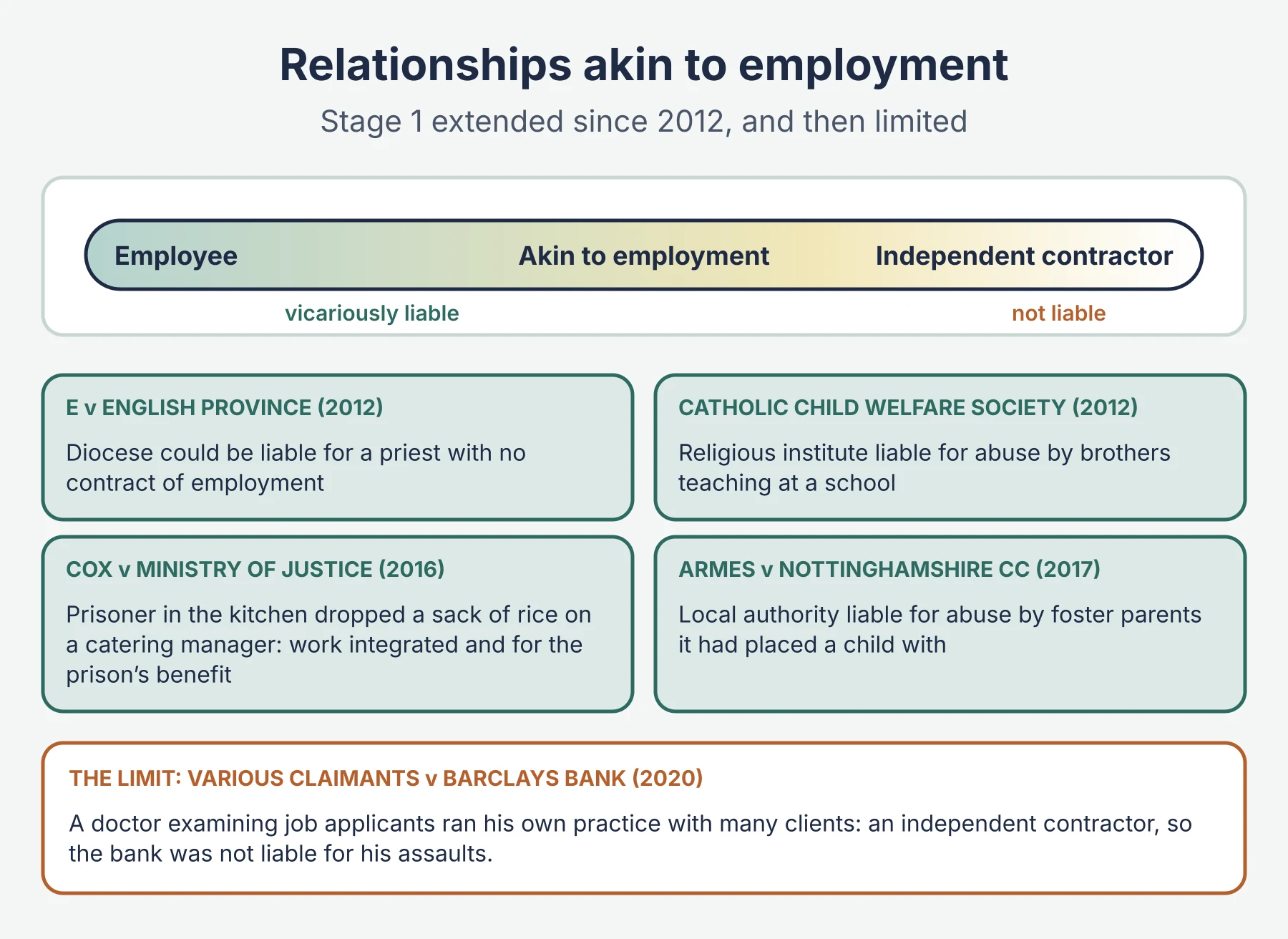
Since 2012 the courts have extended stage 1 beyond formal employment.
- In E v English Province of Our Lady of Charity (2012) a Roman Catholic diocese could be vicariously liable for a priest, though he had no contract of employment.
- In Catholic Child Welfare Society (2012) a religious institute was liable for abuse by brothers who taught at a school, because their relationship with the institute was akin to employment.
- In Cox v Ministry of Justice (2016) the prison service was liable when a prisoner working in the kitchen negligently dropped a sack of rice on a catering manager. The prisoner’s work was integrated into the prison’s activities and done for its benefit.
- In Armes v Nottinghamshire CC (2017) a local authority was liable for abuse by foster parents with whom it had placed a child.
The limit came in Barclays Bank (2020). A doctor who carried out medical examinations of job applicants for the bank was an independent contractor running his own practice, with many clients. His relationship with the bank was not akin to employment, so the bank was not liable for his assaults.
Stage 2: course of employment and close connection
The traditional approach
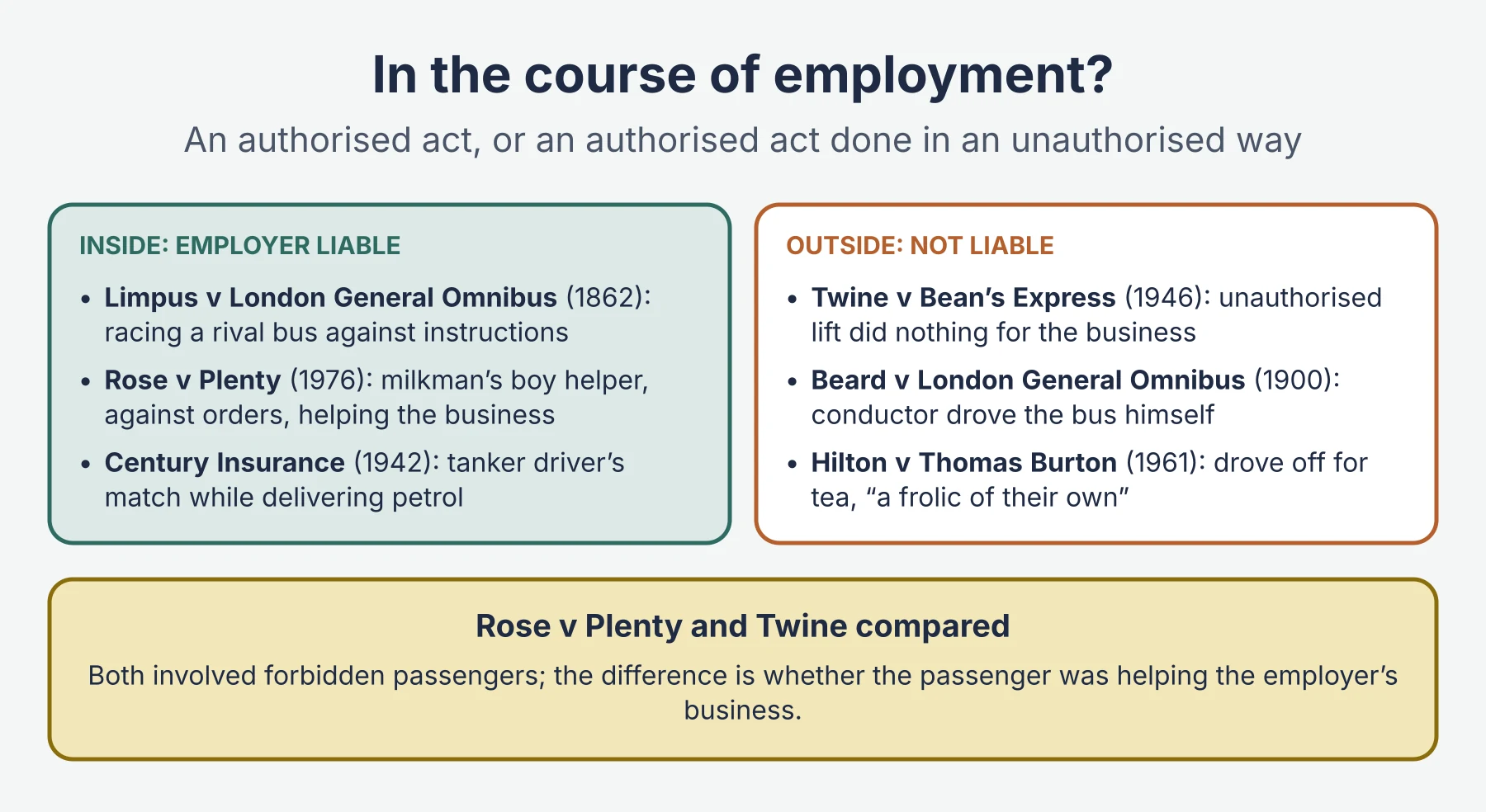
The traditional question was whether the employee was doing an authorised act, or an authorised act in an unauthorised way.
- Prohibited acts in the course of the job. In Limpus v London General Omnibus (1862) a bus driver who raced a rival bus against instructions was within the course of employment. In Rose v Plenty (1976) a milkman who let a boy help on his round against orders was within it, because the boy was helping the employer’s business.
- Careless acts while working. In Century Insurance v Northern Ireland Road Transport Board (1942) a tanker driver who lit a cigarette and threw away the match while delivering petrol was within the course of employment.
- Outside the job. In Twine v Bean’s Express (1946) a driver gave an unauthorised lift to a hitch-hiker, who was killed; the lift did nothing for the employer’s business, so there was no liability. In Beard v London General Omnibus (1900) a conductor who drove the bus himself did something wholly outside his job. In Hilton v Thomas Burton (1961) workmen who drove off for tea during the working day were on “a frolic of their own”.
The close connection test
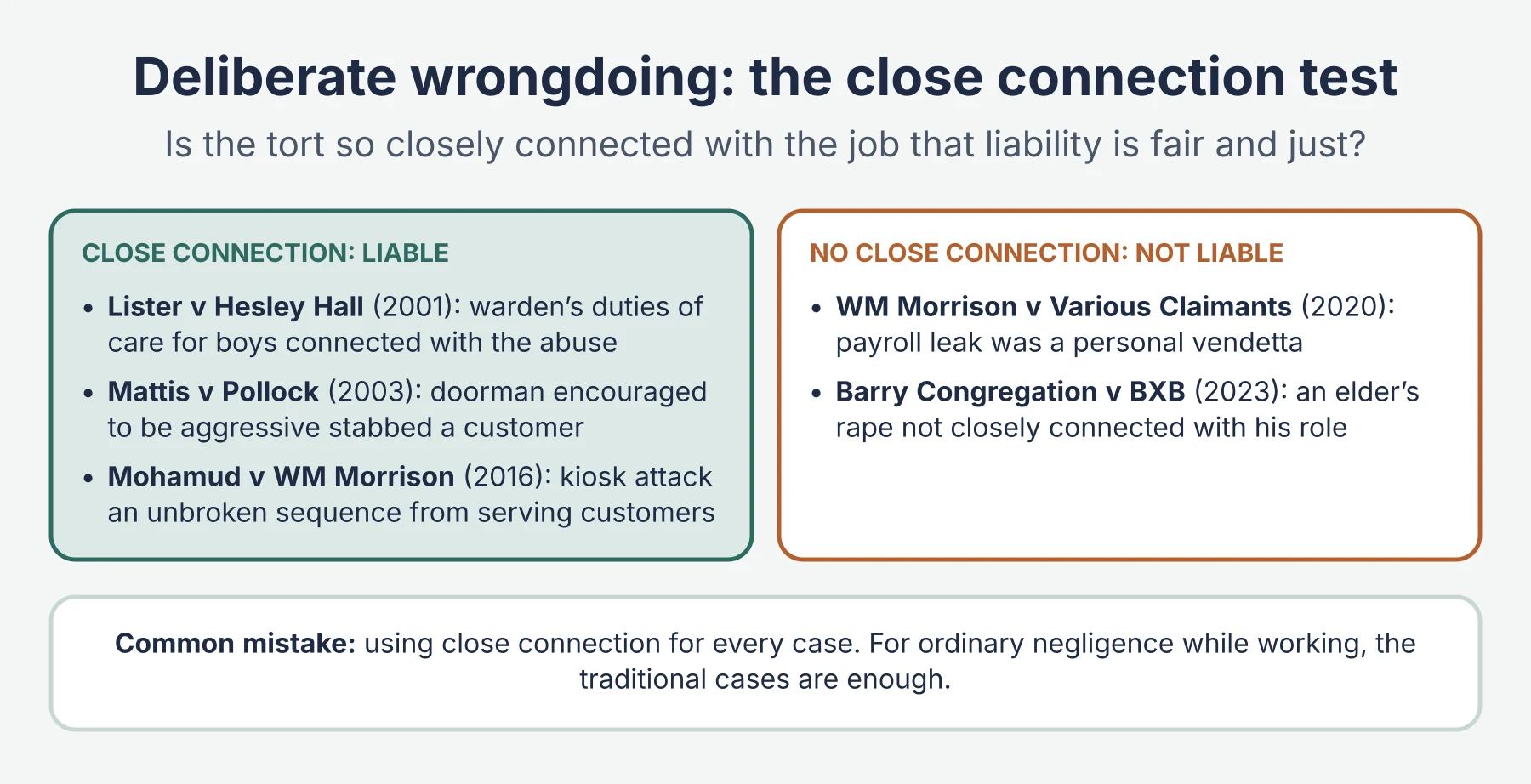
For deliberate wrongdoing, the courts ask whether there is a close connection between the employee’s job and the tort, so that it is fair and just to hold the employer liable.
- Lister v Hesley Hall (2001): a boarding-house warden who abused boys in his care; his duties of care for the boys were closely connected with the abuse.
- Mattis v Pollock (2003): a nightclub doorman encouraged to be aggressive went home, armed himself and stabbed a customer near the club; the employer was liable.
- Mohamud v WM Morrison (2016): a petrol station kiosk attendant attacked a customer after an exchange at the counter; the attack was an unbroken sequence of events from his job of serving customers.
- WM Morrison v Various Claimants (2020): an employee who leaked colleagues’ payroll data to harm his employer was pursuing a personal vendetta; no liability.
- Trustees of the Barry Congregation of Jehovah’s Witnesses v BXB (2023): an elder’s rape of a congregation member was not closely connected with his role, so the congregation was not liable.
Other areas of vicarious liability
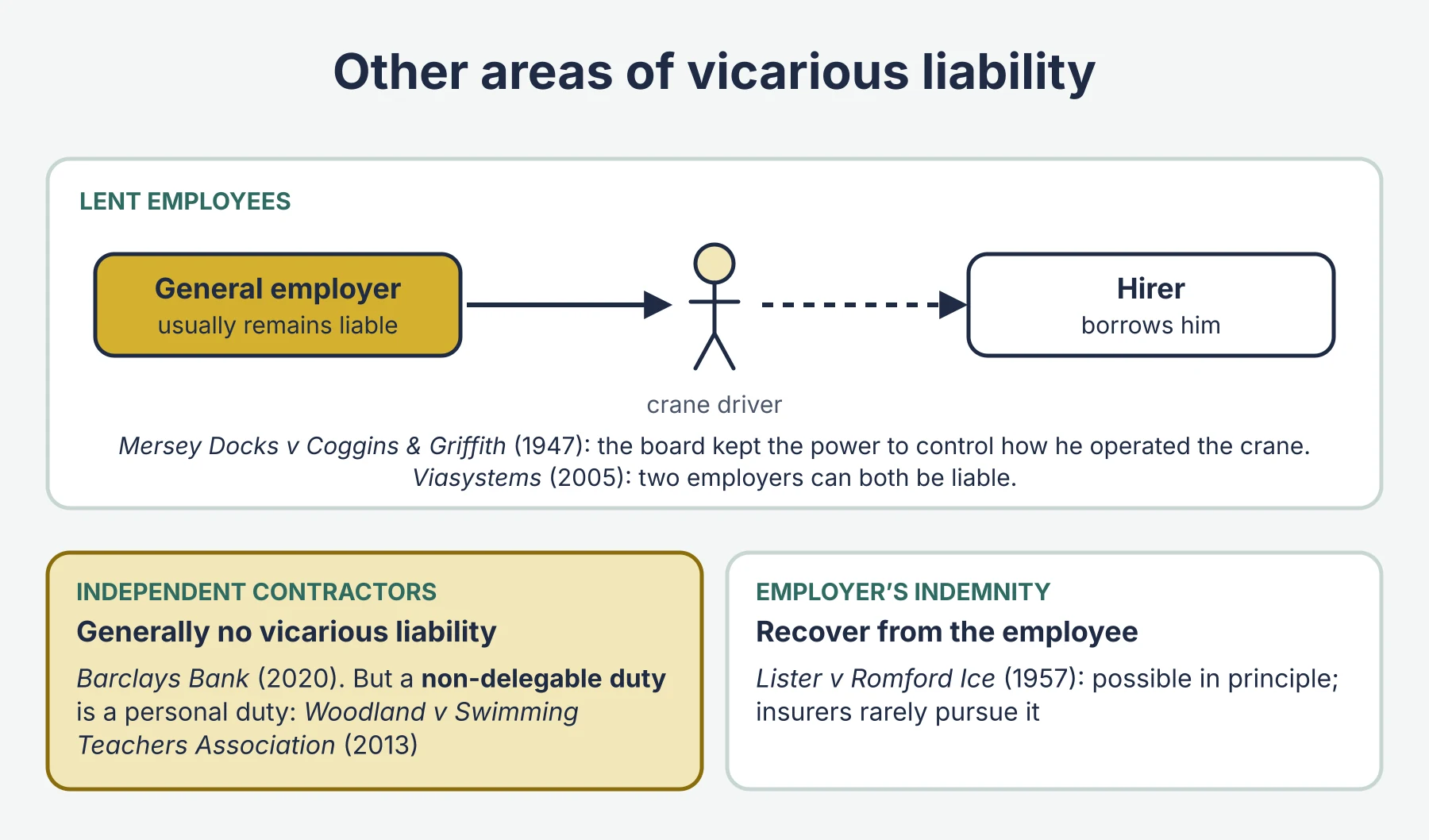
Lent employees. When an employer lends an employee to another business, the general employer usually remains liable. In Mersey Docks and Harbour Board v Coggins & Griffith (1947) a crane driver hired out with his crane was still the employee of the harbour board, which kept the power to control how he operated the crane. In Viasystems v Thermal Transfer (2005) the Court of Appeal accepted that two employers could both be vicariously liable for one worker.
Independent contractors. Generally a person who hires an independent contractor is not vicariously liable for the contractor’s torts (Barclays Bank, 2020). A separate exception is a non-delegable duty: in Woodland v Swimming Teachers Association (2013) a school owed a non-delegable duty to a pupil injured in a swimming lesson provided by an outside contractor. This is a personal duty of the school, not vicarious liability, and should be presented as such.
The employer’s indemnity. An employer held vicariously liable can, in principle, recover its loss from the negligent employee: Lister v Romford Ice and Cold Storage (1957). In practice insurers rarely pursue this.
Worked problem
Zed is a self-employed courier who works only for FastBox, wearing its uniform, using its app to receive jobs and paid per parcel. FastBox forbids couriers from taking passengers. Zed lets his friend ride with him and crashes, injuring the friend and a pedestrian, Lu.
Stage 1:  "Self-employed" label not decisive (Ferguson). Uniform, control of
          jobs through the app, work integral to FastBox's business, no
          other clients - likely employee or akin to employment (Ready
          Mixed; Cox). Contrast Barclays - Zed is not running his own
          business with many clients.
Stage 2:  Lu: Zed was driving to deliver parcels - an authorised act done
          carelessly (Century Insurance). FastBox liable.
          Friend: an unauthorised passenger, not benefiting the business
          (Twine v Bean's Express; contrast Rose v Plenty). FastBox
          probably not liable; friend sues Zed personally.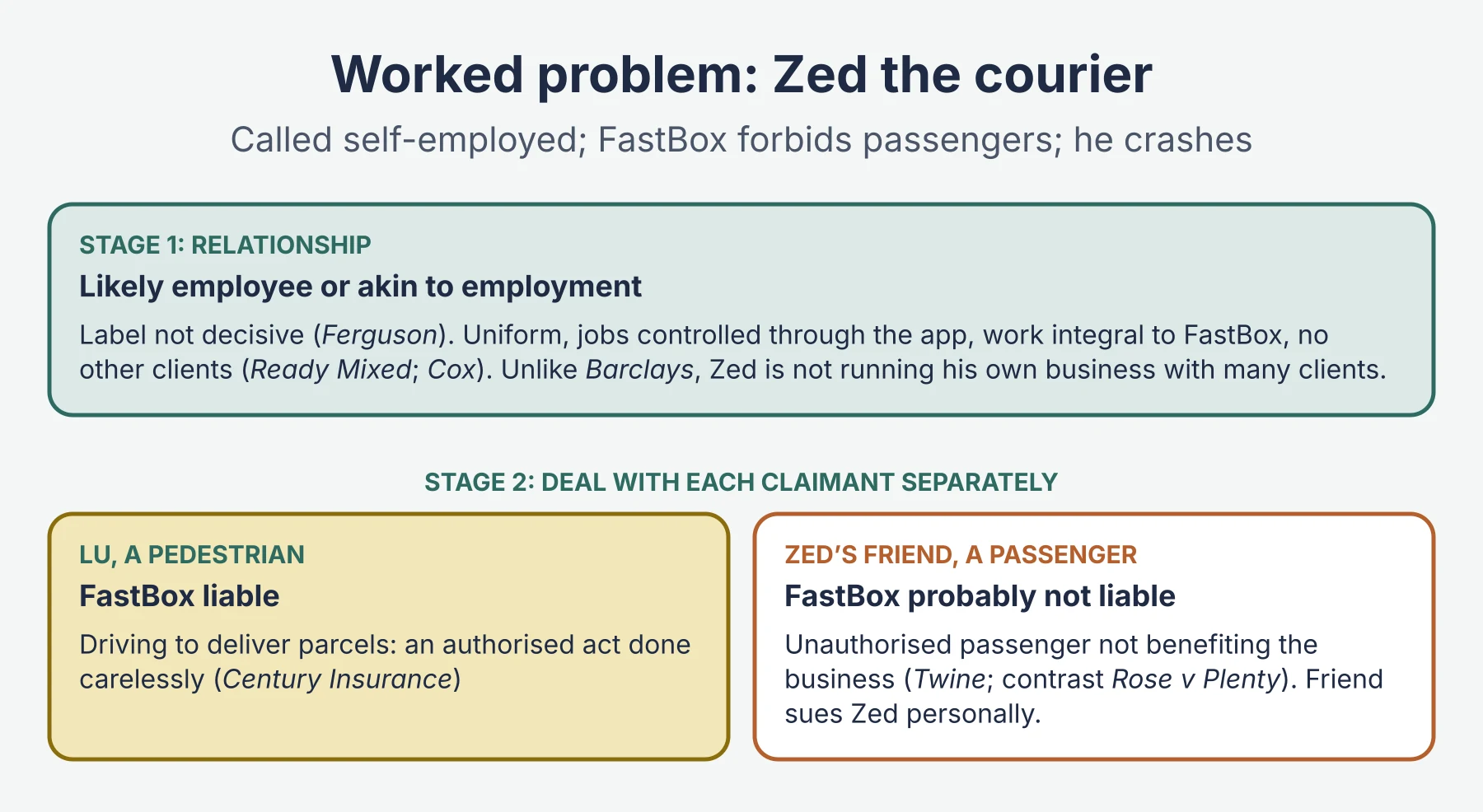
Common mistakes
- Treating vicarious liability as the employer’s own negligence.
- Deciding status on the label in the contract.
- Using close connection for every case: for ordinary negligence while working, the traditional cases are enough.
- Confusing a non-delegable duty with vicarious liability.
Exam technique
State the two-stage test first, then apply each stage with authority. In problem questions, deal with each claimant separately at stage 2: one act can be within the course of employment for one victim and outside it for another, as the worked problem shows.
More resources on this topic
Vicarious liability revision notes | Vicarious liability practice questions | Tort overview
Related resources
-
Practice questions
AQA A Level Law (7162): Vicarious Liability – Practice Questions
Original practice questions with mark-scheme answers on the nature, purpose and two-stage test of vicarious liability, with problem scenarios, for AQA Law 7162.
Law · AQA · A Level
Try questions -
Revision notes
AQA A Level Law (7162): Vicarious Liability – Revision Notes
Recall notes on the purpose of vicarious liability, employment status tests, akin to employment and close connection, for AQA A Level Law 7162.
Law · AQA · A Level
Revise topic -
Study guides
AQA A-Level Law: Tort (7162)
Negligence, occupiers' liability, nuisance, vicarious liability, defences and remedies – the full content of Section 3.3 for AQA A-Level Law (7162).
Law · AQA · A Level
Read guide
Get free revision emails (optional)
Occasional emails with practice questions, worked explanations and links to free resources for the qualification and subjects you choose. No spam, and you can unsubscribe from any email. The free tools on this site never need an email.