
Revision Notes
AQA A Level Law (7162): Nuisance and the Escape of Dangerous Things – Revision Notes
Recall notes on private nuisance parties, the unreasonableness factors, planning permission and every element of Rylands v Fletcher, for AQA A Level Law 7162.
- Subject
- Law
- Level
- A LEVELS
- Topic
- Tort
- Author
- Marlbridge Academic Team
- Updated
- Reviewed by
- Aizaz Raoof Ali (what this means)
Aligned to AQA A Level Law (7162), For teaching from September 2017 onwards, A-level exams 2019 onwards. Official specification .
Syllabus page (what it covers and how it is assessed): AQA A Level Law.
Syllabus points this page covers
7162
- Nuisance and the escape of dangerous things
Found an error? Report a correction.
Need help with this topic? Request a free trial class for A Level Law (7162).
Condensed notes for the section 3.3 row Nuisance and the escape of dangerous things: “Private nuisance” and “The rule in Rylands v Fletcher”. For explanation and a worked problem, use the nuisance and Rylands v Fletcher study guide.
Private nuisance: definition
Unlawful interference with a person’s use or enjoyment of land, or some right over or in connection with it.
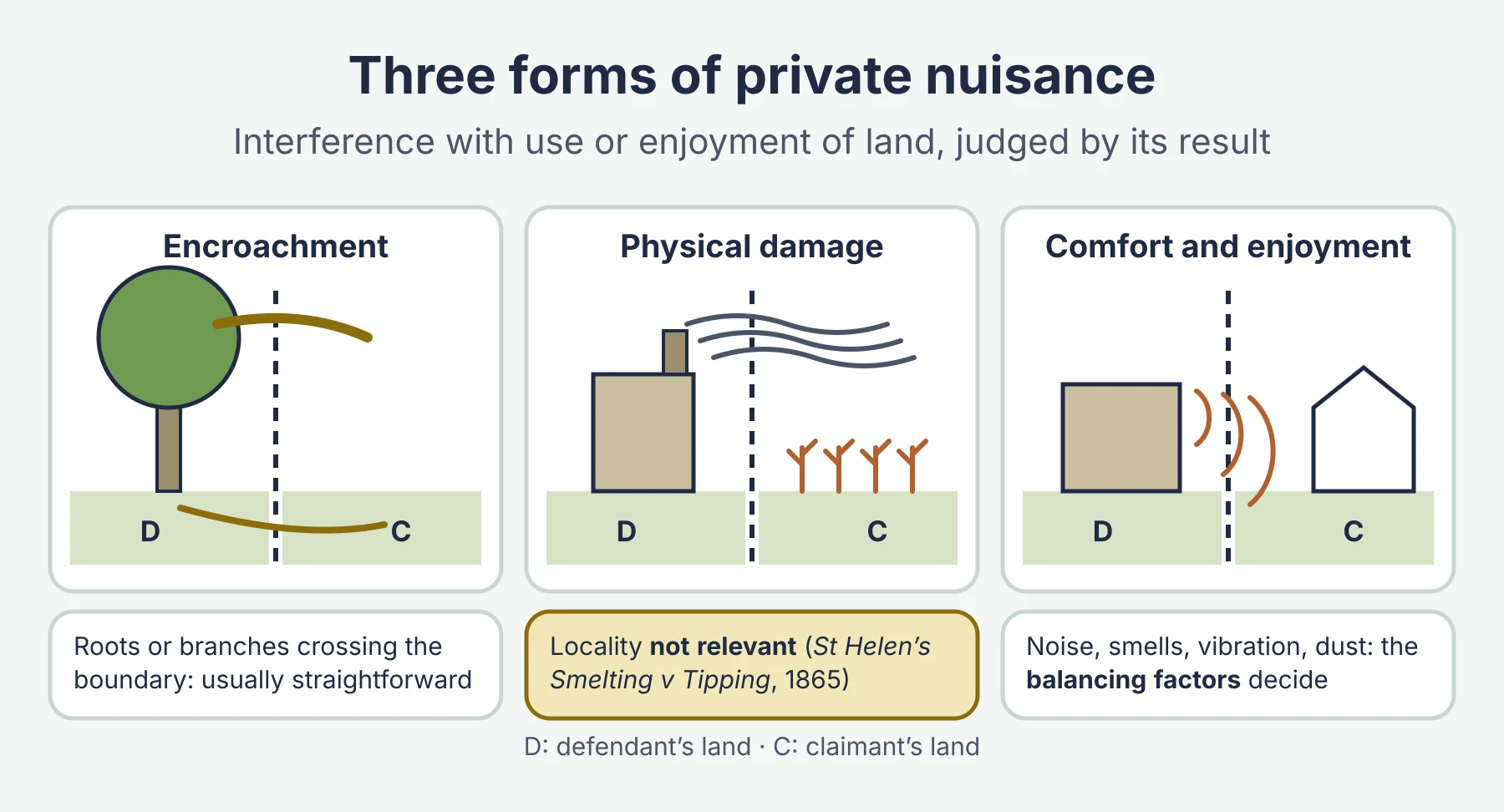
Three types: encroachment; physical damage to land; interference with comfort and enjoyment.
Parties
| Question | Rule | Case |
|---|---|---|
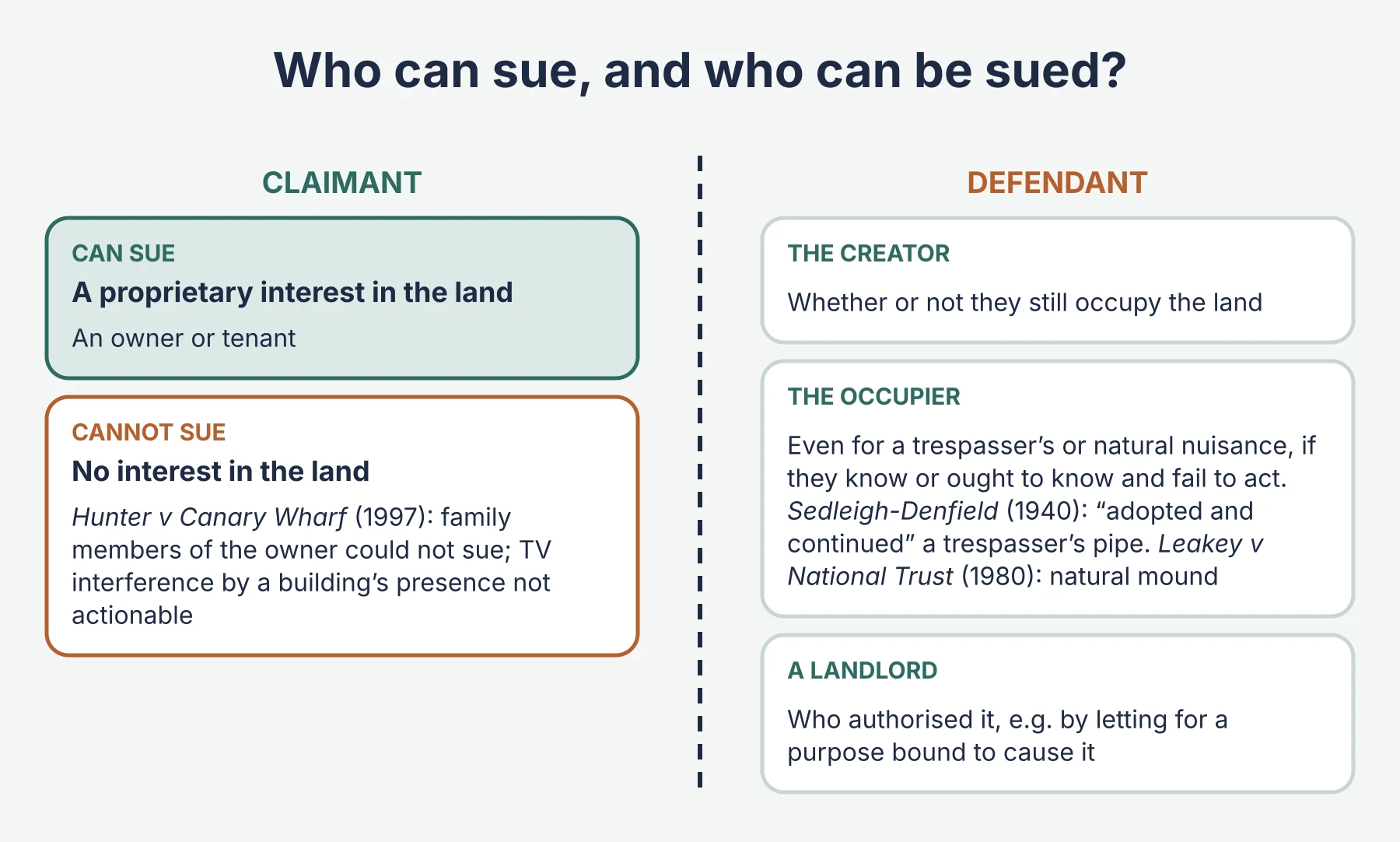
| Who can sue? | Person with a proprietary interest (owner, tenant) | Hunter v Canary Wharf (1997) |
| Who can be sued? | Creator | General rule |
| Occupier who adopts or continues a nuisance created by a trespasser | Sedleigh-Denfield v O’Callaghan (1940) | |
| Occupier who fails to act on a known natural hazard | Leakey v National Trust (1980) | |
| Landlord who authorised the nuisance | General rule |
Unreasonableness factors
| Factor | Case | Point |
|---|---|---|
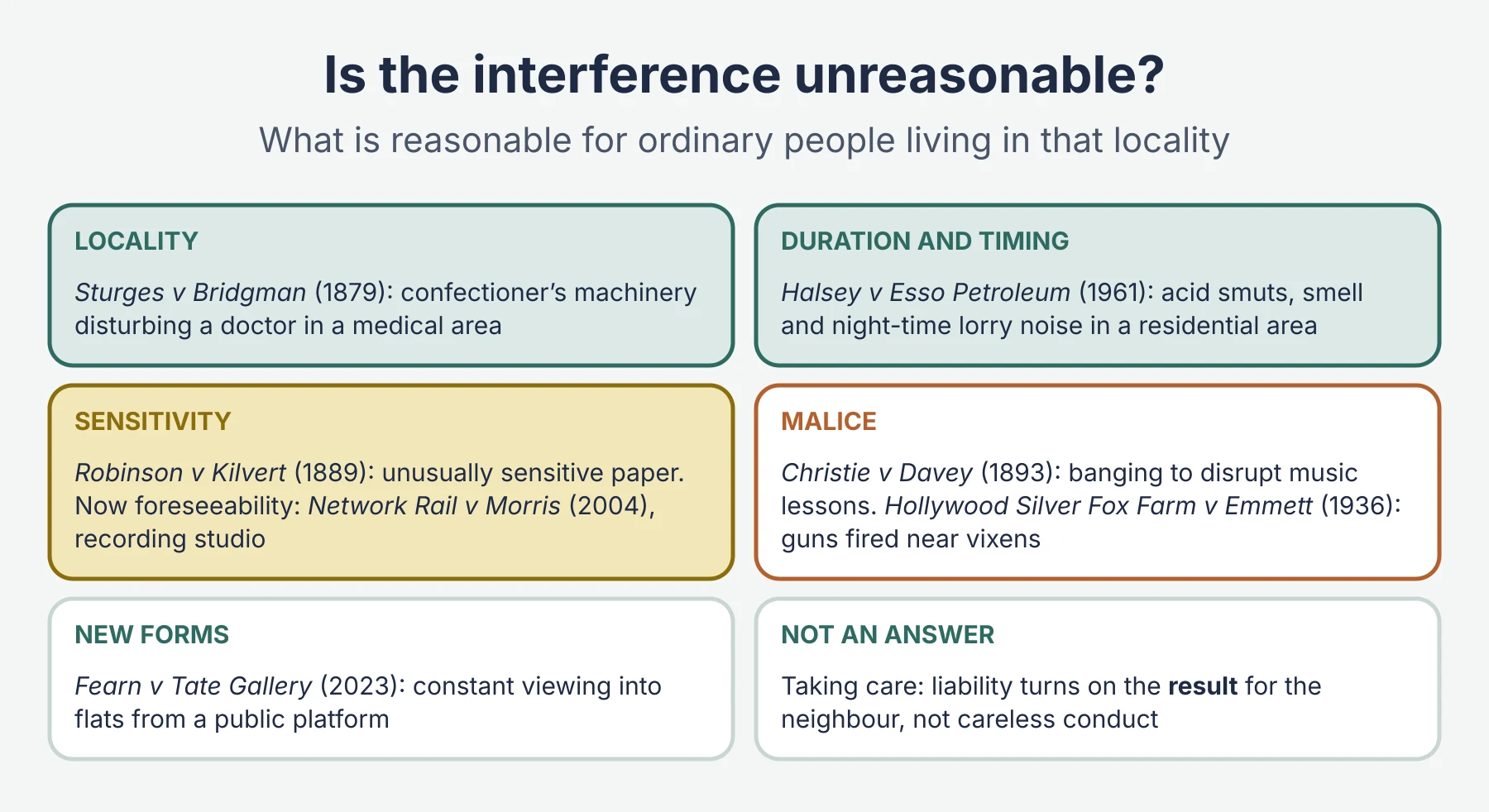
| Locality | Sturges v Bridgman (1879) | Character of the area matters for comfort cases |
| Locality irrelevant for physical damage | St Helen’s Smelting v Tipping (1865) | Damage to trees and crops |
| Duration and time | Halsey v Esso Petroleum (1961) | Night-time noise, smell, smuts |
| Sensitivity | Robinson v Kilvert (1889) | Unusually sensitive use not protected |
| Foreseeability approach | Network Rail v Morris (2004) | Interference with amplified guitars unforeseeable |
| Malice | Christie v Davey (1893); Hollywood Silver Fox Farm v Emmett (1936) | Deliberate harm is unreasonable |
| Overlooking | Fearn v Tate Gallery (2023) | Constant viewing into flats can be a nuisance |
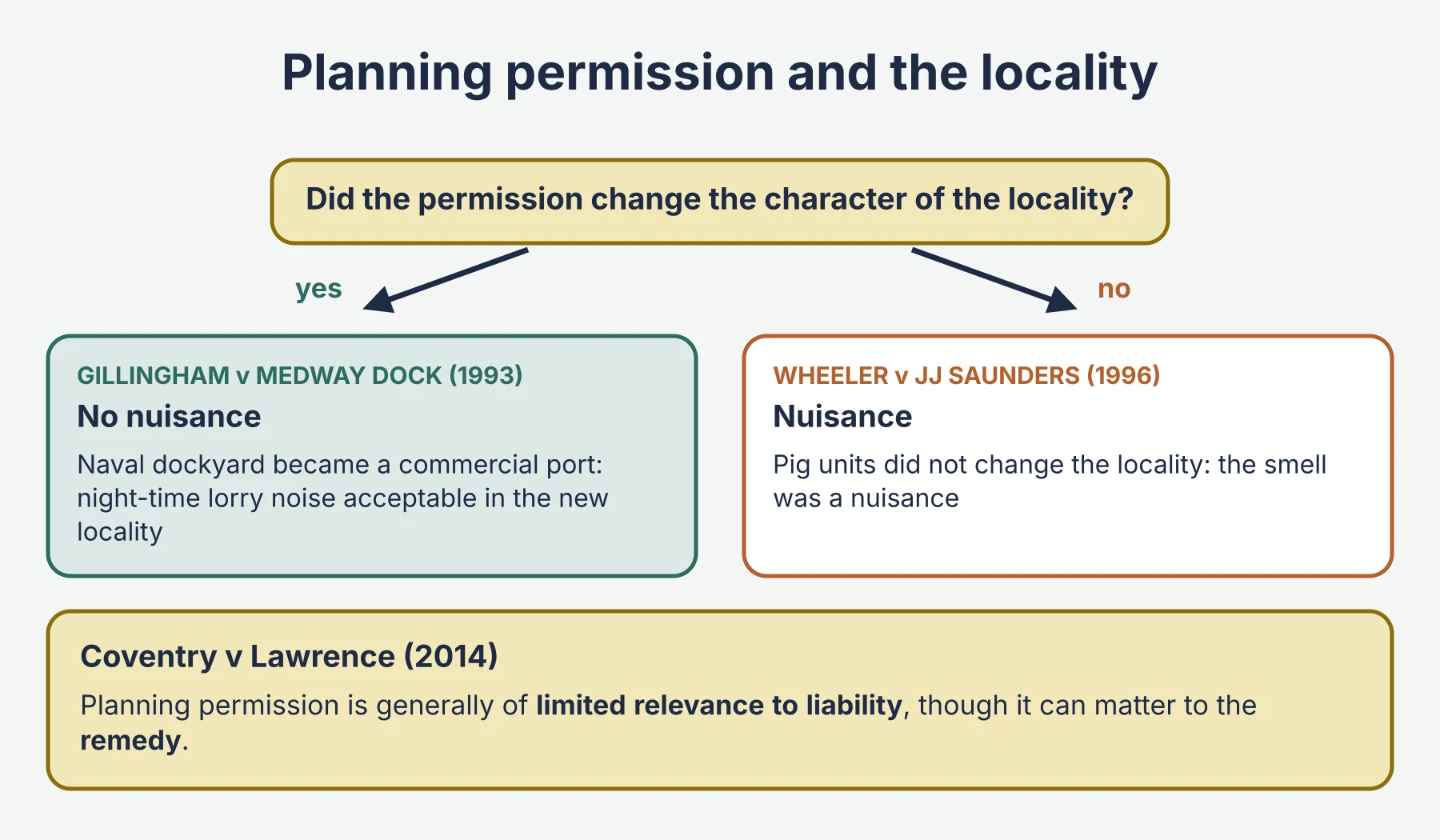
Planning permission: not a defence; may change the locality (Gillingham BC v Medway Dock, 1993) or not (Wheeler v JJ Saunders, 1996); limited relevance to liability (Coventry v Lawrence, 2014).
Rylands v Fletcher
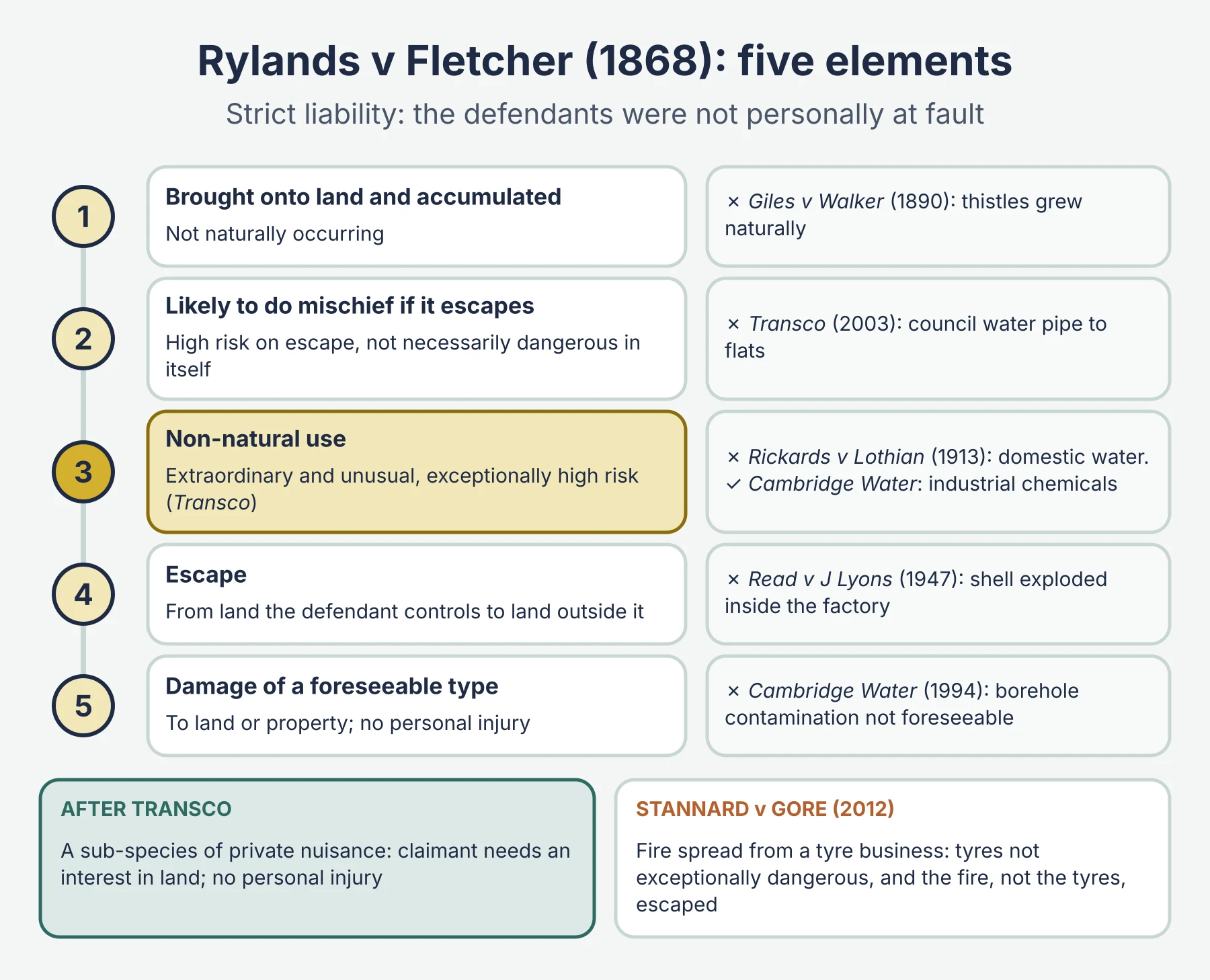
Origin (1868): reservoir water burst into the claimant’s mine through old shafts. Blackburn J: a person who brings onto land and keeps there anything likely to do mischief if it escapes keeps it “at his peril”. House of Lords: use must be non-natural.
| Element | Case | Point |
|---|---|---|
| 1 Brought onto land and accumulated | Giles v Walker (1890) | Naturally growing thistles: no liability |
| 2 Likely to do mischief if it escapes | Transco v Stockport MBC (2003) | Ordinary water pipe not enough |
| 3 Non-natural use | Rickards v Lothian (1913) | Domestic water supply is natural |
| Transco (2003) | Extraordinary and unusual use, exceptionally high risk | |
| Cambridge Water (1994) | Chemical storage almost a classic non-natural use | |
| 4 Escape | Read v J Lyons (1947) | Explosion inside factory: no escape |
| 5 Foreseeable type of damage | Cambridge Water (1994) | Contamination of distant borehole not foreseeable |
Claimant: needs an interest in land (Transco, following Hunter). Damage: to land and property; not personal injury. Fire: Stannard v Gore (2012): tyres not exceptionally dangerous; fire, not tyres, escaped.
Nuisance and Rylands compared
| Private nuisance | Rylands v Fletcher | |
|---|---|---|
| Typical harm | Continuing interference | Single escape |
| Key test | Unreasonable use in effect on neighbour | Non-natural use and escape |
| Fault | Not required as such | Strict liability |
| Claimant | Interest in land | Interest in land |
| Personal injury | Not recoverable | Not recoverable |
Evaluation points
- Balancing rights: nuisance asks neighbours to “give and take”, but outcomes depend heavily on locality and judicial impression.
- Who can sue: Hunter keeps nuisance tied to land, but leaves family members without a claim for the same disturbance.
- Rylands narrowed: after Transco few claims succeed, and personal injury is excluded, so negligence often does the real work.
- Planning: letting public planning decisions change a locality can remove private rights without compensation.
Key terms
| Term | Meaning |
|---|---|
| Proprietary interest | A legal interest in land, such as ownership or a tenancy |
| Encroachment | Something physically crossing onto the claimant’s land |
| Adopting a nuisance | Using a hazard created by another |
| Continuing a nuisance | Failing to end a hazard the occupier knows of |
| Non-natural use | An extraordinary and unusual use creating exceptionally high risk |
| Escape | Movement of the thing from the defendant’s control to outside it |
| Strict liability | Liability without proof of fault |
Exam traps
- Lodgers and family members without an interest cannot sue (Hunter).
- Planning permission is not a defence.
- Rylands never covers personal injury after Transco.
- Escape must be from land the defendant controls.
- Physical damage does not need the locality factor.
Self-test
- Define private nuisance. Unlawful interference with a person’s use or enjoyment of land or rights over it.
- Who can sue in private nuisance? A person with a proprietary interest in the land affected.
- What did Sedleigh-Denfield decide? An occupier who adopts or continues a nuisance created by a trespasser is liable.
- What did Leakey decide? An occupier must take reasonable steps against a known natural hazard.
- Why was locality irrelevant in St Helen’s Smelting? The nuisance caused physical damage to property.
- What did Network Rail v Morris decide? Unforeseeable interference with an unusually sensitive use was not a nuisance.
- How can planning permission affect nuisance? It can change the character of the locality, but it is not a defence.
- What did Fearn (2023) decide? Constant viewing into flats from a platform could be a nuisance.
- Why did Giles v Walker fail? The thistles grew naturally; nothing was brought onto the land.
- What test for non-natural use did Transco give? An extraordinary and unusual use creating an exceptionally high risk.
- Why did Read v Lyons fail? There was no escape from the defendant’s premises.
- Why did the claim fail in Cambridge Water? Damage of that type was not foreseeable.
More resources on this topic
Nuisance and Rylands v Fletcher practice questions | Tort revision notes
Related resources
-
Study guides
AQA A Level Law (7162): Occupiers' Liability
Occupiers, premises, visitors and trespassers under the Occupiers' Liability Acts 1957 and 1984, with cases and a worked problem, for AQA A Level Law 7162.
Law · AQA · A Level
Read guide -
Practice questions
AQA A Level Law (7162): Occupiers' Liability – Practice Questions
Original practice questions with mark-scheme answers on occupiers, visitors, trespassers and the Occupiers' Liability Acts 1957 and 1984, AQA Law 7162.
Law · AQA · A Level
Try questions -
Revision notes
AQA A Level Law (7162): Occupiers' Liability – Revision Notes
Recall notes on occupiers, visitors, trespassers, the common duty of care and the s1(3) conditions of the 1984 Act, for AQA A Level Law 7162.
Law · AQA · A Level
Revise topic
Get free revision emails (optional)
Occasional emails with practice questions, worked explanations and links to free resources for the qualification and subjects you choose. No spam, and you can unsubscribe from any email. The free tools on this site never need an email.