
Study Guides
AQA A Level Law (7162): Nuisance and the Escape of Dangerous Things
Private nuisance and the rule in Rylands v Fletcher: who can sue and be sued, unreasonable use, each Rylands element and a worked problem, AQA Law 7162.
- Subject
- Law
- Level
- A LEVELS
- Topic
- Tort
- Author
- Marlbridge Academic Team
- Updated
- Reviewed by
- Aizaz Raoof Ali (what this means)
Aligned to AQA A Level Law (7162), For teaching from September 2017 onwards, A-level exams 2019 onwards. Official specification .
Syllabus page (what it covers and how it is assessed): AQA A Level Law.
Syllabus points this page covers
7162
- Nuisance and the escape of dangerous things
Found an error? Report a correction.
Need help with this topic? Request a free trial class for A Level Law (7162).
This guide covers the section 3.3 row Nuisance and the escape of dangerous things in AQA A-level Law (7162). The specification names two statements: “Private nuisance” and “The rule in Rylands v Fletcher”. Both protect people’s interests in land against harm coming from a neighbour’s land. The Tort cases, defences and remedies study guide gives the headline factors; this page adds who can sue and be sued, the types of nuisance, the role of planning permission, and a closer look at each Rylands element. Defences and injunctions have their own rows and are referred to only briefly.
Part 1: private nuisance
Definition and types
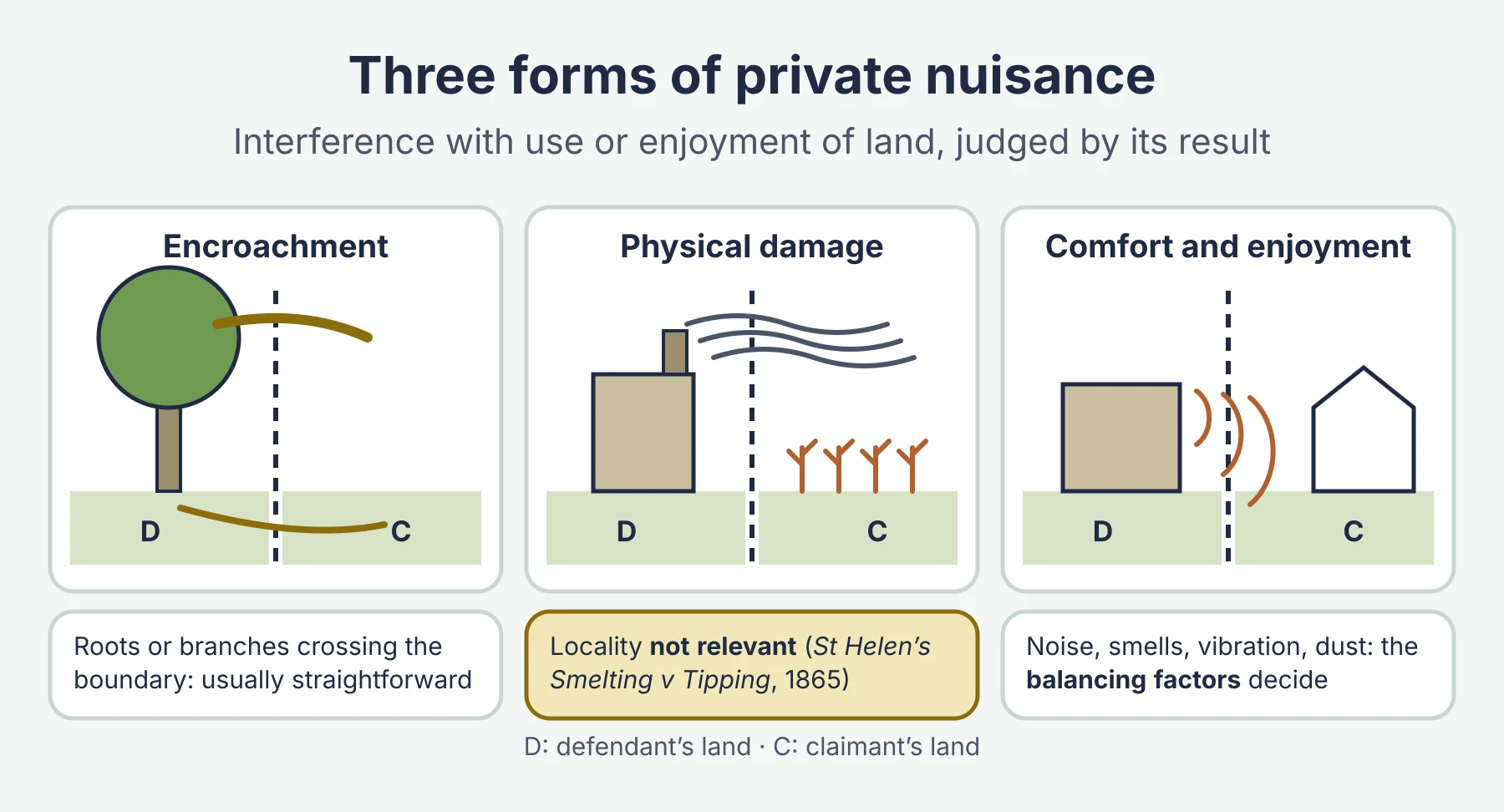
Private nuisance is an unlawful interference with a person’s use or enjoyment of land, or some right over or in connection with it. It takes three main forms:
| Type | Example | Note |
|---|---|---|
| Encroachment | Tree roots or branches crossing the boundary | Usually straightforward |
| Physical damage to land | Fumes damaging crops or buildings | Locality is not relevant (St Helen’s Smelting v Tipping, 1865) |
| Interference with comfort and enjoyment | Noise, smells, vibration, dust | The balancing factors are decisive |
Nuisance is about the result of the defendant’s use of land on the claimant’s land. The defendant may have taken care and still be liable if the use is unreasonable in its effect on the neighbour.
Who can sue?
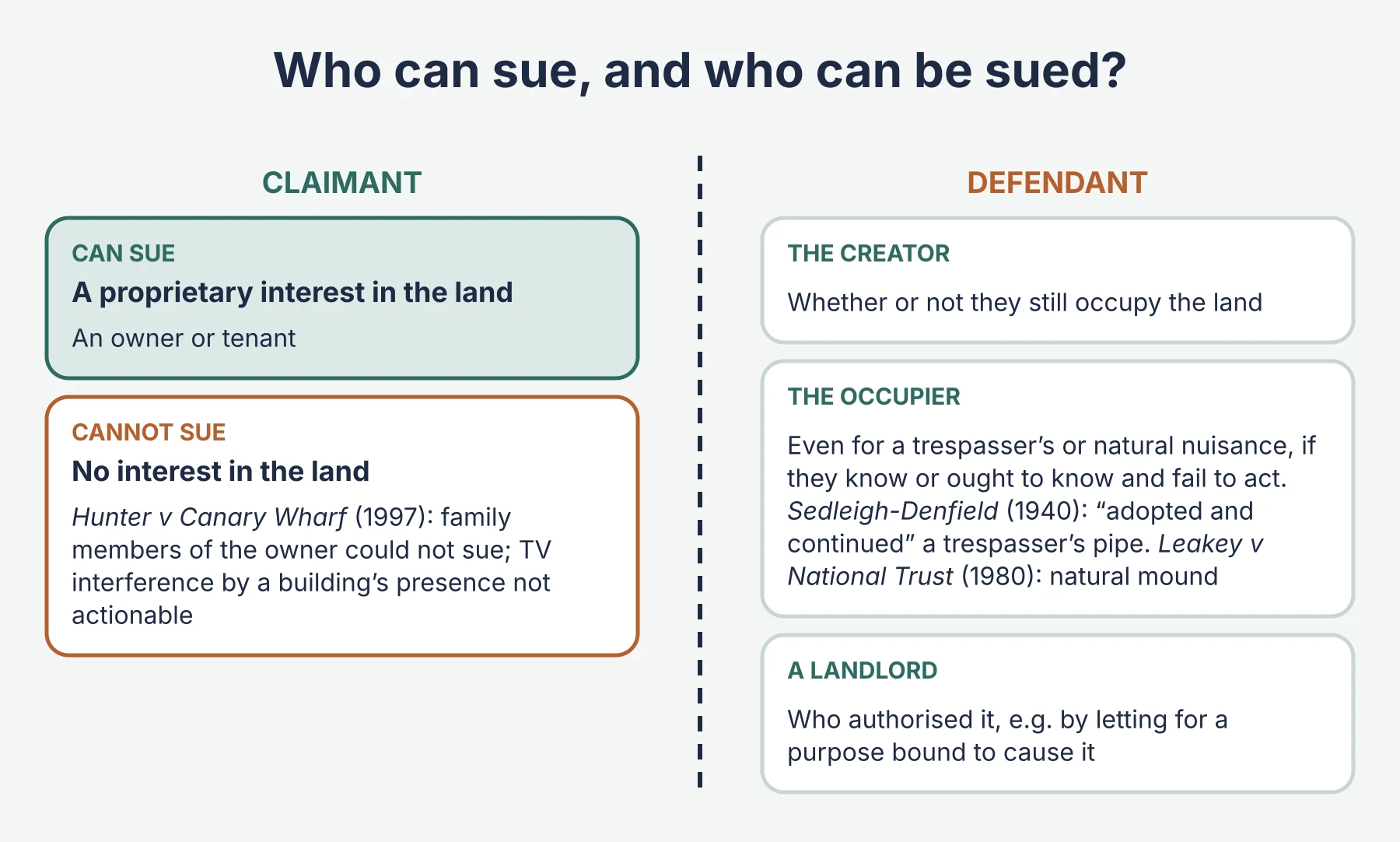
Only a person with a proprietary interest in the land affected, such as an owner or tenant. In Hunter v Canary Wharf (1997) residents complained that a tower block interfered with television reception. The House of Lords held that people with no interest in the land, such as family members of the owner, could not sue in nuisance, and that interference with television reception caused simply by the presence of a building was not actionable.
Who can be sued?
- The creator of the nuisance, whether or not they still occupy the land.
- The occupier, including where a nuisance was created by a trespasser or arose naturally, if the occupier knows or ought to know of it and fails to take reasonable steps. In Sedleigh-Denfield v O’Callaghan (1940) a trespasser laid a pipe on the defendant’s land; the defendant knew of it and used it, so “adopted and continued” the nuisance when it flooded the neighbour. In Leakey v National Trust (1980) soil and rocks fell from a natural mound onto neighbouring houses; the occupier, knowing of the risk, had to take reasonable steps.
- A landlord who authorised the nuisance, for example by letting premises for a purpose that is bound to cause it.
Is the interference unreasonable?
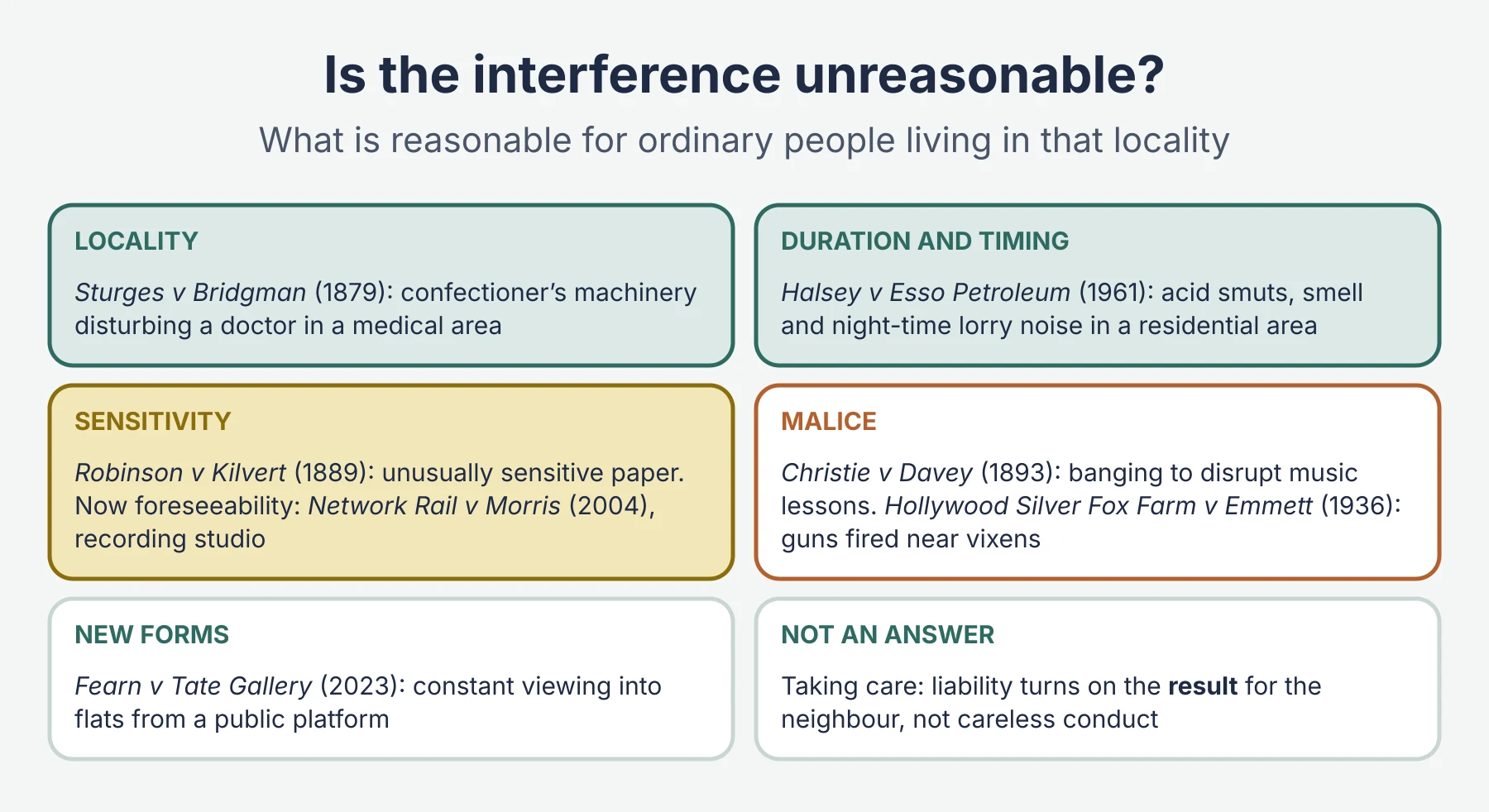
The court balances the defendant’s right to use land against the claimant’s right to enjoy theirs. The test is what is reasonable according to the ordinary usages of people living in that locality.
- Locality. Sturges v Bridgman (1879): a confectioner’s machinery disturbing a doctor’s consulting room in a medical area was a nuisance.
- Duration and timing. Continuing or night-time interference is more likely to be unreasonable. In Halsey v Esso Petroleum (1961) an oil depot’s acid smuts, smell and night-time lorry noise were a nuisance in a residential area.
- Sensitivity. Robinson v Kilvert (1889): no claim for damage to unusually sensitive paper. Modern courts tend to ask instead whether the harm was reasonably foreseeable: in Network Rail v Morris (2004) interference by railway signalling with a recording studio’s amplified guitars was too unusual and unforeseeable.
- Malice. Christie v Davey (1893): deliberate banging and shouting to disrupt a music teacher’s lessons; Hollywood Silver Fox Farm v Emmett (1936): guns fired near the boundary to disrupt breeding vixens.
- New forms. In Fearn v Board of Trustees of the Tate Gallery (2023) the Supreme Court held that constant viewing into flats from a public viewing platform could be a nuisance.
Planning permission
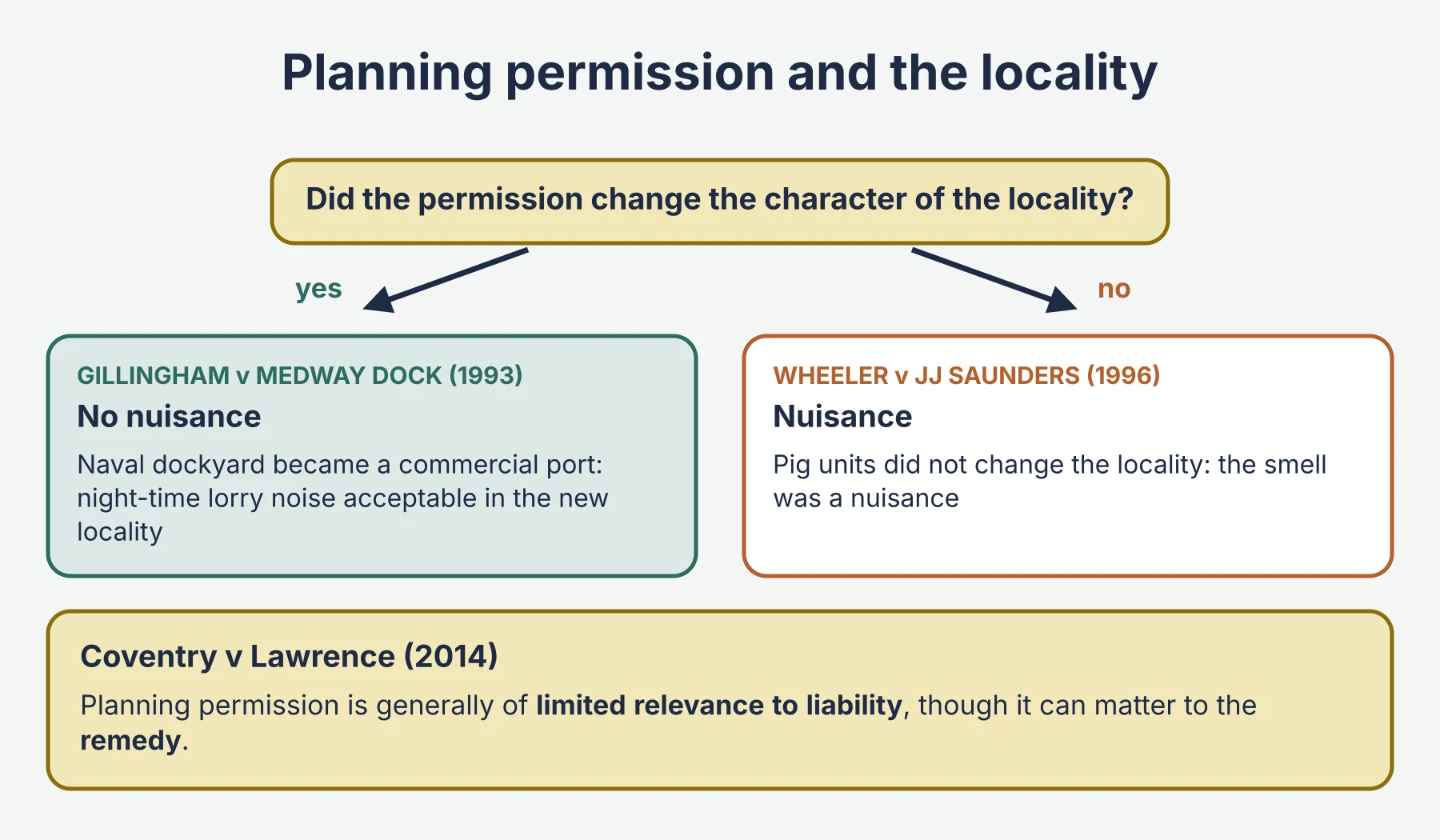
Planning permission is not a defence, but it may change the character of a locality. In Gillingham BC v Medway (Chatham) Dock Co (1993) permission to turn a naval dockyard into a commercial port changed the locality, so night-time lorry noise was not a nuisance. In Wheeler v JJ Saunders (1996) permission for pig units did not change the locality, and the smell was a nuisance. Coventry v Lawrence (2014) confirmed that planning permission is generally of limited relevance to liability, though it can matter to the remedy.
Part 2: the rule in Rylands v Fletcher
Origin
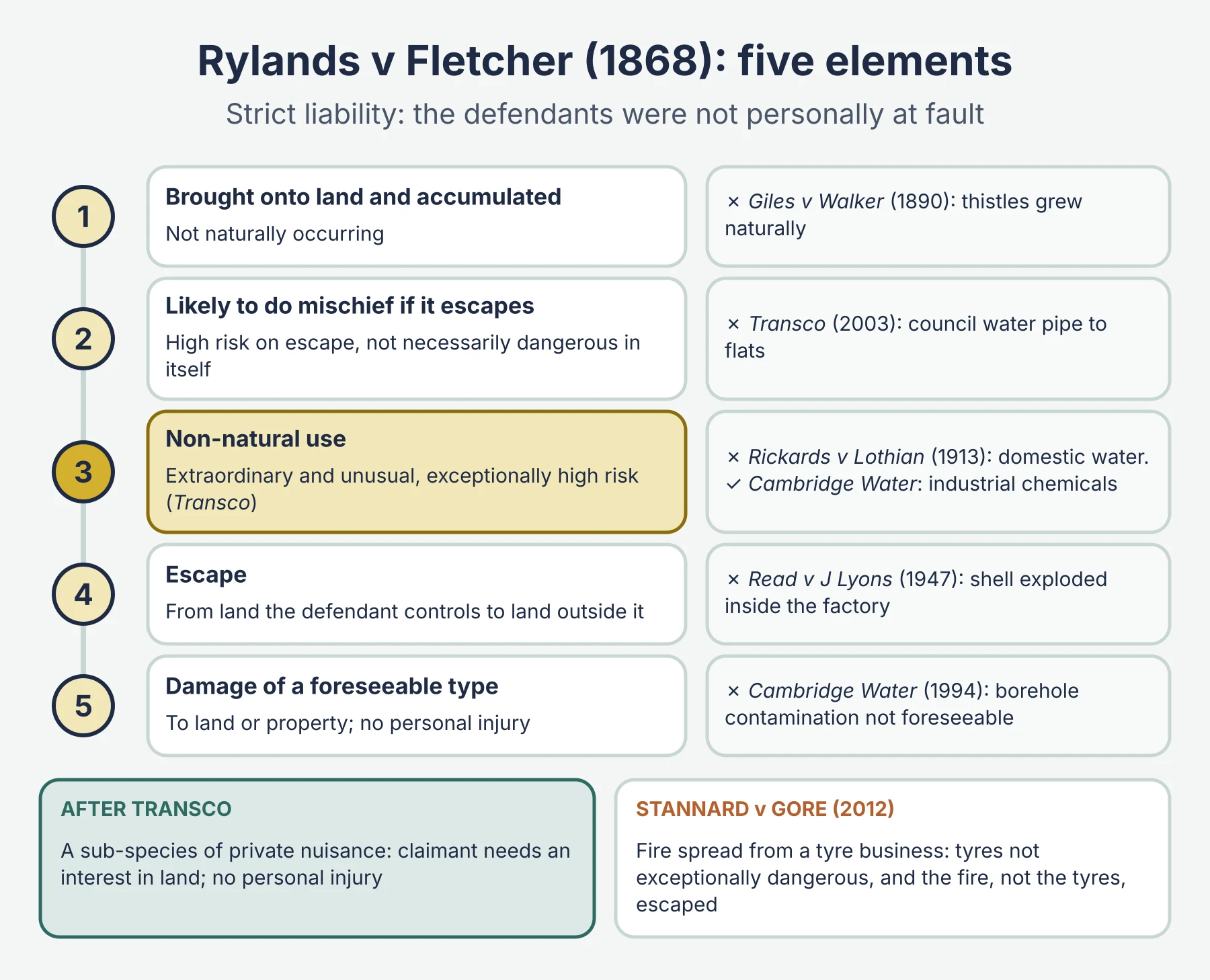
In Rylands v Fletcher (1868) the defendants had a reservoir built on their land. Their contractors failed to block old mine shafts, and water burst through into the claimant’s mine. The defendants were not personally at fault, but were held liable. Blackburn J stated that a person who for their own purposes brings onto their land and collects and keeps there anything likely to do mischief if it escapes must keep it in at their peril. The House of Lords added that the use must be non-natural.
The elements
1. Bringing onto land and accumulation. The thing must be brought there, not occur naturally. In Giles v Walker (1890) thistle seeds blowing from land where thistles grew naturally did not create liability.
2. Something likely to do mischief if it escapes. The thing need not be dangerous in itself, but must create a high risk if it escapes. In Transco v Stockport MBC (2003) a council’s water pipe supplying a block of flats was not such a thing.
3. Non-natural use. Rickards v Lothian (1913): an ordinary domestic water supply is a natural use. Transco restated the test as an extraordinary and unusual use creating an exceptionally high risk. In Cambridge Water v Eastern Counties Leather (1994) storage of substantial quantities of chemicals on industrial premises was described as an almost classic case of non-natural use.
4. Escape. The thing must escape from land under the defendant’s control to land outside it. In Read v J Lyons (1947) a shell exploded inside a munitions factory, injuring an inspector; there was no escape, so Rylands did not apply.
5. Damage of a foreseeable type. Cambridge Water: chemicals seeped into the ground and contaminated a borehole far away; the claim failed because damage of that type was not foreseeable at the time.
Who can claim and for what. After Transco, Rylands is a sub-species of private nuisance, so the claimant needs an interest in land, and personal injury is not recoverable. Recovery is for damage to land or property.
Fire and Rylands
In Stannard v Gore (2012) a fire at a tyre business spread to neighbouring property. The Court of Appeal held that Rylands did not apply: tyres are not exceptionally dangerous, and it was the fire, not the tyres themselves, that escaped.
Worked problem
Kemi runs a car-body repair shop in a mixed area of shops and flats. She works until midnight with loud compressors. Her neighbour Leo, who owns his flat, cannot sleep; his lodger, Ana, also complains. Kemi stores large drums of paint thinner in her yard; one leaks and the thinner seeps under the fence, killing Leo’s garden plants.
Nuisance - Leo:  has an interest in land (owner). Noise until midnight in an
                 area with flats; continuing; likely unreasonable (Halsey).
                 Carrying on a trade is not a defence.
Nuisance - Ana:  a lodger has no proprietary interest - cannot sue
                 (Hunter v Canary Wharf).
Rylands - Leo:   thinner brought onto land and accumulated; likely to do
                 mischief if it escapes; bulk storage of chemicals arguably
                 non-natural (Cambridge Water; Transco); escape onto Leo's
                 land; damage to plants is a foreseeable type. Likely liable
                 without proof of fault.
Remedies:        damages for plants; injunction limiting hours of noisy work
                 (see remedies row).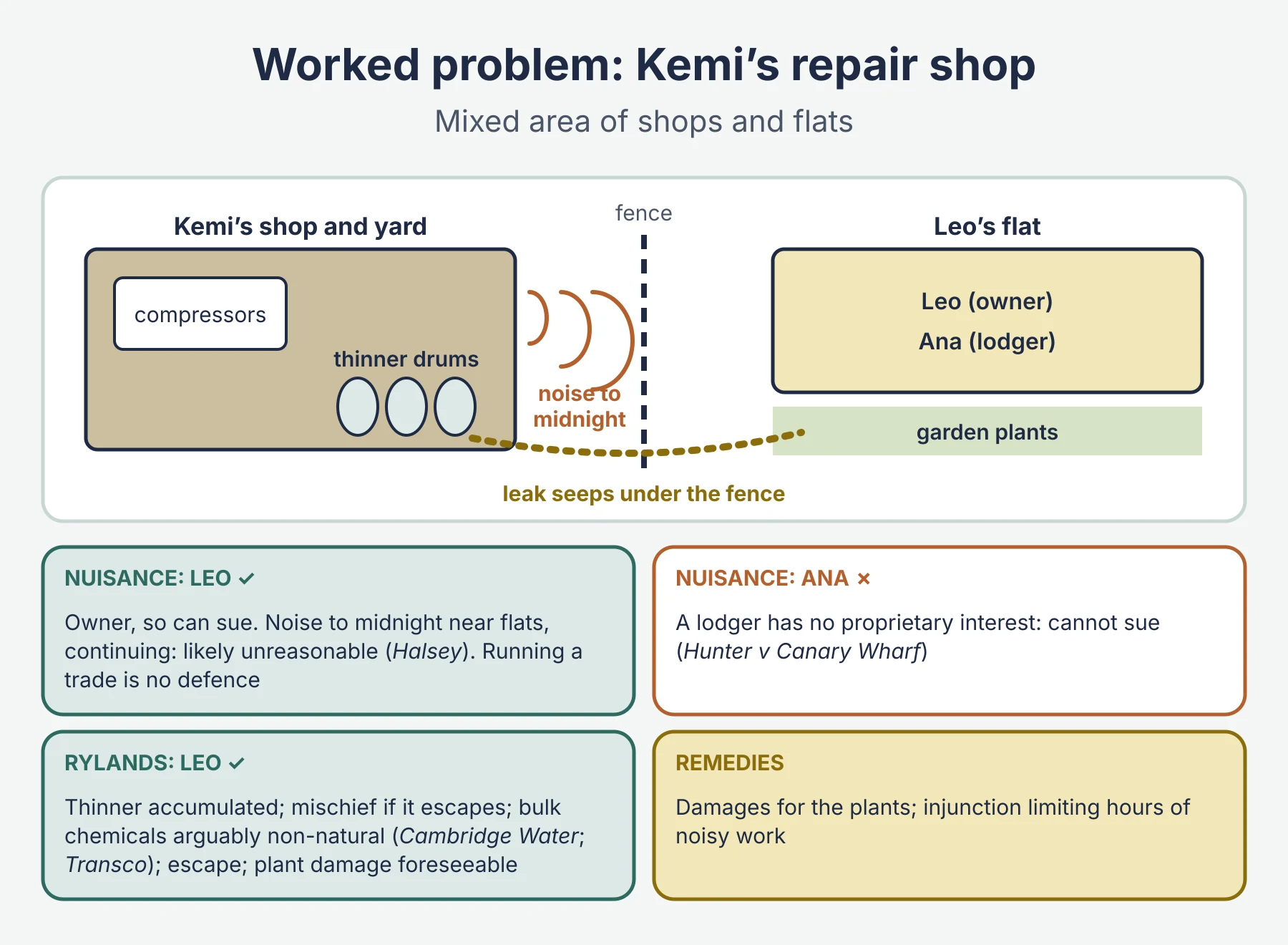
Common mistakes
- Letting a non-owner sue in private nuisance.
- Treating planning permission as a defence.
- Claiming personal injury under Rylands.
- Forgetting that physical damage is a nuisance regardless of locality (St Helen’s Smelting).
- Assuming fault must be proved: neither tort depends on careless conduct as such.
Exam technique
Organise nuisance answers around the parties (who can sue, who can be sued) and then the balancing factors; organise Rylands answers element by element. Many problem questions include both torts on the same facts: deal with each separately and say which is easier for the claimant.
More resources on this topic
Nuisance and Rylands v Fletcher revision notes | Nuisance and Rylands v Fletcher practice questions | Tort overview
Related resources
-
Practice questions
AQA A Level Law (7162): Nuisance and the Escape of Dangerous Things – Practice Questions
Original practice questions with mark-scheme answers on private nuisance and the rule in Rylands v Fletcher, with problem scenarios, for AQA Law 7162.
Law · AQA · A Level
Try questions -
Revision notes
AQA A Level Law (7162): Nuisance and the Escape of Dangerous Things – Revision Notes
Recall notes on private nuisance parties, the unreasonableness factors, planning permission and every element of Rylands v Fletcher, for AQA A Level Law 7162.
Law · AQA · A Level
Revise topic -
Study guides
AQA A Level Law (7162): Occupiers' Liability
Occupiers, premises, visitors and trespassers under the Occupiers' Liability Acts 1957 and 1984, with cases and a worked problem, for AQA A Level Law 7162.
Law · AQA · A Level
Read guide
Get free revision emails (optional)
Occasional emails with practice questions, worked explanations and links to free resources for the qualification and subjects you choose. No spam, and you can unsubscribe from any email. The free tools on this site never need an email.