
Revision Notes
AQA A Level Law (7162): Occupiers' Liability – Revision Notes
Recall notes on occupiers, visitors, trespassers, the common duty of care and the s1(3) conditions of the 1984 Act, for AQA A Level Law 7162.
- Subject
- Law
- Level
- A LEVELS
- Topic
- Tort
- Author
- Marlbridge Academic Team
- Updated
- Reviewed by
- Aizaz Raoof Ali (what this means)
Aligned to AQA A Level Law (7162), For teaching from September 2017 onwards, A-level exams 2019 onwards. Official specification .
Syllabus page (what it covers and how it is assessed): AQA A Level Law.
Syllabus points this page covers
7162
- Occupiers' liability
Found an error? Report a correction.
Need help with this topic? Request a free trial class for A Level Law (7162).
Condensed notes for the section 3.3 row Occupiers’ liability: “Liability in respect of visitors (Occupiers’ Liability Act 1957)” and “Liability in respect of trespassers (Occupiers’ Liability Act 1984)”. For explanation and a worked problem, use the occupiers’ liability study guide.
Five-step route
1 Occupier?      control of premises (Wheat v Lacon, 1966)
2 Premises?      land, buildings, fixed or movable structures (s1(3)(a) 1957)
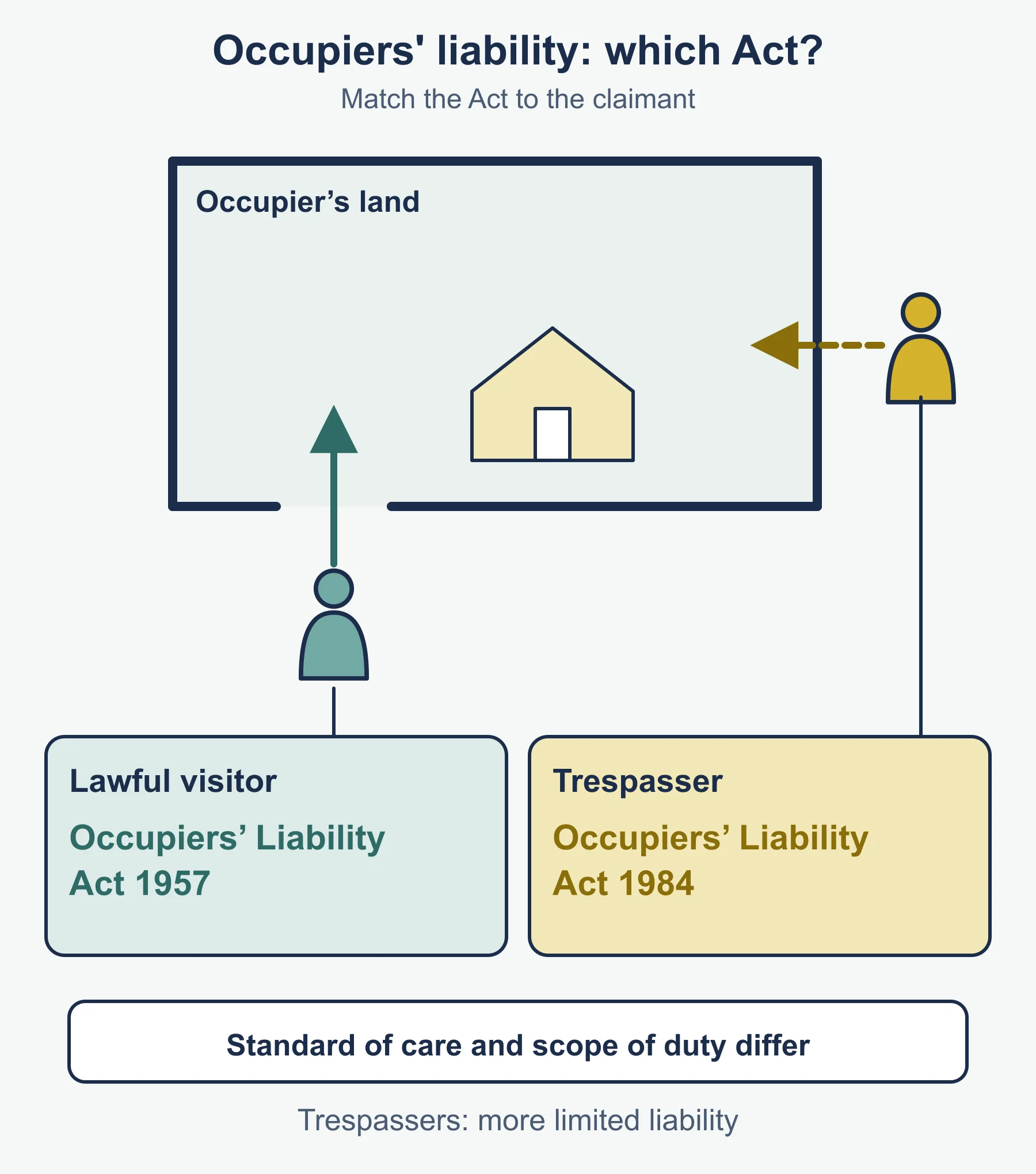
3 Status?        visitor (permission) -> 1957 Act | trespasser -> 1984 Act
4 Duty/breach?   1957: common duty of care s2(2) | 1984: s1(3) conditions, s1(4) duty
5 Damage?        1957: injury + property | 1984: injury only (s1(8))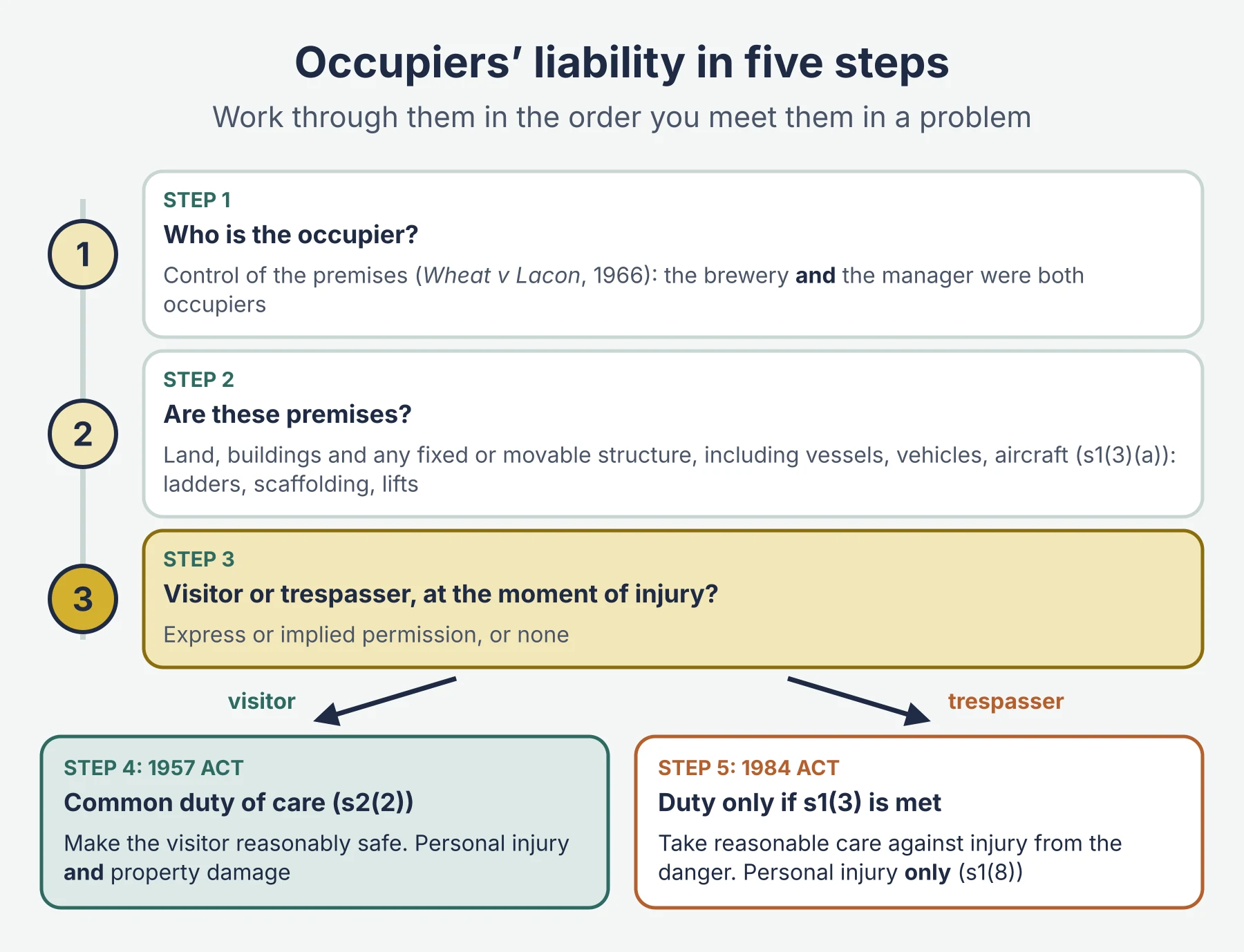
Occupier, premises and status
| Point | Authority |
|---|---|
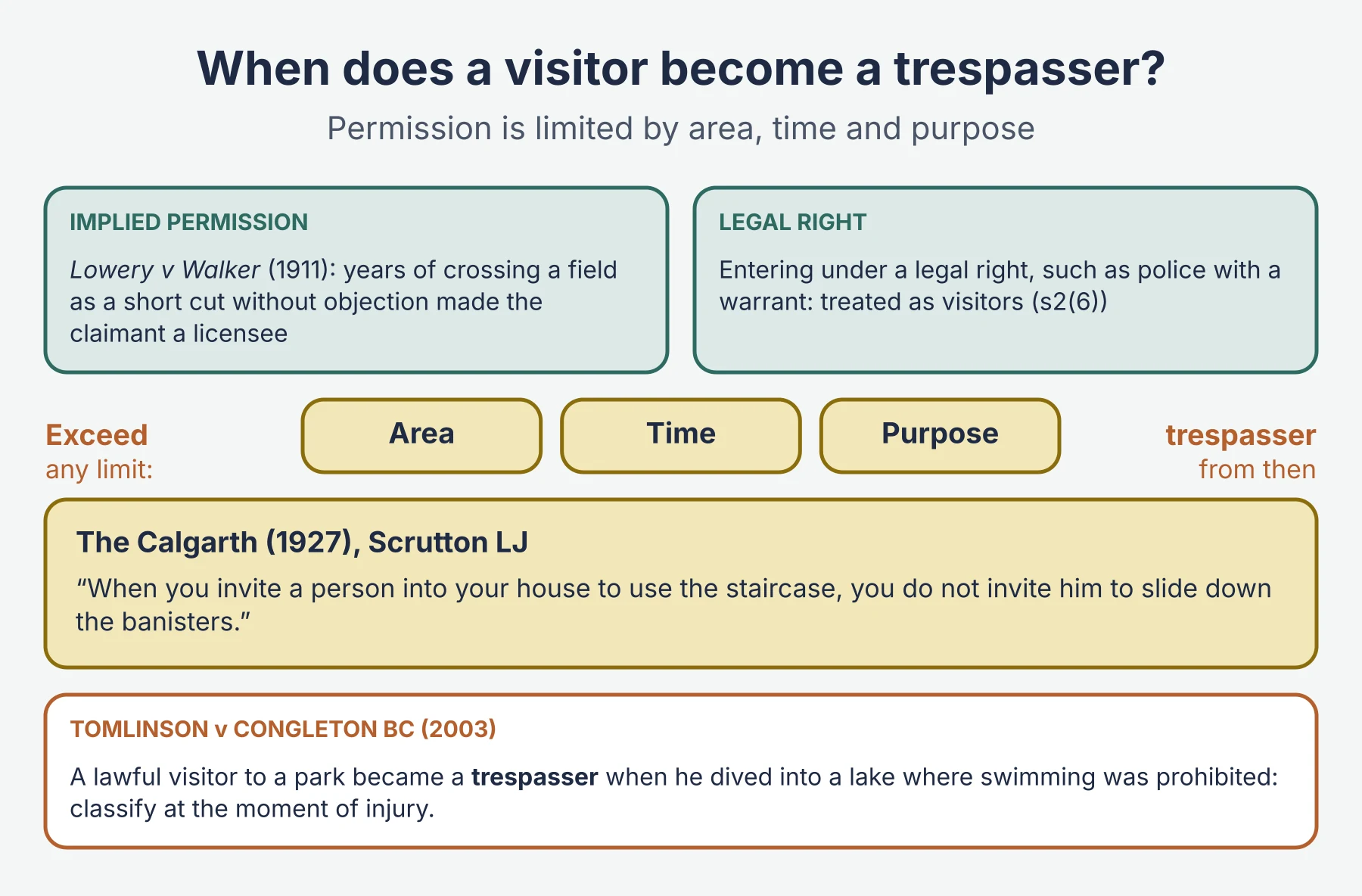
| Occupier = sufficient degree of control; can be more than one | Wheat v E Lacon & Co (1966) |
| Premises include vessels, vehicles, aircraft | s1(3)(a) OLA 1957 |
| Implied permission from long acquiescence | Lowery v Walker (1911) |
| Exceeding permission makes a trespasser | The Calgarth (1927): “slide down the banisters” |
| Visitor can become trespasser by prohibited activity | Tomlinson v Congleton BC (2003) |
| Entry under a right conferred by law treated as visitor | s2(6) OLA 1957 |
OLA 1957: visitors
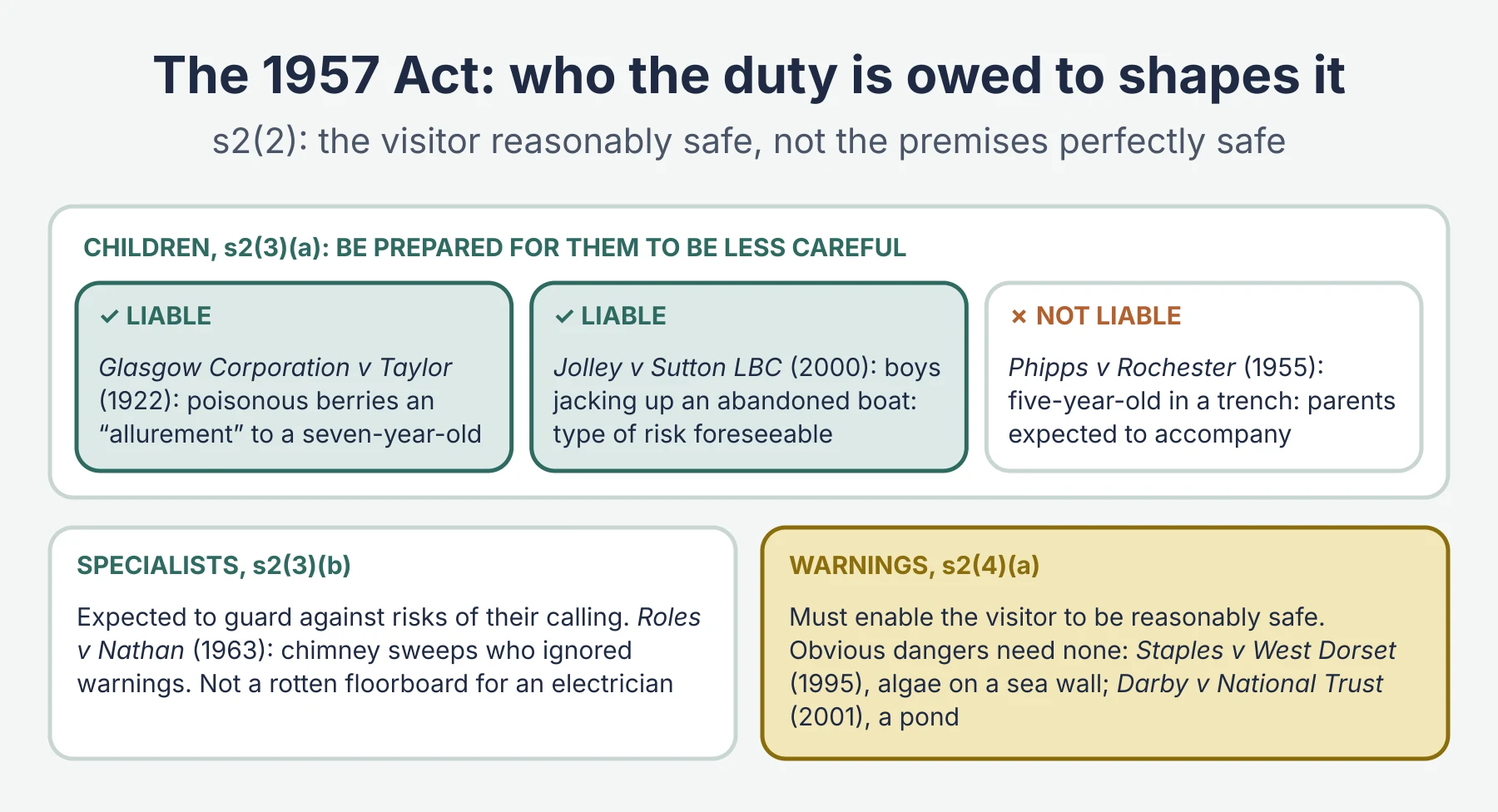
s2(2) common duty of care: reasonable care to see the visitor is reasonably safe in using the premises for the permitted purposes.
| Provision | Rule | Cases |
|---|---|---|
| s2(3)(a) children | Expect children to be less careful; allurements | Glasgow Corp v Taylor (1922); Jolley v Sutton LBC (2000) |
| Very young children | Parents share responsibility | Phipps v Rochester Corp (1955) |
| s2(3)(b) specialists | Expect them to guard against risks of their calling | Roles v Nathan (1963) |
| s2(4)(a) warnings | Must enable the visitor to be reasonably safe; none needed for obvious risks | Staples v West Dorset DC (1995); Darby v National Trust (2001) |
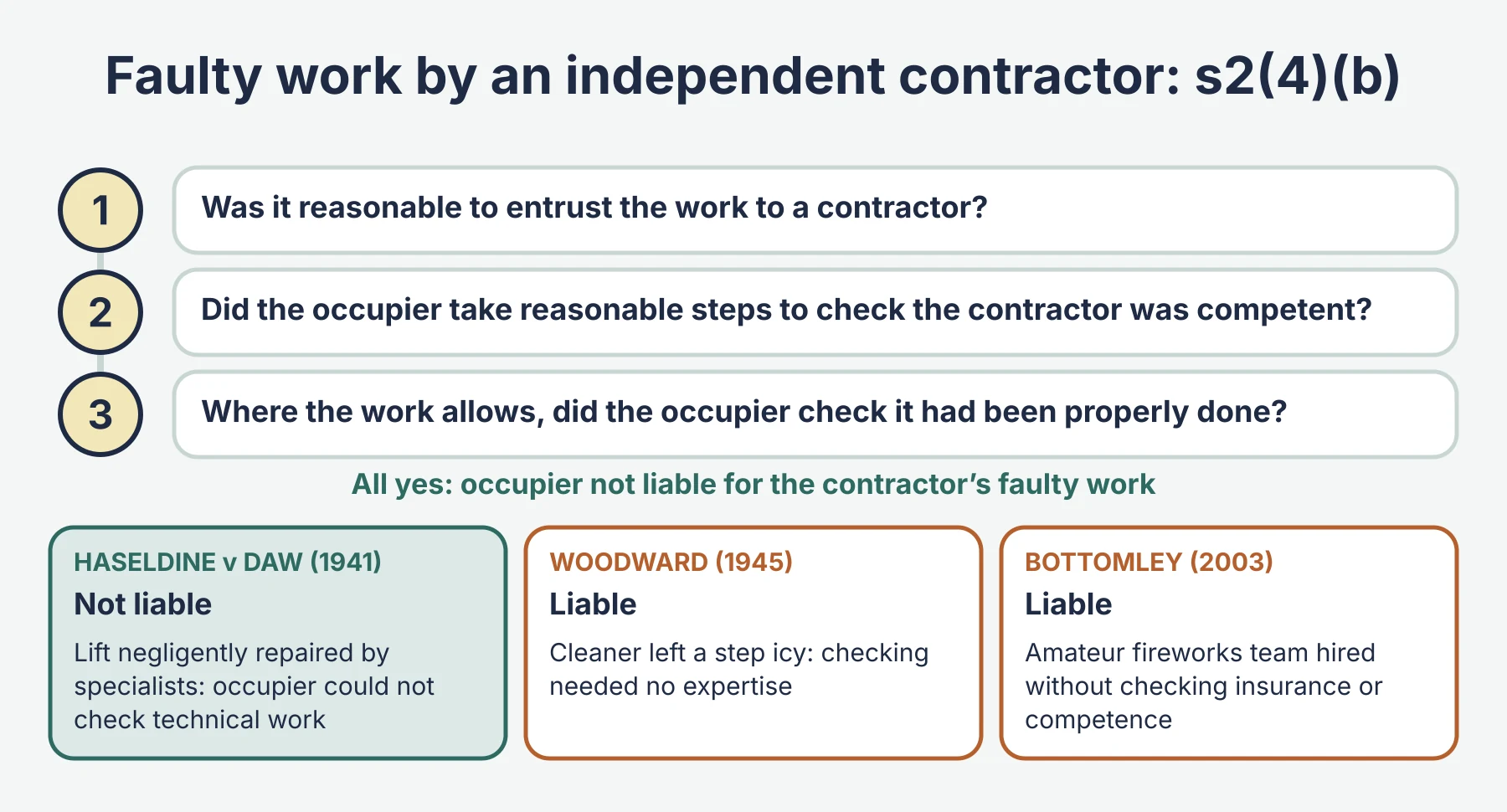
| s2(4)(b) contractors | Not liable if reasonable to entrust, competence checked, work checked where possible | Haseldine v Daw (1941); Woodward v Mayor of Hastings (1945); Bottomley v Todmorden CC (2003) |
| s2(1) exclusion | Possible by notice or agreement, subject to UCTA s2(1) and CRA s65 |
OLA 1984: trespassers
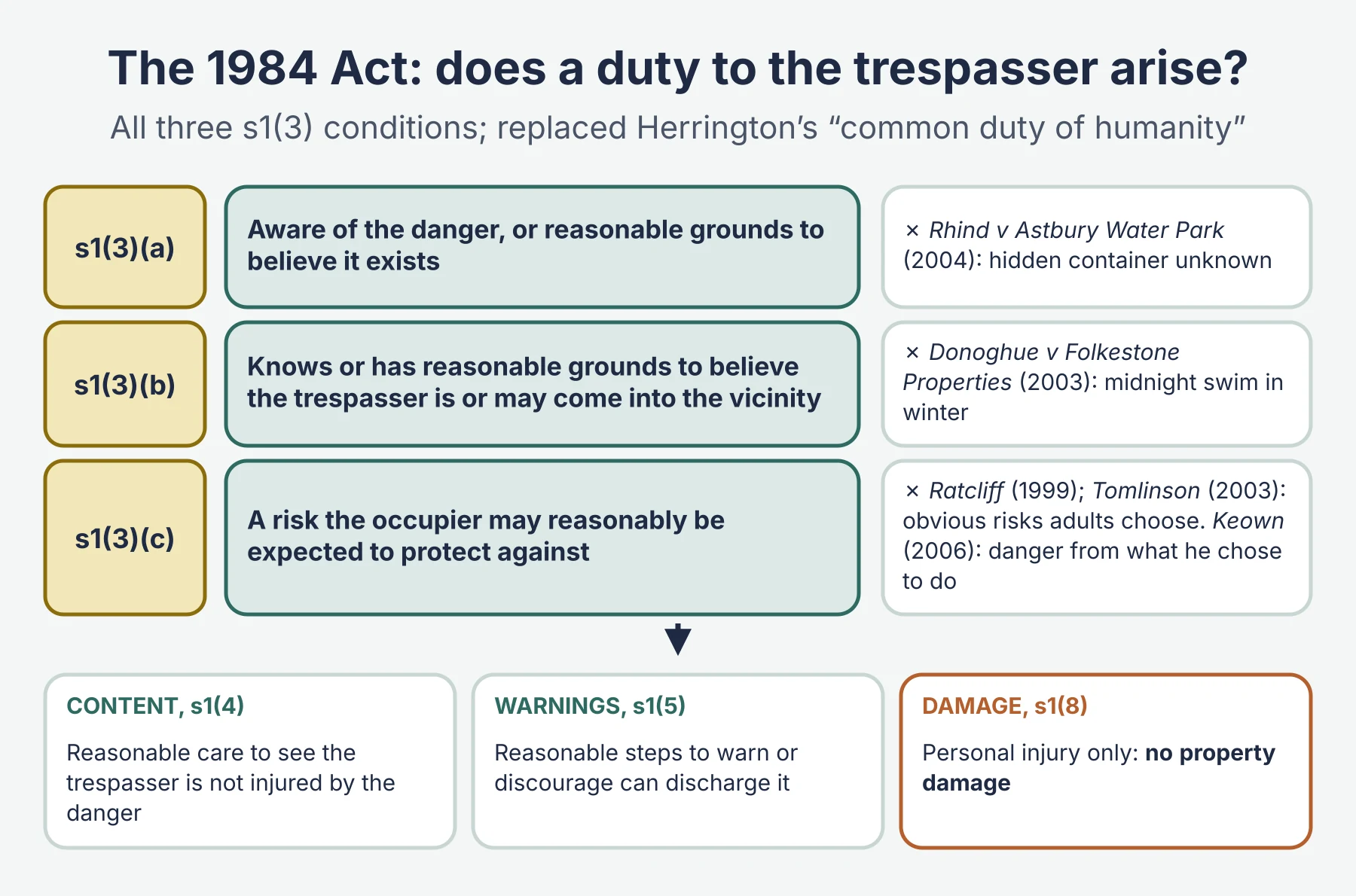
Background: BRB v Herrington (1972), “common duty of humanity”.
s1(3): duty arises only if all three:
- aware of the danger, or reasonable grounds to believe it exists;
- knows, or has reasonable grounds to believe, the trespasser is or may come into the vicinity;
- risk is one against which the occupier may reasonably be expected to offer some protection.
s1(4): duty to take reasonable care to see the trespasser does not suffer injury by reason of the danger. s1(5): discharged by reasonable steps to warn or discourage. s1(8): no liability for property damage.
| Case | Point |
|---|---|
| Donoghue v Folkestone Properties (2003) | Midnight winter swim: no reason to expect anyone there |
| Rhind v Astbury Water Park (2004) | Hidden object unknown to occupier: no awareness |
| Keown v Coventry Healthcare NHS Trust (2006) | Danger from the child’s own activity, not the premises |
| Ratcliff v McConnell (1999) | Obvious risk voluntarily taken by an adult |
| Tomlinson v Congleton BC (2003) | No duty to protect against obvious risks of swimming |
1957 and 1984 compared
| 1957 Act | 1984 Act | |
|---|---|---|
| Claimant | Visitor | Non-visitor (trespasser) |
| When duty arises | Automatically | Only if s1(3) satisfied |
| Standard | Common duty of care | Reasonable care against the specific danger |
| Damage | Injury and property | Injury only |
| Warnings | s2(4)(a) | s1(5) |
Evaluation points
- Clarity: statutory wording gives a clear structure, and section numbers make answers precise.
- Personal responsibility: Tomlinson stresses that adults must accept obvious risks, limiting a “compensation culture”.
- Children: the 1957 Act is generous to children (Glasgow Corp, Jolley), while Phipps places responsibility on parents; trespassing children rely on the narrower 1984 Act.
- Uncertainty: the s1(3) conditions turn on what an occupier “has reasonable grounds to believe”, which makes outcomes hard to predict.
Key terms
| Term | Meaning |
|---|---|
| Occupier | Person with a sufficient degree of control over premises |
| Visitor | Person with express or implied permission to enter |
| Trespasser | Person on premises without permission |
| Common duty of care | The s2(2) duty owed to visitors |
| Allurement | Something attractive and dangerous to children |
| Independent contractor | Person engaged to do work but not an employee |
Exam traps
- Classify status at the moment of injury, not on entry.
- A warning sign is not automatically enough for children or hidden dangers.
- The 1984 Act duty is about the danger due to the state of the premises.
- No property damage claim for trespassers.
- Distinguish Haseldine (technical work) from Woodward (non-technical).
Self-test
- What test identifies an occupier? Sufficient degree of control (Wheat v Lacon).
- What did Lowery v Walker decide? Long acquiescence can give implied permission.
- What is the s2(2) duty? To take reasonable care to see that the visitor will be reasonably safe for the permitted purposes.
- Why was the occupier not liable in Phipps? Parents of very young children are expected to supervise them.
- Which section covers specialists and which case illustrates it? s2(3)(b); Roles v Nathan.
- Why was no warning needed in Staples? The danger was obvious.
- What three steps protect an occupier under s2(4)(b)? Reasonable to entrust; checked competence; checked work where possible.
- Why was the occupier liable in Woodward? Checking a cleaner’s work needed no expertise.
- State the three s1(3) conditions. Aware of danger; knows trespasser may be nearby; risk one against which protection is reasonably expected.
- Why did Donoghue v Folkestone fail? No reason to believe anyone would be swimming there at midnight in winter.
- What is excluded by s1(8)? Liability for damage to property.
- What did Keown decide? The danger arose from the boy’s activity, not the state of the premises.
More resources on this topic
Occupiers’ liability practice questions | Tort revision notes
Related resources
-
Study guides
AQA A Level Law (7162): Remedies in Tort
Compensatory damages for injury, property damage and economic loss, mitigation of loss, and injunctions with damages in lieu, for AQA A Level Law 7162 tort.
Law · AQA · A Level
Read guide -
Practice questions
AQA A Level Law (7162): Remedies in Tort – Practice Questions
Original practice questions with mark-scheme answers on compensatory damages, mitigation of loss and injunctions in tort, for AQA A Level Law 7162 Paper 2.
Law · AQA · A Level
Try questions -
Revision notes
AQA A Level Law (7162): Remedies in Tort – Revision Notes
Recall notes on compensatory damages for injury, property and economic loss, mitigation, types of injunction and damages in lieu, for AQA A Level Law 7162.
Law · AQA · A Level
Revise topic
Get free revision emails (optional)
Occasional emails with practice questions, worked explanations and links to free resources for the qualification and subjects you choose. No spam, and you can unsubscribe from any email. The free tools on this site never need an email.