
Study Guides
AQA A Level Law (7162): Occupiers' Liability
Occupiers, premises, visitors and trespassers under the Occupiers' Liability Acts 1957 and 1984, with cases and a worked problem, for AQA A Level Law 7162.
- Subject
- Law
- Level
- A LEVELS
- Topic
- Tort
- Author
- Marlbridge Academic Team
- Updated
- Reviewed by
- Aizaz Raoof Ali (what this means)
Aligned to AQA A Level Law (7162), For teaching from September 2017 onwards, A-level exams 2019 onwards. Official specification .
Syllabus page (what it covers and how it is assessed): AQA A Level Law.
Syllabus points this page covers
7162
- Occupiers' liability
Found an error? Report a correction.
Need help with this topic? Request a free trial class for A Level Law (7162).
This guide covers the section 3.3 row Occupiers’ liability in AQA A-level Law (7162). The specification names two statements: “Liability in respect of visitors (Occupiers’ Liability Act 1957)” and “Liability in respect of trespassers (Occupiers’ Liability Act 1984)”. Occupiers’ liability is a statutory form of negligence for injuries caused by the state of premises. The Tort cases, defences and remedies study guide sets out the main sections of both Acts; this page works through the questions in the order you meet them in a problem, with further cases on each.
Step 1: who is the occupier?
Neither Act defines “occupier”; the 1957 Act (s1(2)) adopts the common law. The test is control of the premises, from Wheat v E Lacon & Co (1966). A brewery owned a pub run by a manager who lived upstairs with his wife and took in paying guests. A guest fell on a back staircase with a short handrail and no light. The House of Lords held that both the brewery and the manager were occupiers, because each had a sufficient degree of control. There can be more than one occupier, and the owner need not be in possession. The claim failed on breach: the staircase was not unreasonably dangerous.
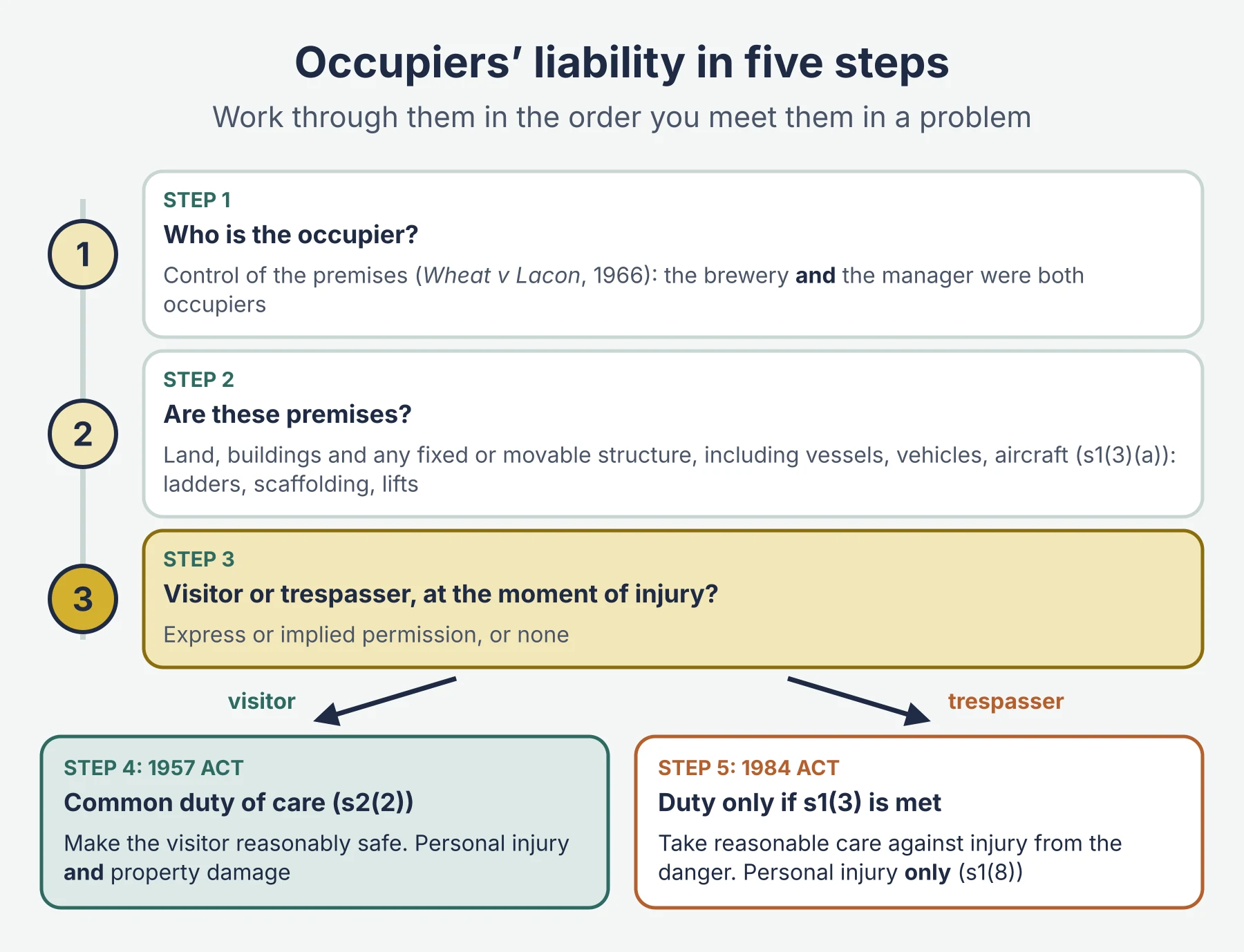
Step 2: what are premises?
Under s1(3)(a) the 1957 Act applies to land and buildings and to “any fixed or movable structure, including any vessel, vehicle or aircraft”. Ladders, scaffolding and lifts have all been treated as premises. The 1984 Act adopts the same meaning.
Step 3: is the claimant a visitor or a trespasser?
A visitor has express or implied permission to be on the premises. A trespasser has none.
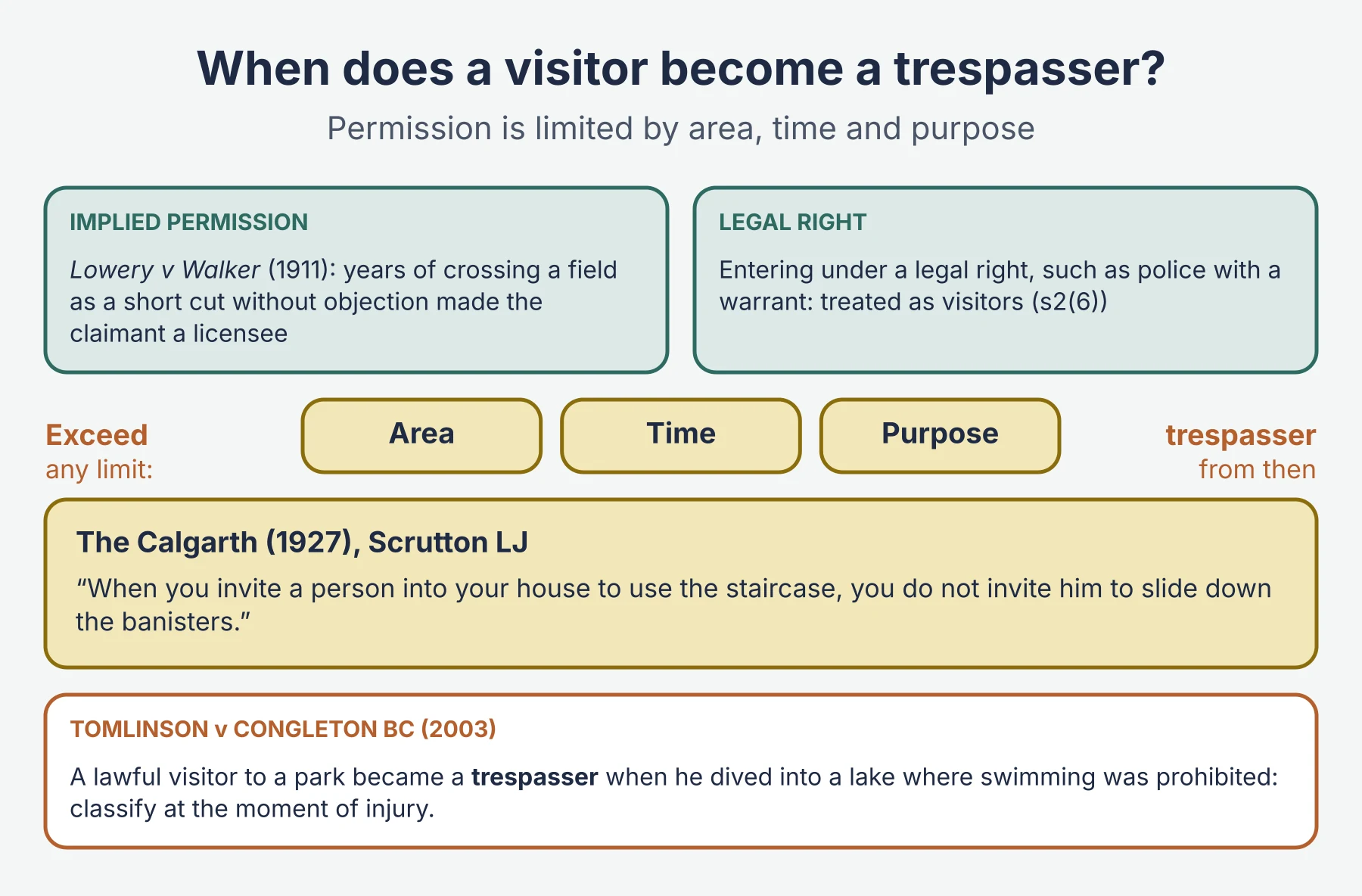
- Implied permission can arise from long acquiescence. In Lowery v Walker (1911) members of the public had crossed a field as a short cut for many years without objection; one was attacked by a horse and was held to be a licensee.
- Exceeding permission turns a visitor into a trespasser. Scrutton LJ in The Calgarth (1927): “When you invite a person into your house to use the staircase, you do not invite him to slide down the banisters.” Permission is limited by area, time and purpose.
- People entering under a legal right, such as police with a warrant, are treated as visitors (s2(6)).
Classify the claimant at the moment of injury: in Tomlinson v Congleton BC (2003) a lawful visitor to a park became a trespasser when he dived into a lake where swimming was prohibited.
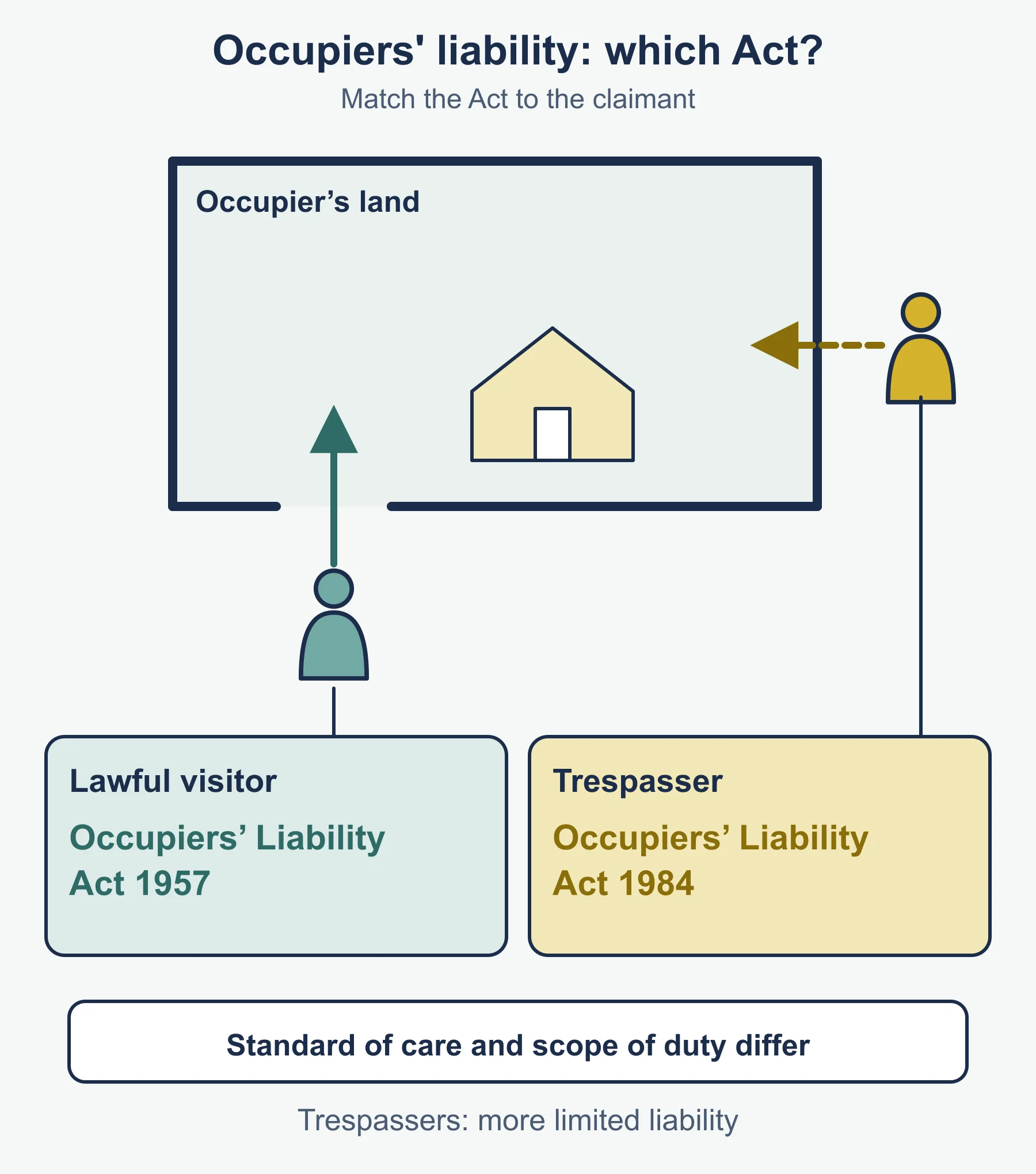
Step 4: the 1957 Act duty to visitors
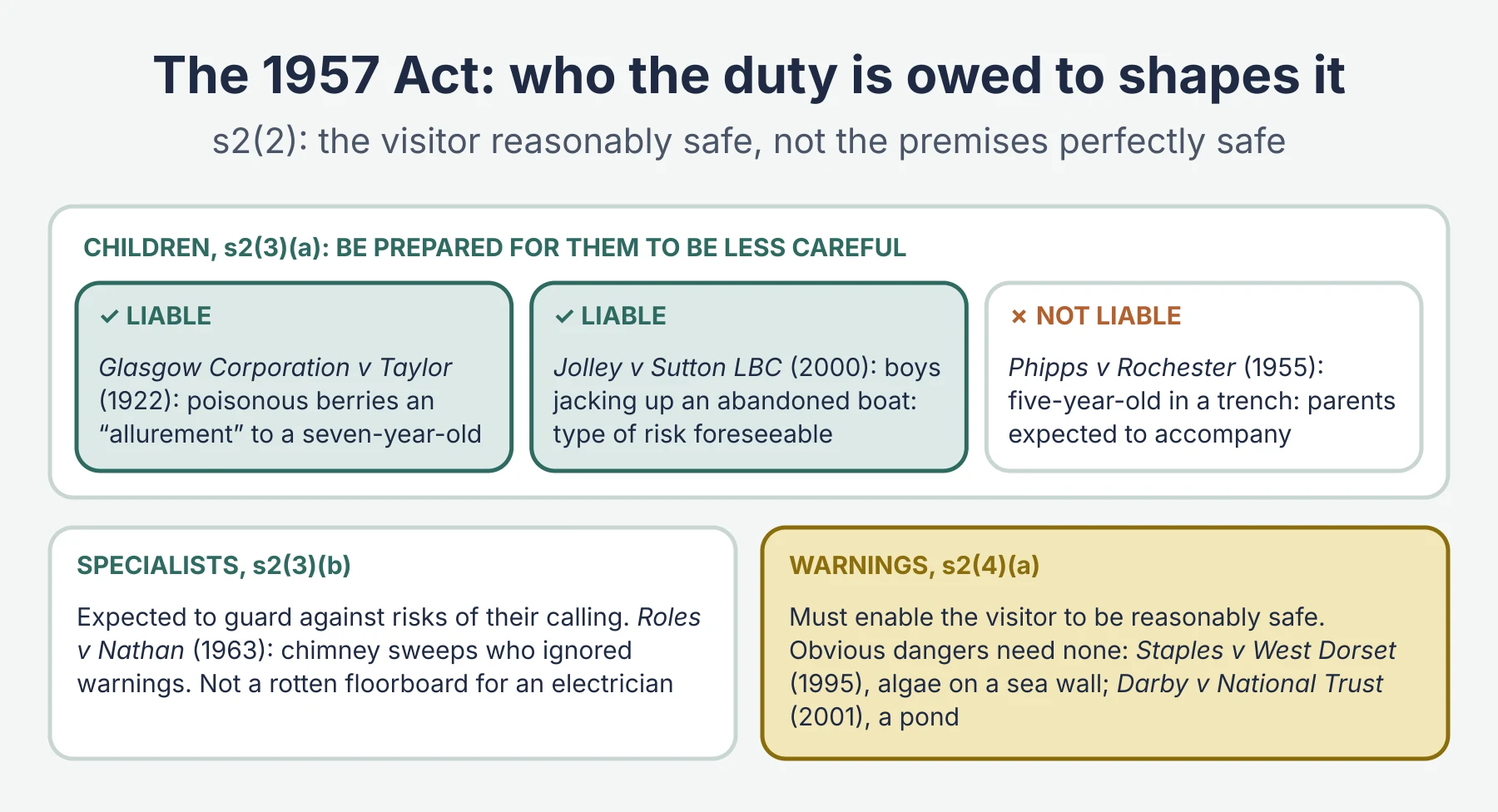
Section 2(2) imposes the common duty of care: to take such care as in all the circumstances is reasonable to see that the visitor will be reasonably safe in using the premises for the purposes for which they are invited or permitted. The duty is to make the visitor reasonably safe, not the premises perfectly safe. Breach is judged using the ordinary negligence factors.
Children: s2(3)(a)
Occupiers must be prepared for children to be less careful than adults.
- Glasgow Corporation v Taylor (1922): poisonous berries in a park were an “allurement” to a seven-year-old.
- Jolley v Sutton LBC (2000): an abandoned boat on council land attracted boys who jacked it up; one was badly injured when it fell. The type of risk, children meddling with the boat, was foreseeable.
- Phipps v Rochester Corporation (1955): a five-year-old fell into a trench on open land. The occupier could expect parents of very young children to accompany them, so there was no breach.
Specialists: s2(3)(b)
An occupier may expect a person in the exercise of their calling to appreciate and guard against risks ordinarily incident to it. In Roles v Nathan (1963) two chimney sweeps died from carbon monoxide after ignoring warnings; the occupier was not liable. The protection covers only risks of the trade: an electrician is not expected to guard against a rotten floorboard.
Warnings: s2(4)(a)
A warning discharges the duty only if, in all the circumstances, it was enough to enable the visitor to be reasonably safe. For an obvious danger, no warning may be needed. In Staples v West Dorset DC (1995) a visitor slipped on algae on a sea wall at Lyme Regis; the danger was obvious, so there was no duty to warn. In Darby v National Trust (2001) the risk of drowning in a pond was obvious to an adult, so no warning was required.
Independent contractors: s2(4)(b)
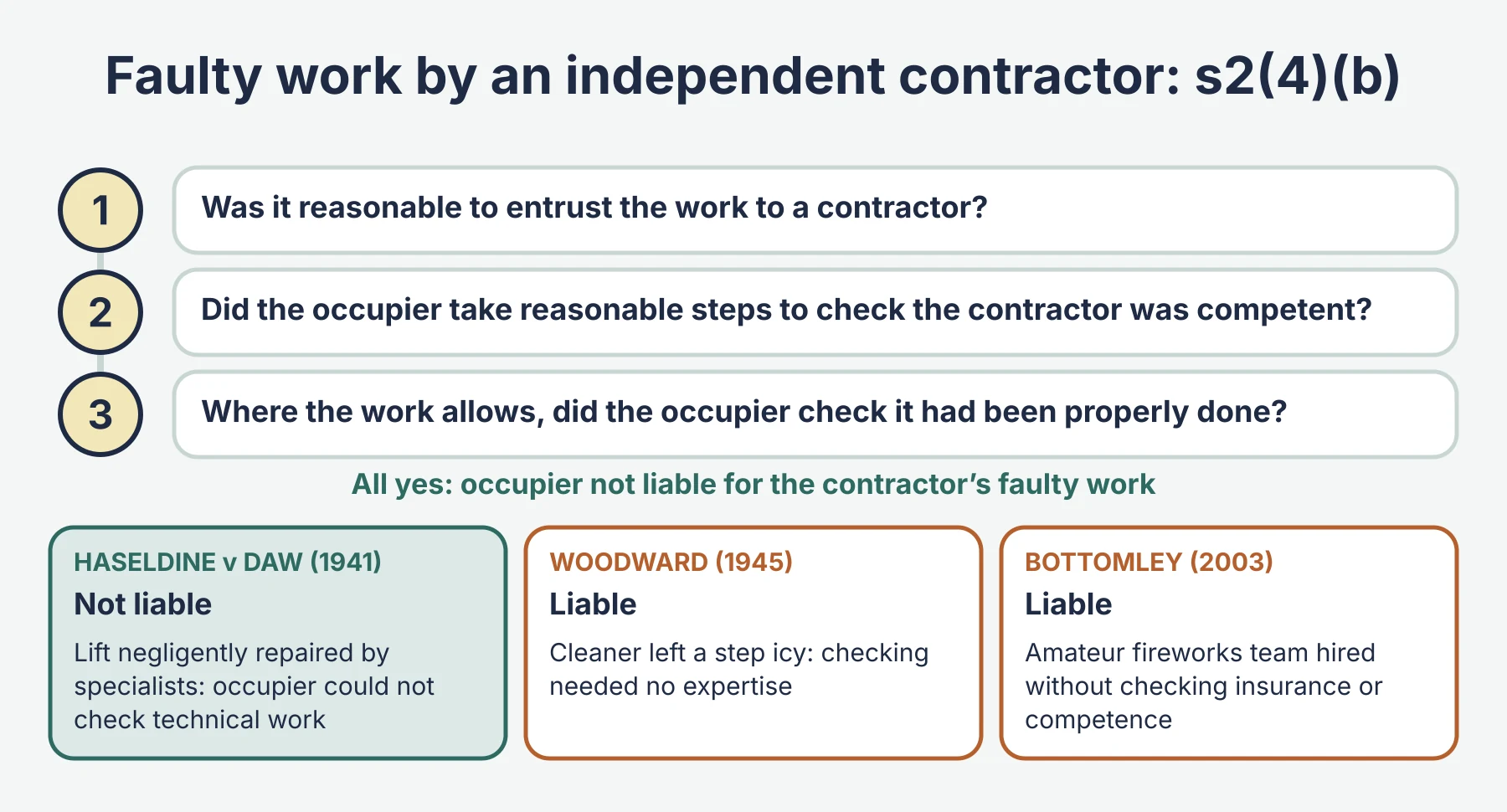
An occupier is not liable for faulty work by an independent contractor if it acted reasonably in entrusting the work, took reasonable steps to check the contractor was competent, and, where the work allows, to check it had been properly done.
- Haseldine v Daw (1941): a lift negligently repaired by specialist engineers; the occupier, who could not check technical work, was not liable.
- Woodward v Mayor of Hastings (1945): a cleaner left a step icy. Checking that work required no expertise, so the occupier was liable.
- Bottomley v Todmorden Cricket Club (2003): an occupier that hired an amateur fireworks team without checking its insurance or competence was liable.
Restricting the duty
Section 2(1) allows the duty to be restricted or excluded by notice or agreement. For business premises, the Unfair Contract Terms Act 1977 s2(1) prevents exclusion of liability for death or personal injury caused by negligence, which includes breach of the common duty of care, and the Consumer Rights Act 2015 s65 does the same against consumers. Consent under s2(5) is considered in the defences row.
Damage covered: personal injury and damage to property.
Step 5: the 1984 Act duty to trespassers
Before 1984, British Railways Board v Herrington (1972) recognised a limited “common duty of humanity” after a six-year-old was electrocuted on a railway line behind a broken fence. The 1984 Act replaced it.
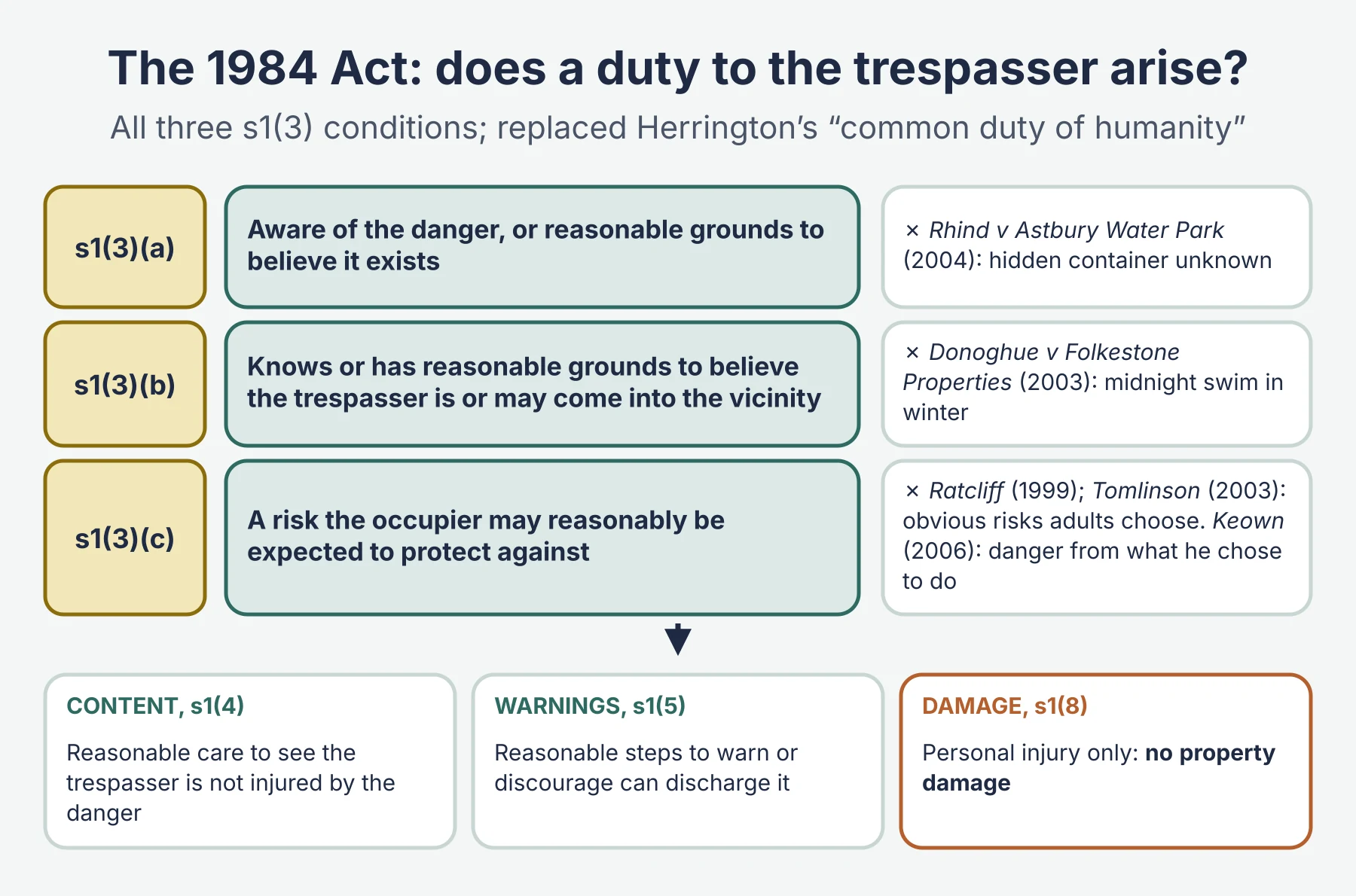
When a duty arises (s1(3)). All three must be met:
- the occupier is aware of the danger or has reasonable grounds to believe it exists;
- the occupier knows or has reasonable grounds to believe the trespasser is in, or may come into, the vicinity of the danger; and
- the risk is one against which, in all the circumstances, the occupier may reasonably be expected to offer some protection.
Content (s1(4)) and warnings (s1(5)). The duty is to take reasonable care to see that the trespasser does not suffer injury by reason of the danger. It may be discharged by reasonable steps to give warning of the danger or to discourage people from incurring it.
Cases on the s1(3) conditions:
- Donoghue v Folkestone Properties (2003): a man dived into a harbour at midnight in winter and hit a submerged grid pile. The occupier had no reason to believe anyone would swim there then, so no duty arose.
- Rhind v Astbury Water Park (2004): a fibreglass container lay hidden on a lake bed. The occupier did not know of it, so condition 1 failed.
- Keown v Coventry Healthcare NHS Trust (2006): an 11-year-old who climbed a fire escape and fell knew the risk. The danger arose from what he chose to do, not from the state of the premises.
- Ratcliff v McConnell (1999) and Tomlinson (2003): no duty to protect adults from obvious risks they choose to run.
Damage covered: personal injury only; s1(8) excludes property damage.
Worked problem
Ivy owns a disused quarry with a flooded pit, fenced on three sides. She knows teenagers often get in through the unfenced side to swim, and has put up one small sign. Rob, 15, swims there and is injured by a submerged shopping trolley Ivy knew had been dumped. His phone is ruined.
Occupier:  Ivy controls the quarry (Wheat v Lacon).
Status:    Rob has no permission: trespasser - 1984 Act.
s1(3)(a):  Ivy knew of the trolley - aware of the danger.
s1(3)(b):  She knew teenagers came to swim - knew he might be in the vicinity.
s1(3)(c):  A hidden hazard, not an obvious risk like deep water (contrast
           Tomlinson; Ratcliff); teenagers, and the risk is cheap to remove:
           protection reasonably expected.
Breach:    One small sign may not be enough warning under s1(5) for a hidden
           danger and a known pattern of entry.
Damage:    Personal injury recoverable; the phone is not (s1(8)).
Defences:  Contributory negligence may reduce damages for a 15-year-old who
           chose to trespass.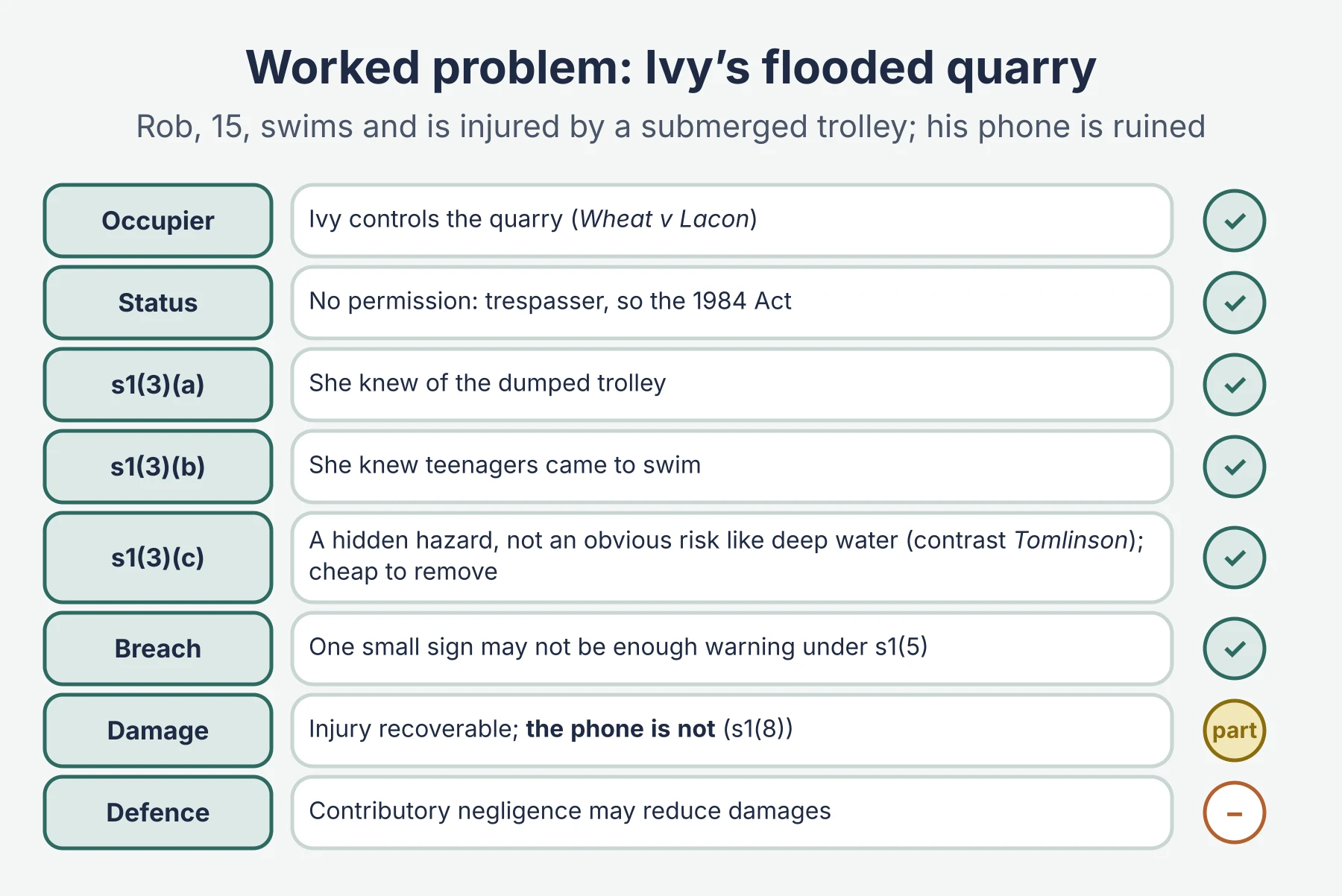
Common mistakes
- Using the 1957 Act for someone who has gone where they were not permitted.
- Forgetting that a trespasser cannot recover for property damage.
- Treating any notice as enough: a warning must enable the visitor to be reasonably safe.
- Holding an occupier liable for a technical contractor’s work without considering s2(4)(b).
- Overlooking Phipps: parents of very young children share responsibility.
Exam technique
Work through the five steps in order and use the section numbers: examiners reward accurate statutory reference. The decisive issue is usually claimant status or, under the 1984 Act, the s1(3) conditions. Spend your time there and conclude on each claimant and each type of damage.
More resources on this topic
Occupiers’ liability revision notes | Occupiers’ liability practice questions | Tort overview
Related resources
-
Practice questions
AQA A Level Law (7162): Occupiers' Liability – Practice Questions
Original practice questions with mark-scheme answers on occupiers, visitors, trespassers and the Occupiers' Liability Acts 1957 and 1984, AQA Law 7162.
Law · AQA · A Level
Try questions -
Revision notes
AQA A Level Law (7162): Occupiers' Liability – Revision Notes
Recall notes on occupiers, visitors, trespassers, the common duty of care and the s1(3) conditions of the 1984 Act, for AQA A Level Law 7162.
Law · AQA · A Level
Revise topic -
Study guides
AQA A Level Law (7162): Remedies in Tort
Compensatory damages for injury, property damage and economic loss, mitigation of loss, and injunctions with damages in lieu, for AQA A Level Law 7162 tort.
Law · AQA · A Level
Read guide
Get free revision emails (optional)
Occasional emails with practice questions, worked explanations and links to free resources for the qualification and subjects you choose. No spam, and you can unsubscribe from any email. The free tools on this site never need an email.