
Revision Notes
AQA A Level Law (7162): Liability in Negligence for Economic Loss and Psychiatric Injury – Revision Notes
Recall notes on pure economic loss, Hedley Byrne special relationships, primary and secondary victims and the Alcock controls for AQA A Level Law 7162 tort.
- Subject
- Law
- Level
- A LEVELS
- Topic
- Tort
- Author
- Marlbridge Academic Team
- Updated
- Reviewed by
- Aizaz Raoof Ali (what this means)
Aligned to AQA A Level Law (7162), For teaching from September 2017 onwards, A-level exams 2019 onwards. Official specification .
Syllabus page (what it covers and how it is assessed): AQA A Level Law.
Syllabus points this page covers
7162
- Liability in negligence for economic loss and psychiatric injury
Found an error? Report a correction.
Need help with this topic? Request a free trial class for A Level Law (7162).
Condensed notes for the section 3.3 row Liability in negligence for economic loss and psychiatric injury: “pure economic loss caused by negligent acts and negligent misstatements” and “psychiatric injury sustained by primary and secondary victims”. For explanation and a worked problem, use the economic loss and psychiatric injury study guide.
Economic loss: classify first
Financial loss
   |-- follows injury or damage to claimant's own property -> CONSEQUENTIAL -> recoverable
   |-- no such damage -> PURE
          |-- caused by negligent ACT -> generally NOT recoverable
          |-- caused by negligent STATEMENT/advice -> recoverable if SPECIAL RELATIONSHIP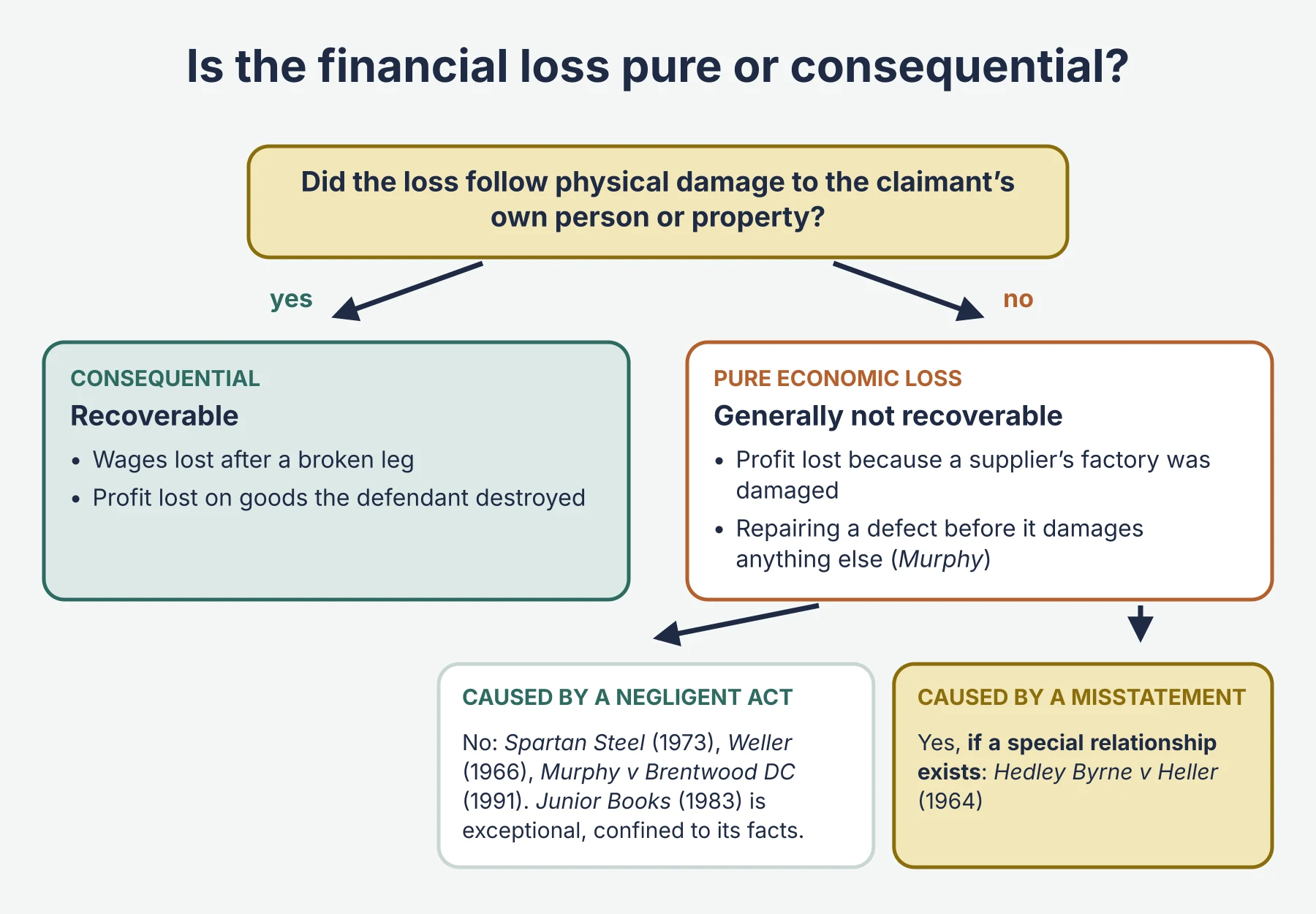
Negligent acts
| Case | Facts | Result |
|---|---|---|
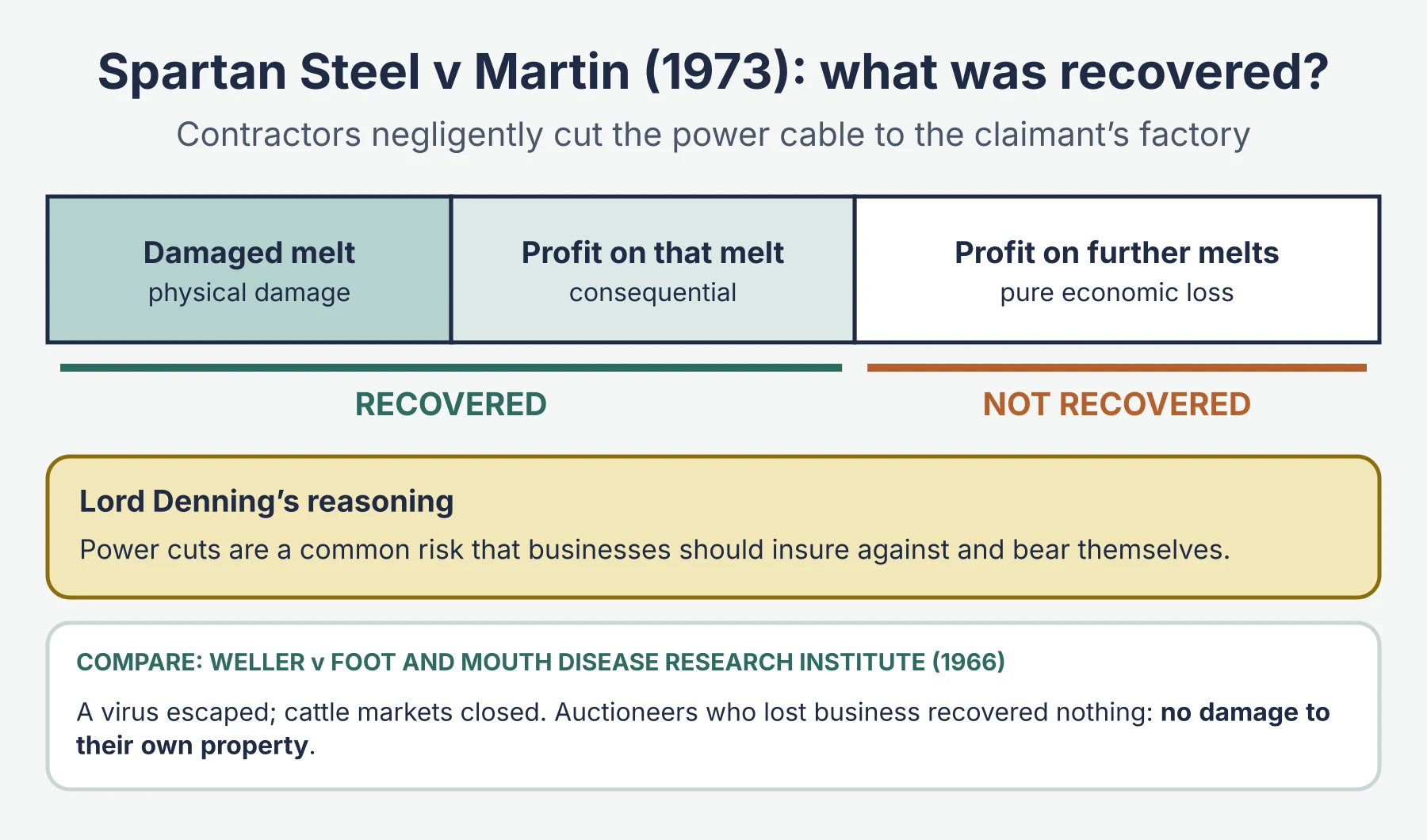
| Spartan Steel v Martin (1973) | Power cable cut; melt damaged | Damaged melt and its profit recoverable; further lost profits not |
| Weller v Foot and Mouth Disease Research Institute (1966) | Virus escaped; markets closed | Auctioneers’ lost business not recoverable |
| Murphy v Brentwood DC (1991) | Defective foundations | Repair cost is pure economic loss; not recoverable |
| Junior Books v Veitchi (1983) | Defective floor by subcontractor | Recovered, but treated as exceptional |
Reasons for the rule: indeterminate liability; businesses can insure; loss spread thinly.
Negligent misstatements
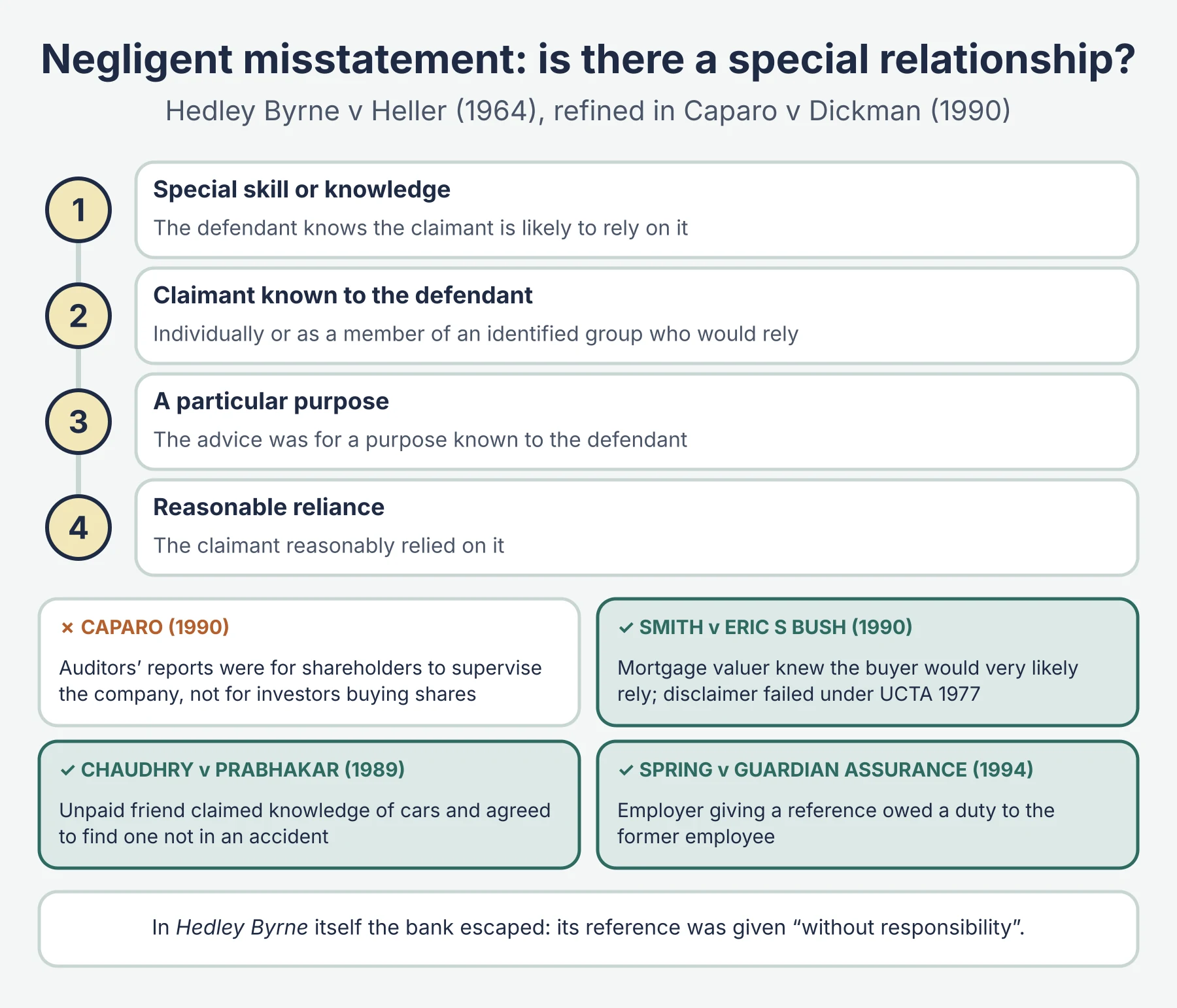
Source: Hedley Byrne v Heller (1964): bank reference; special relationship can create a duty; disclaimer protected the bank.
Special relationship checklist:
- Defendant has special skill or knowledge.
- Defendant knows the claimant (or an identified group) will rely on it.
- For a particular purpose known to the defendant.
- Claimant reasonably relies.
| Case | Point |
|---|---|
| Caparo v Dickman (1990) | Auditors owed no duty to investors buying shares |
| Smith v Eric S Bush (1990) | Surveyor owed duty to house buyer; disclaimer unreasonable under UCTA 1977 |
| Chaudhry v Prabhakar (1989) | Unpaid friend who undertook to find a car owed duty |
| Spring v Guardian Assurance (1994) | Duty to the subject of a reference |
Psychiatric injury
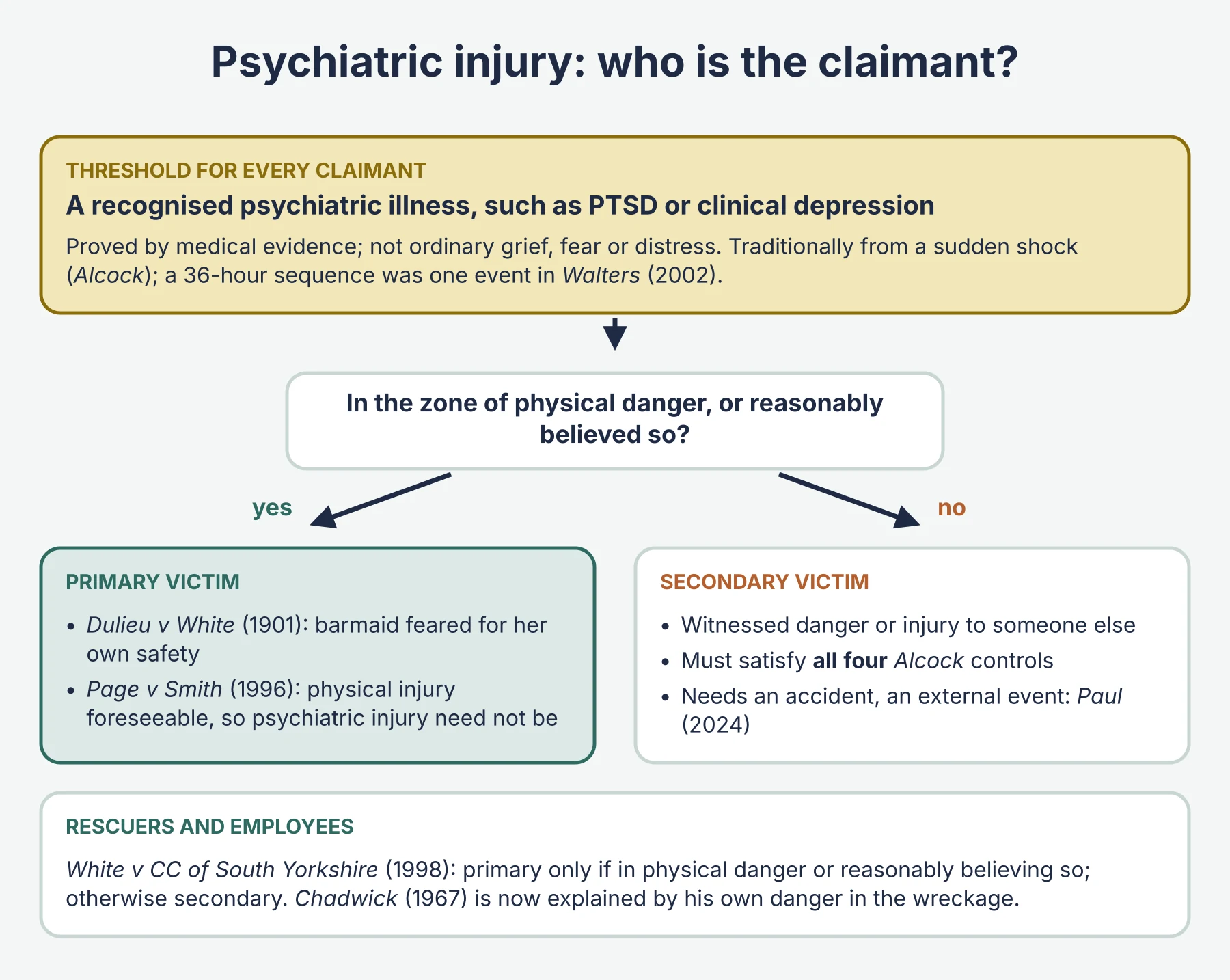
Threshold: recognised psychiatric illness (not grief, fear or distress), caused by sudden shock (Alcock); a sequence over 36 hours treated as one event in North Glamorgan NHS Trust v Walters (2002).
Primary victim: in the zone of physical danger or reasonably believes so.
- Dulieu v White (1901): barmaid feared for herself when a van crashed into the pub.
- Page v Smith (1996): physical injury foreseeable is enough; no need for psychiatric injury to be foreseeable.
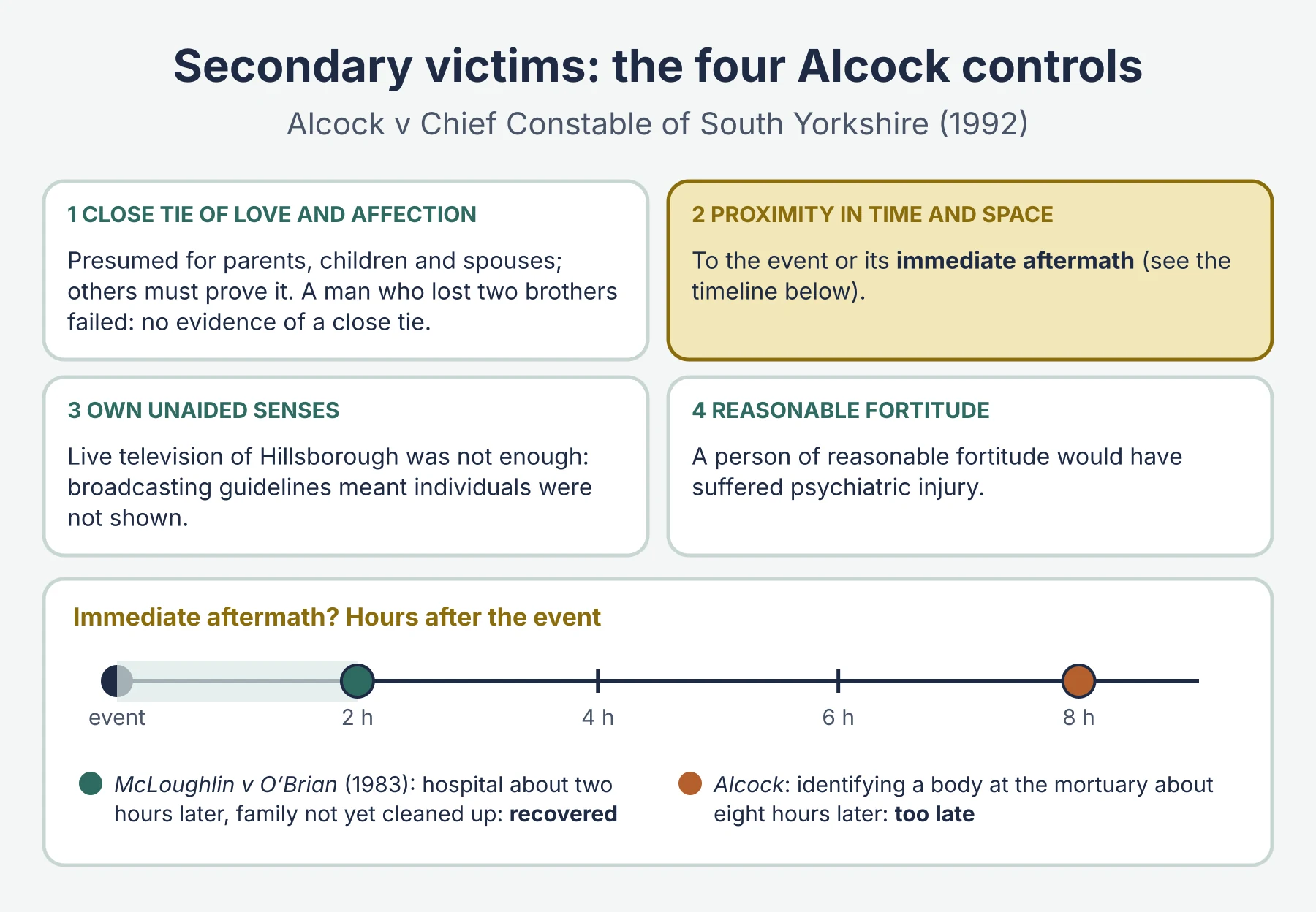
Secondary victim: witnesses harm to another; must satisfy all Alcock (1992) controls.
| Control | Detail | Case |
|---|---|---|
| Close tie of love and affection | Presumed for parent/child, spouses; others must prove | Alcock |
| Proximity in time and space | Event or immediate aftermath | McLoughlin v O’Brian (1983), hospital about two hours later: yes; Alcock, mortuary about eight hours later: no |
| Own unaided senses | Live TV not enough | Alcock |
| Reasonable fortitude | A person of ordinary fortitude would have suffered | Alcock |
Medical negligence: no secondary victim claim for witnessing the later effects of an earlier medical failure: Paul v Royal Wolverhampton NHS Trust (2024).
Rescuers and employees: primary victim only if in danger: White v CC South Yorkshire (1998). Chadwick v BRB (1967) explained on that basis.
Evaluation points
- Economic loss: a clear rule that prevents indeterminate liability, but recovery turns on the chance of whether physical damage came first (Spartan Steel).
- Misstatements: Caparo keeps auditors’ liability within limits; Smith v Eric S Bush shows the law protecting a less powerful party.
- Psychiatric injury: Alcock gives certainty, but sharp lines on time and relationship produce hard cases; reform proposed by the Law Commission in 1998 has not been enacted.
Key terms
| Term | Meaning |
|---|---|
| Pure economic loss | Financial loss not consequential on injury or damage to the claimant’s property |
| Consequential loss | Financial loss flowing from physical injury or property damage |
| Special relationship | Relationship of reliance giving rise to a duty for statements |
| Disclaimer | A notice denying responsibility for advice, subject to UCTA 1977 |
| Recognised psychiatric illness | Medically identified condition, such as PTSD |
| Primary victim | Claimant in the zone of physical danger |
| Secondary victim | Claimant who witnesses danger or injury to another |
| Immediate aftermath | The period soon after an event while victims are still in the condition caused |
Exam traps
- Lost earnings after an injury are not “pure” economic loss.
- Hedley Byrne created the principle but the bank won because of its disclaimer.
- Do not use Page v Smith for secondary victims.
- A sibling must prove the close tie.
- After Paul (2024), relatives in medical negligence cases are generally not secondary victims.
Self-test
- What is the general rule for pure economic loss caused by a negligent act? It is not recoverable.
- What could the claimant recover in Spartan Steel? The damaged melt and the profit on that melt.
- Why did the auctioneers fail in Weller? They suffered pure economic loss; none of their property was damaged.
- Why was the claim in Murphy classed as pure economic loss? The defect had not damaged other property; the loss was repair cost and lost value.
- Why did the bank escape liability in Hedley Byrne? Its reference was given “without responsibility”.
- Why was no duty owed in Caparo? The audit was not prepared for investors deciding whether to buy shares.
- What happened to the disclaimer in Smith v Eric S Bush? It failed the reasonableness test under UCTA 1977.
- Define a primary victim. Someone in the zone of physical danger or who reasonably believed they were.
- What did Page v Smith decide? If physical injury is foreseeable, the defendant is liable for psychiatric injury even if none was foreseeable.
- List the four Alcock controls. Close tie; proximity in time and space; own unaided senses; reasonable fortitude.
- Why did the claimant succeed in McLoughlin v O’Brian? She saw her family in the immediate aftermath at the hospital.
- What did Paul (2024) decide? Witnessing a death caused by earlier medical negligence does not make a relative a secondary victim.
More resources on this topic
Economic loss and psychiatric injury practice questions | Theory of tort law revision notes
Related resources
-
Study guides
AQA A Level Law (7162): Liability in Negligence for Physical Injury to People and Damage to Property
Duty of care, the objective standard, factual and legal causation applied step by step to injury and property damage claims, for AQA A Level Law 7162 Paper 2.
Law · AQA · A Level
Read guide -
Practice questions
AQA A Level Law (7162): Liability in Negligence for Physical Injury to People and Damage to Property – Practice Questions
Original practice questions with mark-scheme answers on duty, breach, causation and remoteness in negligence for injury and property damage, AQA Law 7162.
Law · AQA · A Level
Try questions -
Revision notes
AQA A Level Law (7162): Liability in Negligence for Physical Injury to People and Damage to Property – Revision Notes
Recall notes on the neighbour principle, Caparo, the objective standard, but-for causation, intervening acts and remoteness for AQA A Level Law 7162 negligence.
Law · AQA · A Level
Revise topic
Get free revision emails (optional)
Occasional emails with practice questions, worked explanations and links to free resources for the qualification and subjects you choose. No spam, and you can unsubscribe from any email. The free tools on this site never need an email.