
Study Guides
AQA A Level Law (7162): Liability in Negligence for Economic Loss and Psychiatric Injury
Pure economic loss from negligent acts and misstatements, and psychiatric injury to primary and secondary victims, applied to problems for AQA A Level Law 7162.
- Subject
- Law
- Level
- A LEVELS
- Topic
- Tort
- Author
- Marlbridge Academic Team
- Updated
- Reviewed by
- Aizaz Raoof Ali (what this means)
Aligned to AQA A Level Law (7162), For teaching from September 2017 onwards, A-level exams 2019 onwards. Official specification .
Syllabus page (what it covers and how it is assessed): AQA A Level Law.
Syllabus points this page covers
7162
- Liability in negligence for economic loss and psychiatric injury
Found an error? Report a correction.
Need help with this topic? Request a free trial class for A Level Law (7162).
This guide covers the section 3.3 row Liability in negligence for economic loss and psychiatric injury in AQA A-level Law (7162). The specification names two statements: “Liability for pure economic loss caused by negligent acts and negligent misstatements” and “Liability for psychiatric injury sustained by primary and secondary victims.” Both are areas where foreseeable harm is not enough: the law adds extra requirements to control the number and size of claims. The Tort cases, defences and remedies study guide lists the core rules; here they are taken further, with the facts that make the cases usable in problem answers.
Part 1: pure economic loss
What counts as pure economic loss
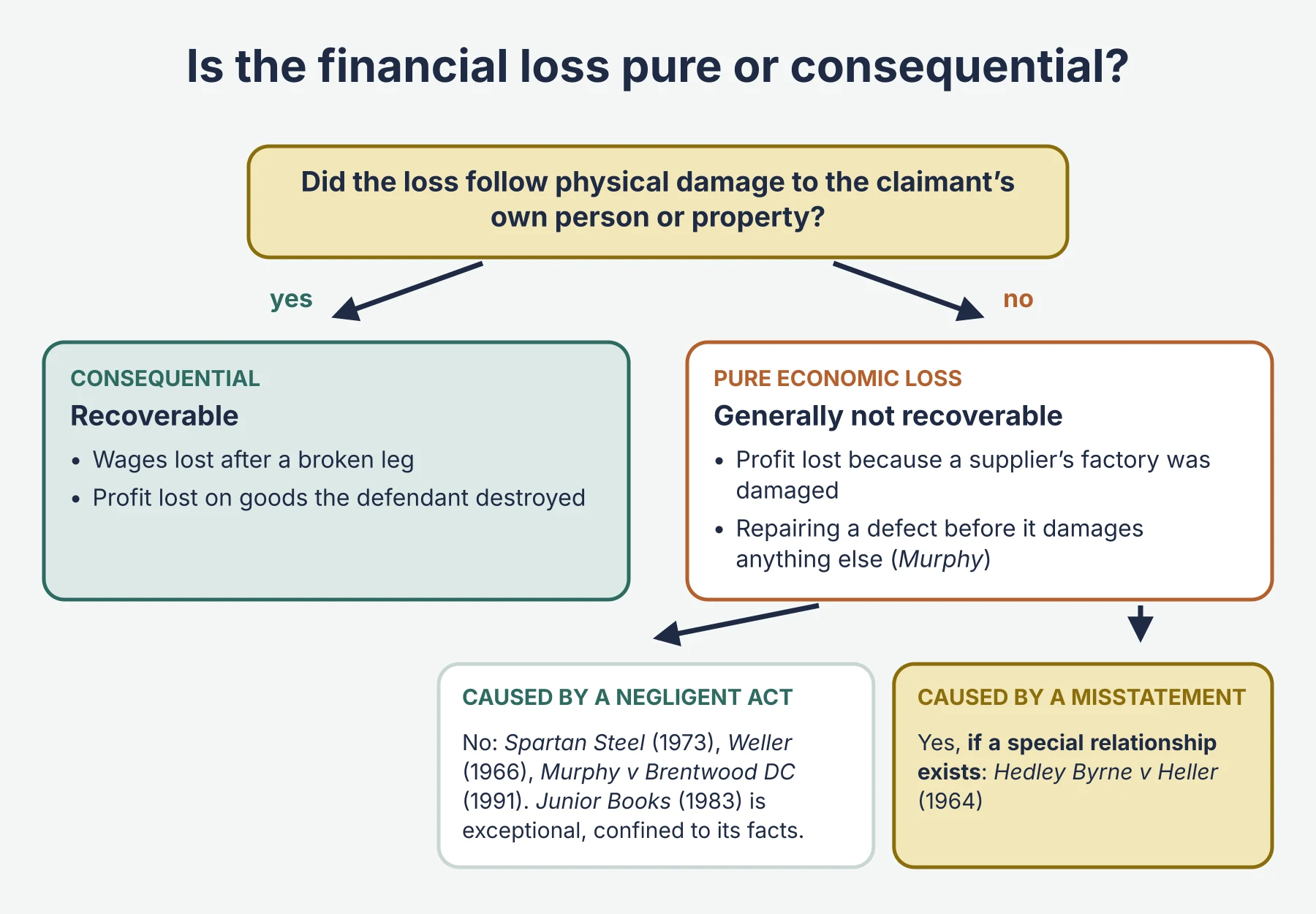
Economic loss is financial loss. The question is whether it is consequential on physical damage to the claimant’s person or property, or pure.
| Loss | Category | Recoverable in negligence? |
|---|---|---|
| Lost wages after a broken leg | Consequential on personal injury | Yes |
| Profit lost on goods destroyed by the defendant | Consequential on property damage | Yes |
| Profit lost because a supplier’s factory was damaged | Pure | Generally no |
| Cost of repairing a defect in a building before it damages anything else | Pure | No (Murphy v Brentwood DC, 1991) |
| Loss caused by relying on negligent advice | Pure | Yes, if a special relationship exists |
Negligent acts
The general rule is that pure economic loss caused by a negligent act is not recoverable.
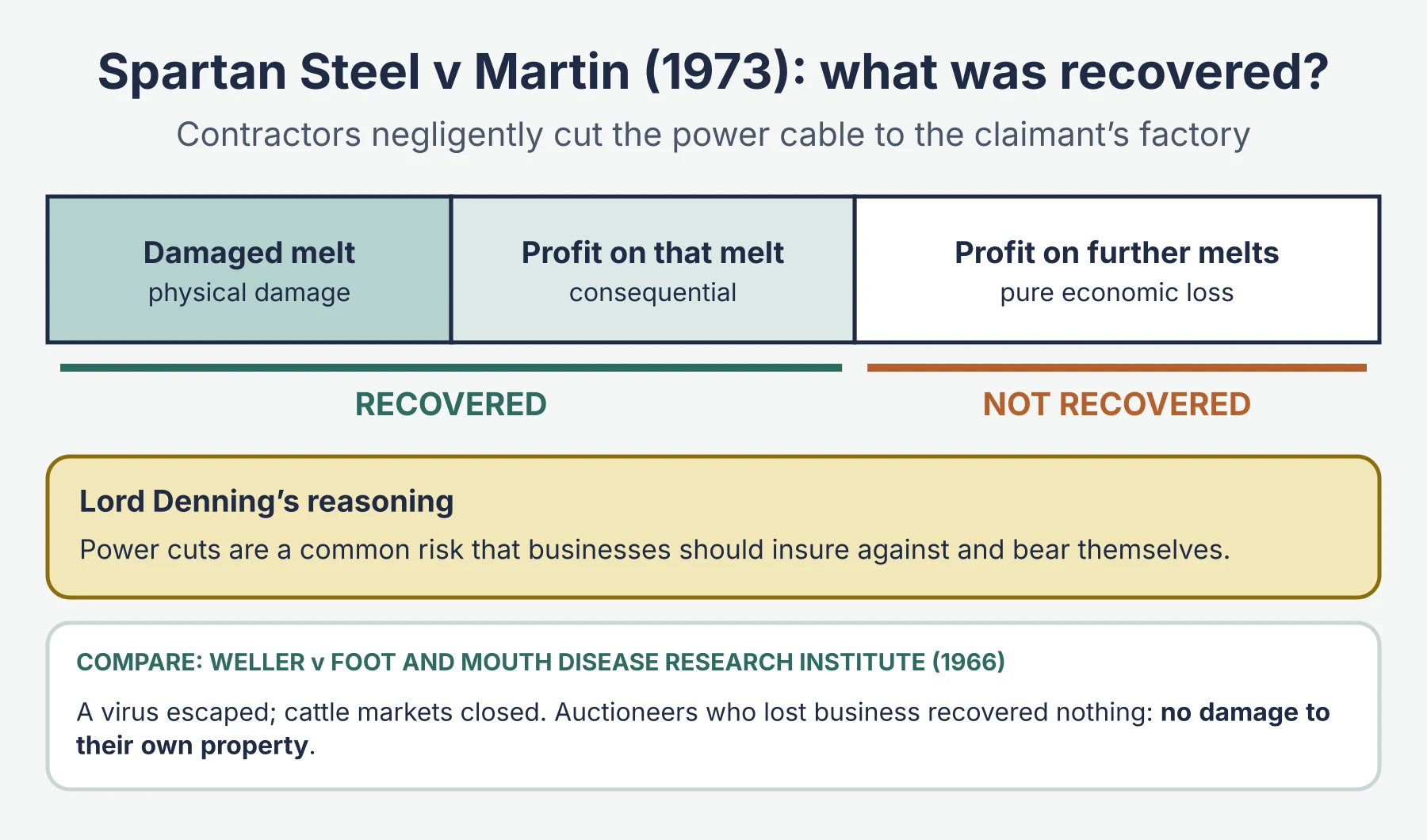
- In Spartan Steel v Martin (1973) contractors negligently cut a power cable to the claimant’s factory. A melt in the furnace was damaged; the claimant recovered for the damaged melt and the profit on it, but not for profits on further melts it could not carry out while the power was off. Lord Denning reasoned that power cuts are a common risk that businesses should insure against and bear themselves.
- In Weller v Foot and Mouth Disease Research Institute (1966) a virus escaped from the defendant’s premises and cattle markets were closed. Auctioneers who lost business could not recover, because they had suffered no damage to their own property.
- In Murphy v Brentwood DC (1991) a house had defective foundations. The cost of repair, or the loss in value, was pure economic loss, because the defect had not damaged other property.
Junior Books v Veitchi (1983), where a flooring subcontractor was held liable for the cost of replacing a defective floor, is treated as exceptional and confined to its very close facts. Use it only to show that the rule is not absolute.
Negligent misstatements
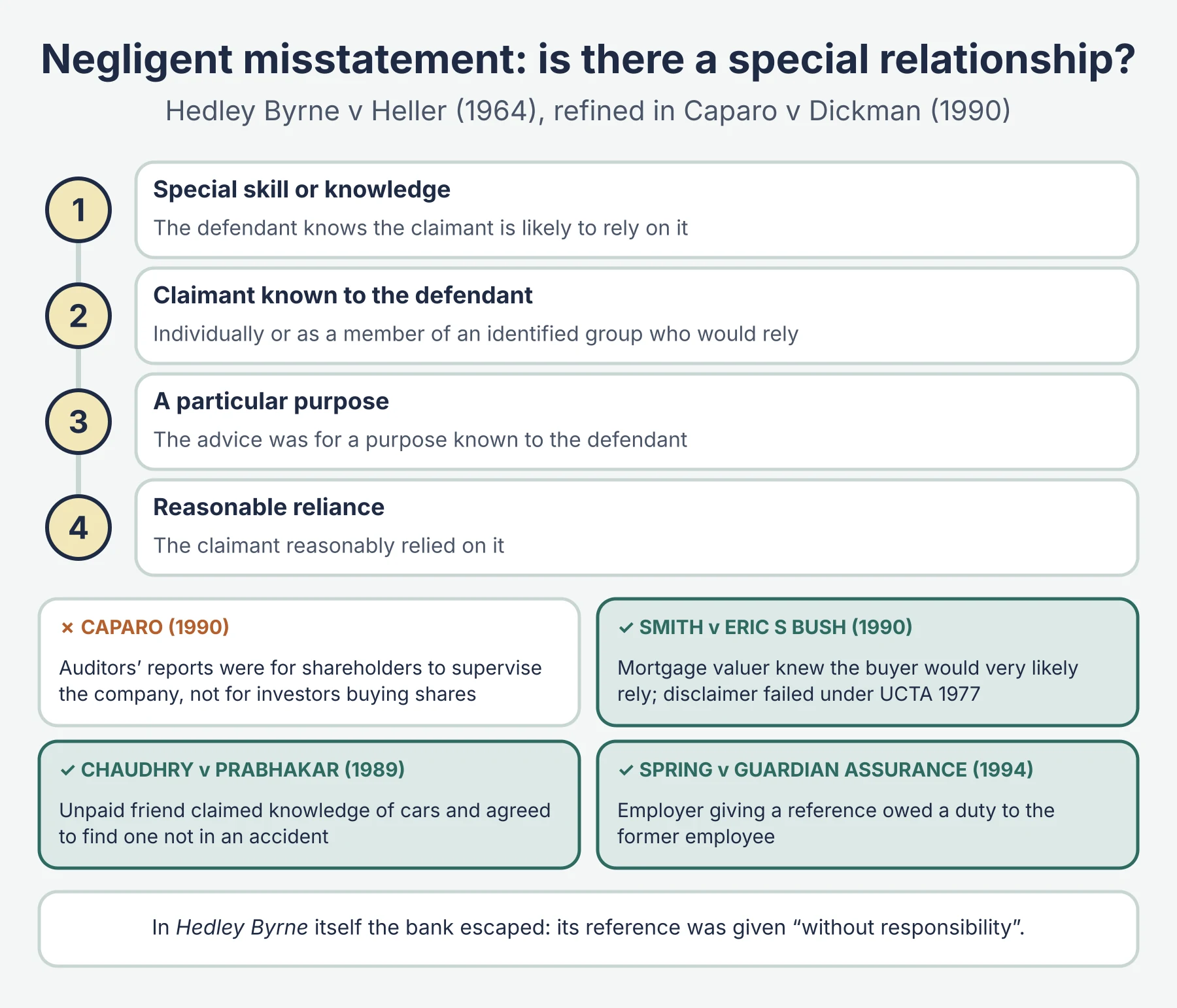
The exception comes from Hedley Byrne v Heller (1964). An advertising agency asked its bank to check a client’s creditworthiness; the client’s bank gave a favourable reference and the agency lost money when the client failed. The House of Lords held that liability for a negligent statement can arise where there is a special relationship, although the bank escaped because its reference was given “without responsibility”.
The elements of a special relationship, refined in Caparo Industries v Dickman (1990):
- Special skill or knowledge on which the defendant knows the claimant is likely to rely.
- The defendant knew the claimant, individually or as a member of an identified group, would rely on the advice.
- The advice was for a particular purpose known to the defendant.
- The claimant reasonably relied on it.
Illustrations:
- No duty to the market: in Caparo auditors’ statutory reports were for shareholders to supervise the company, not for investors deciding whether to buy shares.
- Third party relying on a valuation: in Smith v Eric S Bush (1990) a surveyor valuing a house for a mortgage lender knew the buyer would very likely rely on it; a duty was owed, and the disclaimer failed the reasonableness test under the Unfair Contract Terms Act 1977.
- Unpaid advice from a friend: in Chaudhry v Prabhakar (1989) a friend who claimed knowledge of cars and agreed to find a car that had not been in an accident owed a duty.
- References: in Spring v Guardian Assurance (1994) an employer giving a reference owed a duty to the former employee who was its subject.
Part 2: psychiatric injury
The threshold
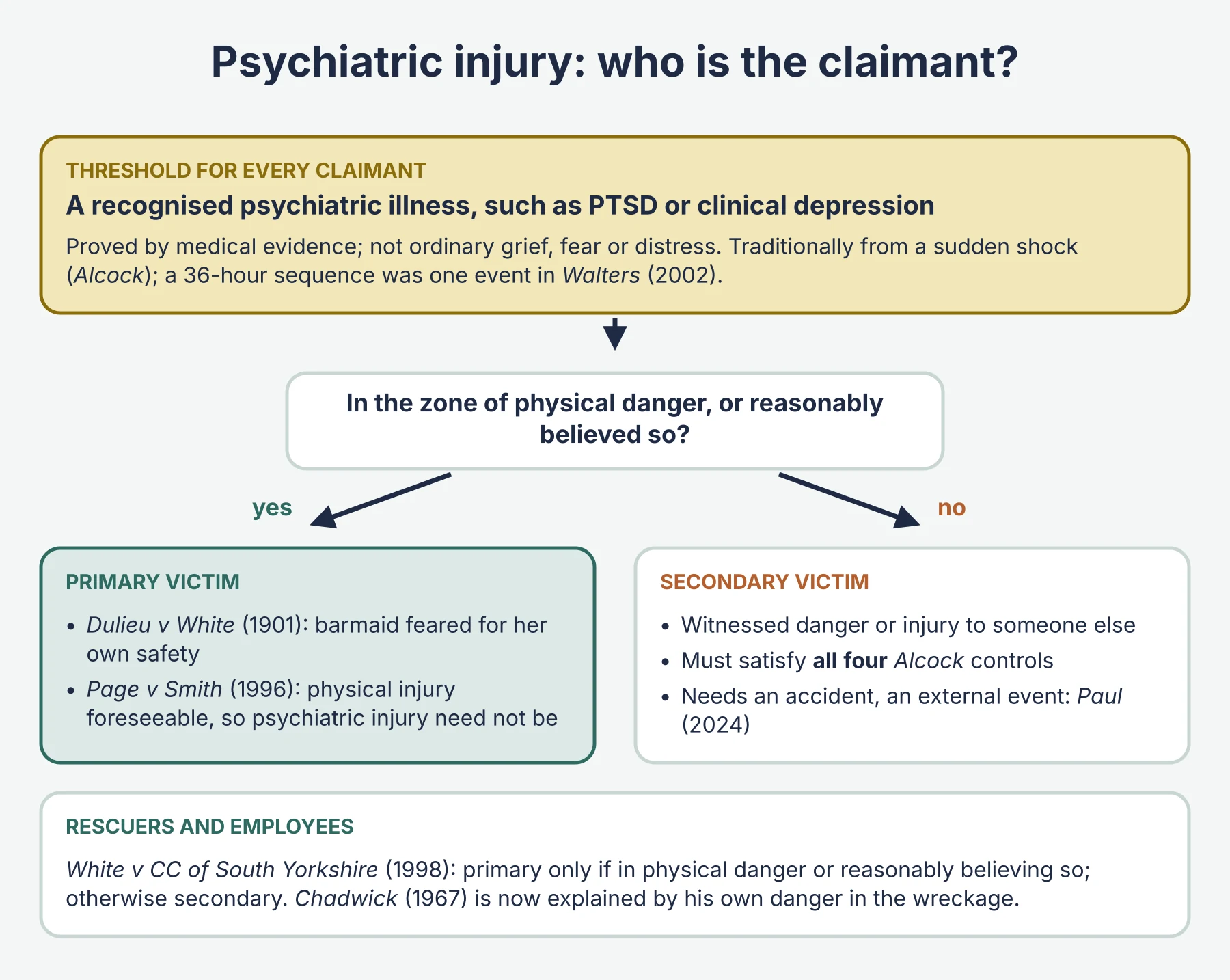
The claimant must prove a recognised psychiatric illness, such as post-traumatic stress disorder or clinical depression, supported by medical evidence. Ordinary grief, fear, distress or anxiety is not enough. Traditionally the illness must result from a sudden shock: a sudden appreciation by sight or sound of a horrifying event (Alcock, 1992). In North Glamorgan NHS Trust v Walters (2002) a mother who watched her baby’s collapse and death over 36 hours recovered, because the court treated the sequence as one horrifying event.
Primary victims
A primary victim is a person who was in the zone of physical danger, or reasonably believed they were.
- In Dulieu v White (1901) a pregnant barmaid suffered shock when a horse-drawn van crashed into the pub where she was working; she feared for her own safety and recovered.
- In Page v Smith (1996) the claimant was in a minor car crash and was not physically hurt, but his chronic fatigue condition returned. Because physical injury was foreseeable, he did not need to show psychiatric injury was foreseeable.
Secondary victims
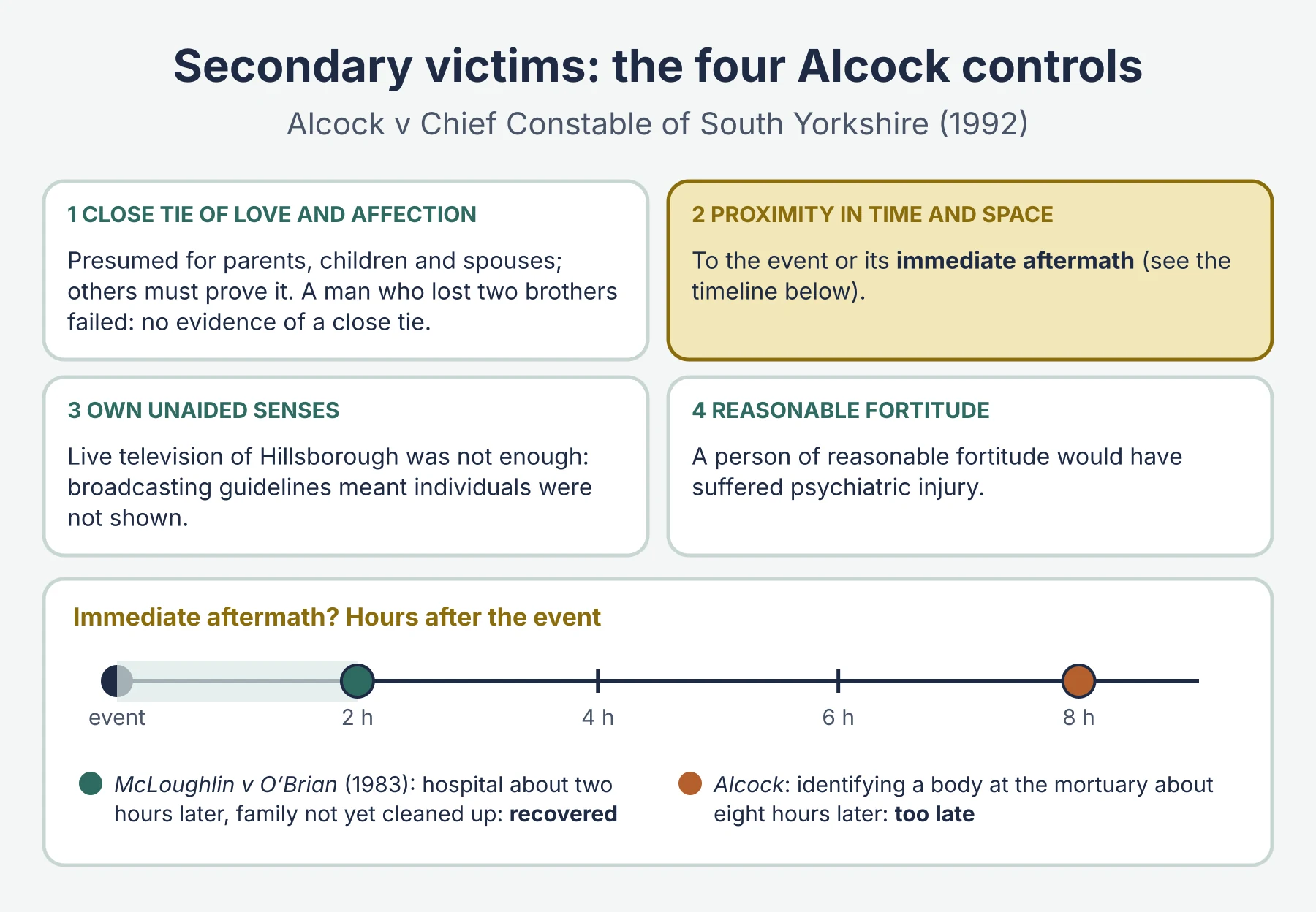
A secondary victim witnesses danger or injury to someone else. The Alcock control mechanisms all apply:
- Close tie of love and affection with the person endangered. It is presumed for parents and children and spouses; others must prove it.
- Proximity in time and space to the event or its immediate aftermath. In McLoughlin v O’Brian (1983) a mother who reached the hospital about two hours after a crash and saw her family before they had been cleaned up recovered. In Alcock identifying a body at the mortuary about eight hours later was too late.
- Perception with the claimant’s own unaided senses. Watching the Hillsborough disaster on live television was not enough in Alcock, partly because broadcasting guidelines meant individuals were not shown.
- A person of reasonable fortitude would have suffered psychiatric injury.
In Alcock a claimant who was at the ground and lost two brothers still failed because no evidence of a close tie was presented. In Paul v Royal Wolverhampton NHS Trust (2024) the Supreme Court held that children who witnessed their father’s fatal collapse, caused by an earlier failure to diagnose heart disease, could not recover: secondary victim liability requires an accident, an external event, not the later effects of medical negligence.
Rescuers and employees
In Chadwick v British Railways Board (1967) a man who helped at a rail crash scene for hours recovered for psychiatric illness. After White v Chief Constable of South Yorkshire (1998), rescuers and employees are treated as primary victims only if they were in physical danger or reasonably believed they were; otherwise they must satisfy the secondary victim rules like anyone else. Chadwick is now explained on the basis that he was himself in danger in the wreckage.
Worked problem
Wren, an accountant, tells her neighbour Ade at a barbecue that a local company is “a safe investment”. Ade invests and loses money. Separately, a crane operated by Bolt Ltd collapses in the street. Ade’s wife Cleo is on the pavement and is narrowly missed; she develops PTSD. Ade’s brother Dev, at home, sees the collapse on a local news livestream and later suffers depression after learning Ade’s son was hurt.
Ade v Wren   (misstatement): Wren has special skill. But casual advice at a
             social event, without knowledge of a particular purpose or
             assumed responsibility, is unlikely to create a special
             relationship (Hedley Byrne; contrast Chaudhry, where the friend
             undertook a specific task). Likely no duty.
Cleo v Bolt  (psychiatric): in the zone of danger, so a primary victim. PTSD
             is a recognised illness. Physical injury foreseeable, so Page v
             Smith applies. Likely to succeed.
Dev v Bolt   (psychiatric): a secondary victim. Uncle - close tie must be
             proved. Not present; saw a broadcast (Alcock: not own unaided
             senses). Likely to fail.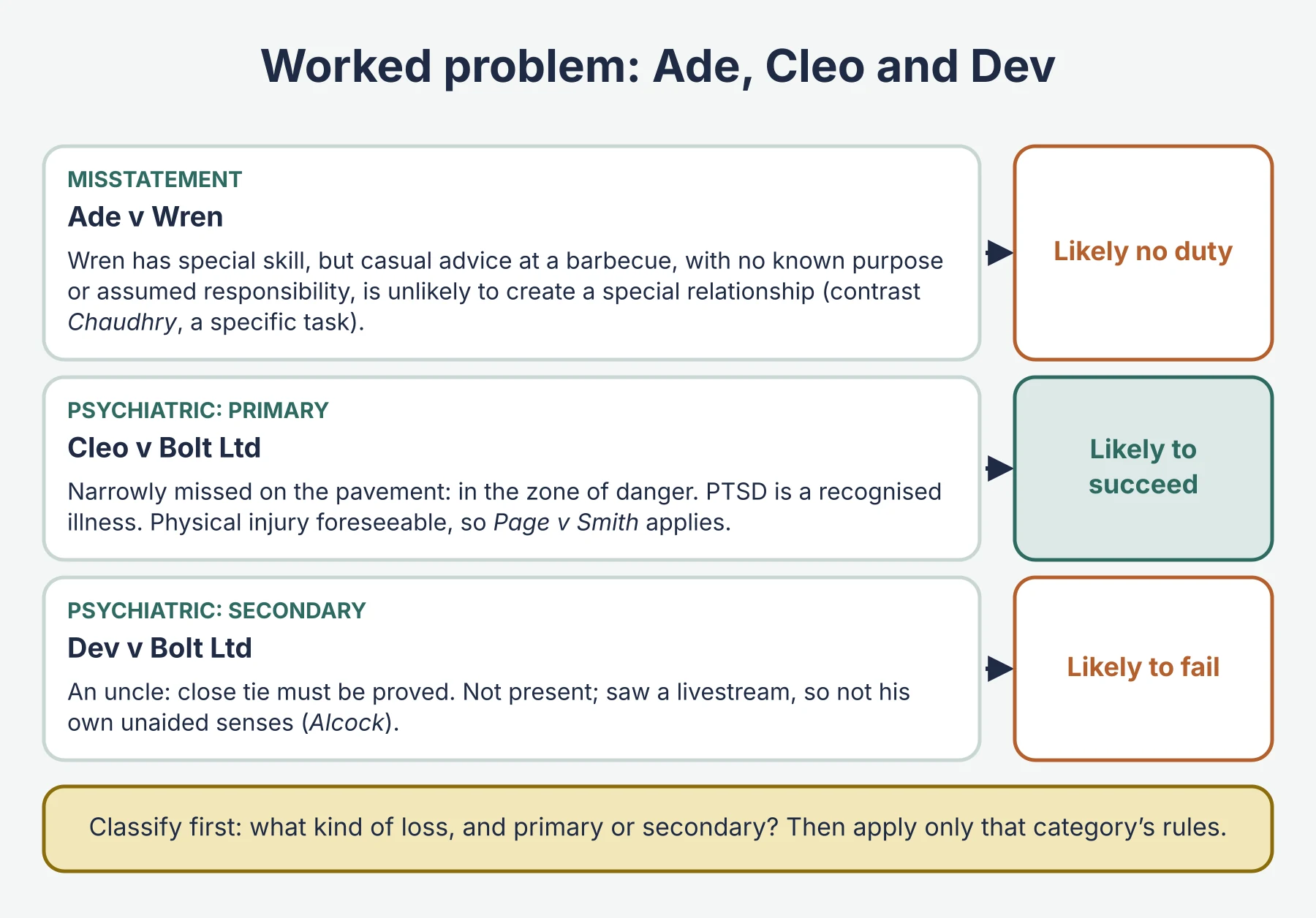
Common mistakes
- Calling every financial loss “pure” economic loss: wages lost after injury are consequential.
- Forgetting that Hedley Byrne is about statements and advice, while Spartan Steel is about acts.
- Treating anyone who is upset as having a psychiatric injury; a recognised illness is required.
- Applying all four Alcock controls to a primary victim.
- Stating that rescuers are automatically primary victims after White.
Exam technique
In a problem, first classify the claimant: what kind of loss, and (for psychiatric injury) primary or secondary. Then apply only the rules for that category. Evaluation questions on this row link directly to the theory of tort: the floodgates argument, arbitrariness of the Alcock controls and the Law Commission’s 1998 recommendations for reform.
More resources on this topic
Economic loss and psychiatric injury revision notes | Economic loss and psychiatric injury practice questions | Theory of tort law study guide
Related resources
-
Practice questions
AQA A Level Law (7162): Liability in Negligence for Economic Loss and Psychiatric Injury – Practice Questions
Original practice questions with mark-scheme answers on pure economic loss, negligent misstatements and primary and secondary victims, for AQA A Level Law 7162.
Law · AQA · A Level
Try questions -
Revision notes
AQA A Level Law (7162): Liability in Negligence for Economic Loss and Psychiatric Injury – Revision Notes
Recall notes on pure economic loss, Hedley Byrne special relationships, primary and secondary victims and the Alcock controls for AQA A Level Law 7162 tort.
Law · AQA · A Level
Revise topic -
Study guides
AQA A Level Law (7162): Liability in Negligence for Physical Injury to People and Damage to Property
Duty of care, the objective standard, factual and legal causation applied step by step to injury and property damage claims, for AQA A Level Law 7162 Paper 2.
Law · AQA · A Level
Read guide
Get free revision emails (optional)
Occasional emails with practice questions, worked explanations and links to free resources for the qualification and subjects you choose. No spam, and you can unsubscribe from any email. The free tools on this site never need an email.