
Study Guides
AQA A Level Law (7162): Liability in Negligence for Physical Injury to People and Damage to Property
Duty of care, the objective standard, factual and legal causation applied step by step to injury and property damage claims, for AQA A Level Law 7162 Paper 2.
- Subject
- Law
- Level
- A LEVELS
- Topic
- Tort
- Author
- Marlbridge Academic Team
- Updated
- Reviewed by
- Aizaz Raoof Ali (what this means)
Aligned to AQA A Level Law (7162), For teaching from September 2017 onwards, A-level exams 2019 onwards. Official specification .
Syllabus page (what it covers and how it is assessed): AQA A Level Law.
Syllabus points this page covers
7162
- Liability in negligence for physical injury to people and damage to property
Found an error? Report a correction.
Need help with this topic? Request a free trial class for A Level Law (7162).
This guide covers the section 3.3 row Liability in negligence for physical injury to people and damage to property in AQA A-level Law (7162). The specification lists three elements: “Duty of care: the ‘neighbour’ principle; the Caparo three-part test”, “Breach of duty: the objective standard of care” and “Damage: factual causation and legal causation (remoteness of damage)”. The Tort cases, defences and remedies study guide gives the core authorities. This page goes further into how each element is argued on difficult facts, with additional cases and a full worked problem.
The claim in outline
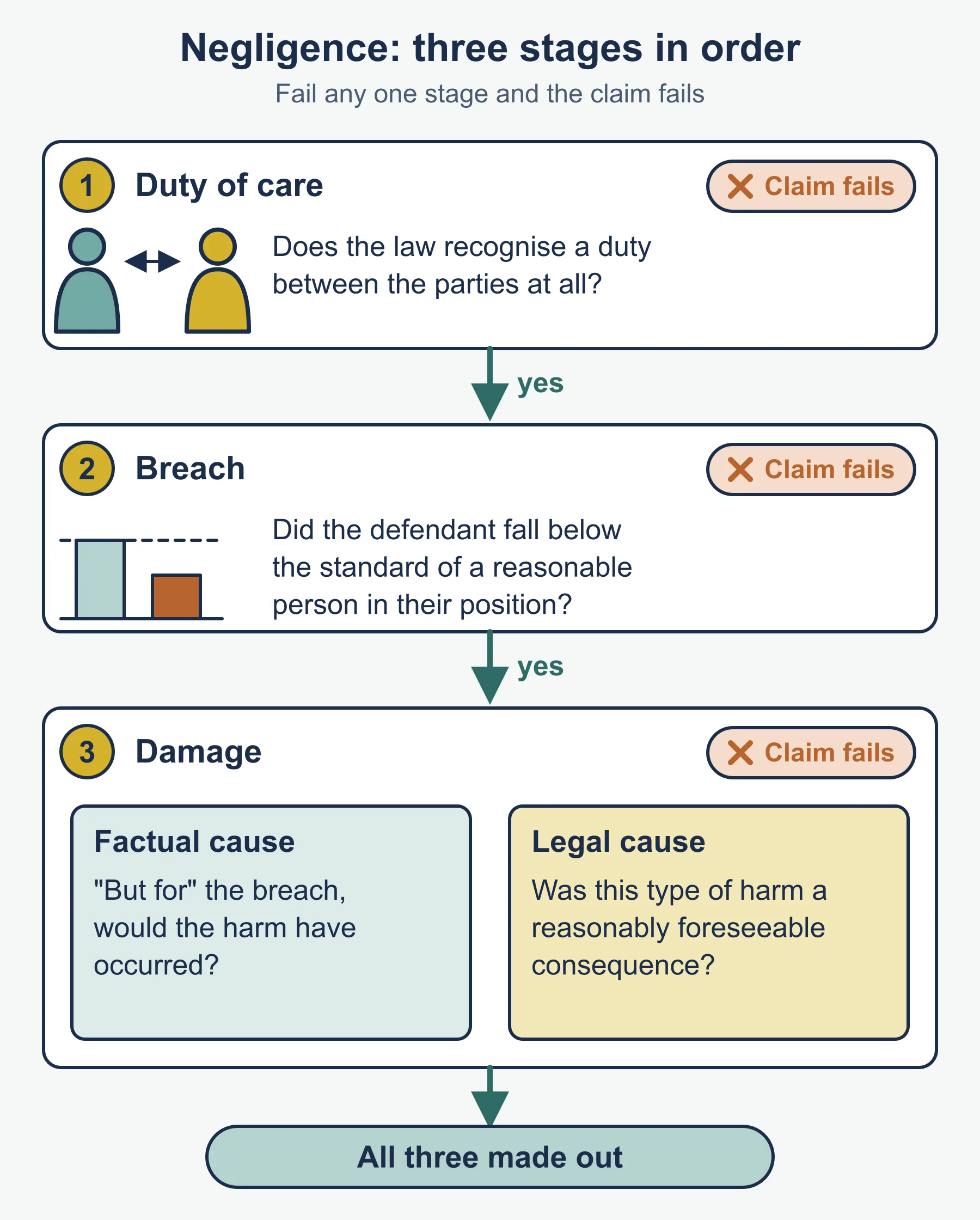
The claimant must prove, on the balance of probabilities, that:
- the defendant owed them a duty of care;
- the defendant breached that duty by falling below the standard of the reasonable person; and
- the breach caused damage of a kind that was not too remote.
Physical injury and property damage are the “core” kinds of harm in negligence: once duty, breach and causation are shown, the law compensates them readily, unlike pure economic loss or psychiatric injury.
Duty of care
The neighbour principle
In Donoghue v Stevenson (1932) the claimant’s friend bought her a bottle of ginger beer in a café; she alleged it contained the remains of a decomposed snail and that she became ill. She had no contract with the manufacturer, but the House of Lords held that a manufacturer owes a duty to the ultimate consumer. Lord Atkin’s statement is the root of the modern law: you must take reasonable care to avoid acts or omissions which you can reasonably foresee would be likely to injure your neighbour, meaning persons so closely and directly affected by your act that you ought reasonably to have them in contemplation.
The Caparo test and incremental development
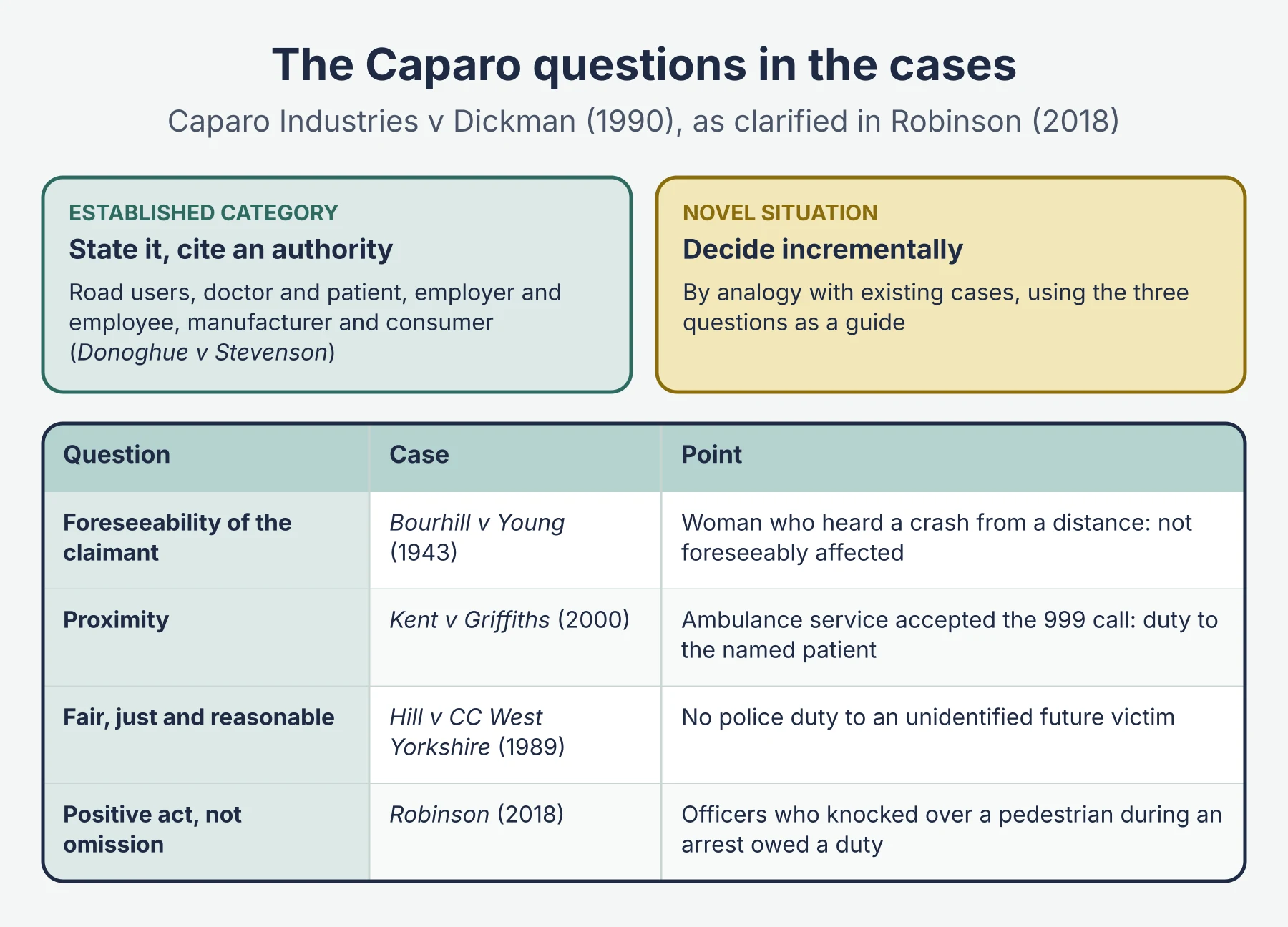
Caparo Industries v Dickman (1990) set out three questions: was the damage reasonably foreseeable; was there a relationship of proximity; and is it fair, just and reasonable to impose a duty? Robinson v Chief Constable of West Yorkshire (2018) clarified how to use it.
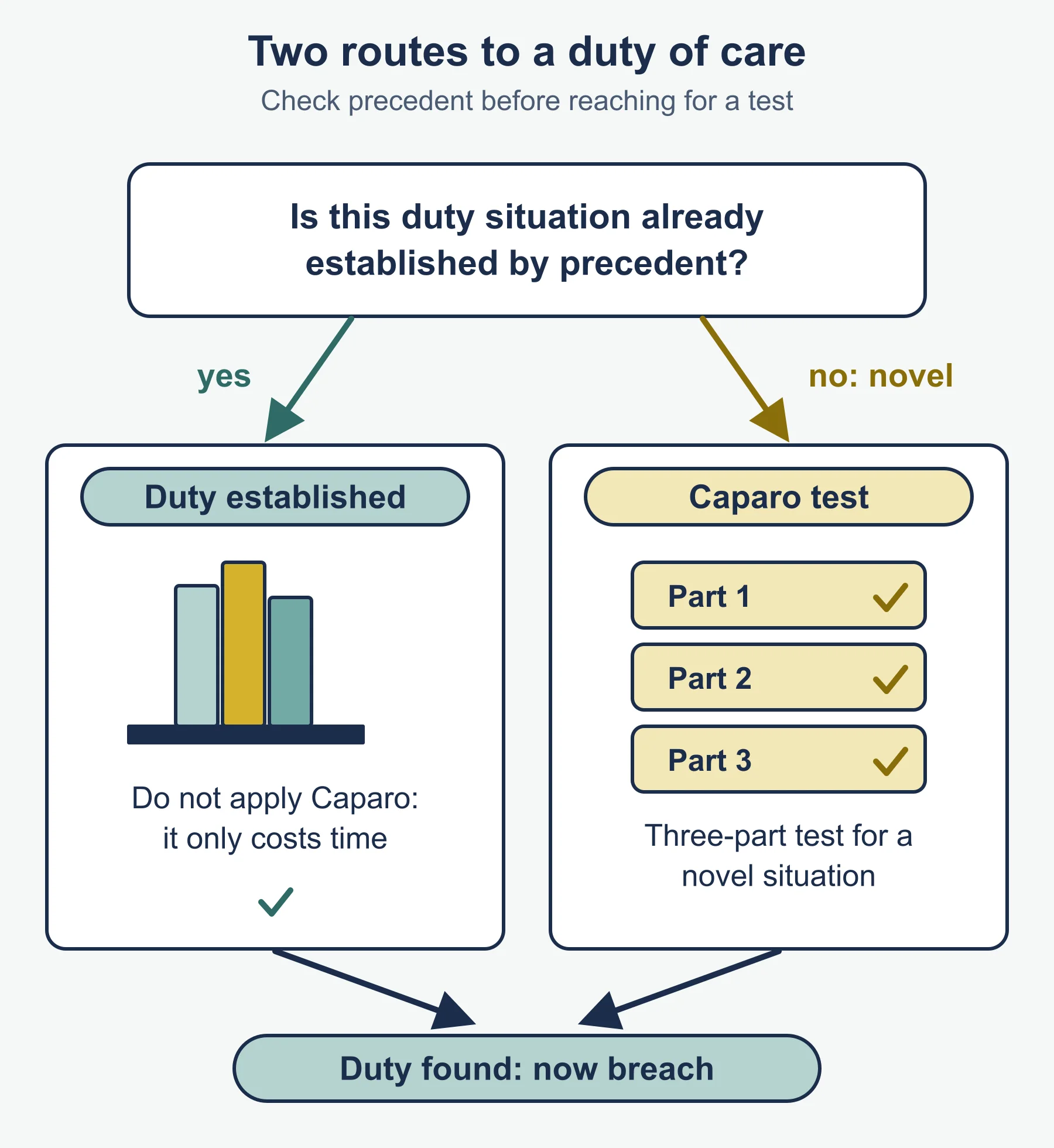
- Established categories (road users to each other, doctor to patient, employer to employee, manufacturer to consumer) need no fresh test. State the category and an authority.
- Novel situations are decided incrementally, by analogy with existing cases, with the three questions as a guide.
Cases illustrating each question:
| Question | Case | Point |
|---|---|---|
| Foreseeability of the claimant | Bourhill v Young (1943) | A woman who heard a crash from a distance was not someone the careless motorcyclist could foresee being affected |
| Proximity | Kent v Griffiths (2000) | Once the ambulance service accepted the 999 call, it owed a duty to the named patient |
| Fair, just and reasonable | Hill v CC West Yorkshire (1989) | No duty owed by police to an unidentified future victim |
| Positive act, not omission | Robinson (2018) | Officers who knocked over a pedestrian during an arrest owed a duty |
In an exam, most physical injury problems involve an established duty. Spending a paragraph on Caparo for a driver who hits a pedestrian wastes time and suggests you have not read Robinson.
Breach of duty
The objective standard
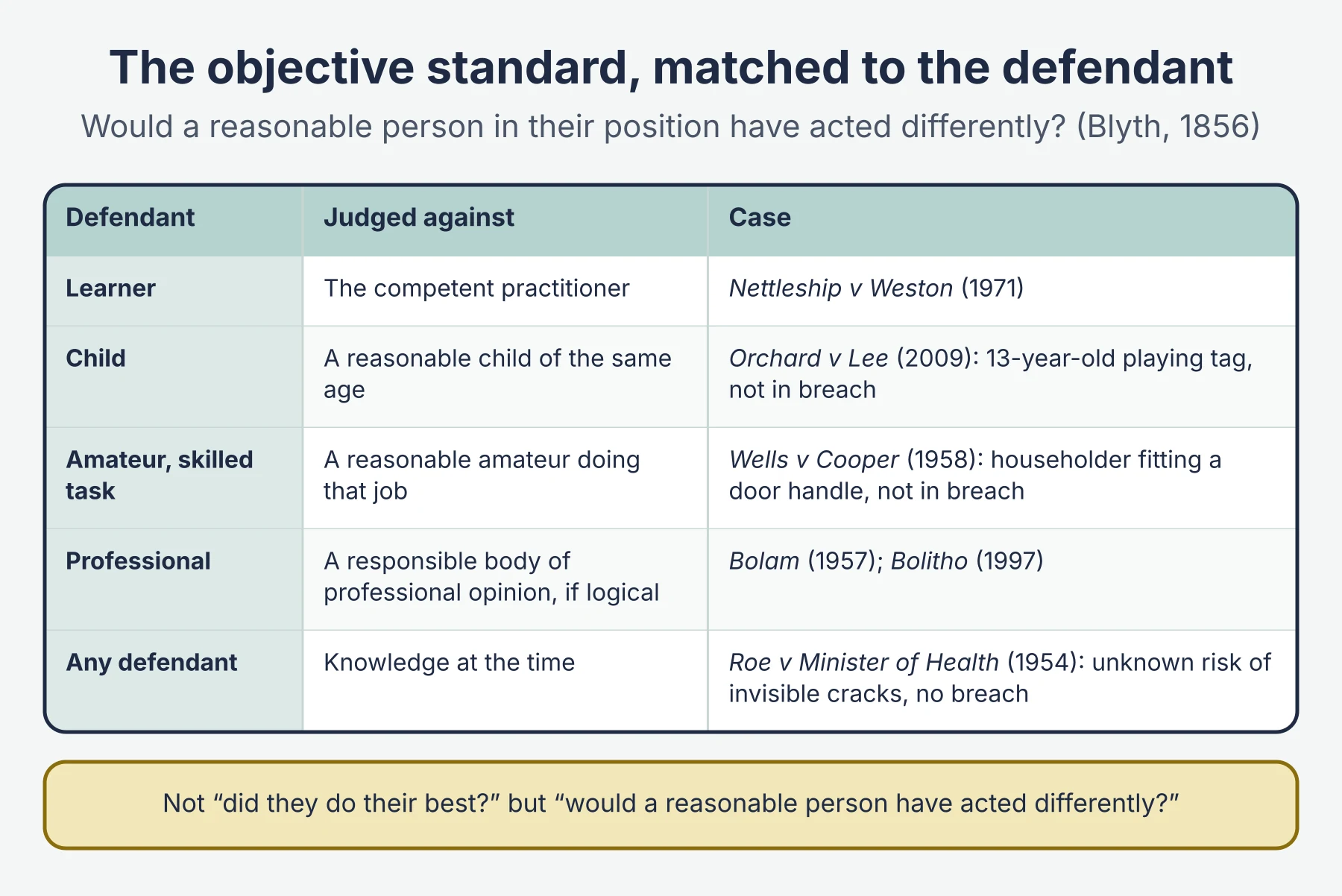
The defendant is judged against the reasonable person in their position (Blyth v Birmingham Waterworks, 1856). The question is not whether this defendant did their best, but whether a reasonable person would have acted differently.
Special standards
- Learners meet the standard of the competent practitioner (Nettleship v Weston, 1971).
- Children are judged against a reasonable child of the same age. In Orchard v Lee (2009) a 13-year-old playing tag who ran into a lunchtime supervisor was not in breach: he was doing what children of that age normally do, without carelessness beyond the game.
- Amateurs doing skilled tasks meet the standard of a reasonable amateur doing that job. In Wells v Cooper (1958) a householder who fitted a door handle that came off was judged as a reasonably competent amateur carpenter, not a professional, and was not in breach.
- Professionals are not in breach if they acted in line with a responsible body of professional opinion (Bolam, 1957), provided that opinion is capable of withstanding logical analysis (Bolitho, 1997).
- State of knowledge is judged at the time. In Roe v Minister of Health (1954) patients were paralysed by contaminated anaesthetic; the risk of invisible cracks in the ampoules was unknown at the time, so there was no breach.
Balancing the risk factors
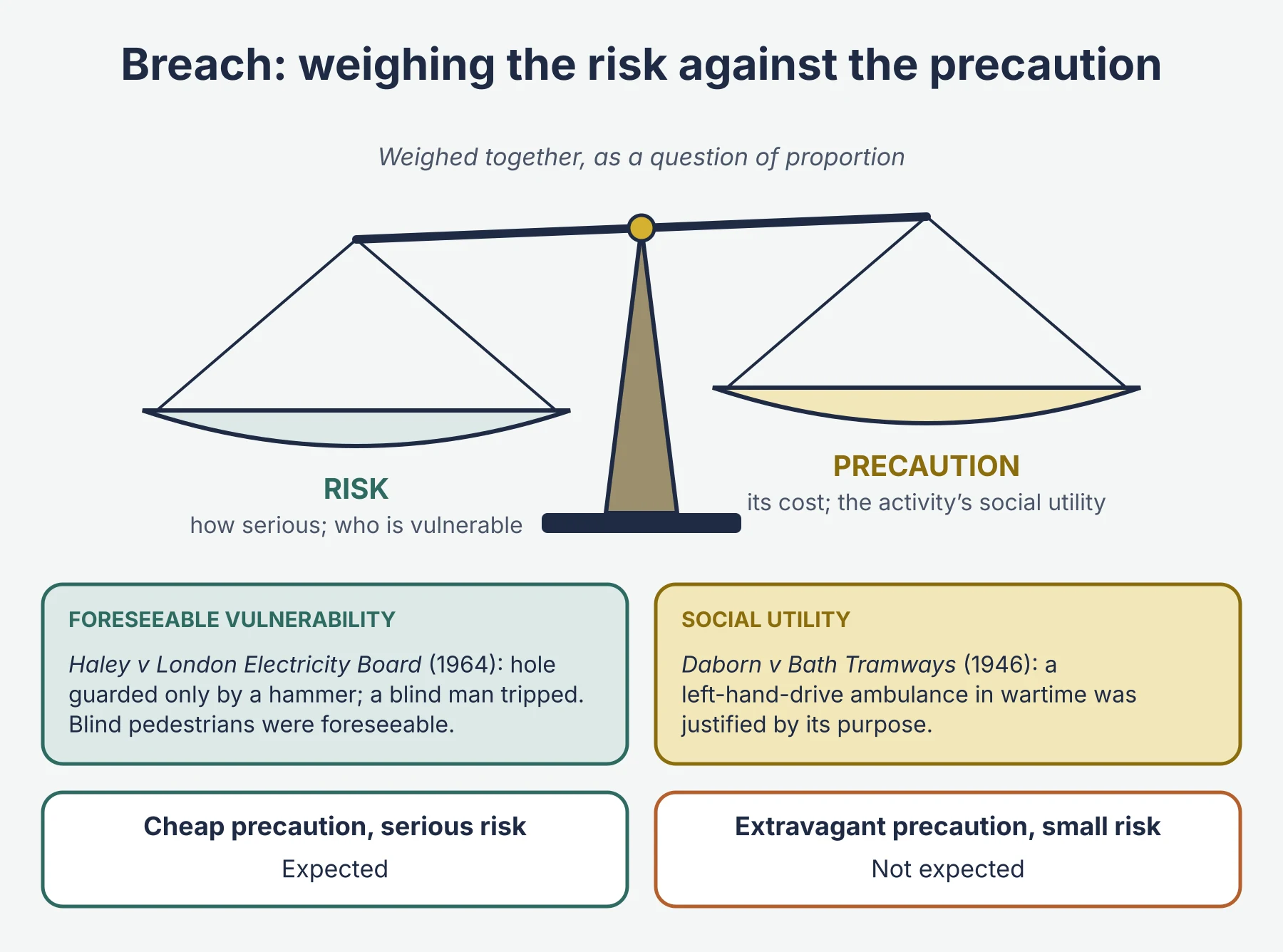
The court weighs four factors together. Additional cases beyond the headline ones:
- Foreseeable vulnerability. In Haley v London Electricity Board (1964) workmen left a hole in a pavement guarded only by a hammer; a blind man tripped and was injured. Blind people walking alone were foreseeable, so the precautions were inadequate.
- Social utility. In Daborn v Bath Tramways (1946) using a left-hand-drive ambulance in wartime was justified by its purpose.
- Cost against risk. The question is proportion. A cheap precaution against a serious risk will be expected; an extravagant precaution against a small risk will not.
Damage: causation and remoteness
Factual causation
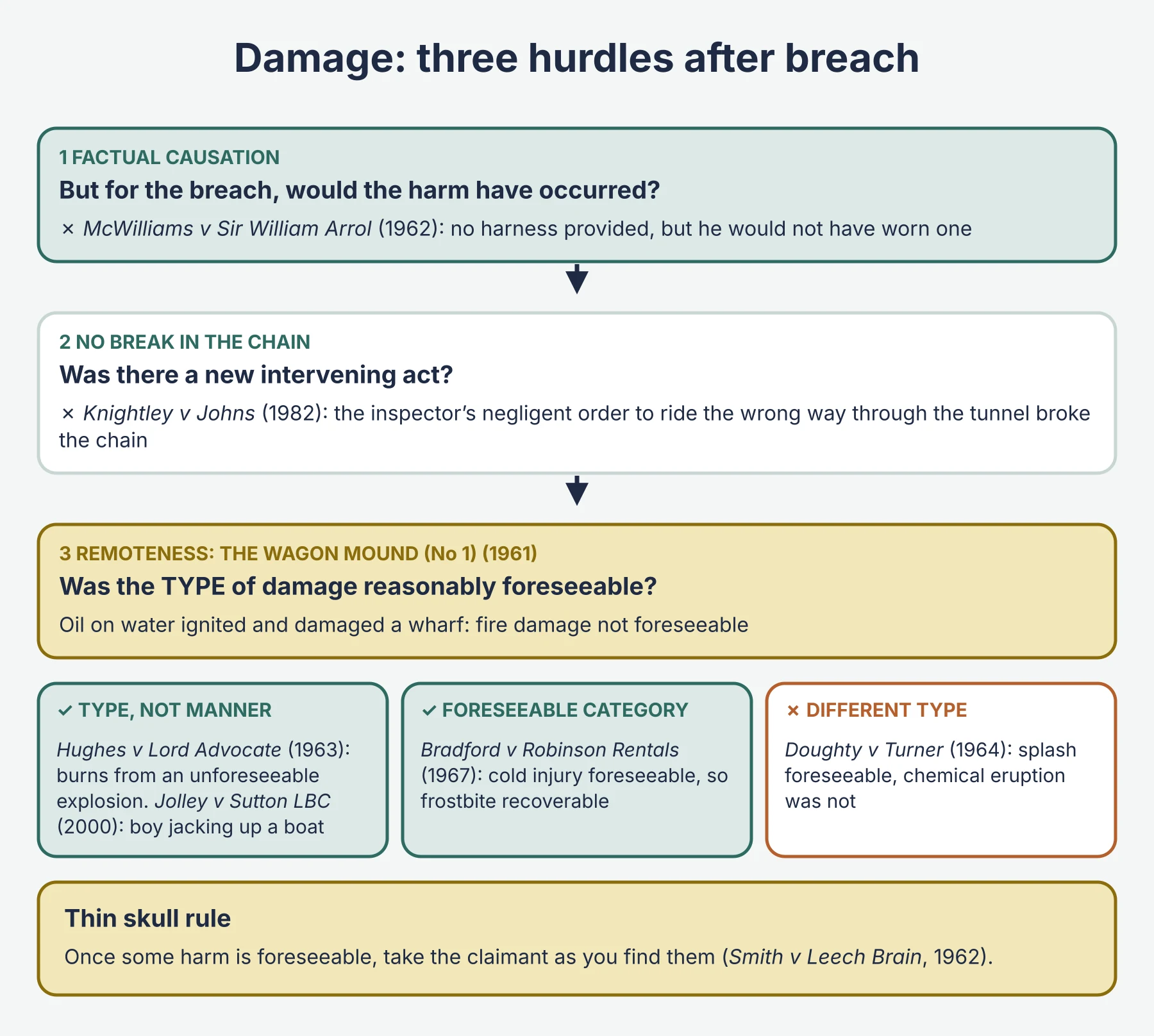
The “but for” test asks whether the harm would have occurred but for the breach. In McWilliams v Sir William Arrol (1962) an employer failed to provide a safety harness, but evidence showed the worker would not have worn one, so the failure did not cause his death.
Breaking the chain
An intervening act can make the defendant’s breach no longer a cause in law. In Knightley v Johns (1982) the defendant caused a crash in a tunnel; a police inspector then negligently ordered an officer to ride the wrong way through the tunnel, and the officer was injured. The inspector’s negligence was a new intervening act, so the original driver was not liable for that injury.
Remoteness of damage
The defendant is liable only for damage of a reasonably foreseeable type (The Wagon Mound (No 1), 1961, where oil spilled in a harbour later ignited and damaged a wharf, but fire damage was not foreseeable from oil on water). The finer rules:
- Type, not manner or extent: in Hughes v Lord Advocate (1963) burns from an unforeseeable explosion of a paraffin lamp were recoverable, because burns were foreseeable. In Jolley v Sutton LBC (2000) injury to a boy jacking up an abandoned boat was within the foreseeable type of harm from children meddling with it.
- A different type is too remote: in Doughty v Turner Manufacturing (1964) an asbestos cover slid into molten metal and an unexpected chemical eruption burned a worker. A splash was foreseeable; an eruption was a different kind of risk, so the claim failed.
- Foreseeable category of harm: in Bradford v Robinson Rentals (1967) a driver sent on a long journey in an unheated van in severe weather suffered frostbite. Injury from cold was foreseeable, so frostbite was recoverable even though unusual.
- Thin skull rule: once some harm is foreseeable, the defendant takes the claimant as found (Smith v Leech Brain, 1962).
Property damage
The same three stages apply. The Wagon Mound itself was a property claim. A driver who carelessly crashes into a parked car, a builder whose falling scaffolding dents a neighbour’s roof, or a contractor whose spark sets fire to a shed all face the ordinary rules: established duty, objective breach, causation and foreseeable type of damage.
Worked problem
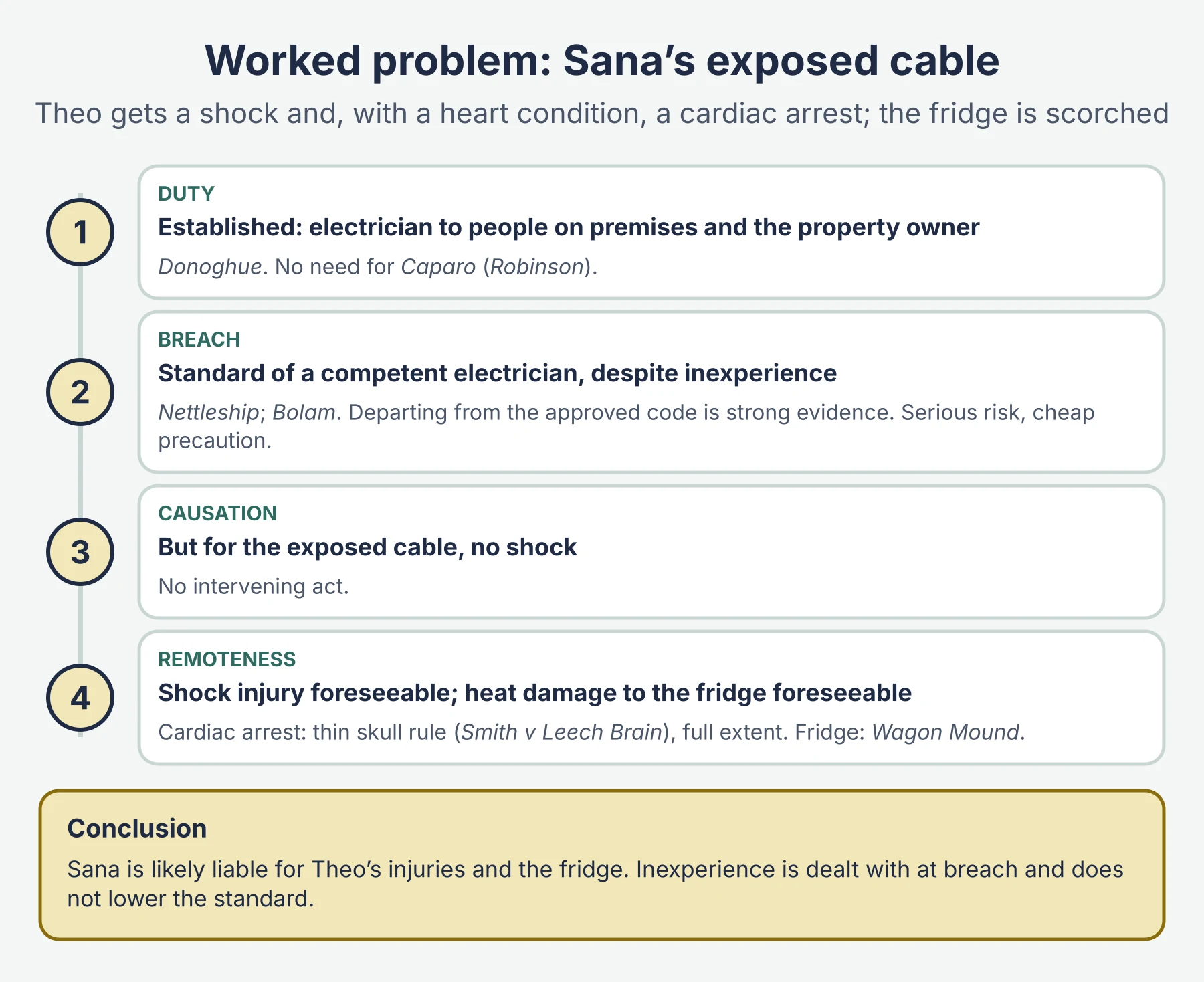
Sana, a newly qualified electrician, rewires a café. To save time she leaves a live cable exposed behind a counter, where an approved code of practice says cables must be covered. Theo, a waiter, brushes against it and receives a shock. Because Theo has an unusual heart condition, the shock causes a cardiac arrest. Sparks from the cable also scorch the café’s fridge.
Duty:      Electrician to people on premises and to property owner -
           established duty (foreseeable physical harm from careless work;
           Donoghue). No need for Caparo (Robinson).
Breach:    Objective standard of a competent electrician, regardless of
           inexperience (Nettleship; Bolam). Departing from the approved
           practice is strong evidence of breach. Risk serious (shock),
           precaution cheap (cover the cable): breach likely.
Causation: But for the exposed cable, no shock (Barnett test satisfied).
           No intervening act.
Remoteness: Electric shock injury foreseeable. Cardiac arrest from a heart
           condition - thin skull rule (Smith v Leech Brain): Sana liable
           for full extent. Scorched fridge - fire/heat damage from an
           exposed cable is a foreseeable type (Wagon Mound).
Conclusion: Sana is likely liable for Theo's injuries and the fridge.
Each step names the rule, gives the authority and applies the facts. Notice that inexperience is dealt with at breach and does not lower the standard.
Common mistakes
- Running all three Caparo stages for a road accident or a doctor’s mistake.
- Saying a defendant is not in breach because they “tried their best”.
- Confusing remoteness with factual causation: “but for” is about whether the breach made a difference; remoteness is about whether the type of harm was foreseeable.
- Applying the thin skull rule before establishing that some harm was foreseeable.
- Forgetting property damage when the facts include it.
Exam technique
In Paper 2 problem questions, use a heading for each element and say which elements are in real doubt; spend your time there. For “explain” questions on a single element, give the rule, a leading case and a contrasting case (for example Hughes and Doughty on remoteness). For evaluation, link to the theory of tort: the objective standard and the Caparo policy limb are named in the specification.
More resources on this topic
Negligence for physical injury and property damage revision notes | Negligence for physical injury and property damage practice questions | Theory of tort law study guide
Related resources
-
Practice questions
AQA A Level Law (7162): Liability in Negligence for Physical Injury to People and Damage to Property – Practice Questions
Original practice questions with mark-scheme answers on duty, breach, causation and remoteness in negligence for injury and property damage, AQA Law 7162.
Law · AQA · A Level
Try questions -
Revision notes
AQA A Level Law (7162): Liability in Negligence for Physical Injury to People and Damage to Property – Revision Notes
Recall notes on the neighbour principle, Caparo, the objective standard, but-for causation, intervening acts and remoteness for AQA A Level Law 7162 negligence.
Law · AQA · A Level
Revise topic -
Study guides
AQA A Level Law (7162): Nuisance and the Escape of Dangerous Things
Private nuisance and the rule in Rylands v Fletcher: who can sue and be sued, unreasonable use, each Rylands element and a worked problem, AQA Law 7162.
Law · AQA · A Level
Read guide
Get free revision emails (optional)
Occasional emails with practice questions, worked explanations and links to free resources for the qualification and subjects you choose. No spam, and you can unsubscribe from any email. The free tools on this site never need an email.