
Study Guides
AQA A Level Law (7162): Theory of Tort Law
The policy behind duty of care, economic loss, psychiatric injury, the standard of care, injunctions and vicarious liability, for AQA A Level Law 7162 essays.
- Subject
- Law
- Level
- A LEVELS
- Topic
- Tort
- Author
- Marlbridge Academic Team
- Updated
- Reviewed by
- Aizaz Raoof Ali (what this means)
Aligned to AQA A Level Law (7162), For teaching from September 2017 onwards, A-level exams 2019 onwards. Official specification .
Syllabus page (what it covers and how it is assessed): AQA A Level Law.
Syllabus points this page covers
7162
- Theory of tort law
Found an error? Report a correction.
Need help with this topic? Request a free trial class for A Level Law (7162).
This guide covers the section 3.3 row Theory of tort law in AQA A-level Law (7162). The specification asks for “analysis and evaluation of when tort law imposes liability” with particular reference to five issues: the policy factors behind the Caparo three-part test, the policy factors limiting liability for pure economic loss and psychiatric injury, the factors governing the objective standard of care, the factors governing the grant of an injunction, and the nature and purpose of vicarious liability. Each issue is a reason why the rules look the way they do. The rules themselves are in the Tort cases, defences and remedies study guide; this page explains the thinking behind them so you can write evaluation, not just description.
What tort law is trying to do
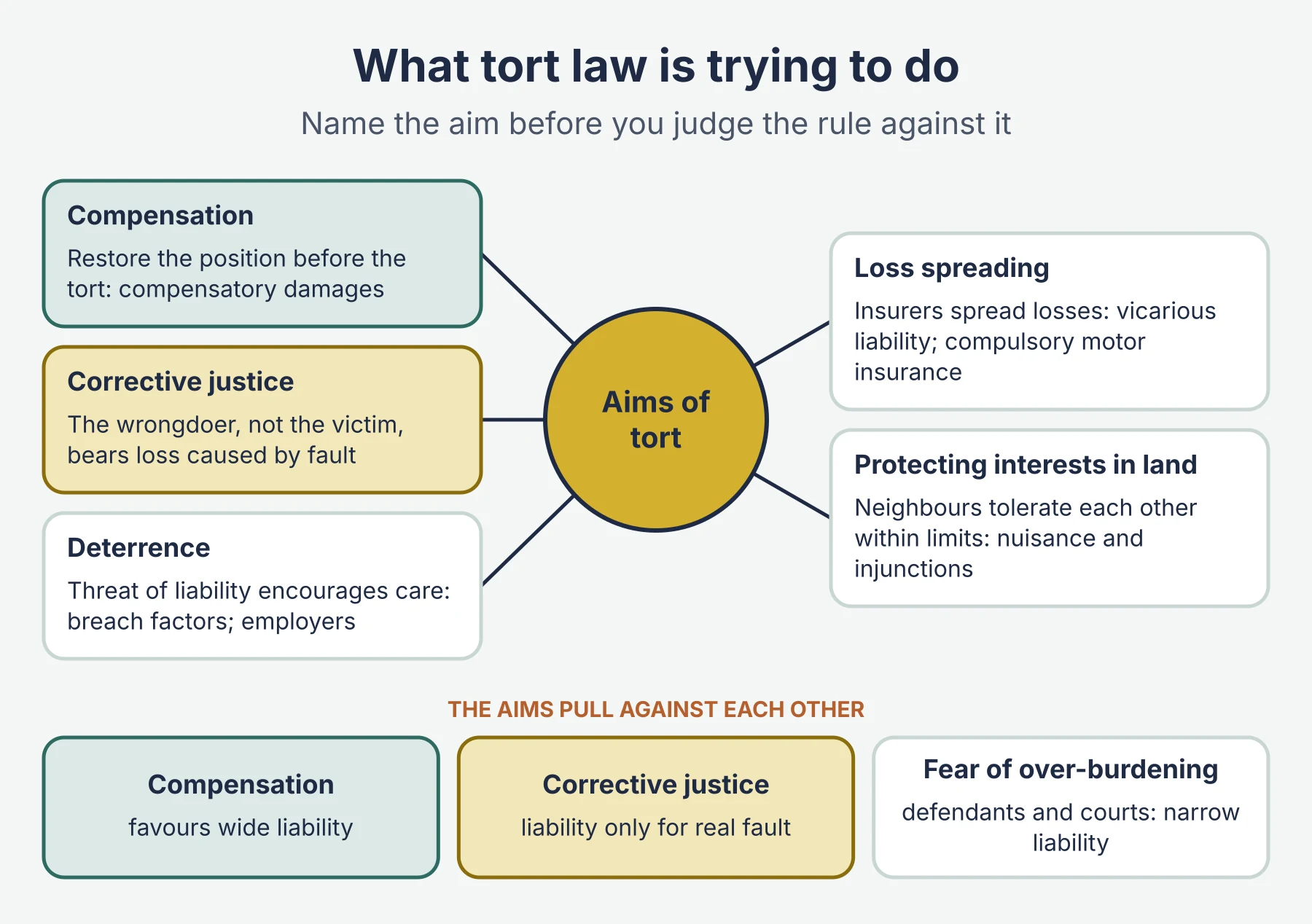
Most theory answers rest on a short list of aims. Name the aim before you judge the rule against it.
| Aim | Meaning | Where it shows |
|---|---|---|
| Compensation | Restore the claimant to the position before the tort | Compensatory damages |
| Corrective justice | The wrongdoer, not the victim, should bear the loss caused by fault | The fault requirement in negligence |
| Deterrence | The threat of liability encourages care | Breach factors; liability of employers |
| Loss spreading | Losses are passed to insurers and spread across many premium payers | Vicarious liability; compulsory motor insurance |
| Protection of interests in land | Neighbours must tolerate each other within limits | Private nuisance and injunctions |
These aims pull against each other. Compensation favours wide liability; corrective justice favours liability only where there is real fault; the fear of over-burdening defendants and the courts favours narrow liability. The five issues in the specification are each a point where the courts have struck a balance.
Issue 1: policy and the Caparo test
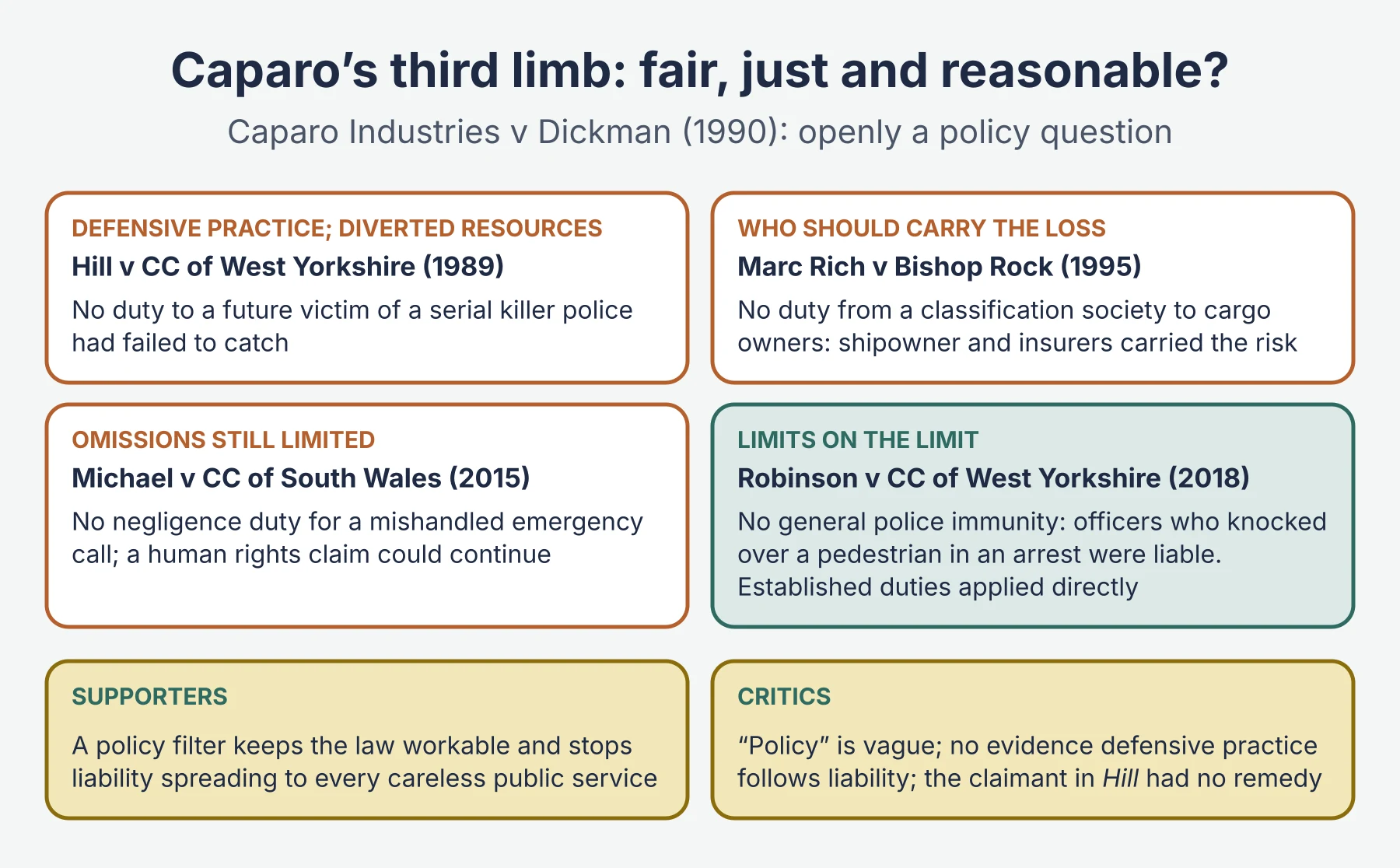
The third limb of Caparo Industries v Dickman (1990), whether it is fair, just and reasonable to impose a duty, is openly a policy question. The courts have used it to refuse a duty even where harm was foreseeable and the parties were close.
- Defensive practice and diverted resources. In Hill v Chief Constable of West Yorkshire (1989) the police owed no duty to a future victim of a serial killer they had failed to catch. The House of Lords feared that liability would make policing defensive and divert officers into defending claims.
- Who should carry the loss. In Marc Rich v Bishop Rock Marine (The Nicholas H, 1995) a ship classification society owed no duty to cargo owners: the shipowner and its insurers already carried that risk, and the society acted for the safety of shipping as a whole.
- Limits on the limit. Robinson v Chief Constable of West Yorkshire (2018) held that there is no general police immunity: police who positively cause injury, as when officers knocked over an elderly pedestrian during an arrest, are liable like anyone else. The courts now apply established duties directly and use Caparo-style reasoning only for new situations, developing the law incrementally.
Evaluation. Supporters say a policy filter keeps the law workable and stops liability spreading to every case of careless public service. Critics answer that “policy” is vague, that judges have no evidence that defensive practice actually follows liability, and that the claimant in Hill was left without a remedy in negligence. Note also that Michael v Chief Constable of South Wales Police (2015) refused a negligence duty to a victim whose emergency call was mishandled, while allowing a human rights claim to continue, which shows the policy limits still operate for omissions.
Issue 2: policy and pure economic loss and psychiatric injury
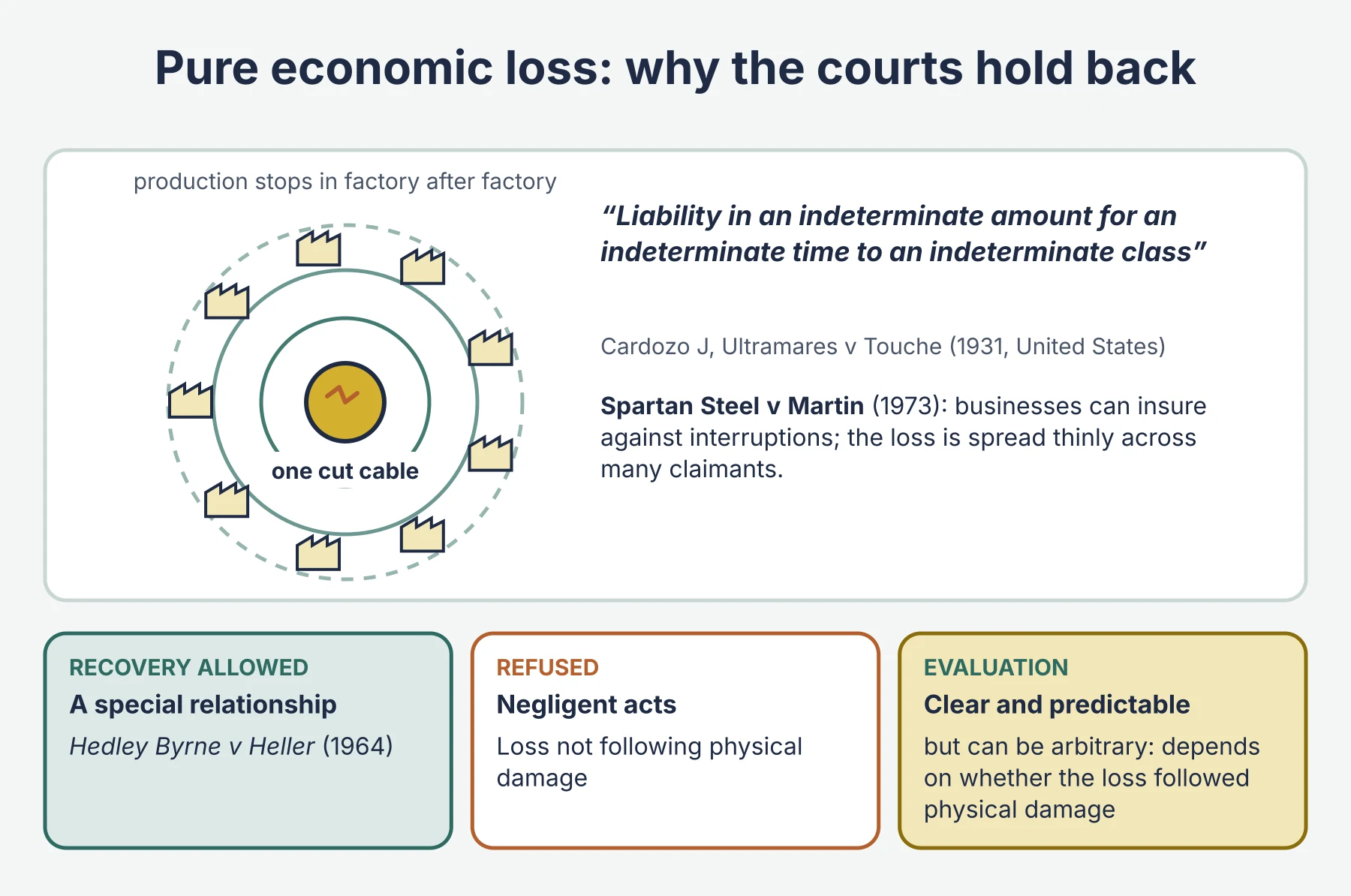
Pure economic loss. Financial loss can ripple outwards without limit: one cut power cable can stop production in a hundred factories. The classic statement of the fear is Cardozo J’s warning in the American case Ultramares v Touche (1931) against “liability in an indeterminate amount for an indeterminate time to an indeterminate class”. Courts respond by allowing recovery only where there is a special relationship (Hedley Byrne v Heller, 1964) and refusing it for negligent acts. Further reasons given in Spartan Steel v Martin (1973) are that businesses can insure against interruptions and that the loss is spread thinly across many claimants. Evaluation: the line is clear and predictable, but it can be arbitrary, since recovery depends on whether the claimant’s loss happened to follow physical damage.
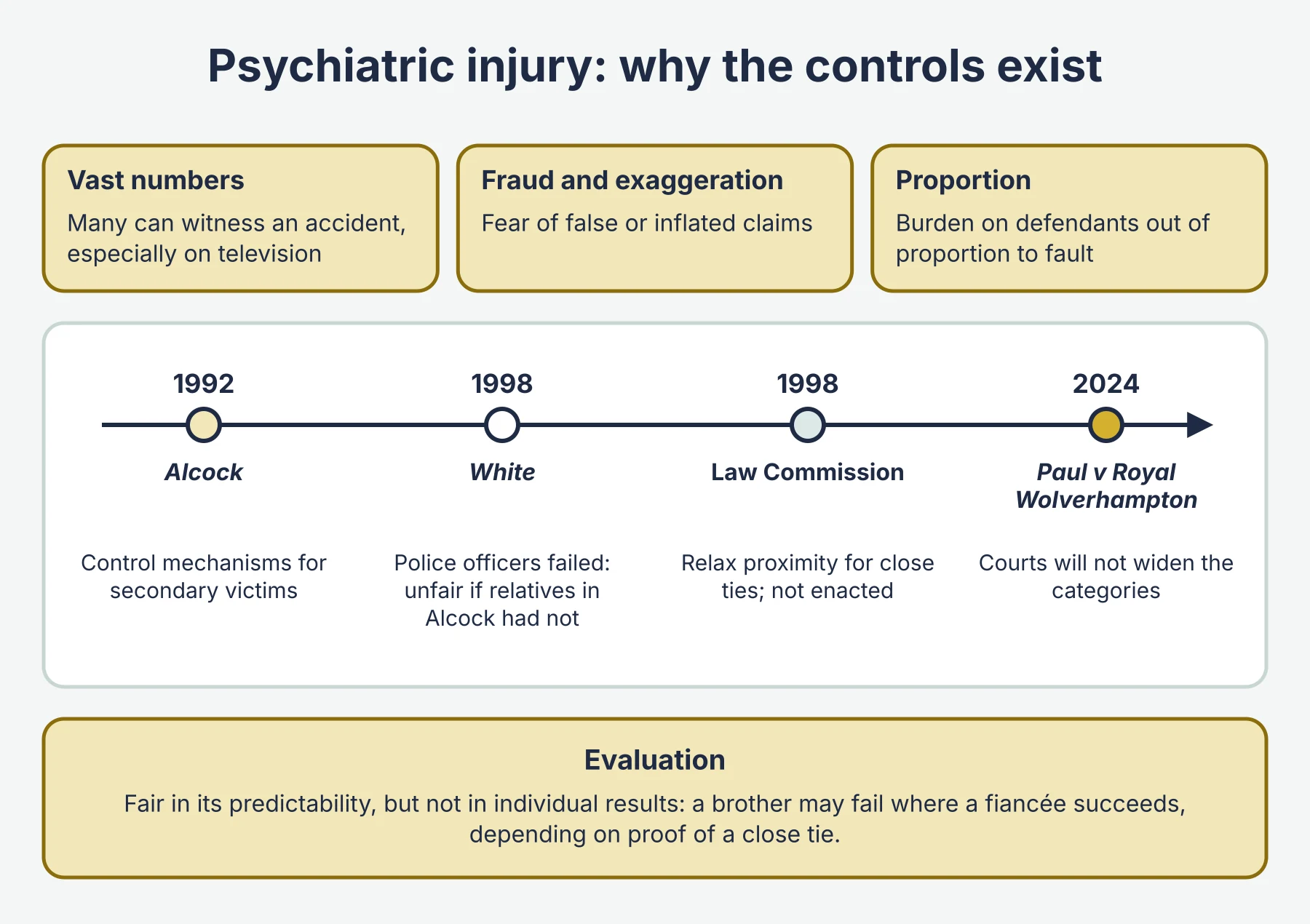
Psychiatric injury. The control mechanisms in Alcock v Chief Constable of South Yorkshire Police (1992) exist because the number of people who can be affected by witnessing an accident, especially one shown on television, is potentially vast. Courts also worry about fraudulent or exaggerated claims and about burdening defendants out of proportion to their fault. Evaluation: the result can seem unjust. In White v Chief Constable of South Yorkshire (1998) police officers at the same disaster failed, partly because it would have been unfair for officers to recover where bereaved relatives in Alcock had not. The Law Commission’s 1998 report on liability for psychiatric illness recommended relaxing the proximity requirements for people with a close tie to the victim, but Parliament has not acted, and Paul v Royal Wolverhampton NHS Trust (2024) confirmed that the courts will not widen the categories themselves.
Issue 3: the objective standard of care
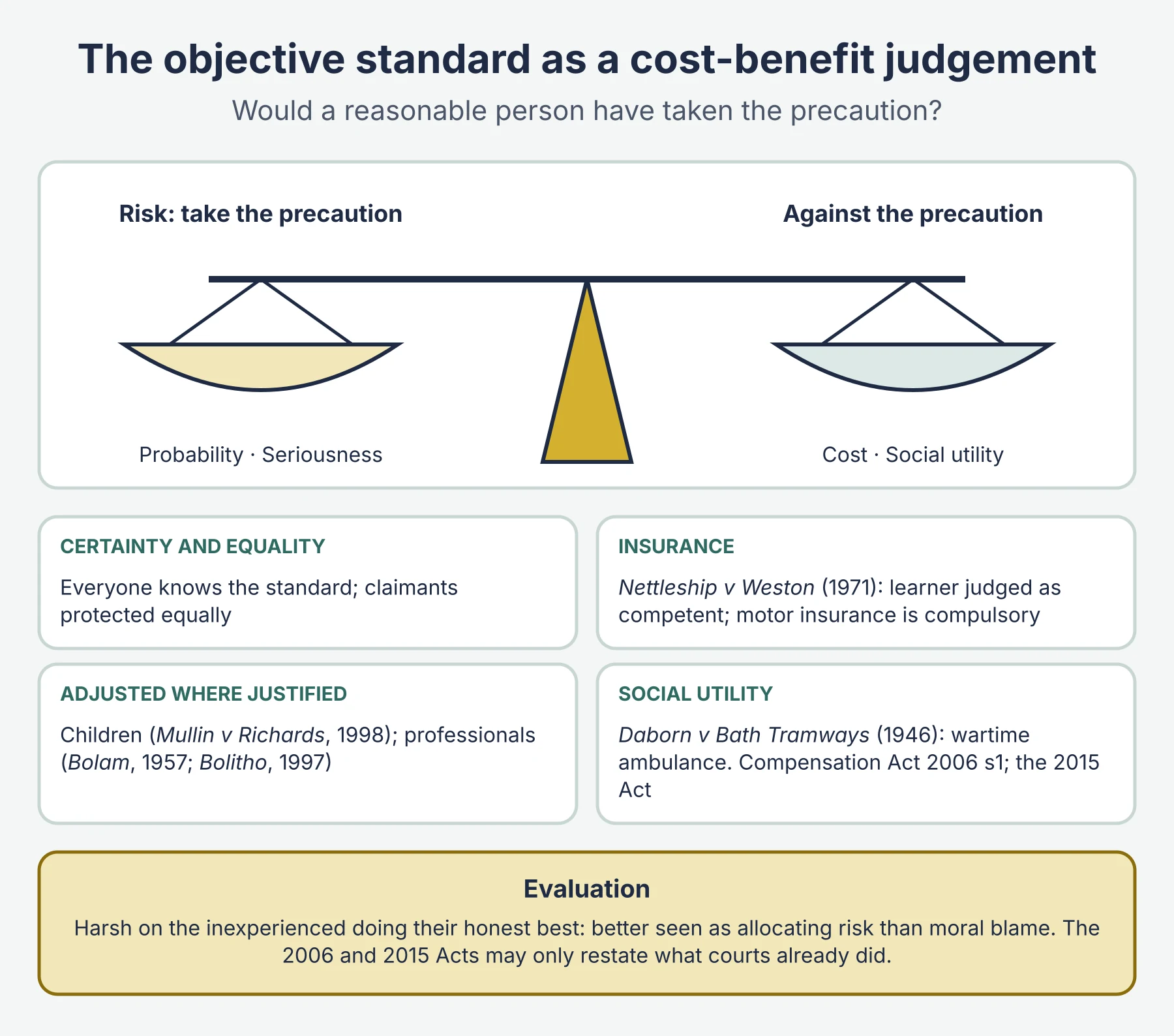
Breach is measured against the reasonable person, not against the defendant’s own abilities. The reasons:
- Certainty and equality. Everyone knows the standard expected of them, and claimants are protected equally whoever injures them.
- Insurance. In Nettleship v Weston (1971) Lord Denning accepted that a learner driver was judged as a competent driver partly because motor insurance is compulsory, so the loss falls on an insurer.
- Adjustment where justified. The standard is moved for children (Mullin v Richards, 1998) and for professionals, judged against a responsible body of opinion (Bolam, 1957), which itself must be logically defensible (Bolitho v City and Hackney HA, 1997).
The balancing factors (probability, seriousness, cost of precautions and social utility) are themselves a cost-benefit judgement. The court asks whether a reasonable person would have taken a precaution given what it would cost and what it would prevent. Social utility can justify risk: in Daborn v Bath Tramways (1946) a left-hand-drive ambulance used in wartime was not negligent despite the limited signalling it allowed. Parliament has reinforced this through s1 Compensation Act 2006 (the court may consider whether precautions would discourage a “desirable activity”) and the Social Action, Responsibility and Heroism Act 2015.
Evaluation. The objective standard can be harsh on the inexperienced, who are found “at fault” for doing their honest best. It is better understood as allocating risk than as moral blame. Critics of the 2006 and 2015 Acts argue they restate what courts already did, and that they respond to fears of a “compensation culture” more than to changes in liability.
Issue 4: injunctions and conflicting interests
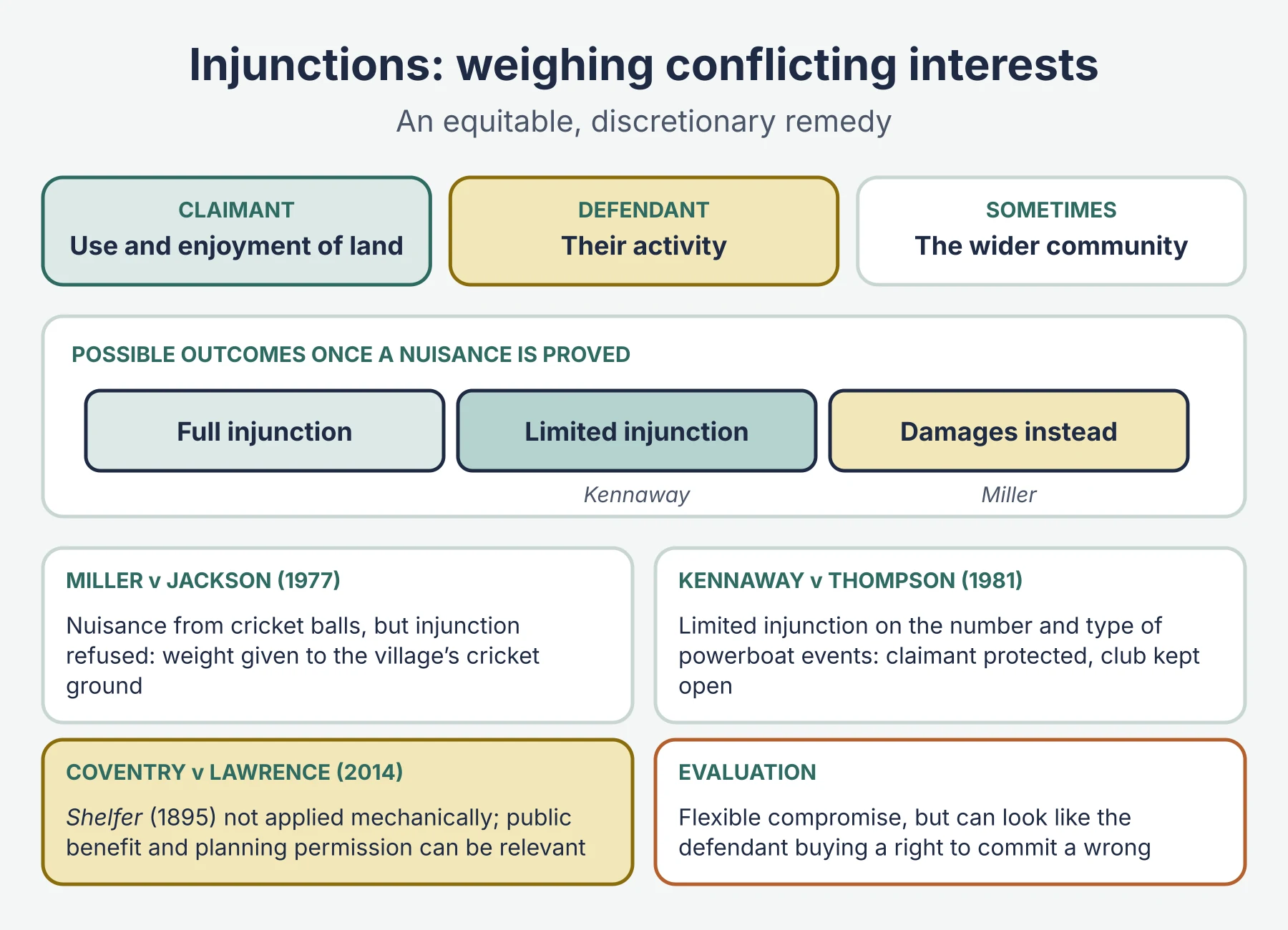
An injunction is an equitable, discretionary remedy, so the court can weigh interests that damages cannot. The claimant’s right to use and enjoy land is set against the defendant’s activity and sometimes the interest of the wider community.
- In Miller v Jackson (1977) the Court of Appeal found a nuisance from cricket balls but refused an injunction, giving weight to the village’s interest in its cricket ground.
- In Kennaway v Thompson (1981) the court granted a limited injunction restricting the number and type of powerboat events, which protected the claimant without closing the club.
- In Coventry v Lawrence (2014) the Supreme Court held that the Shelfer (1895) guidance on when damages should replace an injunction must not be applied mechanically; public benefit and planning permission can be relevant.
Evaluation. Flexibility lets the court find a compromise, but it means a claimant who proves a nuisance may still have to tolerate it in exchange for money, which can look like the defendant buying a right to commit a wrong.
Issue 5: the nature and purpose of vicarious liability
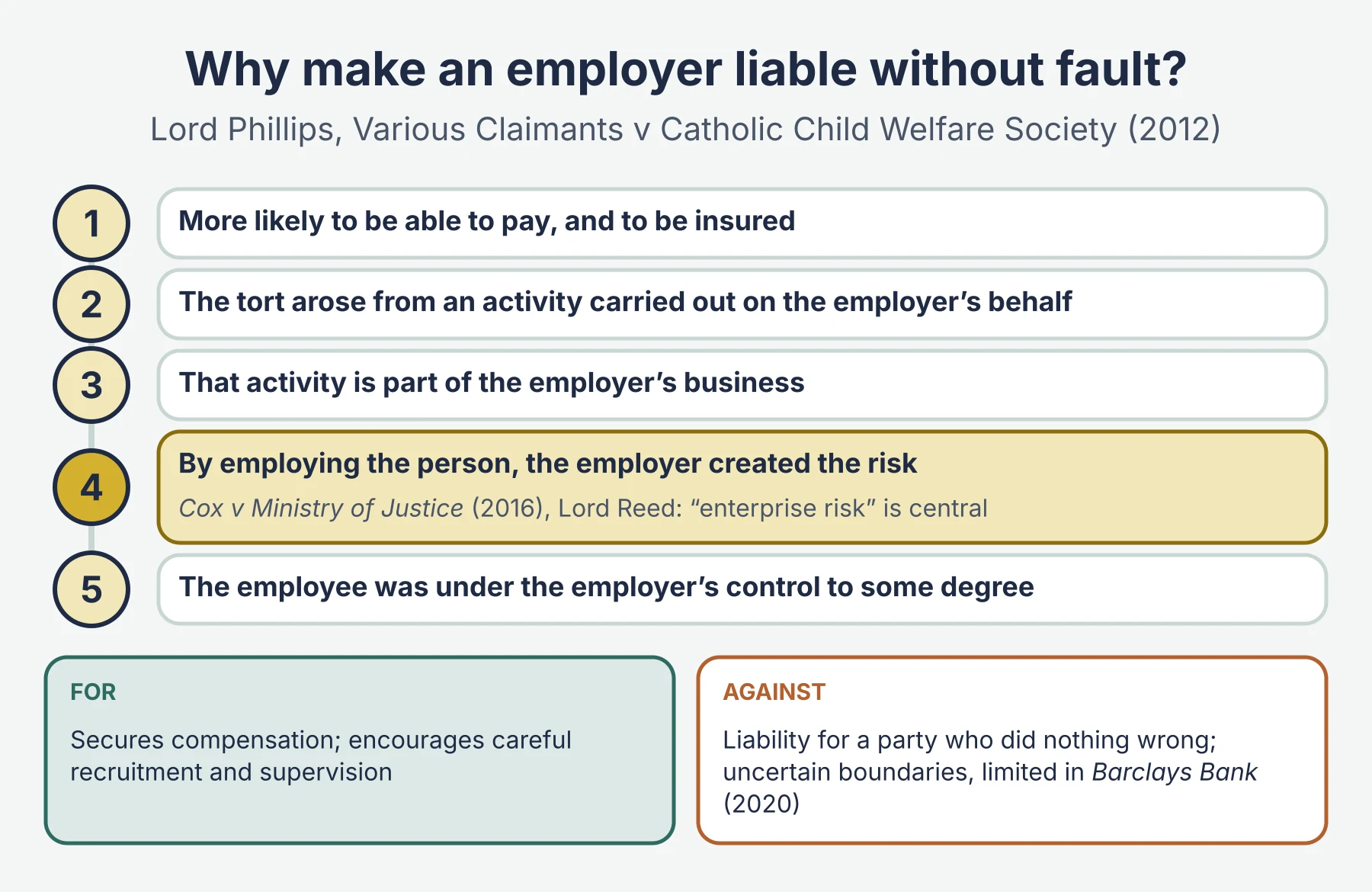
Vicarious liability makes an employer liable for an employee’s tort without any fault of its own. In Various Claimants v Catholic Child Welfare Society (2012) Lord Phillips gave five policy reasons: the employer is more likely to be able to pay and to be insured; the tort arose from an activity carried out on the employer’s behalf; that activity is part of the employer’s business; by employing the person the employer created the risk; and the employee was under the employer’s control to some degree. In Cox v Ministry of Justice (2016) Lord Reed treated the “enterprise risk” idea as central: a body that benefits from an activity should bear the risks it creates.
Evaluation. The doctrine secures compensation and encourages careful recruitment and supervision. Against that, it imposes liability on a party who did nothing wrong, and its expansion to abuse cases and relationships “akin to employment” has made the boundaries less certain, which is why the Supreme Court drew limits in Various Claimants v Barclays Bank (2020).
Annotated model paragraph
Question: Evaluate the policy reasons that restrict liability for psychiatric injury.
The courts restrict claims by secondary victims mainly through fear of the floodgates [names the policy]: in Alcock (1992) millions watched the disaster on television, and allowing all affected viewers to sue would expose a defendant to liability out of all proportion to its fault [explains why it matters]. The control mechanisms achieve certainty [advantage], but they produce arbitrary outcomes: a brother may fail where a fiancée succeeds, depending on proof of a close tie [disadvantage with example]. The refusal of the officers’ claims in White (1998) shows the courts choosing consistency between claimants over compensation [links to aim]. Reform has been recommended but not enacted, so the law is fair in its predictability but not in individual results [reasoned judgement].
Common mistakes
- Describing the rule without stating the policy that justifies it.
- Using “floodgates” as a slogan without explaining who the extra claimants would be.
- Treating vicarious liability as a fault-based liability of the employer.
- Forgetting that an injunction is discretionary, so the court may award damages instead.
Exam technique
“Explain” questions want the policy factor plus a case that shows it. “Evaluate” and “discuss” questions want a judgement: state the aim, show where the rule achieves it, show where it fails, and conclude. In Paper 2 essays, one well-developed criticism with an authority earns more than a list of unexplained points.
More resources on this topic
Theory of tort law revision notes | Theory of tort law practice questions | Tort overview
Related resources
-
Practice questions
AQA A Level Law (7162): Theory of Tort Law – Practice Questions
Original practice questions with mark-scheme answers on policy behind duty, economic loss, the standard of care, injunctions and vicarious liability, AQA 7162.
Law · AQA · A Level
Try questions -
Revision notes
AQA A Level Law (7162): Theory of Tort Law – Revision Notes
Recall notes on the policy behind Caparo, economic loss, psychiatric injury, the standard of care, injunctions and vicarious liability for AQA Law 7162.
Law · AQA · A Level
Revise topic -
Study guides
AQA A Level Law (7162): Vicarious Liability
The two-stage test for vicarious liability: employment status tests, relationships akin to employment, course of employment and close connection, AQA Law 7162.
Law · AQA · A Level
Read guide
Get free revision emails (optional)
Occasional emails with practice questions, worked explanations and links to free resources for the qualification and subjects you choose. No spam, and you can unsubscribe from any email. The free tools on this site never need an email.